INTRODUCTION
Second language (L2) acquisition has been studied using a variety of techniques. Syntacticians have relied on introspective intuitions—from binary to gradient grammaticality judgments—as the main source of evidence for their theorizing (e.g., Montrul & Bruhn de Garavito, Reference Montrul and Bruhn de Garavito1999; Schwartz & Sprouse, Reference Schwartz and Sprouse1996; Sorace, Reference Sorace1993; White, Reference White2003). Sociolinguists have employed survey data, sociolinguistic interviews, questionnaires, and other methods typically used in field work as data collection techniques to study the impact of social context on learner language and L2 acquisition (e.g., Bayley & Preston, Reference Bayley and Preston2008; Tarone, Reference Tarone2007). Phonologists perform acoustic comparisons of recorded speech samples to study the variables involved in the perception and production of nonnative sounds (e.g., Elliott, Reference Elliott, Lafford and Salaberry2003; Flege & Eefting, Reference Flege and Eefting1987; Flege, Schirru, & MacKay, Reference Flege, Schirru and MacKay2003; Smiljanic & Bradlow, Reference Smiljanic and Bradlow2005). Psycholinguists have used a variety of behavioral measures to study how L2 speakers engage linguistic knowledge online during comprehension and production (e.g., Dussias, Reference Dussias2003; Dussias & Sagarra, Reference Dussias and Sagarra2007; Felser & Roberts, Reference Felser, Roberts and 2007; Fernández, Reference Fernández2003; Frenck-Mestre, Reference Frenck-Mestre, Heredia and Altarriba2002, Reference Frenck-Mestre, Kroll and de Groot2005; Jackson & Dussias, Reference Jackson and Dussias2009; Juffs, Reference Juffs1998; Juffs & Harrington, Reference Juffs and Harrington1996; Kroll & de Groot, Reference Kroll and de Groot2005; Kroll & Stewart, Reference Kroll and Stewart1994; Love, Maas, & Swinney, Reference Love, Maas and Swinney2003; Marian & Spivey, Reference Marian and Spivey2003a, Reference Marian and Spivey2003b; Papadopoulou & Clahsen, Reference Papadopoulou and Clahsen2003; Roberts, Gullberg, & Indefrey, Reference Roberts, Gullberg and Indefrey2008). Neuroscientists have employed measures of brain activity such as event-related potentials (ERPs) and functional magnetic resonance imaging (fMRI) to study what brain structures are involved in computing different kinds of information during the processing of a nonnative language and to investigate the cognitive and neural consequences of housing two or more languages in a single mind (e.g., Abutalebi, Cappa, & Perani, Reference Abutalebi, Cappa, Perani, Kroll and de Groot2005; Hahne & Friederici, Reference Hahne and Friederici2001; Stowe & Sabourin, Reference Stowe and Sabourin2005; Tokowicz & MacWhinney, Reference Tokowicz and MacWhinney2005; van Hell & Tokowicz, Reference van Hell and Tokowicz2009; Weber-Fox & Neville, Reference Weber-Fox and Neville1996). What is significant from this list is that scholars have made use of the wide range of methodological tools available to them to study how L2s are acquired and processed. Among this family of techniques, the recording of eye movements is becoming increasingly popular among researchers interested in uncovering how structural processing proceeds when adult L2 speakers comprehend sentences in their L2.
What is it about eye-movement records that are especially informative and attractive? Theories of sentence processing have generally been interested in the online or incremental nature of comprehension processes. As soon as each word is encountered, readers are assumed to make structural decisions about how to integrate each word within the ongoing syntactic structure. Over three decades of eye-movement research shows that when eye movements are recorded during reading, there are systematic relations between fixation durations and the characteristics of the fixated words (Ehrlich & Rayner, Reference Ehrlich and Rayner1981; Just & Carpenter, Reference Just and Carpenter1980; Rayner Reference Rayner1978, Reference Rayner and Rayner1983). Readers spend more time fixating on harder words and on more important words than on easier words. Longer words are also more likely to be fixated on than shorter words, and words that are likely to be skipped are short, function words.
We also know that eye movements are influenced by textual and typographical variables. Print quality, length of the line of text, and amount of space between letters all influence processing. Eye movements are likewise heavily influenced by variations in the content of the text. For example, when the text becomes more complex or contains uncommon or contextually implausible words, eye fixation duration increases, and saccade length (i.e., small jumps made by the eye to move through text) decreases (Duchowski, Reference Duchowski2002). What is crucial for researchers is that this variation in fixations can be captured in the gaze duration of readers (i.e., the initial amount of time a reader spends in a region from first entering it until the eyes move to another word). Word frequency has the most influential effect on gaze duration: a high-frequency word like rain in The heavy rain damaged the crops decreases gaze duration (O'Regan & Lévy-Schoen, Reference O'Regan, Lévy-Schoen and Coltheart1987; Rayner & Pollatsek, Reference Rayner, Pollatsek and Coltheart1987) compared to a lower-frequency word like hail, which is matched for length, number of syllables, meaning, and sentence frame. Unpredictable words also have immediate effects on fixation duration. Readers tend to look at unpredictable words for 60–90 milliseconds longer than predictable words and they skip over predictable words more frequently than unpredictable words (Ehrlich & Rayner, Reference Ehrlich and Rayner1981). Moreover, when disambiguating information in a structurally ambiguous sentence is inconsistent with the syntactic interpretation assigned by a reader, there is considerable disruption in eye movement. Thus, participants reading the syntactically ambiguous sentence The photographer accepted the money might not be legally obtained Footnote 1 (from Wilson & Garnsey, Reference Wilson and Garnsey2009) show long fixation durations at the disambiguating region might not, launch regressive saccades from the disambiguating point to the syntactically ambiguous noun phrase the money, or reread the sentence for a second time. The fact that inconsistencies associated with the structural analysis of a particular word (or collection of words) are noticed by readers as soon as they arise provides support for the immediacy assumption—the assumption that readers do not wait to interpret text until a number of words have been encountered, but rather interpret each word of a text as soon as it is encountered (Carpenter & Just, Reference Carpenter, Just and Rayner1983). These facts suggest that recordings of eye movements can be very informative when studying the structural decisions that people make during reading.
In the remainder of this article, I review some facts about eye movements during skilled reading and provide a description of an experimental paradigm developed to arrive at these facts. Next, I present recent developments in the use of eye tracking to study L2 spoken-word processing. Then, I discuss the work that has investigated ambiguity resolution processes in L2 speakers for which eye-tracking and self-paced reading data are available to highlight differences in the results that may be attributed to the differences in the two methods. Finally, I discuss research investigating syntactic processing when L2 speakers process mixed language. I end with suggestions for future directions.
SOME FACTS ABOUT EYE MOVEMENTS DURING READING
When we read, our eyes do not move smoothly across the text, as our experience as readers might suggest. Instead, we make very small, high velocity jumps called saccades. Four types of saccadic movements have been identified in reading: forward or rightward movements, regressions, return sweeps, and corrective movements (McConkie, Reference McConkie and Rayner1983). Approximately 10–15% of the time, readers perform regressive saccadic movements to go back to material that has already been read. The average length of a saccade is approximately eight letter spaces. Readers normally make about three to four saccadic movements per second, each lasting between 20 and 40 milliseconds. Saccades are separated by moments during which our eyes remain still. These are called fixations and allow readers to extract important and useful information about the text.
McConkie, Kerr, Reddix, and Zola (Reference McConkie, Kerr, Reddix and Zola1988; see also Rayner, Reference Rayner1998; Reichle, Pollatsek, Fisher, & Rayner, Reference Reichle, Pollatsek, Fisher and Rayner1998) reported a landing position effect for fixations such that readers tend to fixate about halfway between the beginning and the middle of a word. An average fixation lasts approximately 200–250 milliseconds, although there is considerable within- and between-reader variability. Thus, a fixation can range from a little under 100 milliseconds to more than 500 milliseconds. Variation is also found in saccadic length, which can range from 1 to 15 letter spaces—although such long saccades typically occur following a regression. The variability in fixation duration and saccadic length is thought to be associated to the cognitive processes related with the ease or difficulty of comprehending text (Rayner, Reference Rayner1998).
An important question in reading research concerns the amount of information that readers acquire at each fixation. Experiments using three types of paradigms, the moving window, boundary, and foveal mask, have been instrumental in providing some answers. Given space limitations, I will explain only the first technique. In the moving window technique developed by McConkie and Rayner (Reference McConkie and Rayner1975), a window is sized to include a number of letter spaces to the left and the right of a fixated word, so that only a portion of the text to each side of the fixation is visible to the reader. Outside that window, the text is replaced by Xs, and spaces between words are preserved. When the reader advances the eyes, the window advances, too (see Figure 1). The idea behind this technique is that when the window is as large as the region from which the reader can obtain information, there should be no difference between reading in this condition and reading during normal viewing (i.e., when there is no window).
Example of the moving window paradigm. The first line shows a normal line of text; the fixation point is marked with an asterisk.

Using this technique, a large number of experiments have confirmed that the perceptual span, or the region from which readers are able to acquire useful information, is quite small. For readers of left-to-right languages like Dutch, French or English, the span is asymmetric: it extends from not more than three or four letter spaces to the left of the fixation to approximately 14–15 letter spaces to the right of the fixation. For readers of languages printed from right-to-left (such as Hebrew), the span is also asymmetric but in the opposite direction; it is larger to the left of the fixation than to the right of it (Pollatsek, Bolozky, Well, & Rayner, Reference Pollatsek, Bolozky, Well and Rayner1981). Pollatsek et al. (Reference Pollatsek, Bolozky, Well and Rayner1981) have also found that orthography modulates the size of the span. The span of English readers is larger than that of Hebrew readers, presumably because English is less “densely packed” than Hebrew—that is, it takes more characters to write the same sentence in English than in Hebrew (Rayner, Reference Rayner, Ygge and Lennerstrand1994). Studies with Japanese readers (e.g., Osaka, Reference Osaka, O'Regan and Levy-Schoen1987, Reference Osaka, Groner, d'Ydewalle and Parham1990) indicate that their span is even smaller.
To the right of a fixation, different types of information are acquired. Information needed for identifying a word is obtained within the region providing the highest degree of visual resolution, called the foveal region, and at the beginning of the parafoveal region—the area immediately surrounding the foveal region. Word length information, which guides eye movements to the next location, is acquired at about 15 letter spaces to the right of the fixation.
Experiments have also reported that word identification span (the area from which words can be identified on a given fixation) is smaller than perceptual span—it generally does not exceed seven or eight letter spaces to the right of the fixation (Rayner, Reference Rayner1998; Rayner, Well, Pollatsek, & Bertera, Reference Rayner, Well, Pollatsek and Bertera1982; McConkie & Rayner, Reference McConkie and Rayner1975). However, this value is influenced by word length and the ease or difficulty that readers experience in processing the word. When two or three short words occur in succession, readers are typically able to identify all of them, but if the fixated word is difficult to process, readers obtain less information from the upcoming word (Henderson & Ferreira, Reference Henderson and Ferreira1990).
What dependent variables are available to the investigator when collecting eye-movement records? For any critical region or regions of interest, a number of measurements can be distinguished. The earliest measure is first fixation, defined as the first time the eyes land on a region (whether a single word or a string of words). This measure appears to be sensitive to lexical information such as word frequency. The next measure is first pass time, which refers to the sum of all fixations in a region, from first entering it until the eyes first exit to the left or right of the region. On regions with only one word, first pass time equals gaze duration (e.g., Rayner & Duffy, Reference Rayner and Duffy1986). First pass time has been found to be most informative in revealing detections of syntactic anomalies. Regression path time (the sum of all temporally contiguous fixations from the time the reader first enters the region of interest until advancing to the right beyond that region) has also been interpreted as a sensitive measure of immediate anomaly detection, given that readers often respond to processing difficulties by regressing to earlier portions of the sentence (e.g., Liversedge, Paterson, & Pickering, Reference Liversedge, Paterson, Pickering and Underwood1998; Wilson & Garnsey, Reference Wilson and Garnsey2009). Another commonly used measure is second pass time, which refers to the time spent reading a region after leaving the region (in other words, excluding first pass time). Finally, total time is the sum of all fixations in a region (effectively, the sum of first pass time and second pass time). In addition to the measurement of time, another useful dependent measure is the probability of a regression, defined as the percentage of regressive eye movements (leftward movements in a language like English) out of a region. This index is usually restricted to first pass regressions.
The major advantage of the eye-movement recording technique is that it allows researchers to obtain evidence about what is happening during the comprehension of a sentence moment by moment, as processing unfolds, without significantly altering the normal characteristics of either the task or the presentation of the stimuli. Eye movements are a normal characteristic of reading, and while eye-movement records are collected, participants are free to move their eyes along the printed line of text. Recent advancements in eye-movement technology also make available eye-tracking equipment that is extremely versatile, and replaces traditional, fixed eye-tracking systems with more flexible head-mounted systems, or remote systems that do not require the use of a headband or head (i.e., chin or forehead) support. In addition, to obtain the dependent measure, participants are not required to perform a secondary task (such as a button or pedal press) that might disrupt the normal comprehension process. Furthermore, thanks to several decades of eye-movement research during reading, we have a very good understanding of the amount of visual information processed while our eyes fixate on text.
EYE-TRACKING APPLICATIONS IN SECOND LANGUAGE RESEARCH
Eye-movement records have been employed in L2 research primarily to ask how proficient L2 speakers manage the presence of two languages in a single mind. If it were the case that L2 speakers could be characterized as two monolinguals in one head, then this question would not be very interesting. However, the available evidence from the word-recognition and sentence-processing literature suggests that when two linguistic systems are housed in a single brain, they interact closely with one another, and these interactions influence the way in which L2 speakers read and understand spoken words in each of their language (e.g., Dussias & Sagarra, Reference Dussias and Sagarra2007). In this section, I review two major areas of research activity that illustrate how eye-tracking methodology has been used in L2 processing research. The first examines the way in which L2 speakers recognize words when they are spoken in each language. The second concerns the comprehension of sentences and asks whether the specific syntactic subprocesses engaged during L2 language comprehension are different when monolingual and L2 speakers process input in the target language. Although the review will necessarily be brief, its scope is to illustrate the benefits of using eye-tracking techniques in L2 acquisition research.
Monitoring Eye Movements to Investigate Processing at the Word Level
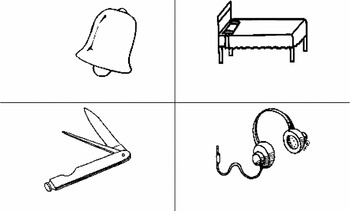
Building on work by Cooper (Reference Cooper1974), researchers studying language processing have employed an eye-tracking method known as the visual world paradigm to test the seriality of lexical selection mechanisms (Allopenna, Magnuson, & Tanenhaus, Reference Allopenna, Magnuson and Tanenhaus1998; Altmann & Kamide, Reference Altmann and Kamide1999; Tanenhaus & Spivey-Knowlton, Reference Tanenhaus and Spivey-Knowlton1996; Tanenhaus, Spivey-Knowlton, Eberhard, & Sedivy, Reference Tanenhaus, Spivey-Knowlton, Eberhard and Sedivy1995; Trueswell, Sekerina, Hill, & Logrip, Reference Trueswell, Sekerina, Hill and Logrip1999). In the version of the paradigm used in Allopenna et al. (Reference Allopenna, Magnuson and Tanenhaus1998), auditory material is concurrently presented with a related visual scene containing pictured objects that are displayed on a computer screen. The auditory material plays spoken instructions related to the objects (e.g., click on the bell), which participants are asked to follow. During the experiment, participants’ eye movements to the objects are monitored as the name of the target object (i.e., the object mentioned in the instruction) unfolds over time. On some crucial trials, a distractor object that is phonologically similar to the name of the target is included in the visual scene. For instance, the target object bell in Figure 2 may be presented together with the picture of a competitor object such as bed, which overlaps at the onset. The general finding from these studies is that participants are equally likely to fixate on the target word and the competitor word early during the processing of the auditory input stimulus (e.g., in Figure 2, before participants hear the phoneme that allows selection of bell over bed). This indicates that eye movements to the visual scene are closely time-locked with the auditory input.
Example of a display in the visual world eye-tracking paradigm.

In recent years, the visual world paradigm has been extended to the L2 domain to investigate whether proficient L2 speakers activate words from their two languages in parallel when they hear words in one language alone (e.g., Ju & Luce, Reference Ju and Luce2004; Marian & Spivey, Reference Marian and Spivey2003a; Spivey & Marian, Reference Spivey and Marian1999). The critical manipulation in these studies is the presence of objects whose spoken name in one language is phonologically similar to the name of an unrelated object in the other language. To illustrate, in Spivey and Marian (Reference Spivey and Marian1999), first language (L1) Russian speakers proficient in English heard the instruction “Put the marker below the cross” in the presence of a visual display that contained four objects: a marker, a stamp (whose translation in Russian, marka, shares initial phonetic features with the English marker), and two other objects whose English and Russian names had no phonetic similarity to the target word. Findings showed that when Russian-English speakers heard the word marker in English, they were likely to also look at the Russian between-language competitor marka. This result, replicated with L2 speakers of other language backgrounds (e.g., Canseco-Gonzalez, Brick, Fischer, & Wagner, Reference Canseco-Gonzalez, Brick, Fischer and Wagner2005, Spanish-English; Ju & Luce, Reference Ju and Luce2004, French-English speakers; Weber & Cutler, Reference Weber and Cutler2004, Dutch-English), suggests that L2 listeners do not appear to be able to deactivate the irrelevant mental lexicon when they are in a unilingual situation. Although a number of studies have found evidence of native language activation during nonnative language processing (Blumenfeld & Marian, Reference Blumenfeld and Marian2005; Marian & Spivey, Reference Marian and Spivey2003a, Reference Marian and Spivey2003b; Weber & Cutler, Reference Weber and Cutler2004; Weber & Paris, Reference Weber and Paris2004), results indicating nonnative language activation during native language processing are mixed (Ju & Luce, Reference Ju and Luce2004; Marian & Spivey, Reference Marian and Spivey2003b; Weber & Cutler, Reference Weber and Cutler2004) and seem to be modulated by language proficiency and the cognate status of the words (Blumenfeld & Marian, Reference Blumenfeld and Marian2007).
Eye Movements During L2 Sentences Processing
What are the semantic, morphological, and syntactic variables that constrain sentence comprehension in a L2? When L2 speakers read in their L2, they face many uncertainties about how the people or objects referred to in the text are connected to one another. This is so because as they move their eyes along a line of printed text, the information needed to establish correct dependencies among each of the words being encountered may not be immediately available. Because learners who are relatively proficient in two or more languages have access to the grammar and lexicon of each language when they comprehend written sentences, one critical question concerns whether the specific semantic and syntactic subprocesses engaged during L2 language comprehension are different when monolingual speakers and L2 learners process input in the target language.
Recent online behavioral investigations of L2 structural processing have employed the recording of eye movements in large part because of its high temporal resolution and the ability to divide reading time into distinct components that may provide detailed information about the cognitive processes engaged during online L2 sentence comprehension (e.g., Dallas, Cowles, & Kaan, Reference Dallas, Cowles and Kaan2009; Dussias, Reference Dussias2003, Dussias & Sagarra, Reference Dussias and Sagarra2007; Felser, Cunnings, Batterham, & Clahsen, Reference Felser, Cunnings, Batterham and Clahsen2009; Felser, Sato, & Bertenshaw, Reference Felser, Sato and Bertenshaw2009; Frenck-Mestre, Reference Frenck-Mestre, Heredia and Altarriba2002; Keating, Reference Keating2009; Roberts et al., Reference Roberts, Gullberg and Indefrey2008; Witzel, Witzel, & Nicol, Reference Witzel, Witzel and Nicol2009). It is common in native sentence processing research to seek for converging evidence using the eye-movement technique and other laboratory methods (e.g., moving window paradigm or phrase-by-phrase self-paced reading) because such convergence enhances the confidence in the phenomenon being observed and makes for a coherent set of results (Carreiras & Clifton, Reference Carreiras, Clifton, Carreiras and Clifton2004). However, there is only one syntactic structure in the L2 sentence processing literature that has been investigated using different online behavioral techniques. The resolution of relative clause ambiguities has received a disproportionate amount of attention relative to other syntactic constructions, because the existence of cross-linguistic differences in relative clause attachment provides a fertile ground to test whether sentence parsing in the L2 is influenced by the reader's native language. In the next section the focus is on the research that has examined resolution of syntactically ambiguous relative clauses because it provides the clearest illustration that we can learn more about the set of variables that constrain L2 sentence processing by studying experiments in which the results diverge.
Ambiguity Resolution in L2 Reading
One of the recurring questions in the L2 processing literature concerns whether the same structure-based principles that have been identified during monolingual syntactic processing are also found in nonnative language processing. Structure-based principles have been postulated to explain the preference by the parser (i.e., the mechanism responsible for constructing a syntactic tree for a given string of words) to initially compute a certain syntactic analysis over other analyses. A classic example of this is given in (a):
(a) Molly said that she will go to New Jersey yesterday.
In this case, the ambiguous constituent (yesterday) can be linked either to the higher clause or to the lower clause. If linked to the higher clause, the sentence means roughly, “It was yesterday that Molly said that she would go to New Jersey.” Linking it to the lower clause will result in the implausible interpretation that “Molly will go to New Jersey yesterday.” For the vast majority of readers, the tendency is to link the ambiguous constituent to the lower clause. The realization that the outcome yields an incorrect interpretation forces reanalysis of the ambiguous site.
Two structure-based principles that are assumed to be operative during monolingual sentences processing are recency, which refers to a tendency by the parser to reduce the distance between a potential host site and a modifier within the sentence, and predicate proximity, the preference to attach a modifier as close as possible to the head of a predicate phrase (Gibson, Pearlmutter, Canseco-Gonzalez, & Hickock, Reference Gibson, Pearlmutter, Canseco-Gonzalez and Hickock1996). The principles have been proposed to explain cross-linguistic differences in attachment preferences involving potential attachment sites for a modifier. Specifically, preferences reflecting the application of recency have been found in languages like English, Brazilian Portuguese, and Arabic, but the application of predicate proximity has been reported in other languages like Spanish, Dutch, German, and French (e.g., Abdelghany & Fodor, Reference Abdelghany and Fodor1999; Brysbaert & Mitchell, Reference Brysbaert and Mitchell1996; Carreiras & Clifton, Reference Carreiras and Clifton1999; Zagar, Pynte & Rativeau, Reference Zagar, Pynte and Rativeau1997). To illustrate, consider the temporarily ambiguous sentence The man called the daughter of the psychologist who lives in California, in which the relative clause who lives in California can be interpreted as referring to one of the two potential attachment sites in the complex noun phrase the daughter of the psychologist (hence the temporary ambiguity). Empirical evidence suggests that in English recency dominates over predicate proximity, so the preferred resolution of the ambiguity is to “attach” the relative clause to the noun closest to it (NP2 attachment or low attachment). This results in an interpretation in which the psychologist lives in California. Contrary to this, in Spanish, predicate proximity is strong enough to dominate over recency. In this case, the ambiguity is resolved in favor of NP1 attachment or high attachment, resulting in an interpretation in which the daughter lives in California.
Whether L2 speakers use structure-driven or structure-based parsing principles during L2 sentence parsing in a matter of debate. Clahsen and Felser (Reference Clahsen and Felser2006) have recently argued that the structure-building processes during online L2 sentence comprehension are fundamentally different from the representations built by native speakers of the target language. According to their shallow structure hypothesis, the syntactic representations that L2 learners construct while processing input in their L2 are “shallower” and less detailed than those computed by adult L1 speakers. In their view, whereas L1 speakers prioritize on structure-driven strategies and syntactic information during sentence processing, L2 speakers privilege lexical-semantic and pragmatic information.
One of the pieces of evidence that Clahsen and Felser (Reference Clahsen and Felser2006) present in favor of shallow processing by L2 speakers is their finding that proficient L2 speakers do not show a particular preference for high or low attachment when processing constructions in their L2 that contain temporarily ambiguous relative clauses. They present data from several self-paced reading studies that examine the behavior of L1 and L2 speakers while processing syntactically ambiguous relative clauses (The dean liked the secretary of the professor who was reading a letter.). To investigate the processing of these constructions in L2 learners, Papadopoulou and Clahsen (Reference Papadopoulou and Clahsen2003) asked native readers of high-attaching languages to read ambiguous constructions in their L2 Greek, a language where high attachment is also the preferred strategy. The online behavioral method used for data collection was a noncumulative self-paced reading task. In this task, a sentence was divided into segments, and participants pressed a button to read each segment. Participants began the trial by pressing a key that displayed the first segment. Once they finished reading it, the next key press removed the first segment from the computer screen and displayed the second segment. Participants continued until they reached the end of the text. In this task, the dependent measure was the time participants spent reading each segment.
Using this technique, Papadopoulou and Clahsen (Reference Papadopoulou and Clahsen2003) found that proficient L2 speakers showed no preference for high or low attachment when processing a L2 that, like their L1, also favored high attachment (similar results are reported in Felser, Roberts, Gross & Marinis, Reference Felser, Roberts, Gross and Marinis2003). This finding, coupled with the fact that clear attachment preferences were observed when lexical cues guided attachment decisions, was interpreted as evidence that L2 speakers do not use structure-based information but rather are mainly guided by lexical cues.
There is some indication coming from the L2 eye-tracking literature, however, that suggests that the choices that L2 speakers make while parsing temporarily ambiguous structures could be explained via the application of structure-based principles of parsing. For example, Dussias and Sagarra (Reference Dussias and Sagarra2007) collected eye-movement records with Spanish-English bilinguals and monolingual Spanish speakers to investigate the effect that intense contact with English had on attachment preferences in Spanish, their L1. L1 Spanish speakers proficient in English, who had lived in an L2 environment for an extended period of time, and functionally monolingual Spanish speakers participated in the study. The structure under investigation contained a complex noun phrase followed by a relative clause (e.g., El policía arrestó a la hermana del criado que estaba enferma desde hacía tiempo / The police arrested the sister of the (male) servant who had been ill (fem) for a while). Analyses of total time fixations at disambiguating region (i.e., the adjective within the relative clause) revealed that the Spanish monolingual participants showed the conventional bias for high attachment reported in the literature. Conversely, the Spanish-English speakers showed a consistent preference for low attachment when reading sentences in their L1, suggesting that the parsing routines used to process the L2 had an impact on the processing of the L1 as well. This finding was taken to indicate that parsing routines in bilinguals are permeable, but importantly for the present purposes, the Spanish-English speakers showed a robust preference that emerged in eye-tracking records of the participants.
In a more recent study, Witzel et al. (Reference Witzel, Witzel and Nicol2009) examined the eye movements of highly proficient Chinese learners of English on sentences involving temporarily ambiguous structures that have been used to reveal biases based on structure-based parsing principles. Three kinds of syntactically ambiguous structures were investigated (syntactically ambiguous material is underlined): (a) Relative clause attachment ambiguity (The son of the actress who shot himself on the set was under investigation); (b) adverb attachment ambiguity (Jack will meet the friend he phoned yesterday, but he doesn't want to) and (c) noun phrase versus sentence coordination ambiguity (The nurse examined the mother and the child played quietly in the corner). Regression path duration—a measure usually taken to reflect initial processing—and total times showed that like the monolingual English controls, the Chinese-English speakers show clear attachment biases on all three structures, suggesting, contra Clahsen and Felser (Reference Clahsen and Felser2006), that the L1 and L2 parsers behave similarly with respect to establishing abstract structural relations between phrases.
In addition, another eye-tracking study by Frenck-Mestre and Pynte (Reference Frenck-Mestre and Pynte1997) shows that under some circumstances, the L2 parser initially favors structure-based parsing principles such as low attachment. These authors used eye-movement records to investigate the way in which advanced English-speaking learners of French and French native speakers resolved attachment ambiguities involving prepositional phrases. The pattern of first pass reading times as well as regression time revealed that the L2 speakers momentarily experienced greater difficulty than native speakers with verb phrase attachment (i.e., high attachment) of the prepositional phrase in sentences such as He rejected the manuscript on purpose because he hated its author. No such difficulty was observed when the L2 speakers read structures in which the correct analysis required attachment of the prepositional phrase to the noun phrase immediately preceding it (i.e., low attachment or late closure), as would be the case in He rejected the manuscript on horses because he hated its author. In other words, L2 speakers temporarily adopted a strategy of attaching the ambiguous prepositional phrases low, to the most recently processed constituent. This analysis resulted in an incorrect interpretation in the first example but not in the second example. To account for this finding, Frenck-Mestre and Pynte proposed that nonnative readers may have a general preference for a low attachment (late closure) strategy, which, in this case, amounts to attaching the prepositional phrase to the noun phrase immediately preceding it.
The collection of studies already presented suggests that differences in the methods used for data collection may be responsible for some of the divergent findings reported in the literature. Reading studies that have used self-paced reading or phrase-by-phrase reading tasks as the method of data collection have generally concluded that during L2 sentence processing, L2 speakers are not guided by phrase-structure-based parsing principles of the kind that have been attested in L1 processing. Studies using methods of data collection that are more sensitive to the time course of processing, such as eye tracking, suggest that the pattern of results produced when nonnatives read syntactically ambiguous structures in their L2 show evidence of the application of phrase-structure-based parsing principles.
SPOKEN-LANGUAGE COMPREHENSION IN AN L2
Although reading processes have provided important insights into the mechanisms involved during L2 sentence processing, one question that has not been adequately addressed is whether the processing characteristics uncovered to date are specific to L2 reading or can be generalized to L2 spoken-language comprehension. One experimental methodology that has had great success in research on auditory language processing with monolingual participants is the visual world paradigm. In addition to the competitor effect discussed earlier, previous research has shown that participants are able to anticipate forthcoming linguistic reference to objects in the visual scene before these objects are actually mentioned in the auditory input (e.g., Altmann & Kamide, Reference Altmann and Kamide1999). For example, Lew-Williams and Fernald (Reference Lew-Williams and Fernald2007) showed that when Spanish-speaking children are shown different-gender objects, they orient their eyes to the object whose gender is congruent with the article they hear, even before they hear the name of the object. In the experiment, children were presented with visual scenes showing same-gender objects (e.g., galleta[fem]/cookie and pelota[fem]/ball) as well as different-gender objects (galleta[fem] and zapato[masc]/shoe), while they listened to instructions about the objects (encuentra la pelota / find the ball), which they were asked to follow. The main finding was that shortly after the article accompanying the noun was available in the auditory input, children had already launched reliably more and longer looks to the appropriate noun in the picture (i.e., the noun that matched the gender of the article) than to the inappropriate noun. This suggests that the most likely forthcoming referent was anticipated on the basis of the linguistic and visual information available.
Only one study to date has used the visual world paradigm to ask whether grammatical information known to affect native language processing also influences processing when speakers are hearing mixed-language input. Valdés Kroff, Guzzardo, Dussias, Gerfen, and Gullifer (Reference Valdés Kroff, Guzzardo, Dussias, Gerfen and Gullifer2008) investigated whether gender-marked articles are an informative cue when L1 Spanish speakers of English process spoken code-switched utterances. The question is theoretically relevant because corpus data containing spoken and written mixed-language switches suggest that the masculine article el can precede an English noun whose Spanish translation equivalent is masculine (el candy) or feminine (el candle), possibly due to the default status of masculine grammatical gender in Spanish. However, in mixed-language speech la only appears with feminine translation equivalents (la candle but not la candy). Given this asymmetry, it is possible that the gender-marking of articles facilitates to a lesser extent the processing of code-switched speech.
Pairs of objects were displayed on a computer screen as the eye movements of 24 Spanish-English speakers were recorded. Participants listened to sentences naming one of the objects and were instructed to click on the named object. Pictures were presented in three blocks: a block of English-only sentences, in which participants heard sentences such as There is a boy looking at the candle on the window sill, while the picture of two objects that were phonological competitors in English (e.g., candy and candle) was displayed on a computer screen, and a Spanish block in which participants heard sentences like La chica está comprando la vela para su amiga (“the girl is buying the candle for her friend”) in two conditions: a condition in which the two objects matched in grammatical gender (e.g., vela and galleta) and a condition in which they did not match (vela-caramelo). Materials in the code-switching block were phonological competitors in English (e.g., candy/candle) for which the Spanish translation equivalents contrasted in grammatical gender (e.g., el caramelo [the candy] vs. la vela [the candle]). Finally, target English words were spoken with a Spanish article that matched the gender of the Spanish translation equivalents (e.g., El high school student que está mirando la candle lleva new sunglasses / The high school student who is looking at the[fem] candle is wearing new sunglasses) or did not match (El high school student que está mirando el candle lleva new sunglasses / The high school student who is looking at the[masc] candle is wearing new sunglasses).
Data were analyzed by comparing the proportion of looks to the objects in each condition. In the Spanish-only trials, the L2 speakers oriented their eye movements to the referent more rapidly on different-gender trials (i.e., when the article was potentially informative) than on same-gender trials, replicating the results reported in Lew-Williams and Fernald (Reference Lew-Williams and Fernald2007). In the English-only trials, when the scene included two objects that were phonological competitors, participants temporarily considered both objects until the disambiguating information in the word became available. This finding replicates the competitor effect reported in previous literature with native English speakers (e.g., Allopenna et al., Reference Allopenna, Magnuson and Tanenhaus1998). However, the bilinguals exhibited differential processing of masculine and feminine articles in the code-switching block. For example, in the mixed-language block, when the article was masculine, participants waited until the disambiguating information was spoken before committing to one of the two pictures. Taken together, the findings suggest that L2 speakers instantiate different linguistic behavior when processing mixed language that is not evident from either unilingual mode.
FUTURE DIRECTIONS
The field of L2 sentence comprehension has reached an exciting point. The number of findings involving different types of syntactic structures is rapidly growing, and explanations are beginning to emerge that attempt to characterize the type of processing that L2 learners engage while constructing a syntactic parse. The framing question underlying much of the L2 processing research is to what extent L2 processing is qualitatively similar or different from L1 processing. Current research shows that a number of linguistic variables affect reading processing among L2 learners and that learners’ characteristics, such as proficiency and type of linguistic experience, often interact with linguistic aspects of the input in producing a parsing outcome. As the nature of the research questions have become more refined, the need for more sophisticated online behavioral measures has become central. The use of these methods has raised the prospect of addressing increasingly subtle issues.
Further research needs to explore the use of different online measures that are closely time-locked to the input so that short-lived input-driven processes are not missed (see also White, Bruhn-Garavito, Kawasaki, Pater, & Prévost, Reference White, Bruhn-Garavito, Kawasaki, Pater and Prévost1997, for a related argument). The visual world paradigm brings with it a new set of exciting possibilities to study real-time spoken-language comprehension. In addition, because participants interact with the world, other lesser studied types of information, such as referential and pragmatic information, can be brought into the study of L2 language comprehension. Increasingly, researchers will also need to invest some effort in replicating the findings produced by one particular method with other techniques. Relying on multiple response measures for our theorizing has the advantage that the weaknesses of one method can be compensated by the strength of another method. Some obvious pairings include the use of ERPs and eye tracking with the same materials (see Rayner & Clifton, Reference Rayner and Clifton2009, for a recent discussion of the two methodologies to investigate language processing during reading and listening) and the monitoring of eye movements during reading and spoken-language processing to ensure that the findings from reading studies are generalizable to spoken-language processing as well. Finally, one very important direction in the use of eye-tracking methodology is to investigate language processing at various stages of L2 development to understand the developmental trajectory of reading processes as learners gradually become more proficiency in the L2. Taken together, the advantage of the approaches is that they will produce a stable body of results that will widen the range of theoretical issues in our field.
AUTHOR NOTE
The writing of this article was supported in part by National Science Foundation grant BCS-0821924 to Paola E. Dussias and Chip Gerfen. I would like to thank Charlene Polio and an anonymous reviewer for insightful comments and for their close reading of the manuscript. All errors are my own.