Experimental
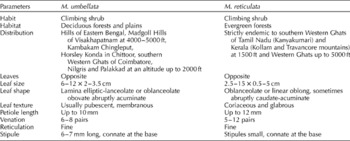
Morphological parameters of both species are documented (Table 1 and Supplementary Table S1, available online only at http://journals.cambridge.org). About 58 authenticated leaf samples were collected from 16 locations representing eight provinces (Supplementary Table S2, available online only at http://journals.cambridge.org), and genomic DNA was extracted using a DNA isolation kit following the manufacturer's protocol (Helini Biomolecules, Chennai, India).
Resemblance of the vegetative characteristic features between Morinda umbellata and Morinda reticulata

PCR amplification was performed with 25 ng DNA using universal primers (Supplementary Table S3, available online only at http://journals.cambridge.org). The PCR mixture consists of 25 μl PCR mix (contains 10 × Taq buffer, 2 mM MgCl2, 0.4 mM dNTP mix and 2 U Taq DNA polymerase), forward and reverse primers of 1 μl each (10 pmol/ml) and 1 μl template DNA. The final volume was made up to 50 μl by adding 22 μl nuclease free water. PCR conditions for amplification are detailed in Table S3 (available online only at http://journals.cambridge.org). The amplified PCR products were sequenced using an ABI 373 automated sequencer (Applied Biosystems, Inc., Foster City, CA, USA). These sequences were analysed using the BLAST of NCBI with BLASTX and annotated using the NCBI ORF tool combined with BLASTP (Supplementary Table S4, available online only at http://journals.cambridge.org). Multiple sequence alignment (MSA) was performed using the MultAlin interface (Corpet, Reference Corpet1988). Evolutionary trees were constructed using the neighbour-joining method (Saitou and Nei, Reference Saitou and Nei1987) with the Kimura-2 parameter distance correction (Kimura, Reference Kimura1980) implemented in MEGA 5.05 (Tamura et al., Reference Tamura, Peterson, Peterson, Stecher, Nei and Kumar2011).
Discussion
The observed morphological parameters of M. umbellata and M. reticulata were similar to those of published data (Dassanayake and Clayton, 1998; Gopalan and Henry, 2000). It was found that the distinction of these two closely resembling Morinda species is difficult in a mixed population distributed at an altitude between 2000 and 5000 ft. The leaves of both species resemble closely (Table 1). M. umbellata exhibits variability in leaf size and shape. The observation of M. umbellata revealed eight different shapes of leaves with varying sizes. A similar observation of M. reticulata revealed only four different shapes of leaves, resembling to M. umbellata. Reproductive parts showed a close resemblance between the two species. Flowering and fruiting seasons were overlapping with each other (Supplementary Table S1, available online only at http://journals.cambridge.org).
The MSA of rbcL (534 bp) and matK (621 bp) between M. umbellata and M. reticulata revealed three SNPs at sites 1, 22 and 51 in rbcL and only one SNP at nucleotide position 499 in matK (Fig. 1(a) and (b); Supplementary Figs S1 and S2, available online only at http://journals.cambridge.org). Genetic divergence between the two species was found to be 0.002 for matK and 0.006 for rbcL by taking the number of base substitutions per site into account, and evolutionary dendrograms were constructed (Supplementary Figs S3 and S4, available online only at http://journals.cambridge.org). Sequencing of these genes from both species from 16 samples covering eight provinces did not reveal any intra-specific variations in the sequenced regions. Thus, the SNPs identified for the distinction between M. reticulata and M. umbellata can be used as a reliable DNA marker.
(a) Nucleotide sequence alignment of a 534 bp fragment spans from position +89 to +622 of the 703 bp rbcL open reading frame, using the Morinda officinalis (GQ436556) rbcL sequence as reference. (b) Nucleotide sequence alignment of a 621 bp fragment spans from position +62 to +682 of the 809 bp matK open reading frame, using the M. officinalis (GQ434175) matK sequence as reference. A colour version of this figure can be found online at journals.cambridge.org/pgr

The use of adulterated herbal medicines often leads to health hazards (Mosihuzzaman and Choudhary, Reference Mosihuzzaman and Choudhary2008). DNA markers are the most reliable tool for the precise identification of herbs compared with unreliable conventional methods (Kaplan et al., Reference Kaplan, Chavan, Warude and Patwardhan2004). Significance in the precise identification of Morinda species was emphasized as a high degree of morphological variability was observed within the Morinda genus (Roonyamarai et al., Reference Roonyamarai, Rungsihirunrat, Vipunngeun and Ruangrungsi2011). M. reticulata and M. umbellata are indispensable part of herbal formulations in India. Habitat destruction and large-scale harvesting rendered the status of M. reticulata as endangered. The roots of M. umbellata possess high medicinal properties and the root bark contains colouring constituents (Nair and Seeni, Reference Nair and Seeni2002). Thus, the misidentification of M. reticulata as M. umbellata poses threats to the existing population. Both species share common medicinal properties. However, M. reticulata was precisely used for back pain, blood purification and postnatal care (Ijinu et al., Reference Ijinu, Anish, Shiju, George and Pushpangadan2011), whereas M. umbellata is used for leukaemia, gonorrhoea and syphilis (Nair and Seeni, Reference Nair and Seeni2002; Ismail and Sulthana, Reference Ismail and Sulthana2008). Thus, misidentification leads to the deterioration of the quality of herbal drugs as they exhibit unique medicinal properties. The mixed population of these species with variations in morphology due to environmental conditions (Singh et al., Reference Singh, Srivastava, Srivastava and Srivastava2011) confounds the harvesters. Thus, the development of a DNA marker is essential for monitoring the population besides maintaining the quality, as M. umbellata has been extensively supplied as an adulterant/substitute for Coscinium fenestratum Gaertn. (Menispermaceae) (Balasubramani and Venkatasubramanian, Reference Balasubramani and Venkatasubramanian2011). DNA barcodes have been utilized for detecting adulterants in Chinese herbal medicines (Asahina et al., Reference Asahina, Shinozaki, Masuda, Morimitsu and Satake2010); however, no serious attempt has been made in the context of Indian herbal medicines. This work describes the utilization of DNA barcodes for the two closely related Morinda spp. of medicinal importance. The frequency of SNPs was higher in rbcL than in matK, indicating rbcL to be more reliable for distinguishing these species. Sequencing of complete matK may reveal more variations since a faster substitution rate has been reported in matK than in rbcL (Olmstead and Palmer, Reference Olmstead and Palmer1994). This result is expected to be useful for authentication of these species either in the state of raw material or with other herbal medicines. This result is reliable over phytochemical methods due to reproducibility. Moreover, minute quantities of samples are sufficient for analysis. A similar study can be applied to distinguish other closely related medicinal plants in addition to monitoring adulterants in commercial herbal formulations by utilizing the rbcL and matK genes.
Acknowledgements
The first author would like to thank the Department of Biotechnology, Manonmaniam Sundaranar University, Tirunelveli, Tamil Nadu for providing facility for the present work. We express our gratitude to Mr Rajagopal, Museum, Trivandrum, Kerala for his assistance in plant collection. We thank Dr N. Sasidharan, Kerala Forest Research Institute, Peechi, Kerala for providing information about Morinda spp. This study is part of the PhD work of the first author.