In March 2018, the Swedish Left Party, an opposition party formally committed to supporting the Löfven I minority cabinet, voted against the government on a migration and refugee policy issue (Sveriges Riksdag 2018). Even though the Left Party was deeply involved through a broad support agreement, including all budget issues (TT Nyhetsbyrån 2018), it chose to confront the minority government.
In general, opposition parties under minority governments face the dilemma of safeguarding government stability while still competing against other parties, including the minority government, to expand their electoral bases. To deal with this dilemma, broad policy cooperation between opposition parties and minority governments happens frequently (Bale and Bergman Reference Bale and Bergman2006b; Bergman Reference Bergman1995; Christiansen Reference Christiansen2008; Christiansen and Pedersen Reference Christiansen and Pedersen2014; Strøm Reference Strøm1984, Reference Strøm1990). Through such a support agreement (Strøm Reference Strøm1984), policy influence is given to the opposition party in exchange for its support when voting on policies. Several studies highlighted the advantageous position held by opposition parties that formally commit to supporting a minority government. Especially when interests with the government generally diverge, a support agreement is an appealing option since it poses lower risks of the party being perceived as similar to the government, compared to a cabinet membership (Bale and Dann Reference Bale and Dann2002; Christiansen and Seeberg Reference Christiansen and Seeberg2016).
Still, despite publicly committing to minority government support, the Left Party opposed the Löfven I government on one of the party's core issues. This is surprising from the standpoint of seeing support party policy pay-offs as a trade-off for government endorsement (Christiansen and Seeberg Reference Christiansen and Seeberg2016; Strøm Reference Strøm1990). Receiving policy concessions would be particularly appealing on the issues where a support party is concerned (see Klingemann et al. Reference Klingemann, Hofferbert and Budge1994) and where it can fulfil its accountability by presenting itself to its electorate as a policymaker. However, the Left Party's behaviour throws doubt on this perception of support party pay-off and these parties' balancing act of influencing policies while fulfilling their accountability towards their electorate.
This gives rise to the question: under which circumstances do support parties choose to support a minority government or highlight their distinct party profile? The research question is addressed by testing the influence of support parties' policy saliency as an explanatory factor for balancing supportive and distinguishing behaviour. By doing so, the analysis tests if support parties indeed behave differently from genuine opposition parties and whether the overall ideological distance from the government has a moderating effect on their behaviour on core issues.
Several studies have shown that the issues a party emphasizes during the election campaign influence the party's legislation behaviour (Bäck et al. Reference Bäck, Debus and Dumont2011; Klüver and Bäck Reference Klüver and Bäck2019). These core issues are precisely where a party's accountability is at stake, leading to cautious behaviour in order not to alienate the electorate (Klingemann et al. Reference Klingemann, Hofferbert and Budge1994; Laver and Budge Reference Laver and Budge1992). The present study argues that meeting the electorate's expectations while publicly supporting the minority government is expected to be easier when interests converge with the government's.
The article sheds light on this aspect of party competition and support party behaviour, and contributes to the literature on government–opposition dynamics under minority government formation. The empirical analysis is based on an original data set on party voting behaviour on committee proposals in the Swedish Riksdag during 23 years of minority governments (1991–2018). This extensive data on legislative activity allows us to shed light on opposition party strategies when dealing with competing interests. The study contributes to our understanding of the inner workings of minority governments and the opposition–government challenges this involves and is, therefore, of interest beyond the Scandinavian countries, to parliamentary democracies with multiparty systems.
The findings bolster the idea that non-cabinet parties have varying incentives for signalling their distinct party profile on legislative activities.Footnote 1 When not accounting for proximity, non-cabinet parties behave similarly on their core issues vis-à-vis the government. However, when including proximity measurements, the analysis suggests that only ideologically distant support parties behave more ambiguously, being highly reluctant to support the government on their core issues. The findings question our present understanding of policy pay-offs as a trade-off for minority government support, which we would expect to be especially appealing on the support party's core issues. Instead, these parties engage in vote-seeking when substantial concessions would accompany the compromise. The findings also highlight the rationality for a party entering a support agreement rather than joining the cabinet or remaining in a genuine opposition status. By entering formal support partnerships, these parties have the advantage of receiving policy concessions while still distinguishing themselves from their competitors when compromise is not rewarding in electoral terms.
Theoretical assumptions on opposition party behaviour under a minority government
Support parties' strategies under minority governments
Opposition parties under minority governments face the dilemma of keeping a high party profile in order to compete with other parties for votes while cooperating in the collective endeavour of making a minority government work. In addition to internal negotiations with other cabinet parties, minority governments also engage in cross-parliamentary bargaining with opposition parties to form a parliamentary majority. To smooth this process, minority governments conclude official agreements with opposition parties. Such a support agreement ‘is negotiated prior to the formation of the government, and … takes the form of an explicit, comprehensive, and more than short-term commitment to the policies as well as the survival of the government’ (Strøm Reference Strøm1984: 204). Support parties are thus often essential for the minority government's stability (Christiansen and Pedersen Reference Christiansen and Pedersen2014; Krauss and Thürk Reference Krauss and Thürk2021; Thürk Reference Thürk2021). However, there is a trade-off for minority government support: the support party receives pay-offs in the form of policy concessions – and sometimes even has personnel participating in the administration – and in turn officially commits to support the minority government (Anghel and Thürk Reference Anghel and Thürk2021; Bale and Dann Reference Bale and Dann2002; Christiansen and Damgaard Reference Christiansen and Damgaard2008; Christiansen and Seeberg Reference Christiansen and Seeberg2016).
Still, the support party pay-off mostly concerns policy influence since these parties are not part of the cabinet and therefore do not receive the same rewards in terms of ministries, which clearly distinguishes them from junior coalition partners. However, by the same token, support parties do not experience the costs of ruling since they are less likely to become associated with government policy outputs than junior coalition partners (Fisher and Hobolt Reference Fisher and Hobolt2010; Klüver and Spoon Reference Klüver and Spoon2020; Thesen Reference Thesen2016).
Despite not having cabinet membership, by publicly committing to minority government support, these parties are more likely to be linked to government legislation than genuine opposition parties without an official support agreement. Still, support parties consider the trade-off between successfully shaping government policies and losing electoral support (Bräuninger et al. Reference Bräuninger, Debus and Wüst2017). Upholding the party's distinctiveness vis-à-vis the government is, therefore, significant for non-cabinet parties and a greater undertaking if they enter formal support partnerships (Christiansen and Seeberg Reference Christiansen and Seeberg2016).
In summary, support parties seem to experience the dilemma of securing government stability while also keeping a distinct party profile in a pronounced fashion. The literature suggests that support parties handle this dilemma quite smoothly, being able to influence policies while also highlighting their distinctiveness from the government and, therefore, being less likely to experience the cost of ruling. They seem to behave differently from both junior coalition parties and genuine opposition parties; however, the circumstances influencing their behaviour vis-à-vis the minority government have not yet been studied.
Expectations of support parties' behaviour on core issues and ideological distance to the minority government
In receiving these pay-offs, support parties are expected to show greater commitment to supporting a minority government than genuine opposition parties. Despite the keen desire of all non-cabinet parties to keep a high party profile, the policy involvement a support agreement implies suggests higher support for the minority government.
Hypothesis 1: Support parties are more likely to support the minority government than genuine opposition parties.
However, support parties are expected to still be driven by the desire for a distinctive party profile. Several studies within coalition research suggest that even coalition parties have strong incentives to distinguish themselves from other government parties to safeguard their electoral support (see Boston and Bullock Reference Boston and Bullock2012). To fulfil their accountability to the electorate, coalition parties strategically signal conflict in their political communication when the electorate is watching closely (Sagarzazu and Klüver Reference Sagarzazu and Klüver2017). A recent study by Klüver and Bäck (Reference Klüver and Bäck2019) underlines these findings by showing that coalition agreements aim to limit delegation problems on conflicting issues. Bäck et al. (Reference Bäck, Debus and Dumont2011) state similar considerations, arguing that issues emphasized during an election campaign influence coalition bargaining and ministry appointments. To fulfil election campaign promises, coalition parties strive for certain offices to avoid electoral punishment. These studies highlight that even coalition parties engage in the balancing act of cooperative and distinguishing behaviour when safeguarding their accountability.
Based on saliency theory, all studies suggest that parties are especially eager to be accountable on their core issues to avoid electoral punishment (Klingemann et al. Reference Klingemann, Hofferbert and Budge1994; Laver and Budge Reference Laver and Budge1992). These core issues reflect a party's issue profile and are relevant for highlighting distinctiveness from other parties when safeguarding its electoral support (Budge Reference Budge2015).
Ganghof and Bräuninger (Reference Ganghof and Bräuninger2006) show that Danish opposition parties facing a minority government are driven not only by policy aspirations but also by concern about their electoral performance. This suggests that even support parties engage in the balancing act of influencing policies while keeping a distinct party profile. Since non-cabinet parties have only limited legislative influence, they can be expected to present a clear alternative to government policy on their core issues especially. Minority government support is thus less likely.
Hypothesis 2: The more important a support party considers an issue, the less likely it will be to support the minority government.
However, several studies argue that support parties receive policy pay-offs in return for their support of the minority government (Anghel and Thürk Reference Anghel and Thürk2021; Christiansen and Damgaard Reference Christiansen and Damgaard2008; Christiansen and Pedersen Reference Christiansen and Pedersen2014; Christiansen and Seeberg Reference Christiansen and Seeberg2016). On the support party's core issues in particular, the party should feel the urge to implement its own ideas (Thesen et al. Reference Thesen, Green-Pedersen and Mortensen2017). By shaping the policies on which the electorate holds the party accountable, support parties can present themselves as policymakers. Besides, by fulfilling the electorate's policy wishes, support parties can justify their official commitment to support the minority government.
Yet, implementing policy ideas and receiving electoral rewards is easier when interests of government and opposition converge (Hix and Noury Reference Hix and Noury2016; Klüver and Zubek Reference Klüver and Zubek2017; Tuttnauer Reference Tuttnauer2018). Entering a support agreement may adjure a closer relationship towards the minority government, but variation in the ideological distance between parties and legislative periods is expected to be present and to influence the willingness to give support. When sharing the same electorate group as the government, common policy outcomes are more likely. Under such circumstances, the desire to uphold a distinguishable party profile from the minority government is expected to be lower. Instead, the ideologically close support party would rather try to sell the policy gains, especially on the core issues, to the electorate and improve its reputation as a policymaker. These parties may agree to enter a support agreement, if cabinet participation is denied by the government (Bale and Bergman Reference Bale and Bergman2006a: 195), in the hope of building up a reputation as reliable cooperation partner, and may even a future coalition partner (Bale and Bergman Reference Bale and Bergman2006a: 206; see also Christiansen Reference Christiansen, Akkerman, Lange and Rooduijn2016). Ideologically close support parties are less likely to experience electoral punishment and are more interested in deepening their cooperation with the minority government, which leads to an overall stronger willingness to support the government (see left-hand side of Table 1).
Expectations of Support Parties' Behaviour by Ideological Distance and Issue Saliency

For ideologically distant support parties, circumstances are different. Even though party profiling is easier, voters' patience may be stretched when the party enters an agreement with a distant government in the first place. Therefore, these support parties prefer to enter support agreements instead of coalition agreements since their interests diverge from the minority government's and compromise is harder to reach (Bale and Bergman Reference Bale and Bergman2006a: 196). Support agreements offer these parties the chance to influence some policies while having lower risks of being held directly responsible for government activities (Bale and Bergman Reference Bale and Bergman2006a: 193).
These parties are, therefore, expected to behave cautiously on issues on which their electorate holds them accountable. When electoral punishment is less likely, these parties will engage in policymaking and, consequently, support the minority government. In contrast, when the party's accountability is at stake, these parties are expected to refrain from support since compromise would bring large policy sacrifices. Instead, support parties use their core issues to sharpen their distinct party profile while opposing the minority government (see right-hand side of Table 1).
Hypothesis 3: The more important a support party considers an issue, the less likely it is to support an ideologically distant minority government.
Method and data
Case selection and data
The present study tests the hypotheses through a single case study of Sweden. Scandinavian countries generally have a praxis of minority governments facilitated by the institutional constraint of negative parliamentarism (Bergman Reference Bergman1995). However, Sweden has the most powerful opposition (Garritzmann Reference Garritzmann2017: 12), which lends opposition parties comparatively strong responsibility for government stability. Handling the dilemma between supporting the minority government and upholding a distinct profile to compete for votes can be expected to be intense for powerful opposition parties. Loxbo and Sjölin's (Reference Loxbo and Sjölin2017) study on policy counter-proposals suggests that oppositional confrontation in the Swedish Riksdag increased over time. Still, broad cooperation is the rule as Swedish opposition parties frequently vote in line with the government (Louwerse et al. Reference Louwerse2017). Forming broad and even written support agreements has become increasingly popular in Sweden to organize stable majorities (Bäck and Bergman Reference Bäck, Bergman and Pierre2016). However, such contracts hinder support parties from upholding a distinct party profile, which increases the opposition dilemma. Hence, the Swedish case is instructive for studying opposition party behaviour under minority governments and the strategic dilemma involved.
The testing of the arguments is based on opposition parties' parliamentary voting behaviour. Even though legislative activities such as voting are less visible to the electorate, parties still use it to signal their constituency (Williams Reference Williams2016) and to fulfil their accountability. Further, Ilonszki and de Giorgi argue that opposition parties' voting behaviour ‘shows whether or not they are relentless challengers of the government and sends a clear message to their potential constituency’ (Ilonszki and de Giorgi Reference Ilonszki, de Giorgi, de Giorgi and Ilonszki2018: 4).
The novel data set used to test the hypotheses contains the plenary voting behaviour of every opposition party on every committee voting proposal on which the government voted yes during 23 years of minority government in Sweden (1991–2018) (N = 86,420). The voting behaviour analysed in the article relies on electronically registered votes. The parliament only votes electronically on an MP's request or when a counter-proposal has been submitted, which means that these legislative issues bear a higher level of conflict. Moreover, parliamentary voting reflects the legislative performance of minority governments, since proposals are only forwarded if plenary support is secured (Matthieß Reference Matthieß2019; Thürk Reference Thürk2021).
The data structure has opposition parties nested in voted committee proposals and different legislative periods. The appropriate way of dealing with this structure is to apply a multilevel model specification that nests the party votes within dyads of all legislature-opposition party combinations as the level-2 unit (31 level-2 groups). Since the data consist of six legislative periods and overall nine opposition parties, the two variables were combined into one grouping variable. The intra-class correlation coefficient indicates that 9% of the overall variance lies between the legislature-opposition party groups, suggesting a multilevel model specification (see Model 1 in Table 2) (Field et al. Reference Field, Miles and Field2014; see Hox et al. Reference Hox, Moerbeek and van de Schoot2018: 12). The null model also reveals a variance associated with legislature–opposition party dyads with a significance level of 0.1 (p-value of 0.051) (see also Garson Reference Garson2019: 58–60). Since the dependent variable, minority government support, is binary coded (opposition party voting in favour or not), logistic regression with a random intercept specification is used for model estimation.
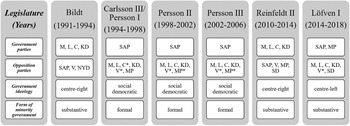
The investigation period, including six legislative periods, is divided into four centre-left and two centre-right governments (Figure 1). Between 1991 and 2018, some changes in the party system occurred. New Democracy could not secure its re-election, and the Green Party entered parliament after the 1994 election. Further, the Sweden Democrats entered parliament after the 2010 election. Figure 1 also illustrates that support agreements were only concluded under centre-left minority governments.
Investigation Period
Notes: * = opposition party that has entered a support agreement; SAP = Social Democrats, M = Moderates, L = Liberal Party, C = Centre Party, KD = Christian Democrats, V = Left Party, MP = Green Party, NYD = New Democracy, SD = Sweden Democrats.

Measures of dependent and independent variables
The dependent variable, minority government support, reveals whether an opposition party supports the minority government (value 1) on a voting proposal on which the government votes in favour, or not (value 0). Considering the relative majority needed for legislation, opposition parties can support a minority government with either a yes vote or an abstention. The most important support is a direct vote of confidence in the government's legislation. Abstaining is considered indirect support (see Bergman Reference Bergman1995: 29) and is not as frequent as a direct vote of support (see Online Appendix A1, Figure 1). Since the latter occurs rather seldomly, the present study focuses on direct support by voting in favour. The voting data has been hand-coded from plenary reports from 1991–2002 and partly drawn from the Swedish Riksdag's online service from 2003–2018 (Sveriges Riksdag 2002–2018). Lastly, it is important to consider that support parties are not expected to vote without informing the government about their plans since such behaviour would alienate future cooperation and pay-offs (Thürk Reference Thürk2021: 9).
The main independent variables are the party-specific issue saliency, the party-specific ideological distance from the minority government and the opposition party status. The opposition party status variable is a dummy giving information on whether a party explicitly and publicly committed to supporting a minority government (coded with value 1) or remained in its genuine opposition status (coded with value 0) (Bäck and Bergman Reference Bäck, Bergman and Pierre2016). The ideological distance between an opposition party and the seat share-weighted ideology of the government coalition is measured with the rile-index of the Comparative Manifesto Project (CMP) data set (Volkens et al. Reference Volkens2019). The party-specific issue saliency variable is also measured using the CMP data setFootnote 2 (Volkens et al. Reference Volkens2019) and recoded by the running average of two elections (t + t1). Taking the issue-saliency value of two successive elections promises a more precise measure for importance ratings when studying legislative voting behaviour. The party-specific issue saliency variable assignment from the CMP data set to the Swedish committees is based on Bäck et al. (Reference Bäck, Debus and Dumont2011) and the CMP data set's online codebook (see Online Appendix A2, Table 1). All these variables are measured every fourth year or after an election.
Besides, common control variables are included to avoid biased effects. To account for pressure from outside parliament, the analysis controls for the electorate saliency (measured for each committee/policy area using the importance ratings from the National SOM Survey cumulative data set) (University of Gothenburg, SOM Institute 2019) election years (Döring and Manow Reference Döring and Manow2019), since the electoral cycle influences a support party's endorsement for the government (Müller and König Reference Müller and König2021) as well as economic pressure. Arguing that despite being partly responsible for government stability, non-cabinet parties engage in party profiling, the electorate's opinion should play a major role when choosing strategies. Through Z-standardization of the budget deficit, unemployment rate and real GDP growth rates over the entire observation period, an index for economic pressure is generated based on the Comparative Political Data Set (Armingeon et al. Reference Armingeon2019). Measuring economic pressure in this fashion also controls for the need for unpopular cuts that may affect opposition parties' propensity to support a minority government. Finally, controlling for different policy fields accounts for variation in the committees that prepared a voting proposal.Footnote 3
Analysis
Descriptive statistics
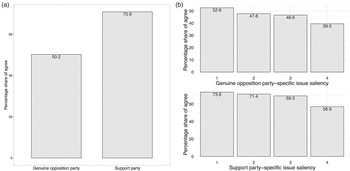
To get a first impression of the data and potential variation in the behaviour of different opposition party types, Figure 2a indicates different levels of minority government support averaged over all legislative periods and all policy fields. The figure confirms that support parties and genuine opposition parties alternate between opposing and supporting patterns. It also suggests that support parties are more inclined to support the minority government than genuine opposition parties. This is not surprising with regard to the official minority government support these parties committed to. However, it also confirms the assumption that these parties behave differently from genuine opposition parties that did not publicly commit to supporting the government.
Minority Government Support by Opposition Party Type and Issue Saliency Level (Averaged Over All Legislative Periods). Left (a) support by opposition party type; right (b) support by issue saliency and opposition party type
Notes: In Figure 2b, party-specific issue saliency is divided into four steps. X-axis value 1 represents the least important policy issues. X-axis value 4 represents the most important policy issues.

The distribution of minority government support over opposition party types and different issue saliency steps illustrate these differences between support parties and genuine opposition parties (see Figure 2b; the figure also depicts declining readiness to support with increasing levels of issue saliency).
In substantive terms, the difference in a support party's willingness to support the party's non-salient issues (x-axis value of 1) compared to highly salient issues (x-axis value of 4) is over 18 percentage points. This is surprising, considering the concept of policy pay-offs that support parties receive as a trade-off for their support. It appears that on a support party's important issues, its willingness to endorse the government is not increased by policy influence. In contrast, especially on these issues, support parties are cautious about supporting the government. A similar pattern can be found for genuine opposition parties, suggesting only a degree of difference in support readiness between support parties and genuine opposition parties.
The theory section further argued that the ideological distance moderates a support party's support behaviour on its core issues. Figure 3 depicts the percentage share of genuine opposition parties and support parties agreeing with the government on the party's three most important issues compared to the readiness to agree on all other issues. Figure 3 also displays the government's ideological distance, listing the ideologically closest opposition party first and the most distant one last.
Minority Government Support on Important Issues per Legislative Period
Note: Dark-grey-coloured bars indicate the opposition party-specific three most important issues. Light-grey-coloured bars indicate all other issues. Support parties are indicated with an asterisk (*). The order of the parties in the bar plots indicate the party's ideological proximity to the government (left side = ideologically close, right side = ideologically distant).

Figure 3 indicates that ideologically close and ideologically distant opposition parties entered official agreements with minority governments throughout the investigation period. When looking at the average minority government support, it can be observed that the agreement between the Left Party and the Carlsson III/Persson I minority government is lower for important issues than for all other issues. Such a pattern is not observable for the Centre Party, an ideologically close support party to the Carlsson III/Persson I minority government, where the agreement is higher for important issues and lower for all other issues.
Similar results can be found in the legislative period Persson II. Both ideologically distant support parties, the Left Party and the Green Party, show stronger support for the minority government when issues are not important. Still, this pattern is not observable in all legislative periods. In the legislative periods Persson III and Löfven I, support parties, despite their ideological closeness, are less convinced to support the minority government when issues are important to them.
For genuine opposition parties, Figure 3 shows no general pattern of support. In some legislations, ideologically close genuine opposition parties tend to support the minority government on non-important issues (see New Democracy under Bildt). In others, they support important issues more frequently (see Moderates under Löfven I). Ideologically distant genuine opposition parties sometimes support the minority government, especially on the most important issues (see Christian Democrats under Löfven I). However, contrary patterns can also be found in all other legislative periods.
Since, for illustration purposes, the bars in Figure 3 show the percentage share of agreement on the three most important issues compared to all other issues, the linear variable for party-specific issue saliency used in the statistical analysis promises finer-grained results.
Regression analysis
Several multilevel logistic regression models have been estimated to probe the determinants of different non-cabinet parties on the level of minority government support on their core issues. The results are illustrated in Table 2.
Results of the regression analysis

Notes:
a When also controlling for policy fields, the multilevel model did not converge.
*** p < 0.001, ** p < 0.01, * p < 0.05.
The unconditioned effects in Model 2 (Table 2) confirm that support parties – that is, opposition parties publicly committed to supporting the minority government – are more likely to support the minority government than genuine opposition parties. Further, the coefficient for ideological distance is not significant (see Model 2, Table 2), which is not surprising in a multilevel model estimation grouping among all dyads of legislation-opposition party combinations.
As a result of policy pay-offs, are support parties more likely to support the minority government on their core issues? The conditioned effect on minority government support in Model 3 (Table 2) suggests that support parties do not behave differently from genuine opposition parties regarding the party-specific issue saliency, which underscores previous findings by Ganghof and Bräuninger (Reference Ganghof and Bräuninger2006). Against the expectations of support party policy pay-offs, the negative coefficient indicates that support parties are more reluctant to support the minority government with increased issue saliency. Even though the effect is insignificant, it questions the assumption that support parties receive policy pay-offs on their core issues and support the minority government as a trade-off.
Still, Hypothesis 3 argued that it is considerably easier for ideologically close support parties to receive policy pay-offs on important issues since their interests converge with the minority government and compromise is facilitated. Ideologically distant support parties have a harder time implementing their core issues since interests diverge, and compromise with the government comes with greater concessions of which the electorate may not approve.
Model 4 (Table 1) suggests that such a relationship is reflected in the data. The significant conditioned negative effect indicates that ideologically distant support parties are less prone to support the minority government on their important issues. On such issues, these parties rather highlight their distinct party profile by opposing the government. Using an alternative measure by recoding the linear issue saliency variable into a factor variable by splitting it into four equal parts, the analysis arrives at similar conclusions (see Model 5, Table 2). The more important an issue is to a support party, the less likely it is to endorse the minority government. However, the categorical variable suggests that the more reluctant support behaviour is especially pronounced on the support party's most important issues (issue saliency value of 4). In particular, these core issues appear to evoke a more opposing behaviour vis-à-vis the minority government.
Further, this more reluctant support pattern on core issues is not observable for ideologically distant genuine opposition parties (see Model 5, Table 2). This can be read from the coefficients of the interaction terms of issue saliency and ideological distance. Modelling the three-way interaction with the support party as a binary moderator means the coefficients of the two-way interaction terms of issue saliency and ideological distance represent this variable's effect on genuine opposition parties (Brambor et al. Reference Brambor, Clark and Golder2006). These show a higher likelihood of supporting the minority government with increasing issue saliency and ideological distance. The results suggest that ideologically distant genuine opposition parties are more willing to support the minority government on important issues, which underlines that they appear to pursue different strategies than support parties.
The coefficients for the control variables election year and electorate issue saliency indicate negative effects on an opposition party's voting behaviour. The control variable economic pressure coefficient indicates a positive effect on an opposition party's voting behaviour.
Since the size of the interaction effects can only, to a limited degree, be interpreted through the coefficients in the logistic regression, the predicted probabilities are presented in Figures 4 and 5, which are based on Models 3 and 4.
Relationship between Party Issue Saliency and Opposition Party Status
Note: The x-axis ranges from 0 to +2 standard deviations above the mean of opposition party issue saliency.

Relationship between Party Issue Saliency and Opposition Party Status by Ideological Distance
Note: The x-axis ranges from 0 over the mean to +2 standard deviations above the mean of opposition party issue saliency.

Figure 4 illustrates the conditional effect of issue saliency and opposition party status (based on Model 3, Table 2). The graphs display a decreasing effect of issue saliency on the probability of minority government support, independent of opposition party status. Both support and genuine opposition parties are less willing to support the minority government with increasing policy importance. The figure reveals a level difference, suggesting that the endorsement towards the minority government is overall higher for support parties than genuine opposition parties. Yet, both slopes move in the same direction. This is also indicated by the insignificant interaction term in Model 3, Table 2.
In substantive terms, Figure 4 illustrates that the predicted probability of support parties supporting the minority government on important issues is 65% (x-axis value of +2 standard deviations), a decrease of 12 percentage points compared to less important issues (x-axis value of 0). For genuine opposition parties, the predicted probability of supporting the government on the party's most important issues is 46%, also decreasing by 12 percentage points. A moderating effect of the opposition party status on the influence of issue saliency on minority government support is not observable.
These results bolster Hypothesis 2, which expects decreasing minority government support with increasing levels of issue saliency. Support parties appear to behave more cautiously on their core issues, which questions our understanding of support party policy pay-offs as a way of trading minority government support for policy influence.
Treating support parties similarly does not account for ideological differences that may influence a support party's willingness to support a minority government on important policy issues. Figure 5 illustrates the statistical relationship between opposition party status, issue saliency and ideological distance from the government on the probability of minority government support.
The figure suggests that ideologically distant support parties (dark-coloured graph on the right-hand side) behave differently on their most important issues from ideologically close support parties (dark-coloured graph on the left-hand side). Ideologically close support parties are willing to support the minority government on all policy issues, regardless of issue saliency (left-hand side). There is no difference in the predicted minority government support observable, which suggests no evidence for higher endorsement due to policy pay-offs on especially important issues for ideologically close support parties. When interests converge, support parties are generally willing to support the minority government since compromise and electoral approval are more likely to be achieved. A clear decrease in the readiness of ideologically close support parties to give support on core issues is observable for average ideologically distant support parties (middle position in Figure 5).
Even more ambiguous results are observable for ideologically distant support parties. These parties appear to behave more flexibly vis-à-vis the minority government, being most willing to support it on non-important issues and least willing on their core issues. On an ideologically distant support party's most important issue, the predicted probabilities for minority government support are 29%. In comparison, on a non-important issue, the predicted minority government support is 72%, a substantive increase of 43 percentage points. This result bolsters the argument of ideologically distant support parties' strategic behaviour, where compromise and policy pay-offs on core issues are harder to achieve. Especially on these issues, ideologically distant support parties chose to oppose the minority government, aiming to highlight their distinct party profile in the electorate's eyes. Strikingly, readiness to give support on core policy issues is higher for ideologically distant genuine opposition parties with no official agreement than for ideologically distant support parties (see Figure 5). This suggests that ideologically distant support parties particularly engage in party profiling on their core issue.
Figure 5 also reveals that the ideological distance to the minority government does not influence a genuine opposition party's support readiness on either important or non-important issues (light-coloured graphs). The decrease in minority government support with increasing issue saliency appears not to be moderated by proximity arguments for genuine opposition parties. The results presented above are stable over various alternative measures (see Online Appendix A3, Tables 3 and 4) and robustness checks such as jack-knifing (see Online Appendix A3, Table 2).
Overall the findings suggest that ideologically distant genuine opposition parties do not differ from ideologically close genuine opposition parties regarding their need to signal distinctiveness on important issues. Only support parties lacking proximity to the government appear to engage in strongly varying behaviour and to worry about their party profile on the issues on which their electorate holds them accountable. Still, the results indicate that the probability for minority government support by an ideologically distant support party on its core issues is 29%, suggesting that policy pay-offs do happen sporadically.
In general, support parties appear to relish the opportunity of behaving more ambiguously towards the minority government. When a support party's accountability to the electorate is at stake, these parties can highlight their distinct party profile in legislation, something that coalition parties, for example, cannot do. This finding also bolsters research by Thesen (Reference Thesen2016), arguing that support parties perform better in terms of electoral support than junior coalition parties. In a similar vein, when lucrative policy pay-offs are possible, support parties can engage in the policymaking process, which genuine opposition parties cannot do, or only to a limited degree. Entering a support agreement is a rational choice that is especially attractive for parties that strive to behave flexibly towards the minority government, presenting themselves to their constituency as policymakers, yet without losing their distinct party profile.
These findings have important implications for minority governments since entering an agreement with an opposition party leads to overall higher support. Still, this support will be more ambiguous when ideological proximity is missing. The more important an issue is to an ideologically distant support party, the less likely it is that the minority government can count on its support. However, since plenary voting is a mirror of preceding bargaining (see Christiansen Reference Christiansen2008), the opposing behaviour of ideologically distant support parties on their core issues only reflects conflict issues that still gained a majority (see Matthieß Reference Matthieß2019; Thürk Reference Thürk2021). Support parties' agreement rate on the government's core issues is 72.7%, indicating that support parties are a reliable support. However, it also shows that they can still safely disagree in over 27% of cases without harming government stability. This underlines that support parties have a more independent position, allowing flexible behavioural patterns.
Analysing Swedish opposition parties' behaviour could also correlate with the performance of minority governments in other Scandinavian countries with comparable institutional settings, such as negative parliamentarism. Similar parameters are therefore expected, although less pronounced than in the Swedish case. Since the present study's main arguments build on opposition parties with official agreements, it is impossible to draw any conclusions regarding the influence of unofficial and informal agreements between an opposition party and the minority government. As the study focuses solely on opposition party behaviour facing minority cabinets, the findings cannot be generalized to majority cabinets in Scandinavian or other countries.
Conclusion
Under which circumstances do opposition parties choose to support a minority government, and under which do they deviate from the government's legislative output? This study has focused on diverging interests on opposition parties' core issues evoked by arguments of proximity to minority governments. Previous studies have shown that the perception of a coalition party's performance in its electorate's eyes affects its behaviour. Especially on issues a coalition party got voted for, it is very cautious about its accountability towards the electorate and more prone to highlight its distinctiveness. The present findings suggest that non-cabinet parties facing a minority government also have incentives for signalling a distinct party profile on their core issues in legislation. This even applies to non-cabinet parties that are officially committed to supporting the minority government when their interests with the government diverge.
When support parties have a hard time selling their official agreement to their electorate, they especially fear appearing too close to the government on the policy issues they emphasized most in an election campaign. Despite their official commitment to support the minority government, ideologically distant support parties appear to engage in a more flexible relationship vis-à-vis the minority government, allowing them to fulfil their accountability towards the electorate more feasibly. They switch between cooperative and opposing behaviour patterns, highlighting a distinct party profile or presenting themselves as policymakers.
By analysing parliamentary voting proposals in 23 years of minority governments in Sweden (1991–2018) with a multilevel logistic model specification, the study could add to these previous findings by illustrating that opposition parties officially committed to minority government support share similar concerns when their interests diverge from the government's. However, genuine opposition parties without an official support agreement appear to be less concerned about being perceived as too close to the government, leading to less ambiguous behaviour vis-à-vis the minority government.
The findings thereby question our present understanding of support party pay-offs, which would expect support parties to be given policy influence on their core issues. As a trade-off, they would show their endorsement towards the minority government, leading to higher minority government support on the support party's core issues. Instead, the findings suggest the opposite, proposing that support party pay-offs occur in a more complex manner. This adds to recent literature advocating a revision of our understanding of support party pay-offs as the simple trade-off between oppositional policy influence and minority government support (Anghel and Thürk Reference Anghel and Thürk2021). Support parties struggling to compromise on important issues that do not deviate too far for their constituencies to approve, seem to be reluctant to engage in pay-offs in general. Instead, these support parties seek to catch votes on their core issues by refraining from policy involvement and opposing the government.
Thus, the findings bear important ramifications concerning the rationality of entering a support agreement. Support parties have the potential to engage in cooperation and policy pay-offs when electoral approval is anticipated while also opposing the minority government on legislative activities when compromise is not rewarding. Such a position is advantageous compared to both coalition parties and genuine opposition parties since it allows the best of both worlds. Therefore, the study empirically underlines the results by Thesen (Reference Thesen2016) and Bale and Bergman (Reference Bale and Bergman2006a), highlighting the rationality of entering a support agreement rather than participating in the cabinet, which is especially interesting for opposition parties that strive to engage in a more flexible relationship with the minority government.
This article also has some limitations and offers further research possibilities regarding the form of support party pay-off and the strategies pursued by support parties to justify their behaviour to their electorate when supporting or opposing the minority government. In a similar vein, when comparing the electoral performance of support parties in Sweden between the years 1991 and 2018, the results are mixed, sometimes indicating increased support but also losses. A more detailed study regarding the electoral benefits for support parties when pursuing the strategies highlighted in the article is desired. Moreover, in the light of generalizability, a study comparing Scandinavian minority governments with minority governments in a more adversarial setting such as Canada would offer an interesting contrast. This, altogether, would further contribute to the understanding of opposition–government dynamics under minority governments – a formation type that facilitates responsible and strategic opposition parties and stable governments, something from which other parliaments struggling with majority formation and effective governments can draw encouragement.
Supplementary material
The supplementary material for this article can be found at https://doi.org/10.1017/gov.2021.60.