Introduction
Since first appearing nearly two decades ago, the “Pivotal Politics Theory” (see Krehbiel Reference Krehbiel1998) has been an influential and widely used analytical framework in the study of American politics.Footnote 1 Initially designed to study the United States (US) lawmaking process, Pivotal Politics – a one-dimensional spatial model predicated on the notion that outcomes are constrained by supermajority voting rules – has proven remarkably flexible. In addition to inspiring work that has delved more deeply into legislative productivity (Wawro and Schickler Reference Wawro and Schickler2004, Reference Wawro and Schickler2006; Lapinski Reference Lapinski2008, Reference Lapinski2013), Pivotal Politics has also been adapted and extended to study unilateral presidential action (Moe and Howell Reference Moe and Howell1999; Howell 2003), presidential agenda setting (Beckman Reference Beckman2010), congressional delegation to executive agencies (Epstein and O’Halloran Reference Epstein and O’Halloran1999), and advice and consent in treaty making (Auerswald and Maltzman Reference Auerswald and Maltzman2003) and judicial selection (Johnson and Roberts Reference Johnson and Roberts2005; Primo et al. Reference Primo, Binder and Maltzman2008).
Despite its influence and widespread use, Pivotal Politics has received mixed results in empirical testing. Krehbiel (Reference Krehbiel1998) found a significant, negative relationship between the size of the “gridlock interval” (the ideological space between the members who represent the cloture and veto-override “pivots”, respectively) and the number of important laws enacted in the post-World War II era, in keeping with the theory’s core prediction. More recent tests of Pivotal Politics, however, have not produced similarly supportive results (for a useful summary, see Woon and Cook Reference Woon and Cook2015). This has been true not only in studies of legislative productivity but also when various roll-call-based measures are used as dependent variables.
In sum, the current state of the literature suggests that Pivotal Politics provides useful theoretical intuition (or perhaps serves as a useful starting point for theory building), but falls short in empirical verification. Going further, superior results from models that move beyond an exclusive focus on rules might imply that Pivotal Politics is too reductionist, and that too much real-world complexity has been stripped away in the model-building process.
We argue instead that prior studies of Pivotal Politics have been lax in fully connecting theory to testing, specifically in constructing appropriate and consistent measures. That is, the Pivotal Politics model is explicitly about the connection between spatial preferences and outcomes, given supermajoritarian voting rules. Because of this, valid empirical tests must feature a tight connection between their preference measures and their outcome measures. Yet, the typical independent variable (the size of the gridlock interval) is based on a single spatial dimension of ideological (liberal-to-conservative) preferences, whereas the dependent variable is typically a count of important laws – regardless of whether those laws actually invoke the ideological preference dimension. Many of the bills that factor into the construction of the dependent variable draw from different preferences than those that are measured as the independent variable, creating a disconnect that undermines the validity of these tests.
Following Lee (Reference Lee2009), we code landmark laws by ideological content and examine how Pivotal Politics performs in a “fair” test – using ideological landmark laws as the dependent variable. We uncover results consistent with Pivotal Politics’ core prediction: the gridlock interval is significant and negatively related to the production of ideological landmark laws. Moreover, we find the opposite (a significant, positive relationship) when looking at nonideological landmark laws. We argue that these results suggest that members of Congress, under constant electoral pressure to produce new legislation, pursue different types of landmark laws based on the level of gridlock that they face. When gridlock is higher, they focus more on nonideological legislation; when gridlock is lower, they shift their attention to ideological legislation.
Thus, in firming up the connection between theory and testing, by selecting appropriate and consistent measures, we not only find support for Pivotal Politics but we also uncover evidence of a broader phenomenon – that reelection-seeking members of Congress alter their lawmaking behaviour in the face of changes in the ideological polarisation of key legislative actors.
Pivotal Politics: theory and evidence
The Pivotal Politics model, as developed in Krehbiel (Reference Krehbiel1998), is an elegantly simple approach to explaining legislative productivity that focusses on the “pivotal” actors in the lawmaking process: the legislators who decide (a) whether a filibuster on a bill will be broken and (b) whether a presidential veto on a passed bill will be overridden. The model assumes that, for any individual policy, there is a single dimension of preferences over that policy’s outcomes that captures the entire lawmaking process, and that these policy preferences are the sole determinants of votes. More specifically, legislators are assumed to possess single-peaked, symmetric preferences over policy outcomes and, given two options, pick the one closer to their ideal point. There is no role in the theory for parties, elections or any other concern, except so much as they endogenously alter members’ policy preferences.
Pivotal Politics thus functions as an extension of classic “median-voter” games, with the addition of two supermajority features of the federal lawmaking process: the filibuster in the Senate and the presidential veto. These deviations from simple majority rule yield two new pivotal actors: a filibuster pivot and a veto pivot. The filibuster pivot is the senator who decides the success of a filibuster attempt (i.e. whether “cloture” is invoked or not). The veto pivot is the member who determines the success of an attempt to override a presidential veto.Footnote 2 The decisions of each pivot are clear from the model. As all status quos, once considered, move in the direction of the median voter, any status quo that lies between a pivot and the median would move away from that pivot, making any passable change less desired than the status quo itself. Thus, the leftmost pivot on the policy line will not consider moving any status quo that lies between itself and the median member. The same is true for the rightmost pivot. This creates an interval of status quos between the pivots that cannot be altered. Any of these status quos, which a majority could replace with a policy closer to the median, would either be filibustered or vetoed (with an insufficient number of votes to invoke cloture or override, respectively). This set of unmovable status quo policies is referred to as the “gridlock interval”.
Figure 1 (adapted from Krehbiel Reference Krehbiel1998, p. 35) illustrates one possible set of pivotal actors: “F” represents the Filibuster Pivot; “M”, the Median Member; “V”, the Veto Pivot; and “P”, the President. No status quo between F and V can be altered in equilibrium.
An example of the Pivotal Politics gridlock interval.

Although many scholars and pundits have identified divided government as the cause of legislative stalemate (c.f. Mayhew 2005 [Reference Mayhew1991]), Pivotal Politics focusses instead on the size of the gridlock interval as the chief explanation for changes in legislative productivity. If the distribution of status quos is assumed to be uniform,Footnote 3 then the larger the gridlock interval, the fewer the policies that are available to be moved. Only status quos at the extremes of the distribution can be altered. As the gridlock interval narrows, however, more moderate policies also become eligible for change. Thus, Pivotal Politics predicts a negative relationship between the size of the gridlock interval and the production of important laws.Footnote 4
Krehbiel (Reference Krehbiel1998) found initial empirical support for this negative relationship.Footnote 5 However, in subsequent years, additional confirmatory evidence has been hard to come by – whether in terms of legislative productivity or other more general phenomena. Chiou and Rothenberg (Reference Chiou and Rothenberg2003) found no significant relationship between the size of the gridlock interval and the proportion of significant bills on the agenda that were enacted in the post-World War II period. In a 2006 study, the same authors reported similar results with regard to counts of significant laws over a period extending into the 19th century. Covington and Bargen (Reference Clinton2004) and Stiglitz and Weingast (Reference Stiglitz and Weingast2010) found weak results for a pure preference-based theory relative to a partisan gatekeeping model. Krehbiel et al. (Reference Krehbiel, Meirowitz and Woon2005) reported ambiguous results for Pivotal Politics (in comparison to other, party-based models), whereas Clinton (Reference Cox and McCubbins2007) found little support for a Pivotal Politics approach. Richman (Reference Richman2011) reported mixed results for Pivotal Politics and stronger results for a partisan model when analysing policy locations using National Political Awareness Test surveys. Woon and Cook (Reference Woon and Cook2015) also presented mixed results for Pivotal Politics in a novel test that departed from the common assumption of uniformly distributed status quos. Only Heitshusen and Young (Reference Heitshusen and Young2006) reported findings consistent with Pivotal Politics, uncovering a negative relationship between policy production (based on the number of section changes to the US Code) and the size of the gridlock interval for the 1874–1946 era.
Thus, in the nearly two decades since Krehbiel (Reference Krehbiel1998), there have been more failures and ambiguous results than successes. Given the inherent logic of Pivotal Politics, these results might lead one to believe that the theory serves as a useful starting point, but that additional complexity (of some form) is needed to better capture the data-generating process in lawmaking. We challenge this belief and, in doing so, resuscitate the empirical bases of Pivotal Politics.
Retesting Pivotal Politics
We first retest the core prediction of Pivotal Politics – that the size of the gridlock interval is negatively related to legislative productivity. Our dependent variable is a count of Landmark Laws by Congress, from the 80th Congress (1947–1948) through the 113th Congress (2013–2014). These counts, as initially compiled by Mayhew (2005 [Reference Mayhew1991]) and subsequently updated, are based on two separate sweeps.Footnote 6 “Sweep One” includes laws deemed important by newspaper reporters at the time, whereas “Sweep Two” includes laws considered important by experts in retrospect. Sweep Two requires the passage of time and thus was only applied by Mayhew through 1990. Although both the combined and Sweep One counts are imperfect, having a consistently measured dependent variable is essential. Even if both sweeps covered the same period, they are fundamentally different time series and combining them is not advisable (Howell et al. Reference Howell, Adler, Cameron and Riemann2000). Therefore, we rely only on Sweep One counts in this article, which Cameron (2000) and Howell et al. (Reference Howell, Adler, Cameron and Riemann2000) refer to as “landmark laws”.Footnote 7
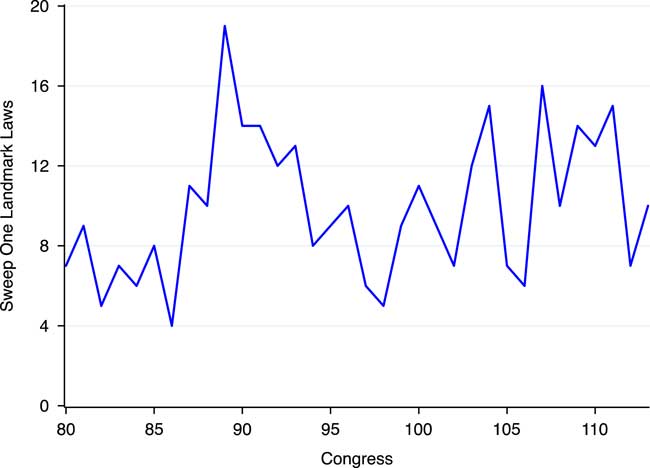
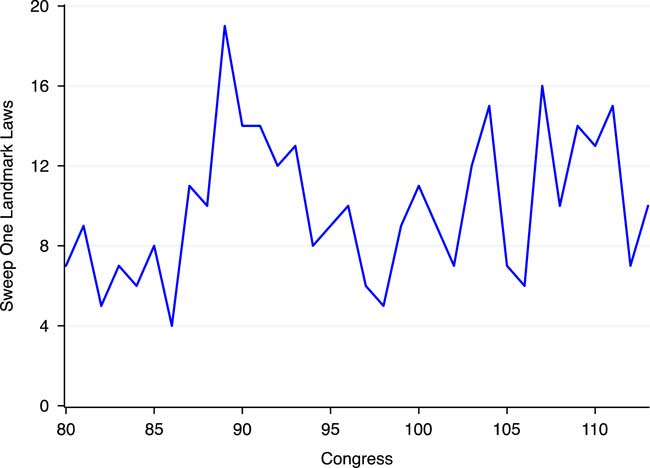
Figure 2 shows Mayhew’s landmark laws for the 80th through 113th Congresses. Just under 10 landmark laws were produced per Congress, on average, with a minimum of four (86th Congress; 1959–1960) and a maximum of 19 (89th Congress; 1965–1966).Footnote 8 The SD is 3.63. Although Congress-to-Congress fluctuations are sometimes considerable, average landmark legislative productivity is relatively flat over the span of the time series.
Landmark laws, 80th–113th Congresses.
The key independent variable is a measure of the Gridlock Interval.Footnote 9 Krehbiel’s (Reference Krehbiel1998) original measure relies on partisan information (shifting seat control between the two major parties) to determine a change in the gridlock interval, despite the theory not including parties in any way. A better way of testing the theory would make use of data that are not explicitly partisan. One option is to use measures of revealed preference, such as Common Space DW-NOMINATE scores (Carroll et al. Reference Carroll, Lewis, Lo, McCarty, Poole and Rosenthal2015), which has become the standard approach of measuring the gridlock interval (see Chiou and Rothenberg Reference Chiou and Rothenberg2003, Reference Chiou and Rothenberg2006; Woon Reference Woon2009; Richman Reference Richman2011; Oh Reference Oh2015; Woon and Cook Reference Woon and Cook2015).Footnote 10 We follow this approach, as it allows us to estimate the gridlock interval on a single policy-preference dimension (line) for each Congress.Footnote 11 Common Space scores do not allow individual members to vary over time, but they are comparable across time and chambers. This is important because Pivotal Politics assumes representatives and senators are arrayed on the same policy dimension. Although the constancy of Common Space scores does diminish the variance between units, Poole (Reference Poole2007) argues that members do not change significantly during their time in Congress, and the use of static scores is justified in this context.
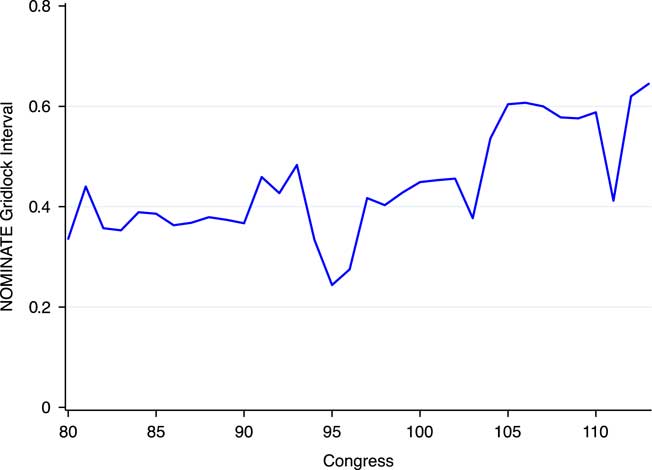
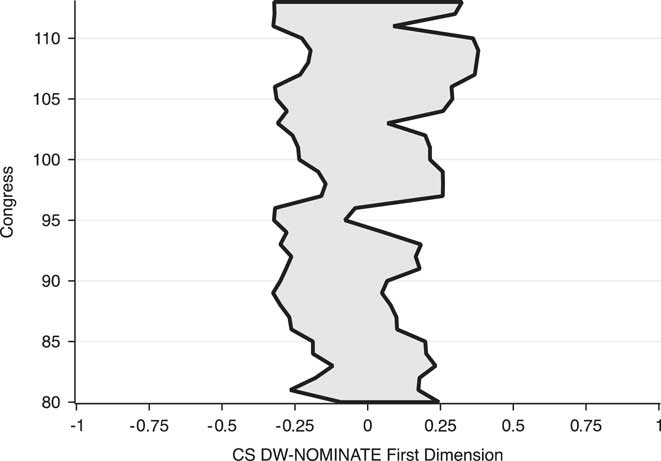
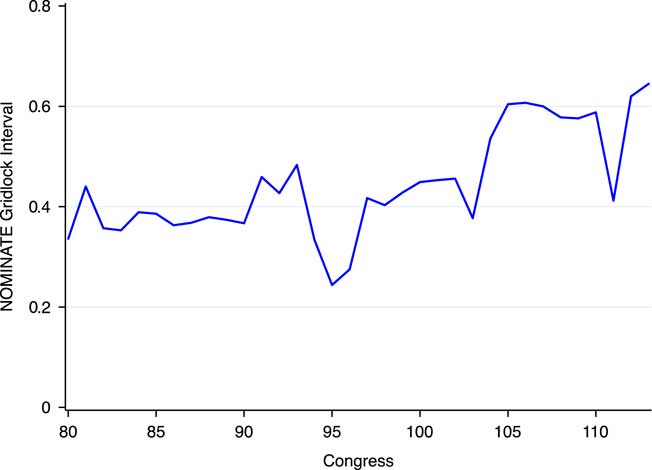
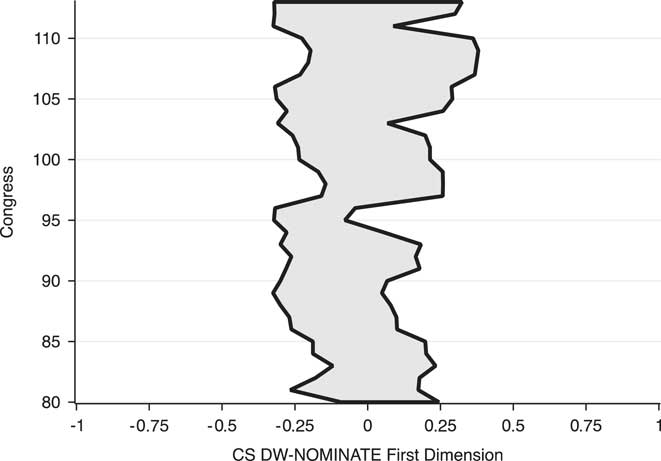
Figure 3 shows the size of the gridlock interval for the 80th through 113th Congresses, whereas Figure 4 shows the regions of the policy line gridlocked in each Congress over the same range.Footnote 12 The mean gridlock interval is 0.44 on the NOMINATE scale, which encompasses more than a fifth of the measure’s theoretical range). The minimum is 0.24 (95th Congress; 1977–1978) and the maximum is 0.65 (113th Congress; 2013–2014). After the series low in the 95th Congress, the size of the gridlock interval has been increasing in a near continuous manner (with just a few Congress-to-Congress declines), in keeping with the ever-rising polarisation in Congress.
Size of gridlock interval, 80th–113th Congresses.
Gridlocked Space on the policy line, 80th–113th Congresses. Note: CS=Common Space.
We also include other factors that are potentially part of the data-generating process. This is important because lawmaking is inherently complex and responds not only to the preferences of legislators, but also the influences exerted on them by their electorates, the context and time in which they serve, and exogenous shocks. Many macro trends influence the agenda: international relations, economic cycles and popular movements are three such examples. Any of these may correlate with the gridlock interval and thus be subsumed into that variable should a similar important factor be omitted. Although each included variable corrects for potential omitted variable bias, it also removes a crucial degree of freedom – which is a nontrivial concern, as we begin with a maximum of 34 observations. Thus, we must be as minimal as possible while also incorporating the necessary variables to plausibly describe the legislative process.
We include single proxy measures for the political, economic, electoral and international relations context that existed during each Congress. For the political context, we use Unified Government, which is coded “1” when the president’s party also controlled both chambers of Congress and “0” otherwise.Footnote 13 Scholars have debated whether unified partisan control of government enables legislating (Binder Reference Binder2003; Mayhew 2005 [Reference Mayhew1991]). There are clear reasons to think that it would: if parties are useful and powerful institutions, then a unification of the levers of power should make it easier to enact a party’s agenda. To capture the economic context, we include gross domestic product (GDP) Growth Rate, which is the average of the two annual growth rates of the US’ Real GDP during a given Congress.Footnote 14 Economic concerns motivate many important laws, ranging from bailouts and jobs bills to industry subsidies and stimulus packages. Economic circumstances may change the immediacy of a bill’s need and in extreme circumstances may represent a shock that temporarily alters preferences over certain policies.Footnote 15
For the electoral context, we include a measure of the national Policy Mood, as developed by Stimson (Reference Stimson1991), which taps the public’s support for government programmes.Footnote 16 When this measure is high, there should be greater demand for new legislation. If members of Congress exhibit an “electoral connection”, then these changing pressures may influence their willingness to pursue enactments. Finally, for the international relations context, we include an indicator of whether the US was at War, which is coded “1” for all conflicts that lasted at least half of one Congress and “0” otherwise.Footnote 17 Wars often require emergency appropriations, as well as corresponding compensation systems for members of the armed forces. Although Congress technically declares wars, presidents retain control of the military and war-making powers to such a degree that endogeneity in this variable is not a serious concern.
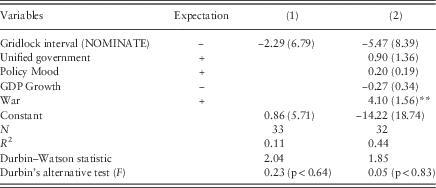
In Table 1, we present results from ordinary least squares (OLS) models estimating the relationship between the Gridlock Interval and Landmark Laws.Footnote 18 Model 1 is a simple bivariate model, whereas model 2 includes controls. Directional expectations appear next to the variable names.
Impact of gridlock interval on landmark laws, 80th–113th Congresses

Note: Numbers in cells are ordinary least squares regression coefficients with Newey–West standard errors in parentheses. Both models include a time trend and a one-Congress lagged version of the dependent variable. One-tailed tests are used for all coefficients with a specified directional prediction. Two-tailed tests are used for all other coefficients.
**p<0.01.
To reiterate, the Pivotal Politics model predicts a negative relationship between the size of the gridlock interval and legislative productivity. That is, as the gridlock interval expands, the number of status quos that can be altered decreases; therefore, we should expect fewer landmark laws. With this in mind, the results in Table 1 are striking. In the bivariate model (column 1), the coefficient for Gridlock Interval, while signed correctly, is not statistically significant. This null result is also present when controls are added (column 2). Of the control variables, only the coefficient for War is significant in the expected direction.
Rethinking theory to testing: selecting similar measures
The preceding analysis is not very surprising given the history of weak empirical results for a pure preference-based theory of pivotal actors. Yet, this type of testing suffers from deficiencies in accurately translating theories and hypotheses into data and analyses. Many data and testing choices made by Krehbiel (Reference Krehbiel1998) have persisted for nearly two decades. What once helped his cause has (seemingly) become a hindrance. One primary example is the use of Mayhew’s significant laws, which are a standard in the literature.
On their own, Mayhew’s laws are not incorrect. When just Sweep One counts are used, they represent one justifiable means of measuring importance: what journalists remarked upon at the end of a session. However, when Sweep One counts are incorporated as the dependent variable in a Pivotal Politics model, a disconnect between theory and testing occurs.Footnote 19 Pivotal Politics describes the process of producing a policy from a set of preferences. In the most abstract form, there are a potentially infinite set of these preference dimensions, corresponding to a potentially infinite set of policies. This is understandably intractable for empirical testing: it is impossible to measure legislator preferences on so many different policy questions. The universal empirical shorthand is to rely on the concept of liberal–conservative ideology. Scholars (implicitly) assume that, at least in post-war American politics, a large number of these preference dimensions on certain types of policies are so highly correlated that we can generalise them to a single underlying dimension of liberal–conservative policy preferences.
Thus, in the modal empirical application of Pivotal Politics, the theory is treated as making legislative predictions from a single dimension of ideological policy preferences. The common use of the first-dimension DW-NOMINATE score (often thought of as a measure of ideological preferences) reinforces this. Yet, not every policy fits into our concept of “ideology”. Some policy areas draw on different dimensions of preferences – in these cases, the size of the gridlock interval and the resulting predictions for policy outcomes under Pivotal Politics would be different from the gridlock interval and predictions based on ideological preferences. An ideal test of Pivotal Politics should assess whether observed outcomes match the predictions of Pivotal Politics. Thus, if we narrow the testing to an empirically workable dimension of ideological preferences, we should only use outcomes that would rely on that dimension. Yet, Mayhew’s laws, the most common outcome variable, were chosen only for their importance, not for whether they represent any genuine conflict between liberal and conservative values. As Lee (Reference Lee2009) argues, not all issues generate conflict, and not even all issues for which there is partisan conflict can be coherently placed on an ideological line. Many of the laws counted by Mayhew may draw on different sets of preferences, which would yield different Pivotal Politics predictions if we could measure those dimensions.
This weakness provides an opportunity for a new dependent variable, but does not require departing from Mayhew. Instead, we create subsets of Mayhew’s Sweep One laws, separating those that fit into a liberal-versus-conservative ideological conflict from those that do not. The goal is to create a subset (ideological laws) that sufficiently matches the ideological gridlock interval we measure so that we have a consistent set of Pivotal Politics predictions to test. In this, we rely on Lee’s (Reference Lee2009, pp. 61–64) definition of ideology and resulting coding scheme for classifying issues as ideological or nonideological.
Lee identifies “ideological issues” as “disputed understandings of the proper role and purpose of government” with respect to four categories: economic, social, hawk-versus-dove and multilateralism versus unilateralism.Footnote 20 The economic category includes laws that change levels of economic regulation (such as environmental regulations for businesses) or redistribution (e.g. changing the graduation of the tax schedule or expanding Medicaid funding) or affect the overall level of government spending and share of the economy (such as large economic stimulus spending). The social category includes civil rights legislation and crime measures, as well as laws that push policy away from traditional gender, family, sex and race norms (such as “Don’t Ask, Don’t Tell”, abortion rights or school prayer). The hawk-versus-dove category involves authorisations for the use of military force, weapons investment and limitations on weapons testing. Finally, the multilateralism versus unilateralism category includes debates over the importance of international organisations to America’s foreign policy (e.g. policies that promote the United Nations).
Laws outside of these four categories do not have a clear place in modern American ideological debates. In these cases, it is difficult or impossible to place a status quo or policy alternative on the left-to-right policy dimension, which makes these laws incompatible with Pivotal Politics predictions drawn from ideological preferences.Footnote 21 Many laws fall into this nonideological category, including those that deal with good governance (such as Freedom of Information policies) and departmental reorganisation, nonredistributive and nonregulatory programmes (such as the anticancer efforts begun by the National Cancer Act of 1971), disaster relief and the distribution of power between the branches of the federal government (such as the War Powers Resolution). Nevertheless, “nonideological laws” is not a category equal to “ideological laws”. We treat ideological laws as a group because we believe preferences over these policies are tightly correlated, enabling them to be treated as a single composite dimension. We have no such beliefs about nonideological laws. There could be numerous policy dimensions represented in this category. There is no threshold of “nonideologicalness” to receive the label. This is a remainder category – everything that is not “ideological” is “nonideological”. We should therefore be cautious about reading too much into the results for this remainder category. Necessarily, there are dimensions of preferences for these policies that we do not measure and complexity that we do not observe.
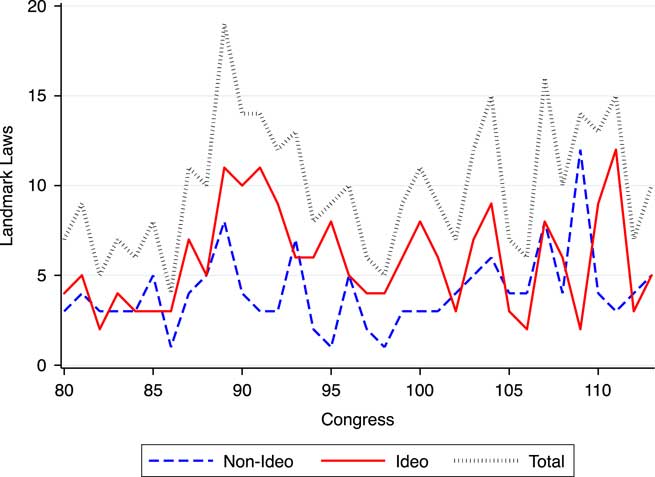
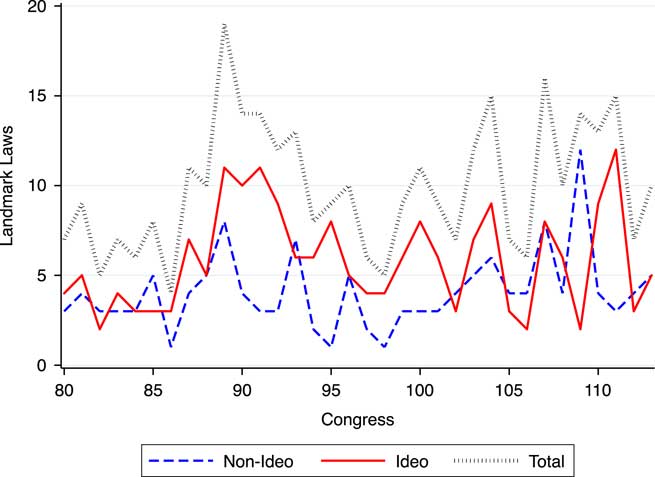
For each Sweep One law, we determine whether it fits into one of Lee’s categories of ideological conflict. If so, the law is coded as ideological; if not, it is coded as nonideological.Footnote 22, Footnote 23 Figure 5 illustrates the resulting time series of ideological and nonideological landmark laws. The mean level of ideological laws (5.85) is higher than nonideological laws (4.09), but both series display meaningful variation (SDs of 2.83 and 2.19, respectively). The minimum and maximum for ideological laws are two (106th and 109th Congresses; 1999–2000 and 2005–2006) and 12 (111th Congress; 2009–2010), whereas the minimum and maximum for nonideological laws are one (86th, 95th, 98th Congresses; 1959–1960, 1977–1978, and 1983–1984) and 12 (109th Congress; 2005–2006). Overall, the two series exhibit no meaningful correlation (r=0.03).
Landmark laws split into ideological and nonideological categories, 80th–113th Congresses.
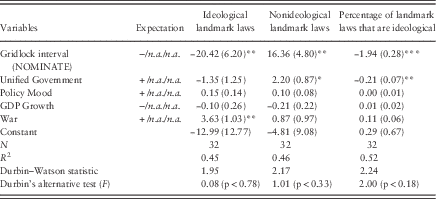
In Table 2, we present OLS regression results similar to those in Table 1, except divided by landmark law type.Footnote 24 In model 1, the dependent variable is the count of ideological landmark laws, whereas in model 2 the dependent variable is the count of nonideological landmark laws.Footnote 25 In model 3, the dependent variable is the proportion of landmark laws that are ideological. Note that this variable is not a count and has a theoretical range of 0–1.Footnote 26 We carry over all theoretical (directional) expectations from Table 1 to model 1 in Table 2. Without clear theoretical expectations for models 2 or 3, we present them descriptively, with two-tailed tests.
Impact of gridlock interval on ideological and nonideological landmark laws, 80th–113th Congresses

Note: Numbers in cells are ordinary least squares regression coefficients with Newey–West standard errors in parentheses. Each model includes a time trend and a one-Congress lagged version of the dependent variable, whereas Model 3 includes an additional two-Congress lagged version of the dependent variable. One-tailed tests are used for all coefficients with a specified directional prediction. Two-tailed tests are used for all other coefficients.
GDP=gross domestic product.
*p<0.05, **p<0.01.
When used to explain the production of ideological landmark laws (model 1), Gridlock Interval has a negative, statistically significant coefficient – exactly as Pivotal Politics predicts. A1 SD increase in the gridlock interval corresponds to a 2.14 decrease in the expected number of ideological landmark laws. We have argued that a fair test of the theory requires a data choice for the dependent variable that actually fits the concepts invoked in the theory: conflict over ideological preferences. Model 1 offers strong support for that argument. When tested with all Mayhew Sweep One laws (Table 1), Pivotal Politics generated null results. Nevertheless, when applied to a measure of the dependent variable that is more appropriate for the theory, Pivotal Politics achieves its predicted (negative) coefficient.
The coefficient for Gridlock Interval in model 2, however, is entirely different: positive and statistically significant. A 1 SD increase in the gridlock interval corresponds to a 1.72 increase in the expected number of nonideological landmark laws.Footnote 27 Taken together, the two models in Table 2 explain the model in Table 1. For one set of bills (ideological), the gridlock interval has a strong and significant negative relationship, and for a different set (nonideological) it has a strong and significant positive relationship. When analysed collectively, these work out to the small, negative and insignificant relationship we found in Table 1. Side by side, they show the dangers of data that poorly fit a theory: they can undermine a theory’s empirical strength just as well as enhance it.
The results in models 1 and 2 of Table 2 imply that ideological and nonideological laws do not have independent relationships with gridlock. As one (ideological) decreases, the other (nonideological) increases in apparent compensation. This is perhaps best seen in model 3, where we find a significant, negative relationship between the size of the gridlock interval and the proportion of landmark laws that involve an ideological issue. A 1 SD increase in the gridlock interval corresponds to about a 20-point decrease in the expected percentage of landmark laws that are ideological. One plausible explanation for this is that when the ideological gridlock interval increases, making it harder or more uncertain for legislator to pass ideological laws, they switch their focus to laws that do not involve major ideological disagreements, which may provide easier or more certain results. That is, they substitute nonideological legislation for ideological legislation.Footnote 28 More generally, facing a constant pressure to “produce” even as Congress becomes more polarised, legislators find points of common ground (Harbridge Reference Harbridge2015). Here, such common ground may take the form of nonideological legislation, which, as Lee (Reference Lee2009) suggests, members may take up to solve their electoral needs or to augment their (or their party’s) power. Although we reference “nonideological” as a homogeneous category, it is important to recognise that it is made up of a variety of policy areas with their own preference dimensions and gridlock intervals.
These results help make sense of the following disconnect: average landmark legislative productivity has remained relatively flat over time (Figure 2), even as the ideological polarisation of pivotal actors has increased significantly (Figure 3). Members’ need to produce legislation has not changed over time, but the changing ideological circumstances affect what issues are available for them to achieve legislative success.
Table 2 also sheds light on the debate over unified government. Mayhew (2005 [Reference Mayhew1991]) and Krehbiel (Reference Krehbiel1998) have argued that unified government does not, in practice, differ from divided government. This was a natural outgrowth of Pivotal Politics. If legislators are individual actors rather than partisan groups, then it is the distribution of preferences that matters, not partisan control. Table 2 reveals a nonexistent relationship between unified government and ideological landmark laws. However, it also shows a significant, positive effect for unified government on nonideological landmark laws, and an overall negative effect on the proportion of landmark laws that are ideological. All else equal, when one party controls the presidency and both chambers of Congress, the expected percentage of landmark laws that are ideological drops by 21 points, and this makes some sense as in the absence of ideological fault lines that members can use as individualists, partisanship may serve as an organising principle to solve collective action problems within Congress (see Lee Reference Lee2009).
Robustness of results
In this section, we investigate whether our main findings are sensitive to particular distributional assumptions. We also explore whether the key concept around which our study is organised – ideology – can be operationalised differently and produce the same results.
Sensitivity to assumptions about the status quo distribution
The preceding analyses rely on a common assumption in the literature: that status quos are uniformly distributed across the theoretical range of the policy space. This assumption is convenient: it allows us to use a spatial measure (the gridlock interval) as our main independent variable, as an expansion of length x anywhere on the line captures the same portion of status quos. Stated differently, as long as status quos are uniformly distributed, the distance between the pivots is an accurate measure of the percentage of status quos gridlocked.
Despite being common, the uniform status quo assumption has not been immune to criticism (Krehbiel Reference Krehbiel2006a, Reference Krehbiel2006b; Richman Reference Richman2011; Krehbiel and Peskowitz Reference Krehbiel and Peskowitz2015; Woon and Cook Reference Woon and Cook2015). A normal distribution may in fact be a better approximation because it would reflect the process of history: policies being moved towards the median, leading to a status quo distribution that is far denser in the middle than at the tails. This is significant because an expansion of length x in the gridlock interval captures a different percentage of the total status quos depending on where on the line the expansion occurs. In short, this becomes a case of measurement error: if the status quo distribution is nonuniform, spatial distances will not properly measure the actual percentage of status quos gridlocked.
Status quos being distributed normally makes a great deal of sense in the context of all legislation. However, it is less apparent in our context, as we analyse landmark laws exclusively. The set of status quos that have the capacity to be significant if altered may not be the same as all status quos, and thus their distribution may also be different. At first glance, legislation may be more likely to achieve landmark status when it produces a large policy shift, best exemplified by new major federal programmes and policies. This implies that status quos at the extremes have a greater probability of being significant. If the set of all status quos is normally distributed, however, these extreme areas also have the lowest concentration of status quos, which partially nullifies their heightened potential. In addition, many of Mayhew’s laws were deemed significant not for enormous policy shifts but rather because they altered existing major programmes and policies – increasing the minimum wage, expanding social security benefits or changing the top marginal tax rates. Cases such as these are more likely to reflect the movement of policies around the middle of the distribution.
Collectively, these arguments may in fact point to the validity of a uniform distribution – reflecting both the concentration at the centre and the increased significant potential of status quos in the periphery. As the nature of the status quo distribution remains an open question, however, we explore whether our results are dependent upon the uniformity assumption.
To test the sensitivity of our findings, we replicate our analyses with a variety of possible distributions, and show that our results are robust and insensitive to these potential sources of measurement error. We include two primary categories of potential distributions. First, we analyse truncated normal distributions centred at 0, with six different SDs (0.10, 0.15, 0.20, 0.25, 0.35 and 0.45). To this, we add truncated normal distributions centred at points informed by the previous Congresses’ median voters (with one-, three- and five-congress averages), each with three different SDs (0.15, 0.25 and 0.35). This produces 15 different distributions, along with the basic uniform distribution.
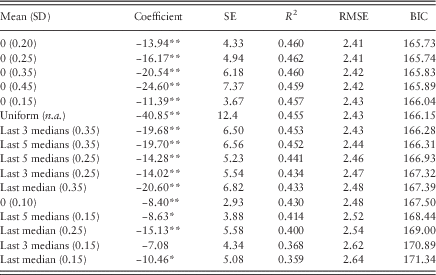
From each distribution, we calculate the percentage of status quos gridlocked with each Congress’s pivot locations. We then use these values in place of the Gridlock Interval variable in OLS regressions that replicate model 1 in Table 2 (where ideological landmark laws represent the dependent variable). The results of those regressions, which are reported by row in Table 3, indicate that our earlier results are not dependent on the uniform status quo distribution. In fact, the “transformed” Gridlock Interval measure is significant in all but one of the 16 models that we analyse.Footnote 29 This suggests that the uniform distribution assumption may not create a serious measurement problem after all. In addition, in terms of overall fit, the model based on the uniform distribution outperforms 10 of the 15 models with alternate status quo distributions.
Summary of regression results with different gridlock interval measures based on different status quo distributions

Note: Each row presents results of a separate ordinary least squares regression with Newey–West standard errors. The dependent variable is the number of Ideological landmark laws. The independent variable is the percentage of status quos gridlocked (based on the given distributional assumptions). Coefficients represent a one-unit change in variables theoretically bound between 0 and 1. Additional covariates [Unified Government, Policy Mood, gross domestic product (GDP) Growth, and War] are included in each model, but coefficients not reported. Each model also includes a time trend and a one-Congress lagged version of the dependent variable. The N in each model is 32.
RMSE=root mean squared error; BIC=Bayesian information criterion.
*p<0.05; **p<0.01; all tests one-tailed.
Replication using adjusted Americans for Democratic Action (ADA) scores to measure the gridlock interval
One limitation of our approach is that we must make strong assumptions about the nature of DW-NOMINATE scores. We have to assume that the NOMINATE methodology produces a first dimension of revealed ideological preferences from a set of all votes (on both ideological and nonideological issues) and that the collection of issues that informs this dimension closely matches the set of issues that we use to define liberal–conservative ideology (from Lee). If nonideological issues inform the first-dimension NOMINATE score, then our measure may be flawed. An ideal measure would estimate ideal points exclusively from votes that would qualify as ideological in our definition. For the range of years we examine, this would require a gargantuan and difficult coding effort of tens of thousands of roll calls. But the possibility of measurement error from the NOMINATE approach cannot be ignored. Thus, we consider an alternative measure, based on a subset of votes that we believe are disproportionately ideological: the ADA’s Liberal Quotient Scores.
ADA is a liberal interest group that describes itself as “America’s most experienced independent liberal lobbying organization”.Footnote 30 The group’s function most known to political scientists, however, is its “scoring” of members of Congress on key roll-call votes. The group typically selects about forty important, ideologically divisive votes per chamber, per Congress, and gives members points for voting in the direction that the ADA deems to be more liberal. Because these scores are available for more than 60 years and have been constructed to be explicitly about ideology, they have served as measures of ideological preferences for members of Congress. We use Groseclose et al. (Reference Groseclose, Levitt and Snyder1999) Adjusted ADA Scores – as calculated by Anderson and Habel (Reference Anderson and Habel2009), and updated through 2012 – which take into account the differing means and dispersions within each year, making the measures more comparable across time and chamber.Footnote 31
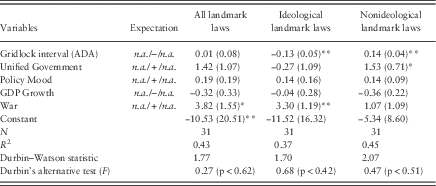
We construct gridlock intervals for the 80th–112th Congresses in largely the same way we did with the Common Space DW-NOMINATE scores.Footnote 32 Table 4 replicates Tables 1 and 2, using these ADA-based gridlock intervals in place of NOMINATE-based measures.Footnote 33 These OLS models analyse the relationship between the gridlock interval and the production of landmark laws (in total and broken down by ideological/nonideological content).
Impact of Americans for Democratic Action (ADA)-based gridlock interval on ideological and nonideological landmark laws, 80th–112th Congresses

Note: Numbers in cells are ordinary least squares regression coefficients with Newey–West standard errors in parentheses. Each model includes a time trend and a one-Congress lagged version of the dependent variable. One-tailed tests are used for all coefficients with a specified directional prediction. Two-tailed tests are used for all other coefficients.
GDP=gross domestic product.
*p<0.05, **p<0.01.
The results in Table 4 mirror the results in Tables 1 and 2.Footnote 34 In model 1, the ADA-based gridlock interval is not associated with the production of all landmark laws. In model 2, it has a negative, significant relationship with the production of ideological landmark laws – as Pivotal Politics predicts. In model 3, the relationship is reversed: a positive, significant relationship between the ADA-based gridlock interval and the production of nonideological landmark laws. Overall, then, models with the more ideologically focussed ADA-based measures produce substantially similar results to models with NOMINATE-based measures.
These findings partially alleviate fears that NOMINATE includes considerably more information than just the ideological preferences that we typically associate with the measure. ADA scores feature considerably fewer nonideological votes and require weaker assumptions about what the scores mean.Footnote 35 That our results hold up with an ADA-based gridlock interval implies both the robustness of our results and the suitability of first-dimension Common Space DW-NOMINATE scores for our purposes.
Comparisons with other models
Finding confirmatory evidence for a theory’s predictions is not the only necessary step in theory testing. A secondary task is to evaluate a theory relative to competing theories that attempt to explain the same process. The objective success of a theory may be undone by the superior performance of alternative theories in comparative analysis. We follow this approach by testing Pivotal Politics in a “horserace” manner against rival theories of lawmaking.
The main theories that we contrast Pivotal Politics with are those focussed on party-driven agenda power. First, we include the Cartel theory, which uses partisan negative agenda control to explain lawmaking in the US. House (Cox and McCubbins Reference Covington and Bargen2005).Footnote 36 The Cartel theory postulates that the House majority party – per the actions of its leaders, working on behalf of the median majority member’s preferences – prevents bills from coming to the floor that would make a majority of its members “worse off” upon passage. As a result, status quos on that portion of the policy space equal to twice the distance between the House majority median and the floor median are blocked from consideration. This “blockout interval” is directly analogous to Pivotal Politics’ “gridlock interval”, with the same implication that a larger blocked-out space corresponds to fewer status quos that can be updated through new legislation. To measure the blockout interval, we take the Common Space DW-NOMINATE first-dimension distance in each Congress between the Congressional median and the majority median’s reflection point.Footnote 37
Second, we include a model of partisan positive agenda control to explain the lawmaking process (Romer and Rosenthal Reference Romer and Rosenthal1978; Smith Reference Smith2007). This pure “Agenda Setter” theory assumes that majority parties completely determine all proposals that come to the floor and use closed rules to preclude the floor median from commandeering the lawmaking process through amendments. This results in an interval of blocked-out space corresponding to status quos for which there is no policy that both the majority party median and floor median prefer to the status quo. Because majorities can propose their own ideal point without concern that it will be amended to the floor median, the size of the blockout interval is smaller than in Cartel theory.Footnote 38
In addition to Cartel and Agenda Setter theories, we also include models that combine each with the veto and filibuster pivots of Pivotal Politics.Footnote 39 This envisions a legislative process in which parties control the agenda either negatively or positively, but proposals must still pass the supermajoritarian hurdles of the congressional policymaking.
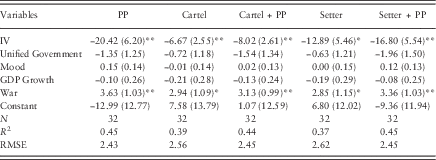
In Table 5, we present five models side by side. Each is identical except for having a different independent variable measure. Model 1 uses the Pivotal Politics Gridlock Interval measure, and is thus identical to model 1 in Table 2. Model 2 uses the Cartel Blockout Interval measure. Model 3 uses Cartel predictions plus pivots. Model 4 uses the Agenda Setter Blockout Interval measure. Model 5 uses Agenda Setter predictions plus pivots. The dependent variable in all five models is the count of ideological landmark laws. In all other respects, each model uses the specifications of model 1 in Table 2.
Comparing Pivotal Politics (PP) to alternative models of lawmaking, 80th–113th Congresses

Note: Numbers in cells are ordinary least squares coefficients with Newey–West standard errors in parentheses. The first variable (labelled IV for Independent Variable) is a stand-in for the specific measure named in the first row of each column. All models include a one-Congress lagged version of the dependent variable and a linear time trend.
GDP=gross domestic product; RMSE=root mean squared error.
*p<0.05; **p<0.01.
The key result from Table 5 is that Pivotal Politics performs best at explaining the data. It achieves the highest R 2 and the lowest root mean squared error, indicating that it explains the largest amount of variance in the data and its resulting estimates have the lowest typical error. The three models that include pivots (models 1, 3 and 5) all perform approximately as well; however, even in this set, a pure Pivotal Politics model still performs marginally better. The pure Cartel and Agenda Setter models, by comparison, perform distinctly worse. Although they achieve significance in the expected direction, they have smaller expected effects and greater uncertainty while explaining less of the data.
In sum, we find that Pivotal Politics not only effectively explains the production of ideological landmark laws, but it does so better than rival (partisan) theories. Moreover, building additional complexity (in the form of parties, either through negative or positive agenda control) on top of Pivotal Politics provides no additional explanatory power.
Conclusion
We began this article with something of a puzzle. We noted first that, since its inception nearly two decades ago, Pivotal Politics has had a profound effect on the development and direction of the study of American political institutions. This is a fairly uncontroversial statement. At the same time, however, the empirical result at the heart of Pivotal Politics – that the size of the gridlock interval is significantly and negatively associated with legislative productivity – has not consistently held up in a range of tests over the years.
Our solution was not to suggest that Pivotal Politics was of limited utility – that is, useful in terms of theoretical intuition or as a starting point in a more complex theory building enterprise, but not as a legitimate “work horse” model in the empirical study of lawmaking. Rather, we argued that a disconnect between theory and testing led to Pivotal Politics’ empirical undoing. Specifically, scholars have tested Pivotal Politics’s predictions based on an ideological preference dimension, using an explicitly ideological independent variable (the left-right gridlock interval), but the dependent variable has not been strictly ideological – it has instead been a basic count of important laws. When we suitably transform the dependent variable into two sets of landmark laws – those with an ideological basis and those without – the key expectation of the Pivotal Politics model is validated: there is a significant, negative relationship between the size of the ideological gridlock interval and the production of ideological landmark laws. Moreover, Pivotal Politics explains variation in ideological landmark law production better than rival-party-driven theories.
We also found a significant, positive relationship between the size of the gridlock zone and the production of nonideological landmark laws. This helps explain why the core pivotal politics prediction was not borne out in a model of all landmark laws. We also believe that it suggests a substitution effect in congressional lawmaking: legislators seek to produce landmark laws, and draw from different “bins” of potential legislation depending on changing contexts. That is, they pursue ideological laws when gridlock is lower, and nonideological laws when it is a higher. The negative association between the size of the gridlock interval and the proportion of landmark laws that are ideological provides additional support. Further, concentrated work is needed, however, to confirm these results and determine whether a true substitution effect exists.
From a normative perspective, this ideological/nonideological tradeoff is consequential and shows that the polarisation of pivotal actors does in fact limit the effectiveness of Congress. Such polarisation makes passing policies that address macroeconomic conditions more difficult. It increases the intractability of problems such as economic inequality (see McCarty et al. 2006), civil rights for minorities and disadvantaged groups, and many social welfare and redistributive policies. Consider the Patient Protection and Affordable Care Act (ACA). The law was initially passed during a brief and sudden reduction in the gridlock interval owing to the unusually large Democratic Senate majority in the 111th Congress. However, the gridlock interval quickly expanded after the death of Sen. Ted Kennedy (D-MA) and replacement election of Sen. Scott Brown (R-MA),Footnote 40 and then further after the next general election. Since then, Congress has been largely unable to alter health-care policy because the issue is gridlocked between ideologically opposed views – and each holds enough institutional power to prevent change. Indeed, in the seven years since the ACA’s passage, the Judicial and Executive Branches have played the most significant roles in health-care policy in the US, as the meaning and implementation of the ACA has been decided by a variety of federal agencies and courts. This is merely one example out of a wide variety of areas in which ideological gridlock prevents Congress from setting policy on issues that are important to many Americans, which thereby increasingly threatens Congress’s place in the Constitutional Order.
Finally, apart from empirically validating the Pivotal Politics model, we underscore the larger point regarding care in the transition from theory to testing. Multiple points of disconnect can occur as one moves from theorising (and hypothesis generation) to testing; that is, in constructing an empirical research design, a number of important decisions have to be made about data, the construction of measures and model specification.Footnote 41 To focus only on one of these decisions here, as Howell et al. (Reference Howell, Adler, Cameron and Riemann2000), Madonna (Reference Madonna2011), Jenkins and Monroe (Reference Jenkins and Monroe2016) and others have shown, how variables are constructed – whether it be the dependent variable or the key independent variable(s) – can have a significant impact on the results recovered, and whether expectations are met. The empirical literature on Pivotal Politics, we believe, should also serve as a cautionary tale in this regard.
Acknowledgements
The authors thank Scott Adler, Sarah Anderson, Joshua Clinton, Alexander Coppock, Robert Erikson, Laurel Harbridge, Keith Krehbiel, David Mayhew, Nathan Monroe, Sharyn O’Halloran, John Patty, Maggie Penn, Rachel Potter, Jesse Richman, Jason Roberts, Craig Volden, Jonathan Woon and various conference and workshop participants for many helpful comments. T. G. acknowledges and appreciates financial support from the Bankard Fund for Political Economy at the University of Virginia.
Supplementary materials
To view supplementary material for this article, please visit https://doi.org/10.1017/S0143814X1700023X