Introduction
Parasitic wasps, also known as parasitoids, are fascinating organisms that rely on a wide range of communication channels to locate their hosts, including visual (Segura et al., Reference Segura, Viscarret, Carabajal Paladino, Ovruski and Cladera2007; Benelli & Canale, Reference Benelli and Canale2012), vibrational (Meyhöfer & Casas, Reference Meyhöfer and Casas1999) and olfactory ones. Parasitoids forage in a complex environment and exploit a broad range of olfactory cues, known as foraging kairomones, to locate their victims. These include chemicals directly produced by the attacked organism, such as pheromones, cuticular hydrocarbons, faeces and other metabolic by-products (Ruther et al., Reference Ruther, Meiners and Steidle2002) as well as stimuli indirectly arising from the victim's microhabitat (Kaplan, Reference Kaplan2012). Concerning the latter, an example of pivotal importance is the systemic emission of host-induced plant volatiles host-induced plant volatiles (HIPVs), mediating a great number of parasitoid–host interactions (Wajnberg & Colazza, Reference Wajnberg and Colazza2013).
Across all the Animal Kingdom, learning allows species to better exploit environmental features peculiar to certain ecological contexts, enhancing their fitness (Dukas, Reference Dukas2008, Reference Dukas2013). The role of learning in the host-seeking behaviour of parasitic wasps is widely studied not only because of their great importance in biological control programmes against arthropod pests, but also because they are model systems helpful to address theoretical questions in behavioural ecology (Lewis & Takasu, Reference Lewis and Takasu1990; Tamò et al., Reference Tamò, Ricard, Held, Davison and Turlings2006; Smid et al., Reference Smid, Wang, Bukovinszky, Steidle, Bleeker, van Loon and Vet2007; Hoedjes et al., Reference Hoedjes, Marjolein Kruidhof, Huigens, Dicke, Vet and Smid2011; Froissart et al., Reference Froissart, Bernstein, Humblot, Amat and Desouhant2012; Ngumbi et al., Reference Ngumbi, Jordan and Fadamiro2012). Associative learning (i.e. the establishment through experience of an association between two stimuli or between a stimulus and a response) for olfactory cues has been demonstrated for various parasitoid species (Lewis & Tumlinson, Reference Lewis and Tumlinson1988; Vet et al., Reference Vet, Lewis, Cardè, Cardè and Bell1995; Takasu & Lewis, Reference Takasu and Lewis1996; Geervliet et al., Reference Geervliet, Vreugdenhil, Dicke and Vet1998; Fukushima et al., Reference Fukushima, Kainoh, Honda and Takabayashi2002; Meiners et al., Reference Meiners, Wackers and Lewis2003; Olson et al., Reference Olson, Rains, Meiners, Takasu, Tertuliano, Tumlinson, Wackers and Lewis2003; Müller et al., Reference Müller, Collatz, Wieland and Steidle2006; Tomberlin et al., Reference Tomberlin, Tertuliano, Rains and Lewis2005; Ngumbi et al., Reference Ngumbi, Jordan and Fadamiro2012), while it appears to be absent in others (Potting et al., Reference Potting, Otten and Vet1997). Moreover, the adaptive role of learning skills across parasitoids have been widely investigated using comparative approaches (Bleeker et al., Reference Bleeker, Smid, Steidle, Kruidhof, van Loon and Vet2006; Gols et al., Reference Gols, Veenemans, Potting, Smid, Dicke, Harvey and Bukovinszky2012; Ngumbi et al., Reference Ngumbi, Jordan and Fadamiro2012). However, to the best of our knowledge, little is known about associative learning of olfactory cues in parasitoids of tephritid flies (Dukas & Duan, Reference Dukas and Duan2000).
Psyttalia concolor (Szépligeti) (Hymenoptera: Braconidae) is a synovigenic koinobiont larval-pupal endoparasitoid able to attack at least 14 Tephritidae species developing on wild and/or cultivated plants, including pests of great economic importance, such as the Mediterranean fruit fly, Ceratitis capitata (Wiedemann) and the olive fruit fly, Bactrocera oleae (Rossi) (Benelli et al., Reference Benelli, Daane, Canale, Niu, Messing and Vargas2014a ). Shortly after emergence, P. concolor males approach females performing a courtship song (Canale et al., Reference Canale, Benelli and Lucchi2013a , Reference Canale, Benelli, Lanzo, Giannotti, Mazzoni and Lucchi b ) then attempt copulation (Benelli et al., Reference Benelli, Bonsignori, Stefanini and Canale2012). After mating, the P. concolor females start searching for tephritid larvae (Canale & Benelli, Reference Canale and Benelli2012; Benelli et al., Reference Benelli, Gennari and Canale2013a ). Olfactory signals mediate the host-seeking behaviour; synthetic blends that mimic the odours emitted by infested fruits (e.g. peaches) are attractive to P. concolor females (Benelli et al., Reference Benelli, Revadi, Carpita, Giunti, Raspi, Anfora and Canale2013b ). It has been recently shown that the attractiveness of the blend is due to specific HIPVs (e.g. ethyl octanoate, decanal and 4-decanolide) (Benelli et al., Reference Benelli, Revadi, Carpita, Giunti, Raspi, Anfora and Canale2013b ), whereas other HIPVs typical of C. capitata-infested peach fruits (e.g. nonanoic acid; decanoic acid and geranyl acetone) evoked no innate attraction for female parasitoids, even though electroantennographic assays showed that the chemicals are perceived by females (Benelli et al., Reference Benelli, Revadi, Carpita, Giunti, Raspi, Anfora and Canale2013b ).
However, if P. concolor females can detect these HIPVs in association with key resources such as food (i.e. sweet exudates from tephritid-infested decaying fruits) and hosts, then we hypothesize they can learn to respond favourably to these cues in subsequent experiences. On this basis, here we evaluate associative learning skills of P. concolor females for these host-induced olfactory cues. We tested if P. concolor females are able to associate a food reward (unconditioned stimulus) with the presence of different dosages of three HIPVs from C. capitata-infested peaches (conditioned stimulus), thus developing a preference for an odour innately unattractive odour.
Materials and methods
Parasitoid and host rearing
Females of the original P. concolor colony were collected in 1990 from infested olive fruits harvested in Palermo (Sicily, Italy). During the following 23 years of mass-rearing this strain was refreshed three times (1995, 1998 and 2004) through the introduction of wild P. concolor specimens collected from infested olives in Tuscany (1995, 1998) and Calabria (Southern Italy, 2004). The parasitoid P. concolor and the host C. capitata were reared as described by Canale & Benelli (Reference Canale and Benelli2012). The C. capitata production unit consisted of cylindrical PVC cages, each containing about 2000 adults (sex-ratio 1:1), fed on a dry diet of sugar and yeast extract (10:1 w:w). Eggs were collected every 2 days and distributed into plastic bowls (50×15×2 cm), each containing 0.5 kg of artificial culture medium. The cages for P. concolor breeding were made of transparent Plexiglas tubes (40 cm diameter, 50 cm length) into which 1500 adults were introduced (male:female ratio 0.3:0.5). Nylon mesh bags, each containing up to 600–800 third instar C. capitata larvae, were placed in the cage for parasitization (15 min). Immediately after emergence from the host, parasitoids were sexed and individually stored in clean glass vials [21±1 °C, 50±5% relative humidity and 16:8 (L:D) photoperiod]. A 20% (w:w) sugar solution was offered to the wasps (Benelli et al., Reference Benelli, Revadi, Carpita, Giunti, Raspi, Anfora and Canale2013b ).
General observations
All experiments were conducted in a room illuminated with daylight fluorescent tubes. Neon tubes (Philips 30W/33) were used, and the light intensity in close proximity of the Plexiglas® arena was approximately 1000 lux, estimated over the 300–1100 nm waveband using a LI-1800 spectroradiometer (LI-COR Inc., Lincoln, NE, USA), equipped with a remote cosine receptor. Diffused laboratory lighting was used to reduce possible reflection and phototaxis. The temperature was 21±1 °C and the relative humidity 50±5%. Bioassays were all performed between 10.00 and 15.30 h. All wasps were 6–12 days old. For each replicate, the wasp was replaced by a new one of the same age. The bioassays were carried out over several days to account for any daily variability.
Chemicals
Parasitic wasps were trained and tested in two-choice bioassays using three C. capitata-induced HIPVs, innately unattractive to the parasitoid (Benelli et al., Reference Benelli, Revadi, Carpita, Giunti, Raspi, Anfora and Canale2013b ), as conditioned stimuli: (1) nonanoic acid; (2) decanoic acid; (3) geranyl acetone. All chemicals were purchased from Sigma Aldrich (Munich, Germany).
Odour training procedure
We evaluated if P. concolor mated females are able to associate a food reward (unconditioned stimulus) with the presence of different dosages of the three selected HIPVs (conditioned stimulus), developing a preference for an odour innately unattractive. In all tested parasitoids, mating occurred when wasps were 1–3 days old, a male and a female were introduced in a glass vial (diameter 10 mm; length 50 mm) and copula was directly tracked by an observer (Benelli et al., Reference Benelli, Bonsignori, Stefanini and Canale2012). Females were starved for 48 h before the training phase. Training was carried out in a Petri dish arena (diameter 5 mm; height 30 mm).
Trained wasps: the still-air arena contained a small filter paper disc (diameter 10 mm) treated with 2 μl of a hexane solution containing a given HIPV (conditioned stimulus) (dose for each HIPV: 1 μg μl−1 or 10 μg μl−1) and, in its close proximity, a small plastic dispenser (diameter 10 mm, height 0.5 mm) containing a cotton wick treated with 0.4 ml of a 20% (w:w) sucrose solution (unconditioned stimulus). For training, a P. concolor female was gently transferred into the arena using a glass vial and observed feeding on the sugar solution for 20 s. Both training arena and chemicals were renewed for each new wasp tested. The interval between the training and the testing phase for each wasp was 2 min.
Naïve wasps: as a control, P. concolor mated females were exposed to similar procedures but only trained to clean air (i.e. clean untreated filter paper) while feeding (20 s). Clean air (and not the solvent) was used as control odour during training (Ngumbi et al., Reference Ngumbi, Jordan and Fadamiro2012). Associative learning for hexane from HIPV solutions can be ruled out, since is it known that hexane is not electrophysiologically perceived by P. concolor (Benelli et al., Reference Benelli, Revadi, Carpita, Giunti, Raspi, Anfora and Canale2013b ).
Associative learning assays
In the testing phase, two choice bioassays were conducted using a still-air arena comprised of Plexiglas unit (150×150×30 mm) described in Carpita et al. (Reference Carpita, Canale, Raffaelli, Saba, Benelli and Raspi2012). In the centre of this unit there was a circular chamber (i.e. the specimen release chamber, diameter: 40 mm), connected to two other identical chambers by means of two linear paths (length: 20 mm, width: 10 mm), forming a 90° angle. The top of the arena was covered with a removable glass panel.
During the testing phase of trained and naïve wasps, one of the two chambers contained a clean piece of filter paper (diameter 10 mm). The other chamber contained an identical filter paper wetted with 2 μl of a given HIPV dissolved in hexane (dose: 1 μg μl−1 or 10 μg μl−1 for all tested chemicals). In each replicate, at the beginning of the test a wasp was gently transferred to the release chamber using a glass vial and carefully released on the floor of the chamber. Each wasp was observed for 8 min. A wasp was considered to have made a choice when it visited a treated filter paper on which it remained for at least 20 s performing walking, antennal drumming and arrestment plus antennal waving (Canale & Benelli, Reference Benelli and Canale2012). Parasitoids that did not make a choice within 7 min after being released (about 35% of the tested wasps, see also Benelli et al., Reference Benelli, Carpita, Simoncini, Raspi and Canale2014b ) were disregarded.
Both for trained and naïve wasps, for each replicate we recorded, (a) the latency time (s) (i.e. the time between the wasp release and initiating search behaviour), (b) the female choice and (c) the time spent on the chosen cue (s) (Benelli & Canale, Reference Benelli and Canale2013; Benelli et al., Reference Benelli, Pacini, Conti and Canale2013c ). The cue sources were renewed at each replicate. For each bioassay, 30 replicates were performed. With each new wasp, the arena was rotated clockwise 90° to avoid positional effects. The relative position of the cues was also randomized for each replicate. After each bioassay, the Plexiglas arena and the glass lid were first washed for about 30 s with hexane, then with warm water at 35–40 °C. After, it was cleaned in a water bath with mild soap for about 5 min, rinsed with hot water for about 30 s and finally rinsed with distilled water at room temperature (Benelli & Canale, Reference Benelli and Canale2013).
Data analysis
For each choice-test, a likelihood χ2 test with Yates correction (with α=0.05) was used to compare the proportion of wasps choosing a given cue. Latency and the time spent on each chosen cue were analysed in JMP 7 (SAS, 1999), using a weighted generalized linear model with one fixed factor: y=Xβ+ε where y is the vector of the observations (e.g. latency, time spent on the cue), X is the incidence matrix, β is the vector of fixed effects (i.e. the treatment, trained or naïve wasps) and ε is the vector of the random residual effects. A probability level of P<0.05 was used for determining significance of differences between means.
Results
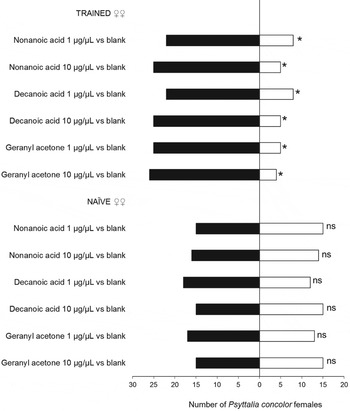
Trained female P. concolor showed positive chemotaxis to the learned cues in all tested odour combinations. For both tested dosages, HIPV-trained females preferred the reward-associated odour more than blank filter papers in experiments with nonanoic acid (1 μg μl−1: χ2=5.63, df=1, P<0.05; 10 μg μl−1: χ2=12.03, df=1, P<0.05); decanoic acid (1 μg μl−1: χ2=5.63, df=1, P<0.05; 10 μg μl−1: χ2=12.03, df=1, P<0.05) and geranyl acetone (1 μg μl−1: χ2=12.03, df=1, P<0.05; 10 μg μl−1: χ2=14.70, df=1, P<0.05) (fig. 1). In contrast, naïve females did not show significant preferences for any tested HIPVs, regardless of the dose (fig. 1).
Effect of associative learning on the attraction of P. concolor females to HIPVs. HIPVs were tested vs. clean filter paper in two-choice bioassays conducted in a still-air arena. Trained females experienced previous exposure to HIPVs plus a food reward, whereas naïve ones did not. Thirty wasps were tested in each experiment. For each experiment, asterisks indicate significant differences in the number of wasps landing on the two given cues (χ2 test with Yates correction, P<0.05).

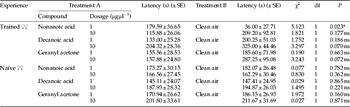
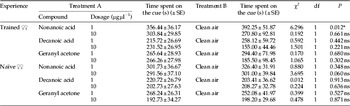
HIPV-trained females did not show differences in latencies when choosing reward-associated cues over blanks (table 1), with a single exception: the longer latency on nonanoic acid at 1 μg μl−1 than the corresponding blank (χ2=5.123, df=1, P=0.023). No differences in latencies were found in choice tests with naïve females (table 1). Neither HIPV-trained nor naïve wasps spent more time on HIPV treated than blank paper discs (table 2), with the exception of shorter time spent by trained wasps on nonanoic acid at 1 μg μl−1 over the corresponding blank (χ2=6.296, df=1, P=0.012).
Mean latency time (seconds) (±standard error) spent by P. concolor females that previously experienced exposure to HIPVs plus a food reward (trained), or not (naïve). HIPVs were tested vs. clean filter paper in two-choice bioassays conducted in a still-air arena. Thirty wasps were tested in each experiment. For each row, an asterisk indicates significant differences; ns=not significant; df=degrees of freedom (Generalized Linear Model, P<0.05).

Mean time spent on each given odour source (i.e. treatments A and B) by P. concolor females that previously experienced exposure to HIPVs plus a food reward (trained), or not (naïve). HIPVs were tested vs. clean filter paper in two-choice bioassays conducted in a still-air arena. Thirty wasps were tested in each experiment. For each row, an asterisk indicates significant differences; ns=not significant; df=degrees of freedom (Generalized Linear Model, P<0.05).

Discussion
Psyttalia concolor showed positive chemotaxis to a learned cue in subsequent experiences; for all tested chemicals, regardless of dosage, HIPV-trained females preferred the reward-associated odour. Among braconid parasitoids, learning for host-related olfactory cues has been demonstrated for several species (Vet et al., Reference Vet, Lewis, Cardè, Cardè and Bell1995). Good examples are Aphidius ervi (Takemoto et al., Reference Takemoto, Powell, Pickett, Kainoh and Takabayashi2012) Cotesia glomerata (L.), Cotesia rubecula Marshall (Geervliet et al., Reference Geervliet, Vreugdenhil, Dicke and Vet1998; Bleeker et al., Reference Bleeker, Smid, Steidle, Kruidhof, van Loon and Vet2006; Smid et al., Reference Smid, Wang, Bukovinszky, Steidle, Bleeker, van Loon and Vet2007; van den Berg et al., Reference van den Berg, Duivenvoorde, Wang, Tribuhl, Bukovinszky, Vet, Dicke and Smid2011), Cotesia kariyai (Watanabe) (Fukushima et al., Reference Fukushima, Kainoh, Honda and Takabayashi2002), Cotesia marginiventris (Cresson) (Costa et al., Reference Costa, Ricard, Davison and Turlings2010; Ngumbi et al., Reference Ngumbi, Jordan and Fadamiro2012) and Microplitis croceipes (Cresson) (Takasu & Lewis, Reference Takasu and Lewis1996, Reference Takasu and Lewis2003; Lewis & Tumlinson, Reference Lewis and Tumlinson1988; Meiners et al., Reference Meiners, Wackers and Lewis2003; Olson et al., Reference Olson, Rains, Meiners, Takasu, Tertuliano, Tumlinson, Wackers and Lewis2003; Tomberlin et al., Reference Tomberlin, Tertuliano, Rains and Lewis2005). On the other hand, no learning skills were detected in several braconids, such as Cotesia flavipes Cameron (Potting et al., Reference Potting, Otten and Vet1997). To the best of our knowledge, the only evidences available about associative learning in parasitic wasps attacking tephritid fruit flies concerns learning of fruit-borne olfactory cues in Fopius arisanus (Sonan) (Dukas & Duan, Reference Dukas and Duan2000), and visual cues in P. concolor (Benelli & Canale, Reference Benelli and Canale2012) and Diachasmimorpha longicaudata (Ashmead) (Segura et al., Reference Segura, Viscarret, Carabajal Paladino, Ovruski and Cladera2007). The two latter species are generalists that search for hosts concealed in fruits, and both showed good associative learning abilities only for colours while unable to learn to distinguish among shapes. In contrast, a high rate of shape learning has been found in other braconid parasitoids, such as M. croceipes, and it has been suggested that this may be adaptive in dealing with the homochromatic but multi-shaped environment in which this species searches for herbivorous hosts (Wäckers & Lewis, Reference Wäckers and Lewis1999; Segura et al., Reference Segura, Viscarret, Carabajal Paladino, Ovruski and Cladera2007).
Two of the C. capitata-induced HIPVs tested here, nonanoic and decanoid acid, have been recently shown to be innately attractive to P. concolor virgin males (at 1 μg μl−1 and at 10 μg μl−1), allowing us to hypothesize that perception of these may be important to guide the males, towards infested fruits on which they can find newly emerged conspecific females. This may raise males’ chances to locate receptive females during their lifespan (Benelli & Canale, Reference Benelli and Canale2013). On this basis, both HIPVs are considered possible sexual kairomones (sensu Ruther et al., Reference Ruther, Meiners and Steidle2002). The strong response of P. concolor for the tested C. capitata-induced HIPVs after associative learning training supports our hypothesis that odour learning is of key importance for a relative generalist parasitic wasp such as P. concolor. As observed in other braconid wasps (Wäckers & Lewis, Reference Wäckers and Lewis1999; Segura et al., Reference Segura, Viscarret, Carabajal Paladino, Ovruski and Cladera2007), the P. concolor's potential habitats are variable from generation to generation but quite constant within a generation. On this basis, P. concolor females can find hosts and/or food associated with one or more olfactory cue(s) characterizing a given microhabitat in subsequent searching events (see also Benelli & Canale, Reference Benelli and Canale2012). Through odour learning, a more efficient localization of resources may occur in subsequent experiences. According to the Optimal Foraging Theory (Stephens, Reference Stephens, Papaj and Lewis1993), associative learning would provide an adaptive advantage by reducing the time wasted on the decision of where to search for hosts and/or food, enhancing reproductive rates of parasitoids, thus fitness (see also Dukas, Reference Dukas2008). From an applied perspective, this research on how P. concolor learns to pick up olfactory cues highlights that HIPVs may be used to provide experience to mass-reared P. concolor females via associative learning practices. This can help to advance critical steps in mass-rearing of this biocontrol species, and potentially improve its efficacy in the field.
Acknowledgements
We would like to thank two anonymous reviewers for their comments on an earlier version of the manuscript, Nicolas Desneux for constructive discussions about associative learning in parasitic Hymenoptera, Augusto Loni for help in parasitoid mass-rearing, Adriano Carpita and Graziano Fusini for providing some chemicals, Giulia Giunti and Donato Romano for assistance during experiments. Giovanni Benelli is supported by a MIS. 124 MODOLIVI Grant. Funds were also provided by the Italian Ministry of Education, University and Research (MIUR). Funders had no role in study design, data collection and analysis, decision to publish, or preparation of the manuscript.