1. Introduction
Like several other Germanic languages, Danish has three partitive constructions:Footnote 2
(i) Regular Partitive Construction
- (1)
(a) en af turisterne one of tourists-def‘one of the tourists’
(b) en gruppe af turisterne one group of tourists-def‘one group of the tourists’
- (1)
(ii) Direct Partitive Construction (DPC) [ D N1 N2]
(2) en gruppe turistera group tourists‘a group of tourists’
(iii) Indirect Partitive Construction (IPC) [ D N1 P N2]
(3) en gruppe af turistera group of tourists‘a group of tourists’
The DPC and the IPC (=pseudopartitives) exhibit a strong surface similarity: both involve a determiner (D), an N1 that is a kind of measure noun, and an indefinite mass or plural N2. The only immediately obvious difference is the presence of a preposition (either af ‘of’ or med ‘with’) in the IPC. There are, however, a number of less obvious differences between the two, which we shall examine in section 4.Footnote 3, Footnote 4
The Danish pseudopartitive constructions exhibit an interesting interaction with definiteness marking: IPCs, but not DPCs, allow suffixal definiteness marking on N1 (Heltoft Reference Heltoft1996: 23, Kinn 2001: 147).
(4) gruppen af turister [IPC]group-def of tourists‘the group of tourists’
(5) *gruppen turister [DPC] group-def tourists
We explore this interaction with three goals in mind: first, to provide a solution to the puzzle provided by the definiteness marking facts; second, to fill a descriptive gap in the literature on Germanic pseudopartitive constructions, which have been thoroughly studied in Swedish (Delsing Reference Delsing1993: 185–224), Norwegian (Kinn 2001), English (Akmajian & Lehrer Reference Akmajian and Lehrer1976, Jackendoff Reference Jackendoff1977: 119–126, Selkirk Reference Selkirk, Peter, Thomas and Adrian1977, Guéron Reference Guéron1979, Abney Reference Abney1987: 187–188, Corver Reference Corver, Alexiadou and Wilder1998, Schwarzschild Reference Schwarzschild2006, Grimshaw to appear), Dutch (Corver Reference Corver, Alexiadou and Wilder1998, van Riemsdijk Reference van Riemsdijk1998, Vos Reference Vos1999) and German (Löbel Reference Löbel, Christa, Elisabeth and Claudia Maria1989, van Riemsdijk Reference van Riemsdijk1998, Vos Reference Vos1999), but relatively little studied in Danish (though Daugaard Reference Daugaard1994 provides a detailed corpus study); and third, to explore how the definiteness marking phenomena shed light on the structure of these partitive constructions, and also on larger theoretical issues such as the nature of extended projections.
There are several reasons why Danish is well placed to shed light on the structure of partitive constructions: English has only one pseudopartitive construction (the IPC) and only one way to mark definiteness; Dutch and German have both the DPC and the IPC, but only one way to mark definiteness; Danish, however, has both kinds of pseudopartitive construction and two ways of marking definiteness (prenominal article and post-nominal suffix), and definiteness marking behaves differently in the two pseudopartitive constructions. Earlier work (including Delsing Reference Delsing1993; Embick & Noyer Reference Embick and Noyer2001; Hankamer & Mikkelsen Reference Hankamer and Mikkelsen2002, Reference Hankamer and Mikkelsen2005; and Julien Reference Julien2005) has established that definiteness marking is sensitive to structural relations between the definite D head and the N in its complement NP, so that definiteness marking provides a probe into the structure of the nominal projection. We exploit this below.
2. The puzzle
The puzzle hinted at in section 1 consists of three interrelated sets of facts. First is that the N1 of the IPC can bear the definite suffix (6), while the N1 of the DPC cannot (7):
(6) gruppen af turister [=(4)] [IPC]group-def of tourists‘the group of tourists’
(7) *gruppen turister [=(5)] [DPC] group-def tourists
If there is a prenominal adjective present, both the IPC and the DPC may have the prenominal definite article:
(8) den store gruppe af turister [IPC]def large group of tourists‘the large group of tourists’
(9) den store gruppe turister [DPC]def large group tourists‘the large group of tourists’
This is as expected, since a prenominal adjective always blocks the suffixed form, cf. Delsing (Reference Delsing1993: 75), Embick & Noyer (Reference Embick and Noyer2001: 580f.), Hankamer & Mikkelsen (Reference Hankamer and Mikkelsen2002: 139, 2005: 87f.).
The second puzzling fact is that in the absence of modifiers neither the IPC nor the DPC can have the prenominal definite article:Footnote 5
(10) *den gruppe af turister [IPC] def group of tourists
(11) *den gruppe turister [DPC] def group tourists
This is puzzling because all previous analyses (including Delsing Reference Delsing1993; Embick & Noyer Reference Embick and Noyer2001; Hankamer & Mikkelsen Reference Hankamer and Mikkelsen2002, Reference Hankamer and Mikkelsen2005) have in one way or another analyzed the distribution of the definiteness markers so that the prenominal article is an elsewhere case, arising whenever the definite suffix cannot be realized. Thus the ungrammaticality of (10) is expected given (6), but the ungrammaticality of (11) is a mystery given (7).
The third part of the puzzle is that prenominal definiteness marking is allowed in both IPCs and DPCs in the presence of a restrictive relative clause:
(12) den gruppe af turister som netop ankom [IPC]def group of tourists that just arrived‘the group of tourists that just arrived’
(13) den gruppe turister som netop ankom [DPC]def group tourists that just arrived‘the group of tourists that just arrived’
The first part of the puzzle ((6) vs. (7)) is the main puzzle and we propose a solution to it in section 5, after reviewing a range of relevant properties of the two pseudopartitive constructions in section 4. The solution to the third part of the puzzle (why both constructions can occur with a prenominal definiteness marker in the context of a restrictive relative clause) turns out to follow directly from our earlier proposals about the structure of restrictive relative clauses in Danish (Hankamer & Mikkelsen Reference Hankamer and Mikkelsen2005). We present that solution, together with other consequences of our analysis, in section 6. There we also examine the one remaining part of the puzzle, namely the ungrammaticality of (11), and suggest that it requires a semantic solution. In section 7, we conclude with a brief summary of our analysis, and some pointers toward future research.
3. Background
3.1. Definiteness marking in Danish
We adopt the analysis of definiteness marking developed in Hankamer & Mikkelsen (Reference Hankamer and Mikkelsen2002, Reference Hankamer and Mikkelsen2005), according to which the definite suffix is found when the definite D is in direct construction with (i.e. sister to) N; the prenominal article is found elsewhere:
- (14)
(a) gruppengroup-def‘the group’
(b) *den gruppe def group
(c)

- (15)
(a) *store gruppen big group-def
(b) den store gruppedef large group‘the large group’
(c)
- (16)
(a) forfatteren [til bogen]author-def to book-def‘the author of the book’
(b) grisen [med blå pletter]pig-def with blue spots‘the pig with blue spots’
(17) den forfatter [som vandt prisen i fjor]def author who won prize-def in last-year‘the author who won the prize last year’

When there are no modifiers, the definite D is in direct construction with N, as in (14).Footnote 6 The definite suffix is licensed, and the prenominal definite article is prohibited. When there is a prenominal adjective, as in (15), the definite D is not in direct construction with N (the NP sister of D is not minimal), and the definite suffix is not licensed; only the prenominal article is possible. In the case of postnominal PP complements and modifiers, as in (16), we assume, following Hankamer & Mikkelsen (Reference Hankamer and Mikkelsen2005: 111–113, 118), that such postnominal PPs are always adjoined at some level higher than NP, and consequently the D and N are in direct construction, licensing the postnominal definite suffix. As for restrictive relative clauses, as in (17), we assume that they are derived by a DP raising analysis which insures that the D and N are not in direct construction, thus permitting the prenominal article (Hankamer & Mikkelsen Reference Hankamer and Mikkelsen2005: 113–116). We return to the analysis of relative clauses in section 6.2.
3.2. The semantic range of pseudopartitives
As noted in the introduction, pseudopartitives are not unique in involving two nominals. Regular partitives may do so as well, as shown in (18).
(18) et antal af boligerne [Regular Partitive Construction]a number of homes-def‘a number of the homes’
- (19)
(a) et antal boliger [DPC]a number homes‘a number of homes’
(b) et antal af boliger [IPC]a number of homes‘a number of homes’
However, there is an intuitive meaning difference between regular partitives and pseudopartitives: whereas regular partitives refer to a subpart of a whole or a subset of a previously established set (some specific set of homes in (18)), IPCs and DPCs refer to a portion of some substance, collection, or kind (homes in (19)). In a pseudopartitive, N1 establishes the unit of measurement and N2 signifies the type of substance or entity that is being measured (Löbel Reference Löbel, Christa, Elisabeth and Claudia Maria1989: 155, Koptjevskaja-Tamm Reference Koptjevskaja-Tamm, Östen and Maria2001: 526f., Schwarzschild Reference Schwarzschild2006: 81). This characterization provides a natural understanding of why the substance noun is definite in regular partitives (boligerne), but indefinite in pseudopartitives (boliger).
Most studies of pseudopartitives further subcategorize these according to the kind of N1 involved. Koptjevskaja-Tamm (Reference Koptjevskaja-Tamm, Östen and Maria2001: 530), for instance, distinguishes seven kinds of pseudopartitives based on semantic properties of N1 (see also the classifications in Delsing Reference Delsing1993: 203–211, Daugaard Reference Daugaard1994: 54, van Riemsdijk 1998: 13, and Kinn 2001: 86–101).Footnote 7 This subcategorization is relevant for capturing two facts about Danish pseudopartitives: first, whereas the DPC is possible with N1s from all seven semantic categories, the IPC is possible only with a subset of N1 categories; second, which preposition is used in the IPC (af ‘of’ or med ‘with’) correlates with N1 categories (see Daugaard Reference Daugaard1994: 49f., Koptjevskaja-Tamm Reference Koptjevskaja-Tamm, Östen and Maria2001: 550, and especially Kinn 2001: 151–179 for relevant discussion). Despite this variation across the seven categories as to whether the N1 also occurs in IPCs, and if so which preposition is used, all seven categories exhibit a systematic behavior with respect to definiteness marking. No DCPs allow a definite suffix on N1, and all IPCs do:
- (20)
(a) * D N1-def N2 (for all N1s)
(b) D N1-def af/med N2 (for all N1s allowed in the IPC)
Thus the semantic subcategorization of pseudopartitives is irrelevant for our purposes: suffixal definiteness marking on N1 is impossible in DPCs and possible in IPCs, regardless of semantic category. In what follows we will therefore not distinguish these subcategories, except when properties of just one of them are at issue (as in the discussion of inflectional deficiency in section 4.3). As far as we can tell, the remaining parts of the definiteness puzzle (see (8)–(13)) are also observed consistently across all the semantic categories.
4. Properties of Danish pseudopartitives
In this section we lay out the characteristic properties of Danish IPCs and DPCs. The generalization that emerges from these is that N1 of an IPC behaves like a regular noun, whereas N1 of a DPC does not. This is the starting point for the syntactic analysis we propose in section 5.
4.1. Prosody
As observed by Grønnum (Reference Grønnum1998: 206), Kinn (2001: 126), and Koptjevskaja-Tamm (Reference Koptjevskaja-Tamm, Östen and Maria2001: 553), N1 has regular word stress in the IPC, but is destressed in the DPC:
(21) en ‘gruppe af ‘turister [IPC]a group of tourists
(22) en 0gruppe ‘turister [DPC]a group tourists
In contrast, N2 carries regular word stress in both the IPC and the DPC.
4.2. Restrictions on N1
As noted in section 3.2, some items can occur as N1 in the DPC, but not as N1 in the IPC. Representative examples are given below:
(23) en liter (*af) vanda liter of water
(24) et kilo (*af) smøra kilo of butter
(25) et par (*af) turistera pair of tourists
Daugaard (Reference Daugaard1994: 49f.) reports that of the 260 items that can occur as N1 in a Danish DPC, only 95 were also attested as N1 of an IPC in the DK87-90 corpus of 4 million words that he examined. This clearly indicates that we need to distinguish the N1 of a DPC from the N1 of an IPC, even though many items can take on both roles.
4.3. Inflectional deficiency
In his study of Swedish pseudopartitives, Delsing (Reference Delsing1993: 204) makes the interesting observation that some of the items that can only occur in the DPC are inflectionally deficient in the sense that they do not have a plural form distinct from the singular. The same is true for Norwegian (Kinn 2001) and for Danish, as the following examples show (we know from (23) above that liter occurs only in the DPC):
- (26)
(a) en liter vandone liter water
(b) tre liter vandthree liter water
(c) *tre liter-e vand three liter-pl water
This behavior is strongly reminiscent of classifiers, which characteristically occur in plural noun phrases without showing plural agreement. We are not claiming that liter is a classifier, but we do take the lack of plural marking to indicate that liter is not a regular lexical noun, but rather belongs to some functional nominal category.
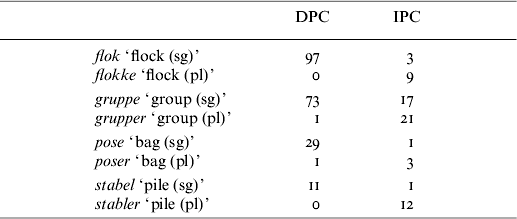
Danish exhibits another interaction between plurality and pseudopartitives which to our knowledge has not been observed before. Many items that occur freely as N1 in DPCs when singular do not occur, or occur much less frequently, when plural. In IPCs, this preference for singular over plural is not observed, as shown in table 1.Footnote 8
Corpus frequencies of singular and plural N1 in DPC and IPC
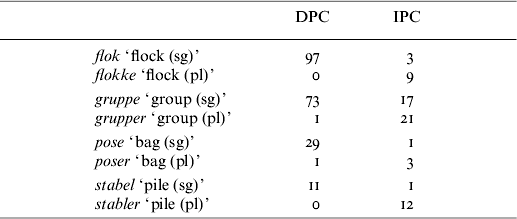
Unlike N1s like liter, which cannot be morphologically plural at all (see (26c)), N1s like pose can be morphologically plural, but rarely occur in DPCs when plural. The one plural example found with pose in the corpus is given in (27):
(27) Der er faktisk næsten dobbelt så mange poser kartofler,there be-pres actually almost double as many bags potatoesder ikke overholder kravene, som i fjor.that not obey requirements.def as in last.year‘There are actually almost twice as many bags of potatoes that do not meet the requirements as last year.’
This example is typical in that plural marking on N1 is accompanied by some kind of a plural determiner or quantifier (here dobbelt så mange ‘twice as many’). Of the 58 examples of DPCs with a plural N1 that we found in the corpus, 57 involved a plural determiner or quantifier. In contrast, plural N1s occur regularly in IPCs without any (overt) plural determiner or quantifier, as in (28).
(28) Børn samler de sære ting op, som ligger og ser fremmedekids pick the strange things up that lie and see foreignud på fortovet. Konservesdåser og poser med mel. out on side.walk.def canned.goods and bags with flour‘Kids pick up the strange things that are lying on the sidewalk and look unfamiliar. Canned goods and bags of flour.’
We interpret these quantitative patterns to mean that number morphology on N1 is disfavored by the DPC, but not by the IPC. This can be seen as a second indication that N1 is less noun-like in the DPC than in the IPC, since regular nouns occur freely in the plural, with or without a plural determiner.
4.4. Agreement
There are two domains of agreement to consider in connection with pseudopartitives: internal agreement (between D and N1 and/or N2) and external agreement (between the pseudopartitive as a whole and other elements in the clause). The latter in particular has played a prominent role in the literature as a key diagnostic for determining the syntactic head of pseudopartitives. In Danish the agreeing features are number (singular vs. plural) and gender (neuter vs. common).
The facts of internal agreement are clear-cut: in both DPCs and IPCs the determiner agrees with N1 in number and gender, never with N2. In (29), for instance, where N1 is common gender and N2 neuter, D must have the common gender form en; the neuter form et is impossible.
(29) en/*et spand (med) vanda-com/a-neu bucket-com with water-neu‘a bucket of water’
The pattern of external agreement, which in Danish is restricted to predicate adjectives, is much less clear. We investigated the judgments of two speakers in some detail (obtaining judgments on 110 examples from each speaker), but the results were inconclusive and we therefore do not report them here.
4.5. Summary
In this section we have established various similarities and differences between the DPC and the IPC in Danish. The two behave similarly with respect to (internal) agreement, but differ with respect to prosody, lexical range, and number inflection. The differences all concern the behavior of N1 and can be summarized by stating that N1 behaves like a regular noun in the IPC, but not in the DPC.
5. Structure of Danish pseudopartitives
To account for the facts laid out in section 4, we propose two different structures for the IPC and the DPC. Though we arrived at these structures on independent grounds, the essence of our proposal is strikingly similar to the one Löbel (Reference Löbel, Christa, Elisabeth and Claudia Maria1989) makes for German pseudopartitives. There are also similarities with van Riemsdijk's (Reference van Riemsdijk1998) analysis of German and Dutch pseudopartitives, which we discuss in section 6.3.
5.1. Structure of the IPC
Hankamer & Mikkelsen (Reference Hankamer and Mikkelsen2005: 118) argue that the structure of a nominal phrase with a complement PP, such as (30), is as in (31), with PP adjoined to DP:
(30) en forfatter til rapportena author to report.def‘an author of the report’
(31)
The motivation given for structure (31) in Hankamer & Mikkelsen (Reference Hankamer and Mikkelsen2005) is connected to our analysis of definiteness marking in Danish (cf. section 3.1). If, as we have argued, the primary condition for postnominal realization of the definite morpheme is a sisterhood relation between D and N, we are forced to conclude that postnominal PPs, whether modifiers or complements, must adjoin higher than NP, because their presence does not license the prenominal definite article ((32b) is grammatical if den is stressed, but in that case den is a demonstrative, not the definite article; see footnote 5):
- (32)
(a) forfatteren til rapportenauthor-def to report.def‘the author of the report’
(b) *den forfatter til rapporten def author to report.def
According to standard definitions, of course, these PPs are not complements of N, since they are not sisters of N. They are, however, located within N's extended projection (in the sense of Grimshaw Reference Grimshaw1991, Reference Grimshaw2005) and we assume that they can be selected by N. An alternative, which we have not pursued, would be to assume that these PPs originate as sister to N and undergo an obligatory extraposition (or a version of ‘late merger’ (Fox & Nissenbaum Reference Fox, Nissenbaum, Sonya, Andrew, Jason and Peter1999, Fox Reference Fox2002, Bhatt & Pancheva Reference Bhatt and Pancheva2004)) to a higher position in the DP. This is essentially what Julien (Reference Julien2005: 67–69) proposes to account for the use of the definite suffix with argument PPs. If we adopted either of these alternatives, we would have to assume that after such movement there is a reduction in structure (a form of tree pruning (Ross Reference Ross1966)) in order to guarantee that at the point of Vocabulary Insertion D and N are in direct construction. It seems most straightforward to assume that ‘complement’ PPs are merged initially as adjuncts to DP, and that selection by the lexical head can extend to elements merged in that position.
Our proposal here is that the IPC has this same structure:Footnote 9
- (33)
(a) en gruppe af turistera group of tourists‘a group of tourists’
(b)
Given this structure for the IPC, we expect the following:
(i) D should agree with N1, since N1 is the head of D's complement.
(ii) N1 should have ordinary word stress, since it is a regular noun.
(iii) N1 should show plural inflection, since it is a regular noun.
(iv) N1-def should be possible in IPCs (as in D–N–PP generally), since D is sister to a minimal NP.
These expectations are all fulfilled: (i) is confirmed by (29), (ii) by (21), (iii) by (34), and (iv) by (6).
- (34)
(a) to spand-e med vandtwo bucket-pl with water‘two buckets of water’
(b) *to spand med vand two bucket.sg with water
In short, IPCs share the properties of ordinary N+PP complement constructions, because they have the same structure. This similarity extends to adjectival modification of N. In both IPCs (36) and other N+PP structures (35), N can be modified by a preceding adjective, and when it is, only prenominal definiteness marking is possible:
- (35)
(a) den yngste forfatter til rapportendef youngest author to report.def‘the youngest author of the report’
(b) *yngste forfatteren til rapporten youngest author.def to report.def
- (36)
(a) den store gruppe af turister [=(8)]def large group of tourists‘the large group of tourists’
(b) *store gruppen af turister large group.def of tourists
Under the analysis proposed here, the ungrammaticality of the b. examples is due to the general restriction that the definite suffix is only found when D[def] has as its sister a minimal N. This restriction is not met in the b. examples since the NP sister of D[def] contains an AP modifier.
Two further points deserve mention. First, the restriction on P in IPCs to af or med can be understood as a case of l-selection; PP is not a classical complement of N1, but it can be l-selected because it is within N1's extended projection. Second, since the complement of P is a DP, it should be possible for N2 to be accompanied by a determiner including a definite article. While we have not investigated the Regular Partitive Construction in detail, it seems reasonable to assume that the Regular Partitive Construction is just what we have when the second DP in the IPC contains a definite article:
(37) en gruppe af [turisterne]a group of tourist-pl-def‘a group of the tourists’
(38) en gruppe af [de netop ankomne turister]a group of def just arrived tourists‘a group of the recently arrived tourists’
5.2. Structure of the DPC
The real task is to propose an analysis of the DPC which will account for the ways in which it differs from the IPC. Our proposal, in essence, is that N1 in the DPC is not a regular N, but a functional category which we will call n,Footnote 10 which takes NP as a complement.
The DPC, then, is one extended nominal projection in the sense of Grimshaw (Reference Grimshaw1991, Reference Grimshaw2005), or one M-projection in the sense of van Riemsdijk (Reference van Riemsdijk1998) and Vos (Reference Vos1999).
- (39)
(a) en gruppe turistera group tourists‘a group of tourists’
(b)
Given the structure in (39), we have a different set of expectations for DPCs as compared with IPCs:
(i) We expect D to agree with N1, just as in the IPC, since N1 (=n) is the head of D's complement, and we assume that n has inherent gender features.
(ii) The prosodic weakness of N1 is expected since functional categories are typically prosodically weak (Selkirk Reference Selkirk, James and Katherine1996).
(iii) Similarly, the inflectional deficiency of N1 is not surprising since functional categories are often inflectionally deficient (see Roberts & Roussou Reference Roberts, Roussou and David2002 and references cited there).
(iv) The impossibility of N1-def follows from the structure (and the general condition on the distribution of the definite suffix reviewed in section 3.1): D[def] is not the sister of a minimal N.
(v) The impossibility of N2-def (*en gruppe turister ne ‘a group tourists (def)’) is accounted for, because n takes a NP, not DP, as complement.
We now have a solution to the first definiteness puzzle. Since N1 of the IPC is a regular N, and the structure of the IPC is just that of a nominal phrase containing a PP complement, the N1 of the IPC can bear a definite suffix: it is of the right category (N), and occurs in the right configurational relationship with D at spell-out (see (40a)). The N1 of the DPC cannot bear the definite suffix, on the proposed analysis, because it is not in direct construction with D at spell-out; as (40b) shows, this is because its complement is NP rather than PP, and NP, unlike PP, never adjoins to DP.Footnote 11
- (40)
(a) IPC:
(b) DPC:
In the particular DPC diagrammed in (39), the NP complement of n is minimal, as indicated by the N/P notation. In (40b) we represent the complement of n as NP to reflect the fact that this NP may but needn't be minimal. In particular, the NP complement of n can contain an adjectival modifier, as shown in (41).
(41) en gruppe [ ustyrlige turister]a group unruly tourists‘a group of unruly tourists’
Similarly, nP can be modified by an adjective, which we take to involve left-adjunction of AP to nP:
- (42)
(a) en [ stor gruppe] turistera large group tourists‘a large group of tourists’
(b) den [ store gruppe] turister [=(9)]def large group tourists‘the large group of tourists’
The analysis also allows us to account for one more fact from section 4, namely that not all nominals that can occur as N1 in the DPC can occur as N1 in the IPC. Such nominals (liter, kilo, par) exist as n's, which is why they can occur in the DPC. We might assume that they also exist as N's, but N's which do not c-select a PP complement; or, perhaps more radically, that they do not exist as N's at all. Either way, they would not occur in the IPC.
6. Consequences
Having accounted for several of the core puzzles concerning the differences between the IPC and the DPC, we now turn to some further consequences of our analysis. In section 6.1 we examine a difference between the IPC and the DPC in the distribution of additive particles, and show that our analysis accounts for this difference straightforwardly. In section 6.2 we examine the interaction between prenominal definiteness marking and relative clauses, and show that the observed behavior follows from independently motivated assumptions about relative clause formation. In section 6.3 we discuss a consequence of our analysis for an aspect of the theory of extended projections. In 6.4 we return to the remaining bit of the original puzzle – the fact that in the DPC, when a relative clause is not present, neither the prenominal definite determiner nor the definite suffix is permitted – and suggest a way to account for this fact that is consistent with our overall analysis.
6.1. Distribution of additive particles
As observed for Norwegian by Kinn (2001: 150), DPCs and IPCs differ in the possible positions of additive particles like til ‘more’. The same is true for Danish. In general, additive particles occur either immediately after D or at the end of the DP:
- (43)
(a) en til røget fiskone more smoked fish‘one more smoked fish’
(b) en røget fisk tilone smoked fish more‘one more smoked fish’
As (44a, b) and (45a, b) show, these two positions are available in both the IPC and the DPC.Footnote 12 IPCs, moreover, allow the additive particle to occur between N1 and N2 (44c); DPCs do not, as seen in (45c).
(44) IPC
(a) en til gruppe af turisterone more group of tourists‘one more group of tourists’
(b) en gruppe af turister tila group of tourists more
(c) en gruppe til af turistera group more of tourists
(45) DPC
(a) en til gruppe turistera more group tourists‘one more group of tourists’
(b) en gruppe turister tila group tourists more
(c) * en gruppe til turister a group more tourists
This pattern generalizes to the additive particles mere ‘more’ and ekstra ‘extra’ and to the ‘subtractive’ particles mindre ‘less’ and færre ‘fewer’ (the latter will be subsumed under ‘additive particles’ in what follows).
Given the structures for the IPC and the DPC proposed above, we suggest that these facts can be understood as follows. Additive particles right-adjoin to D, in essence creating a complex quantifier. If no further operations target the additive particle, we have the structures in (46) and (47), which give rise to (44a) and (45a), respectively.
(46)
(47)
We further propose that additive particles may extrapose to right-adjoin to DP.Footnote 13 The ability of these particles to adjoin either to a head (D0) or to a maximal projection (DP) could be understood as a consequence of such particles' being simultaneously minimal and maximal in the sense of Bare Phrase Structure (Chomsky Reference Chomsky1994), and hence able to behave either as heads (X0s) or as maximal projections (XPs). For DPCs, extraposition of the additive particle yields the derivation in (48), which corresponds to (45b).
(48)
For IPCs there are two options, depending on whether extraposition of the additive particle precedes or follows adjunction of the PP. (49) gives the derivation where particle extraposition follows PP adjunction. This results in (44b):
(49)
If instead the particle extraposes first, we obtain the derivation in (50) and the word order in (44c).
(50)
We now have an account of why all three word orders in (44) are possible. It relies on three assumptions, all of which seem reasonable to us. First, that IPCs involve adjunction of PP to DP; this is a cornerstone of the solution to the first definiteness puzzle and a consequence of the general analysis of definiteness marking in Hankamer & Mikkelsen (Reference Hankamer and Mikkelsen2002, Reference Hankamer and Mikkelsen2005). Second, that an additive particle may, but needn't, extrapose to the end of DP; something like this assumption seems necessary to explain the basic facts in (43). Third, that there are no restrictions on the order in which additive particles extrapose and PPs adjoin, which seems to us to be the null hypothesis. Since we propose that IPCs have the same syntactic structure as any noun phrase in which N takes a PP complement, we expect the latter to show the same distribution of additive particles. This is indeed the case, as (51) demonstrates. (As is the case with IPCs, the phrase-final position of til in (51b) is slightly less natural than the other two positions; see footnote 12 above.)
- (51)
(a) en til ven af familienone more friend of family-def‘one more friend of the family’
(b) en ven af familien tila friend of family-def more
(c) en ven til af familiena friend more of family-def
As for why til cannot occur in the intermediate position in DPCs, the answer can now be shown to follow from the analysis of the intermediate position proposed for IPCs in (50), together with the assumption made in section 5.2 that NPs never adjoin to DP. (50) shows that the intermediate position of til relies on the PP adjoining to DP after til extraposes. If the NP in a DPC never adjoins to DP, but always merges as the sister of N, there is no way to derive the intermediate position of til: til either occurs immediately after D, as in (47), or after N2, as in (48). These analytical options correspond precisely to the empirically observed pattern in (45).
6.2. Prenominal definiteness marking and relative clauses
Recall that IPCs and DPCs differ with respect to postnominal definiteness marking, but both can occur with the prenominal definite article in the context of a restrictive relative clause:Footnote 14
(52) den gruppe af turister som netop ankom [IPC]def group of tourists that just arrived‘the group of tourists that just arrived’
(53) den gruppe turister som netop ankom [DPC]def group tourists that just arrived‘the group of tourists that just arrived’
In DPs in general a restrictive relative clause licenses prenominal definiteness marking:
- (54)
(a) forfatteren [til bogen]author-def to book-def‘the author of the book’
(b) *den forfatter [til bogen] def author to book-def
(c) den forfatter [til bogen] som kom til festendef author to book-def who came to party-def‘the author of the book who came to the party’
So we need to show that the difference between the structures we have proposed for the IPC and the DPC does not affect the licensing of prenominal definiteness marking by a restrictive relative clause.
In Hankamer & Mikkelsen (Reference Hankamer and Mikkelsen2005: 113–116), following Bianchi (Reference Bianchi1999), we adopted a DP-raising analysis of Danish restrictive relative clauses, which we supported by language-internal evidence from reconstruction effects:
(55)
Since at spell-out D[def] is not a sister of N (D[def] is the sister of CP), we get prenominal definiteness marking, the elsewhere case (see section 3.1).
If we combine this relative clause analysis with the structures we have assumed for the IPC and the DPC, we get the following structures for (52) and (53):
(56) IPC
(57) DPC
Just as in the case of an ordinary DP, both pseudopartitive constructions have structures in which D[def] is not the sister of N, and hence the prenominal article is the only permitted realization of it. This is the solution to the third part of the definiteness puzzle. The possibility of prenominal definiteness marking in (52) and (53) has nothing to do with the structure of the DPC and the IPC, but everything to do with the derivation of restrictive relative clauses in Danish.Footnote 15
6.3. Pseudopartitives and extended nominal projections
Above we proposed that the Danish DPC forms a single extended nominal projection in which N2 is the lexical head and N1 and D are both functional heads (following Grimshaw Reference Grimshaw1991, Reference Grimshaw, Jane, Joan, Chris, Jane and Annie2005) we would assume that D has a higher F-value than N1 since D occurs higher in the projection). In contrast, the Danish IPC contains two extended projections: one whose lexical head is N1 and one whose lexical head is N2. The latter obligatorily contains a preposition (af or med) as its highest functional head. As regards the analysis of the IPC, we find ourselves in convergence with Grimshaw's (to appear) analysis of English IPCs like a box of books, a bottle of water, and a plate of cookies. Grimshaw argues that these necessarily involve two extended projections. Since English does not have a DPC, the question of whether it would involve one or two extended projections does not arise in Grimshaw's discussion. It does arise in van Riemsdijk's (Reference van Riemsdijk1998: 13–18) discussion of Dutch and German DPCs, where he argues that these ‘show the behavior of single projections rather than dual projections’ (p. 13), citing evidence from semantic selection, case agreement, and the distribution of determiners between N1 and N2. However, van Riemsdijk also suggests that Dutch and German DPCs cannot straightforwardly be analyzed as a single extended projection in Grimshaw's sense, because N1 ‘retains more of its independence than would be expected if it were a functional head’ (p. 15). In particular, N1 of a DPC can antecede relative clauses and determine adjective order independently of N2, and it forms a semi-open class (DPCs with novel N1s can be formed).Footnote 16 To accommodate these observations, van Riemsdijk proposes that a third kind of category be recognized alongside Grimshaw's lexical and functional categories, namely semi-lexical categories, and that the N1 of a DPC is a semi-lexical head. A single projection may contain a semi-lexical head above a lexical head, but below any functional heads. Thus the German DPC in (58a) has the single projection structure in (58b), where the subscripts F, S, and L indicate functional, semi-lexical, and lexical categories, respectively (van Riemsdijk 1998: 39). For comparison, we include our structure for the corresponding Danish DPC in (59).
- (58)
(a) eine Flasche Wein a bottle wine‘a bottle of wine’
(b)
- (59)
(a) en flaske vina bottle wine‘a bottle of wine’
(b)
The existence of DPCs is one of van Riemsdijk's (Reference van Riemsdijk1998) main empirical arguments against Grimshaw's (Reference Grimshaw1991) theory of extended projections and in favor of his own notion of (M-)projections. Grimshaw (Reference Grimshaw2005: 12, footnote 11) responds that she does not see the logic of this argument, and suggests that N1 and N2 of a DPC can ‘form part of a single extended projection provided that the measure noun [i.e. N1 – JH&LM] has an F-value greater than that of a regular noun’. In our view this is a reasonable response to van Riemsdijk's (Reference van Riemsdijk1998) criticism, but we nonetheless believe that Dutch and German DPCs, as well as the Danish DPCs studied above, present a serious challenge to Grimshaw's theory. The problem lies not with accommodating two nominals in one extended projection, but with the fact that the two nominals may differ in number and gender, as shown in (60) and (61) (see also (29) above and examples (13a, b, e), (14a), (16a), (17a), (20a, b), (22a) in van Riemsdijk Reference van Riemsdijk1998):
(60) en flok fuglea-sg flock-sg bird-pl‘a flock of birds’
(61) en spand vanda-com bucket-com water-neu‘a bucket of water’
Such number and gender mismatches pose a problem for analyzing the DPC as a single extended projection because of the consistency requirement that Grimshaw (Reference Grimshaw2005) imposes on extended projections:
The extended projection analysis automatically requires ‘agreement’ between a functional head which is specified for number and the head of its complement. For a and this/these/that/those, assuming these to be F-heads, the features projected from D to DP will include number and the features projected from N to NP to DP will also include number. A consistency requirement will therefore automatically exclude cases where the D and N disagree in number, allowing only combinations where both have the same value for the feature, or at least one of the two is unspecified for the feature. The functional head and the lexical head of the extended projection can never have contradictory values for projected features, because both sets of features are projected onto the same phrase. (Grimshaw Reference Grimshaw2005: 17f.)
Grimshaw's (Reference Grimshaw2005) motivation for imposing the consistency requirement is that it allows for an elegant and simple analysis of semantic selection and agreement between extended nominal projections and (verbal) elements outside the projections. For instance, one does not need to assume that the English definite determiner the is ambiguous between a singular form and a plural form. On the other hand, if we analyze Danish DPCs as extended nominal projections, they are clearly in violation of the consistency requirement. This is a dilemma because the evidence presented in sections 4.1–4.3 points strongly to Danish DPCs' forming a single extended projection; if Grimshaw's theory isn't able to accommodate them as such, it is a weakness of the theory.
Van Riemsdijk's (Reference van Riemsdijk1998) theory of (M-)projections does not have a problem with the number and gender mismatches, since no consistency requirement is assumed. On the other hand, the lack of such a consistency requirement leaves open how the English selection and agreement facts discussed by Grimshaw (Reference Grimshaw2005) should be analyzed, as well as the more general question of when exactly elements of a single projection may disagree, and with respect to which features. Van Riemsdijk (Reference van Riemsdijk1998: footnote 16) acknowledges the latter issue and suggests that what is needed is a theory of feature percolation, while leaving the development of such a theory to future research. We are not in a position to resolve this issue here either, but we would like to suggest that the notion of semi-lexical category could be useful in this regard. In particular, one could hypothesize that projection-internal mismatches are allowed if a semi-lexical head is involved, but not when an extended projection contains only a lexical head and one or more functional projections. One possible test case, pointed out to us by a reviewer, is the English a-kind-of-N construction, which appears to be a single extended projection and which allows number mismatches (see corpus data in Zamparelli Reference Zamparelli, Alexiadou and Wilder1998: 292). While this hypothesis obviously needs to be tested more thoroughly, it does reconcile Grimshaw's (Reference Grimshaw2005) analysis of selection and agreement in English with van Riemsdijk's (Reference van Riemsdijk1998) analysis of German and Dutch DPCs and our analysis of Danish DPCs.
6.4. DEF-n puzzle
We have one remaining puzzle. While DPCs can occur with prenominal definiteness marking in the context of a restrictive relative clause, the string in (62), which lacks a restrictive relative clause, can only be interpreted as a demonstrative phrase (this is part of what we called the second puzzling fact in section 2, cf. (11)):
(62) den flok fugledem/*def flock birds‘that flock of birds’
(63) *flokk-en fugle flock-def birds
This is strongly reminiscent of another fact, namely that the simple D–N string (64) can also only be interpreted as a demonstrative:
(64) den fugldem/*def bird‘that bird’
Hankamer & Mikkelsen (Reference Hankamer and Mikkelsen2002, Reference Hankamer and Mikkelsen2005) propose that the lack of a definite interpretation of (64) is due to Poser-Blocking (i.e. blocking of a phrase by a lexical item, cf. Poser Reference Poser, Ivan and Anna1992) of D[def] N by (65):
(65) fugl-enbird-def‘the bird’
However, we cannot appeal to Poser-Blocking in the case of (62), since the analogue to (65) is (63), which is ungrammatical. If only Poser-Blocking were at work, (62) should be good on the definite (non-demonstrative) interpretation.
One might be tempted to suggest that both (62) (on the definite, non-demonstrative reading) and (63) are ruled out because D[def] simply cannot take an nP complement (while D[dem] can). Such a restriction would explain the lack of a definite (non-demonstrative) reading for (62), as well as the ungrammaticality of (63). Crucially, it would not incorrectly rule out (66), since under our analysis of (66) the D[def] (=den) takes CP as its complement and the nP [flok fugle] is the complement of a null D. Note also that this is fully compatible with the assumption made in Hankamer & Mikkelsen (Reference Hankamer and Mikkelsen2005), as well as in Bianchi (Reference Bianchi1999), that the null D is not definite (if it were, it should not be able to combine with nP and hence there would be no derivation for (66)).
(66) den flok fugle vi så i gårdef flock birds we saw yesterday‘the flock of birds we saw yesterday’
This approach will not do, however, because when n is modified by a prenominal adjective the definite interpretation is available:
(67) den store flok fugledem/def big flock birds‘the/that big flock of birds’
According to our assumptions, adjectives are adjoined to the complement of D[def] (NP or nP), and the presence of an adjective should not affect the selection of that complement by D.
It appears that what we must accept is that when a n is unmodified, it is incompatible with D[def]. Note that this does not mean that it is incompatible with definiteness per se, since the D[dem] is surely definite. Rather, it is incompatible with the sort of definiteness associated with the definite determiner used anaphorically (let us call this ‘anaphoric definiteness’), but not with the definiteness associated with a restrictive relative clause, or the definiteness associated with a demonstrative.
Consider, for example, a situation in which there are two flocks of things, a flock of birds and a flock of sheep, and the birds fly away. In a language like English it is perfectly normal to say (68):
(68) The flock of birds flew away.
But in Danish, under the same circumstances, the DPC does not permit the definite article:
(69) *Flokk-en fugle fløj væk. flock-def birds flew away
(70) *Den flok fugle fløj væk. def flock fugle flew away
The only things one can say involve a compound (71) or a non-partitive simple noun (72):
(71) Fugle-flokk-en fløj væk.bird-flock-def flew away
(72) Fugle-ne fløj væk.birds-def flew away
We assume that this difference between English and Danish results from the fact that English does not have a DPC (hence, flock in English is not a semi-lexical head), whereas in Danish a DPC does exist and flok is a semi-lexical head when it occurs in the DPC. It appears to be a semantic property of semi-lexical heads of this kind that they cannot participate, unless modified, in anaphoric definiteness relations.
7. Conclusion
While our focus has been on the morphosyntactic and prosodic properties of the DPC and the IPC, it is clear that there are also semantic issues that deserve investigation. First, the literature (cf. section 3.2) recognizes a range of subcategories of N1. We have ignored these subcategories here, since all N1s appear to behave alike with respect to the definiteness marking puzzle that is the central concern of our paper. It seems likely, however, that a fuller understanding of pseudopartitives, especially their semantics, will require a fuller understanding of the different subcategories of N1s. We have also largely ignored the question whether there are restrictions on the determiner in the two constructions (though we touched on one specific such restriction in section 6.4 (the def-n puzzle)). Again we believe that the issue is bound up with the semantics of these constructions.
A second area in which further investigation is in order concerns the differences between Danish on the one hand and Swedish and Norwegian on the other. Whereas suffixal definiteness marking on N1 is impossible in Danish DPCs, N1 may bear the definite suffix in Swedish whether the suffix is the sole exponent of definiteness or expresses agreement with a prenominal definite article (Delsing Reference Delsing1993: 215). The latter is an example of so-called double definiteness marking, which arises when an attributive adjective is present (and in various other contexts). In Norwegian DPCs, N1 can bear the definite suffix when participating in double definiteness, but not when the suffix is the sole exponent of definiteness, most notably when there is no adjective modifying N1 (Kinn 2001: 147). These facts should presumably be related to the fact that Swedish and Norwegian permit double definiteness marking, while Danish does not.
What we believe we have shown is that in Danish, the DPC has a structure in which N1 is not an ordinary N, but rather a functional or semi-lexical category (n) which takes an NP complement, whereas the IPC structure is just that of a nominal phrase, headed by an element of category N, which takes a PP complement. In conformity with earlier work (Hankamer & Mikkelsen Reference Hankamer and Mikkelsen2005, Julien Reference Julien2005), we assume that this PP occurs adjoined to DP, while the NP complement of n in the DPC never occurs in this position. These assumptions about the syntactic structures provide an explanation for the prosodic difference, the inflectional deficiency of N1 in DPCs, almost all of the definiteness marking puzzles, and the distribution of additive particles. In brief, the DPC behaves like a single extended projection of N2, while the IPC does not.
 syntax: A study of phrase structure.