Introduction
Cosmetic surgery has become widespread in many countries. In the USA alone, more than 1.5 million cosmetic surgical procedures were conducted and over 10 million non-surgical cosmetic procedures were performed in 2009 (American Society of Plastic Surgeons, 2010). Cosmetic surgery is, by definition, surgery that is not medically necessary but is conducted primarily to enhance appearance (Nahai, Reference Nahai2009). Given the financial costs, the potential risks to patients and the medical resources allocated to such procedures, information is warranted about the characteristics of patients who choose to undergo cosmetic surgery and the psychological and mental health effects of such surgery.
Research examining patient characteristics prior to cosmetic surgery has shown that patients demonstrate greater dissatisfaction with the specific body feature considered for cosmetic surgery than non-patients (Pertschuk et al. Reference Pertschuk, Sarwer, Wadden and Whitaker1998; Sarwer et al. Reference Sarwer, Wadden, Pertschuk and Whitaker1998; Didie & Sarwer, Reference Didie and Sarwer2003), thereby indicating that patients' motivation to undergo cosmetic surgery is to improve specific body features. However, the literature provides mixed findings regarding the notion that patients seek cosmetic surgery to increase appearance in general; some studies have shown that prospective patients are more dissatisfied with their overall appearance than comparison groups (von Soest et al. Reference von Soest, Kvalem, Skolleborg and Roald2006), whereas others have found no such difference (Pertschuk et al. Reference Pertschuk, Sarwer, Wadden and Whitaker1998; Sarwer et al. Reference Sarwer, Wadden, Pertschuk and Whitaker1998; Didie & Sarwer, Reference Didie and Sarwer2003). Because of conflicting findings and methodological limitations (Sarwer et al. Reference Sarwer, Zanville, LaRossa, Bartlett, Chang, Low and Whitaker2004), studies to date have not provided any firm conclusion as to whether cosmetic surgery patients have a higher frequency of mental health problems prior to surgery compared with the average population. However, research does provide some preliminary signs that several indicators of mental health problems are more frequent in prospective patients than in the population at large (Sarwer et al. Reference Sarwer, Zanville, LaRossa, Bartlett, Chang, Low and Whitaker2004).
With regard to the psychological and mental health effects of cosmetic surgery, several limitations of the research examining the issue have been highlighted (Cook et al. Reference Cook, Rosser and Salmon2006). One major limitation is short follow-up periods, typically between 6 and 12 months, in studies examining changes from pre- to post-surgery. However, three recent studies have followed cosmetic surgery patients over longer periods after surgery (Sarwer et al. Reference Sarwer, Infield, Baker, Casas, Glat, Gold, Jewell, LaRossa, Nahai and Young2008; Murphy et al. Reference Murphy, Beckstrand and Sarwer2009; von Soest et al., in press). The results provide support for long-term improvements in general appearance satisfaction after surgery, but only minor or no change was found in mental health-related outcomes including self-esteem and depressive symptoms. Unfortunately, none of the studies compared the results from surgery groups with adequate comparison groups. Prior research is further limited by the fact that most measures used to examine psychological effects of cosmetic surgery tend to be general because of a lack of psychometrically sound instruments specifically designed to measure psychosocial changes after appearance alteration (Cano et al. Reference Cano, Browne and Lamping2004; Carr et al. Reference Carr, Moss and Harris2005). One exception is a study using a well-validated measure of appearance distress specific to the body site to be operated on (Moss & Harris, Reference Moss and Harris2009). The study found greater improvements in appearance distress in cosmetic surgery patients 3 and 12 months after surgery compared with a control group in whom non-appearance-altering surgery was performed. To summarize, follow-up studies of cosmetic surgery patients provide first indications that cosmetic surgery primarily influences factors closely related to appearance, and particularly to the body feature altered, whereas broader psychological constructs may change to a lesser extent after surgery (Murphy et al. Reference Murphy, Beckstrand and Sarwer2009).
Relatively recent research using register data on breast implant patients has been used to provide additional insight into cosmetic surgery patients' mental health. These studies have documented a two- to threefold greater risk of suicide among breast augmentation patients compared with the general population (see Sarwer et al. Reference Sarwer, Brown and Evans2007). It has been noted, however, that these studies provide little information about the causal nature of the relationship between cosmetic breast implants and suicide (Sarwer et al. Reference Sarwer, Brown and Evans2007). One possible explanation of higher suicide risk is that cosmetic surgery patients have greater mental health problems than non-patients prior to surgery. Indeed, one register study provides initial evidence for such a mechanism by showing that breast augmentation patients had a higher prevalence of admission to psychiatric hospitals prior to surgery than other surgery groups (Jacobsen et al. Reference Jacobsen, Holmich, McLaughlin, Johansen, Olsen, Kjoller and Friis2004). Register data have nonetheless offered limited information about the effects of cosmetic breast augmentation on mental health.
Because of the limitations of previous studies examining the causal relationship between mental health and cosmetic surgery, methodologically sound research is required on pre-surgical characteristics of patients, and also on the psychological and mental health effects of cosmetic surgery. Randomized control trials cannot be conducted for obvious ethical reasons, so one of the best ways to obtain reliable data is to prospectively follow representative population samples starting at an age before cosmetic surgery is typically conducted, such as adolescence, and assess them again after such surgery has most commonly been performed. This paper presents the first study with just such a design, using data from a Norwegian population-based sample.
Aside from minor co-payments, all medical treatments in Norway are covered by the state-run national insurance plan. Cosmetic surgery without medical indication is generally not included in this plan; as such, these operations are paid for by the patients themselves and are only conducted at private clinics. However, plastic surgery that is medically indicated, as for instance certain breast reduction operations, would typically be covered by the health plan.
Aim of the study
The aim of the present research was twofold. First, we prospectively examined whether psychological and mental health variables predict cosmetic surgery. In addition to appearance satisfaction and mental health, other potential predictors include risky sexual behavior, drug use and conduct problems. Second, we examined potential changes in these variables among patients after cosmetic surgery compared to individuals not undergoing surgery. Prior research has shown considerable gender differences in the demographic and psychosocial profile of cosmetic surgery patients (Ishigooka et al. Reference Ishigooka, Iwao, Suzuki, Fukuyama, Murasaki and Miura1998). Because of a possible gender-specific relationship between cosmetic surgery and psychological and mental health variables, we chose not to conduct analyses where data from both genders were combined.
Method
Procedure
Data were obtained from the Young in Norway Study (Wichstrøm, Reference Wichstrøm1995; von Soest & Wichstrøm, Reference von Soest and Wichstrøm2008). This study was initiated in 1992, with the initial sample comprising 12287 students in grades 7–12 (ages 12–19 years). Each school grade was equally represented and every school in Norway was included in the register, from which the schools were selected. Schools were drawn with probability according to size (proportional allocation), with the initial response rate in 1992 (T1) at 97%. Participants at T1 were followed up in 1994 (T2); however, at T2, a sizeable proportion of the students had completed the 3-year track at junior and senior high school and were therefore no longer at the school they had attended at T1. Of those who were still at their original school, 92% responded. On the basis of a comparatively lower postal response rate among those no longer attending the same school, only students who completed the questionnaires at school at T2 (n=3844) were followed further. As the study was originally planned to be two-wave, new informed consent had to be obtained at T2; those then consenting (n=3507; 91%) also received questionnaires in 1999 (T3) and 2005 (T4). In all, 2924 (84%) and 2890 (82%) completed the questionnaires at T3 and T4 respectively, resulting in an overall response rate of 67%. In the current paper, we primarily used data from T2 and T4. The study was approved by the Norwegian Data Inspectorate and the Regional Committee for Medical Research Ethics.
Multiple logistic regression analyses were conducted to examine potential selective attrition from T1 to T4 among female participants. A high frequency of conduct problems [odds ratio (OR) 1.32, 95% confidence interval (CI) 1.01–1.72] and smoking (OR 1.39, 95% CI 1.10–1.76) at T1 predicted attrition at T4, and also low population density (OR 0.83, 95% CI 0.78–0.89) and low parental education (OR 0.91, 95% CI 0.85–0.97). No other variable included in the current study predicted participants' likelihood to drop out between T1 and T4 (p>0.05).
Measures
All variables were assessed at both T2 and T4, if not stated otherwise.
Cosmetic surgery
At T4, the respondents were asked to indicate whether they had undergone cosmetic surgery. In addition to indicating the date of surgery, they were requested to describe in their own words the type of operation and on which body part it had been performed.
Appearance-related measures
General satisfaction with own appearance was measured by the Body Areas Satisfaction Scale (BASS; Brown et al. Reference Brown, Cash and Lewis1989), which consists of seven items rating satisfaction with specific body parts. The items were ranked on scales ranging from 1 to 5 and mean scores were computed, whereby high scores indicated high appearance satisfaction. The single item measuring satisfaction with breasts was used in additional analyses. The five-item Physical Appearance subscale of a revised version of the Self-Perception Profile for Adolescents (SPPA; Harter, Reference Harter1988; Wichstrøm, Reference Wichstrøm1995) was used as another measure of general appearance satisfaction. Mean scores ranging from 1 to 5 were computed, where higher scores indicated higher appearance satisfaction.
Mental health
Symptoms of depression and anxiety during the preceding 2 weeks were measured by a 12-item version of the Hopkins Symptom Checklist (SCL; Derogatis et al. Reference Derogatis, Lipman, Rickels, Uhlenhuth and Covi1974). Mean scores ranging from 1 to 4 were computed, with high scores indicating high symptom load. Suicidal ideation was assessed by one question addressing thoughts of committing suicide; actual suicide attempts were measured by asking respondents whether they had attempted suicide at some point in their life. Deliberate self-harm was assessed in the same manner by one item. Eating problems were evaluated by a 12-item version of the Eating Attitude Test-26 (EAT; Garner et al. Reference Garner, Olmsted, Bohr and Garfinkel1982; Lavik et al. Reference Lavik, Clausen and Pedersen1991). Mean scores were computed ranging from 1 to 4, where high scores indicate high levels of disordered eating.
Sexual behavior and drug use
At T2, respondents reported whether they had had sexual intercourse, and, if so, at what age they had their sexual debut. Alcohol consumption was measured by asking how often respondents had consumed five drinks or more in one sitting over the past 12 months; response alternatives varied from 1 (‘never’) to 6 (‘more than 50 times’). Smoking behavior was measured by determining whether or not respondents smoked daily. Illicit drug use was assessed by one question about use of marihuana and one regarding use of other illicit drugs during the past 12 months. A dummy variable was computed to capture whether or not respondents had used at least one type of illicit drug.
Conduct problems
At T2, 16 items closely related to criteria for conduct disorders in DSM-III-R were used to measure conduct problems during the preceding 12 months. The items were selected from the Olweus scale of antisocial behavior (Olweus, Reference Olweus and Klein1989) and the National Youth Longitudinal Study (Windle, Reference Windle1990). Response options ranged from 1 to 6, and mean scores were computed whereby high scores indicated high frequency of conduct problems. At T4, the items were partially adapted to the higher age of the respondents.
Sociodemographic variables
Respondents' age was recorded, and also the degree of urbanization in their home community at T1 (ranging from ‘countryside’ to ‘city’). Socio-economic status (SES) was measured at T2 by classifying parents' occupation on a five-point scale ranging from 1 (‘manual workers’) to 5 (‘professional leaders’). As an additional measure of SES, both parents' education was recorded on a scale ranging from 1 (‘elementary school or less’) to 5 (‘higher university degree’). The score of the parent with the highest level of education was used as the indicator of parental education. Respondents further reported whether their parents were unemployed or on welfare.
Analyses
With a dummy variable indicating experience with cosmetic surgery as the outcome variable, logistic regression analyses were conducted to test for pre-surgical differences between patients and non-patients. Linear and logistic regression analyses were conducted to assess how changes in variables from T2 to T4 manifested in patients versus non-patients. In these analyses, the variable of interest at T4 was included as outcome, whereas cosmetic surgery experience and the same measure assessed at T2 were included as predictor variables, thereby modeling an autoregressive model of change; in this way, the analyses could show how cosmetic surgery predicted changes in the variable of interest from T2 to T4. Because the results could be confounded by participants' age, socio-economic background and demographic factors, the relationship between these variables and cosmetic surgery was examined by logistic regression analyses. Maximum likelihood estimations robust to deviations from normality were used, and missing data in the independent variables were handled by a full-information maximum likelihood (FIML) procedure. The sample was weighted to adjust estimates for variables at T1 that significantly predicted drop-out (i.e. conduct problems, smoking, population density, and parental education). Weights were computed by the inverse probability weighting method and parameters were estimated by maximizing a weighted log-likelihood function. Sandwich estimators were used to compute standard errors.
Results
Of 2890 respondents at T4, 127 reported to have undergone at least one cosmetic operation, 2754 reported no such surgery, and nine persons did not answer the question. Of the 127 patients, 21 described types of surgery we did not categorize as operations whereby the primary aim was to enhance appearance. In total, then, 106 participants in the sample had undergone cosmetic surgery; of these, 78 were women (4.9% of all women) and 28 were men (2.2% of all men). Because of the low prevalence of surgery among men, only data from female participants were used in further analyses.
Seven women either reported the date of surgery to be before T1 or did not report the surgery date at all. As the aim of the study was to investigate prospectively the relationship between psychological factors and surgery, data from these seven respondents were excluded from further analysis. No participants reported having undergone surgery between T1 and T2, thus the final data file was composed of information from 1597 women, of whom 71 reported having undergone cosmetic surgery between T2 and T4.
Among the patients, 65 underwent one operation, four patients had two, one patient four, and one patient five operations. Thus, a total of 82 surgical procedures were performed. Of the surgery conducted, 22 (26.8%) operations were breast augmentations, 16 (19.5%) breast reductions, and four (4.9%) breast lifts. Furthermore, 13 (15.9%) liposuctions, six (7.3%) ear operations, four (4.9%) rhinoplasties, four (4.9%) birth mark operations, three (3.7%) abdominoplasties, two (2.4%) scar corrections and two (2.4%) eyelid operations were performed. The remaining six (7.3%) operations could not be categorized in any of the surgery types mentioned above. Among patients with multiple operations, the most common combinations were multiple liposuctions and breast reduction or augmentation combined with liposuction. The mean age at which surgery was conducted was 24.61 (s.d.=3.90) years.
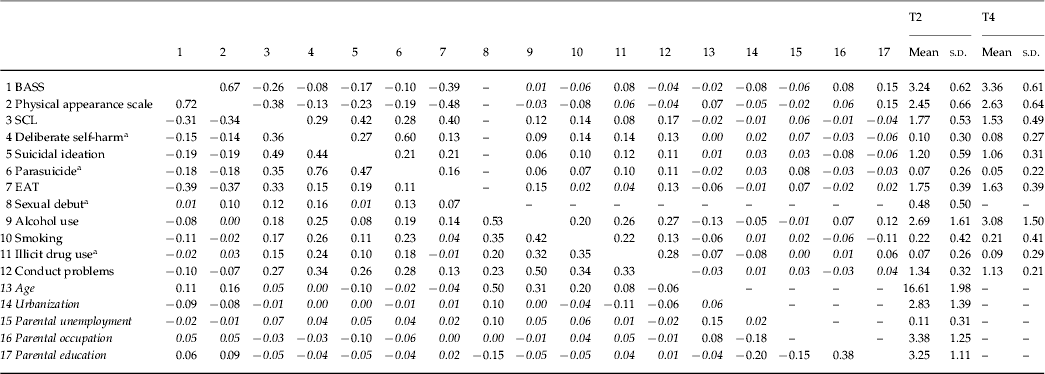
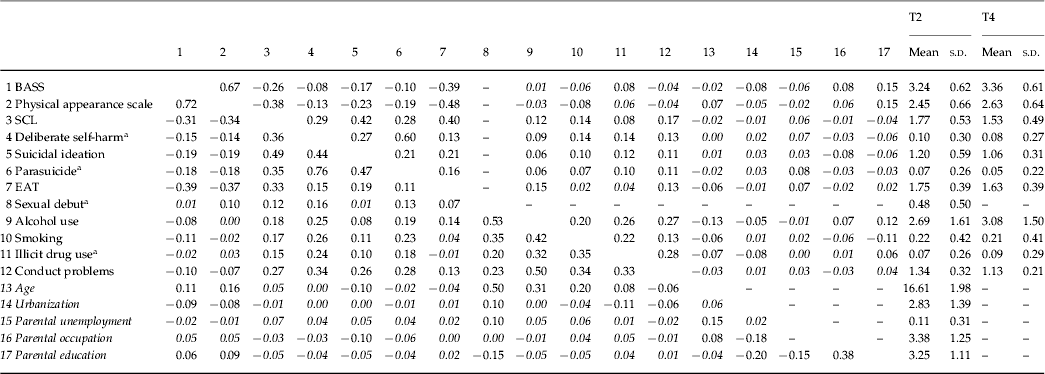
Table 1 displays descriptive statistics and correlations between all variables. The results show similar correlations between the majority of variables for T2 and T4, and generally low correlations between most study variables and sociodemographics. Regression analyses showed that none of the sociodemographic variables were significantly related to cosmetic surgery (all p's >0.05). The variables were therefore not included as covariates in the following analyses.
Means, standard deviations (s.d.) and correlations of 17 variables at T2 (below diagonal) and T4 (above diagonal). Estimates weighted for selective attrition
BASS, Body Area Satisfaction Scale; SCL, Hopkins Symptoms Checklist; EAT, Eating Attitude Test.
Variables in italics are covariates measured at T2 only (urbanization measured at T1).
Correlations in normal font are significant (p<0.05); correlations in italics are not significant.
a Variables are coded: 0=no, 1=yes; the mean indicates the proportion bearing symptoms.
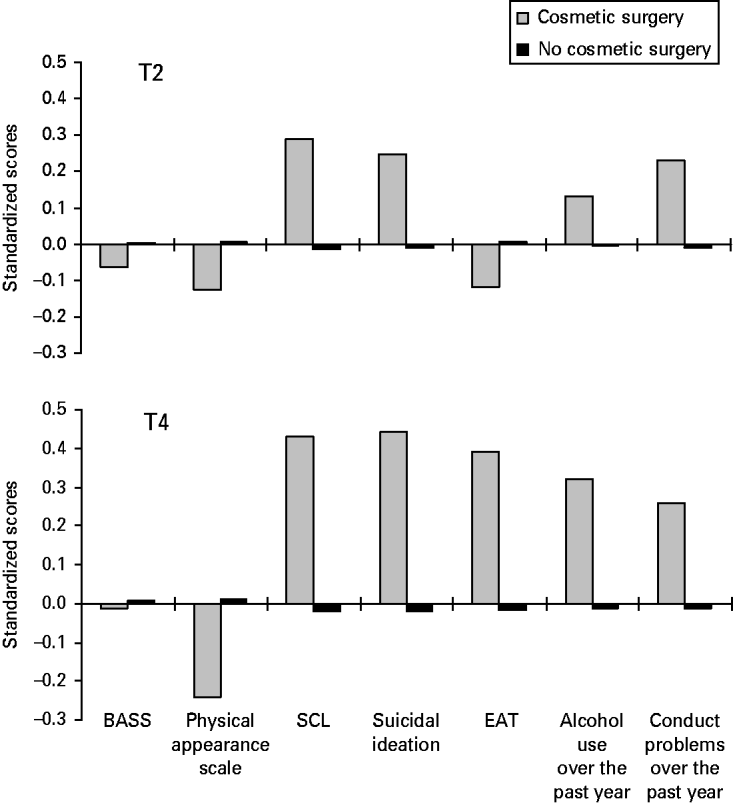
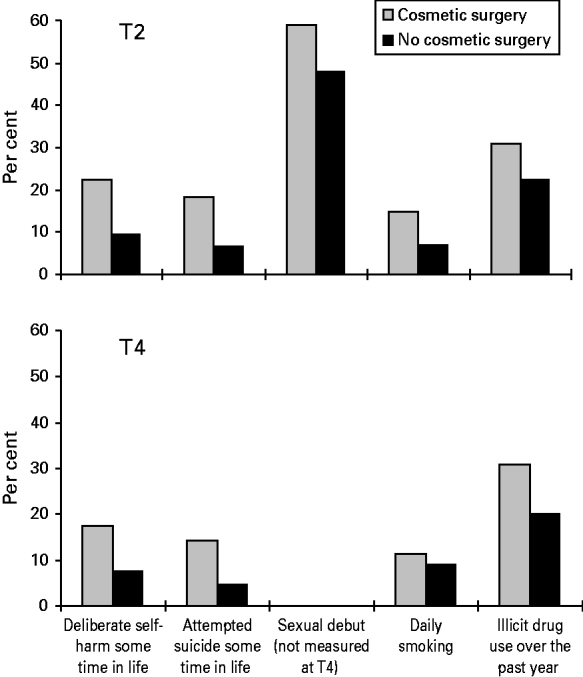
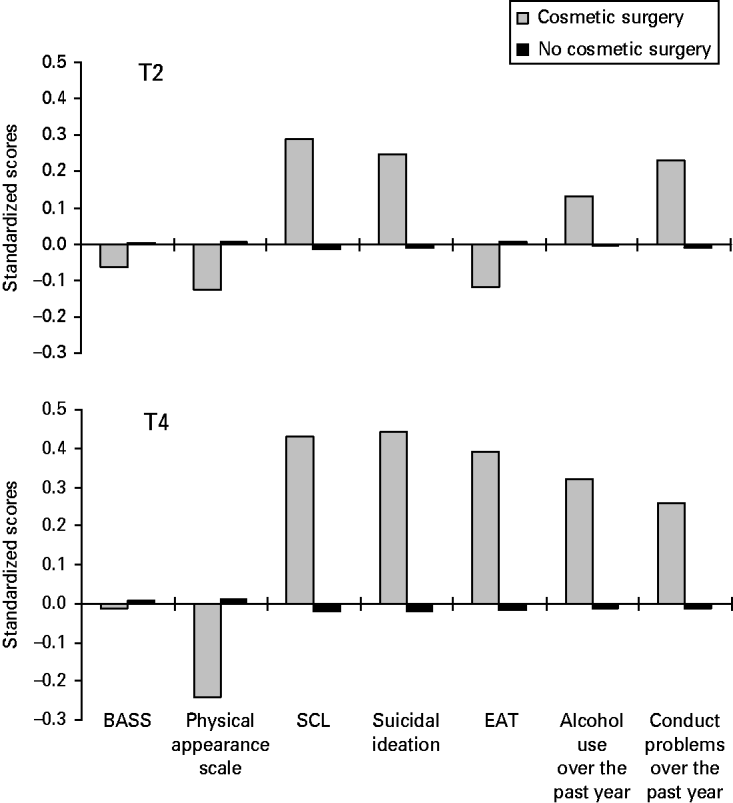
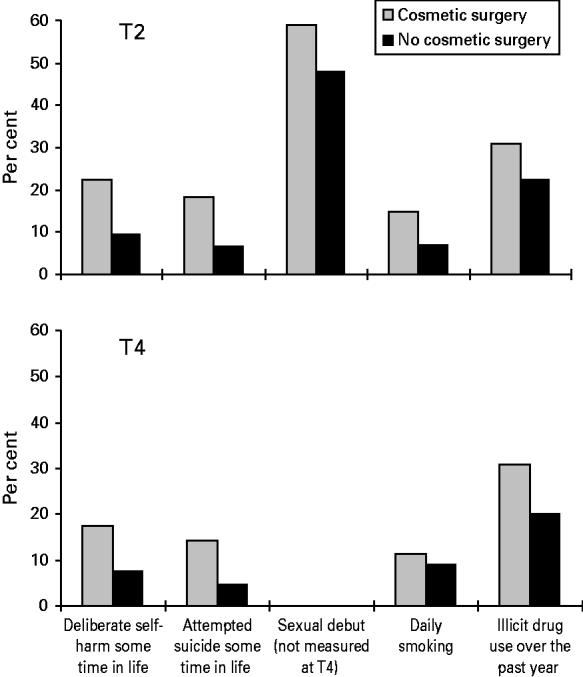
Figures 1 and 2 display statistics for all variables at T2 and T4 for cosmetic surgery patients and non-patients separately. To facilitate comparison of mean score differences between patients and non-patients, the values in Fig. 1 are displayed as standardized values, with a mean of zero and a standard deviation of one.
Scores of cosmetic surgery patients and non-patients before surgery (T2) and after surgery (T4) on seven variables. Means adjusted for selective attrition. BASS, Body Area Satisfaction Scale; SCL, Hopkins Symptom Checklist; EAT, Eating Attitude Test.
Proportion of mental health problems of cosmetic surgery patients and non-patients before surgery (T2) and after surgery (T4) on five variables. Estimates adjusted for selective attrition.
Factors predicting cosmetic surgery
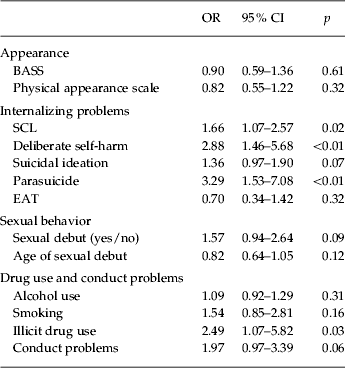
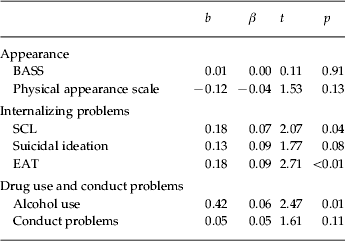
We conducted logistic regression analyses to examine which variables at T2 prospectively predicted cosmetic surgery. As shown in Table 2, general appearance satisfaction was not related to subsequent cosmetic surgery, either when measured with the BASS or with the Physical Appearance Scale. We further explored whether pre-surgical patients were more dissatisfied with the specific body feature to be operated on than other women; for this purpose, logistic regression analyses were performed testing whether dissatisfaction with upper torso could specifically predict breast surgery while controlling for covariates. (Data from other surgery groups were removed in this analysis.) The results show that satisfaction with breasts strongly predicted a decreased probability for breast surgery (OR 0.50, 95% CI 0.37–0.67, p<0.01).
Logistic regression analyses examining predictors of cosmetic surgery. Estimates weighted for selective attrition
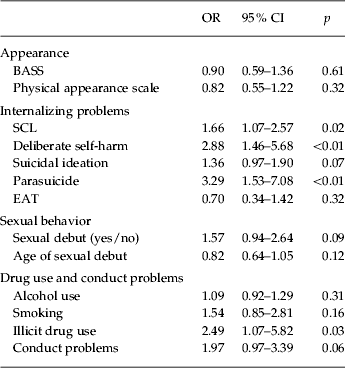
BASS, Body Area Satisfaction Scale; SCL, Hopkins Symptoms Checklist; EAT, Eating Attitude Test; OR, Odds ratio; CI, confidence interval.
Symptoms of anxiety and depression significantly predicted cosmetic surgery, indicating that a higher score on the SCL was related to an increased probability to undergo surgery. Similarly, the probability of undergoing surgery more than doubled when respondents reported at least one suicide attempt or episode of deliberate self-harm at T2. Eating problems, however, did not predict cosmetic surgery. A post-hoc explanation of the relationship between deliberate self-harm/suicide attempt and cosmetic surgery could be that surgery is undertaken to repair damage caused by self-harm episodes or suicide attempts. Additional logistic regression analyses were therefore conducted where data from the two patients with scar corrections were excluded, resulting in only marginally reduced ORs (for self-harm: OR 2.56, 95% CI 0.24–5.28, p=0.01; for suicide attempts: OR 2.91, 95% CI 1.28–6.60, p=0.01).
Illicit drug use more than doubled the likelihood of cosmetic surgery. Conduct problems also almost doubled the probability for such surgery, though the p value for this relationship failed to reach significance. However, whether women had had sexual intercourse at T2, age of sexual debut, alcohol consumption and smoking were not related to opting for cosmetic procedures.
Multiple logistic regressions were conducted in which all predictor variables from the bivariate analyses were included simultaneously to test the unique effects on cosmetic surgery. A backwards deletion procedure was used to exclude variables that were shown to not predict cosmetic surgery in the multiple model. Only suicide attempts (OR 3.29, 95% CI 1.53–7.08, p<0.01) remained significant.
Finally, because breast reduction surgery may be medically indicated, additional logistic regression analyses were conduced wherein breast reduction surgery patients (n=16) were compared to other patients (n=55). The results showed no differences between the two patient groups on any of the variables included at T2 (all p's >0.05).
Effects of cosmetic surgery
A series of linear regression analyses were conducted to examine whether cosmetic surgery predicted changes in psychological and mental health variables between T2 and T4. These results are presented in Table 3 and show that cosmetic surgery did not predict changes in BASS or the Physical Appearance Scale. We further explored whether satisfaction with the specific body feature operated on increased to a greater extent in patients than non-patients. For this purpose, linear regressions were performed, whereby breast surgery significantly predicted a larger increase in satisfaction with breasts compared to non-patients (b=0.62, β=0.10, t=3.90, p<0.01; data from other surgery groups were removed in this analysis).
Linear regression analyses examining psychological and mental health changes after cosmetic surgery. Estimates weighted for selective attrition
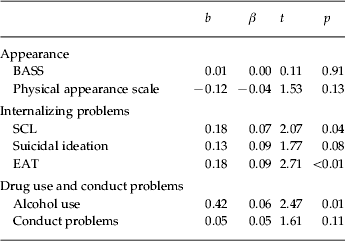
BASS, Body Area Satisfaction Scale; SCL, Hopkins Symptoms Checklist; EAT, Eating Attitude Test.
Table 3 shows that cosmetic surgery predicted a greater increase in symptoms of anxiety and depression and eating problems compared to non-patients, whereas changes in suicidal ideation were not significantly related to surgery. Moreover, logistic regressions showed that such surgery predicted increases in suicide attempts from T2 to T4 compared to non-patients (OR 2.16, 95% CI 1.01–4.59, p=0.05), whereas it did not predict changes in deliberate self-harm, smoking or illicit drug use (p's >0.05; not shown in the table). Finally, cosmetic surgery predicted increased alcohol consumption but not conduct problems (Table 3).
Additional regression analyses were performed to compare breast reduction patients' changes in psychological variables from T2 to T4 with those in all other patients. The results show significantly less improvement in appearance satisfaction among breast reduction patients compared to other patients (p=0.04). No further differences were found between patient groups (p's >0.05).
Discussion
The results of this study support the notion that prospective cosmetic surgery patients have, on average, more mental health problems than non-patients, as seen in their higher symptom rates of depression and anxiety, deliberate self-harm and parasuicide. More frequent use of illicit drugs was also seen among cosmetic surgery patients. Moreover, these patients had a greater increase in symptoms of depression and anxiety, eating problems, suicide attempts and use of alcohol compared to females who had no cosmetic surgery experience.
The study provides little support for the claim that cosmetic surgery is motivated primarily by dissatisfaction with one's general appearance, as prospective patients did not differ from other women in their evaluation of overall appearance. Nor did analyses support the contention that patients' satisfaction with their general appearance improved after surgery; the study did, however, indicate that patients were motivated by dissatisfaction with the specific body feature to be operated on, because breast surgery patients were more dissatisfied with their breasts than others prior to surgery. Finally, the breast patients' comparably high increase in satisfaction with their breasts after surgery supports the finding from other studies that surgery in fact increases satisfaction with the specific body feature operated on.
The results in the current study indicating higher frequency of parasuicide, deliberate self-harm and symptoms of depression and anxiety in patients prior to surgery are in accordance with findings that prospective breast augmentation patients bear a greater risk of suicide and a higher prevalence of admission to psychiatric hospitals prior to surgery compared to the general population (Jacobsen et al. Reference Jacobsen, Holmich, McLaughlin, Johansen, Olsen, Kjoller and Friis2004). In addition, the results from recent long-term follow-up studies of cosmetic surgery patients showing no or only small changes in mental health-related outcomes (Sarwer et al. Reference Sarwer, Infield, Baker, Casas, Glat, Gold, Jewell, LaRossa, Nahai and Young2008; Murphy et al. Reference Murphy, Beckstrand and Sarwer2009; von Soest et al., in press) are supported by the current study, in that no indication of mental health improvement after surgery has been found. Finally, the study results are consistent with research showing that the choice to undergo cosmetic surgery is related to some form of drug use (Cook et al. Reference Cook, Daling, Voigt, deHart, Malone, Stanford, Weiss, Brinton, Gammon and Brogan1997; Schofield et al. Reference Schofield, Hussain, Loxton and Miller2002).
The prevalence of cosmetic surgery patients in this study (4.9%) was somewhat higher than a recent population-based study among young women in northern Norway, in which 3.4% reported experience with cosmetic surgery (Javo & Sørlie, Reference Javo and Sørlie2009), yet somewhat lower than estimates (7.7%) from an earlier population-based Norwegian study where older women were included as well (von Soest et al. Reference von Soest, Kvalem, Skolleborg and Roald2006). Prevalence estimates (5%) using data from a sample of young Californian female college students were similar to the figures in our study (Sarwer et al. Reference Sarwer, Cash, Magee, Williams, Thompson, Roehrig, Tantleff-Dunn, Agliata, Wilfley, Amidon, Anderson and Romanofski2005), whereas an Australian population-based study among 45- to 50-year-old women reported a higher estimate (7%) (Schofield et al. Reference Schofield, Hussain, Loxton and Miller2002). Thus, our study shows fairly similar or somewhat lower prevalence estimates than other studies from Norway and other countries. The higher prevalence estimates in some research may be due to the higher mean age of respondents in these studies.
This study is one of the first to use a prospective design from a large-scale representative survey to investigate predictors and effects of cosmetic surgery. Its strengths lie in the relatively high response rates, the assessment of a variety of different potential predictors, and adjustment for selective attrition. However, the study also has limitations. First, the fact that no more than 71 women had undergone cosmetic surgery in the sample at hand meant that no adjustments for the number of tests could be made because of the relatively low power of the analyses. Second, although differences between breast reduction patients and other patients were analyzed, important differences may have remained undetected because of the relatively low power of the analyses due to the aforementioned limited number of patients. Breast reduction patients may differ from other patient groups in that these operations may in part be conducted to alleviate physical symptoms and, in many cases, the costs of surgery will then be covered by the Norwegian health-care system whereas other cosmetic operations are not. We decided, however, to include breast reduction patients in the study, as the respondents themselves defined these procedures in the questionnaire as cosmetic in nature. Third, as there were few male cosmetic surgery patients, the sample was restricted to females only. Fourth, because no randomized control trial could be conducted, unmeasured factors might explain some of the relationships found. For instance, appearance changes due to cosmetic surgery may in fact lead to improved mental health; however, such effects may be counteracted by possible post-surgical medical side-effects, which in turn could have a negative effect on patients' mental health (Sarwer et al. Reference Sarwer, Brown and Evans2007). Moreover, potential pressure from friends, partner or family members to have cosmetic surgery may have an impact on the decision to undergo surgery, in turn potentially confounding the relationship between mental health and cosmetic surgery by relationship or family factors. Fifth, although the present study showed that poor mental health predicted surgery, previous studies have shown that mental health problems are related to higher general health-care service use (Koopmans et al. Reference Koopmans, Donker and Rutten2005). Thus, the relationship concerning mental health may not be specific to cosmetic surgery, but may be general for several types of health-care service. Sixth, undergoing surgery may be influenced not only by patient characteristics but also by external factors. For instance, women suspected to suffer from eating disorders would probably be refused an operation because eating disorders are regarded as contra-indicative for cosmetic surgery. Thus, although we did not find an over-representation of eating problems among surgery patients, eating disordered patients may nevertheless seek out such treatment more often than other females. Additional external factors, as for instance geographical variations in availability of cosmetic surgery, may also serve as unmeasured confounders. Moreover, although well validated, the measures of psychological constructs and psychopathology used in this study were relatively general and not designed specifically to measure changes after appearance alteration. Instead, applying instruments more specifically related to aspects of appearance adjustment might have proven more advantageous in revealing psychological changes after cosmetic surgery. Finally, the current study was based on questionnaire measures alone, with no diagnostic interviews having been conducted with respondents. An example of the limitations of survey data is found in participants' self-reports concerning deliberate self-harm and suicide attempts; as Table 1 shows, the lifetime prevalence of such behaviors was in fact higher at the first time-point than the second. This surprising finding may reflect failure to remember such episodes, or re-evaluation of experiences that participants considered dramatic at a young age, but as less serious when looking back later in life.
Despite these limitations, the study provides an indication that cosmetic surgery patients score more negatively on a variety of psychological and mental health variables prior to surgery than women not undergoing cosmetic surgery. Moreover, although cosmetic surgery may improve specific body-part satisfaction, it does not alleviate mental health problems; on the contrary, cosmetic surgery patients' mental health problems may increase rather than decrease compared to non-patients. Thus, the results from this study provide no evidence that cosmetic surgery should be used to alleviate mental health problems in women dissatisfied with their own appearance. Nor do the study results support the notion that cosmetic operations in exceptional cases should be covered by the public health-care system due to a potential psychotherapeutic effect for the patient.
Acknowledgements
The Research Council of Norway funded the data collection.
Declaration of Interest
None.