Implications
This paper presents a selection of research activities and scientific and technical initiatives from Australia and Brazil that aim to reduce greenhouse gas (GHG) emissions from ruminant livestock production. This paper focuses on the extensive pasture-based beef production systems in each country. The production of food in the world will increase to meet the growing global population. This increase in production should occur in a sustainable manner, enabling economic and social development without detriment to the environment. There are already applicable technologies for sustainable beef production and GHG mitigation, but adoption on farm will be driven by government policies and favourable market conditions.
Introduction
Australia is now the world's largest exporter of beef, supplying ∼1.4 million t carcass weight, with Brazil ranking a close second, supplying ∼1.32 million t carcass weight (Meat and Livestock Australia (MLA), 2012). By 2020, the global demand for food will grow by 20% (FAO, 2002) and countries such as Australia and Brazil could have the capacity to satisfy about 40% of this increase (FAO, 2011). However, most of the increased animal protein production across the developed world will not only come from ruminant livestock, but also from fish, swine and poultry with higher intensity of production (FAO, 2003) than extensive production systems such as those already existent in Australia and Brazil. The increased demand for food will be driven by an increasing population, forecast to reach almost 7.6 billion by 2020 (UN, 2012). Most of this increase is projected to occur in the developing nations in Asia and Africa where traditional food production is deficient. An increasing proportion of these people will be more demanding about the quality and quantity of food available and the focus will be on meat consumption, expected to increase by 25% (cattle, sheep, pig, poultry meats) from 2015 to 2030 (Alexandratos, Reference Alexandratos2009). Consequently, total GHG emissions from livestock production systems and agriculture will increase as world population and food demands increase (O'Mara, Reference O'Mara2011). In the last decade, the agriculture sector has been targeted as a major contributor to increasing GHG emissions. In addition, it is often suggested that there is more inherent scope to mitigate emissions from agriculture compared with other sectors, with a particular interest in ‘on-farm’ emissions.
Australia and Brazil: agriculture, beef production and emissions
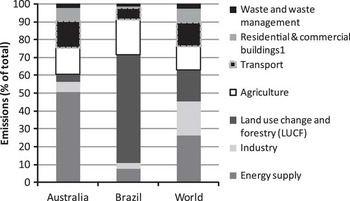
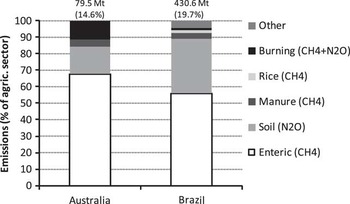
Australia and Brazil have similar total GHG emission profiles (Figure 1), but more specifically both countries have the capacity to reduce agricultural emissions (Figure 2) because of extensive geographical areas associated with favourable climatic conditions and well-developed management systems. Overall, enteric sources in Australia and Brazil (Figure 3) are responsible for 67.7% and 56.0%, respectively, of national agricultural emissions (CO2-e).


The profile of GHG emissions in Australia and Brazil relevant to agriculture (%). The total emissions from agriculture and the percentage of the country's total GHG emissions are also shown. Sources: Department of Climate Change and Energy Efficiency (2010), Ministério da Ciência e Tecnologia (2010).

Across both Australia and Brazil, beef production from the northern rangelands and central cultivated pastures, respectively, are typified as having high methane (CH4) emissions. These emissions are primarily the result of the reliance on pastures with inherently lower nutritive value compared with arable systems, young cattle having low growth rate and cows with long inefficient reproductive cycle. This potentially translates to the production of extensively farmed beef having approximately three to four times the emissions than the equivalent amount of intensively farmed beef (Nijdam et al., Reference Nijdam, Rood and Westhoek2012). Among the different sources of GHGs originating from agriculture in both Australia and Brazil, CH4 emissions from enteric fermentation in ruminants are the most significant. CH4 from Australia's farmed livestock accounts for ∼11% (CO2-e) of total Australian GHG emissions (Australian Greenhouse Emissions Information System, 2008) of which almost 95% originate from enteric sources. In Brazil, the figures are similar: 94% of CH4 emissions were enteric in origin in 2005, accounting for 63.2% of all CH4 produced in the agriculture sector (MCT, 2010). The Australian beef herd totals 24.8 million, with Queensland and the Northern Territory alone accounting for 13.6 million or 54.8% of the national herd (Australian Bureau of Statistics, 2009). Across these regions, pastures (definable land units) used for beef production are large, typically 120 km2 or more (Hunt et al., Reference Hunt, Petty, Cowley, Fisher, Ash and MacDonald2007), and are dominated by C4 grasses, which generally have lower nutritional value than temperate grasses (Wilson, Reference Wilson1994). Poor soils and marked seasonal rainfall support a wide range of native and introduced grasses, legumes and forbs. This range of pasture communities, in association with mixed soil types, contributes to marked heterogeneity in grazing systems. In addition, seasonal fluctuations in rainfall affect available forage biomass, quality and ultimately digestibility. In these extensive grazing environments, cattle can also experience prolonged live weight (LW) stasis, loss or compensatory growth throughout their life. This has an impact on achieving target slaughter weight and therefore lifetime CH4 production (Charmley et al., Reference Charmley, Stephens and Kennedy2008). In Australia, recovery from drought conditions contributes to increases in livestock numbers, with enhanced pasture availability, increased grain production from arable land and associated emissions from the agricultural sector. This post-drought improvement in overall agricultural productivity in Australia has effectively resulted in increases in annual net emissions. For example, emissions increased by 88.4 Mt CO2-e or 3.5% in the 12 months up to September 2012 (Department of Climate Change and Energy Efficiency, 2012). Although this increase is primarily related to enteric fermentation emissions from the ruminant livestock sector and is a common theme in both countries, emissions from agricultural soils and emissions from savanna burning have also contributed.
In Brazil, 34% of the national herd occupies 26% of the central savanna pastures, which are also characterized by native and mainly introduced grasses. Extensive beef production generates about 3% of Brazil's total value of agricultural production (IBGE, 2006). As in Australia, the combination of poor soils, marked seasonal rainfall and introduced C4 grasses affect the availability, quality and digestibility of forage throughout the year. In addition, there is a transition from warm temperatures in the north (Amazonia) to cold in the south (lowlands). When pasture availability in these central Brazilian pastures decrease during the dry season, around 10% of grazing cattle are transferred to feedlots to maintain a constant supply of beef (Millen et al., Reference Millen, Pacheco, Arrigoni, Galyean and Vasconcelos2009).
Meeting the challenge of measuring CH4 emissions from cattle in the tropical grazing systems
Currently, two main methods are available to measure CH4 emissions: respiration chambers and the sulphur hexafluoride (SF6) tracer technique. Others methods have also been suggested, such as blood CH4 concentrations, whole body thermography or direct measurement of enteric fermentation using indwelling rumen sensors, but these are difficult to use other than at an individual animal level and hence not applicable to estimating emissions for extensive grazing environments at a herd or farm scale. A novel approach using micrometeorological methods has been tested and may offer a more appropriate method for extensive production systems (McGinn et al., Reference McGinn, Turner, Tomkins, Charmley, Bishop-Hurley and Chen2011). To date, most of the experimentation in Australia and Brazil that has either measured CH4 emissions or investigated the effect of different mitigation strategies on CH4 emissions have been conducted under well-defined and controlled conditions using the SF6 tracer method (Johnson et al., Reference Johnson, Huyler, Westberg, Lamb and Zimmerman1994) or open-circuit respiration chambers (McCrabb and Hunter, Reference McCrabb and Hunter1999; Tomkins et al., Reference Tomkins, Colegate and Hunter2009; Kennedy and Charmley, Reference Kennedy and Charmley2012). However, beef production dominates a large proportion of the grazing systems in both countries, and this introduces a dimension of scale for determining emissions and mitigation effects where the smallest unit of measure may be at the herd level.
Determining intake for grazing cattle
In order to know CH4 yield, and how this is influenced by diet intake and composition, it is critical to measure intake of dry matter (DM) and its components. Thus, it deserves a specific mention in this review. In the extensive grazing environments of Australia and Brazil, measuring individual animal intake is often more challenging than measuring actual CH4 emissions. Field measurements of available pasture biomass can be conducted before and after grazing periods throughout CH4 measurements, but can fail to provide consistent or biologically valid DM intake estimates mainly because of the heterogeneous nature of tropical pastures and selection by livestock for palatable pasture parts (stems or leaves) or species (O'Reagain and Turner, Reference O'Reagain and Turner1992). Alternative methods for estimating grazing intake include the use of stable C-isotopes, plant cuticular-wax markers and microhistological procedures, all of which have also been used with varying success (Mayes and Dove, Reference Mayes and Dove2000). Although some of these external indigestible markers such as n-alkanes (Dove and Mayes, Reference Dove and Mayes1991), chromium oxide (Fenton and Fenton, Reference Fenton and Fenton1979) or titanium dioxide (Myers et al., Reference Myers, Ludden, Nayigihugu and Hess2004) have been widely used to estimate DM intake in grazing animals, they require regular dosing over defined periods and faeces must be collected over consecutive days. A non-invasive and less-intensive methodology for grazing cattle was required and has been found in faecal near-infrared spectroscopy (FNIRS). This methodology has been used to estimate DM digestibility for tropical pastures and to define seasonal changes in diet quality (Dixon and Coates, Reference Dixon and Coates2010). Estimates of diet digestibility and intake can therefore be used to identify corresponding seasonal changes in CH4 production from extensively managed cattle. More indirectly, grazing intakes may be derived from LW and LW gain data using available algorithms (Australian Research Council, 1980). Demarchi et al. (Reference Demarchi, Lourenço, Manella, Alleoni, Friguetto, Primavesi and Lima2003) reported a similar approach for estimating DM intake of tropical forage, and the Cornell Net Carbohydrate and Protein System can also be used to calculate intakes that are generally biologically acceptable relative to LW (Fox et al., Reference Fox, Tedeschi, Tylutki, Russell, Van Amburgh, Chase, Pell and Overton2004).
Measurement of GHGs from cattle on pastures
Ruminant livestock production generates two GHGs of interest: CH4 from enteric fermentation and manure, and nitrous oxide from excreta nitrification/denitrification. In northern Australia, the loss of volatile N compounds from manures is low because of low feed N content and conditions favouring rapid drying of manures (Bentley et al., Reference Bentley, Hegarty and Alford2008). Emissions from rangeland cattle grazing extensive tropical pastures are recognized to be higher (i.e. emissions intensity is high) than emissions characteristic of cattle grazing temperate and improved pastures. Because of this high emissions intensity, it is possible that mitigation activities suitable for beef production in both northern Australia and central Brazil would yield the greatest environmental and economic returns, but it is first necessary to acquire reliable baseline emission data to assess the effect of mitigation activities at a farm or regional scale.
Current GHG estimates for both Australia and Brazil are derived from Intergovernmental Panel on Climate Change (IPCC, 2006) methodologies; however, national inventories require accurate CH4 emission measurements from whole farm systems (McGinn et al., Reference McGinn, Chen, Loh, Hill, Beauchemin and Denmead2008) and to be meaningful need to be related to geography or agronomic land units, management (including mitigation strategies) and seasonal influences. Determining emissions in situ across northern Australia and central Brazil creates a suite of challenges; however, if emissions are to be quantified and the relative merits of a mitigation strategy determined, then it is important to have reliable measurement techniques. In Australia and Brazil, it has been recognized that robust farm methodologies are required to generate reliable national baseline emission data and to assess the effect of mitigation activities at the herd scale.
Micrometeorological methods compare favourably with the SF6 technique for determining emissions from grazing ruminants in well-defined pastures and with open-circuit respiration chambers (Leuning et al., Reference Leuning, Baker, Jamie, Hsu, Klein, Denmead and Griffith1999; Tomkins et al., Reference Tomkins, McGinn, Turner and Charmley2011). Laubach et al. (Reference Laubach, Kelliher, Knight, Clark, Molano and Cavanagh2008) clearly describe three paddock-scale micrometeorological methods for measuring emissions from beef cattle. Specifically, one methodology based on inverse dispersion (Flesch et al., Reference Flesch, Wilson, Harper and Crenna2005) has been shown to have potential for estimating CH4 emissions from feedlot and grazing production systems (Laubach and Kelliher, Reference Laubach and Kelliher2005a and Reference Laubach and Kelliher2005b; McGinn et al., Reference McGinn, Flesch, Crenna, Beauchemin and Coates2007 and Reference McGinn, Chen, Loh, Hill, Beauchemin and Denmead2008; Loh et al., Reference Loh, Chen, Bai, Naylor, Griffith, Hill, Denmead, McGinn and Edis2008). This methodology has now been used across a number of grazing systems in northern Australia to determine herd-scale CH4 emissions. The basis of this methodology relies on the use of open-path infrared lasers to detect emitted gas in the atmosphere as it is transported away from the source (cattle) by the wind and dispersed by turbulence, and the ability to define wind statistics throughout each measurement period using dedicated weather stations. Langrangian stochastic (LS) models are then used to simulate the paths of gas molecules of interest using flow velocity statistics. However, at the individual animal scale, the micrometeorological/backward LS dispersion method can result in emission values up to 27% higher compared with the SF6 technique. This may be because the model implicitly overestimates gas diffusivity (Laubach and Kelliher, Reference Laubach and Kelliher2005b). As a result, the micrometeorological methods are generally more suited and reliable for measuring mean herd-scale emissions (Laubach et al., Reference Laubach, Kelliher, Knight, Clark, Molano and Cavanagh2008), but are dependent on maintaining cattle within close proximity of the sensors. Emission values (g CH4/kg LW) previously reported for temperate steers grazing high-quality ryegrass (Lolium ssp.) pastures (Laubach et al., Reference Laubach, Kelliher, Knight, Clark, Molano and Cavanagh2008) are, as expected, lower compared with tropically adapted temperate steers grazing a Rhodes grass (Chloris gayana) pasture (Tomkins et al., Reference Tomkins, McGinn, Turner and Charmley2011): 0.49 v. 0.61(g CH4/kg LW), respectively. The micrometeorological method has now also been used across properties in northern Queensland and the Northern Territory, Australia. Daily mean (±s.e.m.) CH4 emissions have been found to range from 136 ± 21.5 g/hd per day for steers grazing irrigated Rhodes grass pastures to 281 ± 22.3 g/hd per day for Brahman cows grazing mixed Buffel (Cenchrus ciliaris) and Sabi (Urochloa mosambiensis) grass pastures. The lowest emissions have been associated with young steers grazing irrigated and improved pasture fertilized with urea and managed intensively (Tomkins et al., Reference Tomkins, McGinn, Turner and Charmley2011). In comparison, high CH4 emissions have been associated with mature Brahman cows and heavier steers (LW>200 kg) grazing either Buffel or Sabi grass-dominated pastures, respectively. CH4 emissions have been within the range of estimated values previously reported for Brahman and crossbred cattle typical of tropical production systems (Hunter, Reference Hunter2007 – reported a correction factor for algorithms based on Dicanthium aristatum and Chloris gayana; McCrabb et al., Reference McCrabb, Berger, Magner, May and Hunter1997 – fed steers under nutritional conditions designed to match those of a typical wet and dry season in the tropics), although generally higher than the values reported by Kennedy and Charmley (Reference Kennedy and Charmley2012) for hay diets ranging from Black spear grass (Heteropogon contortus) (53.9 ± 4.44 g CH4/day) to Buffel grass (159 ± 13.7 g CH4/d) fed to steers under animal house conditions. The relationships described by Kennedy and Charmley (Reference Kennedy and Charmley2012) for tropical pastures, grasses and legumes indicate that CH4 production could be predicted as 19.6 g/kg forage DM intake, or 8.6% to 13.4% of digestible energy intake, and 5.2% to 7.2% of gross energy intake. Emissions at the farm or herd scale will vary depending on pasture type, seasonality, weight and class of ruminant livestock. Overall, work in Australia to date has suggested that current values used for Australia's national inventory purposes are only representative of a small portion of the total northern beef herd given the seasonal extremes and extent of tropical forage species across the northern rangelands (McCrabb and Hunter Reference McCrabb and Hunter1999; Kennedy and Charmley, Reference Kennedy and Charmley2012).
Considering the importance of developing national inventories, the Brazilian government funded a significant research network project (called ‘Pecus’), initiated in 2011 and aiming at estimating the contribution of different livestock production systems to GHG dynamics in the country. The project targets CH4 and N2O emissions, carbon sequestration by soils, and overall contributes to the acquisition of reliable baseline emissions data while drawing comparisons between potential mitigation options. The project will help the Brazilian government identify suitable mitigation strategies and support the governmental policies by integrating predictive models and measurement methodologies within the heterogeneity of production systems across Brazil. The main characteristics of the ‘Pecus’ network are: evaluation of representative production systems in all major biomes; trials repeated in time and space; use of internationally recognized methodologies; study of soil-plant-animal-atmosphere compartments; standardized data organized in data base; modelling and evaluation of environmental and socio-economic implications of findings to the country; and development of scenarios to support government decisions, avoiding the use of default indexes and tiers that would not necessarily be applicable to Brazilian production systems. The first challenges of this project were establish and evaluate the complete production cycle, from weaning to slaughter or entire lactation, of different productions systems in the six major biomes of Brazil: Amazonia, Cerrado (savannah), Atlantic Forest, Caatinga (semi-arid), Pantanal (wetlands) and Pampa (lowlands). Initial assessment of GHG emissions began in 2012 and data are still preliminary. Throughout the network, it was decided to use the SF6 tracer technique to estimate the enteric CH4 emissions by cattle. In spite of variations inherent to the technique, it is the only one capable of measuring individual emissions among different but neighbouring production systems. The network team also decided to use static chambers to estimate CH4 and N2O soil emissions. Estimation of the DM intake by grazing animals is one of the most challenging variables. The network has used titanium dioxide and n-alkanes as external markers instead of chromium oxide, mainly because of health and environmental restrictions related to the use of chromium.
Mitigation strategies for ruminant livestock
In the absence of any adoption of mitigation strategies, global agricultural emissions are expected to increase from 5.6 (in 2005) to 8.2 billion t CO2-e in 2030 (O'Mara, Reference O'Mara2011). Achieving reductions in enteric CH4 emissions from farmed ruminant livestock, particularly beef cattle, is a common target among countries given anticipated corresponding increases in production efficiency and environmental benefits in carbon-constrained production systems.
In countries such as Australia and Brazil where the supply of beef is expected to increase, corresponding increases in total emissions will be offset to some extent by improved production efficiencies. In the last decade, the ongoing debate on climate change, fuelled by the estimates of increasing emission of GHG and consequent global warming, has targeted the agricultural sector as a major contributor, but in so doing has also suggested that there is more inherent scope to mitigate emissions compared with other sectors, with a particular interest in ‘on-farm’ emissions. Available strategies target increasing animal production efficiencies based on nutritional and reproductive opportunities. Smith et al. (2011) classify mitigation under three board headings: improved feeding practices, use of specific agents and diet additives and improved animal breeding. A number of these strategies are discussed in detail by Cottle et al. (Reference Cottle, Nolan and Wiedemann2011), although Waghorn and Clark (Reference Waghorn and Clark2006) argue that many proposed mitigation options have little application to grazing environments. Nevertheless, nutritional and management strategies for mitigation of livestock CH4 are the cornerstone of a current Australian research programme providing research funding totalling $201 M, over 6 years (Department of Agriculture, Fisheries and Forestry, 2011). The outcomes of this programme will contribute to enhancing sustainable agricultural practices through abatement technologies, strategies and innovative management practices. There are many different strategies to reduce GHG emissions from ruminant livestock. The real challenge will be in finding strategies that suit extensive grazing situations and are persistent in their effect. Regardless of the production system, two recurring themes are apparent: (1) large reductions in CH4 intensity (emissions/unit feed eaten or unit of product) will require the application of an integrated number of options, (2) adoption will only occur if the profitability benefits exceed the costs of implementation.
Grainger and Beauchemin (Reference Grainger and Beauchemin2011) provide a concise review of dietary and farm system strategies to mitigate enteric CH4 emissions from ruminants and the potential effects on animal production. These strategies include intensive management of pastures, the use of grain and concentrate feeds to reduce emissions/unit product, forage processing to reduce particle size, the increasing use of pasture legumes and the specific addition of tannins, saponins, essential oils, saturated and unsaturated fats and oils, ionophores, nitrate compounds, yeasts of various origins, malate and fumarate to the diet.
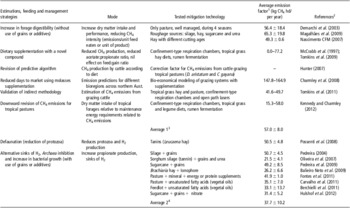
In terms of direct nutritional management and manipulation in the rumen, three specific strategies to reduce enteric CH4 production have been recognized: reduce the production of H2, provide alternative sinks for free H2 already produced by enteric fermentation and reduce the population of methanogenic microorganisms, namely, the CH4-producing Archaea (Joblin, Reference Joblin1999). Ongoing research across the world continues to investigate different mitigation strategies with varying success. The recent scope of research work conducted in Australia and Brazil is an example of coordinated approaches to improving emission estimates, measurement and mitigation practices (Table 1).
Australian and Brazilian research related to different strategies for estimating, measuring and mitigation of enteric CH4

CH4 = methane.
1Average emission factor calculated considering all evaluated treatments (control and mitigation) in each experiment.
2Some references are published as abstracts, Master or PhD thesis.
3Average 1 calculated considering only the three Brazilian experiments listed.
4Average 2 calculated considering the nine experiments above.
The research developed in Brazil typically targets modifying digestibility of the diet, favouring food intake, weight gain and dilution of emissions per unit of product, resulting in an average emission factor of 57 kg CH4/hd per year. The default values provided by the IPCC (2006) for Latin America are 63 kg CH4/hd per year for dairy cows and 56 kg CH4/hd per year for ‘other cattle’, values very close to those found in Brazilian surveys. On the other hand, the direct interference in rumen to reduce the production of H2, to provide alternative sinks for the H2 already produced and reduce populations of methanogenic microorganisms, generated an average emission factor of 37.7 kg CH4/hd per year, a value 34.8% lower than the average of animals in pastures improved and supplemented (57.0 kg CH4/hd per year). These results indicate that there is a wide range of potential mitigation strategies under conditions of production in Brazil. Nutritional management strategies have the greatest short-term impact and include the use of synthetic chemicals, halogens, nitrates and natural compounds (Cottle et al., Reference Cottle, Nolan and Wiedemann2011), but the reduction in CH4 is variable. In a grazing environment, the use of these additives to achieve a sustainable reduction in enteric CH4 production would be extremely challenging. Specific antimethanogenic activity (as % suppression) of several substances such as myristic acid (47%), nitroethane (26% to 69%), corrinoid inhibitors (15.5% to 97.1%), horse radish oil (90%) and a halogenated CH4 analogue (93%) has been identified in ruminants (Machmüller et al., Reference Machmüller, Soliva and Kreuzer2003; Anderson et al., Reference Anderson, Carstens, Miller, Callaway, Schultz, Edrington, Harvey and Nisbet2004; Mohammed et al., Reference Mohammed, Lila, Ajisaka, Hara, Mikuni, Hara, Kanda and Itabashi2004a and Reference Mohammed, Ajisaka, Lila, Hara, Mikuni, Hara, Kanda and Itabashi2004b; Tomkins et al., Reference Tomkins, Colegate and Hunter2009). The use of many additives would require specific technological advances before they can be widely used in grazing systems. Adoption of antimethanogenic additives for extensive beef production systems may be restricted by the need to develop products that are delivered in slow-release boluses, released through selectively permeable membranes or coated by an inert material that provides stability before delivery. However, CH4 suppression is often transient and adaptation by methanogens to feed additives confounds long-term effects.
Across Australia and Brazil, improved herd genetics and property infrastructure are the most common strategies being adopted to improve production efficiencies, which ultimately have the potential to indirectly reduce emission intensities on farm. By contrast, specifically selecting animals with superior residual feed intake, using additives and supplements and improving the efficiency of feed conversion, has been seen as more direct strategies for intensively managed cattle to reduce emission intensities on farm especially where associated input costs can be justified (Boadi et al., Reference Boadi, Benchaar, Chiquette and Masse2004; Hegarty, et al., Reference Hegarty, Goopy, Herd and McCorkell2007, Beauchemin et al., Reference Beauchemin, Kreuzer, O'Mara and McAllister2008, Perdok and Newbold, Reference Perdok and Newbold2009; Berndt, Reference Berndt2010).
Previous estimates of livestock production systems efficiency in Brazil indicate that the reduction in slaughter age through adequate pasture management and strategic finishing feedlot for 90 days can significantly reduce emissions intensity, even when considering all emissions necessary for the production and distribution of inputs. Monteiro RBNC (2009) simulated the progressive intensification of a beef production system based on 800 ha, considering (1) extensive grazing system, (2) intensive grazing system and (3) intensive grazing system with finishing in feedlot. When considering the inputs, the estimated emissions in CO2-e/carcass-e were 19.88, 14.11 and 12.3, respectively, indicating that a strategic feedlot period equivalent to 90 days could significantly reduce the slaughter age and associated emissions by as much as 38%. Cardoso (Reference Cardoso2012) also simulated the effect of emission of GHG at different levels of intensification of beef production systems in Brazil by applying appropriate emission factors. Four scenarios were established with 100 cows: (1) animals spent the entire cycle in areas of degraded pastures in an extensive system, (2) the animals spent the entire cycle on improved pastures but under an extensive system, (3) the animals were raised on extensive improved pastures and supplemented in growing and fattening systems and (4) the animals were raised on pastures with intensive finishing on high-grain diets. The estimates of the GHG emissions were based on national studies of the characteristics and husbandry for each scenario. Using the methodology of the IPCC Tier 2, the annual amount of CO2-e/carcass-e produced in scenario 2 was 35.47% lower compared with scenario 1. Less than 18.85% in scenario 3 compared with scenario 2, and 19.6% lower in scenario 4 compared with scenario 3. Similarly, Hunter and Niethe (Reference Hunter and Niethe2009) have calculated the effects of weaning rate, growth rate of the slaughter generation and finishing strategy for beef cattle typical of northern Australia. These calculations indicate that CH4 emissions from a breeding cow/steer unit could be reduced by as much as 30% if weaning rate or growth rate could be increased by 20% or 0.3 kg/day, respectively. However, the greatest reduction in CH4 emissions, ∼55%, were achievable if steers at 400 kg LW were removed from a grazing system and finished on high-grain diets in a feedlot. These studies clearly illustrate the potential to reduce CH4 emissions per unit of product (kg of meat) when beef production systems are intensified especially for finishing cattle. In contrast, Charmley et al. (Reference Charmley, Stephens and Kennedy2008) report a scenario that would be typical of extensive grazing environments in Australia and Brazil, which are subject to seasonally variable pasture productivity. In this exercise, reproductive cattle were either unsupplemented or provided with a molasses-based supplement to prevent loss of bodyweight in the dry season. Over a 6-year scenario, supplementation was found to increase the number of calves born from 2 to 4, reduce predicted CH4 emissions from the cow per live calf output by 45%, but increased total emissions from the system by 11%. This exercise indicates that the greatest gains in reproductive efficiencies and unit emissions can be made with the individual cow calf unit in the extensive grazing systems typical of both Australia and Brazil, but not necessarily for the whole production system.
Regardless of the country of interest, examples of strategies for reducing GHG emissions per kilo of product are similar: increase the production efficiency by diluting emissions per unit of product (meat or milk); improve the productive and reproductive rates by increasing the genetic merits of the herd; reduce the age at first calving and at slaughter; and reduce the calving interval.
Major abatement of emission intensities (as t CH4/t LW gain) are required if Australia's northern beef industry is to contribute to national reductions in GHG emissions under any proposed Australian legislation for a Carbon Pollution Reduction Scheme or Carbon Farming Initiative. In November 2011, the Australian federal parliament passed the Clean Energy legislation, which aims to reduce carbon pollution by 160 million t by 2020. This legislation excluded agriculture; however, it is now economically and practically prudent for the agricultural sector, including livestock, to be developing methods capable of not only accounting for all the carbon produced, stored and emitted, but to also concentrate on management practices with GHG mitigation as a primary incentive. Estimates generated by Barioni et al. (Reference Barioni, Lima, Zen, Guimarães Júnior and Ferreira2007) for Brazilian conditions suggest that an increase in calving rate from 55% to 68%, a reduction at slaughter age from 36 to 28 months and a reduction in mortality up to 1 year from 7% to 4.5% in 2025 would effectively reduce emission intensity by as much as 18% (carcass equivalent). This would be possible even with an estimated 25.4% increase in meat production.
During the 15th Conference of the United Nations in Copenhagen in late 2009, Brazil announced voluntary targets to reduce their emissions of GHGs to 38.9% of projected emissions based on a scenario of ‘business as usual’ for 2020. Aiming to facilitate the fulfilment of the commitments made by the Brazilian government, in the area of agriculture, the Agriculture Low Carbon Program or ‘ABC Program’ (Ministério da Agricultura, Pecuária e Abastecimento, 2010) was institutionalized in line with the Nationally Appropriate Mitigation Actions and to operate within the National Policy for Climate Change. The ABC program provides a specific line of credit to the industry and brings together investment strategies and on-farm activities designed to support environmental sustainability for the next 10 years. For 2011/2012, the program will have provided up to 3.15 billion Reais (∼1.5 billion USD). To achieve the 38.9% reduction in emissions, Brazilian agriculture will aim to reduce emissions of GHG by 83–104 Mt CO2-e by recovery of 15 million ha of degraded pastures and 18–22 Mt CO2-e with the implementation of integrated crop-livestock-forest production systems in 4 million ha in addition to a further 15 to 20 Mt CO2-e from initiatives in zero-tillage, waste management and genomics. This approach involves a range of mitigation strategies relevant to beef production systems, both intensive and extensive. Only 10% of the finishing cattle in Brazil are under feedlot conditions compared with 34% of all adult cattle slaughtered in Australia (MLA, 2011). Intensively finished cattle would have regular and controlled access to diets containing potential antimethanogenic agents. The effect of a strategy based solely on intensifying beef production is weak on the balance of national emissions for both Australia and Brazil. On the other hand, strategies that involve genetic improvement of herd and pasture species have small individual effect by year or generation, but a significant part of the production systems are able to use this technology and thus have an important impact on national emissions. Theoretically, the combination of both individual and systemic strategies can bring more favourable results to reducing GHG emissions from beef production systems.
The different strategies to reduce GHG emissions from livestock should be evaluated concurrently to prevent the possible benefits of a strategy being cancelled out by negative consequences of adoption. Across northern Australia and central Brazil, poor-quality pastures, marked seasonal rainfall and low animal productivity are typical, but are also associated with high CH4 emissions intensity per unit animal product. The use of high nitrogen fertilizers in pastures can increase forage production, digestibility of the forage, animal performance and reduce enteric CH4 production. This strategy also has the potential to significantly increase N2O emissions, and thus an adequate analysis is necessary before this option could be widely adopted across the northern and central rangelands of Australia and Brazil. The introduction of legumes, such as Leucaena, Siratro or Dolichos into a sward, requires significant intervention and legumes often have lower metabolizable energy yields relative to grasses and their N content can result in increased N2O emissions from urine patches (Waghorn and Clark, Reference Waghorn and Clark2006). The widespread introduction of legumes across the northern and central pastures of Australia and Brazil are restricted by the cost of establishment and persistence of the consortium.
Although there appears to be significant potential for mitigating livestock-related GHG emissions with currently available technologies, the cost of implementation is still likely to constrain adoption. This conundrum has previously been mooted (Cottle et al., Reference Cottle, Nolan and Wiedemann2011; O'Mara, Reference O'Mara2011) and highlights the necessity to develop not only new technologies, but also cost-effective strategies that will promote the adoption of existing mitigation options with on-farm application.
Conclusions
The growing global demand for food of animal origin will allow both Australia and Brazil to increase their beef production and share in international exports. This increased production is expected to occur by productivity increases rather than the expansion of grazing areas. The strategies for reducing GHG emissions should be evaluated in the context of the production system, seeking a broader analysis, which would include the emissions of CH4, nitrous oxide and carbon sequestration. On-farm practices aimed at CH4 mitigation are more likely to target emission intensities (t GHG/t LW gain, or kg GHG/kg beef yield) rather than individual animal emissions. Determination of CH4 emissions using non-intrusive methodologies is a viable option in extensive grazing systems in both Australia and Brazil especially when cattle are managed as specific herds, dry cow, cow/calf herds or for steers grazing specific pasture types. Under these extensive grazing conditions, livestock management can incorporate mitigation practices and report reductions in GHG emissions. Australia and Brazil already recognize that a greater practical understanding of the biological processes associated with GHG production in extensive grazing systems is required to facilitate more adaptive management and mitigation of emissions. Brazil has substantial research investment in the ‘Pecus’ project, which will identify the contribution of different livestock production systems to GHG dynamics and guide national mitigation strategies. The evaluation of entire beef production systems that are exclusively based on extensive grazing systems is complex and requires a multidisciplinary approach in both Australia and Brazil. It is fortunate that the governments of both countries recognize this challenge and actively support ongoing research activities.
Acknowledgements
The authors gratefully acknowledge the support of employees and students of Embrapa Southeast Livestock and CSIRO, and funding from Embrapa and CNPq. The input provided by two independent reviewers to improve the manuscript is greatly appreciated.
This paper was published as part of a supplement to animal, publication of which was supported by the Greenhouse Gases & Animal Agriculture Conference 2013. The papers included in this supplement were invited by the Guest Editors and have undergone the standard journal formal review process. They may be cited. The Guest Editors appointed to this supplement are R. J. Dewhurst, D. R. Chadwick, E. Charmley, N. M. Holden, D. A. Kenny, G. Lanigan, D. Moran, C. J. Newbold, P. O'Kiely, and T. Yan. The Guest Editors declare no conflict of interest.