Introduction
Despite being one of the most celebrated archaeological sites in Europe, the origins of Knossos, on the island of Crete, Greece (Figure 1), remain enigmatic. The site was brought into the limelight at the turn of the twentieth century when Sir Arthur John Evans excavated and reconstructed the Bronze Age (Minoan) palatial complex on top of Kephala Hill. In the deepest soundings of his excavations, underneath the ubiquitous Bronze Age remains, he discovered a long, approximately 10m-deep series of Neolithic deposits. It was not until the late 1950s, however, that the Neolithic aspect of Knossos became better researched, with renewed excavations establishing the arrival of domesticates and early farming practices on the island. The first radiocarbon determinations from these early layers, combined with a suggested absence of ceramic technology and pottery use, gave rise to the idea that the very beginning of the Neolithic at the site could be best characterised as an Aceramic/Pre-Pottery phase. The Cretan Neolithic was therefore seen to parallel the Anatolian and Cypriot evidence, where Aceramic phases were known to precede pottery-containing Neolithic layers.
a) Map of Greece and western Turkey, showing the location of Knossos on the island of Crete; and b) a schematic illustration of the Bronze Age Palace of Knossos, showing the location of trenches yielding Neolithic material dug by A.J. Evans, J.D. Evans, and N. Efstratiou and A. Karetsou.

Given that the existing temporal framework for the site lacked precision, we undertook a new chronological investigation, focusing in particular on the Aceramic and Early Neolithic phases. We obtained a series of new AMS radiocarbon measurements on charred plant remains, wheat seeds and wood charcoal, and incorporated all available determinations in Bayesian statistical models to best reconstruct the chronology of the Neolithic sequence of Knossos.
Brief history of excavations
Following the initial discovery by Sir Arthur Evans of a thick Neolithic deposit below the Bronze Age remains of Knossos in the early 1900s (Mackenzie Reference Mackenzie1903), more Neolithic remains were excavated in the following decades by the same team (Evans Reference Evans and Evans1928). Evans saw the development of the Neolithic as a continuum with the Early Minoan layers. Subsequently, Furness (Reference Furness1953) studied and published the Neolithic pottery from Evans’ test soundings. Under the auspices of the British School at Athens, a series of systematic investigations was initiated at the Palace's Central Court, directed by Sinclair Hood in 1957 and by J.D. Evans from 1958–1960, and at the West Court, Central Court and various other peripheral test pits between 1969 and 1970 (Evans Reference Evans1964, 1971, 1994; Warren et al. Reference Warren, Jarman, Jarman, Shackleton and Evans1968). Totalling 11 soundings, these investigations confirmed a long and well-stratified Neolithic sequence, and, for the first time, a near-bedrock layer containing no pottery (Stratum X) was described and labelled as Aceramic (Figure 2). J.D. Evans defined this as a “temporary camp site set up by the first arrivals on the virgin hill-top” (1964: 142), although he later revised his opinion on the founding of the village on the basis of further excavations (Evans 1971).
Section profiles from trench AC (Reference EvansEvans 1964) and trench II (Efstratiou et al. Reference Efstratiou, Karetsou, Banou, Margomenou, Cadogan, Hatzaki and Vasilakis2004).

In February 1997, during a rescue excavation, two trenches were opened in the north-east corner of the Central Court (Figure 1) (Efstratiou et al. Reference Efstratiou, Karetsou, Banou, Margomenou, Cadogan, Hatzaki and Vasilakis2004). Trench I was heavily disturbed (it had been used by previous investigators as a dumping place) and was therefore quickly abandoned. Trench II was then excavated to a depth of 8m. Initially, trench II covered an area of 3 × 2m, but the excavation below the depth of 4.5m was restricted to an area of 1.5 × 1.5m. The deposit was dug in 39 arbitrary spits, hereafter called excavation levels, which varied in thickness due to micro-stratigraphic features such as soil, sloping surfaces, structural and spatial characteristics (Efstratiou et al. Reference Efstratiou, Karetsou and Ntinou2013) (Figure 2).
Trench II covers the entire Neolithic sequence from the Aceramic to the Early Neolithic I and II (EN I and EN II) and Late Neolithic (LN) periods. Final Neolithic remains were absent from this trench. The assignation of the 39 levels from the 1997 excavations and their features to specific chronological and cultural periods and sub-phases was based on ceramic and stratigraphic criteria, and followed the well-established typological sequence for the site. For the sake of simplicity, the same chrono-typological scheme is followed here rather than Tomkins’s (Reference Tomkins, Barrett and Halstead2004, Reference Tomkins, Isaakidou and Tomkins2008) framework, which attempts to align and integrate the mainland Greek terminology with the Cretan terminology. According to this, Stratum X (Figure 2) is relabelled Aceramic/Initial Neolithic; Knossos EN I (Strata IX–VIII, VII–VIB, VIA–V) is subdivided into Greek EN, MN and LN I respectively; Knossos EN II (Stratum IV) (Figure 2) is attributed to LN II. Although the merits of an integrated scheme are obvious, continuity between previous and current publications and site field notes are also issues worth considering.
Previous chronology
A review of all previously available radiocarbon determinations from Neolithic Knossos was compiled by Facorellis and Maniatis (Reference Facorellis, Maniatis, Efstratiou, Karetsou and Ntinou2013). In total, 36 radiocarbon determinations covered the pre-palatial period, falling between the seventh and fifth millennia BC (Table S1 in online supplementary material). Nineteen conventional determinations were available from J.D. Evans’s excavations. The samples were recovered from Aceramic, EN I, EN II, MN and Final Neolithic contexts beneath the West and Central Courts and were produced at the now defunct British Museum Radiocarbon Laboratory (laboratory code BM) (Barker & Mackey Reference Barker and Mackey1963; Barker et al. Reference Barker, Burleigh and Meeks1969). Seventeen further radiocarbon dates were obtained from material from the 1997 rescue excavations. Ten were produced using conventional methodologies at the Laboratory of Archaeometry of N.C.S.R. ‘Demokritos’, Greece (laboratory code DEM), while seven are AMS measurements, prepared and measured in the late 1990s at the Oxford Radiocarbon Accelerator Unit (ORAU), University of Oxford, UK (laboratory code OxA) (Facorellis & Maniatis Reference Facorellis, Maniatis, Efstratiou, Karetsou and Ntinou2013).
These determinations give a relatively consistent picture, and the ages mostly follow sample position and depth. Two important observations pertain to both series. First, they both detect an early (8–7.5 ka 14C BP) occupation (Stratum X and level 39; Figure 2), described by the excavators as lacking ceramics but with relative abundance of other types of remains (e.g. charred seeds). These early determinations from Stratum X were difficult to accept due to their antiquity, and have been the focus of intense debate since their original publication (e.g. Winder Reference Winder1991; Bloedow Reference Bloedow1992–Reference Bloedow1993; Reingruber & Thissen Reference Reingruber and Thissen2009). A second point is the considerable time gap registered between the end of the earliest units (Strata X/IX and level 39) and the start of the EN I phase. This again has often been considered an artefact of sampling and dating, or of the location and extent of the settlement during this later period. We will return to both points in the discussion section below.
New AMS 14C dates and the current chronological framework
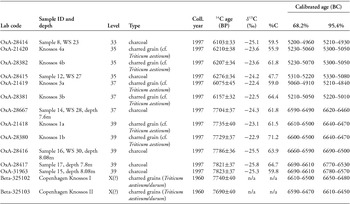
In the framework of the current dating project, 14 new AMS determinations were produced, ranging from 7.8–6.1 ka 14C BP, or 7.0–5.0 ka BC (Table 1). Twelve come from charcoal and charred seeds collected during the 1997 excavations (OxA codes) and two from charred Triticum aestivum/durum grains (Beta-325102, Beta-325103), previously stored in Copenhagen (National Museum of Denmark), most probably from the Aceramic Stratum X (1959–1960 season) (Figure 1) (see supplementary material for further information on sample provenance). All determinations were calibrated using the IntCal13 calibration curve (Reimer et al. Reference Reimer, Bard, Bayliss, Beck, Blackwell, Bronk Ramsey, Buck, Cheng, Edwards, Friedrich, Grootes, Guilderson, Haflidason, Hajdas, Hatté, Heaton, Hoffmann, Hogg, Hughen, Kaiser, Kromer, Manning, Niu, Reimer, Richards, Scott, Southon, Staff, Turney and van der Plicht2013). In order to evaluate how comparable the old and new radiocarbon data are, we constructed two separate Bayesian statistical models using the OxCal platform (Bronk Ramsey Reference Bronk Ramsey2009a). The stratigraphic information available for each sample formed the prior information employed in the Bayesian framework. Different outlier models (General, SSimple, Charcoal; Bronk Ramsey 2009b) were used to assess how the dates conform to the overall archaeological stratigraphy. A more detailed discussion on the results can be found in the supplementary material.
New AMS determinations from trench II at the Central Court of Knossos reported in the current study. The determinations come from two separate trenches excavated in 1959–1960 by J.D. Evans (trench AC) and in 1997 by Efstratiou and colleagues (trench II).

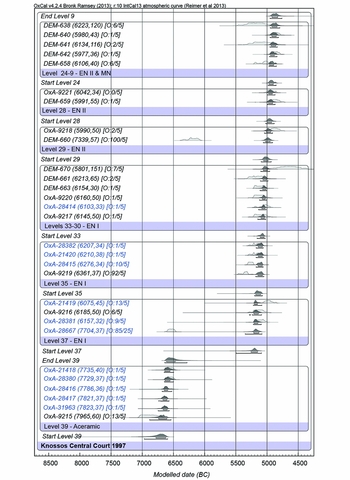
In the first calibration and Bayesian modelling exercise (Figure 3, Table S2), all dates from the 1997 excavations were used to compile the Bayesian framework (new dates from recent sampling are printed in blue). Of the 29 determinations only 3 are deemed to be outliers in the model (OxA-28667, OxA-9219, DEM-660). The start of the earliest Aceramic phase (level 39) is estimated at 6790–6620 BC (68.2%) or 6970–6590 BC (95.4%). The next reliable date (OxA-28381) from overlying level 37 places the beginning of EN I towards the end of the sixth millennium BC (5260–5150 BC at 68.2%, or 5500–5080 BC at 95.4%).
Calibration and Bayesian modelling of all available determinations from the Neolithic deposits recovered in the 1997 excavations. New AMS determinations are shown in blue. Previously published AMS determinations from the same trench are in grey. The posterior outlying likelihoods are given in square brackets; only three were identified as outliers (OxA-28667, OxA-9219, DEM-660; outlier probability >60%). Numerical values, and calibrated and modelled ranges can be found in Table S2.

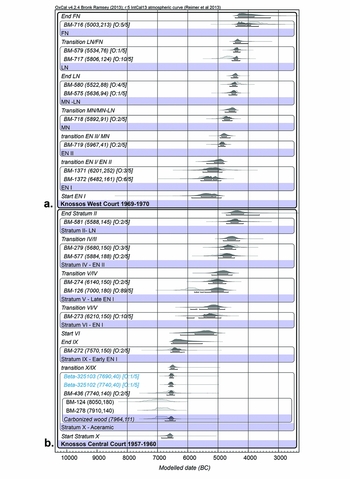
In the second model, 21 determinations from Evans's 1957–1960 and 1969–1970 excavations were used to build two separate sequences, the Central Court and the West Court series (Figure 4a & b, Table S3). Again the model is quite robust, identifying only one outlier (BM-126). This second model indicates that the start of the Aceramic phase in the 1957–1960 sequence (Central Court) falls between 6660–6520 (68.2%) or 6910–6480 BC (95.4%), which agrees well with the calculated start for level 39 in the 1997 trench. A statistical combination of both start boundaries (Stratum X and level 39) results in a weighted mean of c. 6800–6600 BC (6710–6610 BC at 68.2%, or 6810–6590 BC at 95.4% probability) (Table S4). The start of EN I in Evans's trenches is less precise due to the lack of AMS determinations, and was calculated at 5770–5140 BC (68.2%) or 6240–5030 BC (95.4%) for the 1957–1960 series, and 5570–5080 BC (68.2%), or 5890–4860 BC (95.4%) for the 1969–1970 series.
Calibration and Bayesian modelling of 21 radiocarbon determinations from the Neolithic deposits recovered from: a) the Central Court 1957–1960; and b) the West Court 1969–1970. The posterior outlying likelihoods are given in square brackets; only one was identified as an outlier (BM-126). AMS determinations produced on wheat seeds previously stored in Copenhagen, which lack definite stratigraphic assignation, are given in blue. Numerical values, and calibrated and modelled ranges can be found in Table S3.

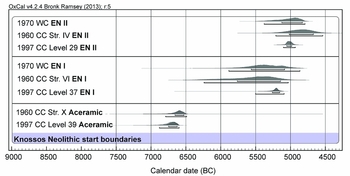
In order to assess the synchronicity of the different cultural phases across the site, we compared the boundaries obtained for the start of the Aceramic and the subsequent EN I and EN II in all excavation trenches where these layers were identified (1957–1960, 1969–1970 and 1997 campaigns) (Figure 5). There is a remarkable agreement in the beginning of these phases, which clarify not only the site's founding but also its development over time, especially with regard to the transition from the Aceramic to the EN I phase. It is worth noting that where new AMS determinations exist, there is a two/threefold improvement in the precision of these boundary estimates.
Probability distribution functions for the start boundaries corresponding to the beginning of the Aceramic, EN I and EN II phases of Knossos, in the separate trenches where these were identified (CC: Central Court; WC: West Court). The enhanced precision in the start boundary of Stratum X (Evans's excavations) compared to boundaries for the subsequent EN phases is due to the addition of two new AMS determinations from Stratum X Aceramic (see main text).

Discussion
The updated chronological framework for Neolithic Knossos elucidates two separate events in the life of the settlement: the foundation of the ‘pioneer site’ (Aceramic) and the subsequent establishment of the EN I village. Our results firmly place an early Knossian farming community in the first half of the seventh millennium BC. This securely pre-dates the ‘8.2 ka BP/6.2 ka BC’ climatic event and invalidates hypotheses suggesting that the Neolithic expansion across the Aegean was the result of a period of pronounced environmental cooling and aridity (e.g. Thissen Reference Thissen and Lichter2005; Weninger et al. Reference Weninger, Alram-Stern, Bauer, Clare, Danzeglocke, Jöris, Kubatski, Rollefson, Todorova and Van Andel2006, Reference Weninger, Clare, Rohling, Bar-Yosef, Böhner, Budja, Bundschuh, Feurdean, Gebe, Jöris, Linstädter, Mayewski, Mühlenbruch, Reingruber, Rollefson, Schyle, Thissen, Todorova and Zielhofer2009).
In the absence of evidence supporting the appearance of cultivates and domesticates on Crete as the result of a local pre-Neolithic process involving indigenous hunter-gatherers, the establishment of Knossos may be attributed to an intrusive movement of agropastoralists to the island (e.g. Cherry Reference Cherry1981, 1990; Broodbank & Strasser Reference Broodbank and Strasser1991). Archaeobotanical and zooarchaeological data, such as the lack of comparable endemic wild flora and fauna, corroborate this view (Horwitz Reference Horwitz, Efstratiou, Karetsou and Ntinou2013).
Highly skilled maritime activities are now well attested archaeologically, in both Neolithic and pre-Neolithic contexts across the eastern Mediterranean (Simmons Reference Simmons2014). Medium-range seafaring enabled the colonisation of Cyprus and is also reflected in the broad distribution of Melian obsidian across several Mesolithic localities throughout the Aegean, from Franchthi Cave (Perlès 2003) to Kerame in Ikaria (Sampson et al. 2012), the Youra islet (Sampson Reference Sampson2008) and Maroulas on Kythnos (Sampson et al. Reference Sampson, Kaczanowska and Kozłowski2010) (Figure 6). The possible Mesolithic presence at Plakias and other Cretan localities (Strasser et al. Reference Strasser, Panagopoulou, Runnels, Murray, Thompson, Karkanas, McCoy and Wegmann2010; Carter Reference Broodbank and Strasser2016) may also have been the result of maritime connections.
a) Map with key Neolithic settlements (red dots) mentioned in the text, in Greece (Knossos, Franchthi and Mavropigi) and western Anatolia (Çukuriçi, Barcın, Ulucak), showing the numerical age estimates for the earliest Neolithic occupation (95.4% probability). The green dots correspond to Mesolithic sites mentioned in the text; b) comparison of the start boundaries (Bayesian-derived probability distribution functions) for Neolithic sites shown on the map. The ‘combined’ start boundary for Knossos is the pooled probability distribution function for the two separate series of dates. The numerical values for these age ranges are given in Table S4.

The existence of maritime networks as far back as the late Mesolithic raises the question of Knossos’s overall position within the Neolithic Aegean landscape. As Broodbank (Reference Broodbank, Isaakidou and Tomkins2008) suggests, the traditional model describing the mechanisms behind the onset of a farming community on Crete involving the arrival of a small nucleus of farmers (n = around 50) bringing with them their domesticated plants and animals could be perceived either as an archaeological ‘oddity’ or as an ‘insular anomaly’. The recently recognised earlier colonisation of Cyprus between the late part of the tenth and first half of the ninth millennia BC (e.g. Klimonas, Shillourokambos), however, no longer renders Knossos such a curiosity.
We suggest that the spread of the farming communities across the Aegean, of which the founding of Knossos was part, was broad-fronted and did not bear the expected characteristics of an idiosyncratic, risky venture, undertaken by a small group of farmers who were ‘forced to leave’, as has often been depicted. Instead, it was the result of an (inter-) active migration brought forward by systematic contact between hunter-gatherers and early farmers, and facilitated by those pre-existing seaborne links. Our proposed scenario agrees with the recent assessment by Horejs et al. (Reference Horejs, Milić, Ostmann, Thanheiser, Weninger and Galik2015), who argue that, in addition to inland routes, the colonisation of the western Anatolian coastal zone also included maritime routes from the eastern Mediterranean to the eastern Aegean from 6700 BC onwards.
While mobility of farmers is almost certain when it comes to the foundation of Knossos, the direction of movement and source of origin of these farmers is difficult to establish. Early research on modern DNA haplotypes pointed to a connection between Crete and Anatolia (e.g. King et al. Reference King, Ozcan, Carter, Kalfoğlu, Atasoy, Triantaphyllidis, Kouvatsi, Lin, Chow, Zhivotovsky, Michalodimitrakis and Underhill2008), but the timing of this gene flow is not accurately known and could relate to larger, later population movements (e.g. Hughey et al. Reference Hughey, Paschou, Drineas, Mastropaolo, Lotakis, Navas, Michalodimitrakis, Stamatoyannopoulos and Stamatoyannopoulos2013). More recently, the most comprehensive study to date, involving ancient genomes of Early Neolithic Aegean farmers, corroborates very close genetic affinities between Anatolia and northern (mainland) Greece (Hofmanová et al. Reference Hofmanová, Kreutzer, Hellenthal, Sell, Diekmann, Díez del-Molino, van Dorp, López, Kousathanas, Link, Kirsanow, Cassidy, Martiniano, Strobel, Scheu, Kotsakis, Halstead, Triantaphyllou, Kyparissi-Apostolika, Urem-Kotsou, Ziota, Adaktylou, Gopalan, Bobo, Winkelbach, Blöcher, Unterländer, Leuenberger, Çilingiroğlu, Horejs, Gerritsen, Shennan, Bradley, Currat, Veeramah, Wegmann, Thomas, Papageorgopoulou and Burger2015); there is, as yet, no published data from Neolithic Crete.
Looking eastwards, an obvious source of origin of Knossian settlers would be the island of Cyprus, which was already occupied by Pre-Pottery Neolithic groups by the first half of the ninth millennium BC (Vigne et al. Reference Vigne, Briois, Zazzo, Willcox, Cucchi, Thiébault, Carrère, Franel, Touquet, Martin, Moreau, Comby and Guilaine2012). The import to Cyprus of non-endemic animals (sheep, goat, cattle, dog), possibly from Syria or the Euphrates River area (Guilaine et al. Reference Guilaine, Briois, Vigne and Carrère2000; Peltenburg et al. Reference Peltenburg, Colledge, Croft, Jackson, McCartney and Murray2000), is the earliest humanly induced introduction of animals to a Mediterranean island (Vigne et al. Reference Vigne, Carrère, Briois and Guilaine2011a & b) and may provide us with a template for the Neolithic transition on Crete. While Cyprus appears to have been a probable source for the origins of Knossian settlers about two millennia later, so far there has been no compelling evidence to support such movement. Some indication for contacts between foraging groups of the two islands during the early Holocene has recently been suggested (Kaczanowska & Kozłowski Reference Kaczanowska and Kozłowski2014). Archaeobotanical data highlight the similarities between the overall composition of the assemblage from Aceramic Knossos and other assemblages from sites in Cyprus (Colledge et al. Reference Colledge, Conolly and Shennan2004: S47), as well as sites farther afield, e.g. southern Levant (Colledge & Conolly Reference Colledge, Conolly, Colledge and Conolly2007: 70), providing additional impetus to explore alternative, coastal routes for the origins of the southern Aegean Neolithic.
In western Anatolia, until recently a terra incognita, the chronological record for the onset of the Neolithic is not dissimilar to that of Knossos. ‘Pioneer sites’ such as Çukuriçi Höyük (Horejs Reference Horejs, Özdoğan, Başgelen and Kuniholm2012), Ulucak (Çilingiroğlu et al. Reference Çilingiroğlu, Çevik, Çilingiroğlu, Özdoğan, Başgelen and Kuniholm2012) and Barcın Höyük (Gerritsen et al. Reference Gerritsen, Özbal and Thissen2013) were settled during the first half of the seventh millennium BC via land and possibly maritime routes along the Anatolian Aegean coast (M. Özdoğan Reference Özdoğan2011; E. Özdoğan Reference Özdoğan2015; Horejs et al. Reference Horejs, Milić, Ostmann, Thanheiser, Weninger and Galik2015). These sites reveal a more or less fully developed Neolithic record and an absence of Mesolithic or Pre-Pottery Neolithic remains. Other Anatolian sites (e.g. Aktopraklik, Ege Gübre, Araplı, Yesilova, Hoca Çesme) do not go back beyond 6500 BC, and hence are not considered here. In Figure 6, we compare the probability distributions for the start of the three aforementioned Anatolian sites, as derived from the Bayesian statistical modelling of all available determinations for each site (the dates and models are not included in this paper; numerical values are given in Table S4). All ranges are statistically comparable, with the sites of Çukuriçi and Barcın having been occupied slightly later than Ulucak. This synchronicity in the establishment of new coastal sites along the southern Aegean (Figure 6) may be taken as evidence of a consistent broader expansion of Neolithic lifeways towards new territories at around this time.
If we were to look westwards, to mainland Greece, Franchthi Cave is the earliest Neolithic occupation of comparable antiquity to that of Knossos (Perlès et al. Reference Perlès, Quiles and Valladas2013). In Figure 6, the modelled start boundaries obtained for Knossos are also compared to that of the Initial Neolithic Stratum at Franchthi. All three estimates overlap statistically, with that for level 39 of Knossos appearing to be slightly earlier in absolute terms. If we were to adopt the hypothesis that seafaring and organised coastal routes were also the mechanisms behind the arrival of domesticates and animal husbandry in southern mainland Greece (Perlès 2005, 2010), this overlap allows us to calculate the rate of the Neolithic expansion across the Aegean to mainland Greece between c. 6900/6800 and 6600 BC; this seems to have occurred within a couple of hundred years at most, perhaps as fast as a few human generations.
In central Greece, it has been suggested that Argissa Magoula, in Thessaly, contained both Aceramic and EN contexts, but the small number of conventional radiocarbon dates from the early 1970s (Protsch & Berger Reference Protsch and Berger1973) cannot be taken at face value without a re-assessment of the record and the undertaking of a new programme of AMS dating (Bloedow Reference Bloedow1992–Reference Bloedow1993; Reingruber Reference Reingruber2008; Reingruber & Thissen Reference Reingruber and Thissen2009). The Neolithic archaeological record of Thessaly is seen to reflect a different origin to that of southern Greece and Knossos, on the basis of crop types and animal husbandry patterns. More detailed work is required to establish the temporal framework and characteristics of the earliest Neolithic ‘package’ and its relationship to that from adjacent regions.
The earliest Neolithic record of northern Greece and Bulgaria, on the other hand, shows strong links with that of western Anatolia, both archaeologically and, more recently, in genetics (Hofmanová et al. Reference Hofmanová, Kreutzer, Hellenthal, Sell, Diekmann, Díez del-Molino, van Dorp, López, Kousathanas, Link, Kirsanow, Cassidy, Martiniano, Strobel, Scheu, Kotsakis, Halstead, Triantaphyllou, Kyparissi-Apostolika, Urem-Kotsou, Ziota, Adaktylou, Gopalan, Bobo, Winkelbach, Blöcher, Unterländer, Leuenberger, Çilingiroğlu, Horejs, Gerritsen, Shennan, Bradley, Currat, Veeramah, Wegmann, Thomas, Papageorgopoulou and Burger2015). Mavropigi Filotsaïri, a newly discovered site in northern Greece, has yielded important evidence of occupation at c. 6600 BC (Figure 6; Karamitrou-Mentessidi et al. Reference Karamitrou-Mentessidi, Efstratiou, Kaczanowska and Kozłowski2016) and is therefore directly relevant to the spread of the Early Neolithic into mainland Europe. The modelled start boundary for Phase I of Mavropigi is compared against Knossos, Franchthi and the three Anatolian sites (Figure 6). With compatible radiocarbon chronologies as shown in Figure 6, a model of multiple origins and diverse routes for the introduction of the Neolithic in Europe (e.g. Perlès et al. Reference Perlès2001), either via Thrace and/or through the Peloponnese and Thessaly, is highly probable. Most other Early Neolithic sites in mainland Greece (Nea Nikomedeia, Sesklo, Achilleion, Dikili Tash, Paliambela) were established c. 200–400 years after the earliest occupation of Knossos.
Returning to Crete, the lifespan of the Knossos founder village was short; it seems to have lasted from a few years up to a maximum of 400 calendar years—or anywhere between 1–15 human generations (at 95.4% probability). Such a short period of time is comparable to the estimate for the earliest Neolithic activity of Cyprus (Cypro-PPNA period) calculated to last at most c. 280 calendar years (95.4% probability) (Manning Reference Manning2014).
Following the end of the Aceramic phase, our results indicate the presence of a considerable time gap until the onset of the EN I occupation. The gap is observed in both series of determinations presented here, yet it has not been easily attested in the stratigraphic sequence of the site. Evans detected at places a very distinct interface between the surface of the Aceramic deposit and the EN I material above (Evans 1971: 102). In the Bayesian model that includes the dates from the 1969–1970 material, a temporal gap is observed between the end of EN I Stratum IX and the start of EN I Stratum VI (Figure 4). Stratum IX is dated with a single conventional date (BM-272: 7570±150 BP) calibrating to c. 6600–6100 BC, whereas all other determinations for subsequent EN strata indicate an age in the fifth millennium BC. In the 1997 excavation, the first EN I level (37), lying directly on top of Aceramic levels 39–38, incorporates three dates, one of which calibrates to c. 6600–6400 BC, and the other two at c. 5000 BC. The ‘asynchrony’ in the position of the long gap in the two sequences must relate to taphonomic disturbance and material mixing, as the presence of EN pits cutting through the Aceramic layer is confirmed in both sequences.
Using the Bayesian models constructed for the two series, we have calculated the numerical duration of this gap; in the 1997 sequence this is between 950–1500 calendar years (94% probability, from the end of level 39 to the start of level 37), while in Evans’s series it is estimated to be up to 1100 calendar years (94% probability, from the end of level IX to the start of level VI). The gaps in these sequences have previously been interpreted as a real hiatus in the occupation of the site, reflecting the non-permanent character of the earliest Aceramic settlement, or as a result of changes in the settlement's spatial organisation and extent.
The EN I phase, starting at the first half of the sixth millennium BC (Tables S2–S3), reflects a moderate expansion (e.g. Katsianis Reference Katsianis and Stadtarchäologie2004), spatial re-organisation and re-structuring of the settlement, and demonstrates intense habitation features and the introduction of pottery. These early ceramics are characterised by impressive plurality in fabrics and tempering, maturity in technological characteristics, and a fully developed pottery tradition (Evans Reference Evans1964; Tomkins 2007). The sudden appearance of pottery in the material culture of Knossos cannot be easily explained as the outcome of internal processes in the evolution of the pre-pottery farming community. Instead, one may again hypothesise the impact of external influences, whether within the island, for example, as a function of local and circum-local exchanges resulting in community expansion, or from farther afield, in the form of an influx of new settlers bringing pottery and technological knowledge. Against the first hypothesis lies the absence of any sites of similar antiquity to that of Knossos within Crete itself. In favour of the second possibility is the archaeological evidence for frequent seafaring activities in the eastern Mediterranean, which, as already argued, reflect a wider maritime network, established by hunter-gatherers since the beginning of the Holocene and maintained for several millennia during the Neolithic period to serve numerous purposes: exploration of new lands suitable for colonisation/cultivation, exchange with indigenous (foraging) populations or other agro-pastoralists, raw material procurement and fishing.
Conclusions
Over a century since its discovery, the Neolithic occupation at Knossos remains unique in its extent, organisation, subsistence strategies and, importantly, its early age in the context of the Aegean and European Neolithic. The excavations of the 1950s and 1960s revealed that the site's rich Neolithic layers recorded the onset and development of farming and animal husbandry on Crete. The rescue work conducted in 1997 enabled the detailed documentation of the stratigraphic sequence and its expansion along the eastern edge of the Minoan Central Court. This latter effort also provided well-provenanced material for scientific analysis, such as the charcoal and seeds used for the new AMS determinations presented here. The new chronology corroborates the previously established framework. There is, however, enhanced precision through the application of AMS dating to short-lived material from secure contexts, as well as, for the first time, the development of Bayesian models containing all radiocarbon determinations from Neolithic Knossos. This allows the comparison of the new chronology with other recently dated sites across the Aegean.
Knossos was first occupied at the beginning of the seventh millennium BC (6900–6600 BC at 95.4% probability). Given that pre-Neolithic groups were, if not completely absent from the island, certainly not numerous, the new settlers must have originated from outside Crete, and brought domestic animals and plants with them. The lifespan of this founder village did not exceed a few centuries, c. 200–400 years (at 95.4% probability). The large temporal gap that followed, registered in the radiocarbon record (1000–1500 years), although not always visible in the stratigraphic sequence, marked the transition from the Aceramic to the pottery-bearing Early Neolithic period, and points to two possibilities, either the translocation of the entire Aceramic community to an as yet undiscovered site, or a long period of abandonment before reoccupation. The former remains a slim possibility, given that several systematic attempts have failed to locate another equally early Neolithic presence on Crete. The latter scenario may have involved a second influx of farmers arriving on the island, bringing with them a fully fledged pottery tradition. The EN I phase of the settlement is characterised by evidence for greater permanency in its construction and significant expansion attested by its size and the remarkable diversity in its material culture. This latter scenario finds exact parallels on Cyprus, where at least two colonisation events have thus far been identified.
The decline of the Aceramic founding village and the long gap until the subsequent establishment of the pottery-bearing settlement may be interpreted as a failed early attempt to establish the Knossian community. In the absence of direct genetic or other relevant data concerning the two periods, we prefer to remain agnostic. The multiple-wave hypothesis for the colonisation of Crete implies that this was not an isolated, casual event, but rather the result of broadening maritime transport networks, which were efficiently maintained for several millennia. The island-hopping and medium-range seafaring activities of Mesolithic hunter-gatherers would have brought them into contact with previously secluded areas, including farming lands, leading to the relocation of agropastoralists to new regions such as Crete shortly after 7000 BC (Aceramic), and again about a millennium later, c. 5700/5500 BC (EN I). The use of the same source of Melian obsidian both by Mesolithic and Early Neolithic groups serves to illustrate this.
In both periods (Aceramic and EN I), the solitariness of Knossos is counterbalanced by its strategic position within an increasingly connected Aegean world that secured against isolation. We acknowledge that a robust chronology for a single site cannot explain the intricacies involved in the developmental processes leading to the Neolithic transition in the Mediterranean basin and continental Europe in the following millennia. We hope, however, that the present work offers a significant step towards deeper understanding of the succession of events, their timing and duration, which led to the adoption of a sedentary, farming lifestyle on Crete and in the rest of the Aegean. Further research focusing on reconstructing the full genetic signature of the pioneering Knossian farmers will elucidate the genetic link with those from surrounding regions, including Anatolia, the Levant, Cyprus and mainland Greece.
Acknowledgements
Funding for the dating aspect of this work was provided by the Oxford University Fell Fund (to KD) and a NERC grant (‘Out of Asia’ project, PI: Glynis Jones, University of Sheffield, UK). Glynis Jones is kindly thanked for her help. The British School at Athens provided additional support in the framework of an Early Career Fellowship to KD (2013) and is thanked.
Supplementary material
To view supplementary material for this article, please visit https://doi.org/10.15184/aqy.2017.29