Introduction
The Jovel Valley is located in highland Chiapas on the western frontier of the Maya cultural area, a region of interregional and intercultural contacts, influences and exchanges. Its position on the edge of the Tzotzil and Tzeltal Mayan-speaking highlands, to the east of the traditionally Zoquean-speaking occupants of Western Chiapas and the Central Depression and the Chiapanec-speaking occupants of the Middle Grijalva during the Postclassic period, made this region an economic and cultural crossroads. As such, its inhabitants developed numerous exchange relationships with distant polities and cultural groups and served as intermediaries within multiple trade networks.
In this study, we identify artifacts that reflect long-standing relationships between Jovel Valley residents and Gulf Coast polities. Significant differences in the ultimate depositional contexts of these objects illustrate the evolving nature of interventions of Gulf Coast and Central Mexican ideas and objects into highland Maya material culture during the Postclassic period, as well as differences in how Jovel Valley residents curated or discarded Gulf Coast-linked objects.
We also observe the diversity represented in the Gulf Coast region itself, with implications for shifting influences and exchanges over time. The western Gulf Coast spans the area that is currently associated with modern Veracruz, from the Sierra de los Tuxtlas northwest through the Sierra de Otontepec (Martínez de León Mármol Reference Martínez de León Mármol2011, 35). During the Classic and Postclassic periods, this area was associated with the Teeneks (Huastecs), the descendants of a Maya group that arrived to the western Gulf Coast (Zaragoza Ocaña Reference Zaragoza Ocaña, Faust and Richter2015, 59). During the same period, the eastern Gulf Coast of northern Tabasco and southwestern Campeche was associated with the Putun or Chontal Maya (Scholes & Roys Reference Scholes and Roys1957; Zaragoza Ocaña Reference Zaragoza Ocaña, Faust and Richter2015, 59), and also had strong stylistic ties with the northwest Maya area of northeast Chiapas and Tabasco, particularly sites such as Palenque.
Material culture, style, and social memory
The identification and interpretation of objects of non-local style and/or provenience is central to innumerable archaeological inquiries regarding the meanings of objects, their use in constructing political arguments and the degree to which these meanings and arguments were contested within societies (Schortman & Urban Reference Schortman and Urban2011, 6). For example, artifact styles actively or passively communicate information about cultural identities, sociopolitical boundaries and the class/status of their owners (Conkey & Hastorf Reference Conkey and Hastorf1993; Golden et al. Reference Golden, Scherer, Muñoz and Vasquez2008; Reents-Budet et al. Reference Reents-Budet, Bishop, Taschek and Ball2000; Sackett Reference Sackett1982; Wiessner Reference Wiessner1983; Wobst Reference Wobst and Cleland1977) and/or the artists and crafters who produced them (Inomata Reference Inomata2001). Particular artifact styles have also been used to identify economic organization more broadly, with respect to the degree and nature of craft specialization (Blackman et al. Reference Blackman, Stein and Vandiver1993; Costin Reference Costin1991); elite control over exchange (Brumfiel & Earle Reference Brumfiel, Earle, Brumfiel and Earle1987; D'Altroy & Earle Reference D'Altroy, Earle and LeVine1992); the identification of market exchange (Hirth Reference Hirth1998; Minc Reference Minc2006; Reference Minc2009; Stark & Ossa Reference Stark, Ossa, Garraty and Stark2010); the identification of elite gift-giving and alliance-building (Foias & Bishop Reference Foias and Bishop1997; LeCount Reference LeCount1999; Reents-Budet & Bishop Reference Reents-Budet, Bishop, Pillsbury, Doutriaux, Ishihara-Brito and Tokovinine2012; Schortman et al. Reference Schortman, Urban and Ausec2001); and political complexity more broadly (Clark & Parry Reference Clark, Parry and Isaac1990). The creation of hybrid styles and decorative motifs, and their deployment in ways that suggest syncretism of different traditions and belief systems, can identify items designed to manifest non-local innovations for a local audience (Lightfoot & Martinez Reference Lightfoot and Martinez1995, 485), or that were designed to resonate with multiple types of viewers across transportation routes and exchange networks (Boone & Smith Reference Boone, Smith, Smith and Berdan2003).
Numerous interpretive challenges hinder the interpretation of inter-polity dynamics from material culture, including the identification of polity boundaries, ethnic boundaries and/or linguistic boundaries (Hall Reference Hall2009, 27; Parker Reference Parker2006). Political and social identities are constantly negotiated and renegotiated, changing through space with time (Hall Reference Hall2009). This is particularly associated with sites located in frontier zones, which represent cultural interfaces with cross-cutting and overlapping social networks that can be defined and recombined at different spatial and temporal scales (Lightfoot & Martinez Reference Lightfoot and Martinez1995, 472). As such, the material culture of frontier zones frequently exhibits blurred and hybridized material expressions of cultural identity, as goods, ideas and people are transported and translated across the frontier over time. Cross-cultural exchange relationships can also serve to hybridize material culture assemblages, through gift exchange among elites, and/or commercial exchange among elites and commoners alike. Schortman and colleagues (Reference Schortman, Urban and Ausec2001, 313) note that aspiring elites frequently draw on exotic objects and ideas in their rise to power, and distinguish themselves from the rest of the population. To do so, they may develop a shared elite identity that cross-cuts political frontiers, accompanied by mutually beneficial trade and gift exchange (Schortman et al. Reference Schortman, Urban and Ausec2001, 313). Elites in political capitals may also use particular types of goods and styles to project their power into or through borderlands (Parker Reference Parker2006, 88).
The translation of cross-cultural materials can occur in multiple archaeologically visible instances. In the moment of creation, translation can occur when a crafter creates an object that mimics or hybridizes the stylistic attributes of a non-local object that has caught their attention (Lightfoot & Martinez Reference Lightfoot and Martinez1995). In moments of acquisition, a cross-cultural item is acquired through exchange and is adapted into a specific context of use by its new owner(s). In moments of modification, new owner/crafters may modify the appearance of a cross-cultural object in ways that further hybridize its cultural meaning and use. Finally, in moments of removal, the meaning of the cross-cultural object is translated again when it is taken out of circulation; this may be done in two principal ways (Schortman & Urban Reference Schortman and Urban2011, 6). Removal may serve as a dedicatory act, linked to processes of offering, commemoration and celebration, that serves to enhance the connections represented by the object, and place it among a group of inalienable objects used to legitimate identity and authority (Kovacevich & Callaghan Reference Kovacevich, Callaghan, Kovacevich and Callaghan2014; Weiner Reference Weiner1992). Dedicatory acts related to the preservation of memory may also include fabricating or restoring buildings, repairing or reworking valuable objects and interring objects in sacred spaces (tombs, caches, caves); these actions can provide physical frames for teaching and performing the past (Hendon Reference Hendon2000; Reference Hendon2010; Meskell Reference Meskell, Van Dyke and Alcock2003). In contrast, removal can take the form of an erasure act: that is, the destruction or obstructing the use of materials previously used to invoke memory and political connections (Canuto & Andrews Reference Canuto, Andrews, Stanton and Magnoni2008; Elsner Reference Elsner, Nelson and Olin2003; Flower Reference Flower2006; Joyce et al. Reference Joyce, Bustamente and Levine2001; Mills Reference Mills, Mills and Walker2008). In pre-Hispanic Mesoamerican contexts, certain acts of destruction are identified as ‘termination rituals’, linked to ritual belief systems and aimed at destroying the supernatural power of ensouled objects, buildings and individuals (Ambrosino et al. Reference Ambrosino, Ardren, Stanton, Brown and Stanton2003) through the intensive burning, smashing, or battering of architecture, monuments and material culture, the purposeful disturbance of preexisting burials or caches, and the scattering of material remains over wide areas (Pagliaro et al. Reference Pagliaro, Garber, Stanton, Brown and Stanton2003, 79). However, other acts of erasure were more casual and subtle, such as depositing once-valuable objects into architectural fills and middens.
Moxviquil
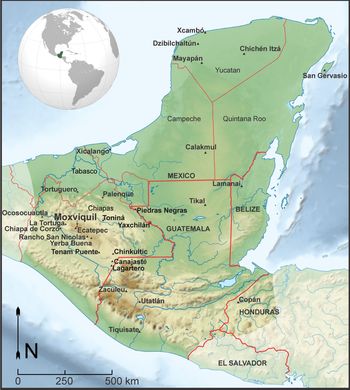
Moxviquil is a small urban centre located on the northern edge of the Jovel Valley, the location of the modern city of San Cristobal de las Casas, Chiapas, Mexico (Fig. 1). The Jovel Valley is the largest intermountain valley in the Central Plateau of highland Chiapas, making it a strategic location for pre-Hispanic settlement. While archaeological projects in the central highlands (Adams Reference Adams1961; Blom & Weiant Reference Blom and Weiant1954; Culbert Reference Culbert1965; Lee Reference Lee1985; McVicker Reference McVicker1969; Reference McVicker1974; Weiant Reference Weiant1954a,Reference Weiantb), including our own (Paris Reference Paris2012; Paris & López Bravo Reference Paris and López Bravo2013; Reference Paris and López Bravo2017) have identified numerous sites in the valley, Moxviquil is the largest and best-documented. Frans Blom and Clarence Weiant conducted excavations at the monumental centre in 1952–53, while our own project, the Proyecto Económico de los Altos de Chiapas (2009–present), has focused on the survey and excavation of outlying residential areas.
The Maya cultural region with sites mentioned in the text. (Map: Elizabeth Paris, from base map by Wikimedia Commons.)

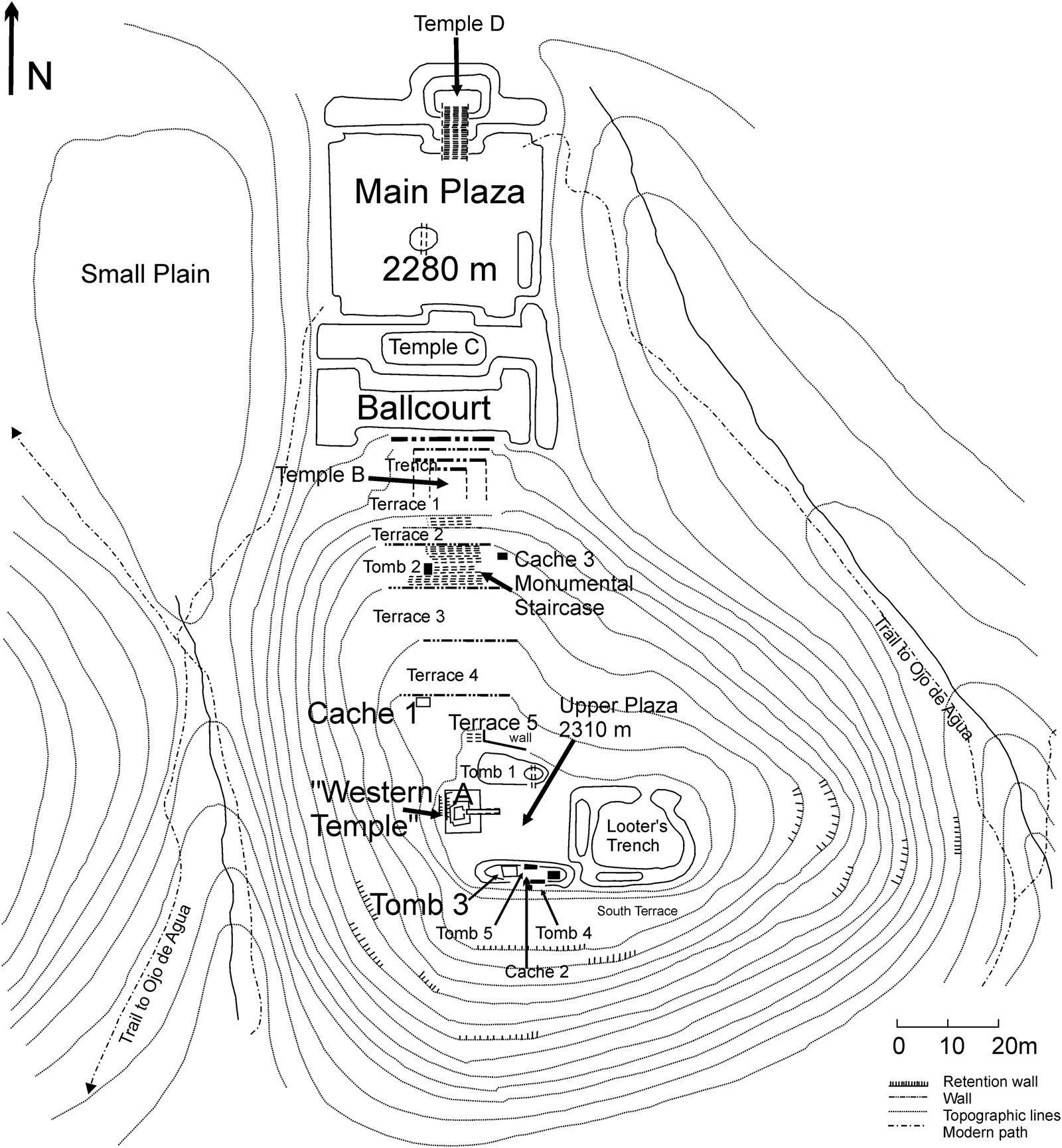
The monumental centre was constructed during the Late Classic period (Fig. 2), a period of prosperity in highland Chiapas. Like other civic precincts in the region dating to this period (see Adams Reference Adams1961; Culbert Reference Culbert1965; McVicker Reference McVicker1969; Paris et al. Reference Paris, Taladoire, Lee, Esponda Jimeno, Morales Bermúdez and Gutiérrez Alfonzo2011; Reference Paris, Taladoire and Lee2015), Moxviquil was built on the apex and slope of a large hill, with a north–south axis that is characteristic of many Late Classic Maya monumental zones (Ashmore & Sabloff Reference Ashmore and Sabloff2002). The Upper Plaza, a small quadrangle group at the apex of the hill, likely was the residence of the local ruling family (Blom Reference Blom1952a,Reference Blomb; Weiant Reference Weiant1954a,Reference Weiantb). Descending the slope to the north of the plaza were five artificial terraces connected by a large monumental staircase. The terraces supported residential structures consisting of low stone foundations surrounded by household midden refuse and lithic production debris. The saddle at the base of the hillside contained spaces and structures that served important public and religious functions: an I-shaped ball-court, a large main plaza and three small temples.
The Moxviquil monumental centre with the marked location of Cache 1, Tomb 3 and the Western Pyramid. (Map: Elizabeth Paris, from the original by Frans Blom, courtesy of the Museo Na Bolom.)

Moxviquil underwent significant population growth during the Early Postclassic period. Numerous structures were built on a hilltop to the west of the civic precinct, including a large, sub-royal elite residence and numerous smaller structures suggestive of commoner houses associated with high densities of utilitarian items. While the occupation at the monumental centre (as reflected in diagnostic ceramics) was roughly equivalent for the Late Classic (32.17 per cent) and the Early Postclassic (34.99 per cent) periods, new settlements on neighbouring hilltops were mostly constructed and inhabited during the Early Postclassic period (96.69 per cent: see Paris Reference Paris2012; Reference Paris2014; Paris & López Bravo Reference Paris and López Bravo2018; Paris et al. Reference Paris, Taladoire and Lee2015).
The Moxviquil hacha and yugo
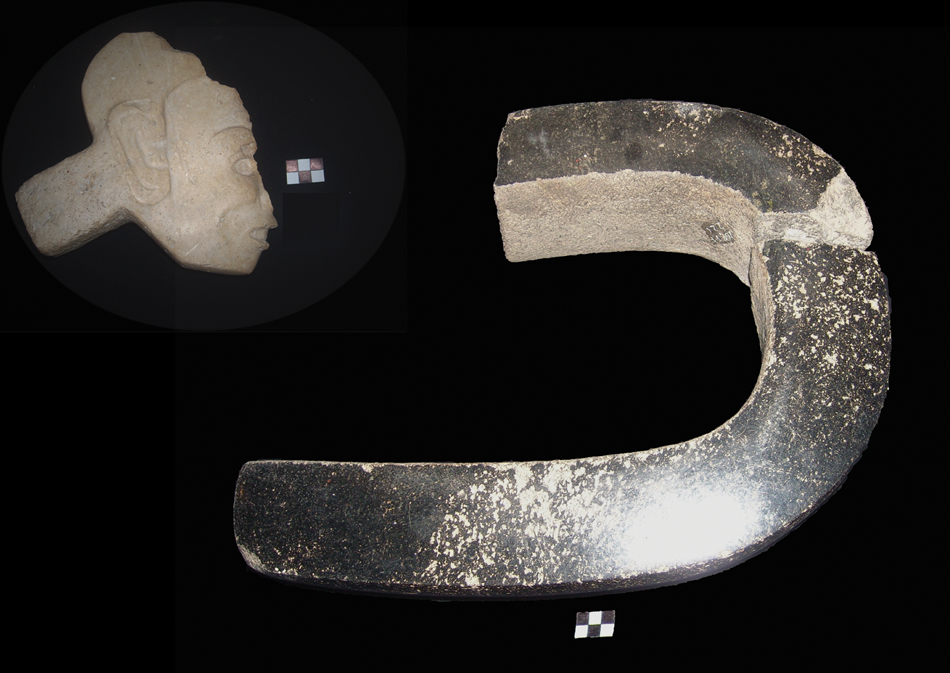
The earliest-known Gulf Coast-linked objects at Moxviquil are two ground stone artifacts traditionally associated with the western Gulf Coast region of Central Veracruz. These include an hacha depicting a human face and a large basalt ball-game yugo [yoke] (Fig. 3). Both items are stylistically associated with the yugo-hacha-palma complex, which originated in the sculptural traditions of Late Classic central Veracruz (Ekholm Reference Ekholm1946; Reference Ekholm1949; Shook & Marquis Reference Shook and Marquis1996, 63). While they represent a type of portable sculpture, their exact purpose is uncertain (Shook & Marquis Reference Shook and Marquis1996, 2). Scholars have suggested uses for yugos ranging from actual ball-game paraphernalia (Lothrop Reference Lothrop1923; cf. Thompson Reference Thompson1941) to ceremonial representations of ball-game paraphernalia (Ekholm Reference Ekholm1946) to moulds for leather yugos (De Vries Reference De Vries1988); and have suggested uses for hachas including handstones (Borhegyi Reference Borhegyi1964; Reference Borhegyi1967, cf. Clune Reference Clune1963) and belt ornaments (Ekholm Reference Ekholm1949). Yugos are most commonly interpreted as stone representations of the yoke-shaped hip padding worn by players of the pre-Columbian ball-game, as depicted on carved lintels and ceramic figurines (Hellmuth Reference Hellmuth1987).
The hacha and yugo from the Moxviquil monumental centre. (Photographs: Elizabeth Paris.)

Both the hacha and yugo were recovered from the monumental centre. The hacha was recovered in the fill beneath the stairs of the ‘Western Pyramid’ of the Upper Plaza (Weiant Reference Weiant1954a, 31), actually a small, three-tiered structure topped by a rectangular building with low masonry walls that supported bajareque [wattle-and-daub] walls and a thatched roof. The rear portion of the structure contains a large bench, the only one at the site, which may have served as a throne for the rulers of the site. We still lack an exact provenience for the yugo, but it is part of the collection of artifacts recovered by Blom and Weiant from the monumental zone.
Notably, the hacha was deposited within the fill of the Western Pyramid during an earlier phase of construction; this suggests that it was terminated and discarded prior to the structure's final building phase, relatively early in the monumental centre's history. Archaeometric dates for the deposit are unavailable, but the ceramics of the Upper Plaza depositional contexts (Paris Reference Paris2014; Paris et al. Reference Paris, Taladoire and Lee2015) suggest a transitional Late Classic to Early Postclassic period date. Similarly, Shook and Marquis (Reference Shook and Marquis1996, 11) hypothesize a temporal provenience for hachas and yugos found in southern Mesoamerica from the Terminal Late Classic period to the beginning of the Early Postclassic period (ad 800–950), which suggests that the items at Moxviquil were discarded after this period. Additionally, both the Moxviquil hacha and yugo were discarded with seeming intent towards termination. The anterior portion (the face) of the hacha was severely cracked and chipped, while the yugo is broken in two places (medially, and at one distal end, which is missing); although we cannot confirm it, we suspect that this happened in antiquity, since the distal end section is not present in the Na Bolom collection. The damage to these items would have taken deliberate effort, due to the highly durable nature of the raw materials, suggesting a specific objective of erasure.
Stone sculptures from the yugo-hacha-palma tradition have been identified at sites throughout southern Mesoamerica (Shook & Marquis Reference Shook and Marquis1996, 2). Many specimens were likely traded into the region from the Gulf Coast, while others show Maya stylistic influence, such as hieroglyphics and stylistic features, and may have been carved locally (Shook & Marquis Reference Shook and Marquis1996, 2). Stone yokes are common in the Basin of Veracruz, although few have been recovered from controlled excavation (Daneels Reference Daneels, Stark and Arnold1997, 238). In both the western Gulf Coast (Veracruz) and in southeast Mesoamerica (Pacific Coast and highland Guatemala), these items were often deposited into elite tombs and caches (Daneels Reference Daneels, Stark and Arnold1997; Shook & Marquis Reference Shook and Marquis1996, 6). Other specimens have been recovered as surface debris and excavation fill, such as the fragments of approximately 15 yugos from the palace at Palenque (Cruz Romero Reference Cruz Romero2012; Shook & Marquis Reference Shook and Marquis1996, 7).
While hachas and yugos are less common in Chiapas when compared to highland Guatemala, a number of examples are known. Edwin M. Shook recorded an hacha fragment in the Othon Schlie Collection in San Cristóbal de las Casas in 1951, of unknown provenance (Shook & Marquis Reference Shook and Marquis1996, no. H65). Other examples from central Chiapas have been documented at Ocozocouautla and Maravillas in the Central Depression; from Tablón and Santa Inés in the western Sierra Madre range; from Paredón on the western Pacific Coast; and from Preciosa in the Tzeltal-Chol-speaking portion of northeast Chiapas (Cruz Romero Reference Cruz Romero2012; Shook & Marquis Reference Shook and Marquis1996). Shook and Marquis (Reference Shook and Marquis1996, 45) also recorded three other unprovenienced examples (Y90, Y91, Y92) in the collections of the Museo Regional de Chiapas in Tuxtla Gutierrez. Sheseña and Lee (Reference Sheseña and Lee Whiting2004) also report three yugos from a private collection, said to be from Bolonk'in in northeast Chiapas, including two plain yugos and a third with a hieroglyphic inscription linking it to the dedication of a ball-court at Toniná around ad 696.
The Moxviquil hacha was made of fine-grained limestone and is carved in the shape of a human head, with a ‘rear tenon’-style mounting area in which the mounting area is approximately perpendicular to the orientation of the face, which may have permitted it to be inserted into portable mounts (Shook & Marquis Reference Shook and Marquis1996, 66). As with most other hachas, the face is carved on both surfaces of the stone, with the front axe-edge forming the profile. The specimen lacks macroscopically visible evidence of paint or inlays. Unfortunately, the geological provenience of the hacha has not been identified; given the karstic geography composing much of the Maya area, it could include any number of sources.
The hacha has a number of traits that are commonly associated with the deity Xipe Totec in Classic Period Veracruz artwork. The Moxviquil example possesses characteristics of Xipe Totec that represent flayed skin stretched over a human face: flaring cheeks; a large ear carved in low relief which sits flat against the head; an open mouth with a well-defined circumferential line around the lips; thin, arched eyebrows; short, cropped hair; and small, round, hollow eyes. Xipe Totec is one of the most represented deities in hachas, and examples are known from at least 26 hachas from El Salvador and the Pacific coast of Guatemala (Shook & Marquis Reference Shook and Marquis1996, 189), although this is the only currently identified example from Chiapas. Although several authors (Hosler Reference Hosler1995; Roskamp Reference Roskamp2010) have suggested a West Mexican origin (Guerrero or Jalisco) for Xipe Totec, the widespread worship of this deity in central Veracruz (Mencos Reference Mencos, Arroyo, Linares and País2010), combined with the central Veracruz origin of the hachas themselves, suggests a Gulf Coast origin for the introduction of both the hacha and its iconography into the material culture of Moxviquil.
The yugo is made of fine-grained basalt; it is almost pure black in colour, and is heavily polished on the dorsal surface, while the lateral surfaces are finely pecked, but remain unsmoothed and unpolished. It is completely plain, with unbevelled edges, and is broken in two places; one distal end is missing completely. The plain style is common among the forms described by Shook and Marquis (Reference Shook and Marquis1996, 37). Provenience studies have not yet been carried out to identify the source of the basalt used to manufacture the yugo; however, it appears to be non-local, because basalts and andesites from the Chiapanecan Volcanic Arc are generally light grey or brown, with coarse-grained textures (Mora et al. Reference Mora, Jaimes-Viera, Garduño-Monroy, Layer, Pompa-Mera and Godinez2007).
The Moxviquil incense-burner covers
Blom and Weiant's excavations in the monumental zone revealed a number of tombs and caches; among the offerings from Tomb 3 are two anthropomorphic incense-burner covers. These objects display stylistic influences from the eastern Gulf Coast, particularly lowland northern Chiapas and eastern Tabasco, and reflect the motifs of Late Classic period Maya iconography from this region (Lee Reference Lee1985; Paris et al. Reference Paris, Taladoire and Lee2015). The lids were found together in the tomb, along with an anthropomorphic figure with a bird headdress, a Provincia Plano-relief (Balancán/Z Fine Orange) annular base bowl, a ball-player figurine in full regalia (missing its head), five olive-shell tinklers and a small ground stone mano, along with a juvenile tibia and human skull fragment, likely representing a secondary interment. The tomb itself was a rectangular masonry structure, located below a plaster floor in the South Mound of the Upper Plaza of the monumental centre. The South Mound was a large rectangular structure that was likely the residence of Moxviquil's ruling elites, and sits adjacent to the Western Pyramid (see Fig. 2). Based on the temporal provenience of Balancán Fine Orange (Smith Reference Smith1958), the tomb's final offering was dedicated no earlier than the Late Classic–Early Postclassic period transition (see below). Along with the other tomb offerings, the lids were objects of veneration. During their use life, they were transformed from incense-burner lids that likely served in sacred rituals for the living to their final role as funerary objects dedicated as part of a second type of sacred ritual; along with the tomb's occupant, they served a commemorative ritual function, and were probably not entirely forgotten. The tomb's location below the floor of a likely residence of the ruling elite, and the other rich offerings it contained, suggest that its occupant may have been a young member of the ruling family.
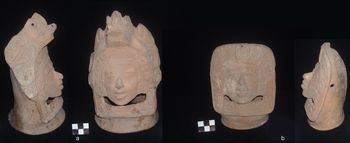
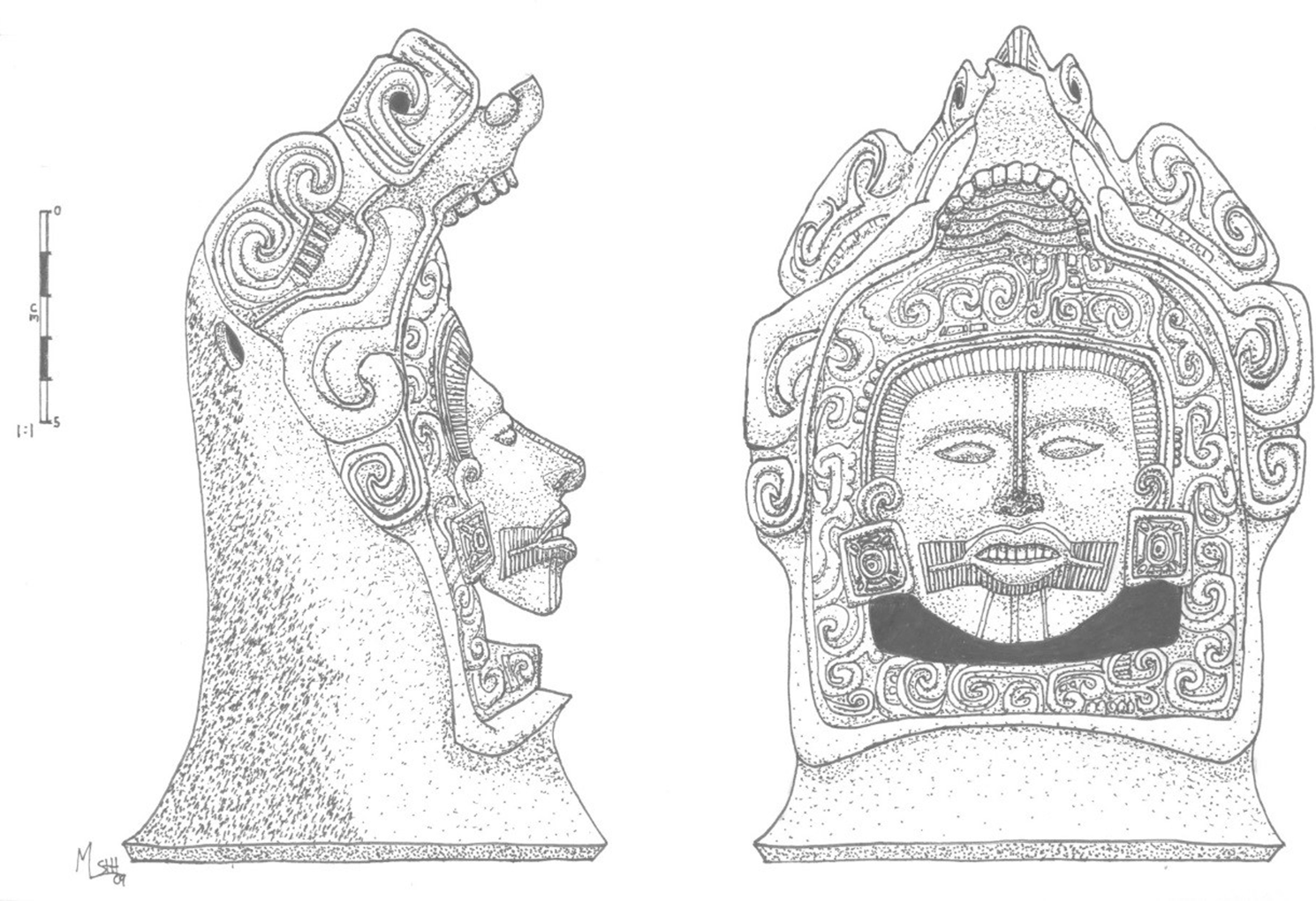
The two lids are highly similar in size and style; both depict human faces emerging from a band of swirling elements (likely smoke or clouds). At the bottom of the band, emitting the scrolls from its mouth, is a stylized Imix monster, as has been observed on the Palenque incense burners (Cuevas García Reference Cuevas García2007, 168). One of the anthropomorphic faces emerges from the mouth of a hybridized animal (Figs. 4a & 5): the scroll motif beneath the eye and the superior portion of the snout are characteristic of the portrayals of snakes in Maya art, specifically the fer-de-lance with its upturned snout and large nostrils; the square incisors of the dental arcade and ridged palate are characteristic of Baird's tapir (Tapirus bairdii). Tapir species are associated with warm, tropical lowland forests rather than the Central Highlands; however, they are represented in faunal assemblages of lowland regions immediately to the west and east, in the Central Depression at Chiapa de Corzo (Flannery Reference Flannery and Lee1969, 210) and in the Comitán Plateau at Tenam Puente (Zúñiga-Arellano Reference Zúñiga-Arellano and Liendo Stuardo2008, table 1). The mandibles of the snake and tapir are not depicted; the lower edge of the ‘jaw’ is formed by the rectangular motif with cloud scrolls. The second one depicts an anthropomorphic face emerging from a rectangular band of swirling elements that may represent smoke or clouds (Fig. 4b).
Anthropomorphic incense-burner cover from Tomb 3, depicting (a) a human face emerging from the mouth of a serpent with hybridized features and (b) a human face emerging from a band of swirling elements, likely smoke or clouds. (Photographs: Elizabeth Paris.)

Anthropomorphic incense-burner cover from Tomb 3, depicting a human face emerging from the mouth of a serpent with hybridized features. (Drawing: Maxime Lamoureux-St. Hilaire for the Proyecto Económico de los Altos de Chiapas.)

Both of the faces have sloping foreheads, suggesting tabular oblique cranial deformation (Tiesler Reference Tiesler2012), and large, square earspools. They have identical rectilinear designs, which may be facial tattoos, paintings or scarring, with a horizontal band across the cheeks and lips and a vertical band from the hairline to the tip of the nose. The hairstyles are depicted as straight across the forehead and down to the ears, suggesting that the hair was pulled back under a headdress. The lids contain traces of Maya Blue (e.g. Arnold Reference Arnold2005; Shepard Reference Shepard1962), suggesting that they were originally painted with the colour on most or all of the anterior surface.
The faces and rectangular band elements on the lids were made using open moulds. Both objects are hollow, with multiple perforations in both the front and rear surfaces to allow smoke from burning incense to escape. The bases of the lids are small and ellipsoid, measuring 12.7 × 11.4 and 9.0 × 7.0 cm. The only incense-burner body elements identified at Moxviquil to date are frying-pan style, but the incense-burner lids were likely associated with stationary braziers. No body sherds have been recovered at Moxviquil that match the lids in terms of their distinctive light-red paste (rare at the site, and in highland Chiapas generally: Paris Reference Paris2012) which could plausibly have formed the body of the incense burner itself.
The figures have forms of body modification suggestive of elite status, and they may represent the ancestor spirits. The theme of the face emerging from the mouth of a serpent is well known in Maya art, perhaps most famously in the Yaxchilan lintels in northeast Chiapas (Schele & Freidel Reference Schele and Freidel1990). The features and proportions of the faces have some similarity to those of human figures depicted on cylindrical censer stands at Palenque and its region (Cuevas García Reference Cuevas García2007, 59), and also some Jaina Island figurines (McVicker Reference McVicker2012, figs 5a & 7b). This suggests that the incense-burner lids from Moxviquil may have had stylistic influence from the eastern Gulf Coast or Middle Usumacinta, as represented in Palenque or Yaxchilan, which is also consistent with the presence of a Balancán Fine Orange bowl in the same tomb (see below).
The Moxviquil K'awiil vase
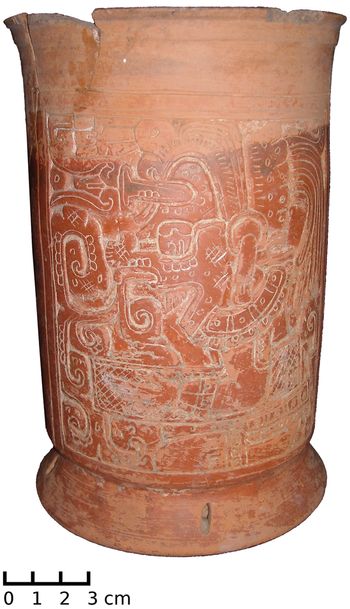
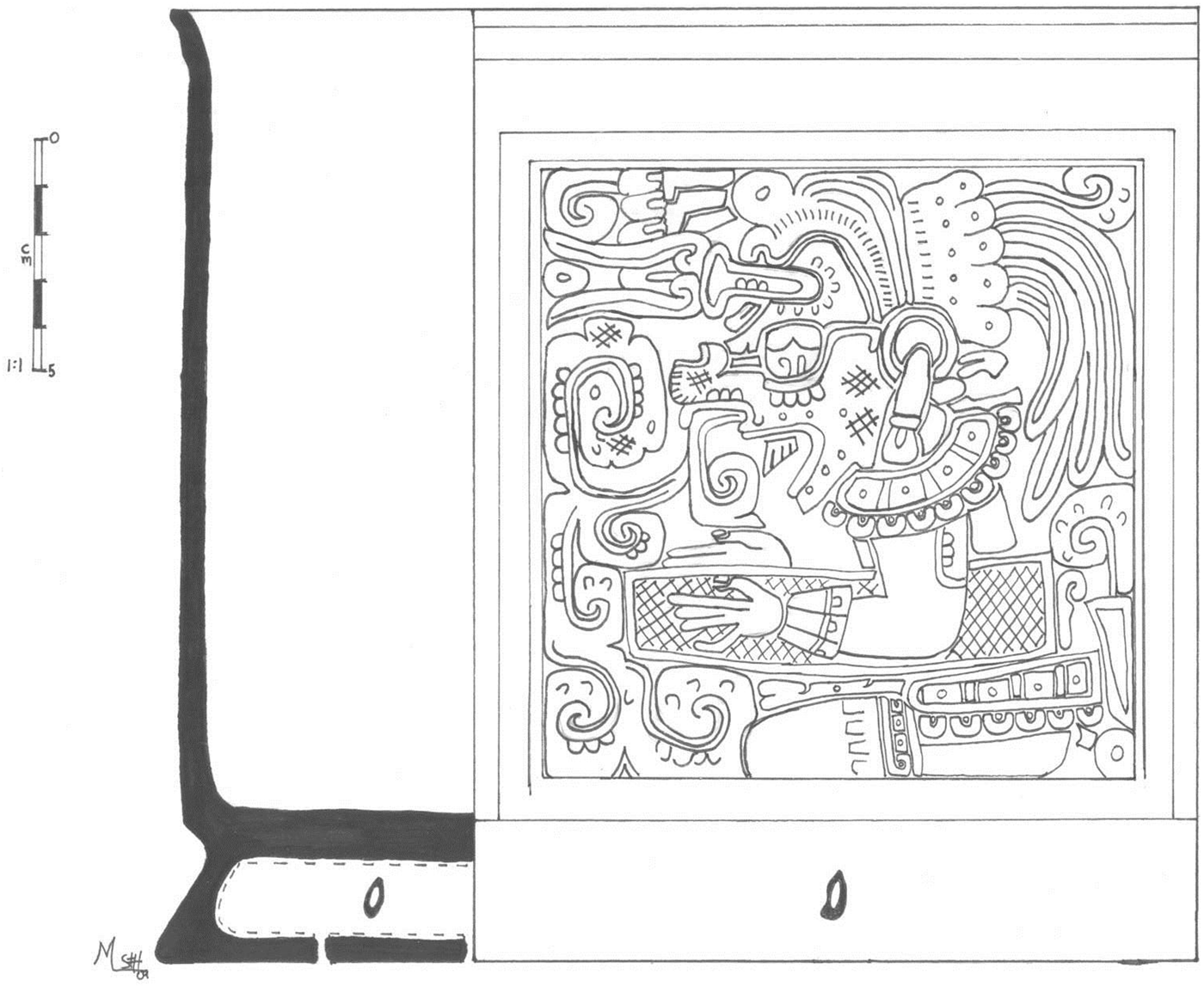
One of the most striking vessels from Moxviquil's monumental zone is a fine orange vase discovered in Cache 1, a small, square, masonry ‘box’ discovered in the northwest corner of Terrace 4, just below the Upper Plaza, associated with architectural remains suggesting the residence of a non-royal but highly-ranked elite family (see Fig. 2). The vessel is a cylindrical vase with an annular pedestal rattle base with a mat impression (Figs. 6 & 7). The paste is fine, hard and light orange in colour and is covered with a medium-orange slip with a post-slip, post-firing incised design. The mouth of the vase was covered with an inverted dish with round, hollow tripod supports. Within the vase were two puma canines, two peccary tusks, two carved bone atlatl [spearthrower] finger loops and an obsidian prismatic blade (Weiant Reference Weiant1954a, 34). Although archaeometric dating has not been performed on any of the objects from the cache, the stylistic attributes of the vase situate it within the transition period from the Late Classic to the Early Postclassic, generally considered to be around ad 900–1000, for reasons explained below. Excavation records suggest that the vase was a reverential offering made by high-ranking elite residents of the monumental centre, with no indication that it represents a late intrusive offering (Weiant Reference Weiant1954a,Reference Weiantb). Although the vase and its contents would have been hidden from everyday view, it was dedicated as a sacred, memory-rich object within the political context of Moxviquil as a seat of local rulership.
The Moxviquil K'awiil vase, a fine orange cylindrical pedestal vase recovered from Cache 1. (Photograph: Elizabeth Paris.)

The fine orange cylindrical pedestal vase from Moxviquil Cache 1. (Drawing: Maxime Lamoureux-St. Hilaire for the Proyecto Económico de los Altos de Chiapas.)

The Moxviquil K'awiil vase is quite likely imported or imitated from well-documented Gulf Coast fine orange traditions, as first observed by Robert E. Smith (Reference Smith1958). Smith visited Frans Blom and examined his collection of fine orange vessels from Moxviquil while developing his typology, and his article illustrates many of the vessels from Moxviquil's tombs, including the K'awiil vase, whose cylindrical form, tall pedestal base and orange slip are more typical of Silho. The square, graphic, carved-incised technique is visually striking, and diverges from the more fluid and curvilinear Balancán designs. It is also wider in diameter relative to its height than most Silho vases and lacks the white exterior slip and bowl/dish forms that characterize Balancán. Furthermore, it uses a square cartouche design that is more typical of Y Fine Orange (Smith Reference Smith1958), now classified as Altar Fine Orange or Pabellón Modeled-Carved in the Usumacinta River region and Petén (Bryant et al. Reference Bryant, Clark and Cheetham2005), and as locally produced Chanal Modeled-Carved in the highlands of Chiapas (Culbert Reference Culbert1965, 69). Sherds of Chanal Modeled-Carved have been recovered at Moxviquil (Paris Reference Paris2012; Paris et al. Reference Paris, Taladoire and Lee2015), but the paste is light grey and much softer than the hard, compact, light orange paste of the K'awiil vase. While Balancán, Pabellón/Chanal and Silho are all generally associated with the Late Classic–Early Postclassic transition, Balancán is generally thought to be earlier in date than Silho, and thought to originate in the Middle/Lower Usumacinta areas of Tabasco, at sites such as Jonuta and Tecolpan (Berlin Reference Berlin1956), while Silho is generally attributed to the Lower Usumacinta/Laguna de Terminos region and the Early Postclassic period (Bishop et al. Reference Bishop, Sears, Blackman and Cobos2012).
The vase depicts K'awiil, the Maya patron deity of lightning and royal lineages (Taube Reference Taube1992). The execution of the post-slip, post-fired, carved-incised design uses a blocky, highly conventionalized representation of anthropomorphic form that is more characteristic of Early Postclassic period art from Tula or Chichen Itza than the fluid, curvilinear forms generally associated with Late Classic Maya art from the southern Lowlands (Coe Reference Coe1992; Coe et al. Reference Coe, Houston, Miller, Taube, Golden, Houston and Skidmore2015). The deity is placed in a square cartouche, in a kneeling position, with an elaborate headdress with quetzal tail feathers descending down the back. Personal ornaments include an elaborate jewelled collar, wrist cuff, round ear spools with a dangling element (possibly shell), loincloth, and thigh band. Under his arm is a rectangle with diagonal cross-hatching, likely depicting a woven petate mat. The face has three small cross-hatched areas, and a fourth appears on the headdress; this decorative technique is used in Maya art to represent black, or darkness (Bassie Reference Bassie2002, 15). A characteristic axe emerges from his forehead, and an elaborate spiralled element emerges from the front of his body, which is conventionally interpreted as speech, song, or breath (see Barber & Sánchez Reference Barber and Sánchez2012), but could also be smoke or clouds (see Tedlock Reference Tedlock1996, 153). Unusually, the artist illustrated the spiralled element as emerging from the figure's nose, rather than the open mouth, which has prominently illustrated teeth. The spiralled element also bears small cross-hatched designs, and a lobed element suggesting of flowers or foliage. His eye is a glyph that resembles the cross-section of a gastropod shell (Montgomery Reference Montgomery2007; Thompson Reference Thompson1966, 84–5). Underneath the glyph is a curved element that is generally interpreted as a serpent eye in Maya iconography (Taube Reference Taube1992).
Similar representations of K'awiil are known from two other Silho Fine Orange ceramic vessels: one from Utatlán (Q'umarkaj), in highland Guatemala (Tedlock Reference Tedlock1996, 153), and one that is housed in the Museo Nacional de Antropología in México City (MNA; Cat. No. 05.0-04556: mna.inah.gob.mx/colecciones 2018). The portrayals of the deity on these vessels also use a relatively blocky style of carved-incised design, use a shell glyph to represent the eye, depict prominent teeth, and have similar items of dress and adornment, although there are notable differences in body position. The proportions of the vessels are slightly different between the Moxviquil vase (20.5 cm tall; 13 cm in diameter) and the MNA vessel (19.2 cm tall; 10.9 cm in diameter), but the broad similarities between them suggest that the Moxviquil vase was part of a larger corpus of Silho-style vessels with representations of K'awiil. Several researchers have previously hypothesized exchange routes for Silho Fine Orange extending from the Petexbatún down the Usumacinta River and its delta, and along the eastern Gulf Coast as far as Xcambó and Dzibilchaltún (Ancona et al. Reference Ancona Aragón, Álvarez, Basto Segovia, Laporte, Arroyo and Mejía2009; Foias & Bishop Reference Foias and Bishop1997); we suggest that fine orange vases from this exchange network may also have been traded to more distant highland political centres, including Moxviquil and Utatlán. The K'awiil vase would thus have been most stylistically legible to Moxvquil's rulers and residents as an eastern Gulf Coast object associated with the area near Laguna de Terminos.
As Taube (Reference Taube1992, 69) has observed, the K'awiil depicted on the Moxviquil vase has similar proportions and stylistic attributes to the two K'awiil figures depicted in the Grolier Codex on pages 1 and 4 (Coe Reference Coe1992, 4, col. L; Coe et al. Reference Coe, Houston, Miller, Taube, Golden, Houston and Skidmore2015). The Grolier versions of K'awiil lack the characteristic forehead axe and the glyph element in the eye itself, and the cross-hatched motifs. The Grolier Codex has been attributed to the region near the Sierra de Chiapas not far from Tortuguero, which is also near many of the likely production sites of Gulf Coast fine orange (Coe Reference Coe1992). The calibrated radiocarbon date of ad 1212 ± 40 obtained for the manuscript (Coe et al. Reference Coe, Houston, Miller, Taube, Golden, Houston and Skidmore2015, 127) is consistent with the hypothesized Early Postclassic (ad 900–1250) date of Silho Fine Orange ceramics and the maximum expansion of settlement at Moxviquil.
The Moxviquil ocarina
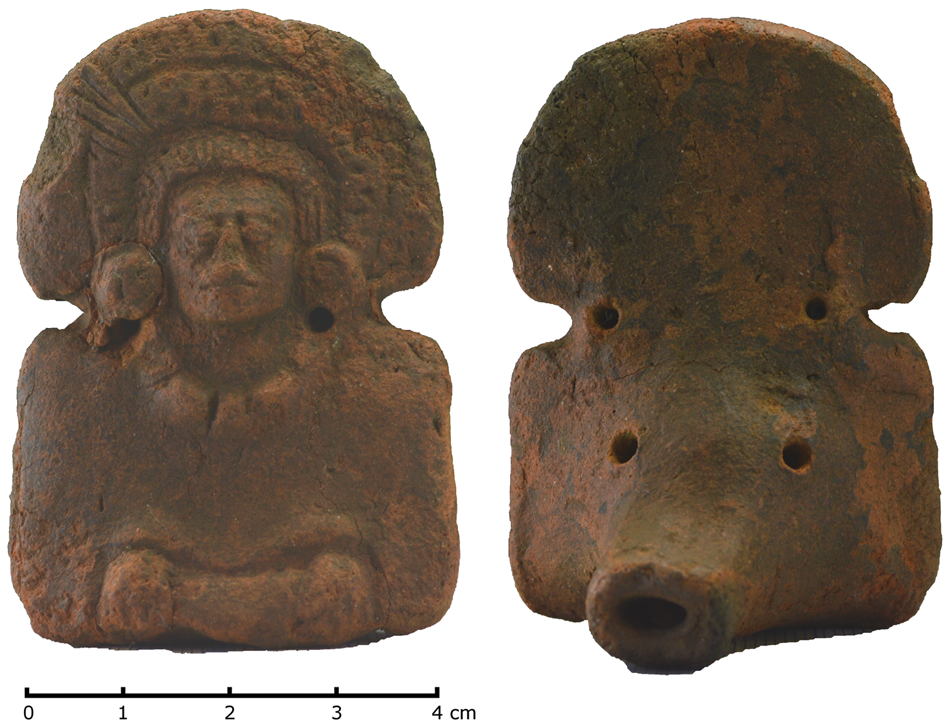
The Moxviquil ocarina was recovered from the horizontal excavation of a large residence on a hilltop to the west of the monumental centre by us in 2015, designated Operation 4. The ocarina is a small whistle, with a flat, mould-made anthropomorphic figurine-like image on the anterior surface, tapering into a whistle with an elliptical mouthpiece towards the posterior end (Fig. 8), a style common in the Peten during the Late Classic (Halperin Reference Halperin, Halperin, Faust, Taube and Giguet2009, figs 13.5 & 13.6), and at Jaina and the eastern Gulf Coast during the Late/Terminal Classic (Jaina Group R: Corson Reference Corson1976, fig. 21). The paste is a fine-textured, soft-fired fine orange paste that is distinct from local types (Paris Reference Paris2012; Reference Paris2014). It strongly resembles the pastes used in fine orange vessels in the eastern Gulf Coast (Jonuta and southern Campeche: Smith Reference Smith1958), and we hope to complete provenience studies in the near future.
The Moxviquil ocarina from Moxviquil Operation 4. (Photographs: Nathan Parrott for the Proyecto Económico de los Altos de Chiapas.)

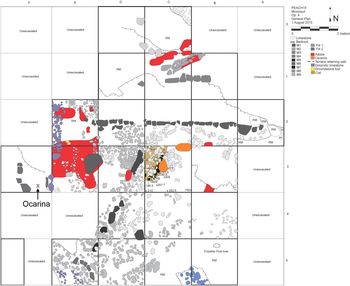
The ocarina was discarded in an act of seeming casual erasure, mixed into the rubble fill of an artificial terrace underlying several residential structures (Fig. 9). It was casually mixed with other domestic refuse, predominantly Early Postclassic period utilitarian ceramic vessel fragments, chert flakes, and ground stone artifacts but also a few other likely valuable items including a miniature effigy greenstone axe and figurine fragments. The refuse was not spatially concentrated in the manner of a waste dump, but was dispersed among the rubble fill. The ocarina was stratigraphically positioned below fill with no evidence of disturbance such as a late intrusive deposit or offering, suggesting that it was discarded in a non-reverential manner as refuse.
Moxviquil Operation 4, showing the location of the ocarina with respect to selected excavated structures and artificial terraces. (Map: Elizabeth Paris.)

The decorative element of the ocarina is mould-made, while the posterior surface is smooth and undecorated, with the exception of the hand-modelled whistle element. The posterior surface has two small, round, perforated apertures. The anterior surface also has two small, round, perforated apertures positioned just below the ear spools, located superior to the apertures on the posterior surface. The player can cover the four apertures (stops) singly or in combination to produce a wide range of pitches.
The moulded human image of the ocarina portrays a kneeling figure in a headdress, large round ear spools, beaded necklace, and a large, draping cloth garment. The garment is a huipil, a traditionally female garment that is found in both the Maya region and central Mexico, rather than the triangular quechquemitl favoured by high-status women in many central Mexican cultures (Diel Reference Diel, McIntyre and Phillips2007, 236); the figure's hands emerge from under the huipil, resting on its knees. Kneeling figures on mould-made ocarinas are known from the Motul de San Jose region (Halperin Reference Halperin, Halperin, Faust, Taube and Giguet2009, fig. 13.6; see also Sears Reference Sears2016, 330) and Jaina (Corson Reference Corson1976, fig. 21); however, the most similar examples with regard to shape and style depict male (often bearded) nobles wearing a War Serpent headdress. In contrast, kneeling women depicted on ocarinas from these sites tend to depict serving-women carrying bowls or baskets, rather than royal women (Halperin Reference Halperin, Halperin, Faust, Taube and Giguet2009); the Moxviquil example may thus represent a noblewoman. The headdress of the figure is large and fan-shaped, with erect fan-shaped feathers emerging from near the head out to the edge of the headdress, crossing two bands with a punctated design that likely signifies spots. The spots could indicate beads, or more likely the use of strips of jaguar skin. A thinner, striped band representing hair frames the upper portion of the face and is similar to the style depicted on the incense-burner lids (see above). The hemispherical shape cross-cut by erect groups of feathers is similar to headdresses in Jaina Group O, while the lack of a War Serpent element may suggest that the depicted individual lacked a rulership role.
Discussion
These Gulf Coast-style objects ended their use lives at Moxviquil in very different stages of remembrance and forgetting, reverence and desecration. The hacha and yugo were damaged, likely terminated with intent, and tossed into architectural fill within a high-status context, likely early in monumental centre's history; the ocarina was not damaged, but casually discarded into terrace fill in a non-royal elite/wealthy commoner context, likely later in the site's history. The incense-burner lids, some Balancán vessels and the K'awiil vase ended their use lives as revered, dedicatory objects, in funerary and offertory contexts respectively; as Balancán is thought to be earlier in temporal provenience than Silho Fine Orange, we can also hypothesize that the dedicatory acts occurred at different moments in time, perhaps as much as a century apart.
These crafted ceramic and stone objects include items that reference the stylistic canons of both the western Gulf Coast (Central Veracruz) and eastern Gulf Coast/Usumacinta River area of Tabasco/southern Campeche/northeast Chiapas. Some objects may represent hybridized materials, like the K'awiil vase which shows a fusion of iconographic content, figure styles and vessel proportions from multiple fine orange stylistic canons. Similarly, the ocarina combines with a moulded design technique commonly used on figurines in the Maya region, with a non-standard stylistic portrayal of an elite woman.
These objects reference both northeast- and northwest-facing communication and exchange routes between the Central Highlands of Chiapas and the Gulf Coast (Navarrete Reference Navarrete, Lee and Navarrete1978). We suggest that there is a slight geographic shift in stylistic influences emphasized at Moxviquil over time. The hacha and yugo, which show an affiliation with the western Gulf Coast, were terminated and discarded early in the site's history. The incense-burner lids and other Balancán Fine Orange vessels (probably earlier) reflect a Middle Usumacinta influence, and the K'awiil vase and ocarina (probably later) reflect a Lower Usumacinta/Campeche coast influence. More broadly, patterns of acquisition, veneration and discard reflect a bias, unconscious or otherwise, towards the eastern Gulf Coast and northwest Maya cultural zone and exchange networks.
The pre-Hispanic exchange relationships between the Gulf Coast and the Maya Highlands are mentioned in several colonial period documents, and in several cases are related to pilgrimages and migration. For instance, the Probanza de Votan (Núñez de la Vega Reference Núñez de la Vega1702, 9–10; see also Calnek Reference Calnek, Bryant, Calnek, Lee and Hayden1988, 9) relates the activities of Ghoxvotan (3 Votan), said to have been born on a large island off the coast of Yucatan called Valum Chivim (likely Cozumel Island); travelled with his followers up the Usumacinta River via Laguna de Terminos; and established a capital called Nachan (meaning ‘House of the Chan lineage’, of which 3 Votan was said to be a member) at the base of the Tumbalá Mountains (see Calnek Reference Calnek, Bryant, Calnek, Lee and Hayden1988, 10–12). The document suggests that Votan's jurisdiction extended over nearly all of highland Chiapas, a part of highland Guatemala and some sector of the Soconusco, and references territorial disputes and later alliances with ‘mexicano’ lords (Brasseur de Bourbourg Reference Brasseur de Bourbourg1857, 69; Calnek Reference Calnek, Bryant, Calnek, Lee and Hayden1988, 12). Documents collected by bishop Núñez de la Vega (Reference Núñez de la Vega1702) suggest that many of the noble lineages in the Chiapas highlands claimed to trace their ancestry back to the leaders of these migrations through the seventeenth century (Calnek Reference Calnek, Bryant, Calnek, Lee and Hayden1988, 12). Similar claims featuring rulers born on (and/or conducting pilgrimages to) Cozumel Island and migration to (or through) the Usumacinta were made in the Relación of Pablo Paxbolonacha, cacique of Acalan-Tixchel (Scholes & Roys Reference Scholes and Roys1957), and the Popol Vuh of the Quiché Maya of highland Guatemala (Tedlock Reference Tedlock1996, 15) as a basis for legitimating sovereignty. The common elements in the three ethnohistoric accounts are particular notable in light of similar Silho Fine Orange vases depicting K'awiil recovered at Moxviquil and Utatlán.
Numerous pre-Hispanic trade and transportation routes existed between the Gulf Coast and highland Chiapas that included both northeast- and northwest-facing routes and a complex network of roads and trails traversing the difficult terrain between them (Navarrete Reference Navarrete, Lee and Navarrete1978; Viqueira Reference Viqueira Albán1999). Viqueira (Reference Viqueira Albán1999; Reference Viqueira Albán and Cramaussel2006) highlights the bellicose relationships between the Zinacantecos, who controlled the Jovel Valley and intermediate areas, and the Chiapanecs, who controlled the Central Depression itself. At some point during the Postclassic period, the Central Depression trade routes became difficult to access for Zinacantecos and their highland Maya allies; they responded by conducting a series of military expansions west via Tecpatán to the ports of Quechula and Chicoasén, and by forming alliances with the kingdom of Pontehuitz, which enabled them to access the Lower Grijalva River trade routes (Viqueira Reference Viqueira Albán and Cramaussel2006, 141). However, the relative scarcity of western Gulf Coast materials and the predominance of eastern Gulf Coast materials suggests that the relative accessibility of these routes may have shifted over the course of Moxviquil's occupation; it is similarly plausible that the hacha and yugo were obtained from the same trade routes that supplied Palenque. Other items were likely imported from and/or influenced by groups from the Lower and Middle Usumacinta, and they represent the cultural syncretism between Maya and non-Maya groups that was historically characteristic of the Gulf Coast region itself; the hacha and yugo found at Moxviquil were most likely imported as commodities from non-Maya groups in Central Veracruz, while other items were likely created by Maya groups, influenced by Early Postclassic international styles representing a blend of cultural traditions. These items speak to the diversity of objects that were transported along highland–coastal exchange networks, and the importance of hybrid cultural identities and lineages for ruling families.
Acknowledgements
The Proyecto Económico de los Altos de Chiapas was carried out under the permission of the Instituto Nacional de Antropología e Historia (INAH) in 2009 and 2015. Funding for field research and laboratory analysis was provided by a National Science Foundation Doctoral Dissertation Improvement Grant (Award ID 0836590) to Paris in 2009 and a Wenner-Gren Foundation International Collaborative Research Grant to Paris and López Bravo in 2015, with additional funds provided by the Christopher DeCormier Memorial Scholarship, the University of Albany, SUNY, and the Universidad de Ciencias y Artes de Chiapas. We thank the University of Calgary, ProNatura Chiapas, Museo Na Bolom, the New World Archaeological Foundation, our project staff and students. Maxime Lamoureux-St. Hilaire, Nathan Parrott and Nicholas Pagnucco contributed to illustrations and photographs that appear in this article.