Why do some non-violent movements fail, while others succeed? Although the literature regularly displays optimism regarding the success of non-violent action, not all non-violent campaigns flourish. According to Maria Stephan and Erica Chenoweth (Reference Stephan and Chenoweth2008), only 53% of all non-violent campaigns yield the desired results. While this is a better rate of success than is seen with violent uprisings, this percentage still indicates that a remarkable number of organized non-violent resistance campaigns fail, such as the Ogoni movement's demand for their share of oil resources in Nigeria or the protests of Chinese students in Tiananmen Square and their demand for democratization. Little research, however, has attempted to resolve this question by addressing the outcomes of non-violent movements. Existing studies have tended to focus on the outcomes of non-violent campaigns by analysing the role of contemporaneous armed challenges (Chenoweth and Schock Reference Chenoweth and Schock2015), internal division (Bramsen Reference Bramsen2018), the support of external actors (Davies Reference Davies2014) and certain group dynamics – such as the capacity to execute different non-violent tactics, general leadership skill and the ability to use resources effectively to achieve success (Ackerman Reference Ackerman2007). The role of a target state's characteristics on the outcomes of non-violent campaigns has yet to be sufficiently empirically examined.
In the current research, we focus on the effect of the target state's natural resource wealth on the likelihood of a successful non-violent effort. While a great deal of research has explored the role of natural resource wealth on the dynamics of violent anti-government campaigns (e.g. Bannon and Collier Reference Bannon and Collier2003; Dreher and Kreibaum Reference Dreher and Kreibaum2016; Fjelde Reference Fjelde2009; Ross Reference Ross2004), scholarly attention on this factor's effects on the dynamics of non-violent movements, especially the outcomes of such movements, remains inadequate. Thus, our contribution to the extant literature is twofold. First, we introduce the question of why some non-violent movements fail, in order to expand the research on non-violent campaign outcomes in general. Second, our study illustrates the ways in which natural resource wealth is used by target states to counter non-violent resistance. This examination builds on previous studies of non-violent campaigns that explain outcomes primarily through the internal dynamics of non-violent dissident groups or support from external states. In addition, we add to the body of research on the link between natural resources and violent anti-government campaigns by exploring the effects of natural resources on their non-violent anti-government counterparts.
In pursuing this goal, we hypothesize that non-violent campaigns in states with abundant natural resource wealth are more likely to fail to achieve their goals because countries rich in natural resources have significant leverage in both the domestic and international spheres, and thus are more successful in causing non-violent movements to fail. In the domestic realm, when such a state faces non-violent resistance, it is able to use natural resource rents to bribe domestic actors crucial to the movement's success, such as military leadership and influential groups from civil society. In the international context, natural resource wealth can be used to discourage external states from supporting non-violent resisters, especially when those countries are already dependent on those resources. Such resource dependence may also make other states reluctant to implement sanctions in response to the repression of unarmed protesters. Thus, we expect that natural resource wealth will increase the likelihood of failure of non-violent movements. We test this theoretical expectation with logit and ordered-logit analyses. The results of these empirical analyses corroborate our hypothesis that non-violent movements are more likely to fail in states with higher levels of natural resource wealth. The results are especially convincing for states dependent on one particular natural resource: oil. In the following sections, we review the existing literature on non-violent campaign outcomes, as well as previous research on the link between natural resource wealth and violent dissident campaigns. We then formulate our theoretical framework into testable hypotheses. Next, we discuss the processes used to test our hypothesis and the measurements and data sources. Finally, we report the results of our statistical analyses and conclude the article with directions for future research and a discussion on the implications of the empirical results.
Literature
Existing studies investigating the reasons for the success or failure of non-violent movements tend to focus on the internal dynamics of non-violent dissident groups. Kurt Schock (Reference Schock2005) examines non-violent movements in six countries (Nepal, Myanmar, the Philippines, Thailand, South Africa and China), and his comparative analysis demonstrates that some group characteristics play a significant role in their success, including the decentralized structure of the non-violent group, their implementation of diverse tactics and their ability to shift from one tactic to another. Peter Ackerman's (Reference Ackerman2007) study emphasizes the effects of a group's characteristics on the success of the campaign, such as the ability of the non-violent dissident group to execute different non-violent tactics to disrupt an unjust order, its leadership qualities and its capacity to use resources effectively to achieve success. In her book examining six historical cases of non-violent resistance employed to trigger regime change in authoritarian countries, Sharon Erickson Nepstad (Reference Nepstad2011) highlights the significance of certain group dynamics on the failure of non-violent resistance, namely internal division within the group and the failure to protect the non-violent ideology. The ability to protect the non-violent ideology is also examined by Chenoweth and Schock (Reference Chenoweth and Schock2015); their qualitative and quantitative evidence demonstrates that a group's incorporation of a violent flank has both positive and negative political impacts on the movement. They also find that using violence and non-violence simultaneously reduces the chance of a non-violent campaign's success.
In addition to the role of protecting the non-violent ideology, internal divisions within a group of non-violent resisters have been noted as another significant factor in the failure of non-violent campaigns (Bramsen Reference Bramsen2018; Chenoweth and Stephan Reference Chenoweth and Stephan2011; Nepstad Reference Nepstad2011). Chenoweth and Stephan (Reference Chenoweth and Stephan2011: 184–191) argue that one reason for the failure of the non-violent Burmese campaign was its inability to maintain a cohesive and decentralized structure in the face of diverse membership. Isabel Bramsen (Reference Bramsen2018) underscores the importance of this factor in understanding the outcomes of non-violent movements in Tunisia and Bahrain. According to Bramsen (Reference Bramsen2018), protesters in Tunisia managed to maintain the unity of the movement against the regime, but internal divisions emerged among protesters in Bahrain, making them vulnerable to crackdowns and resulting in the movement's eventual failure.
Beyond internal dynamics, issues external to non-violent resistance groups are also a common topic in the literature. Nepstad (Reference Nepstad2011) points out the importance of certain macro-level structural factors to the success of non-violent movements, including economic decline, divided elites and the availability of free space within which the group might operate. Building on Nepstad (Reference Nepstad2011), Yoav Tenembaum (Reference Tenembaum2011) compares successful non-violent movements with those that fail and stresses the role of domestic factors that affect a movement's outcomes, such as resisting a democratic regime versus facing a regime that is determined to kill all protesters. Thomas Davies (Reference Davies2014) argues that many international factors also have a considerable impact on the success or failure of a non-violent movement. In particular, support from foreign states can be highly influential in the outcomes of non-violent resistance (Ash Reference Ash2011). This effect has been illustrated in previous studies focusing on particular cases, such as Western governments’ financial support for the Polish Solidarity movement in the 1980s (Schock Reference Schock2013); the part the US played in the People Power movement in the Philippines in 1986 (Mendoza Reference Mendoza, Roberts and Garton Ash2009); and the impact of military intervention by third-party actors siding with either side in protests in Bahrain, Syria and Libya (Davies Reference Davies2014). Along with foreign states, intergovernmental bodies have also been considered significant, such as in the European Union's financial assistance to civil groups in Georgia during the Rose Revolution in 2003 (Jones Reference Jones, Roberts and Garton Ash2009). Similarly, the international media has been identified as influential, as with the positive effect of transnational media on the diffusion of ideas and resistance strategies (e.g. the 1989 Velvet Revolutions) (Kramer Reference Kramer, Roberts and Garton Ash2009).
In sum, the extant literature addressing the outcomes of non-violent movements has theoretically and empirically examined a wide range of factors, from the internal dynamics of these groups to international influences. Among these, the role of the natural resource wealth of the target state has not been empirically investigated. Instead, a great deal of research has evaluated its role in intrastate violence (e.g. Fearon Reference Fearon2005; Fjelde Reference Fjelde2009; Humphreys Reference Humphreys2005; Ross Reference Ross2004, Reference Ross2006) and democratization (e.g. Colgan Reference Colgan2015; Gurses Reference Gurses2011; Ross Reference Ross2001, Reference Ross2008). In these scholarly works, natural resource wealth is primarily considered a structural factor or problem that leads to civil conflict or hinders efforts at democratization. Yet natural resources might also be a tool and means of applying leverage for states dealing with dissidents. Thus, we contribute to the existing literature on intrastate conflict by showing the ways in which natural resource wealth can be employed by incumbent governments to counter dissidents’ efforts and cause anti-government movements to fail. The studies of Bueno de Mesquita and Alastair Smith (Reference De Mesquita and Smith2010), Stephen Haber and Victor Menaldo (Reference Haber and Menaldo2011), Kevin Morrison (Reference Morrison2009), Benjamin Smith (Reference Smith2004) and Jay Ulfelder (Reference Ulfelder2007) all provide examples of how natural resources can be used to co-opt elites and frustrate potential threats. In this sense, the current study can be situated within the existing body of research via its focus on how natural resources can be used to establish patronage networks and bribe elites to retain power.
In addition to our primary offering, we also contribute to the body of research examining the relationship between natural resource wealth and civil wars, in that we analyse the role of natural resource wealth in non-violent conflict. Recent civil war research has established a dichotomous understanding of the topic, highlighting the scholarly importance of the different stages of mobilization, both non-violent and violent, in understanding the potential causes of this type of conflict (Cunningham et al. Reference Cunningham, Gleditsch, González, Vidović and White2017; Quinn and Mason Reference Quinn and Mason2009; Young Reference Young, Mason and Mitchell2016). Understanding how natural resource wealth affects the initial stages of dissident mobilization is also likely to be informative with regards to what comes later. In other words, natural resource wealth should assist in predicting whether a particular anti-government movement will evolve to later stages of mobilization such as full-blown civil war.
Theoretical framework
Concepts and assumptions
Before discussing our theoretical arguments, we must first describe key concepts crucial to our theoretical framework. A non-violent movement is a civilian-based method of protest used by opposition groups, employing social, psychological, economic and political means but not resorting to violence (Butcher and Svensson Reference Butcher and Svensson2016; Stephan and Chenoweth Reference Stephan and Chenoweth2008). Acts of commission, omission and a combination of both are included in this type of dissidence (Sharp Reference Sharp2005). Scholars have noted more than 100 non-violent methods that opposition movements might use to mobilize dissidents or support different policies, including non-violent interventions, boycotts, political and social non-cooperation, protests and labour strikes (Sharp and Finkelstein Reference Sharp and Finkelstein1973). Non-violent struggles occur outside the traditional political environment, and it is this that distinguishes non-violent struggles from non-violent political actions such as electioneering and lobbying (Stephan and Chenoweth Reference Stephan and Chenoweth2008). In terms of the concept of success/failure of non-violent movements, our interpretation is consistent with previous scholarly works, particularly those of Chenoweth and Stephan. According to Chenoweth and Stephan (Reference Stephan and Chenoweth2008), the success of both non-violent and violent campaigns can be judged by whether they meet one of two conditions: (1) the campaign's stated objective occurs within a reasonable period of time after the end of the campaign; or (2) the campaign has a discernible effect on the outcome. Chenoweth and Stephan (Reference Chenoweth and Stephan2011) define failure as a non-achievement of the objectives of the campaign. Thus, we conceptualize the success or failure of a non-violent movement in terms of the attainment of the objectives of that movement.
How natural resource wealth shapes the outcomes of non-violent resistance campaigns
To explain how a target state facing non-violent civil resistance uses its natural resource wealth to protect its position of power, we develop a theory based on two theoretical assumptions. First, the target state may neutralize resistance and protect the domestic status quo in different ways, such as by repressing or diverting the resistance, and by granting political concessions (Davies Reference Davies2016). To do so, the state will use the resources at its disposal and its general capacity to confront resistance. In this service, it may consider using its natural resource wealth as a tool to neutralize dissent. Second, drawing insights from previous studies, both domestic and external actors may play significant roles in shaping campaign outcomes. Therefore, the state may need to render ineffective any domestic or external actors important to the resistance in order to counteract the movement. We argue that in this sense, natural resource wealth may enable the target state to neutralize opponents and their allies, and thus preserve the established power structure.
In terms of domestic actors, natural resource wealth may allow the established government to secure the loyalty of civilian actors crucial to dissidents and the eventual success of the movement. Churches, trade unions, political parties and civil organizations can all play significant roles in strengthening the mobilization capacity of a movement and may eventually increase its chance of success (Hess and Martin Reference Hess and Martin2006; Sutton et al. Reference Sutton, Butcher and Svensson2014). For instance, before Guinea's ‘Bloody Monday’ on 28 September 2009, the opposition had managed to unite six political parties, the major trade unions and a number of civil organizations under an umbrella organization called the Forum of the Forces Vives of Guinea (Human Rights Watch 2009: 20). On the same day, 157 people were killed during a 50,000-person protest march to Conakry's main football stadium. After the massacre, the movement was able to remobilize and organize a stay-at-home strike of 90,000 government workers (Heck Reference Heck2010; Sutton et al. Reference Sutton, Butcher and Svensson2014). States dependent on natural resources might be able to neutralize the impacts of these kinds of civilian actors by co-opting them with natural resource rents, eventually undermining the movement's mobilization capacity and increasing their risk of failure.
In another example, that of the Arab Spring uprisings, Saudi Arabia experienced only very limited unrest, even though several deep-rooted social and economic problems (political repression, distribution issues, unemployment among the youth population, etc.) made the country vulnerable to uprisings similar to those occurring in Egypt and Tunisia (Altunisik Reference Altunisik2014). One of the primary reasons these limited protests failed to force the regime to change its policies was the regime's co-optation of Sahwa, a powerful Islamist network that could have played a crucial role in mobilizing and sustaining dissent (Lacroix Reference Lacroix2011). The Saudi government was aware of Sahwa's importance, and consequently announced a $100-billion aid package for religious institutions that were known to be Sahwa strongholds (Lacroix Reference Lacroix2011). Natural resource-rich states can influence important civil groups by providing these kinds of benefits, yet those groups have no such leverage against the regime. In other words, even if a movement can mobilize large numbers of people from different groups of society, these types of groups may not be able to hurt the regime because the revenue provided to them is produced by the state and not the groups themselves (Schock Reference Schock2005). The lack of leverage diminishes the ability of the movement to force the government to make concessions, eventually reducing the likelihood of the movement's success. Co-opting civil groups and actors (such as the media) that are important to a movement's mobilization not only helps the target state to undermine any possible mobilization capacity, it also brings legitimacy to the target state by reinforcing its relationship with those actors, robbing non-violent resisters of an important tool and discouraging the general population from participating in organized protest. Increasing legitimacy gained by the state at the expense of the movement might make it harder for the civil resisters to succeed and force the government to accept their demands, which may eventually increase the risk of failure of the movement.
In addition to the importance of co-opting important civil groups, buying off the military is also essential to governments facing non-violent resistance. Defection of the military to the protesters’ side would have a critical impact on the outcome of any resistance (Stephan and Chenoweth Reference Stephan and Chenoweth2008; Nepstad Reference Nepstad2011). Failure to retain the Egyptian military's loyalty during the Arab Spring played a vital role in toppling the Mubarak regime (Nepstad Reference Nepstad2013). Therefore, we argue that a resistance movement's chance of success is likely to decrease in natural resource-rich states when the target state is capable of bribing the military leadership with natural resource rents. Such states are more likely to maintain the military's loyalty by providing economic benefits such as involving them in profitable public and private sector ventures that exploit natural resource-related business connections (Volpi Reference Volpi2013). For example, the anti-government demonstrations in Venezuela in 2017 that aimed to stop the Venezuelan leader, Nicolas Maduro, from forcing a vote in the Constitutional Assembly that would consolidate his power (Gupta and Polanco Reference Gupta and Polanco2017) were not supported by the Venezuelan military, in large part because the military enjoys economic benefits stemming from the country's oil revenues. When selecting a leader to run PDVSA, Venezuela's state-run oil company, Maduro chose Manuel Quevedo, an active-duty national guard general, instead of an industry veteran. Quevedo had no experience in the oil industry but won over the president by helping to suppress anti-Maduro demonstrations in 2014 (Otis Reference Otis2018).
As with Venezuela, the failure of protests in Bahrain and Algeria are also cases in point. Bahrain's military forces remained loyal during the Arab Spring protests. Shia protesters attempted to oust the Sunni-dominated regime and re-establish a government that excluded Sunnis from the state bureaucracy (Nepstad Reference Nepstad2013: 344). One of the primary reasons for the military's loyalty was their concern about the potential loss of the economic and political benefits provided by the established government. The military's decision adversely affected the ability of Shia protesters to achieve their goals; the government mobilized the military to repress the protests. The military's harsh response, the dissidents’ inability to maintain unity, and Saudi Arabia's support for the government regime eventually caused the movement to fail. A similar situation occurred in Algeria, when the government increased the police force's wages by 50% during that country's Arab Spring uprising. Military personnel also saw a 40% increase in their salaries one year later (Volpi Reference Volpi2013). Even though Algeria was adversely affected by a substantial wave of anti-government non-violent protests on a significant scale, over time the movement lost momentum and never gained the support of the security forces. The commitment of the security forces to the government was one reason for the movement's eventual failure.
In addition to providing direct economic incentives, rentier states can also allow regime forces to become involved in profitable public and private sector ventures as yet another way of encouraging loyalty (Volpi Reference Volpi2013). Steven Cook (Reference Cook2007) likened the 1980s-era Algerian generals to significant patrons interfering with the delivery of business licences and exclusivity contracts (Volpi Reference Volpi2013). High-ranking military officers also have business relationships in the Algerian oil sector and a number of corruption scandals have been revealed, especially with the Sonatrach oil company in 2010 (Entelis Reference Entelis2011; Volpi Reference Volpi2013). Such business connections played a significant part in motivating the Algerian military to prevent non-violent protesters from succeeding (Volpi Reference Volpi2013).
Target states may also use their natural resource wealth to neutralize any potential support for civil resistance from external states. External actors may provide financial aid to protesters or sanction the target state for punishing protesters through repressive actions, and such measures may help to determine a movement's success (Ackerman and Kruegler Reference Ackerman and Kruegler1994; Davies Reference Davies2014; Lindgren Reference Lindgren2008; Sharp Reference Sharp2005). Schock's (Reference Schock2005) comparative case study shows that the ability to activate third parties significantly affects a movement's chance of success. While external actors, and particularly foreign states, can support civil resisters in various ways and may enhance the prospects for success, their support may not be limitless. If the target state is rich in natural resources, an external state may withhold support for protesters because the country is resource dependent. Since most countries must import oil, other fuels and certain minerals, they have a strong interest in the stability of rentier states (Bellin Reference Bellin2004; Ulfelder Reference Ulfelder2007). Dependency on these natural resources may make foreign powers unwilling to pressure or severely sanction rentier states to accommodate protesters. In this sense, natural resource wealth allows a government to repress unarmed protesters fully without fear of significant repercussions from the international community. Such an unwillingness to provide support can often undermine any chance a non-violent movement has of sustaining its effort. Although non-governmental organizations may sympathize with non-violent resisters and provide various types of assistance (Stephan and Chenoweth Reference Stephan and Chenoweth2008), third-party state support often offers much more in the way of financial resources, and being deprived of such lifelines may effectively eliminate any chance of success.
An example is the Ogoni movement in Nigeria.Footnote 1 Ogoni houses a substantial portion of Nigeria's businesses (Welch Reference Welch1995). In the 1990s, the Ogoni people protested against the government and oil companies, objecting to their unfairly small share of the benefits of the country's substantial oil wealth, as well as the environmental degradation caused by the oil companies operating in the area. Despite the Nigerian government's harsh repression and the execution of key leaders (the ‘Ogoni 9’) after a flawed trial and inadequate judicial review (Welch Reference Welch1995), the international community failed to act resolutely to condemn the government's actions. Only modest sanctions were put in place, such as suspending Nigeria from the Commonwealth (Lewis Reference Lewis1999). The fact that the international community depended on Nigerian oil resources precluded any meaningful sanctions. The absence of international signs of condemnation led the Nigerian military to conclude that the cost was tolerable, at least as long as international oil embargoes remained politically unfeasible (Lewis Reference Lewis1999). While various human rights and non-governmental organizations generated domestic and international pressure on the Nigerian government, the unwillingness of foreign states to take further action made the non-governmental organizations’ efforts ineffective in deterring the military regime from repressing the movement. While there are many reasons that the Ogoni movement failed (such as the execution of its leadership), the lack of resolute sanctions targeting Nigerian oil exports played a considerable role in this unfortunate outcome.
In a second example, the anti-regime protests in Bahrain, the government invited Saudi troops into the country to repress protests. The Saudi government willingly accepted this invitation, eliminating the domestic threat and protecting the Sunni regime. The US took a clear stance in favour of non-violent protesters during the Arab Spring uprisings in countries such as Syria and Egypt, but avoided taking any action in response to the Saudi government's intervention against non-violent Bahraini protesters because it did not want to strain relations with the two oil-rich nations (Nepstad Reference Nepstad2013). Other countries in the international community also showed remarkably little reaction to Bahrain and Saudi Arabia's actions, again due in large part to these two countries being oil rich. The lack of significant external support, coupled with the international community's investment in continuing the regime, led to the movement's eventual failure.
Based on the above arguments, we expect that non-violent movements are less likely to succeed when the target state is rich in natural resources, because that wealth can be used by the government as leverage to secure the loyalty of important domestic actors and disincentivize external states from supporting non-violent dissidents. While our theoretical framework does not place a specific emphasis on the effects of particular types of natural resources, examples of non-violent resistance in Venezuela and Nigeria suggest that oil might be particularly important in affecting the outcomes of non-violent campaigns. Since relatively speaking, oil is of higher importance to domestic economies than are mineral resources, and oil brings higher rents than the sale of other types of goods, oil is likely to be more powerful in neutralizing domestic and international actors alike. Thus, our hypotheses suggest a link between natural resource wealth and non-violent campaign outcomes, but also underscore that oil wealth is particularly effective.
Hypothesis 1:
Non-violent movements become more likely to fail as the state's level of natural resource wealth increases.
Hypothesis 2:
The higher oil wealth the target state has, the more likely it is that a non-violent movement will fail.
Research design
We used time series cross-sectional data to test our hypotheses. The best data source for researching the outcomes of non-violent campaigns is NAVCO 2.0, which provides data in a cross-sectional time series format.Footnote 2 In this database, a resistance campaign is defined as a series of observable and sustained tactics designed to achieve a political objective. The campaigns all have discernible leadership and names, making them distinct from random riots or spontaneous protests (Ackerman and Kruegler Reference Ackerman and Kruegler1994). The unit of analysis used in our study is non-violent campaign-year. Since we focus only on non-violent campaigns, violent campaigns listed in NAVCO 2.0 are excluded from our sample.
Campaigns are identified as non-violent if a given resistance campaign primarily or entirely uses non-violent means; they must be driven by unarmed civilians and not directly threaten or harm the physical integrity of the opponent (Chenoweth and Lewis Reference Chenoweth and Lewis2013). In their process for identifying whether a given conflict is non-violent or violent, Erica Chenoweth and Orion Lewis (Reference Chenoweth and Lewis2013) initially gathered a list of non-violent cases and corroborated these data with other sources, such as case studies and encyclopaedias. They then queried experts on non-violent conflicts to evaluate whether the cases could be appropriately characterized as major non-violent movements (Stephan and Chenoweth Reference Stephan and Chenoweth2008). Their method codes a movement as non-violent when it is primarily or entirely non-violent, and codes a movement violent if it results in a significant amount of violence (Stephan and Chenoweth Reference Stephan and Chenoweth2008: 17). In our analyses, we exclude violent movements since we only focus on non-violent efforts. After excluding violent campaigns, we obtained a sample of 122 non-violent campaigns in 77 countries. The time range covered by the NAVCO 2.0 data is 1945 to 2006, but our analysis is limited to 1970 to 2006, due to the availability of data on natural resources.Footnote 3 Each of our observations reflects our data on non-violent movements, their outcomes, the countries in which these movements occurred and each country's amount of natural resource wealth per year.
Dependent variable
Our dependent variable is whether or not a given non-violent movement failed to achieve its main goal; this is measured according to the NAVCO 2.0 data (Chenoweth and Lewis Reference Chenoweth and Lewis2013). NAVCO 2.0 has a variable regarding the progress of non-violent movements per year, as measured on a five-point scale. Higher scores indicate higher degrees of success. A score of 0 indicates that the status quo was maintained that year: the movement was a complete failure. If the non-violent campaign made visible gains but fell short of concessions, the progress variable is coded as 1. It is coded as 2 if the campaign resulted in limited concessions. If the movement gained significant concessions, its progress is coded as 3. Finally, 4 indicates complete success of the non-violent movement. We convert this ordinal measurement into a binary form, since only one category captures the complete failure and the rest show some degree of success.
Therefore, we use a dichotomous dependent variable. A non-violent movement is coded 1 if the movement failed to obtain concessions in a given year, and 0 if the movement obtained concession in that year. As an alternate measurement, we also include an ordinal success variable ranging from 0 to 2. Non-violent movements whose progress is coded in the NAVCO 2.0 data with a 0 (i.e. full failure) are also coded with a 0 in our data, representing that the movement failed. If a movement is not coded in NAVCO 2.0 with either a 0 or 4, meaning that the movement had some gain but didn't achieve full success, we code that movement with a 1. This captures partial success, meaning that the movement achieved some gains but fell short of concessions or achieved either significant or insignificant concessions.Footnote 4 If a movement is coded with a 4 in NAVCO 2.0, meaning that it achieved full success, we code that movement with a 2. This captures full success. We present the results of the logit models in our statistical analyses. The results of the analyses with the ordinal dependent variable as well as additional robustness check analyses are presented in the online appendix in the robustness check section. The discussion of the interpretation of the results in these analyses is in the appendix.
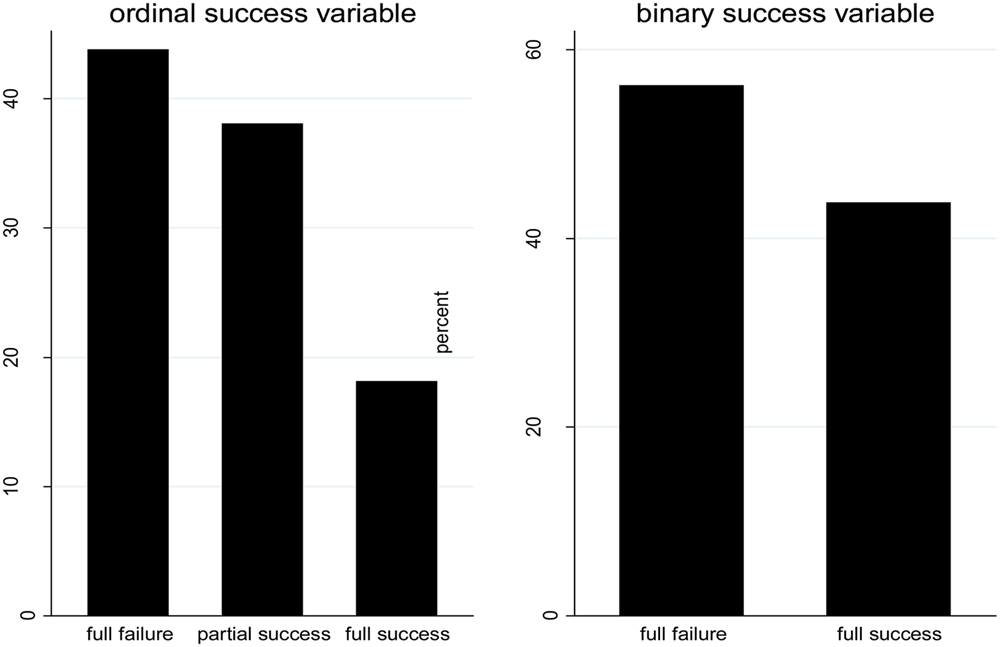
Figure 1 presents descriptive information about the dependent variables in our data. The figure suggests that around 43% of the observations indicate a movement's full failure. Almost 38% report partial success and 18% identify full success of the non-violent movement.
The Descriptive Statistics on the Dependent Variables

Independent variable
Our independent variable is the natural resource wealth of a given country facing a non-violent movement within a given year. To operationalize this independent variable, we use World Bank data for total natural resource rents as a percentage of each country's GDP on a yearly basis. The total amount of natural resource rent captures the sum of the revenue from oil, natural gas, coal, minerals and forest rents. The definition of rent is the revenue above the cost of extraction of the natural resource (Bjorvatn and Farzanegan Reference Bjorvatn and Farzanegan2015). Calculation of the estimated natural resource rent relies on the difference between the price of a given commodity and the estimated cost of producing that resource (Bjorvatn and Farzanegan Reference Bjorvatn and Farzanegan2015: 761). Since we also consider the effects of oil, two variables from James Fearon (Reference Fearon2005) and James Fearon and David Laitin's (Reference Fearon and Laitin2003) data sets are used to operationalize oil wealth. The first measurement is fuel exports as a percentage of GDP for a given year, which captures the degree of oil wealth. This variable appears in Fearon (Reference Fearon2005). The second measurement captures oil dependency and is a binary indicator of whether the fuel exports of a country exceed one-third of the total export revenue. This variable is obtained from Fearon and Laitin (Reference Fearon and Laitin2003).Footnote 5
Control variables
We control for certain factors that might confound the relationship between natural resource wealth and the failure of non-violent movements. External support from foreign states to the government can affect the outcomes of non-violent resistance campaigns (Stephan and Chenoweth Reference Stephan and Chenoweth2008); thus, we take this into account as a control variable. It is dichotomously coded, taking 1 if the target state has formal support from other states. Similarly, external support from foreign states to non-violent resisters might also have a significant impact on the outcome of a campaign. It is also dichotomously coded, taking 1 if the non-violent campaign has formal overt support from other nations. We employ NAVCO 2.0 data, coding 1 if the regime or non-violent campaign received formal support from a foreign state; otherwise, the item is coded with a 0. The degree of repression the target government used against the civil resisters is also controlled, since repression may either backfire and increase the chance of a movement's success, or it may crush the movement when used to a degree such that the government kills protesters (Tenembaum Reference Tenembaum2011). The degree of repression is operationalized in the NAVCO 2.0 data. Their repression variable ranges from 0 to 3, with higher scores indicating higher levels of repression. We also control for the goal of the non-violent campaign, since more specific goals may be easier to achieve than those that are broader. NAVCO 2.0 codes six different goals for non-violent campaigns. Efforts seeking regime change are coded with a 0, and those aiming for significant institutional reform are coded with a 1. Campaigns the goal of which is policy change are coded with a 2, and 3 is assigned to movements seeking territorial secession. Those attempting to achieve greater autonomy are given a 4, and anti-occupation campaigns a 5.
The final characteristic we control is the diversity of the protesters participating in the campaign. The risk of failure is likely to increase when a non-violent movement fails to recruit a diverse and broad-based membership (Chenoweth and Stephan Reference Chenoweth and Stephan2014). In operationalizing the diversity of the campaign, NAVCO 2.0 creates a series of dummy variables that measure whether each is diverse in age, religion, class, ideology, party, region, ethnicity and urban–rural scale. We collapse these dummies into an index; the larger the score in the index, the higher the degree of the diversity. In addition to campaign dynamics, we also control for some characteristics of the target states. We control for regime type because democracies tend to make concessions to non-violent resisters and the likelihood of failure is likely to be lower for democracies than autocracies. Polity IV data are used to measure this variable (Marshall et al. Reference Marshall, Jaggers and Gurr2011). Finally, we control for the GDP per capita of each target state since it is commonly controlled in the intra-state conflict literature, and doing so will help us make our findings more consistent with that body of knowledge. The descriptive statistics for all of the variables appear in the online appendix.
Results
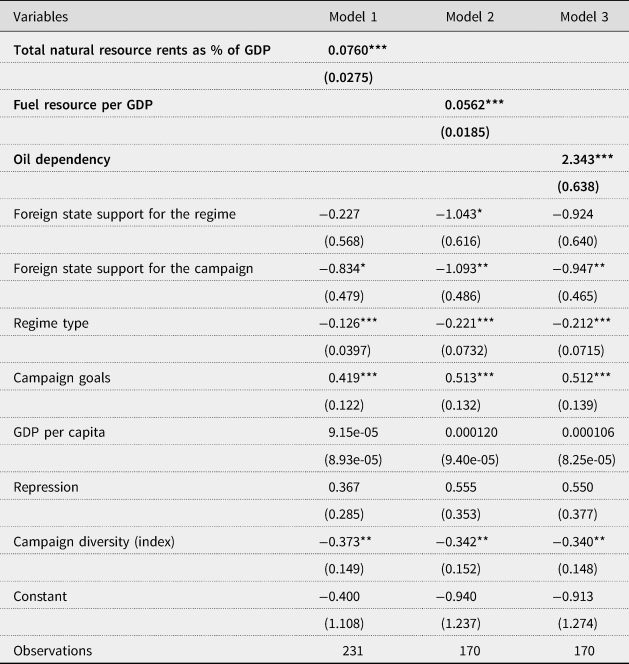
Table 1 presents the results of the logistic regression analyses; three models are described. The first reports the findings regarding the effect of total natural resource rents on non-violent campaign failure. The impact of oil wealth, which is measured as oil dependency and fuel resources per capita, is reported in the second and third models, respectively. The control variables are included in all models. Positive coefficients indicate an increase in the likelihood of failure, and the negative coefficients show the opposite. The number of observations demonstrated by the models is low for two reasons. First, when we exclude violent campaigns from the NAVCO 2.0 data, the number of observations is substantially reduced. Also, the start date for coding the NAVCO 2.0 data is 1945, but the earliest date for data on natural resource wealth is 1970. This also leads to the loss of a significant number of possible observations.
The Logit Models on the Effect of Natural Resource Wealth on Non-violent Campaign Failure

Notes: Robust standard errors in parentheses, and they are clustered on campaign.
*** p < 0.01; ** p < 0.05; * p < 0.1.
According to the models in Table 1, the three independent variables’ coefficients are all positive and strongly significant, suggesting that non-violent movements are more likely to fail as the level of the target state's natural resource wealth increases. More specifically, as the target state's natural resource rents per capita or fuel export per GDP increases, the likelihood of the non-violent campaign's failure also increases. Moreover, non-violent campaigns are more likely to fail in oil-dependent countries than in countries dependent on exporting their oil.Footnote 6 While all three independent variables significantly increase the likelihood of a campaign's failure, the magnitude of each variable's impact on that failure varies. Below, we discuss the marginal impacts of the independent variables on the failure of non-violent campaigns.
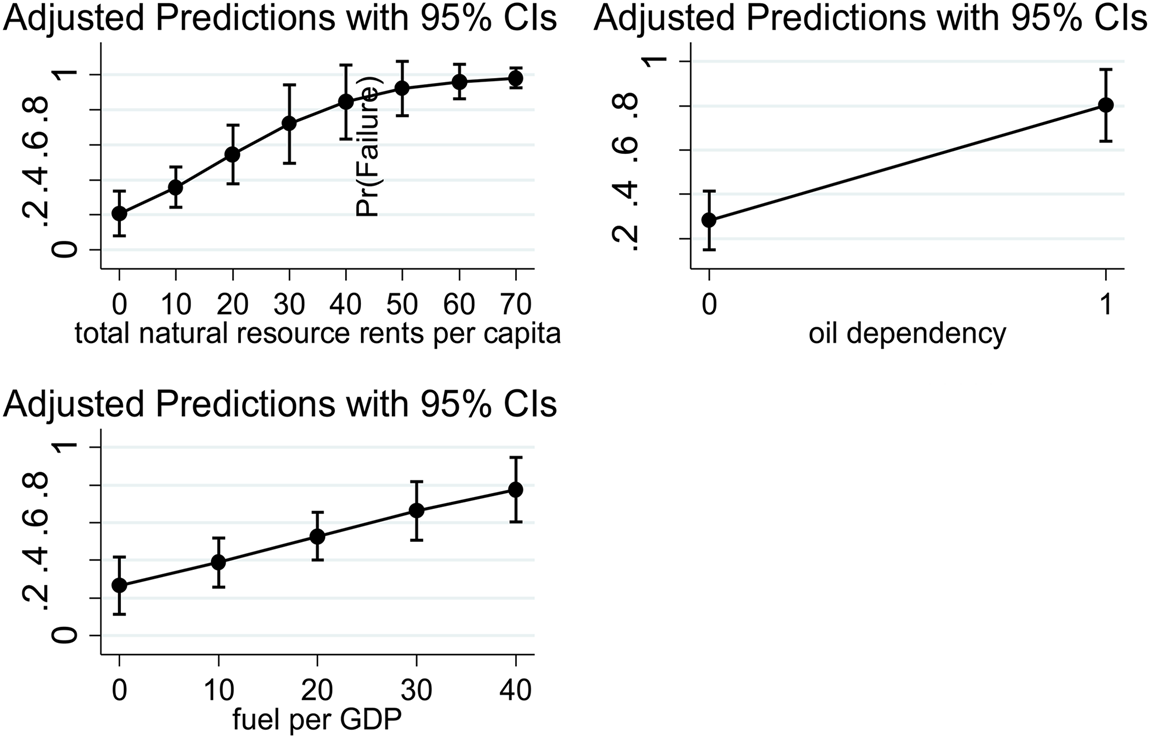
Figure 2 provides three graphs of the predicted probabilities of non-violent campaign failure, given changes in the values of the three measurements of natural resource wealth. The y-axes show the predicted probabilities of failure and the x-axes indicate the values of the independent variable capturing natural or fuel resource wealth. The graph demonstrating the substantive effect of total natural resource rents per capita indicates that the probability of non-violent campaign failure increases by 73%Footnote 7 as the target state's total natural resource wealth increases from 0 to 10% per capita. This illustrates that even small increases per capita in total natural resource wealth are associated with large increases in the likelihood of a non-violent campaign's failure. The graph of the substantive effect of oil dependency on non-violent campaigns shows that the likelihood of campaign failure is 185% higher in oil-dependent countries than in countries not dependent on oil. Finally, the last graph, which highlights the marginal impact of fuel resource exports per GDP, shows that as the percentage of the target state's GDP made up by fuel resource exports increases from 0 to 10%, the likelihood of failure of a non-violent movement increases by 46%.
Marginal Effects of Natural Resource Wealth on Non-Violent Campaign Failure
Note: In the first graph in the figure, total natural resource rents per capita refers to total natural resource rents as a percentage of GDP, as we have signified in the tables. These graphs are obtained by manipulating the figures of independent variables and keeping other variables at their means. Marginsplot command in STATA 14 is used to generate the graphs.

In terms of the findings regarding the control variables, the variable of foreign state support for the campaign is consistently significant across all models; however, external support for the target state is statistically significant only in the second model. This suggests that foreign state support significantly reduces the likelihood of campaign failure. The variable for regime type is also consistently significant, and the coefficients of the variable in all models demonstrate that the likelihood of failure decreases as the target state's level of democracy increases. With regards to the effect of the campaign's goal, the coefficients of the campaign goal variable are consistently significant across all models. This shows that campaigns whose goal is not to change the regime type are more likely to fail than campaigns seeking regime change. Note that campaigns aiming for regime change are coded 0, which is taken as a baseline in the statistical analyses. We also disaggregate the campaign goal variable to compare which types of campaigns are more likely to fail than campaigns seeking regime change. The results show that anti-occupation campaigns are especially more likely to fail. Along with the campaign goal, regime type and foreign state support variables, we also identify a significant relationship between the diversity of the campaign and its failure, suggesting that the more diverse the campaign is, the lower the probability that it will fail. While these control variables have a significant impact on the likelihood of failure, the results for state repression of protesters and GDP per capita demonstrate that neither are significantly associated with campaign failure.
Conclusion
In this research, we examine how natural resource wealth affects the outcomes of non-violent campaigns. We argue that non-violent movements are more likely to fail as the target state's natural resource wealth increases. Possessing natural resource wealth may enable the incumbent government to neutralize potential opposition from both domestic and international actors, thereby decreasing the chances of civil resisters achieving success. More specifically, the reigning regime can use natural resource wealth to secure the loyalty of civilian and military actors crucial to its cause. In addition, other countries being dependent on the target state is likely to discourage their supporting any civil resistance, reducing the overall external support for the resisters and adversely affecting the movement's prospects for success. The results of our empirical models support these hypotheses and suggest that the greater the target state's natural resource wealth, the lower the likelihood of the non-violent campaign's success. Most of our robustness check analyses confirm our arguments. However, we should also note that one of our robustness check analyses suggests that there is no significant relationship between natural resource wealth and non-violent campaign failure when we define the failure at the end of the campaign, but the coefficient is still negative. But we should also note that when we define the failure of the campaign in that way, the number of failures drops dramatically to 16.
Existing theoretical and empirical studies predominantly focus on group characteristics and discuss the role of external actors in outcomes of non-violent movements. To a lesser extent, macro-structural factors (e.g. economic decline, regime type, the role of military, etc.) are also considered. Since the role of natural resources and the ways such resources can be used by target governments to deal with non-violent uprisings has not, to date, been studied, the results of this research fill a lacuna in the literature and highlight an area of rich scholarly opportunity. Along with our contribution to the literature on non-violent campaigns, this work adds to the knowledge of violent intrastate conflicts in the sense that it demonstrates that natural resource wealth is a significant factor in explaining campaign dynamics. In particular, this study underscores the need for future research on the antecedents of civil wars and the part natural resource wealth might play in non-violent mobilization. Considering that some non-violent resistance campaigns escalate to full-scale violent conflict while others remain non-violent or are completely crushed, explaining how natural resources affect such efforts will assist us in obtaining a more precise understanding of the effects of natural resource wealth on the greater civil war process.
Further research should also consider whether natural resource wealth has different impacts on multiple non-violent resistance campaigns within a single state. It is possible that natural resource wealth could increase the likelihood of failure for one campaign but not another. Another opportunity would be to explore the positive effects of natural resource wealth on non-violent movements. In particular, civil resisters could develop relationships with in-state civil groups that support the country. Those relationships might then be used to pressure external states to withdraw their support for the incumbent government. Additionally, the conditioning effect of regime type on the relationship between natural resource wealth and non-violent campaign failure would be an important topic for future study. Steve Hess (Reference Hess2015) demonstrates that resource wealth was a significant predictor of the resilience of autocrats during the Arab Spring protests. Building on his work, future research could examine the conditioning impact of democracy on the relationship between the target state's natural resource wealth and non-violent campaign outcomes. Finally, our results indicate that state repression against non-violent resisters does not have a significant impact on the outcomes of non-violent campaigns, which is not consistent with conventional wisdom that suggests that repression creates counterproductive outcomes for target states. Further research might reconsider the effects of state repression on the dynamics of non-violent campaigns, particularly on their outcomes.
Supplementary information
To view the supplementary information for this article, please visit https://doi.org/10.1017/gov.2019.10
Acknowledgements
We thank David Mason, Jacqueline H.R. Demeritt, Melda Ozsut and Tyler Yates for their valuable comments and suggestions. All remaining mistakes are ours.