Bimetallic nanocatalysts often significantly outperform their monometallic counterparts.[ Reference Sankar, Dimitratos, Miedziak, Wells, Kiely and Hutchings 1 – Reference Wang and Li 2 ] Best performance can be achieved with the optimized structure and composition. In this regard, near surface composition and elemental distribution are the critical factors determining the catalytic property of a bimetallic nanocatalyst.[ Reference Wu and Yang 3 ] Although synthetic methods for preparing monodispersed bimetallic nanoparticles with well-defined geometric structures and overall composition are readily available,[ Reference Wang and Li 2 ] the precise control of surface composition, however, remains a great challenge. Post-synthesis thermal treatment of bimetallic nanoparticles is one of the most commonly used methods to change this surface property, though lots of trial-and-error experiments are typically involved.[ Reference Nierhoff, Conradsen, McCarthy, Johansson, Knudsen and Chorkendorff 4 – Reference Pan, Wu, Yin and Yang 7 ] Thermal processing also dramatically increases the risk for the destruction of desired size and morphology, which are critical for high catalytic performance.[ Reference Wang, Xin, Hovden, Wang, Yu, Muller, DiSalvo and Abruña 8 ]
Recently, gas molecules were used to fine tune the surface composition of shaped bimetallic nano-catalysts. Applying carbon monoxide (CO) gas during the solution phase synthesis was shown to be an alternative route to control surface composition while avoiding the detrimental effects of conventional thermal processing. CO gas was also applied directly during solution phase synthesis for the preparation of shape and composition-controlled Pt–Ni fuel cell catalysts,[ Reference Wu, Gross and Yang 9 – Reference Wu, Qi, You, Gross, Li and Yang 10 ] as-well as two-dimensional Pd nanostructures.[ Reference Pan, Yin, Kwok and Yang 11 – Reference Yin, Liu, Pan, Walsh and Yang 12 ] Reducing gas can also be generated in situ from metal carbonyls and other compounds during the solution phase synthesis.[ Reference Huang, Zhao, Cao, Chen, Zhu, Lin, Li, Yan, Zettl, Wang, Duan, Mueller and Huang 13 – Reference Redel, Krämer, Thomann and Janiak 16 ] In addition, CO gas also can be used directly in gas phase to assist the control of composition. For instance, surface compositions of Ag–Pt and Au-Pd bimetallic catalysts were shown to be changeable with the assistance of chemical vapors, such as CO and argon (Ar).[ Reference Lee, Jung, Cho, Park, Ryu, Jang, Kim, Cho, Park, Ham, Jang and Yoo 17 – Reference Pan, Yan, Shao, Zuo and Yang 18 ] Under CO atmosphere, Pt or Pd atoms can be stabilized on the surface by the adsorbed CO due to the strong affinity between the two. When exposed to Ar gas, Ag- or Au-enriched surface becomes more stable due to the low intrinsic surface energy.
In this paper, we demonstrate a modified hydrothermal method for preparing Ag–Pt nanoparticles with controlled surface composition without altering the bulk composition and microstructure.[ Reference Fu, Ma, Gao, Chen, Tang, Lu and Lee 19 ] Formaldehyde (HCHO), which is often used as a reducing agent in the synthesis of metallic nanoparticles,[ Reference Huang, Tang, Zhang, Zhou and Zheng 20 – Reference Zhang, Wang, Jiang and Xie 22 ] was applied as a surface composition directing agent. Our working hypothesis is HCHO produces CO gas as the primary product when thermally decomposed.[ Reference Saito, Kakumoto, Nakanishi and Imamura 23 ] Thus, HCHO has a great potential acting as a source of CO gas in hydrothermal synthesis when used as an additive in the solution during synthesis, which in turn acts as a directing agent for surface composition. The carbon-supported Ag–Pt nanoparticles were tested as catalysts to study the relationship between surface composition and activity toward the electrochemical oxidation of formic acid.
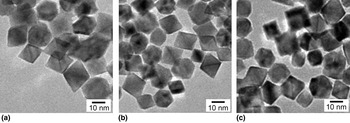
Figure 1 shows the transmission electron microscopy (TEM) micrographs of the as-prepared Ag–Pt nanoparticles under three predetermined amounts of HCHO (0.25, 1.0, and 2.0 mL). No obvious difference in size and morphology was observed despite the volume of HCHO increased from 0.25 to 2.0 mL. Regardless of the amounts of HCHO used, the nanoparticles possessed predominantly octahedral shape, with some icosahedral and decahedral ones; all terminated with {111} surfaces.
TEM micrographs of as-made Ag–Pt nanoparticles with various amounts of HCHO applied during the synthesis: (a) 0.25, (b) 1.0, and (c) 2.0 mL.

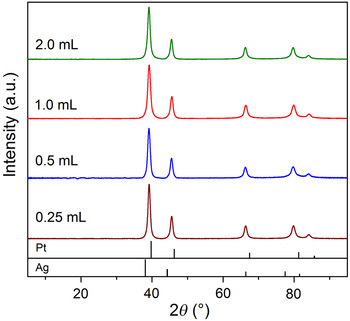
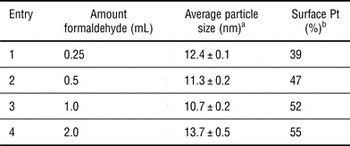
Figure 2 shows powder x-ray diffraction (PXRD) patterns of the as-prepared Ag–Pt nanoparticles. All samples showed a face-centered cubic phase with identical peak positions, located in between those of reference Pt and Ag metals. This observation suggests that all three samples are made of alloys of Ag and Pt with the same overall composition. The (111) peak centered at 39.16°2θ, corresponding to a bulk composition of Ag40Pt60, calculated based on the Vegard's law. In addition, the particle size was calculated by Scherrer equation based on the Rietveld-refined PXRD patterns using a combined Lorentzian–Gaussian function. The results are summarized in Table I and show little variation in size among these samples.
PXRD patterns of Ag–Pt nanoparticles made with different amounts of HCHO added during the synthesis.

Particle size and population of surface atom of Ag–Pt nanoparticles.

a Calculated by Scherrer equation based on PXRD.
b Calculated based on XPS Pt 4f and Ag 3d peaks.
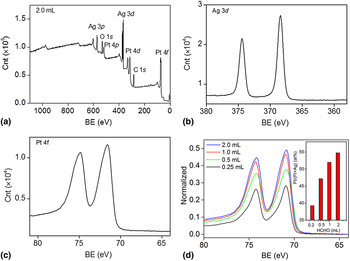
X-ray photoelectron spectroscopy (XPS) measurements were carried out to examine the surface composition of as-prepared Ag–Pt nanoparticles synthesized with different amounts of HCHO. Figure 3 shows the survey scan [Fig. 3(a)], high-resolution scans of Ag 3d [Fig. 3(b)] and Pt 4f [Fig. 3(c)], respectively, of the Ag–Pt nanoparticles formed with 2.0 mL HCHO applied during the hydrothermal synthesis. Other three samples showed similar XPS peaks, but different relative peak intensity (Fig. S1). To help visualization of relative intensity, we normalized the Pt 4f XPS spectra based on the Ag 3d peaks. In the normalized curves, intensity of Pt 4f peak increased for the nanoparticles made with the large amount HCHO used [Fig. 3(d) and Figs. S2–S3]. The surface composition was also quantitatively calculated using the CasaXPS software based on the analysis of Ag 3d and Pt 4f peaks [Fig. 3(d), inset], which changed from Ag61Pt39 to Ag53Pt47, Ag48Pt52, and Ag45Pt55 when the amount HCHO used in the synthesis increased from 0.25 to 0.5, 1.0, and 2.0 mL, respectively (Table I). The XPS results show the efficacy of using HCHO to control the surface composition of Ag–Pt nanoparticles.
XPS (a) survey, (b) Ag 3d, and (c) Pt 4f scans of Ag–Pt nanoparticles made with 2.0 mL HCHO applied during the synthesis. (d) Normalized Pt 4f scans of Ag–Pt nanoparticles made with different amounts of HCHO added during the synthesis. (Inset shows the calculated Pt atomic percentage using the CasaXPS software based on the Ag 3d and Pt 4f peaks.)

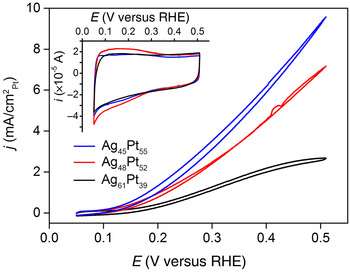
Electrochemical oxidation of formic acid was carried out using these Ag–Pt nanoparticle catalysts supported on carbon. Figure 4 shows the cyclic voltammetry (CV) curves scanned under Ar-saturated 0.1 M HClO4 and 0.5 M HCOOH. The anodic specific current density was normalized based on the ECSA value (see the Supplementary Materials), which was calculated from the CV curve corresponding to the adsorption of hydrogen on the surfaces of Ag–Pt catalysts (Fig. 4, inset). The result shows a clear relationship between surface composition and catalytic performance. In the case where 0.25-mL HCHO was used in the synthesis, the surface composition was Ag61Pt39 and the corresponding current density was 2.56 mA/cm2 at 0.5 V. When the amount of HCHO increased to 1.0, the surface composition changed to Ag48Pt52, and the current density to 6.91 mA/cm2. Similarly, when the amount of HCHO was 2.0 mL, the surface composition became Ag45Pt55, and the current density increased to 9.21 mA/cm2.
CV curves for formic acid oxidation catalyzed by Ag–Pt nanoparticle catalysts with different surface compositions made with varying amounts of HCHO.

Electrochemical oxidation of formic acid occurs via two distinguish pathways. The direct pathway involves the complete oxidation to form CO2, while the indirect pathway produces CO as an intermediate.[ Reference Zhong, Wang, Zhang and Liu 24 ] For Pt catalyst, the indirect pathway is favored and results in large amounts of CO gas at the low anodic potential, which readily poison the surface. However, mixing the surface Pt atoms with Au or Ag atoms can result in a lowered activation barrier and thus enhanced current density.[ Reference Zhong, Wang, Zhang and Liu 24 ] It appears that HCHO decomposition not only enhanced the surface formation of Pt, but also increased the dispersion of Pt and Ag atoms, resulting in a surface favoring the efficient direct oxidation of formic acid. The CO formed in situ through the HCHO decomposition is likely the driving force for the control of surface composition in the synthesis solution, as CO gas was shown to effectively assist the dispersion of Pt and Ag atoms on the surface of Ag–Pt octahedral nanoparticles.[ Reference Pan, Yan, Shao, Zuo and Yang 18 ]
In short, a synthetic method was developed to effectively control the surface composition of Ag–Pt nanoparticles using HCHO as the key reagent. It is a rather unique synthetic system, in which the surface composition can be modified, without altering the bulk composition and essential morphological features, by directly applying a chemical agent in the hydrothermal synthesis. The methodology developed in this work opens up new possibilities for controlling the surface composition of bimetallic nanocatalyst with well-defined size and shape.
Supplementary material
This supplementary material for this article can be found at https://doi.org/10.1557/mrc.2017.17
Acknowledgements
This research is supported in part by NSF (Grant No. CHE-1213926) and Dow Chemical Company (Fellowship to YTP). X-ray diffraction pattern was acquired at the George L. Clark X-Ray Facility and 3 M Materials Laboratory at the School of Chemical Science in University of Illinois at Urbana-Champaign (UIUC). Electron microscopy and XPS was carried at the Frederick Seitz Materials Research Laboratory, UIUC. YTP is also grateful for a fellowship from the Ministry of Education of Taiwan and a Dissertation Completion Fellowship from Graduate College, UIUC.