Implications
Immunomodulatory and antioxidative effects of dietary soy flavonoid genistein and citrus flavonoid hesperidin were assessed in lipopolysaccharide (LPS)-challenged broilers. Results showed that both genistein and hesperidin improved the plasma antioxidant status of growing broilers. Regardless of LPS challenge, supplemental compounds improved the intestinal intraepithelial lymphocyte numbers, relative weights of immune organs and anti-Newcastle disease and anti-avian influenza antibody titers. Overall, results indicate that dietary genistein and hesperidin improved immunocompetence and antioxidant status of broilers.
Introduction
Among farm animals, broilers possess diminutive immunity, and are susceptible to sickness by pathogens. Antibiotics and anticoccidial agents included in broiler feed, modulate gut microbiota in a favorable manner, increase immunity and feed conversion, hence regarded as growth promoters (Cox et al., Reference Cox, Stuard, Kim, McElroy, Bedford and Dalloul2010). However, their use in broiler feed results in development of antibiotic resistance by gut microbiota (Mailk et al., Reference Mailk, Kumar, Verma, Gupta, Sharma, Sharma and Rahal2013; Ansari et al., Reference Ansari, Rahman, Islam, Das, Habib, Belal and Islam2014). Flavonoids, a group of phytochemicals, possess potential health-enhancing effects (Kamboh et al., Reference Kamboh and Zhu2015). Research on laboratory animals has indicated that plant flavonoids improved intestinal efficiency, inhibited the growth of pathogenic organisms, attenuated endotoxin lipopolysaccharide (LPS) effects and up-regulated the innate and adaptive immune responses (Calixto et al., Reference Calixto, Campos, Otuki and Santos2004; Kawaguchi et al., Reference Kawaguchi, Kikuchi, Hasunuma, Maruyama, Yoshikawa and Kumazawa2004). Dietary inclusion of citrus flavonoid hesperidin improved the antioxidative status in broilers (Simitzis et al., Reference Simitzis, Symeon, Charismiadou, Ayoutanti and Deligeorgis2011), ducks (Marzoni et al., Reference Marzoni, Chiarini, Castillo, Romboli, De Marco and Schiavone2014) and lambs (Simitzis et al., Reference Simitzis, Ilias-Dimopoulos, Charismiadou, Biniari and Deligeorgis2013). Genistein, a soy flavonoid, regulated mucosal immunity (Wei et al., Reference Wei, Bhatt, Chang, Sampson and Masilamani2012), as well as enhanced B and T cell populations in rats (Guo et al., Reference Guo, White, Brown, Delclos, Newbold, Weis, Germolec and McCay2002). Furthermore, both genistein and hesperidin ameliorated heat stress during persistent summer stress (Kamboh et al., Reference Kamboh, Arain, Mughal, Zaman, Arain and Soomro2013), modulated lipid metabolites (Kamboh and Zhu, Reference Kamboh, Hang, Bakhetgul and Zhu2013) and improved immunity and intestinal morphometry in broiler chickens (Kamboh and Zhu, Reference Kamboh and Zhu2014). However, to our knowledge, little work has been conducted on the supplementation of genistein and hesperidin in immunologically challenged chickens. Therefore, the present study aimed to investigate the immunomodulatory and antioxidative effects of dietary supplementation with genistein and hesperidin, either individually or in combination in basal diets, in LPS-challenged broilers.
Materials and methods
Broilers and housing
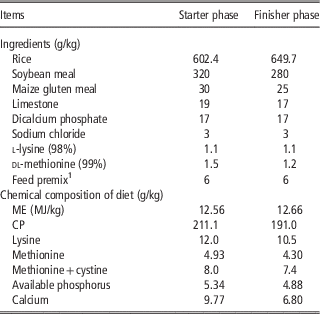
This experiment was conducted at Chicken Experimental Station of Laboratory of Gastrointestinal Microbiology, under the approved guidelines of Animal Care and Use Committee of Nanjing Agricultural University, China. In total, 700 21-day-old commercial Arbor Acres broiler chicks, as hatched were purchased from a local hatchery, and randomly assigned to 12 dietary treatments. Six replicate cages, containing 20 chicks each, were assigned to each treatment group. All the birds were housed in an environmentally controlled room in triple-stacked battery cages. The temperature and relative humidity were adjusted according to optimal range for chickens of this age. Birds were allowed to consume both food and water ad libitum. Fresh diets were prepared once a week and were stored in sealed bags at 4°C. The rice–soybean meal diets (Table 1) were formulated in order to meet the nutrient requirements of broiler chickens (National Research Council, Reference Nghonjuyi, Tiambo, Kimbi, Manka’a, Juliano and Lisita1994). The diets were not supplemented with any in-feed antibiotics and/or anticoccidial agents. At 10 days of age, all the birds were subcutaneously vaccinated against Newcastle disease virus (NDV, B1 strain vaccine) and avian influenza virus (AIV, H5N2 strain vaccine).
Feed ingredients and chemical composition of broilers basal diets

ME=metabolizable energy.
1 Mineral premix provided per kilogram of diet: transretinyl acetate, 25 mg; cholecalciferol, 6 mg; menadione, 1.2 mg; thiamine, 2.3 mg; riboflavin, 8 mg; nicotinamide, 42 mg; choline chloride, 400 mg; calcium pantothenate, 10 mg; pyridoxine HCl, 4 mg; biotin, 0.04 mg; folic acid, 1 mg; cobalamin, 0.012 mg; Fe (from ferrous sulfate), 82 mg; Cu (from copper sulfate), 7.5 mg; Mn (from manganese sulfate), 110 mg; Zn (from zinc oxide), 64 mg; I (from calcium iodate), 1.1 mg; Se (from sodium selenite), 0.28 mg.
Experimental protocols
For this experiment, a 2×6 factorial design was used, using injection with either LPS (250 μg/kg BW) or saline (sterile 0.9%) as one factor; whereas the other factor was supplementation or nonsupplementation of flavonoids (genistein and/or hesperidin). Genistein and hesperidin were purchased from a commercial company (Sigma Chemical Co., St Louis, MO, USA) with 98% purity. The LPS (Escherichia coli, serotype O55:B5; Sigma Chemical Co.) was dissolved in sterile saline for its intraperitoneal inoculation. At 16, 18 and 20 days of age, injections of LPS or an equivalent amount of sterile saline were given in the lower abdominal region to half of the birds in each dietary treatment. Each replicate cage was the experimental unit for dietary treatment and challenge status (i.e. injected or uninjected). The six dietary treatments were as follows: (1) basal diet without any additive (CON); (2) basal diet with 5 mg/kg genistein (G5); (3) basal diet with 20 mg/kg hesperidin (H20); (4) basal diet with 5 mg/kg genistein+hesperidin (1 : 4, GH5); (5) basal diet with 10 mg/kg genistein+hesperidin (1 : 4, GH10); and (6) basal diet with 20 mg/kg genistein+hesperidin (1 : 4, GH20). The dose and ratios of genistein and hesperidin were based on preliminary trials (unpublished data), whereas the dose of LPS was used as described previously for immunological stimulation (Zhang et al., Reference Zhang, Zhong, Zhou, Wang, Du and Wang2010). For combined supplementation, both compounds were used in same proportions (1 : 4) as used in individual doses.
Sample collection
At the 21 and 42 days of age, one broiler chicken per replicate cage was randomly selected, weighed and killed by exsanguination. The whole gastrointestinal tract was removed, and about 2 cm segments from duodenum and jejunum were excised, rinsed twice with cold phosphate-buffered saline (pH 7.6) and stored at −80°C until analyzed for intestinal intraepithelial lymphocytes (iIELs). Thymus, bursa and spleen were collected, and weighed to calculate the immune organ indices using following formula:
 $$\eqalign{ {\rm Immune}\,{\rm organ}\,{\rm index}\,{\rm {\equals}}\,{\rm (immune}\,{\rm organ}\,{\rm weight}\,{\rm in}\,{\rm g/BW}\,{\rm in}\,{\rm g)}\cr \ \ \quad{\times}100}$$
Assay of plasma antioxidant indices
At 21 days of age, individual blood samples were collected from randomly selected broilers, and immediately centrifuged at 3000×g for 15 min at 4°C. The plasma was isolated and stored at −20°C until analyzed for total antioxidant capacity (TAOC), malondialdehyde production (MDA) and superoxide dismutase (SOD) activity using commercial kits (Nanjing Jiancheng Bioengineering Institute, Nanjing, China). All samples were analyzed in triplicate according to the instructions of kit manufacturers, and observations were recorded using spectrophotometer (UNICO 7200; Unico Co., Shanghai, China) at specific wavelengths.
Anti-Newcastle disease virus and anti-avian influenza virus antibody titers
Humoral immunity was assessed by measuring anti-NDV and anti-AIV antibody titers at 20, 27, 34 and 42 days of age. Blood was collected from each group (n=6) using wing veins into nonheparinized tubes for determination of anti-NDV and anti-AIV titers through hemagglutination inhibition assay. Sera were separated by centrifugation at 2000×g for 15 min, and their hemagglutination inhibition (HI) test was carried out, as described by Rahman et al. (Reference Rahman, Nizamani, Soomro, Kalhoro and Rasool2014). The maximum dilution of each serum sample causing HI was used as endpoint, and the results were recorded as the geometric mean titer of log2.
Histological examination of intestinal intraepithelial lymphocytes
In order to estimate the effects of dietary treatments on mucosal immunity, iIELs were calculated using the method of Inagaki-Ohara et al. (Reference Inagaki-Ohara, Sawaguchi, Suganuma, Matsuzaki and Nawa2005). For this purpose, duodenum and jejunum tissues were embedded in liquid paraffin and cut into 5 μm sections at three levels. These were stained with hematoxylin–eosin and sealed with cover slip. The sections were examined by light microscopy (×400 magnifications), and the number of iIELs at five different fields of intestinal villi were counted for statistical analysis of iIELs number change.
Statistics
Data were analyzed using GLM procedure of SPSS 16.0 for windows (SPSS, 1999) as a 6×2 factorial arrangement with dietary treatment of genistein/hesperidin and challenge status as main effects. Tukey’s multiple range test was used to evaluate the significant differences among treatment means. Level of significance was determined at probability level <0.05. All results were presented as mean along with pooled standard error of means (mean±SEM).
Results
Immune organ indices
Diet effects
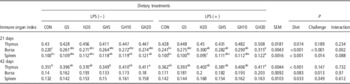
The effects of supplementation of basal diet with genistein and hesperidin on immune organs, such as bursa, spleen and thymus of broiler chicks is shown in Table 2. Supplementation of basal diet with genistein and hesperidin significantly increased bursa and spleen indices in broiler chicks on 21st day (P<0.01). Similarly, dietary treatments exhibited a significant increase in the thymus and spleen indices on 42nd day (P<0.05).
Effect of genistein and hesperidin supplementation on immune organ indices in lipopolysaccharide (LPS)-induced broiler chickens at 21 and 42 days of age

CON=control; G5=5 mg/kg genistein; H20=20 mg/kg hesperidin; GH5=5 mg/kg genistein+hesperidin (1 : 4); GH10=10 mg/kg genistein+hesperidin (1 : 4); GH20=20 mg/kg genistein+hesperidin (1 : 4).a,b,cMean values (n=6) in a row sharing no common superscript are significantly different (P<0.05).
Lipopolysaccharide treatment effects
LPS challenge significantly increased bursa and spleen indices on 21st day and bursa index on 42nd day, as shown in Table 2 (P<0.05). Diet and LPS challenge exhibited a significant interaction for bursa index on 21st day (P<0.01).
Antioxidant activities
Diet effects
The effect of supplementation of basal diet with genistein and hesperidin on antioxidant capacity was shown in terms of TAOC, SOD and MDA levels in broiler chick blood samples (Table 3). Supplementation of basal diet with combined genistein and hesperidin significantly increased plasma TAOC level on 21st day regardless of LPS challenge compared with control and G5 groups (P<0.01). GH20 showed a significant increase in plasma SOD activity for LPS-unchallenged group, on 21st day, when compared with control (P<0.01). Furthermore, the dietary treatments significantly affected the MDA levels in broilers on 21 days of age (P<0.01). However, although decreasing levels of MDA were detected with elevated levels of the supplemented flavonoids, multiple comparison test did not return significant differences (P>0.05).
Effect of genistein and hesperidin supplementation on plasma antioxidant status of lipopolysaccharide (LPS)-induced broiler chickens at 21 days of age

CON=control; G5=5 mg/kg genistein; H20=20 mg/kg hesperidin; GH5=5 mg/kg genistein+hesperidin (1 : 4); GH10=10 mg/kg genistein+hesperidin (1 : 4); GH20=20 mg/kg genistein+hesperidin (1 : 4); TAOC=total antioxidant capacity; MDA=malondialdehyde contents; SOD=superoxide dismutase activity.
a,b,c,d,e,f,gMean values (n=6) in a row sharing no common superscript are significantly different (P<0.05).
1 TAOC and SOD were expressed as U/ml; MDA were expressed as nmol/ml.
Lipopolysaccharide treatment effects
As shown in Table 3, GH20 exhibited a significant increase in plasma SOD activity for both LPS-challenged and unchallenged groups, on 21st day, when compared with control (P<0.05). However, diet and LPS challenge exhibited a nonsignificant interaction for all the antioxidant parameters (P>0.05).
Number change of intestinal intraepithelial lymphocytes
Diet effects
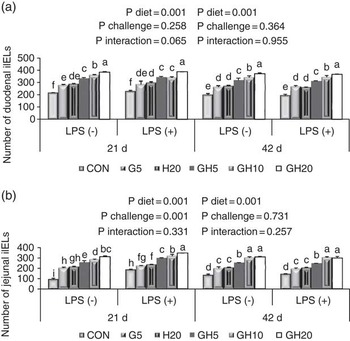
Supplementation of basal diet with genistein and hesperidin significantly increased the number of iIELs in both duodenum and jejunum regardless of LPS challenge, compared with control (P<0.001) (Figure 1a and b). GH20 group exhibited the highest ratio of iIELs during the entire experimental period irrespective of LPS challenge.
Effect of genistein and hesperidin supplementation on intestinal intraepithelial lymphocytes (iIELs) of the duodenum (a) and jejunum (b) in lipopolysaccharide (LPS)-induced broiler chickens at 21 and 42 days of age. a,b,c,d,e,f,g,hMeans (n=6) sharing no common letters differ significantly (P<0.05). CON=control; G5=5 mg/kg genistein; H20=20 mg/kg hesperidin; GH5=5 mg/kg genistein+hesperidin (1 : 4); GH10=10 mg/kg genistein+hesperidin (1 : 4); GH20=20 mg/kg genistein+hesperidin (1 : 4).

Lipopolysaccharide treatment effects
As shown in Figure 1a and b, diet and LPS challenge exhibited a nonsignificant interaction for iIELs on both 21 and 42 days (P>0.05). LPS challenge significantly increased the ratio of iIELs in jejunum on 21st day (pooled mean unchallenged v. challenged=40.8, P<0.05; Figure 1b) but had no effect in duodenum iIELs ratio (P>0.05; Figure 1a).
Anti-Newcastle disease virus and anti-avian influenza virus antibody titer
Diet effects
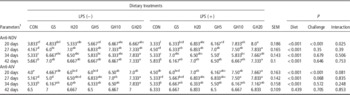
As shown in Table 4, LPS-unchallenged groups showed significant increase in anti-NDV titer for GH5, GH10 and GH20 groups at 20th day, compared with that of control (P<0.01). Supplementation of basal diet with genistein and hesperidin showed a significant increase in anti-NDV titer at 27th day regardless of LPS challenge, as compared with that of control (P<0.01). GH20 group had significantly higher anti-NDV titer means at 34 and 42 days than those of control group (P<0.01).
Effect of genistein and hesperidin supplementation on serum anti-Newcastle disease virus (NDV) and anti-avian influenza virus (AIV) antibody titers in lipopolysaccharide (LPS)-induced broiler chickens from 20 to 42 days of age

CON=control; G5=5 mg/kg genistein; H20=20 mg/kg hesperidin; GH5=5 mg/kg genistein+hesperidin (1 : 4); GH10=10 mg/kg genistein+hesperidin (1 : 4); GH20=20 mg/kg genistein+hesperidin (1 : 4)
a,b,c,d,e,fMean values (n=6) in a row sharing no common superscript are significantly different (P<0.05).
1 Expressed as geometric mean titer (log2).
Likewise, supplementation of basal diet with combined genistein and hesperidin significantly increased anti-AIV titer for all the treated groups at 20th day, regardless of LPS challenge, as compared with that of control (P<0.01) (Table 4). At 27th day, GH5, GH10 and GH20 groups exhibited significantly increased anti-AIV titer in LPS-unchallenged groups (P<0.01). Moreover, only GH20 group, in unchallenged with LPS birds, showed significant increase in anti-AIV titer at 34th day, compared with control (P<0.05). Dietary supplementation with genistein and hesperidin at 42nd day did not cause any significant effect in broiler chickens (P>0.05).
Lipopolysaccharide treatment effects
Table 4 indicated that LPS challenge exhibited a significant increase in anti-NDV antibody titer in all the treated groups at 20th day (pooled mean=7.03 log2), when compared with that of LPS-challenged control (3.33 log2, P<0.01). LPS challenge, however, did not have a significant effect on anti-NDV titer at 27, 34 and 42 days (P>0.05). Furthermore, diet and challenge also showed a significant interaction on 20th day for anti-NDV titer (P=0.025). Moreover, LPS challenge significantly increased anti-AIV titer at 20th day in H20, GH5, GH10 and GH20 groups compared with LPS-challenged control (P<0.01). At 27th day, GH10 and GH20 groups exhibited significantly increased anti-AIV titer in LPS-challenged groups compared with control (P<0.05). However, LPS challenge at 34 and 42 days did not have any significant effect in broiler chickens (P>0.05).
Discussion
Bioflavonoids, such as genistein and hesperidin, used in this study, are proven natural antioxidants, under in vivo and in vitro conditions (Chavan et al., Reference Chavan, Amarowicz and Shahidi1999; Fellenberg and Speisky, Reference Fellenberg and Speisky2006). TAOC describes the ability of water- and fat-based antioxidants to bind the free radicals present in the food systems. The increase in TAOC level for all the supplementation levels in this study; even at low supplementation levels (5 mg/kg) of combined genistein and hesperidin, resulted in higher plasma TAOC activity (Table 3). Jiang et al. (Reference Jiang, Jiang, Zhou, Lin and Zheng2007) also reported an increase in the plasma TAOC of broilers with dietary supplementation of 10 to 80 mg/kg of soy flavonoids. A recent study reported a significant promotion of plasma TAOC in laying hens with the supplementation of a 0.05% bioflavonoid naringenin (Lien et al., Reference Lien, Yeh and Su2008). Bioflavonoids exhibit a structure-oriented antioxidative activity in the food systems (Chavan et al., Reference Chavan, Amarowicz and Shahidi1999). The –OH group in flavonoid structure acts as hydrogen donor to the peroxy radicals produced during the oxidation, which inhibits hydroxyl peroxide formation (Fellenberg and Speisky, Reference Fellenberg and Speisky2006).
Increased levels of dietary supplementation of bioflavonoids genistein and/or hesperidin resulted in increased SOD and decreased MDA production in plasma. Jiang et al. (Reference Jiang, Jiang, Lin, Xi, Yu and Wu2014) associated a similar significant modulation of MDA and SOD in male Lingnan broilers fed with the diets supplemented with 10 to 80 mg/kg isoflavone. Similar positive changes in plasma MDA and SOD levels were reported in layer chickens fed with citrus flavonoids (Lien et al., Reference Lien, Yeh and Su2008). MDA is a naturally occurring complex organic compound, and is an indicator of oxidative stress. It is a highly reactive substance, and is produced by peroxidation of polyunsaturated fatty acids in foods. SOD activity represents defense mechanism of cells against the superoxide radicals. The decreased plasma MDA production, as well as increased SOD enzyme activity in the present study, with supplementation of basal diets with all combination doses of bioflavonoids, even at low and medium doses (5 and 10 mg/kg), indicated increased blood oxidative stability. Decreased MDA production has also been reported for tissues for upto 120 days of storage using the dietary supplementation of bioflavonoids naringin or hesperidin (Goliomytis et al., Reference Goliomytis, Kartsonas, Charismiadou, Symeon, Simitzis and Deligeorgis2015). Likewise, another study reported the potential of dietary bioflavonoid quercetin to increase the oxidative stability of broiler meat for 3 and 9 days at 4°C (Goliomytis et al., Reference Goliomytis, Tsoureki, Simitzis, Charismiadou, Hager-Theodorides and Deligeorgis2014). Therefore, it can be concluded that bioflavonoids are potential natural antioxidants that act as effective free radicals scavengers and influence the in vivo antioxidant defense systems such as SOD, glutathione peroxidase, etc. (Ali et al., Reference Ali, Abdul-Azeez, Humood, Ali, Helal and Wahab2016; Raheema, Reference Raheema2016). It has been hypothesized that bioflavonoids chelate the metal ions such as Fe and Cu, leading to decreased MDA formation (Fellenberg and Speisky, Reference Fellenberg and Speisky2006).
Bioflavonoids exhibit immunomodulatory potential in living systems. Immune organ index is expressed in terms of increase in sizes of thymus, bursa and spleen. Dietary supplemention of genistein and hesperidin increased the immune organ index for bursa, spleen (21 days) and thymus (42 days) in this study, which is in agreement with a recent study of flavonoid-rich extract (Dong et al., Reference Dong, Gao, Tong, Jia, Sa and Zhang2007), which reported a significantly increased sizes of thymus, bursa and spleen. A similar effect of ethanolic extract of Carica papaya leaves was reported in case of coccidia-challenged chickens, which resulted in the increase in size of heart, thymus and bursa (Nghonjuyi et al., 2015). Bursa is recognized as the most responsive immune organ of chicken for microbial infections (Hanieh et al., Reference Hanieh, Gerile, Narabara, Gu, Abe and Kondo2010). Effect of LPS was observed on bursa (21 days), which reflected the stimulatory action of LPS for the production of bursa-dependent B cells (Ogikubo et al., Reference Ogikubo, Orimatsu, Sasaki, Yasuda, Saegusa and Tamura2004). Intestinal mucosa acts as the first barrier against antigens (e.g. microorganism). Intraepithelial lymphocytes are the immunocompetent cells, which encounter the antigens in the mucosal immune system (Liu et al., Reference Liu, She, Wang, Bao, Zhang, Luo, Hu, Ding, Wang and Peng2008). Hence, iIELs play a fundamental role in mucosal immunity of animals. Dietary supplementation of basal feed with genistein and hesperidin increased the levels of iIELs in duodenum and jejunum, which indicated the effectiveness of these flavonoids for improvement of mucosal immunity (Shukla et al., Reference Shukla, Mehta, John, Mehta, Vyas and Shukla2009). The increased number of iIELs in this study indicated an increased production of cytokines (Inagaki-Ohara et al., Reference Inagaki-Ohara, Sawaguchi, Suganuma, Matsuzaki and Nawa2005), which ultimately protected the gut from harmful microflora.
The T and B cells are important types of lymphocytes. The T cells are thymus cells that produce cytokines and toxic granules, which encounter the pathogen-infected cells. On the other hand, the B cells are bursa/bone marrow-derived cells that secrete antibodies, which bind to the antigens, thus protect the body from infection. Supplementation of basal diet with genistein and hesperidin increased antibody titer that indicated an increased responsiveness of T and B lymphocyte subsets for antibody synthesis, which augmented the humoral immune response in chicken (Table 4). This response was stimulated on 20th day, suggesting a dynamic effect of LPS for the differentiation of polyclonal B cells into antibody-producing cells (Ogikubo et al., Reference Ogikubo, Orimatsu, Sasaki, Yasuda, Saegusa and Tamura2004). Hanieh et al. (Reference Hanieh, Gerile, Narabara, Gu, Abe and Kondo2010) reported that flavonoids-enriched purple sweet potato powder modulated the antibody titer of chickens in dose-dependent manner. The present study indicated a significant improvement in humoral immunity of broiler chickens with high supplemental doses (GH20), which protected them from NDV and AIV. Hager-Theodorides et al. (Reference Hager-Theodorides, Goliomytis, Delis and Deligeorgis2014) also reported the improved IgY antibody titers in broilers by the dietary administration of bioflavonoid quercetin. The immune reactions associated with T and B cells are highly sensitive to oxidative damage (Catoni et al., Reference Catoni, Peters and Schaefer2008), so the increased antioxidative activities of the flavonoids improved humoral immunity in this study. In the present work, LPS also stimulated an increase in antibody titers against NDV and AIV on 20th day. This effect of LPS was probably because of an increase in the number of antibody forming T and B cells, which was reported as peak level after 24 h of LPS injection, and likely to diminished within 48 to 72 h (Bowen et al., Reference Bowen, Dienglewicz, Wideman and Erf2009).
Conclusions
Supplementation of plant flavonoids, genistein and hesperidin, both individually, as well as in combination (1 : 4), modulated in vivo antioxidant and immune status in both LPS-challenged and -unchallenged broiler chickens toward a positive direction, through elevation of humoral and mucosal immunity. This improved immune status may be beneficial against infectious agents, particularly for gram-negative bacterial pathogens. Further research with live bacterial challenge (may be in different doses) may investigate the particular role of this immune status during infection.
Acknowledgements
This work was supported by National public benefit research program (200903003). Thanks also go to the Sindh Agriculture University/Higher Education Commission, government of Pakistan for studentship to A. A. K.