FOCUS POINTS
• Clozapine is the gold standard antipsychotic for treatment-resistant schizophrenia (TRS).
• Olanzapine emerged as a very efficacious antipsychotic, and some studies have demonstrated its efficacy also in TRS.
• Olanzapine, particularly in higher dosages, might be considered as an alternative to clozapine in TRS; however, most robust evidence still supports clozapine as the gold standard.
Introduction
Antipsychotics are the mainstay of treatment of schizophrenia.Reference Mueser and McGurk1 However 20–30% of patients do not respond appropriately to conventional or second generation antipsychotics (SGAs)Reference Meltzer and Kostakoglu2 and are considered treatment-resistant, or refractory, presenting persistent psychotic symptoms and chronically disability.Reference Elkis3 This represents a significant socioeconomic impact.Reference McEvoy4
Clozapine is the gold standard for treatment-resistant schizophrenia (TRS) patients,Reference Elkis and Meltzer5 based on its well established efficacy when compared with first generation antipsychotics (FGAs).Reference Brambilla, Barale, Caverzasi, Tognoni and Barbui6–Reference Wahlbeck, Cheine, Essali and Adams12 Nevertheless, serious adverse events, and precautions associated to clozapine use, might limit its use for up to 5% of patients with schizophrenia.Reference Sernyak and Rosenheck13 Data comparing clozapine to other SGAs are still controversial,Reference Leucht, Kissling and Davis14 in spite of recent guidelines emphasizing the recommendation of clozapine for TRS patients.Reference Buchanan, Kreyenbuhl, Kelly, Noel, Boggs and Fischer15
In a meta-analysis published in 2001,Reference Chakos, Lieberman, Hoffman, Bradford and Sheitman7 clozapine had a greater overall effect size when compared with other SGAs in TRS patients, but the difference was small in two trials that compared clozapine with risperidone.Reference Bondolfi, Dufour and Patris16, Reference Breier, Malhotra and Su17 Data obtained from other meta-analyses with patients with schizophrenia, regardless of refractoriness status,Reference Asenjo Lobos, Komossa and Rummel-Kluge18, Reference Leucht, Komossa and Rummel-Kluge19 suggest that clozapine was superior just to zotepine and risperidone, whereas olanzapine was superior to risperidone, quetiapine, and aripiprazole, with no difference when compared with clozapine or amisulpride.
A large pragmatic trial conducted in the UK showed that clozapine led to greater improvement in Positive and Negative Syndrome Scale (PANSS) scores than other SGAs.Reference Lewis, Barnes and Davies20 In the second phase of the Clinical Antipsychotic Trials of Intervention Effectiveness (CATIE), both clozapine and olanzapine were equally effective in reducing total PANSS scores,Reference McEvoy, Lieberman and Stroup21 but olanzapine was more effective in terms of discontinuation rates.Reference McEvoy, Lieberman and Stroup21 In addition, in a meta-analysis comparing the effectiveness of SGAs except clozapine, olanzapine was superior to all other SGAs.Reference Johnsen and Jorgensen22
Findings suggesting similar efficacy between clozapine and other SGAs, particularly olanzapine, might have been partially driven by dose issues.Reference Leucht, Kissling and Davis14 Clozapine in higher doses might produce better effects than at lower doses,Reference Davis and Chen23, Reference Simpson, Josiassen and Stanilla24 and it is possible that the same dose-response relationship might occur with olanzapine in TRS patients, as suggested by one RCT,Reference Meltzer, Bobo and Roy25 although no clear dose-response pattern has been found for olanzapine in non-TRS patients.Reference Citrome, Stauffer and Chen26, Reference Kinon, Volavka and Stauffer27 In addition, metabolic adverse events might limit the use of high doses of olanzapine.Reference Citrome, Holt, Walker and Hoffmann28
Based on the evidence that shows a comparable efficacy of clozapine and olanzapine, but not other SGAs, in patients with TRS, further assessment is needed. Therefore, in the present study, we show the results of a systematic review and meta analyses that assess and test such evidence supporting the use of olanzapine in patients with TRS, as an alternative to clozapine.
Methods
A systematic review of the literature was performed to identify all prospective, randomized, double-blind, controlled trials that have compared SGAs with clozapine in patients with schizophrenia according to the criteria in the Diagnostic and Statistical Manual of Mental Disorders, 4th edition (DSM-IV),29 aged 18 years or older, who were considered treatment-resistant (i.e., have failed to respond to at least one prior antipsychotic with appropriate dose and duration of treatment). Crossover studies were included if it was possible to extract data just from the first part of the study. For the present article, only the studies comparing olanzapine with clozapine were included.
Efficacy outcomes were as follows: (a) mean scores at the endpoint of the trial, or mean changes from baseline to endpoint, on PANSS,Reference Kay, Fiszbein and Opler30 Brief Psychiatric Rating Scale (BPRS),Reference Overall and Gorham31 Clinical Global Improvement (CGI),Reference Guy32 or any other rating scale; (b) proportion of patients with no clinically significant response, as defined by each study; and (c) dropout rates.
An electronic database search was conducted assessing studies that were published until December 2009. The search had no restriction for language, but only articles published in English were analyzed. The following databases were assessed: PUBMED, MEDLINE, EMBASE, Current Contents, BIOSIS, Derwent Drug File, International Pharmaceutical Abstracts, Evidence Based Medical Journals, PsycInfo, Cochrane's Central Register of Controlled Trials (CCRCT), and Database of Systematic Reviews. The combination of terms related to clozapine, second generation antipsychotics, and treatment resistant schizophrenia were searched in titles, abstracts, and keywords using the Boolean operator AND. The complete list of terms that were used in the search is listed in Table 1. Only clinical trials or trials with clozapine or other SGAs as investigational drugs were searched. Reference lists of relevant articles and book chapters were also hand searched.
List of search terms

Two reviewers (J.S. and I.T.) independently inspected all reports of identified studies, based on the titles and abstracts. All potentially eligible studies were then fully assessed to decide by consensus whether these studies met the inclusion criteria. Any disagreement was solved by consensus. The risk of bias was assessed following recommendations from the Cochrane Handbook for Systematic Review Interventions (CHSRI).33 Data resulting from intention-to-treat analyses were carefully separated from data from completers (“as observed”). For dichotomous outcomes, the total number of patients and the number of patients who met the response criteria were recorded. For continuous outcomes, the scores and respective standard deviations (SD) were recorded.
Data were analyzed using the Comprehensive Meta-Analysis software.34 All analyses were performed for single outcome measures if at least 3 studies could be pooled together. For dichotomous outcomes, the relative risk (RR) with a 95% confidence interval (CI) was calculated. For continuous outcomes, the standard mean difference (SMD), with a 95% CI, was calculated. The fixed-effect model method was employed for all analysis. Heterogeneity of studies was assessed using the Q-test as well as I2. The overall statistical significance (p) and Z scores were also calculated.
For publication bias, funnel plots were used, but since they are limited to detect small effects,Reference Egger, Smith and Altman35 they were constructed only if more than 10 studies could be pooled. A sensitivity analysis was conducted; studies with patients who were intolerant to the prior antipsychotic treatment, in addition to the truly refractory patients based on prior lack of efficacy, were excluded. Meta-regressions were conducted using olanzapine doses as moderators of the effect size. In order to establish a standardized comparison, clozapine and olanzapine doses were calculated in terms of dose equivalents of chlorpromazine.Reference Atkins, Burgess, Bottomley and Riccio36, Reference Woods37
Findings
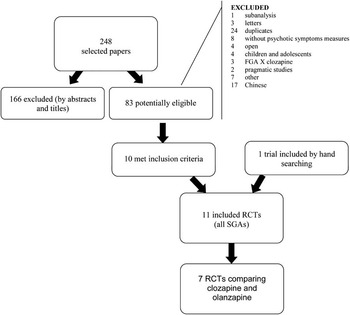
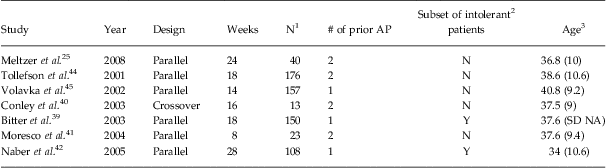
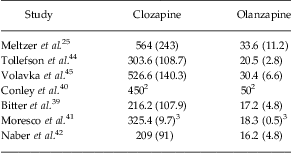
The original search yielded 248 articles. Of those, 83 were selected as potentially eligible to be included, and 10 articles compared SGAs to clozapine.Reference Brambilla, Barale, Caverzasi, Tognoni and Barbui6, Reference Meltzer, Bobo and Roy25, Reference Azorin, Spiegel and Remington38–Reference Volavka, Czobor and Sheitman45 In addition, one study was added by hand searching.Reference Breier, Malhotra and Su17 (See Figure 1.) Seven studies compared clozapine with olanzapine, and therefore are included in the current analyses (Table 2).Reference Meltzer, Bobo and Roy25, Reference Bitter, Dossenbach and Brook39–Reference Naber, Riedel and Klimke42, Reference Tollefson, Birkett, Kiesler and Wood44, Reference Volavka, Czobor and Sheitman45 All these studies were short term (8–28 weeks), parallel group trials, except for one crossover study.Reference Conley, Kelly, Richardson, Tamminga and Carpenter40 Less than 20% of patients were representatives of developing countries. Analysis included 648 patients with schizophrenia and 29 patients with schizoaffective disorder. The mean age ranged from 34 to 40.8 years old, with a mean duration of illness ranging from 7.1 to 15.8 years and the mean number of hospitalizations ranging from 6 to 11. Most studies reported no data regarding the use of concomitant medication, although the use of hypnotic-sedative agents was permitted in all trials. Refractoriness was defined by failure to oneReference Bitter, Dossenbach and Brook39, Reference Naber, Riedel and Klimke42 or twoReference Meltzer, Bobo and Roy25, Reference Conley, Kelly, Richardson, Tamminga and Carpenter40, Reference Moresco, Cavallaro and Messa41, Reference Volavka, Czobor and Sheitman45 prior antipsychotics, but two trials also included an unidentified subset of patients who were intolerant to their previous antipsychotic regimen.Reference Bitter, Dossenbach and Brook39, Reference Naber, Riedel and Klimke42 Two trials specifically compared clozapine to a high dose of olanzapine,Reference Meltzer, Bobo and Roy25, Reference Conley, Kelly, Richardson, Tamminga and Carpenter40 but in all other trials, the mean doses of olanzapine were relatively high (Table 3). With only one exception,Reference Conley, Kelly, Richardson, Tamminga and Carpenter40 all studies were sponsored by pharmaceutical companies, which is an important bias. No meta-analyses pooled more than 10 studies, and therefore no funnel plots were constructed.
Included and excluded studies.

Characteristics of included studies
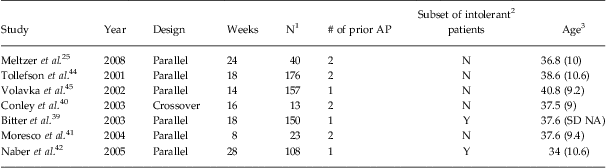
SA = schizoaffective disorder patients, AP = antipsychotics, NA = not available, SD = standard deviation, N = No, Y = Yes, USA = United States of America.
1. Randomized patients.
2. Patients who were intolerant to their prior antipsychotic regimen.
3. Mean (SD).
Clozapine and olanzapine final mean doses (mg/D)1
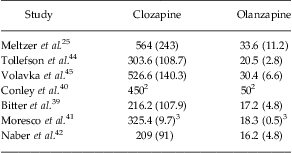
1. ITT.
2. Fixed dose.
3. Completers.
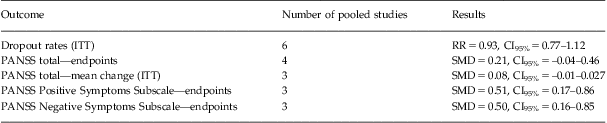
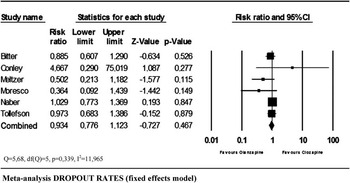
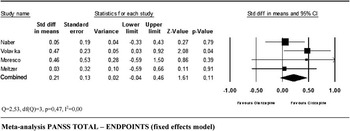
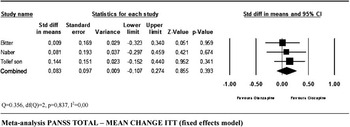
For five outcome measures, it was possible to pool results from at least three studies (Table 4). Meta-analyses did not detect differences between clozapine and olanzapine in terms of dropout rates (ITT) (RR = 0.93, CI95% = 0.77–1.12, Figure 2), in terms of the total PANSS endpoint (SMD = 0.21, CI95%– = –0.04–0.46, Figure 3), or in mean changes of the total PANSS (ITT) (SMD = 0.08, CI95% = –0.01–0.027, Figure 4).
Single outcome metanalysis
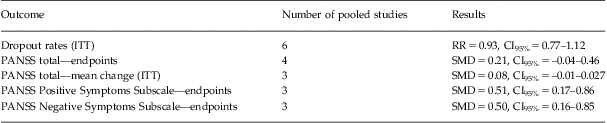
PANSS = Positive and Negative Symptoms Scale; ITT = Intention to treat analysis; RR = relative risk; SMD = standardized mean difference; CI = confidence interval.
Dropout rates (ITT).

Panss total – endpoints.

Panss total – mean change (ITT).

For dropout rates and total PANSS endpoint meta-analyses, a sensitivity analysis was done that excluded studies with a subset of intolerant patients,Reference Bitter, Dossenbach and Brook39, Reference Naber, Riedel and Klimke42 and this did not change the results.
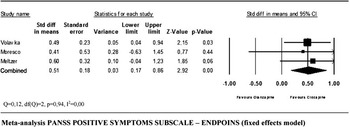
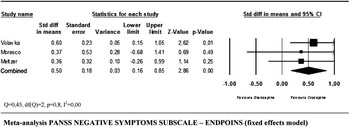
However, in the analysis of endpoints of PANSS positive and negative subscales, clozapine was superior to olanzapine (respectively, SMD = 0.51, CI95% = 0.17–0.86, Figure 5; and SMD = 0.50, CI95% = 0.16–0.85, Figure 6). No heterogeneity was found in any of the meta-analyses. Meta-regression analyses did not show any significant result.
Panss positive symptoms subscale – endpoints.

Panss negative symptoms subscale - endpoints.

Discussion
The results of the present meta-analyses showed that there were no significant differences between olanzapine and clozapine in patients with TRS, as measured by dropout rates or total PANSS scale. However, this similarity should be interpreted with caution, taking into consideration that clozapine was superior to olanzapine in terms of efficacy on both positive and negative symptoms.
The dose issue is particularly important in the interpretation of this present review of results. In fact, two studiesReference Meltzer, Bobo and Roy25, Reference Conley, Kelly, Richardson, Tamminga and Carpenter40 showed an important impact toward better olanzapine results, and that might be related to the mean olanzapine dose, which was considerably higher than the usual dose in both studies (33.6 ± 11.2 and 30.4 ± 6.6, respectively). In all studies comparing clozapine to olanzapine, the olanzapine dose was higher than the standard doses commonly used in clinical practice, with a mean final dose ranging from 16.2 ± 4.8Reference Naber, Riedel and Klimke42 to 33.6 ± 1.2.Reference Meltzer, Bobo and Roy25 Additionally, in at least two studies,Reference Bitter, Dossenbach and Brook39, Reference Naber, Riedel and Klimke42 the mean final dose of clozapine was considered to be subtherapeutic (216.2 ± 107.9 and 209 ± 91, respectively). One of the industry-sponsored trials that was included in this reviewReference Tollefson, Birkett, Kiesler and Wood44 compared a moderate dose of clozapine (303.6 ± 108) with a high dose of olanzapine (20.5 ± 2.8), raising the issue of sponsorship bias. The hypothesis that a high dose of olanzapine can positively influence its efficacy in patients with TRS had already been previously observed in noncontrolled settings,Reference Fanous and Lindenmayer46–Reference Sheitman, Lindgren, Early and Sved53 in spite of the evidence showing a lack of a clear dose-response pattern for non-TRS patients.Reference Citrome, Stauffer and Chen26, Reference Kinon, Volavka and Stauffer27
This is important, as several studies have reported a similar efficacy between clozapine and olanzapine in the last decade. For example, clozapine was found to have similar efficacy to olanzapine, according to PANSS total score and PANSS positive subscale, in a meta-analysis that included 78 studies with 13,558 patients.Reference Leucht, Komossa and Rummel-Kluge19 Additionally, in the case of pragmatic trials, such as the second phase of the CATIE trial, which compared olanzapine, risperidone, and quetiapine, with clozapine, no statistically significant difference was observed between clozapine, with a final mean dose of 332.1 ± 156.9, and olanzapine, with a final mean dose of 23.4 ± 7.9, both in terms of time for discontinuation due to any reason and due to lack of efficacy.Reference McEvoy, Lieberman and Stroup21 However, the relationship between such results and treatment resistance is unclear, since both studies included a nonselected population of schizophrenia patients.
Adverse events and safety-related outcomes of clozapine or olanzapine in TRS patients were not focused on in this review, but should be taken into consideration while assessing the results. The use of SGAs is generally associated with impaired glucose metabolism, diabetes mellitus, weight gain, and dyslipidemia, with olanzapine presenting a higher risk when compared to most SGAs.Reference Citrome, Holt, Walker and Hoffmann28 Therefore high dose olanzapine might represent a higher risk of metabolic adverse events. Although the evidence regarding a dose-response correlation between olanzapine concentration and weight gain is conflicting,Reference Kelly, Richardson, Yu and Conley54, Reference Perry, Argo and Carnahan55 one RCT that was included in the present review, which specifically addressed high dose olanzapine in TRS patients, showed a significantly higher risk of weight gain and increase in body mass index (BMI) for olanzapine-treated patients when compared with clozapine, at 6 months but not 6 weeks, which also raises the issue of time effects when assessing metabolic adverse events.Reference Meltzer, Bobo and Roy25
The present study has the following limitations: (a) Data from the PANSS General Psychopathology Sub-Scale was not available in most studies, which hindered additional analysis regarding differential effects of clozapine and olanzapine in other important general psychopathological symptoms; (b) two studiesReference Naber, Riedel and Klimke42 made no appropriate distinction between truly refractory and intolerant patients, although sensitivity analysis that was conducted excluding these studies showed no important impact in the overall results; (c) two trials included a small subset of schizoaffective patients,Reference Meltzer, Bobo and Roy25, Reference Volavka, Czobor and Sheitman45 although significant heterogeneity was not found due to these studies; (d) non-English language articles were not included in the present review (however, in a meta-analysis that compared clozapine with FGAs, such criteria showed no effect on the final results)Reference Essali, Al-Haj, Li and Rathbone9; and (e) difficulties inherent in research on schizophrenia, such as the lack of homogeneity of a refractory schizophrenia criteria, variability in terms of doses and titration schemes, small sample sizes, and relatively short periods of observation. To our knowledge, this is the first systematic review and meta-analysis that evaluated the efficacy of olanzapine in comparison with a well-established drug (i.e., clozapine) in treatment-resistant schizophrenia.
Conclusions
The results of this study suggest that clozapine is significantly more efficacious than olanzapine in improving positive and negative symptoms in TRS patients.
Disclosures
Juliano S. Souza was an employee at Abbott Laboratories. Monica Kayo has acted as a consultant for Abbott, Aché, Apsen, Glaxo-Smithkline, Janssen-Cilag, Novartis, and União Química; she received a research grant from Roche and travel support from Eli Lilly. Ivson Tassell has received research honoraria from Janssen-Cilag. Camila Bertini Martins has no conflicts of interest to declare. Helio Elkis has acted as a consultant for, received travel support from, was member of the speaker's bureau for, and received research grants from Astra-Zeneca, Eli Lilly, Janssen-Cilag, Lundbeck, Moksha 8, Novartis, Organon, Pfizer, Roche, and Fundação de Amparo à Pesquisa do Estado de São Paulo (FAPESP).