

1. Introduction
What the EU learned about its integration from the migrant crisis is the subject of this article. ‘Migrant crisis’ is a complex and value-laden term. It is a migrant crisis because the EU experienced a dramatic increase in irregular crossing of its external borders between 2015 and 2016 (EC 2017). Those entering were fleeing military conflicts in Syria, Afghanistan and Iraq, as well as poverty and political uncertainty elsewhere. Termed variously the ‘refugee crisis’ (Khiabany Reference Khiabany2016, 755), the ‘migrant crisis’ (Balkan Reference Balkan2016, 118), the ‘refugee and migrant crisis’ (Karolewski and Benedikter Reference Karolewski and Benedikter2017, 294), we operate with the term ‘migrant crisis’ because it is broad enough to embrace different flows of migrants into Europe that, albeit prompted by partly different drivers, raise overlapping concerns and reactions. By using the term ‘migrant crisis’ we do not wish to invisibilize refugees, but rather to acknowledge the overlaps between different facets of migration in the EU that are referred to as ‘mixed flows’ (Pastore and Henry Reference Pastore and Henry2016, 44). We understand the ‘migrant crisis’ as being located at the intersection of various ‘crises’ (economic, social, security, Schengen, etc.) (Seabrooke and Tsingou Reference Seabrooke and Tsingou2018). We acknowledge that the challenges related to the ‘migrant crisis’ are far from being solved. This was apparent, for instance, in the events leading up to the EU summit of June 2018 and the ongoing political divisions that the summit revealed, including about ‘burden sharing’ (European Council 2018). The sense of emergency present in the EU in 2015–2016, however, has dissipated. Our research participants, introduced below, were unanimous in stating that the ‘crisis’ is no longer present, but we do still experience its repercussions; a view recently shared by the First Vice-President of the European Commission, Frans Timmermans (European Commission Press Release Database 2019).
The migrant crisis challenged the EU project at the core, questioning prospects of further EU integration. We understand EU integration broadly as both seeking ways to structure and strengthen the relationships among the existing and (possibly) exiting Member States (MSs) and widening to include new MSs; processes referred to as deepening and widening (La Barbera Reference La Barbera2015).
The article sets out to answer the question: what modes of integration has the EU learned from the migrant crisis? The article argues that the migrant crisis triggered intensive learning in the EU about its integration modes, and that EU integration is happening through learning whereby the EU has been exploring a combination of certain modes of integration. The article begins by reviewing two bodies of literature: organizational learning in the EU and EU integration after the migrant crisis. Then, after detailing our methodological approach, the article shows how the ‘crisis’ served as a ‘tipping point’ for a change of EU priorities as it has placed migration at the centre of its policymaking. Here, empirical findings relating to three interconnected modes of integration are explored: reducing enthusiasm for further enlargement; shaping the relationships with (possibly) exiting MSs by considering fuzziness at the borders with the UK post-Brexit; and seeking differentiation among the existing MSs possibly through promoting a two-tier EU instead of universal deepening.
The article strengthens the link between, and contributes to, two bodies of literature: organizational learning in the EU and EU integration particularly after the migrant crisis. The article highlights the centrality of learning in the EU integration process, especially following the migrant crisis; it intersects organizational learning theory and theoretical approaches to EU integration.
2. Towards Conceptualizing EU Integration in Relation to Learning
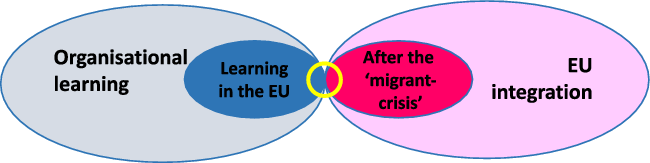
This section locates our research at the crossover of two bodies of literature: organizational learning in the EU and EU integration after the migrant crisis (Figure 1). This literature review also builds a framework for analysing EU integration after the migrant crisis from the perspective of organizational learning.
Locating our research in the existing literature.
2.1. EU Integration after the Migrant Crisis
A significant theme in debates around EU integration after 2015 revolves around the implications of the migrant crisis for the EU’s existence. Literature points to multiple problematizations of the crisis (Greussing and Boomgaarden Reference Greussing and Boomgaarden2017), and the link between the migrant crisis and other recent and ongoing crises in Europe, such as the Global Financial Crisis, the Eurozone crisis and the security crisis (Falkner Reference Falkner2016; Balkan Reference Balkan2016; Seabrooke and Tsingou Reference Seabrooke and Tsingou2018). It also highlights how the migrant crisis interacted with other crises, such as that of the Eurozone, to produce new problems, including rising Euroscepticism (Taggrat and Szczerbiak Reference Taggrat and Szczerbiak2018).
Combined, these problems put EU integration into question (Murray and Longo Reference Murray and Longo2018; Wolf and Ossewaarde Reference Wolf and Ossewaarde2018) to the point that some analysts (Jones Reference Jones2018; Morsut and Kruke Reference Morsut and Kruke2018) identify a reverse process – disintegration. Crises are not new in the EU, and, indeed, they are integral to a cyclical process of EU integration (Scipioni Reference Scipioni2017). Previous crises eventually drove further integration. The current crises, however, are seen as threatening the EU project (Seabrooke and Tsingou Reference Seabrooke and Tsingou2018), with MSs advocating the re-nationalization of policies, including migration policies (Brekke and Staver Reference Brekke and Staver2018).
Post-migrant-crisis literature also addresses the theorization of EU integration, drawing on existing theories: institutionalism (Jones Reference Jones2018), intergovernmentalism (Jones Reference Jones2018), new intergovernmentalism (Falkner Reference Falkner2016), liberal intergovernmentalism (Borzel and Risse Reference Borzel and Risse2018), functionalism (Borzel and Risse Reference Borzel and Risse2018), neofunctionalism (Borzel and Risse Reference Borzel and Risse2018), post-functionalism (Schimmelfennig Reference Schimmelfennig2018), transactionalism and new supranationalism (Falkner Reference Falkner2016).
There is no consensus as to what theoretical approaches are dominant in the recent context. While Falkner (Reference Falkner2016) claims that new supranationalism may be developing, new intergovernmentalism will potentially dominate in EU integration, Borzel and Risse (Reference Borzel and Risse2018), maintain that liberal intergovernmentalism, neofunctionalism and post-functionalism have become the dominant theoretical approaches.
None of the above theoretical approaches can fully explain the integration trajectories adopted following different crises in the EU. For example, Borzel and Risse (Reference Borzel and Risse2018) argue that none of the dominant approaches account for why the Euro-crisis resulted in the substantial deepening of European fiscal and financial integration while MSs preferred disintegration when it came to dealing with the migrant crisis.
A final, related body of literature written after the migrant crisis discusses modes of EU integration, that is, patterns of relationships among the MSs and among the MSs and the candidate countries. Pre-migrant-crisis literature captures a range of these modes. The relationships among the MSs are linked to differentiated integration. Stubb (Reference Stubb1996, 283, emphasis in original) states, ‘[T]he debate about differentiated integration… is characterised by an excess of terminology which can give even the most experienced specialist of European integration a severe case of semantic indigestion’. The multiplicity of routes for differentiated integration has been debated more recently by Antoniolli (Reference Antoniolli2019) and Schimmelfennig and Winzen (Reference Schimmelfennig and Winzen2019). The relationships between the MSs and EU candidate countries are discussed in terms of the advantages/disadvantages of enlargement for the EU (Sjursen Reference Sjursen and Sjursen2006; Grabbe Reference Grabbe2014). Post-migrant-crisis literature focuses on the relationships among the MSs. For example, Panizzon and Van Riemsdijk (Reference Panizzon and Van Riemsdijk2018) discuss the benefits of multi-level governance in managing the migrant crisis and its aftermath. Morsut and Kruke (Reference Morsut and Kruke2018) meanwhile present their own typology of the modes and argue that the EU should use a mix of self-governance, co-governance and hierarchical governance to govern the post-migrant-crisis context so as not to endanger the EU integration project.
The multiple foci and theoretical perspectives in the literature on EU integration point to the difficulty of finding a single theoretical framework for the analysis of EU integration after the migrant crisis. Indeed, it had not been much easier prior to the crisis, as, according to Hooghe and Marks (Reference Hooghe and Marks2008, 39), ‘European integration has thrown up a series of facts that escape the theories on offer’.
2.2. Organizational Learning in the EU
The literature points to the potential importance of organizational learning in the analysis of the work of the EU in general. In particular, Radaelli and Dunlop (Reference Radaelli and Dunlop2013, 923) state that ‘[T]he European Union may well be a learning organisation’, and learning is ‘one of the promising frameworks’ for the analysis of the EU. This may, arguably, be applied to the case of EU integration, as explained in this subsection, which provides an overview of the literature on organizational learning in the EU; a literature based on a wider body of scholarship on organization learning (e.g. Wang and Ahmed Reference Wang and Ahmed2003). This subsection also explores the definition of organization learning.
According to Radaelli and Dunlop (Reference Radaelli and Dunlop2013, 923), ‘[I]n public policy analysis, learning is often defined as a process of updating beliefs about policy based on lived or witnessed experiences, analysis or social interaction’. The term ‘organizational learning’ is similar to the term ‘institutional learning’, but the latter is usually used in research in the field of education (Hale Reference Hale2017; Foutz and Emmons Reference Foutz and Emmons2017). Understanding organizational learning as updating beliefs about policy is the first step in exploring the definition of this key term. It is also important to understand how learning and change are connected, and that different types of learning exist.
Learning in the EU may have tipping moments of change as well as moments of low degree of learning, with crises usually being the triggering factors of learning (Radaelli and Dunlop Reference Radaelli and Dunlop2013). While most studies understand change as following learning (e.g. Radaelli and Dunlop Reference Radaelli and Dunlop2013; Seabrooke and Tsingou Reference Seabrooke and Tsingou2018), Kamkhaji and Radaelli (Reference Kamkhaji and Radaelli2017) suggest the reverse: policy learning follows change. Aside from this, learning usually presupposes advancing knowledge in new ways, but it may also be about ‘unlearning old lessons’ (Zito and Schout Reference Zito and Schout2009, 1111).
The most common typologies of learning discussed in the literature about EU organizational learning include single- and double-loop learning (Argyris and Schön Reference Argyris and Schön1996) and triple-loop learning (Flood and Romm Reference Flood and Romm2018). Single-loop learning is instrumental, focused on changing particular actions, and does not presuppose altering the fundamental values of the organization (Argyris and Schön Reference Argyris and Schön1996). In Kamkhaji and Radaelli’s (Reference Kamkhaji and Radaelli2017) terms, it does not even lead to policy changes as the scholars talk about single-loop learning and policy change as two separate issues. Double-loop learning is about a value change resulting from feedback from learning, which fundamentally transforms organizational behaviour (Arguis and Schön Reference Argyris and Schön1996). Triple-loop learning is the most reflexive and transforming learning sub-process as it leads to the re-evaluation of the context in which the organization operates, a fundamental change of power relations within the organization and between it and other organizations, and a change in how the organization decides what is right for it to do (Flood and Romm Reference Flood and Romm2018). Tosey et al. (Reference Tosey, Visser and Saunders2012, 291), however, critique the term, stating that ‘conceptualizations of triple-loop learning are diverse, often have little theoretical rooting, are sometimes driven by normative considerations, and lack support from empirical research’.
In this sense, the article by Zito and Schout (Reference Zito and Schout2009) is the closest conceptually to our research. That article is a milestone in bringing together the debates about EU integration and learning. While Zito and Schout’s study aims at evidencing learning in the EU at the micro level in terms of individuals and their social interactions, our research deals with the macro level because it considers the learning of the EU as an institution. Also, we look at a specific period – after the migrant crisis, and we are specifically interested in the modes of integration in this period.
The apparent gap in this literature is in applying the notion of learning to EU integration specifically in the post-migrant-crisis context. Our research addresses this gap.
3. Methods
The data informing this article were collected in the framework of a larger project focused on developing understanding of the impact for EU integration of the migrant crisis along the Balkan route. Although we did not set out to research it, organizational learning of the EU about its integration after the migrant crisis emerged as a key theme in the data, and it forms the focus of the current article, which pertains to the EU more broadly rather than the Balkan route specifically.
The larger project, in the framework of which this article was developed, was a qualitative study, consisting of policy analysis and elite interviews with EU-level decision-makers in Brussels. Prior popular discourse analysis based on the online search of relevant articles in media outlets was used to inform the interviews and policy document search.
We received ethical approval from the University of Sheffield Ethics Committee for conducting interviews. In total, 16 semi-structured elite interviews were conducted in Brussels. The majority of the interviewees represented EU-level decision-making bodies. Most of these voices are from the European Commission (EC) – civil servants whose primary responsibility is to develop and execute the implementation of the ideas devised by legislative bodies, such as the European Parliament (EP). In addition, two MEPs were interviewed. The remaining interviewees were researchers or policy analysts representing NGOs or think tanks whose voices were part of the political debates because they informed and evaluated policy-making. The affiliations, as narrow or broad as chosen by the interviewees, are presented in the appendix. Understanding the nature of the voices of these people working in the EU institutions or other relevant NGOS and think tanks is important as it is fundamental to understanding who learns in the EU. We were interested in these people’s perspectives as they have opinions about the modes of EU integration in the post-migrant-crisis context, and their work at the frontline of policy-making has an impact on EU integration.
The sample of interviewees in the context of the larger project was purposeful. It was designed to capture knowledge in the wake of the migrant crisis related to EU internal and external migration (i.e. EU Freedom of Movement and third country economic migrants and refugees), and knowledge linked to EU integration and Brexit. There was an element of snowballing in recruiting the participants. We recruited participants who could discuss all of these areas. We did not succeed in finding interviewees from Directorate European Neighbourhood and Enlargement Negotiations (DG NEAR). Other interviewees, however, were sufficiently competent to comment on the questions linked to EU enlargement due to their prior experience working at DG NEAR, or their current cooperation with EU candidate countries. The interviews took place face-to face, with the exception of three, which were conducted over Skype and email. The interviews were conducted between September and November, 2017. All the interviews relied on the same topic guide. The interviews were voice recorded, and transcribed manually. The transcripts were analysed thematically along with the responses of the interviewees who emailed their answers. The anonymity of interviewees and the confidentiality of their answers was secured by leaving out participants’ names and assigning a code to each participant (1–16). The affiliation of the respondents was also omitted, with the exception of those who did not mind revealing it. Their exact post in the organization, however, was kept confidential.
Policy document analysis was used to supplement the analysis of the interview findings. Policy documents provided further details about the ideas and processes that the interviewees discussed. Most of the policy documents were collected before the interviews took place to generate a timeline of the policy actions that the EU took to support migrants prior to the migrant crisis in 2015–2016, and later the policies that were produced to address the migrant crisis. We collected further documents after the interviews to address specific points raised by the interviewees. The range of documents this article refers to is limited to five recent documents related to EU enlargement and the EU summit about migration.Footnote 1
We acknowledge that the variety of perspectives about the typology of organizational learning in scholarly debates depends on the challenges in studying organizational learning in all areas of the work of the EU. One of the difficulties is in the fact that ‘[C]oncepts of learning overlap, and there are difficulties in specifying whether or not learning has occurred given the many possible intervening variables’ (Zito and Schout Reference Zito and Schout2009, 1104). Moreover, as Radaelli and Dunlop (Reference Radaelli and Dunlop2013, 923) argue ‘…learning as a process is often problematic for social scientists. Researchers have found it easier to observe the products of learning’. There may be, however, a trap hidden in such a logic. It dismisses the possibility of gradually emerging products of learning being part and parcel of the learning process reinforcing and shaping in turn further learning. This article avoids striving to establish the boundary between the learning process and its products. This article also does not intend to offer a solution to the challenges of studying learning. Instead, it draws its hypothesis from Radaelli and Dunlop’s (Reference Radaelli and Dunlop2013) argument that ‘[T]he European Union may well be a learning organisation’, and learning is ‘one of the promising frameworks’ for the analysis of the EU. Based on this hypothesis, we aim to explore what modes of integration the EU has learned from the migrant crisis.
4. Learning in EU Integration after the Migrant Crisis
This section presents the research findings. It examines the learning in the EU that the migrant crisis triggered and what integration modes the EU has been exploring in this context.
4.1. The Migrant Crisis as a Trigger for Intensive Learning
The language that the interviewees used conveys the idea that the migrant crisis has induced learning in the EU on different levels. Language such as ‘learning lessons’, ‘realising’, ‘figuring out’ is quite common, as illustrated by these exemplary quotes:
On the EU level some lessons have been learned about how to react in a more structural way… We learned the lessons and put some mechanisms in force. They existed before but were not working. (Interviewee 4, EU official)
EU countries realized that they need to work more on EU multilateral level… They cannot operate alone. They need cooperation. (Interviewee 14, official working on Strategy ‘European Migrant Smuggling Centre’ at Europol)
They [MSs] are more open to think that more needs to be done together. There were countries that were sceptical. But there is realization now, (Interviewee 10, EU official)
So what’s important for the EU, as far as I can see, is to figure out how to reform the EU, how to handle Poland and Hungary, what to do with countries building fences in Europe to prevent migration, how to deal with the political situation after the elections in Germany. These are the most important problems. (Interviewee 3, MEP)
The idea that the migrant crisis has triggered learning in the EU as an institution and within its MSs is in line with the arguments about the potential of crises to induce learning, put forward in the literature on organizational learning in the EU (e.g. Kamkhaji and Radaelli Reference Kamkhaji and Radaelli2017). While accepting Radaelli and Dunlop’s (Reference Radaelli and Dunlop2013) proposition that ‘[T]he European Union may well be a learning organisation’, we use the explicit references of the interviewees to learning presented above as a basis to recognize that EU integration in particular may be happening through learning, while looking at the period after the migrant crisis.
4.2. EU Integration through Learning
Researchers who study learning in organizations face many challenges, including recognizing whether what is observed is, in fact, learning, and where the boundary is between learning as a process and the outcomes of this process (Zito and Schout Reference Zito and Schout2009). We have stated earlier that we do not intend to identify such a boundary, but rather rely on Radaelli and Dunlop’s (Reference Radaelli and Dunlop2013) argument that the EU may be a learning organization and explore this in relation to EU integration specifically after the migrant crisis by evidencing the integration modes that the EU has learnt post-migrant-crisis. The quotes above suggest that the migrant crisis has triggered learning in different areas of functioning of the EU. In addition, we will illustrate that through the migrant crisis the EU as an institution learnt that EU integration progress had been ineffective, and that three new modes of integration have emerged as a result of this learning.
It is obvious that the migrant crisis brought about challenges in EU integration by causing disagreements amongst the MSs. Moreover, the migrant crisis provoked EU officials to examine EU integration in retrospect and re-evaluate it. They learnt that EU integration had been progressing ineffectively since it had not prepared the EU to deal with the migrant crisis more effectively when the problem arose:
It raised questions about how united the EU was. These cracks existed before but this [migrant crisis] made them more visible. (Interviewees 6, MEP)
This is a very strong theme running through the interview data from different participants, including representatives from think tanks:
The migrant crisis has been a testing ground for a number of political trends that had been developing over the last years. This was a perfect issue to have those trends crystallised and come forward. If we look at this Visegrad group and other Member States – this hasn’t been created by the migrant crisis. The issues had been there and the migrant crisis made them visible. (Interviewee 1, representative of the European Council on Refugees and Exiles)
A side-effect of this learning on the part of EU officials seems to be the recognition of a new central place for migration policy in debates on EU integration:
Migration concern was always seen as a side dish way down in the list of priorities… Today, immigration policy is in the centre. It’s part and parcel of the EU policy. (Interviewee 2, EU policy-making official)
Migration is one of the key priorities for the EU integration. It will be for a long time, considering climate change, external instability, etc. (Interviewee 5, EC official)
This new central place of migration is confirmed by the focus of the new modes of integration explained below:
There is a need for a new vision. There is a job to be done in terms of helping people understand why the EU matters. The post-war peace project is losing ground, so what’s the project now? (Interviewee 6, MEP)
The evidence above highlights weaknesses in EU integration. Seabrooke and Tsingou (Reference Seabrooke and Tsingou2018) fear the existence of the EU project is threatened now. However, none of the interviewees expressed such a pessimistic view about EU prospects. Crises do challenge integration (Wolf and Ossewaarde Reference Wolf and Ossewaarde2018). This seems to illustrate double-loop learning since the fundamental behaviours and structures of the EU have been reconsidered and have started changing, such as putting migration at the centre of policymaking. The evident intensive learning through which integration has been happening after the migrant crisis may serve as a self-correction mechanism in the EU to adapt its integration and respond to the arising challenges. A more detailed picture of this is presented in the next section. This also borders with triple-loop learning as there are traces of fundamental change of what the vision is for the EU future– what is right for it to do and why it exists at all. However, given Tosey et al.’s (Reference Tosey, Visser and Saunders2012) critique of theoretical and empirical credibility of the concept of ‘triple-loop learning’, we can only speculate whether it does take place or what we observe is still within the boundaries of double-loop learning.
4.3. Modes of EU Integration Driven by Learning
Our interview data suggest that the EU has been learning the following modes of integration after the migrant crisis: questioning further enlargement, dealing with succession after Brexit, and leaning towards differentiated integration amongst its remaining MSs.
4.3.1. Shaping the Relationships with Candidate Countries: Questioning Further Enlargement
There are six candidate countries for a potential fifth wave of EU enlargement: Turkey, FYROM, Macedonia, Albania, Serbia and Iceland. Negotiations with Iceland have been put on hold at the request of the Icelandic government. Turkey’s candidacy is also on hold. As the Communication on EU Enlargement Policy (2018) states:
Accession candidates must give the rule of law, justice and fundamental rights utmost priority in the negotiations. This rules out EU membership for Turkey for the foreseeable future. Turkey has been taking giant strides away from the European Union for some time.
The people working in the EU institutions seem to question whether it makes sense to enlarge with the other candidate countries any time soon and whether it is worth enlarging at all. The interviewees suggest that the policymakers are unanimous in this. It is a very strong theme in the interviews, illustrated by the following quote by a MEP, referring to the speech by Jean-Claude Juncker, the State of the Union Address 2017 (European Commission Press Release Database 2018):
…the president of the European Commission said that there would be no enlargement during this period. There are many political negotiations but the enlargement to Serbia or FYROM or any other country is not a political reality just now. (Interviewee 3)
Hesitation as to further enlargement is linked in some of the interviews to the difficulty of the recent negotiations about how to redistribute migrants and how to manage national borders during and after the migrant crisis. The MEP, mentioned above, states:
…nobody is interested in bringing new actors in this process. The process with 28 Member States is already absolutely complicated because everybody says we have some national specifics, far-right parties… It’s all difficult but still possible. (Interviewee 3)
This sentiment that enlargement is not a priority for the EU in the near future can be traced in the documents that have been issued by the EU following the interviews. The language is somewhat softer in the 2018 Communication on EU Enlargement Policy. This states, ‘It is clear that there will be no further enlargement during the mandate of this Commission and this Parliament. No candidate is ready. But thereafter the European Union will be greater than 27 in number’. Hence the prospect of further enlargement is not foreclosed but possibly implicitly placed in a queue after two other priorities: dealing with succession after Brexit and reconstructing the relationships among the remaining MSs.
4.3.2. Shaping the Relationships with Exiting Members: UK–EU
Mixed flows of migration became a fertile ground for conflation and misrepresentation of different types of migration in the UK Leave Campaign leading up to the June 2016 Referendum on the UK’s membership of the EU (Sayer Reference Sayer2017, 99).
The lessons learnt by the EU from the migrant crisis that are driving the reshaping of its relationship with the exiting UK are related to the UK itself, as well as other MSs to prevent them from exiting. In the withdrawal negotiations, which are ongoing at the time of writing, both the EU and the UK have been struggling to define and agree on what their relationship will look like after Brexit. These disagreements on the EU’s side are in part an expression of a dilemma that the EU faces in establishing its new integration mode – shaping the relationships with (potentially) exiting members such as the UK. It requires a redefinition of a range of aspects of EU policy: on the one hand, the EU wants to retain a close cooperation relation with the UK in part by granting privileged status to it in some respects, and on the other hand, it does not want to allow the UK to cherry-pick so as to preserve the coherence of the EU acquis.
Our interviews with EU policymakers suggest that they would favour the EU, as an institution, retaining some aspects of close cooperation with the UK post-Brexit, because the UK is an important strategic cog in the EU machine. The UK’s role in EU security is an example:
The UK is an extremely important player when it comes to the international security of the EU. Since Brexit is happening, we hope that the UK will remain in security agencies such as Europol. It wouldn’t be a good decision to stop participating in such agencies and cooperating with other Member States on the multilateral level in security. It has already been mentioned by the UK authorities that they would remain in Europol at least. (Interviewee 14, official working on Strategy ‘European Migrant Smuggling Centre’ at Europol)
The interviewees favour this close cooperation on security grounds despite the EU’s intent of not granting privileges to exiting members so as to discourage further exits:
If you want to get out, like the UK, you get out… It depends on what Theresa May wants to do. Europe sticks to its principles. This is Europe… These are the rules of the club… If you are not very receptive and can’t change anything, you have to leave the club. (Interviewee 4, EU official)
Indeed, there is a degree of fear in the EU that any ‘cherry-picking’ in terms of retaining some privileges for the UK post-Brexit may encourage other MSs to follow the UK’s path. Brexit has had a very limited impact so far, however, on the party politics of other MSs (Taggart and Szczerbiak Reference Taggrat and Szczerbiak2018), perhaps in part because of how challenging it is proving to find a deal that garners support from the UK parliament. The debate about the deal is complicated but, in a nutshell, it is about the choice between ‘hard’ and ‘soft’ Brexit. ‘Hard Brexit refers to the position of leaving the EU’s Single Market. Soft Brexit refers to staying in the EU’s Single Market and Customs Union’ (Hobolt Reference Hobolt2018, 3). The disagreements exist not only between the EU and the UK but also within the EU and the UK (Hobolt Reference Hobolt2018). A possible no-deal Brexit is discussed by Fahy et al. (Reference Fahy, Hervey, Greer, Jarman, Stuckler, Galsworthy and McKee2017) as the ‘hardest’ version of Brexit. The challenges in Brexit negotiations may also, supposedly, be attributed to a possible hidden agenda of both parties in using the challenges as an argument to eventually retain UK’s membership in the EU by avoiding Brexit. This is speculation but it was also implied by a MEP:
Maybe it’s a reality that we will have a new referendum on Brexit. Many of my colleagues in the EP say that maybe it could be a solution. It would be good for the EU, for the UK. (Interviewee 3).
4.3.3. Shaping the Relationships among the Remaining Member States: Differentiated Integration
The third integration mode the EU has been learning after the migrant crisis focuses on differentiated integration as the way to shape relationships among the remaining MSs. The discussion of further enlargement prospects and the EU–UK case above already evidence a propensity towards differentiated integration. The latter has more broadly become the preferred mode for further integration of the remaining MSs.
A similar issue has recently been addressed by Genschel and Jachtenfuchs (Reference Genschel and Jachtenfuchs2017) when examining the distinction between market integration and core state powers integration in the EU. They argue that the Eurozone and the migrant crisis ‘made horizontal differentiation unattractive, re-regulation ineffective, centralized risk and burden-sharing unfeasible, and the externalization and adjustment burdens to non-EU action necessary by default’ (Genschel and Jachtenfuchs Reference Genschel and Jachtenfuchs2017, 178). The authors also apply these ideas to the analysis of the five escape scenarios from these challenges that were suggested in the 2017 European Commission’s ‘White Paper on the Future of Europe’: (1) ‘carry on’ and tackle problems as they arise; (2) ‘nothing but the Single Market’, which presupposes abandoning the idea to integrate only core state powers; (3) ‘more horizontal differentiation: closer integration among those MSs “who want more”’; (4) ‘doing less more efficiently’ by focusing only on a few most important policy areas and re-nationalizing all others; (5) ‘doing much more together’ by focusing on EU capacity-building in core state powers and avoiding the re-nationalization of any policy areas (European Commission 2017, 191–192).
Our data suggest that these scenarios may not be equally plausible alternatives. Carrying on seems to be the least favoured option because it would perpetuate the problems, according to the interviewees. Instead, a combination of scenarios (5) and (3) seems the priority of EU officials for the future – the securitization of the EU, and considering the reform of the EU into a two-tier region. EU securitization is an example of ‘doing much more’, while considering a two-tier EU illustrates a horizontal differentiation: two-tier means that the core and peripheral countries would have different levels of commitment to the common EU principles, and would also benefit unequally from the privileges that EU membership offers. The concern about various types of divisions in the EU has been heightened following the migrant crisis:
The lack of solidarity in the EU has been noted by Western European countries. There will be an interesting development in this direction… The EU would move on with a two-tier approach… This would be the difference between those countries that want more integration in terms of economical and tax harmonisation, migration, and some countries that want to stay behind. It would be their choice not to move forward. This would have consequences for financial solidarity. At the moment, these are only words, but it may happen. This development has been in the documents for some years but it’s more valid now. (Interviewee 5, EC official)
Some interviewees however, expressed a deep concern about a potential negative impact of this plan on the EU as an institution:
I am worried that we will have deepening integration without some Member States… It would be the end of the European dream if you have a centre with 15 or so countries in the Eurozone, and all other countries on the outside. There will be bad consequences for many countries… Since we are not able to bring all these countries together, then the EU in today’s form is over. (Interviewee 3, MEP)
All the complexity of rebuilding the EU into two tiers and the time it would involve triggers the necessity to search for what may sustain what is left from the solidarity and strengthen it for the time being. The migrant crisis evidences that the fear for the borders is this joining factor, and the response of the EU is supporting securitization. It involves working out mechanisms to protect the EU from external terrorism, as well as preventing the radicalization of the citizens in the EU. This is ensured by the security services of the EU through cooperation among the MSs and, more importantly, through cooperation with the neighbouring countries of the EU:
There is cooperation with third countries, counter-terrorism dialogue with countries of origin, countries of passage, countries at the borders of the EU. All of this can play an important role in preventing the movement in the first place… There is cooperation with countries along the route, with Turkey in particular, countries in the Western Balkans… There are countries that are so close to the EU that the effective use of our internal instruments there can help to protect the security of the EU… Security is the foundation. We have already involved the Ministers of Education, of Healthcare, etc. (Interviewee 8, EU official in the internal security domain)
The same EU official in the internal security domain further explains how the promotion of local level democracy in the EU states facilitates security in the EU overall:
The quality of democracy on the local level matters…All of this needs to come together in reality. And reality is the street, the school, the family. That’s the world where security happens or fails to happen… It’s about having trust in oneself, believing that the other one trusts you, trusting the rule of law, the state, the objectivity and the effectiveness of the institutions, trusting that if you do anything illegal, you will be in trouble, that there are boundaries.
This suggests that differentiated integration may be emerging as a trajectory in terms of both membership and a different extent of cooperation in various policy areas.
5. Discussion and Conclusion
The perspectives of those we interviewed and supporting data from policy document analysis show an important link of EU integration modes after the migrant crisis to learning, which seems to have been overlooked in the literature about the relationship between crises and integration. The migrant crisis served as a ‘tipping point’ (Radaelli and Dunlop Reference Radaelli and Dunlop2013) in EU learning. It triggered intensive learning through, on the one hand, retrospective reflection on the past achievements and faults of integration. A result of this has been a shift in the position of migration from the periphery to the centre of EU policymaking. On the other hand, learning has also occurred through prospective thinking on the possible future course of integration. In this respect, post-migrant crisis learning has yielded new mixed modes of integration. The learning we evidenced gravitates towards double-loop learning (Argyris and Schön Reference Argyris and Schön1996) – the transformation of fundamental behaviours of the organization. Traces of triple-loop learning may be seen in the reconsideration of the vision of the EU as a peacemaker, which does not work anymore and the need to find a new vision. However, because of Tosey et al.’s (Reference Tosey, Visser and Saunders2012) critique of the theoretical and empirical credibility of the concept ‘triple-loop learning’, we can only speculate whether triple-loop learning does take place. We also found an example of single-loop learning, which is instrumental and does not involve fundamentally challenging organizational structure and behaviour (Argyris and Schön Reference Argyris and Schön1996), in the case of securitization.
Applying the learning lens demonstrates the limits of the definition of EU integration as widening and deepening. This finding is in line with the literature operating with the term ‘differentiated integration’ (e.g. Heiskala and Aro Reference Heiskala, Aro, Heiskala and Aro2018; Antoniolli Reference Antoniolli2019). An original aspect of our findings here is on the prospects of enlargement. While widening through further enlargement is still debated, it has been put on hold for the foreseeable future because of the problems that have arisen with the current MSs. Attention is now on coordinating the relationships with the candidate countries rather than on affirming membership. As to deepening, some scholars, such as Heiskala and Aro (Reference Heiskala, Aro, Heiskala and Aro2018), still use the term when they refer to how the EU regulates relationships among its MSs. However, our findings about the emerging preference for differentiated integration suggest that the term ‘deepening’ may no longer express the prospects of the relation between the EU and its MSs. Other than with regard to securitization, the differentiated integration trajectory that our findings point to may offer a more realistic image of cooperation among different groups of MSs. Particularly important here is that the widening and deepening terminology does not seem to capture the new integration mode evidenced by the shaping of the relationship between the EU and its exiting MS – the UK. Choices as to the retained level of integration in this respect are driven by a tension between the objective of reaching a mutually beneficial deal and the objective of giving a clear message to other MSs that leaving the EU results in loss of membership privileges.
The article strengthens the connection between the literature on EU organizational learning and that on EU integration. It shows that novel emerging modes of EU integration after the migrant crisis offer a telling case study in organizational learning. Moreover, the notion of learning provides both an important reading key for existing integration theories, and a conceptual tool to further theorize integration. Our findings are a first step towards recognizing the EU’s learning in its integration modes in the post-migrant crisis context. Since the project from which this article emerged did not set out to investigate learning per se, further research is needed with a research design specifically focused on learning to further our findings.
Acknowledgements
The research underpinning this article was conducted as part of MIGRATE – a Jean Monnet Network, which was co-funded by the Erasmus+ Programme of the EU (2016/2322/011-001). The authors gratefully acknowledge this funding and the wider research MIGRATE team. The authors are also grateful to Dr Pablo Castillo-Ortiz, University of Sheffield, for his helpful comments on an earlier draft of this article, and to the anonymous peer reviewers and journal editor for their constructive feedback on the original submission.
About the Authors
Iryna Kushnir is a Lecturer/Senior Lecturer at Nottingham Institute of Education, Nottingham Trent University, UK. She joined the Institute in 2018. She previously worked at the University of Sheffield as a University Teacher in Social Policy and a Research Associate on the EU-funded Jean Monnet MIGRATE project. She also taught online at Nazarbayev Intellectual Schools in Kazakhstan. Prior to that, Dr Kushnir had been teaching and supervising students on UG and PG Programmes in Education and Social Policy at the University of Edinburgh.
Majella Kilkey is Reader in Social Policy at the University of Sheffield, where she co-founded and currently co-directs the Migration Research Group in the Faculty of Social Sciences, and convenes the MSc International Social Change and Policy programme. Her main research areas are migration, transnational families and care, migration and gender, including masculinities, and family and migration policies. Her geographical focus is predominantly European societies. She has published a number of books on those topics, including: Gender, Migration and Domestic Work: Masculinities, Male Labour and Fathering in the UK and USA (with Diane Perrons, Ania Plomien, Pierrette Hondagneu-Sotelo and Hernan Ramirez; Palgrave, 2013); Family Life in an Age of Migration and Mobility: Global Perspectives through the Life Course (edited with Ewa Palenga-Möllenbeck; Palgrave, 2016).
Francesca Strumia, Senior Lecturer in Law, joined the School of Law of the University of Sheffield in 2014. She previously held a Research Fellowship at the University of Torino, where she contributed to the creation of the Human Rights and Migration Law Clinic. She completed her doctoral studies at Harvard Law School in 2009, and subsequently practised law in London and Milan, whilst holding a non-resident postgraduate research fellowship at Law School. Francesca’s research interests lie at the intersection of EU free movement law, citizenship theory and comparative immigration law.
Appendix. List of interviewees



