Introduction
Almost 90% of trauma deaths occur in low and middle income countries; injuries from road traffic accidents (RTAs), war, and interpersonal violence are the leading causes of death.Reference Hofman, Primack, Keusch and Hrynkow1 Because prehospital transit times are long, most trauma deaths in these countries occur during the prehospital phase; hence efforts to improve survival rates should focus on better care outside the hospital.Reference Mock, Jurkovich, nii-Amon-Kotei, Arreola-Risa and Maier2 Previous studies from countries without formal Emergency Medical Services (EMS) systems report improved trauma survival after training laypersons engaged in casualty transport to provide prehospital care.Reference Mock, Tiska and Adu-Ampofo3,Reference Arreola-Riisa, Mock and Lojero-Weatly4 In Iraq, trauma mortality was reduced from 40% to 10% after a comprehensive prehospital trauma system to manage land mine and war victims was implemented.Reference Husum, Gilbert, Wisborg, Heng and Murad5
These studies were conducted using historical controls in different contexts; thus the results reported may be unreliable. One controlled study from Iraq reported improved trauma survival when layperson first responders were integrated into the prehospital trauma system;Reference Murad and Husum6 no other controlled study of prehospital care efficacy in low-resource settings was found in a search of the literature. Most studies of the effectiveness of prehospital trauma care have been conducted with observational, retrospective and non-controlled designs.7,8
With the invasion in 2003, the embargo on Iraq was lifted, causing a change in the epidemiology of trauma. Large numbers of cars were imported, and many new car owners were inexperienced, unlicensed drivers. Consequently, there was a dramatic increase in the number of RTAs.Reference Mowafak9 The aim of this study was to analyze the effect of a two-echelon prehospital trauma system in severely injured RTA casualties. The main outcome variable was trauma mortality; the secondary outcome variable was the physiological severity on hospital admission.
Methods
The study was conducted with a non-randomized single-blinded design. The reference population was trauma patients with long prehospital transit times in low and middle income communities. The study is based on a cohort of road traffic casualties admitted at Suleimaniah Emergency Surgical Hospital in Iraq from August 2005 through October 2005.
The study was conducted in Suleimaniah in Iraqi Kurdistan, a province with an area of 40,000 kmReference Mock, Jurkovich, nii-Amon-Kotei, Arreola-Risa and Maier2. The province has ten districts with a total population of 1.7 million. Approximately 700,000 people live in Suleimaniah City, where the only referral surgical hospital is located. In the 1990s, the province had no formal EMS; Iraq was under embargo and the few operative ambulances were used to transfer patients among health facilities. There was no dispatch system, and no medical care was provided during evacuations and transfers.
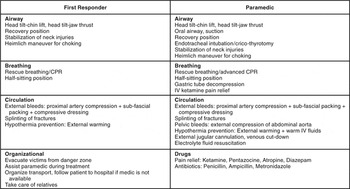
The prehospital trauma system under study was developed during two phases. In 1997, Trauma Care Foundation Iraq (TCF) established a prehospital trauma system for land mine victims in the rural areas along the border with Iran. The system was comprised of health center paramedics providing advanced trauma life support, and village first responders trained and equipped for basic life support (Table 1). The training and treatment protocol was based on a teaching manual for low-income countries.Reference Husum, Gilbert and Wisborg10
Prehospital treatment protocol

The TCF health authorities responded to the post-2003 increase in traffic accidents by training paramedics in health centers and Emergency Departments of the district hospitals along main roads. By 2005, the trauma system of Suleimaniah Province was comprised of 95 paramedics and approximately 5,000 lay trauma first responders. Due to resource limitations, the training program in 2003–2005 targeted the most remote districts of the province. Several districts remained without any prehospital trauma systems. In these districts, trauma casualties were still transported to the hospital by any passer-by, and no medical care was provided on-site or during transport.
The differences among prehospital trauma systems in 2005 facilitated the design of a controlled study of the effect of prehospital trauma care. The endpoint was the single referral surgical hospital in the province. The treatment group consisted of RTA casualties managed on-site and evacuated by trained first responders and paramedics (see treatment protocol, Table 1). The control group consisted of RTA casualties admitted without any prehospital medical care.
Data Collection
Three senior house officers in the hospital Emergency Department collected the data. The study was single-blinded, i.e., the data-gathering team at the endpoint did not know which study group the patients belonged to. Diagnosis and the Injury Severity Score (ISS) for each patient were registered according to the Abbreviated Injury Scale manual.11 The ISS registration was based exclusively on information from the surgical files; due to cultural traditions, autopsies were not performed. Where the surgical files contained sparse information, the ISS grading was conservative.
The patients were stratified into three groups: (1) moderate injuries (ISS <9); (2) severe injuries (ISS = 9–15); and (3) major injuries (ISS >15). In addition, the physiological severity was registered on admission using the Physiological Severity Score (PSS). The PSS is a simplified version of the Revised Trauma Score (RTS), with the Glasgow Coma Scale indicator being replaced by a five-grade level-of-consciousness score (responsive, confused, responds to sound, responds to pain, no response).Reference Champion, Copes and Sacco12 The PSS ranks patients from 0 (lifeless) to 12 (normal vital signs). The score has been found to yield high accuracy for trauma death prediction.Reference Husum, Gilbert, Wisborg, Heng and Murad5 On-site delay and transport times were registered for the treatment group; for the control group, however, there was no information on prehospital time factors.
Study Sample
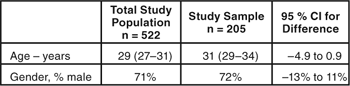
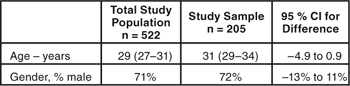
A total of 522 RTA casualties, children and adults, were admitted to the referral center during the study period. For forensic reasons, all prehospital fatalities were taken to the hospital for registration. None of the patients were excluded from study due to insufficient data. Because the main outcome variable was trauma mortality, a subset of patients with ISS ≥9 was selected for further study. Sample size estimation was based on previous studies of trauma mortality in the area.Reference Husum, Gilbert, Wisborg, Heng and Murad5,Reference Wisborg, Murad, Edvardsen and Husum13 Assuming a mortality rate of 30% in the control group and 8% in the treatment group, a total sample size of 160 (80 × 2) would be required to detect a mortality difference of at least 5% with significance level = 0.05 and test power = 0.8. After a three-month study period, 205 patients with ISS ≥9 had been admitted at the endpoint, and the study was closed. The distribution of demographic variables did not differ significantly between the total study population (n = 522) and the study sample of severe injuries (n = 205) (Table 2).
Demographic characteristics for the study population and the study sample, estimates given for 95% confidence intervals
Analysis
The database was established in Excel version 14.0.0 software (Microsoft Corporation, Redmond, WA, USA) and transferred to JMP 7.0 (SAS, Cary, North Carolina, USA) for statistical analysis. The data were initially examined using tabular and graphic methods. Continuous variables with approximately normal distribution are expressed by mean values with 95% confidence intervals (95% CI) constructed by the Student procedure. Proportions are described with 95% confidence intervals established by the exact method.Reference Agresti14 Confidence interval analysis was used for comparison of means and proportions, differences being considered significant when the confidence interval does not include zero. To examine the impact of severity variables on trauma mortality, all assumed death predictors were included in a logistic regression model using a backward selection process with inclusion at significance level of 95%.
Ethical Considerations
The Suleimaniah Directorate of Health gave ethical approval for the study (Ref. no. 22082). There is no other authorized committee for medical research ethics in North Iraq.
Results
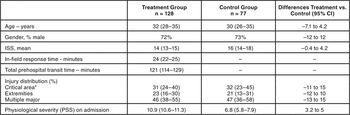
The study sample consisted of 205 severely injured patients, most of them middle-aged men. There were 46 child victims <16 years of age (22%). The treatment group was comprised of 128 patients, the control group 77 patients. No significant differences between the groups were reported for age, gender or anatomical distribution of wounds and organ injuries (Table 3).
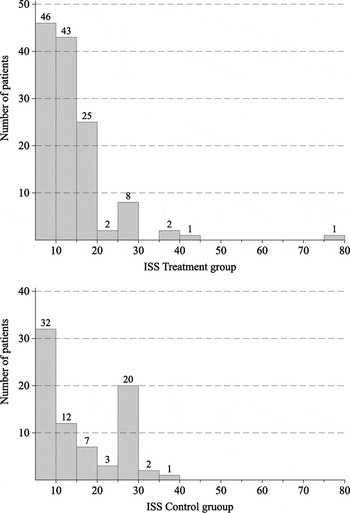
For the anatomical severity indicator, (ISS), the mean values were similar. However, the distribution of the ISS variable differed, the control group having 23 cases of ISS in the range of 25–45 versus 11 cases in the treatment group (Figure 1). The total prehospital transit time was long, a mean of two hours being reported for the treatment group; for the control group there were no reliable data on time variables. In the treatment group, first responders initially treated 53 patients; the other patients (n = 75) were treated exclusively by trained paramedics.
Distribution of anatomical severity as measured by the Injury Severity Score

Descriptive variables for the study sample (ISS ≥9), estimates given for 95% confidence intervals (*Critical area = head, neck, or torso (including pelvis))

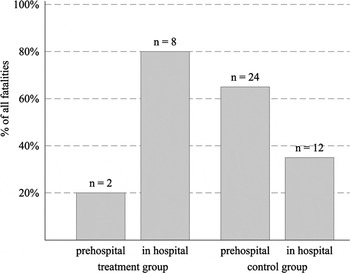
The mean physiological severity score on admission was far lower in the control group (Table 3). Ten patients died in the treatment group (7.8%), one of them a child. In the control group, there were 34 fatalities (44.2%), seven of them children. The difference in mortality rate between the groups was significant (95% CI, 24.8%–48.3%). A regression model including anatomical severity (Chi square 8.9), physiological severity on admission (Chi square 6.6), and prehospital treatment (Chi square 4.1) explained 92% of the mortality distribution. The pattern of fatalities differed between the treatment and control groups. In the treatment group, few patients died during the prehospital phase, while most fatalities in the control group occurred outside the hospital (Figure 2).
Location of trauma deaths by treatment and controls

Discussion
To the best of the authors’ knowledge, the current study is the first controlled study of prehospital trauma care efficacy where transport times are long. Differences in in-hospital quality of care may affect overall trauma mortality; to eliminate this confounding variable, the study was conducted with a single referral surgical center as the endpoint. Therefore, the higher survival rate observed in the treatment group is an effect of the prehospital care provided. The fact that patients in the treatment group were admitted in far better physiological condition further demonstrates the benefit of systematic prehospital care.
The epidemiology of fatalities was different in the two groups; relatively more fatalities in the non-treatment group occurred outside the hospital, while in the treatment group most fatalities were in-hospital. The study was single-blinded; hospital doctors did not know which group patients belonged to. Therefore, it is assumed that the in-hospital quality of care (Emergency Department triage, resuscitation and trauma surgery) was similar for treatments and controls. The difference in mortality patterns may be another treatment effect indicating that trained prehospital paramedics are able to manage major trauma even where transport times are long.
There is room for improvement in the system under study. Better prehospital care allows more patients with severe injuries to survive the prehospital phase, and increases the burden on increases the burden on the hospital, which may disclose flaws in the quality of trauma surgery The Trauma Score – Injury Severity Score (TRISS) calculator for trauma survival probabilities indicates an estimated mortality rate in the range of 5% to 15% for cases representative of the current study sample.15 TRISS estimates are based on large cohorts managed at Western urban Level 1 Trauma Centers, and may not apply in low-resource settings. However, the high mortality rate observed in the control group, 44%, indicates that the in-hospital resuscitation and surgical care should be improved.
The prehospital trauma system under study is comprised of two tiers, trained layperson first responders providing initial basic life support on-site, and paramedics giving advanced life support on-site and during the evacuation. In this study, there was a short in-field delay (a mean of 24 minutes from injury) before the first medical encounter. This is partly due to large numbers of first responders included in the trauma system. However, the study sample is too small to assess which tier, first responders or paramedics, contributed most to survival. In a previous controlled study of the first-responder effect in rural trauma in Iraq (n = 1,340), a significant reduction of mortality in patients initially managed by first responders was observed (10% versus 16%).Reference Murad and Husum6 We therefore recommend that trained layperson first-helpers should be an integral part of EMS systems where resources are few and transport times long.
Following the 2003 invasion, there was an increase in road traffic accidents in North Iraq, and at the same time a surge of war injuries in the central zone. A Lancet survey estimates an excess death rate as a consequence of the war in Iraq corresponding to 2.5% of the population, with gunfire and bomb blasts being the most common causes of death.Reference Burnham, Lafta, Doocy and Roberts16 Mass casualties with burns from powerful explosions pose a different challenge to care providers than do RTAs. The findings and recommendations of the current study are not directly applicable to the war scenario. In addition, in urban civilian traumas with transfer times of 30 minutes or less, efforts to build a comprehensive prehospital trauma system may not be useful. Prehospital life support interventions beyond the basic level have not been shown to be effective and may in many cases be detrimental to patient outcome.Reference Smith and Conn17 However, for civilian trauma in low-resource settings with long evacuation times, we believe the Suleimaniah model of prehospital trauma system should be implemented.
Limitations
Several limitations of the study should be considered. For ethical reasons, the study was non-randomized. Selecting control cases from the districts with established EMS would not comply with the National Bioethics Advisory Commission guideline “Members of any control group should be provided with an established effective treatment, whether or not such treatment is available in the host country.”18 A random effect of the cohort design was uneven ISS distribution in the treatment versus the control group. The ISS is a sensitive predictor of trauma death, and the higher fatality rate in the control group may be partly explained by higher numbers of very severe injuries. However, after adjusting for severity by regression analysis, prehospital treatment was still a significant contributor to survival.
The study cohort was small. In particular, the size of the control group fell just short of the required sample size estimate (n = 77 observed, n = 80 required). In addition, the study sample was too small to identify specific types of injuries where prehospital life support would be most beneficial.
In the control group, there may have been some unregistered prehospital deaths, where victims died on-site, and were buried directly by the family without reporting the case to the hospital or to legal authorities. This was not the case in the treatment group, where paramedic documentation of in-field findings was careful and closely scrutinized. Un-reported prehospital fatalities would have increased the difference between the groups, and thus increased the beneficial effect of the trauma system in this study.
Because the study period was short, major alterations in the study context are improbable. Minor variations that would have been controlled by a randomized design may still have occurred. The effect of such events on the main study result would be minimal.
The time variable is poorly controlled. Time is a critical factor in the management of severe trauma, especially where prehospital transit times are long, as was the case in the current study. Within a time span of two hours, patients with extensive tissue damage and persisting hypoperfusion may develop massive post-injury stress responses. It was impossible to obtain reliable data on prehospital transit times for patients in the control group. The prehospital trauma system chosen for the treatment group was more remote than the control group districts, which were closer to the referral hospital and without EMS facilities. Therefore, it is likely that mean prehospital transit times were longer in the treatment group. However, there may have been cases where victims in the control group were left alone for some time at the site of injury before passers-by found them and took them to hospital.
Conclusion
Where prehospital transit times are long, a two-tier prehospital trauma system significantly reduces mortality in severely injured RTA casualties. Similar interventions in other low-resource countries are recommended.
Acknowledgements
Dr. Rekawt R. Karim, Director of Health KRG, supervised the study. Prof. Torben Wisborg, Hammerfest Hospital, Norway took part in trauma system design. The study is part of a humanitarian medical relief effort sponsored by The Norwegian Ministry of Foreign Affairs.
Abbreviations:
EMS = Emergency Medical Services
ISS = Injury Severity Score
PSS = Physiological Severity Score
RTA = road traffic accident
RTS = Revised Trauma Score
TCF = Trauma Care Foundation Iraq
TRISS = Trauma Score – Injury Severity Score