INTRODUCTION
The majority of rural households in southern Africa depend on fuelwood for cooking, water and space heating (Biggs et al. Reference Biggs, Bohensky, Desanker, Fabricius, Lynam, Misselhorn, Musvoto, Mutale, Reyers, Scholes, Shikongo and van Jaarsveld2004). In South Africa, the post-apartheid government implemented an accelerated electrification programme to address historical developmental imbalances in rural areas in South Africa (DME [Department of Minerals and Energy] 1998). All electrified households receive a small free monthly allowance, but most rural households are unable to make effective use of the additional electricity provided due to the prohibitively high cost of monthly tariffs and electrical appliances (Williams & Shackleton Reference Williams and Shackleton2002; Madubansi & Shackleton Reference Madubansi and Shackleton2006). In comparison, fuelwood is free or cheap, saving households the cost of using additional electricity against the backdrop of widespread poverty (Shackleton & Shackleton Reference Shackleton and Shackleton2004). Rural South Africa thus remains dependent on fuelwood and, without substantial changes in the local economy, will continue to be so into the foreseeable future (Williams & Shackleton Reference Shackleton2000; Karekezi et al. Reference Karekezi, Lata and Coelho2004).
Fuelwood supply-demand models have been used to predict the long-term implications of fuelwood harvesting at both national and local village scales in South Africa. These models showed that, at the national level, aggregate wood supplies are adequate to meet demand (von Maltitz & Scholes Reference von Maltitz and Scholes1995), but that fuelwood shortages occur at a localized village level and the degree of scarcity varies (Shackleton et al. Reference Shackleton, Griffin, Banks, Mavrandonis and Shackleton1994; Banks et al. Reference Banks, Griffin, Shackleton, Shackleton and Mavrandonis1996). National models tend to overestimate the effectively available fuelwood supply since they do not take into account the spatial location of the rural settlement or demand centres. Often these models included data from commercial and natural forests or remote areas inaccessible to the communities that require the fuelwood (von Maltitz & Scholes Reference von Maltitz and Scholes1995; Arnold et al. Reference Arnold, Köhlin and Persson2006). Spatially explicit models operating across various scales, from national through to district level, that capture the spatial variability of fuelwood supply relative to demand-centres have been developed and applied in various countries, including Mexico, Senegal and Tanzania (Ghilardi et al. Reference Ghilardi, Guerrero and Masera2007). These models are useful for identifying areas of critical fuelwood scarcity in the landscape. Harvesting of livewood stems occurs once the deadwood stocks become insufficient to meet local demand (Shackleton Reference Shackleton1993), irrespective of the local traditional and societal control mechanisms in place to discourage this (Kaschula et al. Reference Kaschula, Twine and Scholes2005). In such situations, up to 90% of household energy need is met by livewood harvesting (Shackleton Reference Shackleton1993). This exerts a selective pressure on the communal woodlands, as most harvesters select certain species and particular size classes within these species (Luoga et al. Reference Luoga, Witkowski and Balkwill2000). Over time, this may bring about a change in size class distribution and increased mortality of target species (Luoga et al. Reference Luoga, Witkowski and Balkwill2004), as well as an overall decrease in the species richness of the entire woodland (Shackleton et al. Reference Shackleton, Griffin, Banks, Mavrandonis and Shackleton1994). At landscape level, this should be evident by evaluating the long-term woodland response to harvesting through reductions in stem density, changes in structural and species composition (Frost Reference Frost and Campbell1996) and increased coppice regrowth, a survival mechanism against damage to the stem through fire, herbivory and felling (Shackleton Reference Shackleton2000). Fuelwood harvesting is unsustainable if it results in persistent changes in the woodland structure, such that the quality of fuelwood is diminished for a length of time that is inconvenient to the users, resulting in a decline in their social and economic capital (Shackleton et al. Reference Shackleton, Griffin, Banks, Mavrandonis and Shackleton1994; Scholes Reference Scholes2009).
Communal savannah landscapes are complex, disturbance-driven, socioecological systems, in which humans are the main agents of structural and functional change (Giannecchini et al. Reference Giannecchini, Twine and Vogel2007).
Banks et al. (Reference Banks, Griffin, Shackleton, Shackleton and Mavrandonis1996) constructed and parameterized a predictive fuelwood supply-demand model using empirical data collected from two villages, Athol and Welverdiend, in South Africa in 1992. The model predicted that if fuelwood demand remained constant, wood harvesting around Welverdiend village would be unsustainable, resulting in severe deforestation by 2007. In contrast, harvesting in Athol would not result in negative change in the local communal woodlands. The annual per person wood consumption was similar for both villages, at > 500 kg person−1 yr−1. Banks et al. (Reference Banks, Griffin, Shackleton, Shackleton and Mavrandonis1996) provided baseline data for a long-term natural experiment that we used to quantify the environmental impacts of continuous fuelwood harvesting on communal woodlands between 1992 and 2009, and evaluate whether the different trajectories of woodland development predicted by the model had been realized. This paper examines the ecological impacts of 17 years of increasing fuelwood harvesting on the communal woodlands of Athol and Welverdiend. We track the dynamics of fuelwood supply against the backdrop of the contrasting projections of sustainable fuelwood use in both villages (Banks et al. Reference Banks, Griffin, Shackleton, Shackleton and Mavrandonis1996). Specifically, we aimed to assess the impacts of increasing and continuous wood harvesting on fuelwood availability. We quantified changes in the total wood stock availability, woodland population structure and species diversity. We also assessed the impact of fuelwood harvesting by measuring stem size distribution and species diversity of harvested species within the communal woodlands.
METHODS
Study area
The villages of Welverdiend (24° 35ʹS, 31° 20ʹE) and Athol (24° 34ʹS, 31° 21ʹE) are located in Bushbuckridge Municipal District in the Kruger to Canyons (K2C) Biosphere Reserve (Appendix 1, Fig. S1, see supplementary material at Journals.cambridge.org/ENC). Bushbuckridge consists of the consolidated area of two former ‘homelands’, established by the South African Apartheid-era government (Thornton Reference Thornton2002). Boundaries of village settlements are thus defined by the original boundaries of the farms upon which the settlements were established, and consist of a residential area and village commons consisting of arable fields and communal woodlands (Banks et al. Reference Banks, Griffin, Shackleton, Shackleton and Mavrandonis1996). The maintenance of fence lines in the case study sites does not guarantee the exclusion of residents from neighbouring villages. Within the communal lands, residents practise livestock husbandry more intensively than crop production (Dovie et al. Reference Dovie, Shackleton and Witkowski2006); high densities of livestock and low crop production are characteristic. Households engaging in crop production do so at small scale to supplement purchased food supplies. Economic development is marginalized, unemployment is rife, monetary income is low and human settlements are densely populated, averaging 150–350 people km−2 (Pollard et al. Reference Pollard, Perez de Mendiguren, Joubert, Shackleton, Walker, Poulter and White1998). Most villages have access to electricity but fuelwood dependence remains high; > 90% of all connected households use fuelwood to meet their thermal energy needs (Madubansi & Shackleton Reference Madubansi and Shackleton2006). There is a thriving trade in fuelwood in those villages where local reserves are insufficient to meet the demand (Madubansi & Shackleton Reference Madubansi and Shackleton2007).
The K2C Biosphere Reserve was established in 2001, under the United Nations Educational, Scientific and Cultural Organization's (UNESCO) Man and the Biosphere Programme, to help reconcile the conservation of biodiversity and its sustainable use (UNESCO 1996). Pre-existing communal settlements of Bushbuckridge were incorporated into the transition zone outside the core conservation areas. Provision is made for residents within the transition zone of the reserve to make use of natural resources, provided this is sustainable and maintains ecological functionality (Coetzer et al. Reference Coetzer, Erasmus, Witkowski and Bachoo2010). Village settlements fall under customary land tenure, wherein traditional authorities apportion land-use rights to residents and zone the land into residential areas, arable plots and communal woodlands (Shackleton & Shackleton Reference Shackleton and Shackleton2004). The communal woodlands are open-access, there is little effective regulation of natural resource harvesting due to the waning power of the traditional chiefs (Kaschula et al. Reference Kaschula, Twine and Scholes2005). The woodlands provide a resource base for village residents to browse livestock and extract various non-timber forestry products (Shackleton & Shackleton Reference Shackleton and Shackleton2004). State or privately-owned conservation areas are the next most common land-use type in Bushbuckridge, used for nature conservation, commercial game hunting or ecotourism (Coetzer et al. Reference Coetzer, Erasmus, Witkowski and Bachoo2010). Grazing and resource harvesting pressure in these areas is much lower than in the neighbouring communal rangelands, as a direct consequence of the land use and management plans that prescribe lower stocking rates and exclusion of village residents.
The number of households in Welverdiend rose from 564 in 1992 (Banks et al. Reference Banks, Griffin, Shackleton, Shackleton and Mavrandonis1996) to 1508 in 2009, an increase of 56 households yr−1 or 9.8% households yr−1 (Ruwadzano Matsika, unpublished data 2009). In Athol, the increase was from 292 (Banks et al. Reference Banks, Griffin, Shackleton, Shackleton and Mavrandonis1996) to 517, giving an average numerical increase of 13 households yr−1 or 4.5% households yr−1(Ruwadzano Matsika, unpublished data 2009). Consequently, the residential zones in both villages have expanded outwards into the communal woodlands. Based on aerial photographs from 1986/1987 to 2009, 1000 ha of woodland were lost in Welverdiend compared to 300 ha in Athol (Ruwadzano Matsika, unpublished data 2011). Since the severe drought in the early 1990s, residents of Athol have been allowed to graze their cattle in the communal rangelands belonging to the neighbouring village of Utah (Giannecchini et al. Reference Giannecchini, Twine and Vogel2007; Appendix 1, Fig. S1, see supplementary material at Journals.cambridge.org/ENC). Welverdiend residents began to use and extract resources from Morgenzon, an unoccupied private property on their western boundary (Appendix 1, Fig. S1, see supplementary material at Journals.cambridge.org/ENC) that was perceived to be unused at the time (Rex Mnisi, personal communication 2009) and is now considered part of the Welverdiend resource base.
The topography of the region is gently undulating with an average altitude < 600 m above sea level. The vegetation is Mixed Lowveld Bushveld, characterized by a mosaic of dense bushland on the uplands and open savannah woodlands on the lowlands, dominated by species of Combretum and Terminalia (van Rooyen & Bredenkamp Reference van Rooyen, Bredenkamp, Low and Rebelo1996). Sclerocarya birrea and Dichrostachys cinerea contribute significantly to the woody biomass (Shackleton Reference Shackleton1997). Rainfalls in the austral summer (October to May) mainly in the form of convectional thundershowers with mean annual rainfall of 600 mm. Drought occurs on average once every decade. Mean annual temperature is 22 °C; summers are hot, with a mean daily maximum of 30 °C, and winters are mild and dry with a mean daily maximum of 23 °C (Shackleton et al. Reference Shackleton, Griffin, Banks, Mavrandonis and Shackleton1994).
Data collection
The authors of the baseline study provided the raw data describing woodland conditions for each village in 1992 (see Shackleton Reference Shackleton1993; Banks et al. Reference Banks, Griffin, Shackleton, Shackleton and Mavrandonis1996) and we modelled the 2009 woodland sampling design on the previous studies to enable comparison. Sampling was carried out along four transects radiating outwards from the residential areas towards the border of the communal lands of each settlement (Appendix 1, Fig. S2, see supplementary material at Journals.cambridge.org/ENC). Each transect consisted of three rectangular 5 × 50 m (250 m2) plots. The near plot was placed 350 m from the last agricultural field or residential stand. Agricultural fields were excluded from both studies, as they were generally cleared of all trees except for a few large indigenous fruit trees. The far plot was placed as close to the village commons boundary as possible, in a representative patch of vegetation, and the mid plot was located midway between the two. This method captured any effects of distance from the settlement on resource-use, as in other studies in the region (Shackleton et al. Reference Shackleton, Griffin, Banks, Mavrandonis and Shackleton1994; Fisher et al. Reference Fisher, Witkowski, Erasmus, Van Aardt, Asner, Wessels and Mathieu2012). GPS points of all plot locations were taken to allow for future follow-up studies (Appendix 1, Fig. S2, see supplementary material at Journals.cambridge.org/ENC).
The unit of measurement was woody stems, not individual trees (Shackleton et al. Reference Shackleton, Griffin, Banks, Mavrandonis and Shackleton1994); every woody stem was measured at 35 cm above ground level. Following forestry convention, if the stem split/forked below this point then the stems were measured as separate woody stems, but if forking occurred above this point then it was considered a single stem. All stems emerging from a chopped stump were measured. Data recorded for each woody stem included species, diameter at 35 cm or just above the basal swelling, height, whether the stem had been chopped and whether the stem was a coppice shoot. Only stems that had been chopped within the last year were recorded as such; this determination was based on the colour and freshness of the exposed wood (Appendix 1, Fig. S3, see supplementary material at Journals.cambridge.org/ENC; Luoga et al. Reference Luoga, Witkowski and Balkwill2002). We used bark and leaves to identify species, with the assistance of a local expert, familiar with both the local xiTsonga and English names for tree species; where there was any uncertainty, a specimen of the bark and leaf was taken for identification using the field guide and comparison with specimens held by the herbarium at the University of the Witwatersrand. We used stem height and diameter to calculate woody biomass, using Rutherford's allometric equations (Rutherford Reference Rutherford1979). We also measured stumps as an indicator of past resource quality, recording their species, basal diameter and stump height. We converted all parameters to per hectare density, and performed all statistical analyses, unless otherwise stated, using SAS Enterprise Guide v4.2.
Data analysis
Total wood stock
Following Shackleton (Reference Shackleton1993) and Banks et al. (Reference Banks, Griffin, Shackleton, Shackleton and Mavrandonis1996), we divided the woodland area into three concentric ring-zones defined by the near, mid and far plots along each transect (Appendix 1, Fig. S3, see supplementary material at Journals.cambridge.org/ENC). All spatial measurements and calculations were carried out in ArcGIS v9.3 (ESRI, Redlands, USA) using 2009 aerial photographs of each village. We calculated woody biomass density (aboveground biomass density, kg ha−1) for each zone by averaging the plot biomass densities of the near, mid and far plots, respectively. The woody biomass sub-totals for each ring were summed to give the total on-farm woody biomass stock. Proportional change in woody biomass, relative to 1992 levels, was calculated to establish the magnitude of change.
Change in woodland structure and species composition
The variables chosen to indicate changes in woodland structure were the average stem height and diameter, per hectare densities of woody biomass (tonnes), number of woody stems, seedlings and coppice stems. Following Luoga et al. (Reference Luoga, Witkowski and Balkwill2002), seedlings were defined as newly established shoots < 1 cm diameter, differing from coppice resprouts (which were stems regrowing from stumps or roots after some sort of damage, through cutting or otherwise, to the main stem). We used the structural and functional stem diameter classification as defined by Luoga et al. (Reference Luoga, Witkowski and Balkwill2002) in this study to reflect the user-perspective of the woodland resource base, where
• 1 cm stems were new regeneration by seedlings or resprouts,
• 1 to <4 cm stems were ‘saplings’,
• 4 to <10 cm stems were ‘poles’,
• 10 to <20 cm stems were ‘small reproductive woody plants’, and
• ≥20 cm stems were ‘large reproductive woody plants’.
We tested the variables for normality using the Kolmogorov-Smirnov test. After examining the frequency distribution for woody stem diameter and height for both village datasets the median value was deemed to be the best descriptor of central tendency. Therefore, we tested the significance of changes in average woody stem diameter and height using the Wilcoxon two sample test. The values for woody biomass and coppice stem density values were not normally distributed, so we applied a log (ln) transformation to stabilize the variances. Two sample t-tests were then used to assess the significance of observed changes in density of the woodland parameters between 1992 and 2009. We calculated the proportions of coppice stems and seedlings, and since they were not normally distributed, arcsine transformed these values; we assessed the significance of changes with time using two sample t-tests.
We used the Kolmogorov-Smirnov (KS) two-sample goodness-of-fit test to contrast stem size class distributions (SCD) and assess whether overall population structure had been altered. Paired t-tests were used to test differences in the mean stem densities of each size class over time.
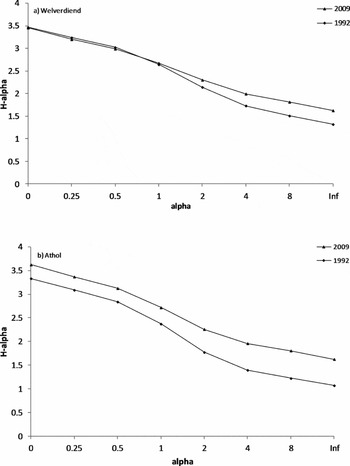
Using methods described in Kindt and Coe (Reference Kindt and Coe2005), we established and tested any changes in species composition using Biodiversity R (R Development Core Team 2011). We used species richness (S), the Shannon-Weiner diversity index (H’) and Simpson's inverse diversity index for each year's dataset as metrics to describe diversity, displayed graphically on a Renyi diversity curve (Tothmeresz Reference Tothmeresz1995). The shape of the Renyi curve indicates evenness; the steeper the slope of the curve, the less evenly distributed are the species in that dataset. The Shannon-Weiner and inverse Simpson's diversity indices can be read at α = 1 and α = 2, respectively, on the Renyi curve. Where the profile of one site is completely above the profile of another, the higher profile curve shows the dataset with the higher species diversity. If the profiles intersect then there is no distinction in diversity between datasets.
Changes in harvesting pressure patterns
We compared the stem-diameter size-class frequency distributions of cut stems for each village in 2009 against those of 1992, and tested for the significance of any observed differences using the two-sample KS test. The density of cut stems in each size class for each year were log transformed compared over time and tested for significant differences using paired t-tests. The median stem diameters found in 1992 and 2009 were calculated and compared to detect shifts in the size of available species using the Wilcoxon two sample test.
Impact of harvesting pressure on species population structure and stability
The impact of harvesting on plant population structure was assessed by evaluating how stable the stem-diameter SCDs of harvested species (with cut stems) were over time, compared to the SCDs of selected non-harvested species (no cut stems). However, it was necessary to limit the analysis to those species that had sufficient data points in both 1992 and 2009 datasets. SCD slopes were calculated according to Lykke (Reference Lykke1998). A least squares regression was carried out on the species SCD using class midpoint (ln transformed) as the independent variable and the average size class density (ln (AveN+1) as the dependent variable. We used the ln-ln transformed values, as they gave the best regression (Lykke Reference Lykke1998). The slopes of these regressions indicate the shape of the SCD slope as well as the health and vigour of the population, a negative slope indicates an inverse J-shaped curve, with abundant recruitment (seedlings and saplings) relative to other size classes. As the slope value approaches 0, this suggests equal numbers of recruitment and larger size classes (mature trees). A positive slope indicates no or very low recruitment densities and relatively abundant mature plants (Shackleton Reference Shackleton1993; Lykke Reference Lykke1998). Following Gaugris and van Rooyen (Reference Gaugris and van Rooyen2010), we used an analysis of covariance (ANCOVA) F-test to compare the regression slopes and intercepts for each village between both points in time using GraphPAD Prism 5 (GraphPad software, San Diego, California, USA, URL http://www.graphpad.com). If the slopes are not significantly different, the software compares the y-intercepts; if these are not significantly different it calculates pooled slope and intercept values to represent both datasets. The pooled slope values were used to categorize the species into four groups, based on the classification used by Obiri et al. (Reference Obiri, Lawes and Mukolwe2002).
Biodiversity R was used to calculate species diversity indices for the harvested species in both Welverdiend and Athol in 1992 and 2009. These were qualitatively compared to describe how harvester species selection has changed over time in each village.
RESULTS
Changes in total wood stock and woodland structure
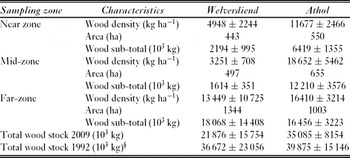
The total standing wood stock of both villages declined over the period of interest (Table 1). More wood was lost around Welverdiend (40% loss) than Athol (12% loss).
Total wood stock in the Welverdiend and Athol communal areas in 2009; sub-totals for each zone and total wood stock values are given in kg ± SE. §1992 values of total wood stock as given by Banks et al. (Reference Banks, Griffin, Shackleton, Shackleton and Mavrandonis1996).

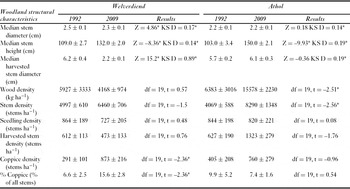
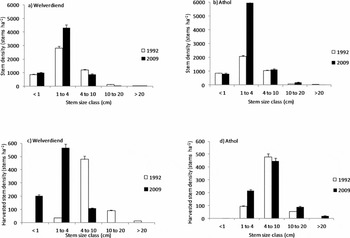
The increased stem abundance in Welverdiend is linked to the significantly higher abundance of coppice stems within the woodland population (Table 2); specifically, the sapling size class increased in abundance between 1992 and 2009 (Fig. 1a; df = 19, t = –2.01, p < 0.05). There were fewer woody stems belonging to the larger size classes, the most significant decrease being the 89% drop in density of small reproductive stems (df = 19, t = 2.12, p < 0.05). The average woody stem in Welverdiend was significantly taller but narrower than in 1992 (Table 2).
Comparison of woodland structural parameters for Welverdiend and Athol in 1992 and 2009 using the Wilcoxon two-sample test to assess the significance of any observed differences in the median stem diameter and the Student's t-test on the transformed density and percentage values. Unless otherwise stated, all values presented are the mean ± SE.* indicates a significant result.

The size class frequency distributions of woody stems within the communal woodlands of (a, c) Welverdiend and (b, d) Athol: (a) and (b) show the distribution of live stem density and (c) and (d) show the distribution of harvested stems. Frequency distributions were divided into the functional size classes defined by Luoga et al. (Reference Luoga, Witkowski and Balkwill2002).

Both stem abundance and wood density around Athol more than doubled (Table 2), yet standing wood stock in 2009 was 12% less than in 1992 (Table 1); as observed around Welverdiend, increased stem density is linked to the increase in the sapling size class (189%, df = 19, t = –2.74, p < 0.05; Fig. 1b). The observed total decline in woody biomass is linked to woodland clearing for settlement expansion in both villages, with > 1000 ha woodland area lost around Welverdiend and c. 300 ha lost around Athol by 2009 (Ruwadzano Matsika, unpublished data 2011). For Athol this was not because of coppice regeneration, as there was no significant change in absolute coppice abundance or proportion (Table 2). There were significantly more small trees (150%, df = 19, t = –2.40, p < 0.05; Fig. 1b) and slightly higher numbers of large trees (not significant) surviving to produce seeds, and this may account for the sharp rise in seedling and sapling abundance. Pole abundance in Athol did not change (df = 19, t = –0.35 p > 0.05; Fig. 1b).
Changes in woodland species composition
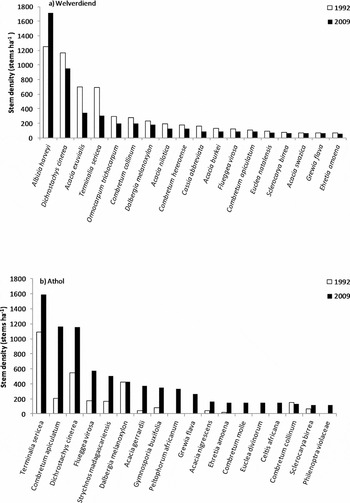
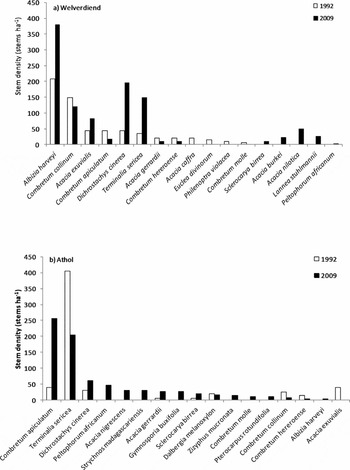
The species-abundance rank order of all woodland species in Welverdiend changed over the time period; A. harveyi and D. cinerea (Fig. 2a) remained the most dominant species, together accounting for 53% and 37% of all observed stems in 1992 and 2009, respectively, although their stem densities have declined. The biggest increases in abundance were observed for Terminalia sericea (725%), Ormocarpum trichocarpum (357%), Acacia nilotica (182%), Combretum hereroense (150%) and Acacia exuvialis (133%) (Fig. 2a). In Welverdiend, species richness (S) and diversity, as measured by the Shannon-Weiner index (H’) and Simpson's inverse index (S’), were higher in 2009 than in 1992 (S1992 = 28, S2009 = 40, H’1992 = 2.37, H’2009 = 2.76, S’1992 = 5.889 and S’2009 = 9.723; Fig. 3a).
The species abundance profiles of (a) Welverdiend and (b) Athol showing the total abundance (stem density) of all species > 20 stems ha−1 in 1992. Species are ranked according to abundance in 1992.

The Renyi profiles for (a) Welverdiend and (b) Athol display the species diversity information for each village dataset in 1992 and 2009, respectively. Shannon-Weiner and Inverse Simpson's diversity indices can be read at alpha (x-axis) = 1 and 2, respectively.

The Athol woodlands have been consistently dominated by T. sericea and D. cinerea stems throughout the study period (Fig. 2b). Like Welverdiend, the changes in the abundance of lower ranking species in the rank abundance diagrams account for the differences in the abundance profiles, particularly increases in Combretum apiculatum, Flueggea virosa, Strychnos madagascarensis, Acacia gerrardii, Gymnosporia buxifolia, Acacia nigrescens and Sclerocarya birrea. The Renyi curve indicates that there has been no clear or significant change in species richness and diversity in the Athol woodlands since 1992 (S1992 = 33, S2009 = 34; H’1992 = 2.65, H’2009 = 2.71 S’1992 = 8.52 and S’2009 = 10.44; Fig. 3b).
Change in harvesting pressure patterns over time
In Welverdiend, there was a significant decrease in the average diameter of harvested stems and an increase in harvesting of smaller size classes (Table 2, Fig. 1a, c). There were significant differences in the stem SCD of harvested stems in Welverdiend (KS D = 0.89, p < 0.0001); no woody stems > 10 cm in diameter (trees) were chopped in 2009, although this may be due to the reduction in abundance of individuals from this size class. Saplings rather than poles were most commonly harvested of all observed stems and, by 2009, seedlings also showed evidence of harvesting (Fig. 1c). There was little change in the number and diversity of harvested species in Welverdiend over the study period (S1992 = 12, S2009 = 13, H’1992 = 2.00, H’2009 = 1.99, and S’1992 = 5.30, S’2009 = 5.29). Eight species were commonly harvested in both 1992 and 2009 (Fig. 4a). The four species no longer harvested in 2009 were already low in abundance in 1992 (< 50 stems ha−1; Fig. 2a). Three of these species (Acacia caffra, Euclea divinorum and Combretum molle) were not observed in the 2009 survey; the fourth, Philenoptra violacea, had persisted in Welverdiend, but declined in abundance since 1992 (Fig. 2a).
Species composition profiles of harvested species in (a) Welverdiend and (b) Athol showing changes in abundance (1992–2009).

Poles remain the most harvested size class in Athol (df = 19, p > 0.05; Fig. 1d), with no change in the median diameter of harvested stems (Table 2), which persisted within the woodland population (Fig. 1b). Stems from all five functional size classes showed evidence of harvesting where previously only saplings, poles and small trees were harvested, resulting in a different SCD curve shape (KS D = 0.19, p < 0.01). There was an increase in the diversity and richness of harvested species in Athol (S1992 = 13, S2009 = 20; H’1992 = 1.448, H’2009 = 2.146; S’1992 = 2.313, S’2009 = 5.304). It is not clear whether this was in response to decreasing abundance, but A. exuvialis and D. mespiliformis had very low stem densities in 2009 and no stems belonging to either species were harvested. In contrast, A. nigrescens had increased in abundance in Athol since 1992, with a concurrent switch to harvesting this species in 2009 (Fig. 1d).
The impact of harvesting on species SCD and population dynamics
Irrespective of species harvesting and the length of time over which harvesting was observed in Welverdiend (in 1992 or 2009, or in both years), there was no significant difference in the SCD slope values between 1992 and 2009 (Appendix 1, Table S1, see supplementary material at Journals.cambridge.org/ENC). The ANCOVA produced pooled slope and intercept values for all species (Appendix 1, Table S1, see supplementary material at Journals.cambridge.org/ENC); the pooled slope values were used to categorize the species into four groups.
Group 1 species (Combretum apiculatum, Combretum hereroense, Philenoptra violacea and Zizyphus mucronata) had flat SCD slopes > –0.04 and approaching zero (Appendix 1, Table S1, see supplementary material at Journals.cambridge.org/ENC). These species were consistently low in abundance within the woodlands with overall densities < 120 stems ha−1 (Fig. 2a). The populations were characterized by poor seedling and sapling recruitment (density < 60 stems ha−1) and the absence of stems larger than poles. The majority of the remaining species fell into Group 2, which included Combretum apiculatum and Terminalia sericea (Appendix 1, Table S1, see supplementary material at Journals.cambridge.org/ENC), with SCD slope values between –0.04 and –0.1. Stem densities in the smaller size classes of this group were still low, but were comparatively higher than those in Group 1. There was poor survival of woody stems into the seed-bearing size classes (stem diameter >10 cm). Group 3 species had SCD slope values ranging between –0.1 and –0.2; in Welverdiend only A. harveyi and D. cinerea had slope values consistently steep enough over time to qualify for this group. The relatively high slope and y-intercept values for this group indicated that there was vigorous recruitment of the seedling and sapling size classes and survival into the seed bearing size classes. Albizia harveyi and D. cinerea were the most abundant and the most frequently harvested species in Welverdiend (Fig. 2a, Fig. 4a). Since there was a noticeable absence of stems in the seed-bearing size classes (>10 cm), the high densities of stems in the seedling and sapling size classes of these species may be linked to their ability to coppice prolifically in response to harvesting.
The species population structures of all the assessed species in Athol have remained stable since 1992, with no significant changes observed in the SCD slope comparisons (Appendix 1, Table S2, see supplementary material at Journals.cambridge.org/ENC). All woodland species in Athol fell into Group 4, except D. mespiliformis, which was classified as a Group 2 species (Appendix 1, Table S2, see supplementary material at Journals.cambridge.org/ENC). Group 4 species have clearly inverse J-shape distribution curves with high persistence of stems into the larger seed-bearing size classes and high recruitment vigour with high density in the seedling and sapling size classes. As in Welverdiend, harvesting pressure or the duration of harvesting had no discernible impact on species stem diameter distribution and the population structures remained stable between 1992 and 2009. Diospyros mespiliformis (Group 2) also had persistently low stem densities in1992 (Fig. 2b) and this trend was echoed in Welverdiend, where it was categorized as a Group 1 species (Appendix 1, Table S1, see supplementary material at Journals.cambridge.org/ENC).
DISCUSSION
Woodland degradation and the sustainability of fuelwood harvesting in communal landscapes
The predictions of Banks et al. (Reference Banks, Griffin, Shackleton, Shackleton and Mavrandonis1996) have been upheld. The fuelwood resource around Welverdiend has become degraded, with systematically smaller stems being harvested due to the dearth of more suitable stems within the woodlands. Conversely, woodland harvesting patterns have not changed at all in Athol, indicating the maintenance of the resource at desired levels. However, the mechanisms behind the apparently divergent woodland-harvest response trajectories are not as predicted. Complete woodland denudation has not yet occurred around Welverdiend two years after the date predicted by Banks et al. (Reference Banks, Griffin, Shackleton, Shackleton and Mavrandonis1996).
Fuelwood availability is a function of woody stem density, size class distribution and harvestable resource area. For Welverdiend, stem density and the woody biomass density did not change significantly. The absolute loss of wood stock may be partially explained by the disappearance of large trees, most likely due to felling, which have been replaced by a proliferation of coppice stems that do not contribute as much to the total woody biomass stock value, thus accounting for the slight decrease in wood density in Welverdiend. Changes in the size class distribution for Athol indicate greater seedling recruitment and survival to the larger size classes. This was consistent with the increased presence of coppice stems within the woodlands, following a different growth strategy, investing in longitudinal growth to escape the firetrap (± 3m) and thereafter expanding in girth (Shackleton Reference Shackleton2000). This suggests that conditions within Athol may have been conducive to high survival rates of saplings (perhaps due to lower fire frequency or intensity) and high recruitment of seedlings into this size class.
The higher wood density is due to the preservation and increase in abundance of individuals within the larger size classes, including the pole size class which is usually the target size class for harvesting (Luoga et al. Reference Luoga, Witkowski and Balkwill2000). Despite these very different woodland structural developments, the total amount of wood available for both villages decreased. This indicates woodland clearing, driven by human population growth in both villages, to create space for agriculture and outward residential expansion (Giannecchini et al. Reference Giannecchini, Twine and Vogel2007). With > 1000 ha woodland area lost around Welverdiend and c. 300 ha lost around Athol (Ruwadzano Matsika, unpublished data 2011), land cover change partially accounts for the decline observed in total woody biomass in both settlements. However in Athol, the decline occurred in spite of a large increase in stem density. While we are confident that some of the decline can be linked to woodland area, we also acknowledge that this highlights shortcomings in the accuracy of the methods used to determine area in the initial study. Furthermore, as the woodland areas have shrunk, the spatial location of sample sites has moved. Given the high spatial heterogeneity of savannah landscapes, the high variance between the two studies, especially in Athol, may also be because sites that have moved spatially over time were compared. The high standard error values reflect the heterogeneity inherent to savannah communal woodland landscapes and incorporate the well-documented influence of catena effects (Venter et al. Reference Venter, Scholes, Eckhardt, du Toit, Rogers and Biggs2003) and disturbance gradients (Shackleton Reference Shackleton1993), although we have not explicitly explored these in this paper. The high variance may also be linked to the relatively low plot sampling intensity at each site, a methodological limitation of the study upon which this was based. Similar studies should endeavour to control for this by establishing permanent plots of known location that can be revisited and re-evaluated in the future.
Increasing human populations, alongside land-cover and land-use change have been identified around other African settlements as being the major drivers of deforestation, rather than targeted harvesting for fuelwood or timber (Cline-Cole et al. Reference Cline-Cole, Main and Nichol1990). Where fuelwood harvesting does contribute to degradation and the loss of stock, such as around Welverdiend, the biophysical changes are a reflection of the higher harvesting pressure per unit area of remaining woodland, as the harvestable area gets smaller and the human population depending on it increases (Cline-Cole et al. Reference Cline-Cole, Main and Nichol1990).
The extent of woodland degradation is highly dependent on the social context within each settlement (Scholes Reference Scholes2009) and includes changes in species composition and structure. The disappearance of certain species, together with prolific coppicing of others has brought about changes in the species composition profiles of both village woodlands. Species switching is a common response to scarcity of the preferred resource (Luoga et al. Reference Luoga, Witkowski and Balkwill2000). Harvesters in Athol switched from mainly harvesting T. sericea to harvesting previously ignored species such as A. nigrescens. This may have been a direct response to the decrease in absolute abundance of this species within the woodlands (Fig. 2b) and may have reduced impact on the fuelwood resources (Luoga et al. Reference Luoga, Witkowski and Balkwill2002). That there was no change in the diversity of species harvested in Welverdiend despite the decline of certain species reflects the dominance of A. harveyi and D. cinerea. As other species were relatively low abundance in comparison to these, they stood less chance of being harvested.
With time, harvesting resulted in significantly different stem frequency distributions in Welverdiend manifested as a measureable decline in the quality of available fuelwood. The lack of individuals in the larger size classes in 2009 was most likely due to the effects of past selective harvesting practices and overharvesting of the preferred pole size class of stem (Luoga et al. Reference Luoga, Witkowski and Balkwill2000). The lower abundance of woody stems within the larger, more optimal size classes in turn may have forced a switch to harvesting predominantly available smaller stems (Luoga et al. Reference Luoga, Witkowski and Balkwill2000). Similar mechanisms were observed elsewhere in South Africa by Gaugris & van Rooyen (Reference Gaugris and van Rooyen2010). Ultimately, this will lead to the loss of heterogeneity in Welverdiend, as the landscape becomes increasingly dominated by species that flourish on high-impact use landscapes, such as D. cinerea, A. harveyi and T. sericea, but are limited to the lower size classes due to the high harvesting pressure (Scholes Reference Scholes2009).
Woodland persistence in response to fuelwood harvesting
The loss of seed-producing trees in Welverdiend, which has not occurred in Athol, may be linked to the low seedling densities in the former. Both woodlands were dominated by stems < 4 cm in diameter, suggesting a high regenerative capacity, but the regenerative mechanism differed for each village. In Welverdiend, this was occurring via the coppice response to harvesting, whereas in Athol the woodlands seemed to be persisting due to seedling recruitment. Although the coppice response may compensate for the lost stems in terms of numbers, the loss of seed-producing plants may have implications for future woodland persistence. The long-term ecological stability of this loss has yet to be established since the effects of continuous harvesting on coppice regrowth vigour in savannah systems have been little studied (Shackleton Reference Shackleton2000). The dbh of the pre-cut stems influences the coppice regrowth vigour and the survival of the resprouts (Shackleton Reference Shackleton2000), the trend towards cutting smaller stems may have an influence on the ability of the stems to survive through coppicing. Furthermore, if recruitment and therefore persistence is occurring as a result of the coppice response, this may leave the woodland population vulnerable to stochastic events such as droughts, disease or fires.
Plant population dynamics relative to social responses to fuelwood scarcity
SCD slopes are used as an indicator of population structure and health, summarizing in a single number the relative regenerative vigour of a species population (Lykke Reference Lykke1998; Obiri et al. Reference Obiri, Lawes and Mukolwe2002). Tracing changes in SCD slopes over time can be used as an indicator of species population dynamics (Gaugris & van Rooyen Reference Gaugris and van Rooyen2010). The results of the ANCOVA of the SCD slopes of both villages showed that the population characteristics and regenerative vigour of the woodlands around both Welverdiend and Athol have remained at 1992 levels. The demand per person for fuelwood had not changed significantly since 1992 (Madubansi & Shackleton Reference Madubansi and Shackleton2006). There has been an increase in human population numbers and a decrease in available fuelwood, yet harvesting intensity has not increased in either village. The answer to this apparent conundrum lies in the different social indicators unique to each village. The development of fuelwood markets, with purchasing of fuelwood rather than collection, indicates fuelwood scarcity within a village (Aron et al. Reference Aron, Eberhard and Gandar1991). Although fuelwood markets have developed around both villages, the market-share of households purchasing fuelwood is considerably larger in Welverdiend (Madubansi & Shackleton Reference Madubansi and Shackleton2006), where the greater degree of woodland degradation occurred. The source of the purchased fuelwood is a socially sensitive topic, as a result of scarcity and the criminalization of live wood harvesting. Households indicated that they were unaware of the source of purchased fuelwood (Ruwadzano Matsika, unpublished data 2009). Another study showed that some of the purchased fuelwood comes from within the Welverdiend woodlands (Twine et al. Reference Twine, Siphugu and Moshe2003). However, not all households in Welverdiend purchase fuelwood. For these households, the shortfall has been mitigated by effectively expanding the harvestable resource area into Morgenzon, without which the observed impacts on woodland structure could have been more severe. Such a response to strained resource availability during environmental stress is not unique to Welverdiend, having occurred in Athol during the same drought (Giannecchini et al. Reference Giannecchini, Twine and Vogel2007). Under such conditions, control mechanisms collapse, giving rise to the occurrence of illegal poaching and harvesting from privately-owned land, conservation areas and neighbouring communal woodlands (Campbell & Byron Reference Campbell, Byron and Campbell2000).
Social perceptions of need and ecological value are highly subjective, depending on the stakeholder consulted in this area. This begs the question, what is the future for conservation areas within the K2C Reserve, as neighbouring communal woodlands become increasingly degraded and the available woodlands are cleared? If the observed trend holds, then communities will seek alternative species, stem size and ultimately new resource harvesting areas. Without any changes in the socioeconomic condition of these settlements, dependence on natural resources will remain prevalent and may turn to local conservation areas as available and abundant resource bases.
If the different observed impacts are not contradictory, then the two villages are examples of communal landscape development at different points along the same trajectory. This leads us to identify potential for future conflict between village communities and conservation practitioners (private and government-owned) within the area, given the well-documented resentments and tensions over natural resource sharing (Pollard et al. Reference Pollard, Shackleton, Carruthers, du Toit, Rogers and Biggs2003). There is an urgent need for the development of more inclusive land management plans, provided that this does not result in the diminishing of ecosystem services (Scholes Reference Scholes2009). This needs to be balanced with the conservation mandate of the K2C Reserve, as the social needs of the communities, if not pre-emptively managed, present a real threat. Greater investment is required into mechanisms to reduce fuelwood demand through the use of more energy-efficient low-cost woodstoves or energy alternatives. Alternatively, methods to manage supply via integrated agroforestry systems, the development of woodlots using indigenous tree species and through integrated rotational harvesting and coppice- management in the communal woodlands need to be investigated.
CONCLUSIONS
The impacts of fuelwood harvesting on vegetation structure and species composition in the communal woodland vary significantly depending on the unique social characteristics within that settlement. Communities change their resource use behaviour and seek alternatives before the collapse of the woodland resource, whether it is a favoured species or the communal woodland itself. While the resilience of savannahs to disturbance has been widely acknowledged in resource management, the resilience of resource users has been underappreciated. This highlights the need to view these rural areas as complex, adaptive socioecological systems when assessing sustainability of resource use.
ACKNOWLEDGEMENTS
This paper forms part of an interdisciplinary research collaboration in the K2C Biosphere region and was part of the BioModels Project (Modelling of the Domestic Energy-System based on Biomass Energy in Rural Areas in Southern Africa) funded by the Volkswagen Foundation. Special thanks are given to Professor C.M. Shackleton for graciously providing the 1992 woodland datasets and to the community leaders of Welverdiend and Athol for assistance. We are especially grateful to the members of the BioModels Project for all assistance given at every stage of this study, and Shirley Hanrahan for her comments on drafts of this paper.