

Recently, there has been a growing convergence of climate goals, developmental priorities, and industrial policy across national and global agendas. This shift, in part, has been anchored by minerals including lithium, nickel, and cobalt, which often are termed as critical, strategic, green, or transition due to their importance for renewable-energy technologies.
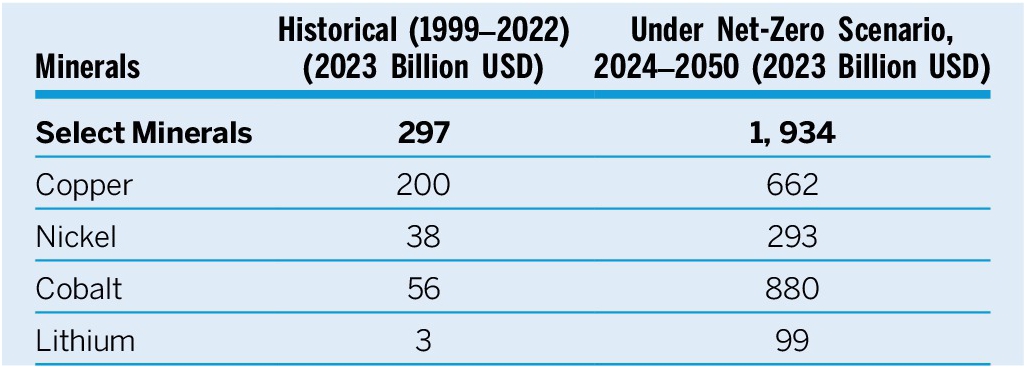
Estimated Cumulated Real Revenues from Production of Select Critical Minerals in Sub-Saharan Africa

Table 1 Long description
The table consists of three columns: Minerals, Historical (1999–2022) in 2023 Billion U S D, and Under Net-Zero Scenario, 2024–2050 in 2023 Billion U S D.
* Select Minerals (Total): Historical 297, Net-Zero Scenario 1,934.
* Copper: Historical 200, Net-Zero Scenario 662.
* Nickel: Historical 38, Net-Zero Scenario 293.
* Cobalt: Historical 56, Net-Zero Scenario 880.
* Lithium: Historical 3, Net-Zero Scenario 99.
The source is cited as the International Monetary Fund 2024.
Source: International Monetary Fund 2024.
With approximately 30% of global critical-mineral reserves located in Africa, resource-rich countries on the continent are well positioned to convert mineral wealth into economic and developmental gains (African Union 2024). Estimated to be worth $2.97 trillion, these minerals potentially could generate $475 billion in taxes (Chen, Laws, and Valckx Reference Chen, Laws and Valckx2024; Diene et al. Reference Diene, Manley, Olan’g and Scurfield2022; Observatory of Economic Complexity n.d.). Revenue from select battery minerals (i.e., copper, nickel, cobalt, and lithium) is expected to increase from $297 billion in 2023 to $1.9 trillion between 2024 and 2050, accounting for 12% of the global minerals market (International Monetary Fund 2024). Across the 15 most mineral-rich countries in Africa, mining already accounts for almost 10% of government revenue and approximately 50% of total export earnings.
Several African mineral-producing states not only hold the largest global reserves but also are leading producers.Footnote 1 However, two systemic constraints significantly complicate the assumed link between mining and development. First, midstream and downstream capabilities, including processing, refining, and recycling, remain limited or absent. As a result, much of the value addition associated with critical minerals occurs outside of the continent. Zimbabwe represents a country that is mineral rich but remains weakly integrated in the global critical-minerals value chain beyond the extractive stage. Despite holding an estimated 20% of global lithium reserves, Zimbabwe currently accounts for less than 1% of the global lithium supply, which reflects limited production capacity and downstream integration (Pavlovic and Chivanga Reference Pavlovic and Chivanga2023).
Second, China dominates the global critical-minerals landscape, accounting for more than 50% of global production and between 60% and 87% of processing and refining; it also is a major actor across African mineral jurisdictions. From acquiring major mining assets to building mining infrastructure and financing mining loans, China’s role is central to the continent’s mineral future (Nantulya Reference Nantulya2025). For context, between 2000 and 2021, of the $57 billion that China disbursed in aid and credit for “transition minerals,” almost $24 billion went to Africa (Escobar et al. Reference Escobar, Zhang, Walsh, Joosse, Parks, Zimmerman and Fedorochko2025).
Any analysis of critical minerals and development therefore must consider China not only as the dominant processor and consumer but also as a major investor in shaping extractive sectors across Africa. At the same time, resource-rich countries increasingly are asserting agency through policy instruments designed to restrict the export of raw minerals and to incentivize local processing and beneficiation. These efforts reflect attempts to capture greater developmental value from the energy transition, even as they confront structural constraints and external pressures.
Any analysis of critical minerals and development must reckon with China’s dual role as the dominant processor and a major investor shaping Africa’s extractive sectors. Meanwhile, resource-rich countries—historically marginal in mineral governance—are asserting greater agency through export restrictions and beneficiation policies to capture more value from the energy transition.
In this context, the central question guiding this study was: Can the twin factors of rising demand for critical minerals on the one hand and China’s dominance over global supply chains on the other generate meaningful developmental gains for African producer countries? Whereas policy and academic debates on critical minerals have largely focused on supply-chain security and disruption, issues of supply-chain justice and developmental outcomes have received far less attention. This article examines the case of lithium in Zimbabwe for three reasons.
First, Zimbabwe’s long-standing challenges—including political, economic, and mineral governance related—make it a revealing site to assess what it takes for governments to translate the opportunities that the energy transition present into concrete developmental outcomes. Second, Beijing and Harare share a close historic relationship, and China currently is one of the largest investors in Zimbabwe’s mining sector, making it a key actor in informing lithium-related developmental trajectories. Third, Zimbabwe has a vibrant civil-society sector engaged closely with mining-affected communities and has found relative success in exerting pressure on both corporations and the state. Together, these three factors make Zimbabwe a useful case to assess the developmental dilemma associated with the extraction of critical minerals.
The article is organized in two parts. The first three sections explore the political and economic foundations that enabled a substantive mineral cooperation between China and Zimbabwe. It also examines the development of China’s critical-minerals diplomacy in Africa, focusing specifically on its engagement in Zimbabwe’s lithium ecosystem. The second part examines the country’s efforts to assert its agency through policy levers aimed at capturing more value. It then analyzes the industrial prospects and structural constraints facing lithium-led development in Zimbabwe.
CHINA AND ZIMBABWE: FOUNDATIONS OF MINERAL COOPERATION
The foundations of China–Zimbabwe relations trace back to the 1960s during the Southern African countries anti-imperial struggle. China supported the Zimbabwe African National Union–Patriotic Front, one of the country’s liberation movements and subsequently its ruling party. Formal diplomatic ties began in 1980, after the country gained independence (Eisenman Reference Eisenman2005). To acknowledge Beijing’s support during the Second Chimurenga war, the country’s first Prime Minister, Robert Mugabe, traveled to China in 1981; another trip in 1985 secured a $55-million loan. China’s first state visit to Zimbabwe occurred a decade later when President Jiang Zemin visited in 1996 (Chun Reference Chun2014). The China–Zimbabwe relationship shifted from ideology to economy due to Deng Xiaoping’s reforms. A key moment came after the Tiananmen Square incident, when Zimbabwe defended China amid international sanctions. This support led to a 431% increase in Chinese investments in Southern Africa between 1989 and 1997 (Chun Reference Chun2014; Taylor Reference Taylor1997).
Likewise, in 2000, following Zimbabwe’s land-reform policies and subsequent Western isolation, China increased its investments in strategic sectors (Moyo, Nhliziyo, and Fayayo Reference Moyo, Nhliziyo and Fayayo2020). This led Mugabe to revive the “Look East Policy,” declaring that “we have turned East where the sun rises and given our backs to the West where the sun sets” (Meldrum Reference Meldrum2005; Nyemba Reference Nyemba2021). Chinese companies began investing in Zimbabwe in 1994 and between 2009 and 2013, investments grew by 5,000%, amounting to $1.3 billion across agriculture, mining, and manufacturing sectors (Chun Reference Chun2014; Kadzere Reference Kadzere2014). Similarly, trade volumes increased from $56.35 million in 1997 to $125.45 million in 2000 and reached $3 billion in 2024 (Chun Reference Chun2014; State Council 2024).
These long-standing political and economic factors contextualize how Zimbabwe emerged as a key investment destination in Africa for Chinese companies. However, they do not alone account for the scale, timing, or sectoral focus on mining. Situating this bilateral relationship within Beijing’s broader resource diplomacy to secure strategic minerals will put into perspective China’s evolving role in Zimbabwe’s lithium sector. China’s mining investments overseas are not ad hoc responses to its relations with individual countries. Instead, they are part of a longer-term strategy shaped by industrial priorities, resource constraints, and evolving coordination between the government and its enterprises. Zimbabwe’s integration into China’s critical-mineral network, therefore, reflects an intersection of a global strategy to secure input to meet domestic demand and leveraging historic, political, and economic alignment as its companies expanded overseas.
CHINA’S CRITICAL-MINERAL STRATEGIES AND RESOURCE DIPLOMACY
China’s critical-mineral strategies began in the 1970s with its rare-earth industry (Shen, Moomy, and Eggert Reference Shen, Moomy and Eggert2020), and academic discussions on strategic minerals emerged in the early 2000s (Chen Reference Chen2002; Qi Reference Qi2002; Zhang Reference Zhang2002). However, it was the National Plan for Mineral Resources (2016–2020) that officially defined 24 minerals as “strategic” (i.e., Zhanluexing kuangchan). In China, the critical-mineral ecosystem is led primarily by the Ministry of Natural Resources, along with the China Geological Survey and the Chinese Academy of Geological Sciences (Andersson Reference Andersson2020). Chinese mining companies began investing in the Democratic Republic of the Congo (DRC) and Zambia in the late 1990s, driven by industrialization, domestic consumption, corporations “going global,” access to raw materials and low labor costs, and less competition from Western firms (Kambudzi Reference Kambudzi2022).
China’s high-risk appetite and an integrated supply-chain approach set its strategy apart from other global actors. “Chinese firms typically secure mining rights, often in high-risk regions, and channel raw materials directly to processing facilities in China, minimizing reliance on third-party traders” (Beuter et al. Reference Beuter, Gnanguenon, Hofmeyr, Gabadadze and Bhuee2025). Chinese firms currently control more than 15 of the DRC’s 17 cobalt-producing mines, and the majority of Congolese cobalt exports (80%–96%) are destined for China (Observatory of Economic Complexity n.d.; Uren Reference Uren2021). At the 2015 Forum on China–Africa Cooperation, mineral collaboration was made a key part of its Africa policy (Ministry of Land and Resources, People’s Republic of China 2016); there currently are 19 mineral partnerships between China and African countries.
Together, these features of China’s critical-mineral strategy and its resource diplomacy—state coordination, firm-level risk tolerance, and integrated supply chains—have shaped how Chinese companies identify and engage with mineral-rich countries. As global attention has shifted from traditional strategic minerals (e.g., cobalt and rare-earth minerals) toward those central to the energy transition, lithium has emerged as a priority input within this broader framework.
Zimbabwe’s substantial lithium endowment, combined with its long-standing political ties with China and a regulatory environment open to foreign mining investment, has positioned the country as a key site for the extension of China’s critical-mineral strategy. The following section examines how this strategic logic has translated into growing Chinese presence across Zimbabwe’s lithium-mining ecosystem.
ZIMBABWE’S LITHIUM VALUE CHAIN AND CHINESE ENGAGEMENT
As countries accelerate their decarbonization efforts, access to lithium—increasingly classified as critical by governments worldwide—is crucial. It is a key input for clean-energy technologies—from electric vehicles (EVs) and energy-storage systems to consumer electronics—and it has defense applications. With Africa’s largest lithium reserves, Zimbabwe is one of the top 10 global producers. The country is poised to benefit from this surge in demand (African Minerals Development Centre, African Union n.d.). Production in the country already has increased dramatically, from 470 metric tons in 2010 to more than 1.1 million metric tons by the end of 2024 (Weng Reference Weng2025). The country’s lithium resources are concentrated in Insiza, Mutoko, Buhera, Bikita, Acturus, and Gwanda, with seven major operational mines. Bikita Mineral Mines, Africa’s largest, holds 11 million metric tons, making it one of the world’s largest lithium sources (Masilela Reference Masilela2023).
Chinese firms dominate Zimbabwe’s lithium sector, holding controlling stakes in all major projects and processing facilities with collective investments amounting to more than $1.5 billion between 2010 and 2023 (Musaidzi Reference Musaidzi2024). For example, Zhejiang Huayou Cobalt, the world’s largest cobalt producer, acquired a controlling interest in the Arcadia lithium mine from Australia’s Prospect Resources for $422 million in 2021 (Reuters 2021). In 2022, Sinomine Resource Group acquired the Bikita Lithium Mine for $180 million and announced a further $200-million investment in a lithium plant (Reuters 2022a). Premier African Minerals partnered with Suzhou TA&A Ultra Clean Technology to export spodumene concentrate from the Zulu Lithium Mine by 2023 (Reuters 2022b). In 2024, China Natural Resources Inc., Feishang Group Limited, and Top Pacific (China) Limited finalized a $1.75-billion acquisition of a lithium operation (Bose Reference Bose2023). In addition to extraction, Chinese firms are investing in midstream processing. Huayou invested $300 million to develop a plant that annually produces 450,000 metric tons of lithium concentrate, and Tsingshan Holdings operates a ferrochrome smelter and plans to build a lithium-processing facility in Zimbabwe (Reuters 2022c).
As discussed previously, these investments represent the convergence of long-standing political ties, China’s global critical-mineral strategy, and Zimbabwe’s efforts to reposition within the energy transition. Together, these dynamics complicate the characterization of China solely as an external investor or development partner. Instead, China’s role in Zimbabwe’s lithium sector reflects the interaction between strategic state interests and domestic political and regulatory choices. Over time, this interplay will shape both opportunities and constraints for lithium-driven development.
LITHIUM-LED DEVELOPMENT AND STATE AGENCY IN ZIMBABWE
China’s significant presence in Zimbabwe’s lithium sector highlights the country’s strategic importance within global critical-mineral supply chains. Yet, the outcome of this engagement is not determined by foreign investment alone. Zimbabwe is actively seeking to shape its own path using policy instruments, industrial strategies, and regulatory measures to capture greater value from its lithium reserves, promote domestic processing, and progress up the global value chain. Central to these efforts are domestic policy measures aimed at moving beyond raw extraction. Most notably, Statutory Instrument 213 of 2022 and Statutory Instrument 5 of 2023 prohibit the export of unprocessed lithium and other base minerals (Government of Zimbabwe 2022, 2023). To encourage more local processing, the government plans to ban the export of lithium concentrates from 2027 (Reuters 2025). Whereas some observers describe these measures as a sign of increasing resource nationalism, others interpret them as part of a broader effort to develop domestic capacity and technical competencies.
However, the translation of these opportunities into sustainable development is far from guaranteed. Lithium-led growth in Zimbabwe is constrained by governance capacity, structural political-economy challenges, and significant social and environmental costs, which highlight the limits of assuming that mineral wealth automatically generates broad-based developmental outcomes.
GOVERNANCE CAPACITY AND INDUSTRIAL PROSPECTS
The country’s National Development Strategy (NDS1) highlights several limitations facing the mining sector, including weak governance; under-exploration; leakages such as transfer mispricing, smuggling, and under-declaration; and a lack of transparency and inadequate scrutiny of agreements entered with investors (International Labour Organization 2021). Scholars argue that Zimbabwe’s Vision 2030, which aims to generate revenue of $12 billion annually, is constrained by the lack of capacity in governmental departments to evaluate mining data and revenue losses due to poor legislative oversight of parliament resolutions (Tanda and Genc Reference Tanda and Genc2024).
NDS1 identified potential solutions, introducing principles such as “finders keep it” and “use it or lose it” to encourage mineral exploration within a specific time frame. It presents policy options including empowering the Mining Promotion Corporation to undertake targeted exploration, upgrading metallurgical laboratories and accounting, strengthening monitoring and surveillance, and setting up industrial parks and innovation hubs. The aim is to capture a share of China’s rapidly expanding EV market by leveraging its lithium reserves to develop domestic-battery manufacturing. Between 2020 and 2023, China’s EV production surged by 851%, with more than 200 manufacturers producing 10 million vehicles in 2024. This accounted for more than 60% of global production, 59% of global sales, and 77% of global battery manufacturing in 2022 (Ezell Reference Ezell2024). This scale of demand underscores the potential economic opportunities for lithium-exporting countries such as Zimbabwe.
Although these options appear promising, an investigative documentary by Al-Jazeera on Zimbabwe’s “Gold Mafia” shed light on the global criminal syndicates and their collusion with top government officials, revealing large-scale corruption and misuse of power (Rees Reference Rees2023). Glass (Reference Glass2022) used the “micro-geopolitics of organized crime” framework to assess Zimbabwe’s lithium sector and concluded that “the way lithium is sourced will determine whether this energy transition supports peaceful, sustainable societies” or pose a “serious threat to human vulnerability.”
SOCIAL COSTS AND ASYMMETRIC DEPENDENCE
This discussion highlights an aspect that is frequently overlooked in the larger energy-transition discussion: how local communities that live near mining areas incur immense costs to host these projects. From pollution of water bodies; to a long line of heavy trucks that emit toxic dust; to earthquake-like blasts that cause cracks in houses, during which “villagers are forced to evacuate their homes and seek refuge in nearby forests to reduce the overwhelming noise and gas emissions,” the risks are several and the costs are high (Mutondoro Reference Mutondoro2024; Tian, Liang, and Li Reference Tian, Liang and Li2019; Zimbabwe Environmental Law Association and Africa Institute of Environmental Law 2023). Mining profits are shared unequally and communities know little about mine ownership and the product’s value, price, or use (Mutuso Dhliwayo, personal communication, 2024). Almost 5,000 jobs were created in Zimbabwe’s seven major lithium mines, but most are short- or fixed term, low-grade roles without benefits (Centre for Natural Resource Governance n.d.). In mining areas, weak land ownership leads to displacement without compensation and communities lose traditional protection when they are moved from ancestral land, which highlights broader issues of sovereignty (Farai Maguwu, personal communication, 2024).
If the state exerts its agency and civil society is empowered, the ecological and social impacts of mining will cease to become a peripheral issue for foreign investors. The costs borne by mining communities for the clean-energy transition could lead to reputational and political risks and perhaps even limit resource access. However, in China’s case, this becomes complex. As a key development partner, there are patterns of asymmetric dependence, with questions about political influence, fiscal dependency, and social equity. As it stands, the country’s development priorities and financing options are closely tied to Chinese capital and policy interests. Projects including the National Pharmaceutical Warehouse, the new parliament building, the Kariba South Power Station, upgrades to the international airport, and rehabilitation of water and sewage systems are only a few that are financed by China (Embassy of the People’s Republic of China in the Republic of Zimbabwe 2024).
The scale, speed, and type of investments have generated considerable concerns about the distribution of benefits and the concentration of power. Scholars argue that China’s presence disproportionately advantages Chinese firms and Zimbabwean political and economic elites, often at the cost of local development (AfriPoli 2024). Controversies include a 2020 law exempting Huawei from income tax, which drew civil society backlash (Zimbabwe Coalition on Debt and Development 2020). Moreover, there is the issue of debt dependence. In 2018, China held an estimated 34% of Zimbabwe’s $18 billion external debt. By 2024, it became the dominant non–Paris Club creditor (i.e., any official government- or state-owned entity that lends money to other countries but is not a member of the Paris Club), accounting for 95% of the country’s debt of approximately USD $2 billion (African Forum and Network on Debt and Development 2018; Zimbabwe Ministry of Finance 2024; Zimbabwe Public Debt Management Office 2023). Furthermore, General Constantino Chiwenga’s visit to Beijing only days before the ousting of President Mugabe also was perceived as evidence of China’s growing strategic influence in the country (Obe Reference Obe2023).
Zimbabwe’s lithium strategy illustrates both the possibilities and the limits of state agency in the critical-mineral economy. Whereas policy interventions signal an effort to capture greater value from the energy transition, persistent governance weaknesses, social costs, and asymmetric external relationships constrain developmental outcomes.
CONCLUSION
The reliance of the energy transition and the technologies that underpin it on critical minerals underscores a complex development dilemma. Resource-rich countries that could fuel global growth but historically have been in the margins of shaping mineral-governance frameworks currently are asserting their agency and demanding value addition at home. Lithium in Zimbabwe is thus not merely a resource; it is a lens for understanding the tensions among global supply chains, state agency, and sustainable development in the twenty-first century. Zimbabwe seeks to leverage its reserves through policy interventions and export restrictions, aiming to move up the value chain. These efforts to capture greater economic and developmental benefits are constrained by governance capacity, structural political–economic challenges, and the social and environmental costs of mining.
The energy transition has elevated critical minerals from strategic commodities to elements at the nexus of climate goals and development aspirations. Zimbabwe’s lithium sector illustrates how resource wealth shapes debates over industrialization, governance, and economic transformation, highlighting the challenge of converting global demand into sustainable national gains.
However, domestic ecosystems and resource wealth alone cannot guarantee sustainable development. The context in which Zimbabwe operates is dominated by China—through control over mines, investment in transport corridors, and technical expertise—which creates opportunities as well as dependencies. This study analyzes the interplay between Zimbabwe’s policy ambitions and external influence to argue that the developmental outcomes of the energy transition are contingent. They are neither automatic nor solely determined by global demand but instead by how states navigate agency and institutional capacity and increase the accountability of strategic partners. These dynamics complicate simplistic narratives of lithium as a straightforward pathway to green development and underscore the inherently political character of the energy transition.
This study analyzes the interplay between Zimbabwe’s policy ambitions and external influence, arguing that the developmental outcomes of the energy transition are contingent. They are neither automatic nor driven solely by global demand but instead are shaped by state agency, institutional capacity, and the accountability of strategic partners. These dynamics complicate simplistic narratives of lithium as a straightforward pathway to green development, underscoring the energy transition’s inherently political character.
ACKNOWLEDGMENTS
The author is grateful to the stakeholders interviewed for this article and to the reviewers for their valuable feedback.
CONFLICTS OF INTEREST
The author declares that there are no ethical issues or conflicts of interest in this research.