Introduction
Explaining political parties' electoral performance is one of the most popular topics for both political pundits in the media and political scientists. Adopting the right campaign strategy, slogans, issue emphasis and positions, the candidates' personalities, shifts in public opinion, and control of the issue agenda all feature heavily in post-election analysis. However, when comparing the popular media and politicians' analysis with that of political scientists, one of the most obvious differences is the greater importance attributed to candidate selection mechanisms by the former. Parties are most likely to reform their nomination methods following poor electoral results, with the dual objective of improving future election performance and strengthening internal party unity. Over the last two decades, Taiwan's parties have also followed this pattern, with candidate selection systems featuring prominently in election post-mortems. Repeatedly, parties have tried to learn the lessons of defeat by revising their nomination methods after electoral setbacks.
Since the lifting of martial law in 1987, Taiwan's party system has seen both continuity and change. Compared to the patterns of party mergers, splits, formations and disappearances seen in the South Korean and Japanese party systems, there has been much more stability in Taiwan. In 2011, the same two political parties dominated Taiwan's party system as in the first multi-party election in 1986. Nevertheless, there has been significant change in the party system during this period, too. The policy positions and organizational structures of the two main parties, the Kuomintang (KMT) and Democratic Progressive Party (DPP), have radically changed.Footnote 1 The number of relevant parties has fluctuated over time, with periods of one-party domination, two-party competition, and even spells of multi-party competition, in which smaller challenger parties made real inroads into the established parties' support bases.Footnote 2 There also have been shifts in the relative strength of the two leading parties, exemplified by the two changes in ruling parties in 2000 and again in 2008. The replacement of the Single Non-Transferable Vote (SNTV) in multiple member districts (MMD) electoral system after 2005 with a predominantly single member district (SMD) system and the halving of the number of legislators also posed a severe challenge to patterns of party competition.Footnote 3
In this article I examine the relationship between nomination systems and electoral results in Taiwan before and after the change in electoral systems. I argue that internal reforms to the main parties' candidate selection mechanisms played a critical role in shaping their electoral performance and the state of the party system fragmentation. In the 1990s, the DPP's use of primaries enabled it to avoid rebel candidates and party splits, and contributed to its improved electoral results.Footnote 4 In contrast, the KMT's top–down nomination during that decade had the opposite effect, encouraging rebel candidates and the creation of splinter parties, both of which split the KMT vote and undermined its campaigns time after time. Following the KMT's fall from power, it adopted a system of party primaries. As these KMT primaries became institutionalized, they contributed to the party's electoral revival. They enabled it not only to avoid damaging rebel candidates but also to attract back Pan-Blue splinter party politicians, thus creating a single and unified Pan-Blue party, the KMT.Footnote 5 The DPP's continued use of primaries after 2000 also helped it to minimize the effect of rebel candidates. However, its nomination reforms in the run up to the 2008 elections undermined party unity and contributed to its worst ever parliamentary election results. In other words, I argue that candidate selection be considered as a potential independent variable for explaining electoral success and failure.
Candidate Selection as an Independent Variable for Election Results?
Scholars of party politics generally agree on the importance of candidate selection, described by Cross as, “one of the central functions of political parties.”Footnote 6 Studies have shown that candidate selection is both a critical arena of internal party power struggles and a key stage in the process of political recruitment. According to Ranney, “the most vital and hotly contested factional disputes in any party are the struggles that take place over its candidates; for what is at stake in such a struggle is, as the opposing sides well know, nothing less than control of the core of what the party stands for and does.”Footnote 7 On the dimension of recruitment, Pesonen notes the power of the party selectors as “the nomination stage eliminates 99.96 percent of all eligible people. The voters choose from only 0.04 percent.”Footnote 8 The amount of media coverage that party candidate nomination receives in Taiwan suggests that it is as important as in any other democracy. Reviews of the Taiwanese print and electronic media show that there is extensive coverage for up to a year while nomination is being contested, even for local elections, and then detailed evaluation of the success or failure of the process after the general election.
The literature on candidate selection has tended to focus on three core questions: How? Why? And so what?Footnote 9 The “How” component of this literature has looked at the methods that parties employ in their nomination process. For instance, studies have attempted to examine nomination processes on spectrums of centralization versus decentralization or the inclusiveness of the selectorate.Footnote 10 The second focus has been on why certain nomination processes are adopted. Studies have attempted to explain choice of certain nomination systems based on variables such as electoral systems, inner-party balance of power, or party type.Footnote 11 The third major field of inquiry has focused on the actual consequences of different nomination systems. This research has looked at areas such as the impact of different nomination methods on candidates' sociological background or the political behaviour of nominated candidates.Footnote 12
This study is located in the third realm of candidate selection research. In some ways this has been the most challenging of the three areas. As Gallagher notes, this is an area that “has received surprisingly little attention” and that “in some or many cases candidate selection may be an intervening variable rather than an independent one.”Footnote 13 Nevertheless, this study proposes a new line of research by suggesting that candidate selection systems can also be an important independent variable for explaining election results and shaping the party system.
The comparative politics literature has tended to focus on four core dimensions of the political consequences of different candidate selection systems: (1) participation, (2) representation, (3) competition, and (4) responsiveness.Footnote 14 Studies focused on participation consider the impact of candidate selection inclusiveness on levels of party member and supporter involvement in the selection process.Footnote 15 Research on the representational consequences of nomination focuses on the sociological background of candidates selected under different types of nomination system. For instance, more democratic nomination mechanisms tend to put female candidates at a severe disadvantage. As Rahat explains, “wide participation in candidate selection is likely to impair the ability of the party to ensure proper representation of various social groups.”Footnote 16 Studies that examine the levels of competition in the nomination process tend to engage with questions such as the advantage for incumbents versus new blood in gaining nomination. Research has shown an incumbency advantage in open primaries in the United States; conversely in Argentina inclusive nomination seems to produce high levels of legislative turnover.Footnote 17 The final dimension of the political consequences literature emphasizes the link between nomination types and the behaviour of successful candidates. The general findings suggest that centralized and exclusive nomination produces a more disciplined party, while decentralized or inclusive nomination encourages politicians to be loyal first to their primary supporters rather than the party centre.Footnote 18
Studies on nomination in Taiwan and other East Asian democracies have grown since the late 1990s. The most common theme related to the electoral consequences of nomination in this region has been on how parties cope with nominating in the SNTV in MMD district electoral systems that were in use in Japan, South Korea and Taiwan for most of the post-war period.Footnote 19 Under this system, larger parties faced the dual challenge of not only endorsing the right number of candidates but also of distributing their votes evenly. In a study that examined legislative elections between 1992 and 2004, Patterson and Stockton show “how nomination errors combined with party fragmentation and shifts in voter support to contribute to the KMT's and DPP's changing electoral fortunes.”Footnote 20
When considering why parties adjust their candidate selection systems the role that nomination plays in election results appears all the more obvious. Party elites interviewed by this author in Taiwan over the last ten years have frequently blamed election defeats on failures in their nomination system.Footnote 21 Working with data from the late 1980s and early 1990s, Wu and Fell tested a number of common stereotypes in Taiwan regarding inclusive party primaries.Footnote 22 These included claims that primaries both undermine election performance and produce inner party divisions. However, Wu and Fell concluded that “the weakening of party competitiveness cannot be blamed on primaries.”Footnote 23 Similarly, numerous candidate selection reforms in Taiwan have been justified by the need to learn from the lessons of the last defeat and to improve future electoral prospects.Footnote 24 Although internal factional power struggles are equally important in explaining adjustment, parties globally adjust their nomination strategies with the objective of winning elections. In contrast, parties are most likely to persist with existing nomination practices following electoral victories.
In this study, I try to build upon elements of both the comparative politics and Taiwan-specific literature on the consequences of candidate selection systems. While Wu and Fell examined the relationship between primaries and electoral performance in the initial post-democratic transition period, I focus on the subsequent elections up to 2008. By looking at two critical indices, I show how failures of candidate selection systems contributed both to the fall from power of the KMT in the 1990s and its post-2000 revival. First, the prevalence of rebel non-nominated candidates who split the party vote and allowed the rival party candidate to win election. This ties in with the responsiveness dimension of the political consequences of nomination field. In other words, do inclusive candidate selection methods serve to reduce party discipline? Secondly, I show how nomination disputes can also lead to the establishment of splinter parties which then split the original parties' vote and allow the true rival party to benefit. However, I also argue that institutionalized nomination systems can discourage party splits and even facilitate party merging through the return of former party defectors. Thus, this study is attempting to build on Patterson and Stockton's argument that party fragmentation undermined the KMT's nomination strategies.
Candidate Selection and the Fall of the KMT
Before looking at the supporting case study material, I will briefly outline the nomination practices employed by the two main parties. In the first multi-party election of 1989, the KMT and DPP both introduced closed member primaries to select legislative candidates. Subsequently, there has been much fluctuation in the degree of inclusiveness of their nomination selectorates.Footnote 25 The DPP did maintain some form of primary from 1989 to 2008. Its major shift was in 1998 when it introduced a mixed primary that included both a closed member vote (weighted at 30 per cent) and opinion surveys (weighted at 70 per cent). In contrast, the KMT dropped primaries in the early 1990s and instead preferred a top–down approach to nomination for the rest of the decade.Footnote 26 Only after losing power in 2000 did the KMT return to inclusive nomination, adopting a mixed primary very similar to the DPP's model. Rahat and Hazan propose a five-point scale for measuring the inclusiveness of the candidate selection process, whereby the most inclusive nomination is determined by the broad general electorate, and at the most exclusive end of the scale, the nomination decision is made by a single party leader.Footnote 27 Based on this scale, it can be said that the two parties started out with moderately inclusive nomination systems in 1989, but that during the 1990s the parties diverged, with the KMT returning to authoritarian nomination practices. After 2000, however, the two parties once again converged on the mixed primaries that are closer to the most inclusive point on the Rahat and Hazan scale.
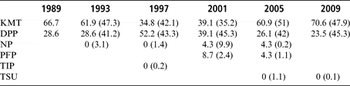
The SMD local executive elections in the 1990s reveal the impact of candidate selection on election results. Table 1 shows the seat and vote shares of the main parties in these SMD elections, while Table 2 outlines the number of rebel and open nominated candidates the two main parties had in these contests and the success rate of officially nominated candidates. Open nomination candidates (baozhun 報准) refers to cases where the party decides not to endorse a party member formally as the official candidate but does not expel or punish the member for standing without endorsement.
Local Executive Seat and Vote Shares

Notes:
This table shows the main parties' seat shares in local executive elections. The party vote shares are shown in parenthesis. Figures for vote share in 1989 not available.
Sources:
National Chengchi University Election Study Center election database at http://www2.nccu.edu.tw/~s00/eng/data/data01.htm; Schaferrer Reference Schaferrer2003.
Rebel Candidates in Local Executive Elections and Success Rate of Nominated Candidates

Note:
This table shows the numbers of rebel and open nomination candidates for the KMT and DPP in local executive elections from 1989–2005. The success rate of official party candidates is shown in parenthesis.
First, while the DPP maintained a consistent use of primaries, it had almost no rebel candidates. In contrast, once the KMT dropped primaries it suffered from large numbers of rebel candidates, as the top–down nomination approach led to a failure to ensure agreement on a single KMT candidate. For instance, in 1993 the KMT had 12 rebel candidates standing against officially nominated candidates, and seven in 1997. The actual success rate of candidates there does appear to show a correlation between the KMT dropping primaries and poorer election results in these elections in 1993 and 1997.
But is there direct evidence of causation? For this, a more detailed look at the actual district level results is necessary. In 1993, the majority of the 12 KMT rebels represented rather minor challengers and only in two districts did the rebels actually lead directly to KMT defeat.Footnote 28 In 1997, however, the picture was far worse. Although there were only seven rebel KMT candidates and two districts with open KMT nominations, these led the KMT to lose in seven districts. Although the KMT's vote share in 1997 was only slightly down, the rebels severely divided the KMT vote and contributed to the KMT's worst ever local executive election results. This election was particularly important as it was the first time the DPP's seat share had exceeded the KMT's.
Two particularly damaging cases that illustrate how KMT nomination failures allowed the DPP to win in 1997 are Taichung County 台中縣 and Tainan City 台南市. The KMT had previously always been the ruling party in these two districts. In Taichung County, the KMT failed to reach agreement on nomination and thus allowed two permitted KMT candidates. These two permitted candidates and one rebel shared almost 60 per cent of the vote, allowing the DPP candidate to win with only 37.6 per cent. The KMT's failure to produce an agreed candidate was even worse in Tainan City where two permitted KMT candidates, two KMT rebel candidates, one allied party candidate, and an independent shared almost 65 per cent of the vote, allowing the DPP to win with only 35 per cent. In 1997, similar cases of nomination disputes led the KMT to lose a number of its traditional strongholds where the DPP had previously never won and never was able to win again in subsequent contests. For instance, since 1997 the DPP has not come even close to winning in Keelung City 基隆市, Taichung City 台中市 or Taichung County.
The presidential elections displayed in Table 3 demonstrate how destructive the failure to find an acceptable nomination process was for the KMT in the 1990s. In both 1996 and 2000, leading KMT politicians called for a democratic candidate selection process.Footnote 29 However, these appeals were ignored by the president and KMT party chairman, Lee Teng-hui 李登輝, who preferred to make the decision essentially unilaterally. In 1996, there were two sets of rebel KMT candidates challenging Lee, who was the official candidate. The main rebel team consisted of two former KMT vice-chairmen, Lin Yang-kang 林洋港 and Hau Pei-tsun 郝柏村. They stood against the KMT after Lee refused to consider holding a primary vote. That time Lee was able to win with a convincing 54 per cent, partly by appealing successfully to DPP supporters rather than to his own base. In 2000, Lee preferred to handpick his successor, Lien Chan 連戰, without reference to any inner party democratic mechanism. However, in 2000 the KMT rebel Soong Chu-yu 宋楚瑜 was a stronger candidate and actually led in the polls for much of the campaign. In the end, Soong came second with 36 per cent compared to the official KMT candidate Lien's 23 per cent, enabling the DPP's Chen Shui-bian 陳水扁 to win the presidency with only 39 per cent of the vote. This case of failed nomination effectively ended the KMT's long history as a ruling party.
Party Vote Shares in Presidential Elections

Note:
KMT rebels in 1996 were Lin Yang-kang and Hau Pei-tsun (14.9%) and Chen Lu-an 陳履安 (10%), KMT rebel in 2000 was Soong Chu-yu (36.8%). The DPP rebel in 2000 was Hsu Hsin-liang 許信良 (0.63%).
The failure of the KMT to resolve nomination disputes in the 1990s also contributed to the establishment of Pan-Blue splinter parties which then further divided the Pan-Blue vote. One of the motivating factors for KMT dissidents to establish the NP in 1993 was dissatisfaction with the KMT's retreat from democratic nomination.Footnote 30 Similarly, in the aftermath of the failed presidential nomination in 2000, the KMT rebel went on to form the PFP.
In both cases these splinter parties subsequently divided the Pan-Blue vote, particularly in legislative elections. The challenge created for the KMT is evident in Table 4, which shows the number of rebel and allied party legislative candidates. In 1995, the official KMT candidates had to face direct competition from 31 rebels and 35 allied party candidates (from the splinter NP). The figures were even worse in 1998, with 51 KMT rebels and 36 NP candidates. While the DPP's vote and seat share showed little change in the mid–late 1990s' MMD elections as shown in Table 5 below, after the KMT abandoned primaries and the splinter NP emerged, the KMT's vote and seat share both dropped.
Numbers of Rebel (including Open Nomination) and Allied Party Candidates in Legislative Elections

Note:
This table shows the number of rebel party and allied party legislative candidates. The allied party legislative candidates are shown in parenthesis.
Parliamentary Elections Seat and Vote Shares

Notes:
These figures show the seat shares for the main political parties in legislative (1992, 1995, 1998, 2001, 2004 and 2008) and National Assembly (1991, 1996) elections. The vote shares are in parenthesis. The vote share for 2008 is for the party vote for the proportional (PR) list for all parties except the PFP. The PFP's district vote share is cited as the party did not nominate candidates for the PR list. If we take the parties' district vote share the main parties would receive the following: KMT 53.5%, DPP 38.7%, TSU 1%, PFP 0.02%.
Sources:
National Chengchi University Election Study Center election database at http://www2.nccu.edu.tw/~s00/eng/data/data01.htm; Schaferrer Reference Schaferrer2003.
The impact is more convincing when looking at district level data. For instance, in the nine seat multiple member legislative district of Taipei City North in 1995, only two of the KMT's five candidates were successful. In this constituency, the pro-KMT vote was split by the three successful allied NP candidates and two KMT rebels, while the DPP vote was more concentrated, enabling four of its five candidates to gain election. In short, even in multiple member district elections, nomination can be treated as an independent variable and did serve to weaken the KMT in the 1990s.
In contrast, the DPP's primaries ensured that it faced minimal numbers of rebel and allied party challengers throughout the 1990s, contributing to its more consistent success rates. While it did face two challenger parties in 1998, these were both motivated by ideological grievances rather than nomination and won a total of only two legislative seats in their histories.Footnote 31
Primaries and the Recovery of the KMT
Following the KMT's defeat in the 2000 presidential election, the party went through its most serious bout of soul searching since it lost power in China. The scale of its internal organizational reforms, and to a lesser extent policy shifts, could also be argued to rival those implemented after 1949.Footnote 32 One of the key lessons that the KMT learned was that the authoritarian nomination practices had contributed to its fall from power. Unsurprisingly, nomination reforms were central to the party's rebuilding process. First, the KMT adopted a primary system similar to the DPP's with a 50:50 weighting for closed member vote and opinion survey for the nomination of all its general election candidates.Footnote 33 It also introduced regulations to block the nomination of candidates linked with political corruption and introduced closed party member primary elections for selection of the party chairman. For a party with such a long history of authoritarian decision making, these were radical reforms. Moreover, these reforms reflect the common perception among politicians that nomination mechanisms can contribute to electoral success or failure.
I now look at the impact of these reforms on the levels of local executive, legislative and presidential elections in the post 2000 period.
In the initial period there is a mixed picture when looking at the introduction of primaries in the KMT. This is not surprising considering the party's long tradition of authoritarian internal party organization. For instance, in the first direct party chairman election in 2001 there was only one candidate, as no one was prepared to challenge the acting chairman, Lien Chan. When looking at the party candidate success rate in 2001, the picture also is mixed for although its candidates were more successful in the local executive elections than in 1997, their success rate was still only 39.1 per cent. Nevertheless, as Table 2 shows, there was a significant reduction in the number of rebel candidates in 2001.
So why did the party still fare so poorly after reintroducing primaries? The most important factors were a growth in DPP support, KMT over-nomination and an increase in the challenge of KMT splinter parties. This last factor was also a legacy of previous failures in the KMT's nomination mechanism from the 1990s. In 2001 the KMT's biggest challenger was not the DPP but the newly-formed People First Party (PFP). Moreover, this party was formed after Soong's narrow failure to win the presidential election in 2000, a rebel candidacy created owing to the failures of the old top–down nomination. Nevertheless, there were some promising signs of the impact of the new primary system. For instance, a detailed look at the local executive elections reveals that rebel candidates were only critical for the KMT losing in two local executive districts compared to seven in 1997.Footnote 34 Instead, it was the allied party candidates that were more damaging to KMT prospects in these local single member districts, leading them to lose almost a quarter of the available seats in five counties.Footnote 35 There was a similar pattern in the legislative elections in 2001 when the KMT had to face 89 allied party candidates from the NP and PFP. This meant that, despite the reduction in rebels, the Pan-Blue vote was more divided than ever and contributed to the KMT's worst ever legislative election performance.
The district legislative case of Taipei City 2 in 2001 shows the impact of the splinter parties. In this ten-seat district, the four official KMT candidates faced competition from six allied party candidates, including three from both the NP and PFP. This split the Pan-Blue vote sufficiently to ensure that only two of the KMT candidates were elected, while four out of the DPP's five candidates were successful.
There were also signs that there was still some resistance to inner party democracy at the top of the KMT in 2004. When it came to select its presidential candidates, the decision was made behind closed doors in an agreement essentially determined by the leaders of the KMT and PFP. It nominated Lien Chan and Soong Chu-yu. In other words, the second and third placed candidates from 2000 had negotiated a joint KMT and PFP presidential ticket. Although this meant the KMT avoided a rebel presidential candidate for the first time, it was nominating two ageing politicians who were past their peaks in popularity. It was a decision based on party hierarchy rather than on public opinion. This team meant that although the KMT lost by a narrow margin, their campaign lacked the enthusiasm that would have been seen if their most popular politician, Ma Ying-jeou 馬英九, had been nominated.Footnote 36
Although the new primary system had had a generally positive outcome for the KMT in its initial three years, the impact started to be more decisive from 2005. In July 2005, the KMT held its first competitive party chairman election using a closed member primary. On this occasion Taipei mayor Ma Ying-jeou defeated the Legislative Yuan speaker Wang Jin-pyng 王金平 by 73.4 per cent to 27.6 per cent.Footnote 37 Ma's island-wide popularity meant that he was a more enthusiastic promoter of inner party democracy in his two year term as party chairman than his predecessor. Under Ma's leadership not only did nomination become more democratic and widespread, but election results also improved dramatically. This was apparent in his first electoral test, the 2005 local executive elections. First, there was only one case of a KMT rebel candidate and this was not a significant candidate.Footnote 38 The party also had its best ever candidate success rate of 70 per cent, winning 14 out of the 23 seats. Moreover, it also faced less of a challenge from its allied parties, as it was prepared to not contest two seats and leave these for its allies such as the PFP and NP.Footnote 39 In fact, it only faced direct challenges from its allied parties in three districts, none of which split the Pan-Blue vote to threaten the KMT's majorities seriously.Footnote 40
Perhaps the most important nomination related impact of 2005 occurred in the candidate selection process for Taiwan's most populous district, Taipei County. In the KMT primary, two leading figures from the PFP rejoined the KMT in order to join its primary. One of them, the legislator Chou Hsi-wei 周錫瑋, actually won both the primary and subsequent general election. This set a precedent for politicians from the splinter parties to return to the KMT to join their primaries.Footnote 41 There was a similar pattern in 2006 when the former chairman of the NP returned to the KMT to contest its primary for Taipei City mayor and then won the general election. This was a reversal of the process seen in the 1990s when the lack of inner party democracy had led to rebel candidates and the creation of KMT splinter parties, which served to split the Pan-Blue vote. In contrast, from 2005, with the KMT primary system working effectively, one of the former motivating factors for KMT defectors had been removed. Therefore this new system encouraged large numbers of PFP and NP politicians to return to the KMT to contest nomination. Thus, these reforms not only contributed to a more united Pan-Blue camp, but they also enhanced the KMT's electoral chances and promoted Taiwan's move towards a two-party system.
Nomination and Election Results under the New Electoral System
Despite the switch to a new electoral system, both the main parties maintained the basic framework of their nomination system for the 2008 legislative elections. In other words, where two or more party candidates contested the nomination, a primary using the 30 per cent member ballot and 70 per cent survey would be employed. The only major adjustment to the nomination regulations came in the DPP which introduced the so called “remove Blues survey” (pailanmindiao排藍民調). This meant that in the telephone survey respondents who had reported previously supporting the Blue parties would not be included and the survey discontinued. At the time it was argued that this was aimed at preventing the KMT from mobilizing its supporters to manipulate the DPP's primary process by supporting weaker DPP candidates in the survey. Nevertheless, it was also claimed that the survey was designed with inner party power struggle considerations to damage the primary prospects of more moderate politicians and factions.
The new electoral system posed enormous challenges for the main parties' nomination strategy. Halving the total number of legislators meant that at least half the incumbents would be unable to remain legislators for the next term. Moreover, the switch to single member districts required the redrawing of the constituencies into smaller districts. This meant that there was often an imbalance in districts that party candidates wished to stand for, with safe seats attracting many interested candidates, while hopeless seats struggled to attract any candidates. The new smaller districts often corresponded with existing city or county council seats, therefore city and county councillors also joined the nomination process. Thus there was intense inner party competition for nomination for a limited number of seats from both incumbents and challengers. The final challenge for the new system was how the mainstream parties would deal with the threat of allied parties. Under the single member districts, a strong allied party candidate was almost certain to split the vote allowing the real rival party to take advantage. This meant that the KMT needed to avoid the NP and PFP nominating district candidates, while the DPP had to dissuade the TSU from standing.
The contrast in the two main parties' seat shares in district Legislative Yuan elections in 2004 and 2008 is quite startling. Table 5 shows the KMT managed to gain almost three quarters of all seats with just over 50 per cent of the vote in 2008. In contrast, despite increasing its vote share, the DPP's seat share fell from 39.6 per cent in 2004 to less than a quarter four years later. The new electoral system did contribute to these disproportional results in 2008, but this does not tell the whole story;Footnote 42 if the DPP had faced a divided Pan-Blue camp with numerous rebels and allied party candidates, it would have performed far better.
I will now explain the role that nomination played in these legislative results. The impact is first evident by looking at the numbers of rebel candidates in Table 4. This shows declines in the number of rebel candidates for both the KMT and DPP with 13 and seven rebel candidates respectively in 2008. For both the KMT and the DPP there was only one case each in which the presence of rebel candidates split their vote sufficiently to enable their rivals to win elections. For instance, in Taipei County District 2, the DPP candidate won with 43.2 per cent, followed by the official KMT's 39.9 per cent and the KMT rebel's 10.9 per cent. In Kaohsiung City, the KMT's candidate won in the traditional DPP stronghold of District 4 with 49.1 per cent, followed by the DPP's 42.71 per cent and DPP rebel's 7.1 per cent. Nevertheless, the impact of the reduction of rebel threats was greater for the KMT, with a record low of 13 rebel candidates.
One of the common features of nomination in Taiwanese elections is that where the nomination process is deemed to be unfair, even if the loser in the process does not stand as a rebel, they can be equally damaging by refusing to support the winner or even undermining their fellow partisan's campaign. An examination of media reports of the nomination process for the two main parties in 2008 reveals a far higher level of dissatisfaction with the nomination in the DPP camp. First, there were numerous complaints that there was a vendetta against more moderate politicians and factions in the primary process. For instance, it was felt that the “remove Blues survey” was designed to damage the primary prospects of moderates both in the district and DPP proportional representation list.Footnote 43 This grievance was further aggravated by a strong media campaign against the so called “11 Bandits” (shiyi kou 十一寇), a group of moderates who had been critical of the DPP over political corruption issues and who had spoken up for more centrist China policies.Footnote 44 This meant that almost all of these politicians failed to get through the primary process and the two that were nominated lost in the general election. During the primary nomination process, the attacks against these moderates were fiercer than the attacks on the KMT, giving the impression of a divided party. This internal struggle was especially vitriolic and damaging in the struggle for nomination in the DPP stronghold of Taipei City 2, where accusations contributed to the primary defeat of the longtime director of the DPP's International Affairs Department, Hsiao Bi-khim 蕭美琴. It was therefore not surprising that the DPP's primary winner was later defeated in the general election.
In addition to the ideological dimension, the trust in the fairness of the DPP primary process was damaged with accusations of primary fraud. It was claimed that certain candidates had purchased a large number of telephone lines in order to gain favour in the survey section. Such accusations led to the cancellation of primaries in two districts, both of which the DPP later lost despite being traditional strongholds.Footnote 45
Compared to the bitter and divisive albeit democratic nomination methods employed for nominating half of the DPP's proportional representation list, the KMT took a much more top–down approach with the whole list essentially determined by a closed-door nomination committee. This was, however, highly effective in avoiding inner party competition over nomination. Out of the top 23 on the list, 15 were incumbent KMT legislators, many of whom were also senior legislators having served at least three terms. Generally, these were politicians who had the ability to get elected but were persuaded or rewarded to join the proportional representation list rather than waste resources fighting divisive primaries in districts where the KMT already had another strong candidate. The party centre played a key role in persuading a number of district KMT candidates who had registered for primaries to withdraw with the possibility of either proportional representation list nomination or even government service if the KMT won power. This persuasion by reward method included cases in Yunlin County 2 雲林縣, Changhua County 2, and Taipei City 8.
A greater challenge for nomination was how to resolve the issue of the allied parties. This task was all the more pressing for the KMT as in 2004 its allied party, the PFP, won 34 seats, while the DPP's allied party, the TSU, had won 12 seats. Table 4 shows how the KMT was comparatively more successful at removing the threat of allied party candidates in 2008, and its nomination system played a key role in this achievement. As mentioned above, issues of inner party democracy had been a motivating factor in the KMT splinter party politicians leaving the KMT. Once this issue had been resolved with institutionalized primaries and once the party was ideologically more orthodox, it became easier for these defectors to return.Footnote 46 A large number of PFP politicians returned to the KMT in 2005–2006 in preparation to join the KMT's 2007 legislative primaries. Out of the 25 PFP district level legislators elected in 2004, 12 had already formally rejoined the KMT when the primary process began in early 2007. Of this 12, ten won KMT nomination and nine won in the general election. Although the KMT could have beaten most of the remaining PFP legislators, it preferred to take a more conciliatory approach of negotiation between the KMT and PFP leaders to avoid splitting the Pan-Blue vote. The KMT was also able to find seats for the remaining PFP legislators who wished to stand by offering two seats on the proportional representation list and leaving six district seats open for incumbent PFP politicians and persuading local KMT politicians not to stand. Of course, it should be noted that a condition of this agreement was that these politicians, while maintaining their PFP membership, should also join the KMT and stand as KMT candidates. For instance, although the KMT had already held a competitive primary in Taichung City 3, it persuaded the winner to withdraw and offered the district to the PFP's Huang Yi-chiao 黃義交. Again, this process was highly successful as all but one of the negotiated PFP candidates won at the general election. This meant that for the first time since 1992 the KMT faced no Pan-Blue rival party candidates in district races.Footnote 47 Moreover, by offering places to the PFP on its proportional representation list, the PFP did not offer a proportional list that would have diluted the KMT's list votes.
In contrast, the DPP had to contest against quite strong competition from the TSU both on the district and proportional list levels. The DPP failed to negotiate the kind of cooperative agreement with the TSU that the KMT achieved with the PFP. For instance, it upset the TSU by attempting to poach some of the stronger TSU politicians to stand for the DPP in three districts where the DPP lacked strong candidates.Footnote 48 It was not prepared to offer any proportional seats to the TSU, and so the TSU ran an expensive, although ultimately fruitless campaign on the proportional representation list, winning votes that could have gone to the DPP. The DPP was also not as generous as the KMT in freeing seats for the TSU to contest. In fact, the DPP only left two seats for the TSU to contest against the KMT, both of which were hopeless seats.Footnote 49 Therefore it is not surprising that the TSU chose to stand against the DPP in 11 of the 13 districts that it contested. Many of the TSU's district candidates were not serious challengers or threats to the mainstream parties. Nevertheless they did have some impact. This almost led to DPP defeat in two districts in Taipei County, and split the Green vote sufficiently to cause the DPP to lose in Chiayi City. At times even the minor TSU candidates appeared to contribute to the DPP's downfall. For instance, in Kaohsiung County 4 a KMT candidate beat a popular DPP incumbent by a margin of 1.77 per cent, where a TSU candidate had also received 0.74 per cent. In short, the DPP's failure to negotiate a cooperative agreement over joint nomination with the TSU had also weakened its election prospects.
Three months after the DPP's disastrous legislative defeat, it suffered an equally demoralizing defeat in the March 2008 presidential election. Both the DPP and KMT had similar formal procedures for nominating presidential candidates involving primaries where there were more than two registered candidates. Nevertheless, the nomination methods they employed for the presidential election and internal satisfaction levels with the process were worlds apart. These contrasting methods and satisfaction levels were to have significant consequences for the two parties' presidential campaigns.
On paper, the KMT looked rather undemocratic as no presidential primary was held. Ma Ying-jeou was the sole candidate to register for KMT nomination. However, this was because KMT leading figures were aware that none had the necessary popularity among members or the general electorate to challenge Ma. In many respects, the KMT chairman election of July 2005 was its party's primary for the 2008 presidential election. The margin of Ma's victory convinced most KMT figures that it would be futile to challenge Ma. This meant that Ma was able to start campaign preparations far earlier than his DPP rivals and there was a high degree of factional unity in supporting Ma's campaign and with the overall nomination process. In fact, there was a higher level of satisfaction with the KMT's presidential nomination than with any of its previous four presidential nominations.Footnote 50
The DPP's presidential nomination looked far more democratic. It held a competitive primary with four heavyweight contestants holding televised candidate debates. The primary was intended to follow the party's standard 30 per cent member vote and 70 per cent survey weighting mechanism, and represented the first time this system had been employed for the DPP's presidential nomination. After the first round of closed member primary there were two clear front runners: former premier Hsieh Chang-ting 謝長廷 had 44.6 per cent, while another former premier, Su Tsen-chang 蘇貞昌, followed with 33.4 per cent. It was clear that if the survey section of the primary was held that none of the candidates would be able to catch Hsieh, so all agreed to cancel the survey component. In a gesture of reconciliation, Hsieh appointed his nearest rival, Su, as his vice-presidential running mate.
Despite the public handshakes and the seemingly institutionalized nomination process, the DPP's presidential nomination was to prove extremely damaging for the actual general election. First, the inclusion of the “remove Blues survey” created tensions as it clearly was designed to promote the primary prospects of more radical candidates, especially the DPP party chairman, Yu Shyi-kun 游錫堃, who ran on a platform far more extreme than the DPP government. Likewise, the “remove Blues survey” was seen as damaging the prospects of the most centrist candidate, Su. There was a widespread perception that Yu was trying to take advantage of his party chairman position to manipulate the primary in his favour. Secondly, and equally damaging, a number of the leading candidates indulged in bitter personal attacks on their rivals during the primary campaign. This not only created a sense of disunity within the subsequent DPP presidential campaign but also provided ammunition for the KMT's campaign. For instance, one of the KMT's TV ads showed news clips of leading DPP presidential candidates launching personal attacks against their rival candidates.
In the aftermath of the two DPP election setbacks, numerous party figures blamed the failures of the nomination system for contributing to its poor performance.Footnote 51 In April 2008, the DPP passed a motion to cancel the “remove Blues survey” from its future primary process.Footnote 52 Then, after the election of a new DPP party chairwoman, the party decided to drop the use of primaries for the 2009 local executive elections and instead employ a top–down approach with a nomination committee at the national party centre and negotiations to ensure no rebel candidates emerged.Footnote 53 The principal justification for this reform was to avoid the kind of divisions within the DPP camp that had been experienced in the destructive nomination process during the 2007 legislative and presidential primaries. After an unbroken record of holding primaries since 1989, this is the most significant shift in the DPP's nomination methods in the party's history.
Conclusions
After eight years in opposition, Taiwan's KMT returned to power on the back of landslide election victories which gave the party a degree of political dominance not seen since its authoritarian era. Naturally, Taiwan's new electoral system, Ma Ying-jeou's popularity and the string of corruption scandals associated with the DPP administration all contributed to the KMT's return to power. However, this study has revealed the critical role that nomination systems played in the KMT's electoral fortunes. Nomination failures contributed not only to the KMT's electoral setbacks that led ultimately to its fall from government office, but also to the party's later recovery and return to power. The KMT's post-2000 nomination reforms were able to avoid damaging rebel candidates and also to attract politicians back from the various Pan-Blue splinter parties. This meant that on the eve of the 2008 elections, the KMT and the Pan-Blue camp as a whole were more united than at any point in the island's democratic history. The DPP had held a long record of successfully holding primaries to nominate candidates and this had ensured it rarely suffered from rebel or allied party candidates. However, reforms to its primaries in 2007 and the level of public antagonism between primary candidates left the DPP looking more divided than in any of its earlier campaigns. The DPP's post-election reforms reveal the degree to which nomination is viewed by its politicians as contributing to electoral success or failure.
Although this study has focused on explaining electoral patterns in Taiwan, it does have implications for the comparative study of candidate selection systems. It suggests that the study of the consequences of different candidate selection systems should be extended to treating the process as a potential independent variable for election results. The study also shows that an additional element to the party discipline consequences of candidate selection systems should be the likelihood of rebel candidates standing for election. Lastly, this research has shown how candidate selection can impact the party system fragmentation, at times promoting party splits and at other times party mergers. Of course, these findings need to be tested in a variety of new and older democratic political systems.