Do democratic regimes possess a credibility advantage over their authoritarian counterparts in selling bonds? North and Weingast argued that constitutions that limit executive discretion enhance the credibility of a country's sovereign debt.Footnote 1 Schultz and Weingast drew the logical conclusion that a “democratic advantage” should exist in debt financing: because they place more limits on their executives, democracies' promises to repay their debts should be more credible.Footnote 2
The literature exploiting historical data, which includes case studies of seventeenth- to eighteenth-century England, nineteenth-century Argentina, and nineteenth-century Brazil, along with panel data on both city states and large states, is generally supportive of the democratic advantage thesis.Footnote 3 However, studies of more recent—and extensive—data sets show a different picture. A study of eighty developing countries in the period 1971–97 finds that democracies were more likely to reschedule their debts than autocracies, not less; and that they paid about the same interest rates. Similarly, Archer, Biglaiser, and DeRouen's study of fifty developing countries in the period 1987–2003 shows that democracies received no more favorable ratings from the major credit rating agencies than did otherwise similar autocracies.Footnote 4 These findings raise the question: where is the democratic advantage?
Our answer has three parts. First, the studies just cited focus on two variables—interest rates and credit ratings—that reflect the price a country has to pay its lenders.Footnote 5 But the debate over a democratic advantage is incomplete without also considering countries' ability to access credit. We argue that many autocracies did not enter the international bond markets because they knew they could not find purchasers at prices they were willing to pay. Thus, the democratic advantage has two components—better access and better prices. Moreover, the first component is more important than the latter. Having to pay a higher interest rate disadvantages autocracies; but being denied access to credit entirely, or having to pay so much higher rates that access is no longer worthwhile, disadvantages them substantially more.
Even when focusing solely on the price of debt, one must consider the possibility that countries seek credit ratings only when they anticipate receiving acceptable ratings, and hence acceptable interest rates. We will show that far fewer autocracies than democracies have chosen to enter the international bond market, suggesting that single-equation estimates of how regime type affects bond ratings (or interest rates) may run afoul of selection bias.
Some previous studies include gross domestic product (GDP) per capita as an exogenous control variable, ignoring arguments by North and Thomas, North and Weingast, Acemoglu, Johnson, and Robinson, and others that good political institutions are a fundamental cause of consistent economic growth.Footnote 6 Following the logic of these arguments, some of our specifications treat GDP per capita as an endogenous variable, seeking to purge it of any portion because of the cumulative past effect of good governing institutions.
All told, we argue for a dual democratic advantage. First, democracies have better access to the international bond market than economically comparable autocracies. Second, conditional on entering that market, democracies receive better bond ratings than otherwise comparable autocracies.
We first review the logic of the democratic advantage and the evidence bearing on it. Next we consider the firms whose credit ratings serve as our dependent variables and reconsider existing empirical evidence regarding the democratic advantage. We then develop an approach to estimating how regime type affects both credit access and credit ratings, analogous to the “reservation wage” model of labor supply.Footnote 7 Finally, we consider how our argument applies to the 1820s, when financial intermediaries first played an important role in the international market for sovereign debt.
The Democratic Advantage
In its first formulation (by North and Weingast), the “democratic advantage” thesis referred primarily to limited government and ran as follows: governments whose chief executives face constitutional checks and balances (additional veto players) can more credibly commit to repaying their debts because the chief executive cannot unilaterally repudiate them. The greater credibility of limited governments means both that more people are willing to purchase their bonds and that those bonds can offer lower interest rates. Or, to turn the point around, the lessened credibility of autocratic governments means both that fewer people are willing to lend them money and that they must offer higher interest rates to attract even those few.Footnote 8
Scholars have reacted to North and Weingast's argument in several ways. One line of inquiry further develops the logic of their argument.Footnote 9 Other research disputes either their logic or their evidence. On the logical front, the credit downgrade of the United States in 2011, after months of wrangling between a Democratic president and Republican House of Representatives, might suggest that democratic “veto players” sometimes worsen rather than enhance a country's credibility. On the evidentiary front, recent studies of credit prices argue that democracies lack any observable advantage.Footnote 10
An important issue with which neither proponents of a democratic advantage nor their critics tend to deal is the initial decision to borrow.Footnote 11 Most studies focus only on states that have already decided to enter the bond market and then seek to explain what determines the credibility of such entrants' bonds. While this focus on “postentry credibility” makes sense for some purposes, it cannot provide a sound foundation for evaluating the overall democratic advantage in borrowing—simply because the most powerful punishment the market can mete out to a noncredible borrower is refusal to lend at all.Footnote 12
Once we expand our conceptual focus to include a country's decision (or perhaps “ability”) to enter the bond market, some problems in the empirical literature become clear. In particular, studies that explore the determinants of credit ratings but use data only for countries that have actually received ratings must implicitly assume that entry is “ignorable” in the statistical sense.Footnote 13 If observations are generated at random, then the origin of those observations is not important, but where observations are not generated randomly, we must consider why certain countries came to receive a rating while others did not.
In this article, we demonstrate that entry cannot be ignored. More importantly, we take a broader conceptual view of the democratic advantage than do articles that examine only credit ratings, interest rates, or default probabilities—one that embraces not just the price of, but also access to, credit.Footnote 14
Our empirical analyses focus on credit ratings issued by Standard and Poor's and Moody's. Until 1990, these two were the only National Recognized Statistical Rating Organizations (NRSROs) designated by the U.S. Securities and Exchange Commission. Moreover, they continue to dominate the rating industry today.Footnote 15
The Credit Ratings Agencies
During the past thirty years, domestic and international markets for stocks, bonds, and a variety of other tradable securities have burgeoned, while reliance on traditional bank loans and deposits has lessened.Footnote 16 This increased reliance on securities markets has opened the door for an important new actor: the credit rating agency (CRA).
CRAs began rating bonds in the United States in the second half of the 1800s, as a response to “market turbulence created by failed railroads, dubious Florida land schemes, and other property deals in the newly opened lands of the western United States.”Footnote 17 Sensing demand for information regarding potential investments, Henry V. Poor published a series of journals and manuals on U.S. railroads. John Moody followed suit with his Manual of Industrial Statistics in 1900. These early investor services positioned Poor and Moody (and the companies bearing their names) to offer bond ratings, which took off following the Glass-Steagall Act of 1933.Footnote 18 To begin with, the CRAs issued credit ratings mainly for U.S. companies and municipalities.
Beginning in the late 1970s, however, more and more countries sought ratings of their sovereign debt (and typically paid for the privilege).Footnote 19 When CRAs rate sovereign debt, they attach a “grade” value to the country's initial issuance of debt, which comes to represent the country's creditworthiness more generally. Although the specific grades attached to various increments differ across the agencies, all CRAs assign ratings along a scale (typically 16 points) that ranges from AAA (Aaa for Moody's) to C.Footnote 20 Credit ratings provide potential investors with information about the probability that their loans will be repaid. Any rating higher than the seven lowest positions on the sixteen-point scale is considered investment-grade, while ratings in the range BB+ (Ba1 for Moody's) to C are considered speculative or “junk.” After a country receives an initial rating, the CRAs continuously monitor its creditworthiness and adjust their ratings accordingly. In our data set there is no case of a country securing a rating and subsequently becoming unrated. So far, it has been “once rated, always rated.”
In deciding each country's rating, CRA analysts consider many factors. One approach to assessing whether any democratic advantage exists in ratings is simply to ask the analysts. Here, the evidence seems mixed. On the one hand, the sovereign debt raters interviewed by Archer, Biglaiser, and DeRouen had difficulty identifying any specific political criteria as influencing their decisions.Footnote 21 On the other hand, David Levey, managing director of Moody's sovereign ratings division from 1985 to 2004, has said the assessment that informed a sovereign credit rating was “always a political analysis as much as an economic analysis.”Footnote 22
Another point is that the CRAs' internal procedures have likely been affected by who their customers are. If our basic thesis is correct, then raters will have observed a biased sample of countries and developed rules of thumb to deal with that sample. Perhaps, if random samples of autocracies and democracies had sought ratings, raters would have developed an explicit preference for democracies over autocracies.
Reconsidering the Evidence
Archer, Biglaiser, and DeRouen present a model in which the dependent variable is the rating (from Moody's, Standard and Poor's, or Fitch) that a country's sovereign bonds receive in a given year. Their predictive variables measure natural resource endowments; history of bond default; macroeconomic conditions such as total external debt, inflation, and current account balance; and various political factors, including a continuous measure of democracy from the Polity IV data set. Their main finding is that “regime type and most other political factors have little effect on bond raters. Instead, trade, inflation, growth and [a past history of] bond default strongly affect sovereign ratings.”Footnote 23 In other words, economic fundamentals and past behavior drive the credit ratings a country receives; no democratic advantage exists.
One caveat to register about Archer, Biglaiser, and DeRouen's results is that relatively few autocracies secured ratings during their period, whereas relatively many democracies did. Using the Przeworski and colleagues' definition of “democracy,”Footnote 24 we find that 67 percent of democratic country-years during the period 1987–2003 were rated by Moody's or Standard and Poor's. In contrast, only 17 percent of autocratic country-years in this period were rated. Moreover, rated autocracies were an unusual lot, consisting mostly of oil-rich kingdoms (Bahrain, Kuwait, Oman, Saudi Arabia), stable regimes sitting atop important emerging markets (China, Malaysia, Singapore, and South Korea before democratization), and dictatorships of geopolitical interest to the west (for example, Egypt).
Suppose that democracies are more likely than autocracies to sell bonds (and hence get ratings) because they expect to receive a ratings “bonus,” purely for being democratic. In this case, autocracies can enter the market only on the strength of their economic credentials; but democracies may gain access to credit partly on the basis of their superior political institutions. Thus, we might expect to find that democracies enter the bond market with poorer economic fundamentals than autocracies.
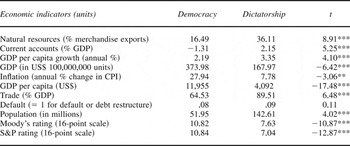
Some evidence supporting this conjecture can be seen in Table 1, which compares average values across regime type for several economic indicators and tests the difference in means (all for the 1963–2008 period). As can be seen, rated autocracies had an average natural resource endowment double that of rated democracies. Autocracies' inflation rates were four times lower on average. Their current account and trade balances were also on average more favorable than that of their democratic counterparts. Growth rates of rated autocracies were larger on average by more than one percentage point than that of democratic countries. Their rated autocracies populations were on average larger. The only rating criteria on which entering autocracies looked significantly worse than entering democracies was that their GDPs and their per capita GDPs were lower on average. In terms of the ratings themselves, Table 1 shows that democracies received significantly higher average ratings from both Moody's and Standard and Poor's—but of course this comparison does not control for economic factors.
Average values of economic indicators for rated countries, by regime

Notes: The third column reports the t-statistic used to test the difference in means between regime types. Statistically significant differences are at
** 95% confidence level;
*** 99% confidence level.
Selection Bias in Estimating the Democratic Advantage
The large difference in the rate at which autocracies and democracies participate in the international bond market is important in and of itself. It also raises the possibility that a single-equation estimator of how regime type affects credit ratings or interest rates will underestimate the relevant effects. One does not directly observe how much autocracy depresses credit ratings (increases interest rates) because those autocracies that would receive low ratings (high rates) decide not to enter the bond market.
We should note that empirically there were two routes by which a country might enter the sample of rated polities. One route, traveled by a substantial majority of new entrants, particularly since the mid-1990s, was self-selection: the country itself requested a rating from one of the CRAs. A second route, traveled by the remaining minority, was selection by interested third parties, either international investment bankers or development banks providing concessionary funding.Footnote 25
Although these modes of entry into the sample might appear different, in principle and in practice, they were very similar. To call country requests for ratings “self-selection” is somewhat misleading in that, typically, investment bankers would both alert a country that it should think about accessing the international bond market and offer to underwrite the country's first bond issue.Footnote 26 Hence, whether the request for rating came directly from the investment banker or from the country on the advice of the investment banker, these financial intermediaries were clearly central to the decision to enter the market for sovereign debt. Accordingly, in what follows we pool data from self-selected and banker-selected entrants.
The “Reservation Rating” Model
We propose a “reservation rating” model that both recognizes the importance of credit access and offers a way to correct for selection bias in assessing credit ratings. In this model, countries that have not yet secured ratings anticipate the rating they would earn, were they to seek one. They actually secure a rating if and only if their anticipated rating exceeds their reservation (or minimum acceptable) rating. In the rest of this section, we elaborate on the factors that influence each country's anticipated and reservation ratings.
Since ratings map directly into interest rates—lower ratings, higher interest rates—we can also view this as a “reservation interest rate” model. Under this interpretation, countries secure ratings if and only if their anticipated interest rate falls short of their reservation (maximum acceptable) interest rate.Footnote 27
Anticipated Ratings
To explain country j's anticipated rating, let p jt. be the probability that j will keep to its repayment schedule on a loan taken out in year t. Suppose that country j's credit rating will be R[p jt], where R is a monotonic increasing function. That is, the credit rating agencies will correctly calculate each country's probability of honoring its debt, p jt, and transform this monotonically into a rating somewhere from C (the lowest possible) to AAA (the highest possible). It will be more convenient to use a numerical version of country j's bond rating. Following Archer, Biglaiser, and DeRouen, we convert the letter ratings to a 0–16 scale. In other words, we can think of R as mapping p jt into a value between 0 and 16.Footnote 28
We assume country j's anticipated rating equals the rating it would in fact get, were it to solicit one. It is as if country j knows its true probability of honoring its debts (p jt) and knows the function R that maps this into a credit rating.
We next assume that p jt, and hence R[p jt], depends on country j's economic fundamentals, X jt, and its regime type, D jt (where D jt = 1, if j is a democracy at t). Letting r jta = R[p jt] represent country j's anticipated credit rating at time t, we write the following:
 $$
r_{jt}^a = X_{jt} \beta + \gamma D_{jt} + \varepsilon _{jt}
$$
Here, β and γ are parameters to be estimated; and ɛjt is an error term. Special interest attaches to the parameter γ, which represents the democratic rating advantage, or how much more creditworthy a country is when it is democratic rather than nondemocratic, holding economic fundamentals constant. We specify particular operational variables representing each country's “economic fundamentals” below but note here that they include current account balances, economic growth rates, size of economy, inflation, trade, resource endowments, and default history.
Reservation Ratings
Country j's reservation rating is the minimum rating (equivalently, maximum interest rate) that it would be willing to accept. To clarify the factors that influence a country's reservation rating, consider each country's marginal debt financing opportunity. After allocating all its available funds (from taxes, state-owned enterprises, foreign aid, and so forth) optimally, country j at time t identifies its next best as-yet-unfunded investment opportunity (henceforth: its marginal project). We assume that j chooses one of the following three options: (1) to forego the opportunity (netting 0); (2) to borrow without securing a rating and use the loan proceeds to finance the project (yielding an expected profit of W jt); and (3) to borrow after securing a rating and use the loan proceeds to finance the project.
Whether country j seeks a rating from a CRA does not affect how much it would pay to bank finance its marginal project, and hence does not affect W jt. To see why, note that j's expected cost of bank financing its project equals the upfront cost of securing the loan, plus the discounted present value of the loan repayments the country expects to make. The upfront costs do not depend on whether the country secures a credit rating because each bank, after completing its research with due diligence, can learn nothing further merely by observing whether the country has sought a rating or not (or received a particular rating). The loan terms the country anticipates getting also do not depend on whether the country secures a rating because the bank will be fully informed by the time it makes a loan offer.Footnote 29
Assuming for convenience that country j is risk neutral, we can define its reservation rating as that rating that yields zero excess profits over its next best option (which is the better of (1) debt financing the project without securing a rating and (2) foregoing the project). Suppose that country j's marginal project at time t requires an investment of L jt and will yield an expected return of V jt(L jt). Country j's expected profit—if it secures a rating, debt finances its project, and honors its debt—is then V jt(L jt) − L jt(1 + i jt) − c jt, where i jt is the interest rate on its bonds and c jt represents the fixed costs of the debt issue.Footnote 30 The fixed costs include any payments made to a CRA to secure a rating and, more importantly, the fees paid to international bankers to handle the marketing of the bonds (which typically run at about 2 percent of the total revenue generated by the bond issue). The maximum interest rate country j will accept is
 $$
i_{jt}^r = [V_{jt} (L_{jt} ) - L_{jt} - c_{jt} - \max \{ 0,W_{jt} \} ]/L_{jt}
$$
and we can denote the corresponding minimum acceptable credit rating by r jtr.Footnote 31
A country's reservation rating, rjtr, declines as its reservation interest rate, i jtr, increases. Thus, r jtr declines as the country acquires more attractive projects to finance (V jt(L jt) − L jt increases), faces lower fixed costs of floating bonds (c jt declines), and has a poor ability to debt finance its projects absent a rating (W jt < 0 rather than W jt > 0).
The expected returns of the investment projects available to most of the countries of the world should have increased during the postwar period, due to the globalization of markets and the reduction in trade barriers. We also believe that the fixed costs of issuing and marketing sovereign debt declined over this period, as the international bond market matured.Footnote 32 Thus, we expect globalization should have produced a secular decline in countries' reservation ratings (r jtr).
If reservation ratings declined globally, then the total number of countries participating in the bond markets should have increased over time; and the average rating given to newly rated countries should have declined. Consistent with the first expectation, the total number of countries with bond ratings from either Moody's or Standard and Poor's increased from three, in 1974, to 101, in 2003. Consistent with the second expectation, Moody's new ratings declined by about one-fifth of a point per year (on a 16-point scale) over the period studied by Archer, Biglaiser, and DeRouen, while Standard and Poor's new ratings declined by about one-seventh of a point per year.Footnote 33
To express our argument about reservation ratings econometrically, let r jtr denote country j's reservation rating in year t and assume
 $$
r_{jt}^r = Z_{jt} \xi + \nu _{jt}
$$
Here, Z jt is a matrix of regressors affecting j's reservation rating in year t, ξ is a column vector of parameters to be estimated, and νjt is an error term. Following our discussion above, we assume that Z jt includes a set of temporal fixed effects. The temporal effects allow the global mean reservation rating to adjust from year to year. If our globalization hypothesis is correct, we should find that the coefficients on the year dummies show a pattern of increasingly negative values.
Entry
In our model, country j will enter the bond market if and only if it anticipates receiving a sufficiently high rating: r jta ≥ r jtr. We observe ratings only for countries that choose to secure them. Let I jt = 1, if country j receives a rating in year t; let I jt = 0, otherwise.
Following Heckman, we assume the errors in equations (1) and (3) follow a bivariate normal distribution:Footnote 34
 $$
\left( \matrix{
\varepsilon _{jt} \hfill \cr
\nu _{jt} \hfill \cr} \right)\~N\left[ {\left( \matrix{
0 \hfill \cr
0 \hfill \cr} \right),\left( \matrix{
\sigma _\varepsilon ^2 \sigma _{\varepsilon \nu } \hfill \cr
\sigma _{\varepsilon \nu } \sigma _\nu ^2 \hfill \cr} \right)} \right]
$$
With this assumption, Pr[I jt = 1|X jt,D jt,Z jt] = Pr[X jtβ + γD jt + ɛjt > Z jtξ + νjt|X jt,D jt,Z jt] = Pr[νjt − ɛjt < X jt β + γD jt − Z jtξ|X jt,D jt,Z jt]. Since the composite error νjt − ɛjt is normally distributed with mean zero and variance τ2 = σɛ2 + σν2 + 2σɛν, one can model the decision to secure a rating as a probit: Pr[I jt = 1|X jt,D jt,Z jt] = Φ[(X jt β + γD jt − Z jtξ)/τ].
The main problem with assuming a bivariate normal distribution for the errors is that the rating variable runs from 0 to 16. To deal with this we linearly transform the credit ratings, r, to  $r' = {1 \over {16}} + {{255} \over {256}}r,$
, and then take the natural logarithm. Thus, our rating variable is ln(r′), rather than r.
Data and Estimation
Sample
Our theory provides no justification for limiting analysis to a particular time period, so we cover the entire period over which new ratings were issued (1963–2008). Similarly, our theory provides no justification for limiting analysis to developing countries, so we include developed ones as well. From an econometric perspective, including the Organization for Economic Cooperation and Development (OECD) countries makes sense because it increases the within-sample variance on our key regressor, democracy. All told, then, our sample includes all countries (both developed and developing) not rated as of 1951, and all years from 1963 to 2008.Footnote 35
Method
We use Heckman's method to estimate the impact of democracy on sovereign credit ratings.Footnote 36 The model he suggests first estimates a probit model of the decision to enter the market, with dependent variable I jt and regressors X jt, D jt, and Z jt. It then runs a second-stage regression, in which the actual credit rating received by countries choosing to be rated is the dependent variable.Footnote 37 The first-stage results serve double duty, both measuring the democratic advantage in credit access and allowing us to correct for sample selection in the second-stage regression.Footnote 38
Although the Heckman model is identified when the same independent variables appear in both the selection and outcome equations, it is generally recommended to include at least one extra explanatory variable that influences selection but not the subsequent outcome of interest. Here we include both decade fixed effects and a variable measuring a country's exports to the United States. This latter measure proxies a country's friendliness with major western powers, which should affect its decision to seek a rating but not the rating it receives, given that we already account for total trade.Footnote 39
Finally, to account for the likely nonindependence of observations from the same country, we (1) use clustered error terms and (2) replicate our core specification using Prais-Winsten regression (which captures any first-order autocorrelation in the errors and produces panel-corrected standard errors). Our results just clustering the errors are very similar to those when using Prais-Winsten.
Control Variables
Our control variables are mostly standard and require no discussion. As noted in the introduction, however, one control—GDP per capita—deserves some scrutiny.
While some studies of sovereign creditworthiness do not include per capita income at all,Footnote 40 those that do typically treat it as exogenous to regime type.Footnote 41 Treating GDP per capita as exogenous, however, ignores a central claim of institutional theorists—namely, that good political institutions exert a long-term and cumulative influence on economic growth.Footnote 42 In these theorists' views, the observed level of per capita income in any country-year partly reflects how long that country has enjoyed good governance, rather than being wholly a function of “economic” circumstances. For example, North, Wallis, and Weingast argue that democracies on average offer a more level economic playing field, with wider opportunities to open businesses and secure basic enforcement of contracts and property rights. More level playing fields lead, in turn, to more people having the confidence to invest and, hence, to higher per capita incomes and wealth.Footnote 43 Most of the empirical support for this view comes from historical or long-term analyses, but a recent pair of difference-in-differences studies examining postwar data have found that democratization results in a permanent increase in growth rate of about 1 percent.Footnote 44
Given these arguments and empirical evidence, including both democracy and GDP per capita in analyses of credit access and credit ratings does not provide a fair test of the democratic advantage. The inclusion of both variables would potentially wash out the effects of a measure of contemporaneous democratic governance (democracy) with a variable that is largely driven by past experience with democratic governance (GDP per capita). To put it in Angrist and Pischke's terms, GDP per capita is a “proxy control”—that is, causally “affected by the variable of interest”—and hence not a good candidate as a control variable.Footnote 45
We have taken two approaches to dealing with this problem. The first is to include GDP in our analyses, instead of GDP per capita. The theoretical arguments reviewed above connect democracy specifically to GDP per capita, rather than to GDP. And, empirically, GDP is not nearly as highly correlated with regime type as GDP per capita, while still conveying information about a country's ability to pay.
Our second approach uses the regressions of log GDP per capita proposed by Acemoglu, Johnson, and Robinson (henceforth AJR) to parse national income into “political” and “nonpolitical” components.Footnote 46 Letting Y jt denote the log GDP per capita in country j, year t, we first regress Y jt on the settler mortality instrument (and other regressors) proposed by AJR. Conceptually, this procedure splits Y jt into two components. The first component, Ŷ jt, represents the expected GDP per capita in country-year jt, based solely on its past experience with democratic institutions. The second component, Y jtresid = Y jt − Ŷ jt, represents how much richer country-year jt is than would be expected, given the quality of its past institutions. We substitute Y jtresid for Y jt in some of our specifications.
Results
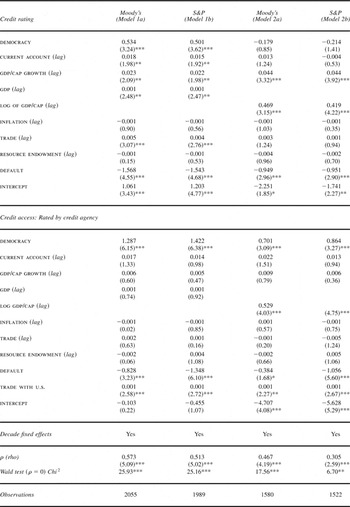
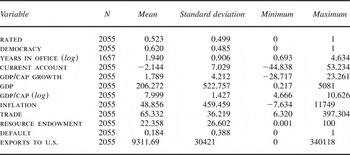
Table 2 reports the results from two “reservation ratings” models, one of which controls for GDP (Model 1) and one of which controls for GDP per capita (Model 2). These models follow previous practice of either excluding GDP per capita or treating it as an exogenous variable. Sample statistics on all variables are provided in Appendix 1.
Effect of democracy on credit access and ratings

Notes: The decade fixed effect results are not shown. Z-statistics are in parentheses. Statistical significance at
* 90% confidence level;
** 95% confidence level;
*** 99% confidence level.
Heckman Stage 1 (Selection) Results
The dependent variable in stage 1 of the models (reported in the bottom portion of Table 2) is whether a country received a rating from Moody's credit rating agency (a) or Standard and Poor's (b) in a given year. Our main finding is that across all models democracies were much more likely than autocracies to receive a rating. Our results also show that countries that had previously defaulted, and those that traded less with the United States, were less likely to receive a rating.
To clarify how much democracy boosts credit access (that is, receiving a rating), Figure 1 overlays two density plots, showing how many autocracies (respectively, democracies) had each possible estimated probability of receiving a credit rating from Moody's.Footnote 47 The results show that, even after we control for economic conditions, democracies have a substantially higher probability of obtaining a credit rating.
Predicted probability of securing a rating by regime type

Heckman Error Correlations
In addition to documenting a democratic advantage in credit access, both analyses in Table 2 also demonstrate that the relationship of regime type to credit ratings is best modeled as a selection process. The parameter rho (ρ), reported at the bottom of the table, captures the correlation between the errors in the first- and second-stage equations.Footnote 48 Its statistical significance indicates that any attempts to model the determinants of credit ratings in a single-equation model will return biased results—not just in estimating the democratic advantage but in estimating all parameters of the model. Indeed, we show in Appendix 3 that the estimated effect of democracy on credit ratings is always lower in models that fail to correct for selection than in those that do, and the magnitude of the bias is sufficient to eliminate any evidence of a democratic advantage when such evidence exists.
Heckman Stage 2 (Ratings) Results
The dependent variable in stage two of the models (reported in the top portion of Table 2) is the actual credit rating assigned to each country that received a rating in a given year. In this stage, we find a democratic advantage in Model 1 but not in Model 2. We think the “disappearance” of a democratic ratings advantage in Model 2 (of Table 2) is misleading, because GDP per capita is itself partly caused by democracy. Thus, we conducted additional analyses to identify that part of GDP per capita due to nonpolitical factors and then used the resulting variable in place of GDP per capita.
Stage 0: The Endogenity of GDP per Capita
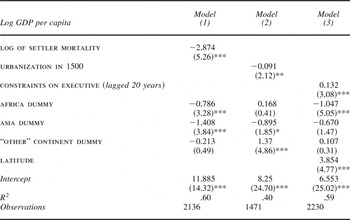
The results of replicating AJR's instrumental variables model of log GDP per capita on our sample are displayed in Appendix 2. Like them, we find that settler mortality is a strong predictor of log GDP per capita. Also as they did, we rely on the instrument (European settler mortality) to ameliorate concerns about both omitted variables and endogeneity. Simply put, settler mortality in the seventeenth to nineteenth centuries should be orthogonal to most plausible omitted variables and not caused by democracy as of the years of our study.
Given that AJR's instrument has been challenged, we also provide two other instruments in Appendix 2.Footnote 49 One is based on urbanization levels in 1500, the other on twenty-year lagged values of the executive constraints variable from the Polity IV data set. Our results hold for any of these ways of identifying the “political” and “residual” components of GDP per capita.
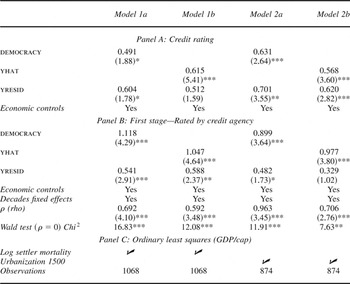
We interpret democracy and Ŷ jt as two distinct ways of measuring a country's institutional quality, one contemporaneous (democracy), and one historical (Ŷ jt). In Table 3, we use either democracy (Models 1a, 2a) or (Models 1b, 2b) to measure “democraticness;” and we use Ŷ jtresid to measure how much “nonpolitical” factors affect national income.
Effect of democracy on credit access and credit ratings (Moody's)

Notes: The variable yhat equals the fitted value from a regression of log GDP per capita on either log settler mortality (Models 1a and 1b) or urbanization in 1500 (Models 2a and 2b). Details of these regressions are provided in Appendix 2. The variable yresid equals the residual from the same regression.
Heckman Results
The models in Table 3 show that, once GDP per capita is purged of that portion attributable to the historical impact of political institutions, democracies enjoy an advantage in both access to credit and credit ratings.Footnote 50 Regardless of how we measure institutional quality, we find that democracies are more likely to be rated and more likely to receive higher ratings, conditional on being rated.
The Size of the Democratic Advantage in Ratings
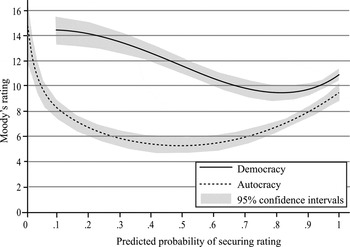
Given that any model that does not take GDP per capita as exogenous demonstrates a democratic advantage in ratings, we return to results from Model 1 in Table 2 to provide a more substantive interpretation of the relationship between political regimes and countries' ratings. In Figure 2, we display a fractional polynomial fit of the data. Specifically, we calculated the predicted value of each country's Moody rating based on a fractional polynomial of their predicted probability of being rated obtained from our “selection” equation described above. Figure 2 shows the resulting curves, along with 95 percent confidence intervals (denoted by the shaded areas) of the estimated means for each type of political regime.Footnote 51
Countries' actual ratings as a function of their predicted probability of being rated, by political regime (fractional polynomial)

The estimates presented in Figure 2 represent a convenient way to match on propensity score and compare credit ratings. As Figure 2 indicates, democratic countries with any given probability of entering the credit market tended to obtain better ratings than their autocratic counterparts.Footnote 52
To illustrate the magnitude of the democratic advantage in ratings, we focus on a hypothetical borrower rated in the 1980s, which had not recently defaulted, and set all other variables to the sample average. The predicted credit rating in that case would increase by 10 points, if the country possessed democratic rather than autocratic institutions (equivalent to going from a Baa3 rating to a Aa2 rating).Footnote 53
Does Financial Intermediation Reduce the Democratic Advantage?
We turn our focus from contemporary cross-national analysis to a historical case study—for two reasons. First, having asserted that the logic of our theory should be generalizable beyond any particular period of time or set of countries, we have an opportunity to expand our analysis beyond the post–World War II era and consider whether events in the international bond market of the 1820s lend support to, or challenge, our theory. Second, this time period provides the opportunity to investigate one remaining counter-argument: that the existence of financial intermediaries such as CRAs effectively nullifies any democratic advantage, as the reputations of the financial intermediaries, not the sovereign regimes, become relevant to investors. Flandreau and Flores argue that, when the first robust international market for sovereign bonds got going in the 1820s, strong financial intermediaries played a crucial role that largely defused the democratic advantage.Footnote 54 Their argument runs as follows.
First, the intermediaries—the Rothschilds, Barings, and other large banks—in effect loaned their reputations to sovereign borrowers. Bond purchasers relied not on the reputation of the sovereign borrower but rather on the reputation of the intermediary. Second, the most prestigious banks—the Rothschilds and Barings—were willing to lend their sterling reputation to any state that “could implement the policy adjustments” they required; and the ability to implement these adjustments depended mainly on “the quality of the administrative apparatus and centralization of decision making” in the state.Footnote 55 Thus, stable and centralized autocratic states such as Russia, Austria, and Prussia were able to borrow on favorable terms. In other words, because intermediaries' reputations were what mattered, and intermediaries were willing to deal with autocrats, no democratic advantage existed. Indeed, Flandreau and Flores conclude that “there was a bias in favor of arch-conservatives who had no remorse about implementing unpopular policies or even ruthless repression. This somewhat frightening conclusion is antithetic to the ‘democratic advantage’ view.”Footnote 56
While we agree that financial intermediaries in the 1820s could in effect rent their reputations to sovereign borrowers, we do not agree with the ultimate conclusion that this lessened the democratic advantage. Rather, we believe that sample selection, similar to that we have identified here, occurred in the 1820s as well; and that once one accounts for this, the success of a few exceptional autocracies no longer casts much doubt on the overall thesis.
Suppose the intermediaries of the 1820s judged a country more creditworthy when its executive faced more democratic restraints, controlling for economic fundamentals. They might still deal with some autocracies—those that could overcome their credibility deficit with other characteristics making them an attractive client. But democracies should still have had an advantage in accessing credit at a reasonable price (interest rate).
The evidence from the 1820s seems broadly consistent with this view. First, Ferguson, echoing Polanyi, argues that the Rothschilds favored borrowers with more democratic restraints in the early 1800s.Footnote 57 More colorfully, consider the case of Gregor MacGregor, a Scottish swindler who managed to sell sovereign bonds for the nonexistent Central American country of Poyais. MacGregor clearly was fully in control of the characteristics of Poyais and he saw fit to endow it not simply with abundant natural resources ripe for exploitation but also with a democratic form of government.Footnote 58 Thus, even swindlers preferred to market sovereign bonds that were backed by more democratic regimes. Second, and more importantly, the vast bulk of autocracies worldwide did not issue sovereign bonds in the 1800s. In contrast, a much higher proportion of the very few states with limited government issued bonds. Thus, the democratic advantage appeared mostly in the form of superior access to credit, rather than in the form of better interest rates, conditional on access.
The evidence from the contemporary period seems similar to that from the 1820s. First, the intermediaries seem to view democracies as more creditworthy, all else equal. Second, as we've shown, a hefty portion of the democratic advantage takes the form of denying autocracies access to credit, rather than charging them a higher price for it.
Conclusion
Beginning with North and Weingast's seminal treatment, various scholars have argued that democracies should be perceived as more creditworthy than otherwise similar autocracies, leading to a “democratic advantage” in borrowing.Footnote 59 Yet, the evidence on this score is mixed. We have argued a series of conceptual, methodological, and substantive points.
First, we stress that there should be a dual democratic advantage, with democracies both having better access to debt markets and being able to price their debt more favorably. Underlining this point is necessary because the critical literature has focused exclusively on variables reflecting the price of credit, such as interest rates or credit ratings, thereby ignoring the theoretically most important part of the democratic advantage.
Second, we provide robust evidence that democracies in the postwar era have in fact had a large advantage in accessing credit. Democracies were roughly four times more likely to secure credit ratings in the period 1987–2003 and this difference remains after we control for economic fundamentals, expand the sample years, and try various specifications.
Our third contribution concerns unbiased estimation of the democratic advantage in credit prices. Studies finding no evidence of such an advantage have thus far pursued single-equation strategies, estimating the effect of democracy on interest rates, credit ratings, or default rates without considering self-selection into the sample available for analysis. Our study shows that selection effects are very large and cannot be ignored. First, as already noted, democracies are significantly more likely to secure credit ratings than autocracies. Second, those autocracies that do secure ratings are a very nonrandom sample from all autocracies. Third, in all our models, regardless of specification, the main statistic designed to test for the existence of selection effects is highly significant. We conclude that future studies of credit price must take selection effects seriously.
A fourth contribution pertains to another threat to proper measurement of how democracy affects credit prices. Previous studies have sometimes included GDP per capita as an exogenous regressor. We have pointed out that the same theorists who predict a democratic advantage in borrowing also argue that GDP per capita reflects past experience with democracy. If one accepts these arguments, then GDP per capita is a “proxy” control variable because it is causally downstream from the regressor of primary interest.Footnote 60 We take Angrist and Pischke's injunction against using such variables seriously and seek alternative controls. When we do so, we are better able to discern the democratic advantage in credit ratings. We would argue that future studies of the democratic advantage should also avoid using the proxy control, GDP per capita.
Finally, when we correct for selection effects (using a Heckman model), avoid including proxy control variables, and expand our sample to include all countries, we find a statistically and substantively significant democratic advantage in credit ratings, contrary to previous studies. As to which of the three changes (correcting for selection, avoiding proxy controls, expanding the sample) is most important to revealing the democratic advantage in credit ratings, unfortunately one can't decompose the total effect additively and attribute a share to each source. To see why, consider the interaction between sampling and correcting for selection bias. Previous studies have examined only countries that have ratings and, if one sticks with that sample, there is no information from which to estimate selection and correct for it. Thus, we cannot correct for selection without expanding our sample to include both rated and nonrated countries.
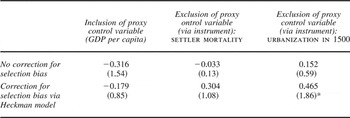
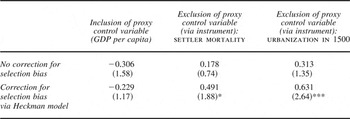
With that point registered, we can say the following (based on the results in Appendix 3, which compare the size and significance of the democracy coefficient across different model specifications). First, if we do not control for selection, none of our models indicate a democratic advantage for ratings. Second, avoiding the proxy control variable is also essential to uncovering the democratic advantage. Third, expanding the sample from developing to all countries is much less important. Restricting the analysis to developing countries reduces the proportion of democracies in the sample, thereby reducing the variance of the regressor of main interest and rendering our estimates of its effects less precise. But those effects are still statistically discernible in some specifications.
The credit rating process is nuanced and, in many ways, opaque. Economic fundamentals are clearly important to the assessments that CRAs make, but it has been widely acknowledged by scholars and practitioners alike that domestic politics also influence credit ratings. With this work, we have attempted to mirror some of the nuance involved in assigning ratings by thinking carefully about how countries come to receive ratings and what some available, and commonly used, indicators are actually telling us about a country's economic and political circumstances. Our results suggest that, in fact, democratic political regimes enjoy an advantage both in access to international financial markets and in credit prices, compared to their authoritarian counterparts.
Appendix 1. Summary Statistics and Definitions
Descriptive statistics—selection equation (Moody's)

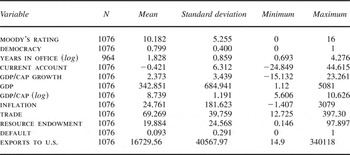
Descriptive statistics—rating equation (Moody's)

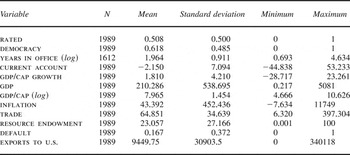
Descriptive statistics—selection equation (Standard and Poor's)

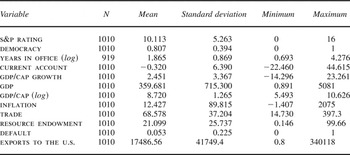
Descriptive statistics—rating equation (Standard & Poor's)

Variable Definitions
current account (lag): Current account, lagged by one year. Source: World Bank 2010.
default (lag): Dummy variable that takes the value of 1 to indicate if an external default or restructuring of a country's sovereign debt exist. Otherwise, it takes the value of 0. Source: Archer, Biglaiser, and DeRouen Reference Archer, Biglaiser and DeRouen2007; Reinhart Reference Reinhart2010; Reinhart and Rogoff Reference Reinhart and Rogoff2010; Saiegh Reference Saiegh2005; Sturzenegger and Zettelmeier Reference Sturzenegger and Zettelmeier2006; Suter Reference Suter1992; Moody's, Standard and Poor's; and news reports.
democracy: Dummy variable that takes the value of 1 if a country is considered democratic according to the criteria in Przeworski et al. Reference Przeworski, Alvarez, Cheibub and Limongi2000. Otherwise, it takes the value of 0. Source: Cheibub, Gandhi, and Vreeland Reference Cheibub, Gandhi and Vreeland2010.
exports to the u.s.: Annual exports to the United Sates measured in current US millions of dollars. Source: Barbieri and Keshk Reference Barbieri and Keshk2008.
gdp (lag): Gross domestic product (expressed in US$100,000,000 units). Lagged by one year. Source: World Bank 2010.
gdp/cap (lag): GDP per capita, lagged by one year. Source: World Bank 2010.
gdp/cap growth (lag): Annual change in GDP per capita, lagged by one year. Source: World Bank 2010.
inflation (lag): Change in CPI, lagged by one year. Source: World Bank 2010.
moody's rating: Rating obtained from Moody's rating agency, reflecting a country's probability of honoring its debt. It ranges from C (the lowest possible) to AAA (the highest possible). Following Archer, Biglaiser, and DeRouen Reference Archer, Biglaiser and DeRouen2007, we convert the letter ratings to a 0–16 scale. In addition, we linearly transform these ratings, r, to r' = 1/16 + 255/256r, and then take the natural logarithm. Source: Archer, Biglaiser, and DeRouen Reference Archer, Biglaiser and DeRouen2007; and authors' calculations.
rated: Dummy variable that takes the value of 1 if a country received a rating by either Moody's or S&P. Otherwise, it takes the value of 0. Source: Archer, Biglaiser, and DeRouen Reference Archer, Biglaiser and DeRouen2007; and authors' calculations.
resource endowment (lag): This measure is constructed by adding annual ores and metals exports (as a percent of merchandise exports) to fuel exports (as a percentage of merchandise exports), lagged by one year. Source: World Bank 2010.
s&p rating: Rating obtained from S&P rating agency, reflecting a country's probability of honoring its debt. It ranges from C (the lowest possible) to AAA (the highest possible). Following Archer, Biglaiser, and DeRouen Reference Archer, Biglaiser and DeRouen2007, we convert the letter ratings to a 0–16 scale. In addition, we linearly transform these ratings, r, to r′ = 1/16 + 255/256r, and then take the natural logarithm. Source: Archer, Biglaiser, and DeRouen Reference Archer, Biglaiser and DeRouen2007 and authors' calculations.
trade (lag): The sum of exports and imports of goods and services measured as a share of gross domestic product, lagged by one year. Source: World Bank 2010.
years in office: The number of years the party of the chief executive has been in office (logged). Source: Keefer Reference Keefer2009.
Appendix 2. Instrumental Variable Models
Auxiliary equations: OLS regression of log GDP per capita

Appendix 3. Comparing the Democratic Advantage Across Model Specifications
Democracy's impact on Moody's credit ratings—developing countries

Democracy's impact on Moody's credit ratings—full sample