Introduction
The Convolvulaceae family comprises nearly 1,650 predominantly tropical species (Austin Reference Austin1997). This family is dominated by twining or climbing woody or herbaceous plants that often have heart-shaped leaves and funnel-shaped flowers (Austin Reference Austin1997). One of the most noticeable anatomical characteristics of Convolvulaceae is the existence of cells that secrete resin glycosides in the foliar tissues and in the roots of the plants (Wagner and Bendz, Reference Wagner and Bendz1973). These glycoresins are an important chemotaxonomic marker of this family and are responsible for the laxative properties among some species of the Convolvulaceae (Pereda-Miranda and Bah Reference Pereda-Miranda and Bah2003; Wagner and Bendz, Reference Wagner and Bendz1973). The genus Ipomoea is the largest genus within the Convolvulaceae family (Austin and Huáman Reference Austin and Huáman1996), comprising approximately 500 to 600 species. Commonly, members of this genus are found in tropical regions, although some species also inhabit temperate zones of the world (McDonald Reference McDonald1991). The Ipomoea are predominantly distributed throughout the South and Central American countries and the tropical African territories (Austin and Huáman Reference Austin and Huáman1996).
Different species of Ipomoea are commonly found in Australia, including Ipomoea costata F. Muell. ex Benth. and Ipomoea polpha R.W. Johnson, and Ipomoea argillicola R.W. Johnson, of which I. costata is the most widespread (APSF 2017). Cowvine (Ipomoea lonchophylla J.M. Black) is a native summer broadleaf weed in Australia. This is a prostrate or twining annual herb that produces a large number of seeds (Johnson Reference Johnson2012). This species is found throughout much of the higher-rainfall areas of northern and central Australia and is tolerant to many herbicides used in cotton (Gossypium hirsutum L.)-cropping systems (ALA 2022; Charles and Johnson, Reference Charles, Johnson, Charles, Roberts and Taylor2006). Ipomoea lonchophylla can be problematic, especially in summer fallow or low-input summer cropping situations in southern New South Wales (NSW). It is believed that this species contains an inseparable mixture of resin glycosides that are toxic to female livestock during gestation and can cause “drunken lamb syndrome” in newly born lambs (MacLeod et al. Reference MacLeod, Ward and Oelrichs1997). It is a metabolic acidosis characterized by D-lactic acidosis. Affected livestock exhibited clinical signs, including hyperthermia (Angell et al. Reference Angell, Jones, Voigt and Grove-White2013). This disease occurs during gestation when the female feed on this toxic species (Angell et al. Reference Angell, Jones, Voigt and Grove-White2013; MacLeod et al. Reference MacLeod, Ward and Oelrichs1997). Therefore, the spread and control of this species are important to both cropping and livestock production systems. The spread of viable I. lonchophylla seeds is the result of weed seed survivors that reach maturity and seed that is imported into the field via other sources, including water, machinery, and animals. Hence, preventing the replenishment of the weed seedbank and the reduction of viable seeds entering a field is critical to successfully managing this weed.
The passage of weed seeds through the digestive tract of ruminants (cattle) has been shown to reduce the viability of several weed and legume seeds, thereby reducing the number of seeds entering the weed seedbank via animal transmission (Stanton et al. Reference Stanton, Piltz, Pratley, Kaiser, Hudson and Dill2002). However, a portion of seeds can still be viable after passing through the digestive tract of ruminants, depending on weed species (Asaduzzaman et al. Reference Asaduzzaman, Piltz, Koetz, Hopwood, Shepheard and Wu2022a; Kneuper et al. Reference Kneuper, Scott and Pinchak2003; Stanton et al. Reference Stanton, Piltz, Pratley, Kaiser, Hudson and Dill2002; Wang et al. Reference Wang, Waly, Ma, Zhang and Wan2017). Weed species are less affected from ingestion by cattle than by sheep (Gardener et al. Reference Gardener, McIvor and Jansen1993a, Reference Gardener, McIvor and Jansen1993b; Haidar et al. Reference Haidar, Gharib and Sleiman2010; Michael et al. Reference Michael, Steadman, Plummer and Vercoe2006; Stanton et al. Reference Stanton, Pratley and Hudson2003). Nevertheless, the role of the animal’s digestive tract on seed viability and the spread of weed seeds has not been sufficiently clarified, and no information is available regarding the effect of adult animal ingestion on I. lonchophylla seeds.
Germination is a key stage of the plant’s life cycle (Xu et al. Reference Xu, Wolfe, Diez, Zheng, Guo and Hu2019). Germination and emergence are positively correlated with the establishment and spread of weeds (Chauhan et al. Reference Chauhan, Gill and Preston2006a, Reference Chauhan, Gill and Preston2006b). Seedling emergence is affected by seed properties and also by abiotic environmental factors, including temperature, light, and depth of burial (Asaduzzaman et al. Reference Asaduzzaman, Koetz and Rahman2019, Reference Asaduzzaman, Koetz and Wu2020; Baskin and Baskin Reference Baskin and Baskin2014; Chauhan and Johnson Reference Chauhan and Johnson2010).
There is an increasing prevalence of I. lonchophylla in higher-rainfall areas of northern and central Australia, but little is known about its seed germination biology and persistence under ensiling practices in Australia. Improved understanding of the germination ecology of I. lonchophylla has become increasingly important, particularly in areas infested by this weed species (APSF 2017). The altered temperature patterns associated with global climate change will have direct effects on seed dormancy, germination, emergence, persistence, and reproduction of weed species (Walck et al. Reference Walck, Hidayati, Dixon, Thompson and Poschlod2011). Subsequently, these attributes will affect the plant distribution, weed species shift, population dynamics, life cycle, phenology, competitive potential, and herbicide control efficacy (Ramesh et al. Reference Ramesh, Matloob, Aslam, Florentine and Chauhan2017; Varanasi et al. Reference Varanasi, Prasad and Jugulam2016).
The life span and reproductive characteristics of a weed may vary from season to season, and a weed’s tolerance to heterogeneous environments can vary due to its phenotypic plasticity (Li et al. Reference Li, Lindquist and Yang2015). The assessment of such phenological data for I. lonchophylla will generate valuable ecological knowledge for improved management of this weed. Weed surveys covering 135 fields were conducted in the cotton-growing regions of NSW and Queensland in 2014 to 2015 and revealed that I. lonchophylla was present in 40% of the fields and its occurrence was increasing over time (Manalil et al. Reference Manalil, Werth, Jackson, Chauhan and Preston2017; Werth et al. Reference Werth, Boucher, Thornby, Walker and Charles2013). The ecology and persistence of I. lonchophylla in different Australian agroecological areas have not been studied, despite the plant’s spread and the increasing risk of I. lonchophylla developing resistance in herbicide-driven cropping systems. Precise knowledge of the germination ecology of this species in response to different environmental factors is required to devise improved weed management options. Our study was conducted to (1) evaluate the germination response of I. lonchophylla under different environmental conditions; (2) determine the effect of ensiling, digestion, and their combined effects on the germination and viability of I. lonchophylla seeds; and (3) determine the effect of emergence timing on the phenology and reproductive efforts of I. lonchophylla in southern NSW.
Materials and Methods
Sources of Seeds
Mature seeds of I. lonchophylla were collected in 2018 from five mature plants at a cotton farm located at Hillston, NSW (33.50°S, 145.45°E). A seed germination test was conducted within 7 d of seed collection.
Germination Response to Different Scarification Techniques
The immediate laboratory germination test showed that the fresh seeds had no germination and expressed a high level of dormancy. Different treatments to break dormancy—ethanol, sulfuric acid, and seed scarification with sandpaper—were applied separately to freshly collected matured seeds. For the ethanol treatment, 25 seeds of I. lonchophylla were treated with absolute ethanol (100%) for 0, 30, 60, 90, and 120 min. Similarly, 25 seeds were treated with concentrated sulfuric acid (98%) for 0, 5, 10, 15, 20, 25, 30, and 35 min. The response to physical scarification was tested with #80 wood sandpaper on 25 seeds at an area opposite from the embryo, which was abraded until the cotyledon was exposed. We compared the results from each of the three scarification methods against results for untreated seeds.
Germination Procedures and Growth Condition in Laboratory
All laboratory experiments consisted of three replicates of 25 physically scarified (sandpaper) seeds placed on two sheets of filter paper (No. 1 filter paper, Whatman International, Maidstone, Kent, ME 14 2LE, UK) in 9-cm petri dishes, unless stated otherwise. The filter paper was moistened initially with 5 ml of distilled water or test solution. All dishes were sealed with Parafilm (American National Company, Greenwich, CT 06836, USA) to reduce desiccation. The treated seeds on petri dishes were kept inside an incubator (Linder and May, Brisbane, QLD 4000, Australia) at predetermined temperatures. The total number of seeds germinated was determined after 12 d, except in the seed burial studies described later.
Germination Response to Temperature
The germination response of I. lonchophylla to a range of temperatures was evaluated by incubating sandpaper-scarified seeds in growth chambers under constant temperatures ranging from 10 to 45 C at 5 C intervals, and alternating temperature ranges of 25/15, 35/25, 40/30, and 45/35 C, with a 12-h light/dark cycle. The objective of this experiment was to find the optimum temperature conditions for seed germination. Based on our results, all subsequent experiments were conducted at 35/25 C day/night temperature with a 12-h photoperiod, as maximum seed germination was observed under these conditions.
Germination Response to Light
The response of I. lonchophylla germination to light was determined under two light conditions. The first light treatment was a 12-h photoperiod (hereafter referred to as “light”), and the second treatment was continuous darkness (hereafter referred to as “dark”) in a growth incubator for 12 d under a day/night temperature cycle of 35/25 C. The dark treatment was achieved by wrapping petri dishes in two sheets of aluminum foil (Asaduzzaman et al. Reference Asaduzzaman, Koetz and Rahman2019; Baskin and Baskin Reference Baskin and Baskin2014).
Germination Response to Salt Stress
The effect of salt stress on the germination of I. lonchophylla was determined by placing sandpaper-scarified seeds on filter paper in petri dishes containing 5-ml solutions of 0, 12.5, 25, 50, 100, 150, and 250-mM sodium chloride (AR grade, Sigma Aldrich, Sydney, NSW 2020, Australia). The solutions were prepared by dissolving 0, 0.75, 1.5, 2.4, 5.8, 8.8, and 11.7 g of NaCl per 1 L of de-ionized water respectively (Ahmed et al. Reference Ahmed, Opeña and Chauhan2015; Asaduzzaman et al. Reference Asaduzzaman, Koetz and Wu2020).
Emergence Response to Seed Burial Depth
Before seed burial, 15-cm-diameter pots were filled with heavy clay soil, manually irrigated every alternate day for 2 min, and kept for 14 d in a glasshouse. Before the experiment, the soil was oven-dried at 105 C temperature for 5 d to sterilize the background weed seeds that already exist in soil. A total of 25 sandpaper-scarified seeds of I. lonchophylla were placed on the soil surface of each pot and then covered with the same soil to bury the seeds to depths 0, 2, 4, 8, and 16 cm. Pots were watered every 2 d up to 28 d. Seedling emergence was counted until 28 d, after which no further emergence was observed.
Germination Response to Ensiling and Ruminal Exposure
The method previously described by Piltz et al. (Reference Piltz, Stanton and Wu2017) to determine the germination response to ensiling and ruminal digestion was employed for this experiment. A total of four treatments were used: (1) untreated (control), (2) burial in silage, (3) in vitro digestion, and (4) silage plus in vitro digestion. Seeds (n = 30) of I. lonchophylla were placed in bags made from white polyester monofilament (53 ± 10 µm pore size) used for in vitro digestion studies (Bar Diamond®).
For the silage treatment, the bags of scarified seeds were layered in chopped lucerne (Medicago sativa L.) forage to ensure each bag was in contact with the silage. The chopped forage was physically compacted and air-vacuumed from the bags, and the bag opening was securely tied to obtain an airtight seal. Then, each bag was placed inside a second bag of the same type, and the vacuuming and tying process repeated. The bags were packed into 200-L drums surrounded by damp sand with a layer of damp sand on the top to maintain weight on the bags. The ensiled seeds were stored in these bags for 3 mo to ensure completion of the ensiling process. The range of silage dry matter content and pH value at the time of opening were 30.96 to 44.12 g kg−1 and 5.23 to 5.30, respectively.
Upon being opened, one bag from each silage replicate was paired with a bag that had not been ensiled. Both bags were placed in the rumen of a mature Red Poll steer for 48 h, using the method described by Tilley and Terry (Reference Tilley and Terry1963). All bags from each silage replicate were placed in the rumen of the same steer, and bags from different silage replicates were placed in different steers. Three steers were fed a diet consisting of lucerne hay, oaten chaff (Avena sativa L.), barley grain (Hordeum vulgare L.), and oat grain at 300, 300, 200, and 200 g kg−1 of the diet, respectively, on an as-fed basis. Diets were fed for 10 d before commencement of the digestion study to ensure the rumen had adjusted to the standard diet, and then for the 48 h, during which digestion degradability of the I. lonchophylla seed was determined. Seed germination was tested by placing seeds on Whatman No. 1 filter paper moistened with 5 ml of water following their removal from the rumen.
Growth and Reproductive Phenology Response to Emergence Times
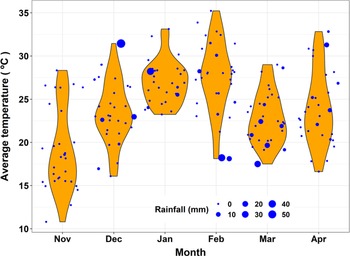
Two sowing times, late spring (November 15, 2020) and midsummer (January 15, 2021), were chosen to test the phenotypic variability of I. lonchophylla in southern NSW. A single physically scarified seed of I. lonchophylla was placed on the soil surface per pot (30 cm by 18 cm), with a total of 12 pots for each sowing time under natural conditions at Wagga Wagga Agricultural Institute (WWAI), NSW. For each sowing time, different phenological events, including the first date of (1) emergence, (2) flower initiation, (3) berry initiation, and (4) seed maturity, were recorded. The number of branches and total seed berries per plant were counted 3 mo after sowing, when plants were near maturity. The weather conditions of WWAI during the experimentation are presented in Figure 1. Growing degree days (GDD) were calculated using the equation (Prentice et al. Reference Prentice, Cramer, Harrison, Monserud and Solomon1992):
 $${\rm GDD}{\rm{ }} = {\rm{ }}\left( {{T_{\rm max}} + {\rm{ }}{T_{\rm min}}} \right)/2{\rm{ }} - {T_{\rm base}}$$
Temperature distribution (by month) and daily rainfall (mm) events during the experimental period at Wagga Wagga Agricultural Institute, NSW (November 2020 to April 2021). The frequency of a higher average temperature increased from November to February.

where T base = 5 C.
Experimental Design and Statistical Analysis
A randomized complete block design was employed for evaluating germination in all laboratory experiments, with incubator shelves considered as a blocking factor to minimize systemic errors. A completely randomized design with three replications was used for the silage experiment. Each experiment was repeated after the end of the first run, except for the silage and ruminant digestion studies. Data were pooled from the repetitions, as there were no time-by-treatment interactions, as determined by ANOVA. A second-degree polynomial regression model (Equation 2) was used to detect the effect of ethanol on breaking seed dormancy:
 $$y{\rm{ }} = {\rm \beta _0} + {\rm \beta _1}x + {\rm\beta _2}{x^2}$$
where y and x are the response variable (% germination) and predictor variable, respectively; β0 is the estimated model intercept; and parameters β1 and β2 are coefficients.
A three-parameter Gaussian model (Equation 3) was fit to the germination values resulting from the experiments using constant temperatures. The model was:
 $$y = a*e\left\{ { - 0.5*{{\left[ {\left( {x{\rm{ }} - {\rm{ }}b} \right)/c} \right]}^2}} \right\}$$
where a is the height of the curve’s peak (maximum germination), b is the position of the center of the peak (the constant temperature required to achieve maximum germination), and c is the width of the curve.
We used ANOVA to assess the effect of alternating temperatures on germination. Three and five parameters of log-logistic (nonlinear) dose–response models were fit for data derived from the burial (Equation 4) and salt experiments (Equation 5), respectively.
 $$y = {\rm{ }}\left\{ {[0{\rm{ }} + {\rm{ }}\left( {d - {\rm{ }}0} \right)/1{\rm{ }} + {\rm exp}(b(\rm log}\left( x \right){\rm{ }} - {\rm log\left( {E{S_{50}}} \right)]} \right\}$$
 $$y = \left\{ {[c + {\rm{ }}\left( {d - c} \right)/(1{\rm{ }} + {\rm exp}(b{{\left( {\rm log}\left( x \right){\rm{ }} - {\rm log\left( {E{S_{50}}} \right)} \right)}^f}]} \right\}$$
In Equations 3 and 4, c (c = 0 for Equation 3) and d are the lower and upper responses against explanatory variables, respectively. The mean response of the control treatment is defined by the upper limit d. ES50 is the effective depth level or salt concentration required to reduce germination by 50%, and b is the slope of the curve around ES50.
The normality and distribution of data were verified using a Shapiro-Wilk normality test. The significant differences among treatment means were identified using Tukey’s HSD at P < 0.05. Data were analyzed using the R environment (R Core Team 2022). The data analysis utilized the packages drc (Ritz et al. Reference Ritz, Jensen, Gerhard, Streibig and Gerhard2020), agricolae (de Mendiburu Reference de Mendiburu2017), and ggplo2 (Wickham Reference Wickham2016) for exploratory data analysis and curve fitting.
Model Goodness of Model Fit
Candidate models were assessed based on the Akaike’s information criteria (AIC) and mean square-root (MSE) values, where if the difference is >2, then the model with the lowest AIC value was selected. Root mean-square error (RMSE) and adjusted R 2 were calculated further to test the goodness of fit for the selected best models (Sarangi et al. Reference Sarangi, Irmak, Lindquist, Knezevic and Jhal2015; Werle et al. Reference Werle, Sandell, Buhler, Hartzler and Lindquist2014). The RMSE was calculated based on the following equation (Roman et al. Reference Roman, Murphy and Swanton2000):
 $${\rm{RMSE}}{\kern 1pt} = {\kern 1pt} \sqrt {{{\sum\nolimits_{i{\kern 1pt} {\rm{ = }}{\kern 1pt} {\rm{1}}}^n {{{({P_i} - {O_i})}^2}} } \over n}} $$
where P i is the predicted value, O i is the observed value, and n is the total number of observations. A smaller RMSE value means a better fit to the model due to closer observed and predicted values.
Results and Discussion
Germination Response to Different Scarification Techniques
The ethanol treatment significantly improved the I. lonchophylla germination percentage to about 5% after exposure to 100% ethanol for 30 to 120 min (Table 1). However, the concentrated sulfuric acid treatment was more effective than the ethanol treatment in breaking seed dormancy (Figure 2). Seed germination percentage increased with increasing exposure to sulfuric acid, plateauing at 20 and 25 min. The seed germination percentage of I. lonchophylla decreased thereafter. The 25-min treatment of concentrated sulfuric acid resulted in 20% germination, but exposure to this concentration for 35 min killed the seeds, and no germination occurred. Physical scarification using sandpaper was the most effective technique for breaking seed dormancy, achieving 70% (±3%) germination (Table 1). Mechanical constraints, including prevention of water and oxygen uptake, and the retention or production of chemical inhibitors are some of the possible mechanisms that cause the strong inhibitory effect of the seed coat on seed germination (Taiz and Zeiger Reference Taiz and Zeiger2002). Our treatment results demonstrated that I. lonchophylla seeds exhibit dormancy due to their hard seed coat. Improving the permeability of the seed coat by mechanical scarification resulted in a 70% increase in the germination percentage compared with 0% germination for untreated seed.
Effect of ethanol (100%) on breaking seed dormancy of Ipomoea lonchophylla.

a Seed germination was observed at 12 d after incubation.
Effect of sulfuric acid (98%) on breaking seed dormancy of Ipomoea lonchophylla. Seed germination was observed 12 d after incubation. Data from six petri dishes (from two runs) were pooled and fit to a three-parameter gaussian model, R2 = 0.79, represented by a solid line. Boxes with vertical bars show the observed means (±SE) of the germination. The calculated root mean-square error value is 4.6.

Dormancy caused by a water-impermeable seed (or fruit) coat is a physical dormancy and occurs in many Ipomoea species (Torres-Reano et al. Reference Torres-Reano, Alarcon-Bravo, Austin, Rojas-Idrogo and Delgado-Paredes2017). Weed species with hard seed coats, such as Ipomoea, Venice mallow (Hibiscus tridactylites Lindl.; syn. Hibiscus trionum L.), velvetleaf (Abutilon theophrasti Medik.), and spurred anoda [Anoda cristata (L.) Schltdl.], persist in the soil for a long time as the process of scarification can be very slow under natural conditions (Chauhan Reference Chauhan2016). Natural scarification depends on many factors, such as variations in temperature and moisture conditions and predation activities by rodents, insects, and microorganisms. Therefore, it is difficult to eradicate I. lonchophylla due to its persistent soil seedbanks. This observation is consistent with the views of many farmers who have had long-term issues managing this weed and explains why this weed continues to be recorded as problematic in industry surveys of in-crop weeds (Manalil et al. Reference Manalil, Werth, Jackson, Chauhan and Preston2017; Werth et al. Reference Werth, Boucher, Thornby, Walker and Charles2013).
Germination Response to Temperature
The germination of I. lonchophylla was observed over the temperature range of 10 to 45 C (Figure 3). The highest germination percentage, when exposed to a fixed temperature, was observed at 20 and 25C (73% and 73%, respectively), with the lowest percentage at 45 C. The highest germination percentage (76%) was observed at the day/night temperatures of 35/25C, and the second-highest germination percentage (56%) was at 25/15C (Figure 4). The germination percentage decreased to 45% and 8% at 40/30 and 45/35C, respectively. These results were consistent with germination responses to temperatures among other weeds of the Convolvulaceae family (Cole and Coats Reference Cole and Coats1973). We found that I. lonchophylla can germinate under a wide range of temperatures in the natural environment and may germinate equally throughout the spring, summer, and autumn seasons in southern NSW. We used scarified seeds, but under natural conditions, scarification is a slow process, depending on many biotic and abiotic factors (Dhanda and Chauhan Reference Dhanda and Chauhan2022).
Effect of constant temperatures on the germination of Ipomoea lonchophylla observed after 12 d of incubation. Data from six petri dishes (from two runs) were pooled and fit to a three-parameter gaussian model, R2 = 0.88, represented by a solid line. Boxes with vertical bars show the observed means (±SE) of the germination. The calculated root mean-square error value is 3.5.

The effect of alternating temperature (day/night) on the germination of Ipomoea lonchophylla was observed after 12 d of incubation. Data from six petri dishes (from two runs) were pooled. The solid bars show the observed means (±SE) of the germination (% germination; P < 0.05, ANOVA). The calculated root mean-square error value is 6.1.

Germination Response to Light
There was no significant (P > 0.05) difference between the germination percentage of I. lonchophylla under continuous light (24/0 h), and continuous dark (0/24 h) (Figure 5). The mean germination percentage was 73% and 74% under 24-h light cycle and under continuous dark (24/0 h) conditions, respectively. From these results, we conclude that I. lonchophylla germination was not responsive to light, and thus I. lonchophylla could be more competitive than light-sensitive crops under low light conditions. Light is an important environmental signal regulating germination for some species (Pons Reference Pons and Fenner2000), but the effect of light on germination is species specific. Light can increase the germination percentage of some species, including redroot amaranth (Amaranthus retroflexus L.) and tick-clover [Desmodium adscendens (Sw.) DC.] (Tang et al. Reference Tang, Hamayun, Khan, Shinwari, Kim, Kang, Lee, Na, Nawaz, Kang and Lee2010). However, light does not promote or may even inhibit the germination of certain weeds (Li et al. Reference Li, Guan and Probert2007), including Japanese brome (Bromus japonicus Thunb.; syn. Bromus arvensis L.) (Li et al. Reference Li, Lindquist and Yang2015), musk weed (Myagrum perfoliatum L.) (Honarmand et al. Reference Honarmand, Nosratti, Nazari and Heidari2016), tropical signalgrass [Urochloa distachya (L.) T.Q. Nguyen] (Teuton et al. Reference Teuton, Brecke, Unruh, Macdonald, Miller and Ducar2004), and Tausch’s goatgrass (Aegilops tauschii Coss.) (Fang et al. Reference Fang, Zhang, Wei, Huang and Liu2012). The light sensitivity feature of these species may restrict their spread in deep-tillage systems, whereas no-till systems might influence their spread.
The effect of light conditions (complete dark or 12-h dark/light) on the germination response of Ipomoea lonchophylla was observed after 12 d of incubation. Data from six petri dishes (from two runs) were pooled. The dots with vertical bars show the observed means (±SE) of the germination (% germination; P > 0.05, ANOVA). The calculated root mean-square error value is 4.1.

Germination Response to Salt Stress
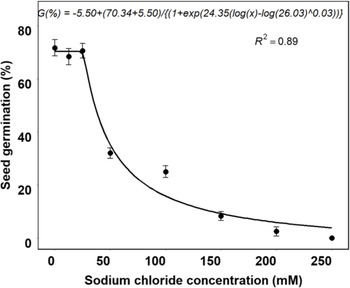
We used a five-parameter log-logistic model to describe the relationship between salt concentration and the germination percentage of I. lonchophylla (Figure 6). The germination of I. lonchophylla occurred over a broad range of salt concentrations. The germination percentage of I. lonchophylla was the greatest at salt concentrations between 0 and 25 mM (67% to 76%), but decreased sharply to 33% at 50 mM NaCl, which was followed by a steady decline to 4% germination at 200 mM NaCl. Germination was completely inhibited at 250 mM NaCl. Based on these findings, we conclude that I. lonchophylla can tolerate moderate levels of salt stress and that a proportion of seeds may still germinate at salinity levels up to 200 mM. This could be an important parameter for the successful adaptation of this weed in the moderately saline areas of southern NSW. The major focus of research on salinity in Australia is on irrigation-induced salinity in the Murray Darling Basin and dryland salinity associated with shallow groundwater, particularly in Western Australia (Rengasamy Reference Rengasamy2002). A total of 16% of the cropping area of Australia is likely to be affected by water table–induced salinity; 67% of the area is subject to transient salinity and other root-zone constraints (Rengasamy Reference Rengasamy2006). Most of the irrigated soils are sodic, with low hydraulic conductivity increasing the probability of salt buildup over time. Furthermore, because of the flat landscape in irrigation areas, the recharge of water has led to an increase in water table levels in recent years, and groundwater salinity is generally high, ranging between 4 and 150 dS m−1 (Rengasamy Reference Rengasamy2006). However, many salinity-affected regions are within local groundwater flow systems that are fast to recover, both because of their small size and because of the inherent climate conditions (warm and wet summers). Therefore, I. lonchophylla can still persist and spread in nonsaline cropping areas. Other Ipomoea species, such as tall morningglory [Ipomoea purpurea (L.) Roth], are more sensitive to salt stress (Singh et al. Reference Singh, Ramirez, Sharma and Jhala2012). Chauhan et al. (Reference Chauhan, Gill and Preston2006b) reported that only 7% of annual sowthisle (Sonchus oleraceus L.) germinated at a salt concentration of 160 mM, and 11% of turnip weed [Rapistrum rugosum (L.) All.] seed germinated at a concentration of 160 mM (Chauhan et al. Reference Chauhan, Gill and Preston2006a, Reference Chauhan, Gill and Preston2006b).
The effect of sodium chloride on the germination of Ipomoea lonchophylla incubated at 35/25 C alternating day/night temperature for 12 d. Data from six petri dishes (from two runs) were pooled and fit to a five-parameter log-logistic model, R2 = 0.89, represented by a solid line. Dots with vertical bars show the observed means (±SE) for the germination. The calculated root mean-square error value is 4.7.

Emergence Response to Seed Burial Depth
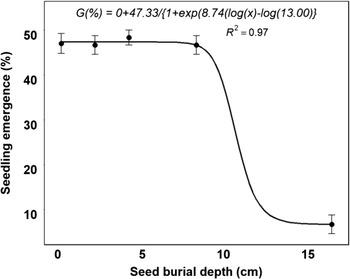
The emergence of I. lonchophylla was not reduced by increasing the seeding depth up to 8 cm (Figure 7). Seed emergence started 3 d after sowing on the soil surface (0-cm depth), with an average emergence of 47%. However, the emergence percentage of I. lonchophylla decreased significantly when seeds were planted at a 16-cm depth, with only 5% emergence recorded from this depth. Our results are consistent with results for other Ipomoea species (Cole Reference Cole1976; Wilson and Cole Reference Wilson and Cole1966). Both studies reported that the emergence of tall morningglory [Ipomoea purpurea (L.) Roth] was delayed and reduced with increasing sowing depth. Also, reduced seedling emergence with increasing seeding depth was reported for ivyleaf morningglory (Ipomoea hederacea Jaq.), white morningglory (Ipomoea lacunosa L.), and entireleaf morningglory (Ipomoea hederacea Jaq. var. integriuscula A. Gray) (Gomes et al. Reference Gomes, Chandler and Vaughan1978; Siahmarguee et al. Reference Siahmarguee, Gorgani, Ghaderi-far and Asgarpour2020). We found a significant number of seeds (47%) emerged from the 8-cm burial depth, and we suggest that shallow burial of seeds through light tillage to reduce I. lonchophylla density may not significantly improve control of this species. However, deeper burial at >16 cm can significantly reduce the emergence of I. lonchophylla. The reduced germination at greater burial depths might be due to the energy reserves of the seed being exhausted before the seedling is capable of emergence.
The effect of seed burial depth on the emergence of Ipomoea lonchophylla buried for 28 d. Data from six pots (from two runs) were pooled and fit to a three-parameter log-logistic model, R2 = 0.97, represented by a solid line. Dots show the observed means (±SE) for the germination. The calculated root mean-square error value is 4.5.

Germination Response to Ensiling and Ruminal Digestion
Seed germination percentage was significantly affected by the silage and rumen treatments. The seeds completely failed to germinate following the silage or silage + rumen treatments (Figure 8). Also, the rumen-alone treatment significantly (P < 0.005) reduced seed germination, with only 10% of seeds germinating, compared with 65% germination for the control. Our results were consistent with previous studies on other broadleaf weed species, including lambsquarters (Chenopodium album L.), A. theophrasti, and wild radish (Raphanus raphanistrum L.) (Hahn et al. Reference Hahn, deMol and Muller2021; Piltz et al. Reference Piltz, Bailes, Boschma and Weston2021), that found that ensiling significantly (P < 0.005) reduced seed germinability and viability of these weed species. Similarly, silage and a rumen treatment proved as effective in reducing seed viability for grass weed species, including barley grass (Hordeum spp.), vulpia (Vulpia spp.), wild oat (Avena fatua L.), brome grass (Bromus diandrus Roth), and feathertop Rhodes grass (Chloris virgata Sw.) (Asaduzzaman et al. Reference Asaduzzaman, Piltz, Koetz, Hopwood, Shepheard and Wu2022a; Piltz et al. Reference Piltz, Stanton and Wu2017, Reference Piltz, Bailes, Boschma and Weston2021). The causes of seed death following ingestion by ruminant livestock are reasonably well understood (Hogan and Phillips Reference Hogan and Phillips2011), but the mechanism(s) operating to reduce or eliminate seed viability during silage are not. Silage is a lactic acid fermentation process and is mainly used to preserve biomass but does affect seed viability of some plant species (Hahn et al. Reference Hahn, deMol and Muller2021; Piltz et al. Reference Piltz, Stanton and Wu2017; Reference Piltz, Bailes, Boschma and Weston2021). Generally, it is speculated that silage acids are the principal mechanisms for rendering seeds nonviable, but Piltz et al. (Reference Piltz, Bailes, Boschma and Weston2021) reported a reduction in viability due to seeds being exposed to a moist environment. Lactic acid is the strongest of silage acids. The concentration of the various acids produced by the fermentation are affected by three plant parameters during the ensiling process: forage dry matter content, water-soluble carbohydrate, and buffering capacity (Piltz and Kaiser Reference Piltz and Kaiser2004). By reducing the number of germinable and viable seeds, silage can help reduce I. lonchophylla, and other weeds from fields, and the combination of both could be one of the “little hammers” in ecological weed management in an integrated farming system.
The effects of silage, digestion, and silage followed by digestion on the germination of Ipomoea lonchophylla. Data from three replicates were pooled. The bars show the observed means (±SE) of the germination (% germination; P < 0.05, ANOVA). The calculated root mean-square error is 1.4.

Growth and Reproductive Phenology Response to Emergence Time
The time of sowing had a significant (P < 0.001) effect on the timing of each reproductive event of I. lonchophylla (Table 2). Plants that emerged in mid-November (late spring) had a longer time from emergence to first flower (26 to 29 d) and from the first flower to when the first berry formed (12 to 14 d), compared with plants that emerged in midsummer in southern NSW. However, the late-spring sowing treatment took 50% less time from seed formation to maturity and produced twice the number of seed berries than the midsummer-emerged plants. Ipomoea lonchophylla that emerged in both late spring and midsummer had similar numbers of vegetative branches per plant and total duration from emergence to first seed maturity. We speculate that the time of seedling emergence determines the ability of I. lonchophylla plants to produce reproductive features. In southern NSW, midsummer-emerged plants took shortest time from flower formation to berry formation but the longest time for seed formation to seed maturity compared with late spring–emerged plants. The results suggest that photoperiod and temperature could be the primary environmental factors determining when reproductive events occur. The low temperature during March in southern NSW (Figure 1) significantly impacted the reproductive features of I. lonchophylla. The late spring–sown plants increased the proportion of the life period spent in flower initiation to seed berry formation and produced a higher number of seeds per plant. Weed plants may be phenotypically plastic, expressing the optimal phenotype at different GDD points in time (Asaduzzaman et al. Reference Asaduzzaman, Wu, Koetz, Hopwood and Shepheard2022b; Bradshaw and Holzapfel Reference Bradshaw and Holzapfel2006; Kaweck and Ebert Reference Kaweck and Ebert2004). We conclude that I. lonchophylla expresses differing reproductive responses to early- and later-season conditions (Figure 1), and this information could help to predict the spread of I. lonchophylla in new areas of southern NSW.
Phenological traits and duration of developmental periods (days) of Ipomoea lonchophylla emerging in late spring and midsummer in southern NSW.

The seeds of I. lonchophylla showed tolerance to environmental conditions such as variable temperature, low light, and burial depth, all of which are known to be constraints for many other problematic weed species of the cropping systems of southern NSW. We conclude that I. lonchophylla can establish and grow under a wide range of the environmental conditions commonly found in Australian cotton and other cropping systems of the south. These characteristics of I. lonchophylla can explain the expansion of this species in Australia, as shallow conservation tillage and surface mulching will do little to stop the spread of this native weed. Our study demonstrated that plants that emerged in late spring in southern NSW produced more seeds than those that emerged midsummer. Concerted effort should be diverted to control the early emergence of I. lonchophylla, especially the late-spring emergence due to its higher berry production.
The early emergence and adaptive ability of I. lonchophylla in a range of environmental conditions enables it to establish itself in both cropping and non-cropping situations. However, it is still unknown how I. lonchophylla synchronizes germination, establishment, and tolerance of shading to avoid being negatively impacted by the crop or by other weeds.
Data Availability
The data that support this study will be shared upon reasonable request to the corresponding author.
Acknowledgments
The authors acknowledge co-investment for the Cotton Research Development Corporation (CRDC) and NSW Department of Primary Industries, Australia.
Competing interests
The authors declare no conflict of interest.