Introduction
Madelung's disease, also known as benign symmetric lipomatosis or Launois–Bensaude syndrome, is a relatively rare condition characterised by the presence of multiple symmetric and disfiguring abnormal fat depositions in the head, neck, trunk, and nerve roots of the upper and lower limbs.Reference Josephson, Sclafani and Stern 1 This results in functional deformities, such as reduced neck mobility, and cosmetic deformities.
Patients often have co-existing illnesses, such as chronic liver disease, polyneuropathy, diabetes, gynaecomastia, hyperuricemia and dyslipidaemia. Madelung's disease is often associated with alcohol abuse, and the lipogenic, anti-lipolytic and decreased lipid oxidation effects of alcohol may play a role in the development of adipocyte hyperplasia in a susceptible person. Furthermore, there is a familial form linked to matrilineal inheritance.Reference Nisoli, Regianini, Briscini, Bulbarelli, Busetto and Coin 2 Treatment is palliative, and consists mainly of the removal of fatty tissue by surgical resection or liposuction.Reference Costantinidis, Steinhart, Zenk, Gassner and Iro 3
In some patients, the fatty deposits in the neck may cause upper airway obstruction that can contribute to sleep-related breathing disorders.Reference Ali and Kishore 4 We report a case of Madelung's disease causing obstructive sleep apnoea (OSA).
Case report
A 56-year-old man affected by Madelung's disease was referred to our department. The patient had no history of dyspnoea or dysphagia.
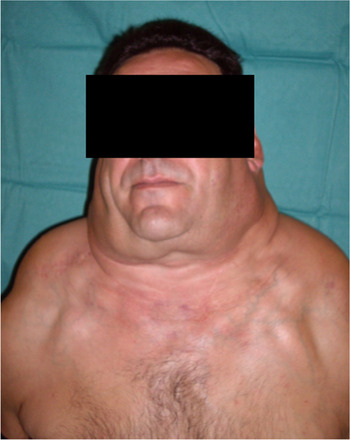
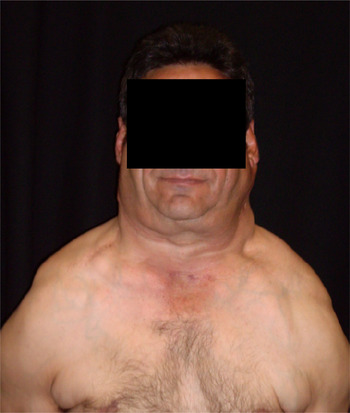
As a result of his cosmetic deformity (Figure 1), he had undergone more than seven procedures to remove fatty deposits from his neck and shoulder area over the previous 10 years.
Pre-operative ‘pseudoathletic’ appearance.

More recently, the patient had complained of snoring and severe daytime sleepiness (Epworth Sleepiness Scale score = 14). In light of suspected sleep apnoea syndrome, the patient underwent a full ENT clinical examination, fibre-optic pharyngo-laryngoscopy with Müller manoeuvre, and polysomnographic study.
He was diagnosed with severe OSA on polysomnographic study. He had an apnoea/hypopnoea index of 32.2 events per hour, an oxygen desaturation index of 39.4 events per hour, a lowest minimum oxygen saturation recorded during sleep of 79 per cent and a cumulative percentage of time spent at oxygen saturations below 90 per cent of 21 per cent.
The patient was referred for nasal continuous positive airway pressure (CPAP) treatment. The ventilatory treatment provided temporary symptom improvement, but compliance was poor (because of the high-pressure setting required to abolish apnoeas of 15.5 cm H2O), resulting in a poor clinical response.
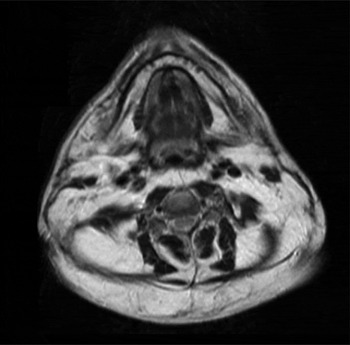
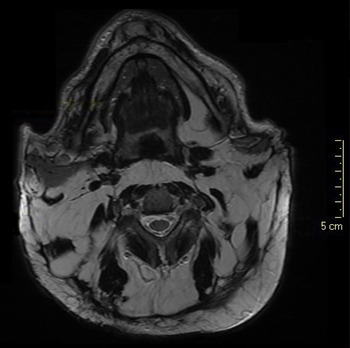
Magnetic resonance imaging (MRI) of the patient's head and neck revealed diffuse fatty deposits in the neck and parapharyngeal space, reducing the pharyngeal airway calibre (Figure 2).
Pre-operative axial magnetic resonance imaging scan.

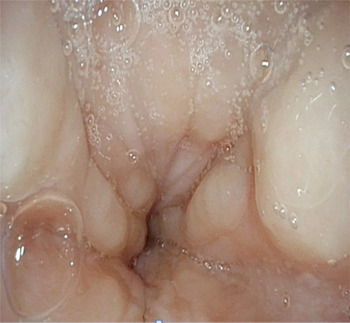
Drug-induced sleep endoscopy was performed to better evaluate the upper airway obstruction and to identify any other obstructive lesion. This showed complete collapse of lateral pharyngeal walls as the sole cause of the upper airway obstruction (Figure 3).
Drug-induced sleep endoscopy view.

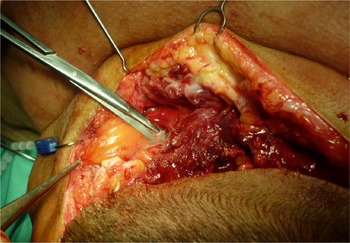
As the initial treatment, functional expansion pharyngoplastyReference Piccin, Pinto and Sorrenti 5 was carried out at the same time as surgical resection of neck fatty tissue (Figure 4). The surgical procedure was completed uneventfully, and the patient was transferred to the intensive care unit where he was extubated 20 hours after admission. The patient was discharged 7 days after surgery, with no swallowing dysfunction.
Removing fatty mass from the posterior part of the neck.

At six months’ follow up, marked improvement in neck movement (Figure 5a–b) and cosmetic appearance (Figure 6) were observed. All sleep disturbance related symptoms, including daytime somnolence, had disappeared (Epworth Sleepiness Scale score = 4), and a polysomnographic examination showed normalisation of the somnographic parameters (apnoea/hypopnoea index = 9, oxygen desaturation index = 9.4, lowest minimum oxygen saturation = 91 per cent, and cumulative percentage of time spent at saturations below 90 per cent = 6 per cent). Post-operative MRI revealed significant widening of the airway lumen (Figure 7).
(a & b) Post-operative improvement of neck movements.

Post-operative cosmetic result.

Post-operative axial magnetic resonance imaging scan.

Discussion
Obstructive sleep apnoea is a highly prevalent disease that is typified by functional narrowing of the pharynx.Reference De Weerdt, Haentjens, Van Binst, Baron, Clement and Vincken 6 The pathophysiology of OSA seems to result from a combination of predisposing anatomical and neuromuscular factors, but the exact mechanisms have not been fully elucidated. Obesity can contribute to OSA in various ways, including mechanical compression of the upper airway by extrinsic fat accumulation in the neck or intrinsic fat infiltration into the upper airway. Theoretically, any mass-like lesion around the upper airway has the potential to cause airway obstruction, resulting in OSA.
Madelung's disease is a rare condition characterised by the presence of multiple symmetric, non-encapsulated fatty deposits (unlike the usual lipoma), distributed in a symmetric pattern. The type I disorder is characterised by the deposition of non-encapsulated lipomatous tissue around the neck, shoulder girdles and arms, giving the patient a ‘pseudoathletic’ appearance.Reference Smith, Stadelmann, Wassermann and Kearney 7 These fatty masses cause cervicofacial cosmetic disfigurement associated with swallowing impairment and reduced neck mobility. Other symptoms can include upper airway obstruction.
Only four cases of severe OSA associated with Madelung's disease have been previously reported.Reference Jalladeau, Crestani, Laissy and Vecchierini 8 In our patient, the narrowing was at the retropalatal level because of lateral pharyngeal wall collapse, as revealed by drug-induced sleep endoscopy. In Madelung's disease, a mechanical factor could be responsible for OSA.
-
• Madelung's disease is rare, characterised by symmetric abnormal fat depositions in the head, neck, trunk and other upper extremities
-
• These fatty masses cause cervicofacial cosmetic disfigurement associated with swallowing impairment and reduced neck mobility
-
• Other symptoms include upper airway obstruction, which can contribute to sleep-related breathing disorders
-
• Elevation of parapharyngeal space fat pad volume could increase surrounding pressure of the lateral pharyngeal wall
-
• Lateral pharyngoplasty decreased pharyngeal collapse, enabling resolution of obstructive sleep apnoea syndrome
-
• Although continuous positive airway pressure remains the choice treatment, specific surgery can be used if ventilatory therapy is not tolerated
Oliven and colleagues suggested that the main mechanical parameter determining collapsibility of the pharyngeal wall was surrounding pressure.Reference Oliven, Kaufman, Kaynan, Oliven, Steinfeld and Tov 9 With regard to the mechanism, it is possible that elevation of the fat pad volume of the parapharyngeal space, as revealed by MRI in our patient, could increase the surrounding pressure of the retropalatal pharyngeal wall. Although the fat pad was present in the parapharyngeal space, it was not close enough to the lateral pharyngeal wall to compress it. Therefore, enlarged volume of the fat pad would not act as a lateral mass, but would increase the redundancy of the pharyngeal wall.
Although our patient underwent several surgical debulking procedures, ranging from simple liposuction to more massive fat mass removal, no improvement of OSA-related symptoms was achieved. This may be explained by the difficulty in reaching the parapharyngeal space. The parapharyngeal space is a challenging anatomical region to access and the traditional transcervical approach provides very limited surgical exposure. Functional expansion pharyngoplasty enabled complete resolution of OSA syndrome. This was achieved by the superolateral repositioning of the palatopharyngeus muscle, which increased pharyngeal airspace and decreased pharyngeal collapse.
Conclusion
Despite the rarity of this clinical situation, each patient with Madelung's disease should be examined carefully for potential OSA. Finally, although CPAP remains the treatment of choice, specific surgery can be used in those patients who cannot tolerate ventilatory therapy.