In the academic study of regulation, scholars do not agree on whether a centralized or a decentralized approach is preferable.Footnote 1 One notable exception, however, is environmental regulation wherein the general consensus has been that centralized regulation works better than decentralized approaches.Footnote 2 It is widely acknowledged that China's environmental problems lie in weak implementation hampered by “local protectionism” (difang baohuzhuyi 地方保护主义).Footnote 3 Existing studies have found that the delegation of key enforcement powers to local environmental protection bureaus (EPBs) that are funded and managed by local governments has led to local protectionism which promotes local economic growth at the expense of damaging the local environment and thus leads to enforcement failure. The proposal to centralize regulatory powers, particularly putting local EPBs under the direct leadership of the Ministry of Environmental Protection (MEP), has long been discussed in environmental agencies and among scholars but has not yet been implemented.Footnote 4
What has not been discussed as much is the centralized or direct enforcement of environmental regulation by MEP. The MEP is generally in charge of drafting policies, setting standards, and making plans.Footnote 5 Direct MEP enforcement has usually been in the form of campaigns that have generated notable but short-term effects.Footnote 6 In 2007, however, MEP introduced a verification programme that aimed to enforce the mandatory pollution reduction targets specified in the 11th Five-Year Plan (FYP). The verification programme has been primarily implemented by MEP's six newly established regional supervision centres and is probably the first sustained effort by MEP to directly enforce an environmental policy. As such it provides an excellent case study for understanding the mechanism and effects of central enforcement of environmental policy in the Chinese context.
The importance of binding targets written into the environmental FYPs cannot be overstated as they have increasingly played a critical role in China's efforts to address its environmental problems.Footnote 7 The existing literature on the subject has focused on the entire targeting process including selection, allocation, implementation, and verification.Footnote 8 The studies point out that enormous efforts have been made to reduce emissions, but there are many loopholes. Examples are target rigidity, the cyclical behaviour of local officials, poor data quality, and the absence of an independent monitoring agency.Footnote 9 Many of those problems can be linked to the weak implementation of the target programme. In her examination of the environmental target system,Footnote 10 Kostka concludes that “binding environmental targets … can be more accurately described as ‘command without control’ as the target-setting central agency does not exercise a high degree of control over implementation and monitoring processes.”
This article examines the design, process, and outcomes of the verification programme. By obtaining a high degree of central control over the implementation and monitoring of the target system, the programme represents MEP's major effort to address the data falsification that has widely been identified as the key problem in meeting targets at the local level.Footnote 11 Through an in-depth empirical analysis of how the verification programme was designed and executed, this study closes a gap in the existing literature on China's target system by examining a rare, centralized, direct enforcement programme and thus provides useful insights into the central versus local enforcement debate and also sheds lights on the principal-agent model widely employed to examine the relationship between political authorities and bureaucrats in the study of public bureaucracy.
The primary data used in this article are official documents and in-depth interviews with national and local government officials, researchers and managers of enterprises.Footnote 12 A relatively developed province (referred to as A) and another less-developed province (B) were chosen as the two fieldwork sites in order to cover probable regional variations. Localities in developed and less-developed regions were expected to have different practices and to face different challenges in verifying pollution reduction. The field research took place mainly from 9–23 July 2010 and included two brief follow-up field trips – from 21–23 December 2013 and from 11–13 December 2015 – to Province B.Footnote 13 Thus, the discussion in this article primarily reflects the situation from 2007 to 2010, but the follow-up investigations indicated that the core elements of the verification process have remained the same since 2010.
The analysis of official documents and interview notes reveals that the central environmental authority has exerted a high degree of control in monitoring pollution reduction targets and in verifying emission data. The six regional supervision centres under the direct leadership of MEP have played both a critical and an intermediary role in verification. To a certain degree, the implementation of the programme increased the difficulty for localities to overreport emission data, enhanced local monitoring and enforcement capacity, and appeared to have deterred violations due to the increased frequency of national and local inspections. Nevertheless, significant challenges remain as the process has been highly resource-intensive and has involved little public participation and oversight, and as MEP has exerted notable yet unchecked discretionary power in determining local compliance with binding reduction targets. Over time, the verification programme appears to have turned into a “numbers game,” which indicates mutual distrust between MEP and local EPBs. All those challenges suggest that central enforcement has arguably failed to achieve its original goal of genuine compliance with pollution reduction targets through improved data quality. Thus, the effectiveness of a central approach to address China's chronic problem of weak policy implementation is not well supported empirically in this study.
The rest of this article first describes the design of the verification programme including an analysis of the rationale behind its launch. It then elaborates the verification process as well as the central and local strategies involved followed by an analysis of the main outcomes and challenges. The article concludes with a summary of main findings and a brief discussion of theoretical implications for the central–local relations and principal-agent theory.
Design of the Verification Programme
The verification programme discussed in this article was initiated by MEP to address the problem of data falsification in implementing pollution reduction targets. The main objective of the programme was to improve data quality to provide a reliable basis for evaluation. One of the core elements of China's pollution reduction target system is the target responsibility system whereby local government leaders and managers of key enterprises are held responsible for achieving targets, yet this has not appeared to help the verification programme to achieve its goal. This section presents the FYPs and related reduction targets, the responsibility system, and the principles and implementing agencies of the verification programme.
Five-Year Plans and targets
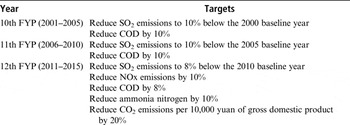
A core component of China's environmental regulation is the environmental FYPs. China has enacted numerous environmental laws and, more importantly, has relied on state planning in its environmental governance.Footnote 14 At the centre of state planning are the overall FYPs for social and economic development. Each FYP is released at the annual joint meeting of the National People's Congress and the Chinese People's Political Consultative Conference in March of the first year of the five-year cycle. The FYP establishes general goals and priorities and also spells out specific targets with timelines. In recent years, the key targets have increasingly included mandatory environmental protection and energy conservation.Footnote 15 Following the release of the general FYPs, MEP, the highest environmental administrative body in China, develops its own environmental FYPs. The concept of total emission control, which aims to control the quantity of pollutant discharge (not the concentration of pollutants), was initially proposed during the 8th FYP (1991–1995). It has been translated into numerical reduction targets since the 9th FYP.Footnote 16 National targets are proposed by MEP and approved by the National People's Congress. Table 1 shows the major pollution reduction targets set in the 10th, 11th, and 12th FYPs. These targets were largely aspirational until the 11th FYP when they became binding agreements with provincial governors and managers of major state-owned enterprises.Footnote 17
Major Pollution Reduction Targets of the 10th, 11th, and 12th Five-Year Plans

Note:
CO2 = carbon dioxide, COD = chemical oxygen demand, NOx = nitrogen oxide, SO2 = sulfur dioxide
Once national targets are officially issued, the central authority negotiates with provincial governors and managers of major state-owned companies to reach mutually agreed targets.Footnote 18 Most provinces end up with targets equivalent to the national ones, while a few provinces receive notably higher or lower targets. The allocation of provincial targets to lower-level governments within a province is also a negotiating process, though they have less say in it. Some cities do not further allocate targets to counties or city districts; instead, city EPBs work directly with county EPBs and major factories to identify reduction projects in order to ensure targets are met.Footnote 19
Although pollution reduction targets were officially written into the FYP and implemented during the 10th and 11th plans, the outcomes were sharply different. As part of the 10th FYP (2001–2005), the central government called on provincial governments to reduce SO2 emissions to an average of 10 per cent below 2000 levels; however, during this period SO2 emissions instead increased by approximately 28 per cent.Footnote 20 In the 11th FYP (2006–2010), the government again set a goal to reduce SO2 emissions by 10 per cent below 2005 levels, and this time total emissions declined by approximately 14 per cent by the end of 2010.Footnote 21 Scholars have identified several important political and economic factors contributing to the successful achievement of reduction targets during the 11th FYP;Footnote 22 the verification programme introduced in 2007 played a critical role.
The verification programme was created in 2007 to address the widely observed falsification of emission data reported by local governments. According to a top MEP official in charge of the programme's design, MEP faced great difficulties in verifying self-reported reduction data during the first year of the 11th FYP.Footnote 23 In general, data falsification has taken place on two levels. One is at plants where regulated parties have adopted a variety of strategies to create data that meet local EPB requirements on paper without investing in pollution control facilities or without operating existing facilities to avoid incurring substantial operational costs. Starting in 2007, MEP required all major polluting sources to install continuous emission monitoring systems known as CEMS so that emission data would be automatically generated and provided to local EPBs and MEP, but studies have found widespread manipulation of CEMS operations throughout the nation.Footnote 24 The second level of data falsification is at local EPBs themselves. MEP observed that local EPBs usually padded baseline emissions in order to facilitate achieving reduction targets in subsequent years. Each year during an FYP cycle, localities underreported new emissions and overreported reductions by working closely with the key polluting sources. Local EPBs were also reported as turning a blind eye to the enterprises falsifying data. It has become essentially impossible for MEP to investigate the more than one hundred thousand sources included in the yearly environmental statistical books that are the main subjects of the reduction targets.Footnote 25
This difficulty in verifying reports and data has been well documented in the literature.Footnote 26 The central authority acknowledged that an important foundation for achieving reduction targets was reliable emission data. In order to enhance data quality and to effectively curtail data falsification, MEP (then the State Environmental Protection Agency) issued a set of documents in November 2007 introducing new statistical, monitoring and verification methods.Footnote 27 Since then, a verification programme has been implemented from the central authority to provincial, city, and county/city-district authorities throughout the nation.
The target responsibility system
In principle, the main target of the verification programme should be local leaders and managers of key polluting sources. One of the key features of the national targets is the target responsibility system (mubiao zerenzhi 目标责任制) that holds local leaders accountable for their implementation.Footnote 28 The responsibility system was first proposed in the 11th FYP. Provincial leaders and managers of key national enterprises that were assigned mandatory targets were to be held accountable for meeting those targets. According to the article “General Work Plan for Energy Conservation and Emission Reduction,”Footnote 29 compliance with conditions to meet assigned targets is a key component of the comprehensive performance evaluations of local leaders and enterprise managers. If they fail to achieve these so-called “veto targets,” they are not eligible for any annual bonuses or “advanced leader” titles. Furthermore, they might risk losing promotion opportunities or even jobs.
Historically, exceptionally important targets under the Chinese Communist Party responsibility system are often designated “priority targets with veto power” (foujue xing zhibiao 否决性指标). Failure to attain these targets unilaterally cancels out all positive work performance in other fields, however successful, in the comprehensive evaluation at the end of the year.Footnote 30 The “priority targets with veto power” designation is reserved in principle for a limited number of targets identified by higher-level Party authorities as critically important. Veto targets are often political, and their achievement constitutes the basis for personnel decisions.
Scholars studying China's cadre evaluation system point out that higher-tier authorities’ heavy use of strict and collective liability has led to problematic behaviour among local officials.Footnote 31 In particular, Minzner concluded that strict, collective and vicarious liability is an institutional response to pervasive informational gaps and principal-agent problems in the Chinese bureaucracy.Footnote 32 Minzner argues that strict liability for success or failure in meeting targets, particularly “veto targets,” is itself the cause of many of the governance problems that the central authorities seek to address. The system promotes selective and distorted policy implementation, particularly in the absence of effective, bottom-up institutional channels for civic participation. Similarly, Edin argues that the system cannot cope with more than a few state goals simultaneously, especially when those goals conflict, and thus leads to selective and often dysfunctional policy implementation.Footnote 33
Interviews with local EPB officials in this study revealed that the local leaders to be held responsible for the pollution reduction targets were administrative leaders, not Party leaders.Footnote 34 For example, in Province A, mayors and vice-mayors in charge of reduction targets are held responsible for failing to meet them,Footnote 35 but the director and vice-director of the provincial EPB are also held responsible while the Party leaders at each level of government and within respective agencies are exempt. The interviewees believed that the reduction targets were government ones in nature so only government leaders were to be held accountable for their achievement.Footnote 36
Perceptions as to whether the veto target responsibility system genuinely affected the behaviour of local governments were divided. An EPB interviewee recalled that a mayor told the EPB director and vice-director that all of them would share the consequences if the city failed to meet the targets and the mayor himself were to be held accountable for its failure.Footnote 37 During the 11th FYP, many provinces had established a warning system under which the governor asked the key leaders of a city or county to come in for a face-to-face discussion if the city or county appeared to be slow in making progress on meeting the targets. Such a discussion was considered an oral warning or reprimand,Footnote 38 and the list of the leaders warned was often released to the public. Both approaches intended to increase pressure on local officials to ensure the realization of the annual and five-year targets.
On the other hand, a provincial EPB official pointed out that the real concerns of most mayors and county magistrates with regard to their career prospects were still gross domestic product (GDP), local revenue, and investment in fixed assets.Footnote 39 Kostka had similar findings in Shandong province. A county magistrate interviewed in this study once openly said that he valued these three targets most and told other agencies to take care of the rest.Footnote 40 Many local leaders still believe that GDP and revenue have the biggest effects on their career prospects. They acknowledged the importance of the pollution reduction targets and thought that some leaders would be singled out for failure and thus removed from their positions by the end of the 11th Five-Year Plan period, so they were making great efforts to ensure that they would not be the ones punished.Footnote 41
Although the rules stipulate that local leaders are responsible for meeting targets, the process of central verification discussed later in this article illustrates that implementation has primarily fallen on local EPBs. In other words, verification has essentially become a top-down check within the environmental administration.
Principles and supporting rules of the verification programme
The principles and rules of the verification programme were drafted to address concerns about data quality; its focus was to limit the room for data falsification and thus promote genuine compliance. As mentioned previously, in the beginning of the 11th FYP, MEP faced great challenges in obtaining reliable emission data from provinces. By the end of 2006, MEP had estimated a national increase of 1.2 per cent in the results of the COD (chemical oxygen demand) test and of 1.8 per cent in SO2 levels instead of the 2 per cent reduction in both required in the FYP.Footnote 42 However, as the Director-General of MEP's total emission control department recalled, all provinces reported a decrease in both for the same period. Some even claimed a reduction of 10 per cent, completing the five-year target in the first year.Footnote 43 While such high rates in any given year were very unlikely, MEP could not detect deliberate fraud during on-site investigations in early 2007 as the ministry lacked effective approaches to examine pollution statistics and to inspect the pollution control facilities of over 100,000 enterprises.Footnote 44 MEP was genuinely concerned that if the trend continued, the 11th FYP reduction targets would not be fulfilled and would eventually become a “numbers game.”
In November 2007, MEP (with the approval of the State Council) issued three official documents that formed the backbone of the national verification programme.Footnote 45 “Statistical Methods for Total Emission Reductions of Major Pollutants” specifies the agencies, types of polluting sources, and calculating methods for preparing quarterly and annual reports. “Monitoring Methods for Total Emission Reductions of Major Pollutants” regulates how local environmental monitoring stations monitor polluting sources to ensure data accuracy. It involves both automated (CEMS) and manual (monitoring work by local EPBs) activities. “Evaluation Methods for Total Emission Reductions of Major Pollutants” describes the subjects, contents, methods and procedures involved in assessing progress on meeting annual reduction targets. The core elements are the national verification programme and the cadre evaluation system linking the completion of targets to promotions or dismissals of local government leaders – the target responsibility system. MEP also developed a set of detailed accounting and verification methods to make the three documents operational. Subsequently in the 12th FYP, the three were consolidated and revised into two main documents. The statistics and monitoring requirements provided the basis for national verification.
The general principles governing the statistics, monitoring and verification of reduction targets during the 11th FYP are “downplaying the baselines” (danhua jishu 淡化基数), “clearly counting new emissions” (suanqing zengliang 算清增量), and “accurately verifying emission reductions” (hezhun jian liang 核准减量).Footnote 46 First, MEP believed that the provincial 2005 emission baselines were widely overreported. Basically, provincial governments padded annual emissions for the last year of a given FYP in order to have reduced targets that could be reached easily in the following FYP.Footnote 47 The new statistical methods focused on clearly counting new emissions and reductions. The baselines were no longer critical.
Second, a GDP-based factor was a key concept that MEP introduced by which to measure new emissions clearly. Among the three sets of emission data obtained from EPB monitoring, mass balance estimates, and emission factor estimates, MEP always chose the highest number as the new emission level of an enterprise and a locality for a given year.Footnote 48 For new SO2 emissions, MEP estimates for a province were based on increased coal consumption data that came from provincial statistical bureaus because an increase in local GDP leads to an increase in coal consumption. For COD, MEP used COD per unit of GDP and GDP increases to calculate new emissions from the industrial sector. It also adopted a COD-generating factor (COD per urban resident) to calculate new emissions from residential areas. The introduction of these GDP-based emission factors was intended to link new emissions in a province to an increase in its GDP: the higher the GDP, the more new emissions expected. In principle, a locality could no longer claim a high GDP growth rate while reporting a small amount of new emissions.
Third, to ensure accurate and reliable reduction data, MEP established a primarily project-based accounting and verification system.Footnote 49 Specifically, acceptable reductions were to consist of (i) project-generated reductions from building specific pollution treatment facilities; (ii) structural reductions by closing down small, heavy-polluting enterprises, production lines, and facilities identified by the central authority; and (iii) supervision-led reductions, e.g. those fully recognized if no violations were uncovered through inspections. Examples of reduction projects are urban wastewater treatment plants and desulphurization projects in coal-fired power plants and other enterprises. An example of a supervision-led reduction is the one generated from implementing a higher pollutant discharge standard. A locality that raised its COD standard from the 100 milligrams/litre national standard to a stricter standard of 60 milligrams/litre would receive reductions estimated from the enhanced standard.
To increase the operational rate of pollution control facilities, MEP introduced a supervision factor during the 11th FYP and further improved the formula for determining its value for a given polluting source during the 12th FYP.Footnote 50 In general, a supervision factor is used to estimate total “abnormal” emissions discharged by individual polluting sources. Those that originally would have been counted as reductions would then be counted as a part of total emissions. For example, all the reductions claimed by polluting sources were effectively cancelled and turned into new emissions instead if non-operational or faulty pollution reduction facilities were uncovered more than twice. In the 12th FYP, the value of supervision factors was determined by a sophisticated formula involving the compliance rate revealed by national and local monitoring and supervisory activities.Footnote 51
In addition, MEP issued the “Verification Methods for Total Emission Reductions of Major Pollutants during the 11th Five-Year (Trial)” and the “Detailed Accounting Rules for Total Emission Reductions of Major Pollutants” in 2007 to guide the verification of emission reductions. The documents specify how emissions are to be counted and verified and what types of emission reductions are not to be counted. For example, reductions generated from closing down small enterprises and facilities that were not in the polluting-source inventory of previous environmental statistics would not be accepted. Also, emission reductions generated from a newly established wastewater treatment plant by a local government that had failed to implement a policy for collecting wastewater treatment fees were not acceptable.
Notwithstanding MEP's deliberate downplaying of emission baselines, in practice the influence of the 2005 baseline data was enormous and thus hard to ignore.Footnote 52 Each province had agreed to improve its COD results and reduce its SO2 emissions by a certain percentage of its 2005 total by 2010. The absolute reduction target was thus directly related to the 2005 baseline data. Many provincial governments found that they had to meet a large reduction target while many of their self-reported emission reductions were not recognized by the national verification programme. The follow-up field research indicated that the verification pattern discussed here during the 11th FYP has continued during the 12th FYP.Footnote 53
Clearly, the entire set of monitoring and verification methods illustrates the deep distrust by the central authority of local EPBs and the emission data reported. These sophisticated methods were designed to increase the difficulty in falsifying data locally.
Implementing regional supervision centres
Overall, the implementation of reduction targets primarily falls on MEP and local EPBs. A new department, the Total Emission Control Department (TECD), was established within MEP to draft relevant policies and to supervise their implementation. Similarly, provincial, city, and county/city-district EPBs created total emission control offices internally. MEP also has the Bureau of Environmental Supervision directing local supervisory work related to verifying emission reductions with direct leadership over regional supervision centres.
The key implementing agencies in charge of national verification are the six regional environmental supervision centres established in 2006. They serve as representatives of MEP and enjoy the administrative status of an MEP department. A centre supervises local governments and EPBs in between three and seven provinces or centrally controlled municipalities (i.e. Beijing, Shanghai, Tianjin, and Chongqing). Initially, regional centres were tasked with preventing local inaction, corruption, or dereliction of duties.Footnote 54 As the national verification programme was formally established in late 2007, the main task of the regional centres has gradually become annual verification and routine supervision of provincial pollution reduction targets.Footnote 55
Process of Verification
The need for the verification programme originated from MEP's profound distrust of locally reported emission data and its urgent need to curtail widespread data falsification in order to improve data quality. National, semi-annual verification was therefore designed as the backbone of the programme to be led by MEP initially in 2008 and by its six regional centres starting in 2009 and onwards.
National verification focuses primarily on emission reductions generated from specific projects and has resulted in the rejection of a notable percentage of locally reported reductions. In general, counties (or cities if the targets are not further allocated to counties) chose the reduction measures. Cities, if the targets were allocated to counties, and provinces examined the construction and operation of those emission-reduction projects, and MEP verified the provincial reduction data. MEP's regional supervision centres and EPBs at and below the provincial level conducted routine (announced and unannounced), on-site inspections. The analysis below illustrates that the entire verification and inspection process is highly resource-intensive, and MEP and its regional centres have significant discretionary powers at their disposal. Verification has, however, increased the frequency of on-site inspections which appear to have deterred violations.
Semi-annual national verificationFootnote 56
The purpose of national verification is to review the emission data reported by provinces and to determine if they are acceptable. A close examination demonstrates a high degree of control by MEP and its regional supervision centres over the data as well as notable discretionary powers. The process usually involves documentary reviews and on-site inspections. Each MEP regional supervision centre investigates the provinces/municipalities located in its geographical area twice a year. The very first national verification took place in 2008 and was led by MEP's departmental directors. Starting in 2009, verification has been primarily led by the directors and vice-directors of the regional supervision centres. Every round of national verification consists of approximately 20 teams. Each verification team is in charge of one or two provinces and contains between seven and ten members. The team members include the staff of the regional supervision centres, experts from the Chinese Research Academy of Environmental Science and the Chinese Academy of Environmental Planning (two MEP-affiliated research institutes), national experts on air- and water-pollution control technologies, and sometimes relevant university scholars. In general, national experts are appointed by MEP based on their availability and vary greatly each year; there is no fixed term for them. The rest of each verification team usually consists of the staff from each regional supervision centre. Verification is carried out first in July and second in January; each round lasts about half a month.
Verification generally starts with a national conference. For example, in July 2010 before the exercise began, MEP held a national television and telephone conference to initiate the process. The then-minister Zhou Shengxian delivered a short speech, then-vice-minister Zhang Lijun distributed the work assignments. The lists of each verification team and detailed verification schedules were announced during the conference. Each province then started preparing for the arrival of a verification team. The field trip in 2010 found that some developed provinces were not always examined by the regional supervision centres located in their geographical areas.Footnote 57 For example, MEP had arranged two regional centres on the east coast to cross-check provinces under their respective jurisdictions.
When the verification team arrives, the province convenes a conference. The meeting begins with an oral report by a provincial government leader (usually a vice-governor or the director of the provincial government office at that time) offering an overview of reduction progress in the province. The national experts on the teams mentioned that many provincial leaders during the 11th FYP had become familiar with the “Manual for the Total Emission Reduction Management of Major Pollutants” published by MEP in addition to all relevant official documents and rules. Once the oral report is delivered, the leader of the verification team usually announces the procedures and emphasis of that particular round of verification work to all the participants (most of them local EPB officials).
After the meeting, the verification team starts reviewing the emission-reduction project inventory and all supporting documents prepared by the provincial EPB. The team needs to examine all the documents supporting every single emission-reduction project, e.g. government approval, inspection reports, permits for trial operation, continuous emission-monitoring data, and monitoring reports from local EPBs. The team also evaluates the implementing conditions of each project and the actual emission reductions. All team members participate in reviewing the documents, usually until midnight every day. The entire documentary review of a province could take two to four days to complete.
The author personally observed the entire review process in 2013. Each city EPB in the province visited sent between one and three staff members to the meeting. During the review, all city EPB staff, together with several provincial EPB staff, assembled in a room adjacent to the one in which the national verification team reviewed the documents, data and any related materials. Whenever the team had questions or needed additional information, the relevant local EPB staff were called in to explain and/or provide it. This was also a good opportunity for city EPB officials to share information and experiences regarding emission reduction work amongst themselves.
Once the documentary review is completed, the team selects some projects for on-site inspection and verification. They focus on problematic projects identified during the documentary review and on the ones with large reported reductions. Depending on the number of projects selected, the verification team is divided into several small groups, and provincial EPB staff accompany them to the project sites. The main purpose of the on-site inspection is to investigate the problems identified in the documentary review and to uncover violations (e.g. whether a small polluting facility was really closed or a control facility was actually operating). Those on-site inspection trips usually take several days to complete.
Some interviewees pointed out that some verification teams would hint at the problems they discovered during the on-site inspection while others offered no indication of any problems until the results were confirmed.Footnote 58 When leaving, the teams would not formally inform the provinces which projects and reductions had been accepted or rejected; instead, formal feedback on each project was usually received after the verification trip, along with the results. A provincial EPB official mentioned that all provincial EPBs sent staff in charge of reduction targets to Beijing to wait for the final results and to seek informal – usually more comprehensive – feedback from MEP officials.Footnote 59
In fact, the TECD at MEP (sometimes with MEP's Planning Department) convenes experts from the national environmental monitoring centre and other relevant ones to analyse and evaluate the provincial results submitted by the verification teams. TECD then suggests an acceptable reduction amount for each province and consults with the regional supervision centre. The regional centres exchange views on the TECD-proposed results in face-to-face meetings in Beijing. It is MEP's TECD that finalizes each province's emission data and sends feedback to the province. The process is intense. Many provincial EPBs feel that they have little say in the final results of annual verifications.Footnote 60 A provincial EPB vice-director said directly:
Our experience shows that the [twice a year] verification by MEP is essentially useless. The verification, in our view, follows the “thousands of reductions are less useful than one-time verification” (qian jian buru yi suan 千减不如一算) principle. Each province's acceptable reduction is actually determined by MEP. It is proportional to the annual reduction target each province was allocated. The acceptable amount of reduction is not correlated to the results of verification.
In their opinion, the acceptable data on reductions is not based on the reductions actually achieved. Local EPBs believed that MEP had predetermined the amount that would be accepted each year for a province; it was irrelevant to the reductions reported and verified. In other words, even if a province had actually surpassed its target, the verification team would find reasons to reject the additional amount. As previously mentioned, MEP deeply distrusted the emission data reported by localities and believed nearly all provinces had overreported their reductions. It is thus not surprising to see that national verification has in practice turned into a process for unilaterally undercutting the numbers provided by local EPBs by identifying errors or finding reasons to reject some locally reported reductions.
During the 11th FYP, the annual achievement of provincial targets primarily depended on the results of the verification in January, with the results in July serving as reference points.Footnote 61 Since the members of the two verification teams were often different in a given cycle, the reductions acceptable in July might be rejected in January if new problems were identified. A provincial EPB official indicated that the mid-year verification during the 12th FYP has become more important than it was during the 11th FYP.Footnote 62 The results are considered more or less equivalent to the results of the end-of-year verification.
Routine local inspections
In addition to the verification visits, there are two types of routine inspections that have played an important role in deterring violations. One is led by MEP's regional supervision centres while the other is a higher-tier EPB inspection of lower-tier EPBs within its jurisdiction. The former is oversight from the top while the latter is a type of self-assessment to ensure problems are identified and fixed before they are uncovered by the regional centres.
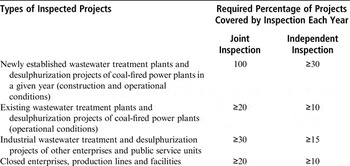
Routine inspections by the regional supervision centres take two forms: joint inspections with provincial EPBs and independent inspections. The joint inspection is supposed to be done at least once every six months, though some regional centres do them quarterly. The regional centres and provincial EPBs jointly schedule each inspection. Independent inspections can be announced to provincial EPBs or unannounced to local EPBs. Table 2 illustrates the types of projects inspected and the required coverage of joint and independent inspections.
Required Frequency of Routine Inspection of Pollution Reduction Projects by MEP's Regional Supervision Centres

Source:
“Verification Methods of Total Emission Reductions of Major Pollutants during the 11th Five-Year (Trial)” (issued on 16 August 2007).
The regional centres often conduct unannounced inspections to uncover the illegal discharge of pollutants and the non-operation of pollution treatment facilities. Since the regional supervision centres are defined as “public service units” (shiye danwei 事业单位), they cannot directly issue a penalty for a violation.Footnote 63 Instead, they can report confirmed violations to MEP, which in turn issues an official penalty, or they can pass along the information to provincial EPBs in their respective jurisdictions and require that the EPBs take action. In addition, the centres can use the number of violations uncovered to determine the value of a province's supervision factor which, as previously discussed, leads to an increase in its annual new emissions and to a decrease in its level of emission reductions accepted by MEP. This effectively cuts the reductions counted towards the achievement of provincial targets. The regional centres usually notify the provincial EPBs of the results after inspections.
Independent inspections might encounter resistance. This study found that regional centres often visited and inspected provinces on a monthly basis. A provincial EPB interviewee mentioned that the staff of the regional centre in the area travelled nearly two hundred work days on average annually during the 11th FYP period to inspect and verify reduction projects.Footnote 64 Many of those visits were not announced to the provincial EPB ahead of time, which was a cause for concern as a provincial EPB official during the 2015 visit recalled a case where the polluting firm refused to let the staff of a regional supervision centre into the factory because the factory guard did not recognize the centre's staff and received no acknowledgement after calling the provincial EPB.Footnote 65 This reveals the practical issues in conducting independent on-site investigations: without notifying local EPBs in advance, officials might not even be able to enter the sites.
The total emission control offices established within provincial, city and county EPBs have also carried out routine inspections of reduction projects and measures; the focus of the inspections was on their construction, operation, and maintenance. A provincial EPB claimed that it organized an inspection led by the provincial EPB director and vice-directors once every two months.Footnote 66 Another provincial EPB indicated that it carried out inspections on a monthly basis during the heyday of meeting the reduction targets.Footnote 67 Such inspections usually consisted of several teams, each team inspecting 30–40 projects. Occasionally, the provincial EPB also initiated joint inspections in collaboration with other government agencies, e.g. the Provincial Supervision Bureau, Housing and Urban-Rural Development Bureau, Statistical Bureau, and Development and Reform Committee.Footnote 68 Unlike the national verification and on-site inspections, provincial EPB inspections did not review documents or verify emission data. Again, the main motivation for the higher-tier EPBs to inspect lower-level entities was to uncover and resolve problems with reduction projects and to ensure the completion and proper operation of the projects before the national verification teams arrived. In other words, the provincial EPBs wanted to decrease the chance of having their reductions rejected by national verification.
City EPBs usually inspected the emission-reduction projects before and after the provincial inspection. They also organized regular inspections to examine the achievement of county reduction targets. The director of a city EPB's total emission control office told me that his office checked wastewater treatment plants once every ten days, inspected key polluting sources once a month, and released the inspection results to the counties in his jurisdiction once every two months.Footnote 69 All those efforts were intended to spot and solve problems and helped the lower-tier EPBs to complete their reduction tasks.
In addition to the inspections organized by local EPB total emission control offices, EPB environmental supervision stations (a subsidiary designated for on-site inspection) also inspect reduction projects as part of their routine work. Interestingly, the newly established EPB total emission control offices have developed their technical capacity for inspecting pollution control facilities and have been primarily in charge of the on-site inspections of those facilities. In fact, they claim that they have developed a higher technical capacity than the staff of environmental supervision stations.Footnote 70
The extensive on-site inspections of pollution reduction projects by central and local environmental authorities increased opportunities to catch violations and, to a certain degree, could have deterred polluting sources, thus enhancing target achievement. Many enterprises found they had been inspected by an environmental authority once every three to five days since 2008. The manager of a state-owned sugar plant claimed that in 2009 alone he had received COD- and SO2-related inspections twice a week on average, which was significantly more than the routine inspections he received before 2009.Footnote 71 He claimed that the frequent inspections since 2008 had effectively prevented the illegal discharge of pollutants, usually a result of the non-operation of pollution control facilities. In his view, frequent inspections, to a certain degree, had increased the probability that enterprises would be caught discharging illegally, and thus had forced them to comply with environmental requirements.
It is important to note that national and local inspections exclusively focused on specific reduction projects rather than on all polluting sources. Those projects generally included: wastewater treatment plants; small, heavy-polluting sources requiring to be shut down; pollution control facilities installed on key polluting sources (most likely state-owned enterprises); and large private companies. Numerous medium-sized and small firms in municipalities and counties were not included, which is indicative of the limited coverage of the national verification programme.
Outcomes and Challenges
The intensive national verification programme's exclusive focus on specific projects has left little room for local EPBs to overreport reductions; MEP and its regional centres have thus exerted significant discretionary power in the process and in determining the results. The growing frequency of on-site inspections has enhanced the probability that violations are caught, and thus might have enhanced compliance of enterprises included in the verification programme. It is worth noting that this compliance is still one-time in nature, meaning that a polluting source is defined as in compliance at the time it is inspected. Strictly and technically speaking, steady, continuous compliance would be 24 hours a day, 7 days a week, and 12 months a year. The sustained achievement of pollution reduction targets by nature demands steady and continuous compliance. As the previous discussion demonstrates, the top-down verification programme has not necessarily led to this type of compliance.
Another main outcome has been improved capacity in local monitoring and inspection. MEP has organized a number of national training workshops for the regional supervision centre and provincial EPB staff focusing primarily on the technical aspects of verification and supervision.Footnote 72 When there were seats available, some provincial EPBs asked MEP permission to bring EPB staff from their key cities. Many provincial EPBs also organized similar training workshops for the city and county EPB staff within their jurisdictions. Many interviewees mentioned that the technical capacity of EPB staff in charge of implementing the reduction targets had improved as a result of the intensive training and on-site supervision.Footnote 73 However, as Kostka cautioned,Footnote 74 technical training is still badly needed for the operators of pollution treatment plants and the CEMS installed at the facilities.Footnote 75
Both the central and local governments made a notable financial investment in building local capacity in environmental monitoring and inspection, with a focus on the purchase of monitoring instruments and vehicles as well as on staff training. A national expert mentioned that approximately 7 billion yuan had been allocated to local EPBs since 2006 for the 11th FYP period.Footnote 76 Wong and Karplus found that transfers to local governments earmarked for energy saving and environmental protection from the central government were 170 billion yuan, equal to 50 per cent of the total national budgetary expenditure in that category in 2013.Footnote 77 Moreover, starting in 2009, the central government permitted each province to use local environmental special funds (based on pollution levies collected) primarily for environmental monitoring and supervision. In recent years, the utilization of state-appropriated funds has usually required local matching funds. As a rule of thumb, the ratio of central to local funds was 1:1.5 for the eastern region during the 11th FYP, 1:1 for the central region, and 1:0.5 for the western region.Footnote 78 In reality, local matching funds provided by provinces varied greatly across the regions.
This financial support has allowed local EPBs to recruit additional staff and to cover the costs associated with implementing the reduction target system. A city environmental monitoring station received about 26 million yuan for improving its oceanic monitoring capacity in 2009 alone.Footnote 79 A provincial EPB was given six new official positions that were covered by government funding for the newly established total emission control office.Footnote 80 Some city EPBs were able to obtain three or four official positions for managing emission-reduction work. These increases in the number of official positions were significant, given the overall national policy of downsizing local bureaucracies.
Notwithstanding the positive effects the verification programme has had on reductions, some fundamental problems exist. One is that with the significant discretionary power exerted by MEP and its six regional centres, the programme appears to primarily target provincial EPBs and not the local governments as specified in the target responsibility system. This is well illustrated by the low acceptance rate of locally reported reductions. Again, many interviewees concluded from their experience that MEP had predetermined the amount of reductions that could be recognized in a given year; this was correlated to each province's annually allocated targets.Footnote 81 Since the verification teams could easily identify problems with the reduction projects (to a certain degree they had to), the percentage of self-reported reductions rejected by MEP was notably high across the regions.Footnote 82 During the 2010 field trip, it was widely believed that a rejection rate of 50 per cent in a given year was not uncommon for a locality (city or county); in some localities, the rejection rate was as high as 70 per cent.Footnote 83 A national expert believed that MEP had used the verification process to “offset the previous reduction bubbles,” i.e. the padded 2005 emission baselines.Footnote 84 As a result, the overreporting problem has been curtailed significantly, but the overall quality of emission data has not necessarily improved.
The discretionary power exerted by MEP is also evident in the inconsistent implementation of the verification process across regions. For example, some EPB interviewees mentioned that the reductions rejected in the previous year could be resubmitted for consideration and verification in the following year, while others complained that those reductions could not be resubmitted.Footnote 85 The interviewees in one region complained that MEP merely recognized the reductions generated from the enterprises that were already in compliance, while the interviewees in another region said MEP had accepted the reductions from many enterprises whose emissions exceeded the discharge standards.
The low acceptance rate raises an interesting question: why has MEP been so strict and selective in accepting emission reductions? The then-Director-General of MEP's TECD believed that MEP was truly concerned about the real effects of local reduction efforts and wanted to reduce data falsification, while the sophisticated accounting and verification methods had made it difficult for local EPBs to overreport the amount of reductions.Footnote 86 Several local EPB officials repeatedly complained that MEP had deliberately made it difficult for local governments to meet the targets.Footnote 87 Another probable explanation might be related to the target responsibility system, under which MEP is the implementing agency for the FYP reduction targets but is not held directly responsible for failure to meet the targets by the end of an FYP cycle.
Another main problem with the verification programme is a lack of external oversight. The only audit on the reduction target system that also included the energy-saving targets was conducted by the National Auditing Bureau.Footnote 88 In all, 18 provinces were selected for auditing from 2009 to 2010. The audit, which could take up to six months to complete in one province, covered every aspect of the target system involving all relevant agencies and organizations. So far, this has been the only systematic, third-party check on target achievement, but it is unclear if and how this might affect the verification performed by MEP and its regional centres, as national auditing of any kind is conducted discretely and the results have not been disclosed to the public. In this regard, the verification programme has remained largely an internal check of the environmental administrative system and has not involved meaningful external oversight and public participation.
The above-mentioned problems raise concerns about the sustainability of the verification programme and whether it could truly improve data quality in the long run. As the detailed verification methods and process presented in this study illustrate, the overreporting of emission reductions on paper has decreased, but steady, continuous compliance might not have been achieved. Local EPBs have come to realize that verification has largely become an internal check between MEP and lower-tier EPBs and that it is totally up to MEP to determine what reduction data are acceptable; there is already an indication that many localities have gradually developed coping strategies. The problem was openly acknowledged by the vice-minister of MEP as of 2015: “Data falsification still exists in many localities. Reliable data is the bottom line of environmental monitoring work. It cannot be touched. Environmental monitoring staff must treat monitoring data as if it were their lives.”Footnote 89
This is consistent with the finding that local officials have strategically chosen measures to meet targets on paper without substantial and continuous efforts to make deeper reductions.Footnote 90 The author's follow-up investigations in 2013 and 2015 also found indications that after nearly eight years of centrally-executed verification, provincial EPBs have developed coping strategies primarily aimed at generating desirable new emission and reduction data on paper. There has been increasing concern that verification has become essentially a “numbers game.” Ran in her study of the implementation gaps between central and local authorities argues that, “Despite the promotion of environmental protection into a hard target …, local cadres are politically incentivized to manipulate environmental statistics.”Footnote 91 Several EPB officials expressed similar opinions drawn from their own experiences with the verification programme.Footnote 92 In fact, the target responsibility system designed to hold local leaders accountable for meeting the targets, in this case primarily local EPB leaders, has itself become the cause of turning the verification programme into a numbers game, precisely the implementation problem the entire verification programme was originally designed to address.
Conclusions
China has long faced significant challenges in its environmental regulation and governance; a centralized approach of enforcement was proposed to address the problem of weak policy implementation. The verification programme established in 2007 to monitor and enforce the binding pollution reduction targets specified in the national FYPs provides a rare opportunity to observe the process and the effects of central enforcement of an environmental programme. The results are mixed.
This analysis reveals that the central environmental authority has exerted great, yet largely unchecked, discretionary power in verifying local emissions and in determining results. To a certain degree, the implementation of the programme increased the difficulty for localities to overreport emission reductions, enhanced local monitoring and enforcement capacity, and deterred violations among regulated parties; nevertheless, significant challenges remain. The process has been highly resource-intensive and appears to be largely a system of internal checks in the absence of meaningful external oversight. Over time, localities have learned to develop coping strategies without putting substantial effort into achieving steady, continuous compliance. The process has increasingly become a numbers game which indicates mutual distrust between MEP and EPBs; the target responsibility system designed to hold local leaders accountable for achieving targets might itself be the cause. These challenges suggest that central enforcement has arguably failed to achieve the original goal of improving data quality as a basis for assessing genuine progress toward achieving targets.
This study has important implications for the central–local relations debates in China. The debate about whether a centralized versus decentralized approach is more effective in implementing central policies is largely dependent upon the issues at hand. In the context of implementing mandatory pollution reduction targets, the goal of central enforcement was to curtail pervasive data falsification in order to ensure genuine progress towards meeting those targets. In practice, however, the central environmental authority has focused primarily on reducing overreporting and not on improving data quality which is the basis for assessing progress. Local EPBs have gradually developed strategies to cope with the discretionary power exercised by the central agency without making concerted efforts to generate accurate, reliable data. Poor data quality is thus still a significant issue today.
These findings also shed new light on the classical principal-agent model widely employed in the study of public bureaucracy. The central issue is the problem of principals not trusting their agents due to information asymmetry.Footnote 93 What is interesting in this study is that not only does the principal distrust the agent, the agent also distrusts the principal because of the unchecked discretionary power exercised by the principal in a non-democratic context. To the best of my knowledge, this has not been described and analysed in the related literature. This mutual distrust appears to be the crux of the problems presented in this article. Future research examining the dynamics of the principal–agent relationship should take this into account, and might reveal more constructive insights on public bureaucracy and policy implementation.
Acknowledgements
Natural Resource Defense Council and Sichuan University generously provided financial support for the first and follow-up field research respectively. The author thanks Benjamin van Rooij, Genia Kostka, Yuen Yuen Ang and Martin K. Dimitrov for useful and constructive suggestions on this article. The author wishes to thank the International Network of Environmental Compliance and Enforcement for granting permission to use the interview notes that had been used for a report prepared for the Network. Any errors remain exclusively those of the author.
Biographical note
Xuehua Zhang is professor of environmental policy at the Institute of New Energy and Low Carbon Technology of Sichuan University. Her area of research interests is environmental policymaking, enforcement and compliance, coordinated pollution control, agricultural sustainability, low carbon rural development, public participation and environmental legal institutions. She received her PhD from the Emmet Interdisciplinary Program in Environment and Resources at Stanford University.