A major issue with implementing education initiatives in remote Indigenous communities is their long-term sustainability. This is exacerbated by the high staff turnover, and experiencing difficulties in attracting and retaining high quality teachers (Lyons et al., Reference Lyons, Cooksey, Panizzon, Parnell and Pegg2006). While we acknowledge that many outside school factors contribute to these disadvantaged students being unsuccessful, quality learning is associated with quality teaching (Hattie, Reference Hattie2009; Smart, Sanson, Baxter, Edwards, & Hayes, Reference Smart, Sanson, Baxter, Edwards and Hayes2008). This article presents a case study of one school, Ischool, that has found a holistic approach to ensure successful education initiatives remain within their school as their teaching staff transfer in and out. This article focuses on exploring two aspects of the approach the school has adopted: power and authority, and the teaching of mathematics, a context in which we are presently working within the school community. RoleM (Representations, Oral Language and Engagement in Mathematics) is a 4-year longitudinal study. Ischool is one of our participating schools. With regard to mathematics, there is also strong evidence that an understanding of mathematics at an early age impacts on later mathematical achievement (Aubrey, Dahl, & Godfrey, Reference Aubrey, Dahl and Godfrey2006). Thus, building strong foundations for students from disadvantaged contexts is crucial. The particular focus of this article is to explore the leadership model used within the school and the processes that have been put in place within the classroom context that positively impact on the sustainability of educational initiatives. The approach incorporates a whole community perspective where the roles and responsibilities of staff are being shared, pedagogies reconceptualised, and teaching has become the responsibility of the whole school community.
Background
Providing a quality education that meets the needs of the Indigenous community in remote contexts is complex. Schools are often isolated and entrenched within Western models of operating that are understood by many Indigenous communities as inappropriate (Foley, Reference Foley2000). Who is given control over the learning and who is given the power to make decisions in remote schools has not always been extended to Indigenous stakeholders in their communities. In addition, inexperienced and/or culturally unprepared teachers and leaders often form the staff of these schools (Heslop, Reference Heslop, Beresford and Partington2011). For non-Indigenous members of the school who are culturally and pedagogically unprepared to deal with the multifaceted challenges that exist in remote communities, improving students’ learning outcomes remains a very difficult task.
For Indigenous staff, the prospect of reclaiming power and authority to make self-determining decisions that will positively impact on both their children's education and capacity building in their community, often remains unrealised (Battiste, Reference Battiste and Battiste2000; Foley, Reference Foley2000). In many instances, Indigenous people feel they have been left out of the educational process. While it is mandated that there be consultation with Indigenous stakeholders (MCEECDYA, 2011), this consultation is often unsatisfactory for all participants. This is not to say that celebrating cultural days, teaching cultural songs and dances and/or employing Indigenous staff are unimportant: they are. However, Torres Strait Island academic Nakata (Reference Nakata, Loos and Osanai1995) argues that these actions still do not give agency to Indigenous voices about how education should be for their children, and how it should be done in their communities (Nakata, Reference Nakata, Loos and Osanai1995). As he further points out:
Educational institutions, policies, research, pedagogies and curricula will continue unabated with conceptual images of people relegated within a marginalised space. That is, until the [Indigenous person] speaks with some understanding of the rudimentary strategies of power and knowledge relations, she/he will continue to be an ‘Indian’ seen from the decks of passing ships. (Nakata, Reference Nakata, Loos and Osanai1995, p. 56)
A way forward is to adopt a critical approach to education. Critical education theorists argue that when schools adopt a critical approach to education they are agreeing to a reconceptualisation and reconfiguration of Western notions of power and authority (Darder, Reference Darder1995; Gilmore & Smith, Reference Gilmore, Smith and McCarty2005; Giroux, Reference Giroux2001). A defining feature for schools adopting the approach is the empowerment of Indigenous staff and the community. This suggests that education needs to be taught in an environment that privileges the marginalised position of the Indigenous community and legitimises their own knowledge, which is commonly rendered as without agency (Gilmore & Smith, Reference Gilmore, Smith and McCarty2005). However, adopting a critical approach to leadership and teaching will only transform education in remote areas if power and authority is redistributed to include the community. This is more likely to occur if: (a) educators come out of their professional isolation and make authentic connections with the community within which they work (Giroux, Reference Giroux1983); (b) school-based education systems accommodate many of the values, beliefs and codes of behaviour that exist in Aboriginal society (Wyvill, Reference Wyvill1991); and (c) the values and beliefs practised in schools are linked to a notion of liberation, personal dignity, and shared authority and responsibility (Giroux, Reference Giroux1983).
The data presented in this article are part of a large 4-year longitudinal study, Representation, Oral Language and Engagement with Mathematics (RoleM), which aims to improve Australian Indigenous students’ numeracy outcomes within the first four years of schooling. This study follows a cohort of Australian Indigenous students from Preparatory and Year 1 students until their completion of Year 3 and Year 4. The larger study comprises eight schools scattered across Queensland, with student enrolment in seven of these consisting entirely of Australian Indigenous students. Five schools are classified as remote, with the remaining two situated in large metropolitan settings. Twenty-five teachers participated in the first year of the project, with 10 of these teachers having less than 4 years prior teaching experience. This particular article focuses on one of these schools, ISchool, a school considered to be one of the most disadvantaged schools in the state. Teachers and IEOs from Ischool participated in professional development activities three times a year. In addition, on-site visits to Ischool occurred five times a year. During these visits members of the RoleM team worked collaboratively with teachers and IEOs, implementing teaching activities aimed at engaging young Indigenous students in learning mathematics. In all, members of the RoleM team visited ISchool on five different occasions during the first year of RoleM. These visits were for periods of up to two days.
Theoretical Framework
The theoretical framework that guided this research into the changed concepts of leadership, power and authority structures in Ischool consisted of two differing perspectives: Weber's understanding of leadership, power and authority that has dominated Western style of leadership and management; and, an Indigenous understanding of leadership, power and authority. Both perspectives allow the research to be viewed through differing lenses, lenses that are not necessarily disjointed. The intention is not to privilege cultural differences or to promote a binary approach to the problem (McConaghy, Reference McConaghy2000), but to allow both perspectives to have a voice. The meaningful dialogue between non-Indigenous and Indigenous perspectives is referred to in the literature as two ways education, a mixing of Western and Indigenous knowledge (e.g., Pearson, Reference Pearson2011; Sarra, Reference Sarra2005). Sarra (Reference Sarra2005) refers to this as ‘Stronger Smarter’. ‘Strong’ emphasises that Indigenous people need to possess a strong and positive sense of their own Aboriginal identity. ‘Smart’ is articulated as quantifiable academic outcomes. Pearson (Reference Pearson2011, p. 56) refers to this as ‘bi-cultural capacity’; the quality of which is judged according to the extent in which a person can move between two cultures, non-Indigenous and Indigenous.
Power and Authority from a Western Perspective
A predominant Western perspective of organisational change is as an expression of authority, an outcome of the change of power (Rojas, Reference Rojas2010; Weber, Reference Weber, Gerth and Wright Mills1946). In this perspective bureaucracies, such as education systems, are subject to social pressures. Historically, a starting point is often Weber's definition of power: individuals, or groups, possess power when others obey their edicts. In this context, power is primarily characterised as a vertical system of authority based on formal organisational roles (Dunlap & Goldman, Reference Dunlap and Goldman1991). Weber in his seminal work on authority and leadership suggests that in general there are three types of leaders, namely traditional, rational-legal, and charismatic (Weber, Reference Weber1978; Henry, Reference Henry2007).
From Weber's perspective there are two paradigms in which leaders work: transactional and transformational. Both traditional leaders and bureaucratic leaders exhibit the characteristics of transactional leaders. They use their knowledge and legal authority to achieve results. Transformational leaders use their personal charm and charisma to assist them to achieve their goals (Weber, Reference Weber1978). Each type of leader expresses different types of authority.
Briefly, ‘traditional authority’ is legitimised by the sanctity of tradition, with the ability to rule being passed down. It does not change over time and often does not facilitate social change. The authority is consensual, and often not challenged by subordinate individuals (Weber, Reference Weber1978). ‘Rational-legal authority’ results from an invested belief in the legality of a well-developed standard set of rules and the authority that these rules have to issue command. This authority is often equated to a system of bureaucracy. Thus, authority extends to those by virtue of the position they hold, and once their position is lost so is their authority (Pace & Hemmings, Reference Pace and Hemmings2007). ‘Charismatic authority’, and control of others, is invested in the characteristics of the leader. If the leader has a vision that inspires others then his/her authority is judged to be charismatic. In this paradigm power is legitimised by the leader's personal qualities that are judged to be exceptional by his/her followers. In many instances these characteristics are perceived as being supernatural, that is, invested in this leader by a higher authority. Both those in traditional authority and rational-legal authority may in fact exhibit charismatic authority as well (Weber, Reference Weber1978; Pace & Hemmings, Reference Pace and Hemmings2007).
The next section uses Weber's authority types to explore models of leadership, authority and power within remote school contexts.
Using Weber's Model to Describe Typical Authority Within Indigenous School Contexts
The Leadership Team
The school leadership team in many remote schools consists of the principal, assistant principal and a curriculum advisor. All are usually non-Indigenous and transfer into the communities for periods ranging from one to five years (Heslop, Reference Heslop, Beresford and Partington2011). Some have had past experiences in other Indigenous communities and some view working in these communities as a ‘quick’ way of gaining a permanent position or promotion with the education system (Heslop, Reference Heslop, Beresford and Partington2011). In addition, their motivation to join these communities is primarily motivated by job availability and educational authority placement. Lyons, Cooksey, Panizzon, Parnell, and Pegg (Reference Lyons, Cooksey, Panizzon, Parnell and Pegg2006) found that male teachers were more generally motivated to move to rural and remote communities by financial and promotional considerations. In contrast, female teachers placed greater priority on family matters such as spouse employment. Given that the principal's power is closely aligned with his/her position within a highly bureaucratic system, their power is deemed to give them rational-legal authority. To a lesser extent other members of the leadership team also possess traditional authority gained from their role as assistant principal and curriculum advisor.
The Classroom Context
Given that schools are bureaucracies and teachers are an integral part of this structure, teachers are considered to exhibit rational-legal authority, but to a lesser extent as compared to members of the leadership team (Metz, Reference Metz1978). In the classroom their authority is closely aligned to traditional authority as a consequence of their role as a teacher. They expect students to obey them simply because they occupy the role of teacher (Metz, Reference Metz1978). While these ideal types of authority do not exist in their pure form, Metz (Reference Metz, Mitchell and Goertz1990) contests that because teachers’ performance in the classroom is often judged in terms of their ability to sustain order, this perceived judgment reinforces the need for traditional authority within the classroom context. In fact, teachers who adopt a more egalitarian approach incite student resistance, as many students feel that these teachers are not doing their job (Swidler, Reference Swidler1979).
In Indigenous communities, many classrooms are also supported by Indigenous Education Officers (IEOs), who within these contexts tend to have little power and authority. Our past research in other communities (Warren, Cooper, & Baturo, Reference Warren, Cooper, Baturo and Zadja2009) has evidenced that these teachers commonly believe that their role is to determine what the IEO does, and that the role of the IEOs is to provide administrative assistance to the teacher, assist with behavioural management, and provide individual tuition to at-risk students. These findings mirror Pace and Hemmings’ (2007) notion of bureaucratic teachers, ‘those who enact the role of boss in the workplace of the classroom’ (p. 7). In these contexts Indigenous education officers are considered subordinate.
Using Weber's Model to Describe Typical Authority within Community Contexts
We conjecture that within the Indigenous community context for the staff employed at the local school, there is a paradoxical shift in who has the power and authority and who does not. By contrast, within the context of Indigenous communities, the IEOs often have traditional authority given to them as a respected elder or they are seen as a respected community member. Teachers often have little authority within these communities. They commonly arrive without any prior experiences of working with Indigenous students and/or have had limited training in how to work in remote Indigenous communities (Hickling-Hudson & Ahlquist, Reference Hickling-Hudson and Ahlquist2003). Principals, while highly paid members of the non-Indigenous community, are still typically viewed as outsiders by Indigenous community members (Warren et al., Reference Warren, Cooper, Baturo and Zadja2009). Tables 1, 2 and 3 summarise the types of authority that exist in many of these contexts.
Authority Type Applied to the Leadership Team Within the School and Indigenous Contexts

Authority Type Applied to the non-Indigenous Teachers Within the School and Indigenous Contexts
Authority Type Applied to the Indigenous Education Officers Within the School and Indigenous Contexts
Power and Authority From an Indigenous Perspective
From an Indigenous perspective, leadership should reflect the culture in which it is situated (d'Arbon, Fasoli, Frawley, & Ober, Reference d'Arbon, Fasoli, Frawley and Ober2009). Indigenous culture is not a single homogenous entity. Aboriginal and Torres Strait Island Australians each have their own distinctive history and culture with distinctions again within each grouping (Dudgeon, Wright, Paradies, Garvey & Walker, Reference Dudgeon, Wright, Paradies, Garvey, Walker, Purdie and Walker2010). Many of the assumptions made about concepts of leadership implemented in Indigenous communities have evolved from using a single socio-cultural lens, a Western lens of leadership (d'Arbon et al., Reference d'Arbon, Fasoli, Frawley and Ober2009; Kumara, Reference Kumara2009). In addition, these assumptions have been based on parochial Western values and practices and implemented in remote Indigenous schools, ignoring the cultural context in which leadership is practised (Kumara, Reference Kumara2009).
Yet, cultural values shape people's perceptions of what constitutes a good leader, and cultural contexts shape how people approach ‘space, time, information and communication’ (Hallinger & Leithwood, Reference Hallinger and Leithwood1998, p. 108). Aboriginal philosopher Mary Graham (Reference Graham2012) argues that Aboriginal culture has been in existence for thousands of years with its own ‘logic, philosophy, values and notions of social development’ (p. 4). It is underpinned by the spiritual belief that everyone and everything is connected, interrelated and continues to inform collective consciousness of Indigenous people today.
In addition, the organising principle underpinning Aboriginal political and social structures is non-hierarchical and non-bureaucratic. Elders, for example, constitute a ‘soft hierarchy’ wherein they are respected as custodians of knowledge, and as such have authority to make some crucial decisions (Graham, Reference Graham2012). However, decision-making is not entirely the domain of the Elders. Decision-making in Indigenous communities is collective, inclusive and respects the equality of both men and women in ‘sharing power and authority in . . . conflict management, evaluating issues and solutions seeking’ (Graham, Reference Graham2012, p. 7). It is heavily influenced by their notion of kinship and all things being interrelated and connected. As such, there is a sense of responsibility for each other (d'Arbon et al., Reference d'Arbon, Fasoli, Frawley and Ober2009; Graham, Reference Graham2009, Reference Graham2012; Kumara, Reference Kumara2009). All perspectives from the community are respected, valued and heard, often leading to a longer decision-making process. This is an accepted way of doing things in communities, which have a long tradition of storytelling and yarning. It is an important element for maintaining harmony and unity, providing a sense of shared ownership and ensuring that the needs of the collective/group take precedence over the needs of the individual. Unlike many Western styles of management and leadership where communication flows from the top down, ‘power is diffused and not concentrated in small elites or in individuals’ (Graham, Reference Graham2012, p. 7).
Central to Indigenous leadership are the reciprocal relationships between the members of the community. Maintaining reciprocal relations arises out of relationships that are forged from shared spiritual, physical and emotional connections to country/place and language. It is where knowledge is passed down, protocols followed and a care for country and others are grounded. Graham (Reference Graham2012) puts forth that the notion of ‘Place’ is central to generating these meanings. However, she also argues that Place is not only confined to a geographic space, but to events in time. Relationships arise out of a shared history and knowing what strongly unites individuals and communities, and extends beyond traditional kinship groups (Dudgeon et al., Reference Dudgeon, Wright, Paradies, Garvey, Walker, Purdie and Walker2010; Graham, Reference Graham2012).
Thus, relationships are a critical component of effective leadership and need to be built on trust and reciprocity between the school and the community (d'Arbon et al., Reference d'Arbon, Fasoli, Frawley and Ober2009). For many Indigenous staff in schools, to separate themselves from their family and community responsibilities and commitments is to break the relationship. One of the problems that has existed in the Western model of leadership in Indigenous communities is to view the school as a separate entity from the community (Sergiovani, Reference Sergiovani2000). However, for power and authority to be given to leaders, they need to be supported and endorsed by the community. Mainstream appointments to executive leadership positions that are based upon experience, skills or academic merit have little import in these contexts.
Research Problem/Questions
The data presented in this paper are part of a large 4-year longitudinal study, Representation, Oral Language and Engagement with Mathematics (RoleM), which aims to improve Australian Indigenous students’ numeracy outcomes within the first 4 years of schooling. This study follows a cohort of Australian Indigenous students from Preparatory and Year 1 students until their completion of Year 3 and Year 4. The larger study comprises eight schools scattered across Queensland, with student enrolment in seven of these consisting entirely of Australian Indigenous students. Five schools are classified as remote, with the remaining two situated in large metropolitan settings. Twenty-five teachers participated in the first year of the project, with 10 of these teachers having less than 4 years prior teaching experience. This article focuses on one of these schools, ISchool, a school considered to be one of the most disadvantaged schools in the state. This article reports on the changes this school has made to ensure that the project remains sustainable in the long term. The particular aims of this article are to:
1. investigate the redistribution of power and authority in the school leadership structure; and
2. describe changed classroom structures that are perceived to support a critical pedagogy which enhances students’ mathematical learning.
Scenario of the Research Process
This research project encompasses many dimensions of an Indigenous perspective of research. Historically, Indigenous communities have found the research goals and findings problematic as they have supported the colonising power's agenda. However, qualitative research that builds on trusting relationships and validates the use of narrative and works towards group consensus may be more aligned with many Indigenous communities (Brayboy & Dehyle, Reference Brayboy and Dehyle2000). While some Indigenous scholars do believe that non-Indigenous scholars should not be conducting research involving communities, there are others who believe that it is permissible if it embraces respectful collaboration and is rooted in the principles of respect, equity and empowerment (Brayboy & Dehyle, Reference Brayboy and Dehyle2000; Smith, Reference Smith1999). Smith (Reference Smith1999) describes four models of research that outsider researchers have taken in an effort to become more culturally sensitive:
• Mentoring model — indigenous peoples are utilised as guides and sponsors.
• Adoption model — relationships are fostered that go beyond the scope of the research
• Power sharing model — community assistance is sought for support
• Empowering outcomes model — questions important to the community are addressed and tangible and beneficial outcomes are worked on.
This research project encompasses many of these dimensions. The change in the school structure and the implementation of the mathematics program began informally 2 years prior to the data collection. An invitation to participate in this community was instigated by an Australian Indigenous person who had formed close relationships in the community. The community requested support to enhance the mathematics outcomes for their children. The research is also grounded in an empowering outcomes model, with Indigenous and non-Indigenous personnel working together to achieve positive, tangible outcomes for the Indigenous students who attend the school.
Methodology
The broad philosophical stance taken for this study is interpretivism. Most qualitative research emerges from the interpretivist paradigm, which Denzin and Lincoln (2008) describe as a situated activity that places the researcher/observer in the world of those who are the object of his/her research interest who then attempts ‘to make sense of, or to interpret phenomena in terms of the meanings people bring to them’ (p. 4). Meaning is ‘unveiled’ through examining what Creswell (Reference Creswell2008) describes the ‘multiple dimensions of a problem or issue . . . in all of its complexity’ (p. 15). Interpretivist research is also viewed as a very effective approach ‘[for] obtaining culturally specific information about the values, opinions, behaviours, and social contexts of particular populations’ (Mack, Woodsong, MacQueen, Guest, & Namey, Reference Mack, Woodsong, MacQueen, Guest and Namey2005, p. 1).
The data was gathered through a research interview. A qualitative research interview is often described as ‘a conversation with a purpose’ (Smith, Flowers, & Larkin, Reference Smith, Flowers and Larkin2010, p. 57). While the ‘conversation’ that is generated is artificial, it still provides an interactive space that permits participants to use their own words to tell their own story. It is also efficacious in terms of collecting rich data to conduct several interviews over a period of time. Data were collected and analysed using qualitative methods. All interviews were audio-taped and transcribed.
This data was analysed using a grounded methodological approach. This form of analysis involves the evolution of themes as one continually scrutinises and categorises the qualitative data (Glaser & Strauss, Reference Glaser and Strauss1967). Open coding was used to break down the data into distinct units of meaning; an inductive approach that allows ideas and themes to emerge from the personal accounts of participants rather than imposing a predetermined theory (Clark, Reference Clarke2009). A fundamental feature of grounded theory is the application of the constant comparative method that involves comparing like with like, to look for emerging patterns and themes. This process facilitates the identification of concepts, that is, a progression from merely describing what is happening in the data to explaining the relationship between and across incidents. In this study, the constant comparative method involved examining various subsets of the initial data. Member checks occurred. The first and second author separately identified the categories from the transcripts and then agreed upon the prevalent themes that emerged.
To gain a greater understanding of the present school structures, key personnel who were active participants in the change process participated in a one-on-one interview. These interviews were conducted by the first author, a person known to the community. Before the interviews occurred, a well-respected Indigenous person who was responsible for instigating the discussion with regard to changing school structures, gave support for all the Indigenous participants to engage in the conversations. The participants of the sample included the non-Indigenous principal (L1), three Indigenous members of the leadership team (L2, L3, L4), two non-Indigenous teachers (T1, T2), and one IEO (IEO1) who worked with T1. The interviews were open-ended, allowing the interviewee to guide the direction of the conversation.
The validity of research corresponds to ‘the degree to which it is accepted as sound, legitimate and authoritative by people with an interest in research findings’ (Yardley, Reference Yardley2000, p. 235). While all interpretations can be viewed as an implicit claim of authority (Denzin & Lincoln, Reference Denzin and Lincoln1994), it is ‘an imperative’ from a practical use perspective that high quality research claims need ‘to be legitimated by criteria which are meaningful to those people for whose benefit the research was intended’ (Yardley, Reference Yardley2000, p. 219).
Results
Changed Leadership Structure
The first stage of introducing change at Ischool was a consensus from all participants (both Indigenous and non-Indigenous) that the present structure was not working. Each time a new principal commenced at the school, new community relationships needed to be formed. The bureaucratic paradigm of the principal and teacher possessing all the power and authority in the school walls was resulting in them holding the sole responsibility of forming strong community relationships. Thus, the school and community were continually engaged in a cyclical dance of beginning, establishing and cementing relationships. Even though the Indigenous staff in some instances had been employed for a substantial amount of time, they were not seen as catalysts for stability nor as being responsible for community relationships. As L1 shared:
Because of the transitional turnover of staff, non-Indigenous staff particularly, we have to remake those connections. Certainly these Indigenous people have these relationships, good relationships across the school [but we still keep starting all over again].
While in many school contexts the transition of staff from one school to another can often be difficult for both the teachers and students, in these communities it is even more problematic with some staff becoming overwhelmed and undermined by the experience. In addition, new members of staff are often inexperienced teachers whose prevalent concern as they begin their teaching careers is ‘behavioural management’, that is, establishing their power and authority in the context of the classroom. But these communities are calling on teachers to engage with new challenges and learning that are not prevalent in conventional mainstream classrooms, and to share their authority with the IEOs who are in their classrooms on a full-time basis. As L1 claims: ‘This place is unique . . . customs, and even language, there are a lot of barriers that are put up . . . you may become confronted by it and isolated.’
The current leadership team within Ischool comprises both Indigenous and non-Indigenous staff. While all of the Indigenous staff have been working at the school over an extended period of time (up to 19 years), it is only in the past 3 years that they feel that they have been treated as equals within the school. The data revealed the main dimensions that have brought about this change are:
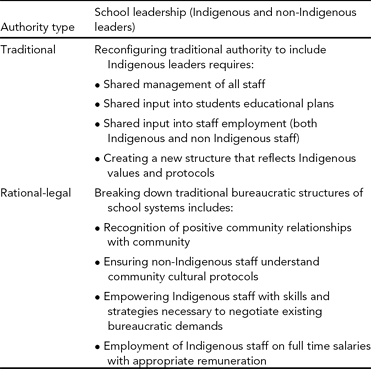
1. Taking on roles and responsibilities that give them greater power and authority in the school structure. L2 states: ‘The principal or assistant principal cannot make any decision about anything unless they pass it through us here all the time in the community. It works a lot better.’ Within this framework, their power has also been extended to include input into students’ educational plans, and to participate in important decisions on the part of the school, including participation in the employment of new staff. The school is governed by a school board comprising the leadership team, teachers, parents and IEOs who make decisions with regard to what the community wants, with the key premise of having positive and high expectations for everyone. Staff members are managed by both the principal and the Indigenous leadership team, with the former's foremost management role encompassing teachers and curriculum, and the latter being responsible for managing Indigenous staff and ensuring cultural protocols and information are made known to the school staff.
2. Being paid a just wage that reflects the ‘worth’ of their participation in the school structure. L3 shares: ‘[speaking about the past principal] she got us full-time positions, she actually said, you do a lot, without you this school would crumble . . . before, through the holidays, you'd go on parenting allowance and that was $150. . . . It was just day-to-day living.’
3. Recognising that positive community relationships are important and that working as a team and presenting to the community a united and collegial front that promotes the community is an important dimension of student learning. L1, L2 and L3 state: ‘Community relationships are very important. That is why we have our admin team- two non-Indigenous leaders and then we have three Indigenous leaders’ (L1); ‘You might have heard something out there in the community about something that is going on or that, and once they ask we will be able to explain it in a cultural way’ (L2); ‘[Before] they are just worried about are there too many white faces. I say forget about that white face, you come and sit and yarn with them. They are just like you sitting and talking to me. It's all the same’ (L3).
4. Recognising that true equity will not occur until all members of the leadership team have similar formal and informal qualifications. L4 shares: ‘If we can get that piece of paper to say we are eligible to teach our kids to their full potential to the best of our ability . . . trusting us to educate our kids.’ Taking this stance has its associated risks. As Indigenous people gain power and authority in a world that is not traditionally theirs and built on the premise of their own suppression, they put themselves at risk of not being accepted within their own culture. This choice requires a great deal of strength and maturity. L3 states: ‘[If you are qualified person] I have had it thrown in my face. . . . when you get up there they like to bring you down. That kind of thing doesn't worry me. I'm kinda strong there. I just turn around and say if I can do it, you can do it.’
Changed Classroom Practices
Discourse around critical pedagogy is not just about teachers acquiring the necessary knowledge, skills and resources required for effectively teaching disadvantaged students, but that it includes and legitimises the knowledge and wisdom held by the communities wherein Indigenous students exist (Darder, Reference Darder1995; Gilmore & Smith, Reference Gilmore, Smith and McCarty2005). Therefore, we argue that IEOs are a critical aspect of improving student learning as it is their knowledge of the learners also impacts on the learning environments. This has been addressed by three main strategies.
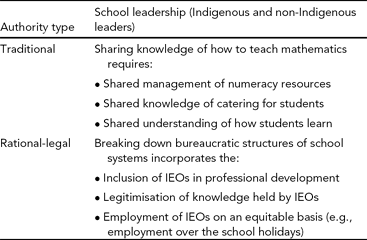
First, in the RoleM professional development program, Indigenous Education Officers are considered as equal partners in the learning process and, in fact, are crucial to its sustainability. Thus in the delivery of the professional learning, processes have been put in place that allow IEOs equal access to the knowledge many teachers use to exert their power and authority, namely, knowledge of and access to appropriate mathematical learning activities. IEOs are supplied with their own set of the materials, and also attend the professional learning days with the classroom teachers. T1 and her teacher IEO1 state:
T1: We got to sit together and talk about it, and they asked just as many questions as we did.
IEO1: I have more opportunity to teach. Kids feel comfortable with me around when they can't understand.
Second, the materials are written in a form that assists teachers and IEOs to understand the key ideas embedded in the activities and how to implement and extend the activities in the classroom. This is an important aspect of the program as it engages IEOs who have not often themselves experienced academic success in mathematics and therefore feel they do not have the knowledge or confidence to support student learning. TI and IEO1 share,
T1: They [the IEOs] feel comfortable using them . . . it really works.
IEO1: It opened my eyes to the different levels of Maths. I am more confident teaching it to the kids now.
Finally, IEOs play an active and specific role in the delivery of the materials at the classroom level. This predominantly is in terms of implementing an activity to a small group of students and discussing with the teacher what occurred during its implementation. An outcome of this strategy has been a ‘lifting’ of the conversations that occur between the teacher and IEO. Not only is the knowledge held by IEOs legitimised, but also knowledge and authority of student learning is being shared by both. T1 and IEO1 claim:
T1: There is a lot of conversation about what level the children are at and how the children went on the activities. They are able to innovate on the activity because now they have got those maths skills.
IEO1: I tell Miss to use different animals from the community, like the fish that the kids know. It's better when they know the animals.
All these points strongly suggest that an educational program will be sustainable if power and authority in the classroom continues to be shared. A consequence of these changing classroom practices has been the significant increase in confidence levels of IEOs. This has occurred in line with their participation in professional development opportunities and growing knowledge base of effective teaching and learning strategies. The benefits were clearly evident the following year when another teacher, T2, revealed her delight that the numeracy program was not interrupted just because she was away sick; IEO1 had carried it through.
T2: [IEO1] is really good . . . she is better than me at it . . . Her confidence has just booomed . . . I give her ownership of a lot of things. One time I had to go out and I had all the rotation things and the relief teacher came in and said ‘I suppose you won't be having rotations now’, and she [the IEO1] said, ‘No, everything is here’ and she supervised it and that teacher couldn't get over it.
Discussion and Conclusions
Reflecting on the Changed Structures
Through the reconfiguration of institutional conditions at ISchool, power and authority is now being effectively shared within a leadership style that is more inclusive of Indigenous culture, values, and knowledge. First, collective decision-making in Indigenous communities has always been an essential aspect for demonstrating respect of all opinions, and acknowledging the importance of the needs of the collective over those of the individual. By sharing power and authority with Indigenous staff, the top-down approach to management and communication, which has been strongly associated with individualism and Western styles of leadership, has become significantly less concentrated. Those in non-Indigenous leadership positions can make no decisions unless it has passed through those who are community representatives, in this case, Indigenous leaders in the school.
Second, the inclusion of Indigenous staff in the decision-making process at both a classroom and leadership level has ensured that a shared ownership and responsibility for developing a positive and holistic school culture is fostered. Community ownership and responsibility for the management of the school in the community is viewed by Indigenous leaders themselves as necessary for improving both the educational outcomes for their students, and the capacity building of their own Indigenous staff. Both have been significantly enhanced with the school and the community treated as interrelated and interconnected entities, rather than as separate entities to be individually dealt with. When problems arise with staff, students or parents, those in Indigenous leadership roles know that they have the power and authority to find culturally appropriate solutions that give dignity to their community. As L2 puts forth: ‘we know them, we know the families . . . [and they are] trusting us to educate our kids . . . to move beyond the social barriers that always stops Indigenous kids in their tracks’. Collective responsibility for the wellbeing of the collective is assured when Indigenous staff is empowered to make ‘right decisions for the school in general and how we think things should be run’.
It is important to note at this point that while Indigenous ways of operating in Ischool have become more prominent in the past 3 years, there are still bureaucratic demands that can be viewed as antithetical to the importance Indigenous people place on relationships and reciprocity. Bureaucracy is fairly perceived by both Indigenous and non-Indigenous staff as being an inflexible and impersonal system, necessary for satisfying the demands of deadlines and accountability, and for establishing compliancy. This attitude is not just confined to Indigenous people; reciprocal relationships cannot be made with a system, only with people. However, there is no escaping the fact that although ISchool is less bureaucratic in its approach to leadership, there are still bureaucratic demands that must be adhered to. For example, keeping assessment records, teacher certification, curriculum delivery, funding, salary and tenure, and a host of other matters are high on the administration agenda. Yet, the community accepts that bureaucracy is something they cannot ignore.
Building capacity in this Indigenous community entails providing Indigenous people with essential skills and knowledge to effectively negotiate those bureaucratic structures of Western education systems that often render them powerless. By doing so, Indigenous members of staff are no longer the ‘“Indian” seen from the decks of passing ships’ (Nakata, Reference Nakata, Loos and Osanai1995, p. 56). Instead, they are empowered to effectively work within and around the power and knowledge relations that exist within the system. We conjecture that it is this power and authority that will enable Indigenous education leaders to make decisions that will ultimately influence what education should be in their community and how it should be done. It is an important point that is not lost on the Indigenous leadership team. L2 strongly stated her desire to run the school in partnership with L3 and L4, and ‘to train our own people’ to take up administration and teaching positions in the school. Once again, the notion of shared ownership and collective responsibility underpins all Indigenous action in education systems. Learning to negotiate the bureaucratic organisation does not change that.
Reconfiguring Leadership Considering Both Perspectives
Weber's model (Reference Weber1978) presented a perspective on leadership where the power and authority is reflected in the assumed bureaucratic structures that exist in many Western contexts. While ISchool is not situated within such contexts, many members of its staff come from (and continue to come from) a Western way of thinking. The lessons learnt for Ischool assists in the reconceptualisation of Weber's model and allows us to begin to imbue it with an Indigenous perspective. Tables 4 and 5 provide a summary of the findings from this research, and represent an attempt to review Weber's work and reflect on the authority types and dimensions that being to assist in this transition.
Dimensions That Assist the Transition Within the School Context
Dimensions That Assist the Transition Within the Classroom Context
The models of leadership described in this research resonate with some aspects of the paradigm of shared leadership. While shared leadership in general is considered a tenuous concept, it is seen as enabling power sharing (Lambert, Reference Lambert2002), and this shared power has traditionally been located within the confines of formal educational structures. The literature on shared leadership also presents different perspectives on authority. The extreme stances are: (a) operating as a team and not ‘weighting’ contributions based on authority (Lightbody, Reference Lightbody2010), a leaderless group, and (b) sharing aspects of leadership but recognising that the onus of responsibility (and authority) rests with the principal (Wallace, Reference Wallace2001), especially within the confines of the school as an institution. Lacking from the literature of shared leadership is the element of ‘beyond the school’ and the link between school and community. The leadership team at Ischool certainly exhibits the five requirements for leadership delineated by Duignan and Bezzina (Reference Duignan and Bezzina2006), namely a shared vision or goal, shared responsibility for working as a group, being valued members, and effective communication in the group. In addition, it adds to these requirements by the inclusion of a cultural dimension and processes that allow sharing of power beyond the school, a requirement of shared authority within and without of the school. The inclusion of key Indigenous personnel within the leadership group and within the classroom context allows this to occur.
Implications
The implications of this case study are far reaching. Developing and implementing education initiatives where staff turnover is high and student attendance is low, is complex. ISchool begins to show a way forward. ISchool provides substantive evidence that supports a growing body of research that associates shared school leadership and its associated power and authority with improved learning outcomes for students. This claim is demonstrated by Ischools students’ significantly improved academic results after the first year of RoleM, when power and authority were a shared concern (Warren & Miller, Reference Warren and Miller2013). Sharing power and authority yields a school culture that (a) values working collaboratively to improve the quality teaching and learning; (b) privileges Indigenous knowledge; (c) promotes Indigenous advancement; and (d) provides positive Indigenous role models. Queensland's remote Indigenous schools are situated in isolated pockets. They are vastly different from those in urban and regional areas, as demonstrated in the differences in language and culture. Often isolationist in nature, teachers are seriously challenged when they are only pedagogically and culturally prepared to teach within the dominant Western education paradigm. Increasingly, however, Indigenous voices within the Ischool community are taking a more prominent role in being part of their students’ education. Sharing power and authority among school leaders combined with professional development models that facilitate the sharing of power and authority in the classroom are creating a new cultural and educational interface. It is within these changing structures that a ‘new generation of people working together in partnership in a new era towards a future that is unknown, but one that has improved outcomes for Tyikim [Indigenous] knowledge interests’ (Ford, as cited in Hewitson, 2005, p. 21).
Acknowledgments
The research reported in this paper was supported by Australian Research Council under grant LP100100154. The authors express their thanks to Eva deVries, participating teachers, Indigenous education officers, students and school communities for their generous support of this project.
About the Authors
Elizabeth Warren is a Professor in the Education Faculty at the Australian Catholic University. She is currently undertaking research in Indigenous schools throughout Queensland. For the past four years she has been the Director of RoleM (Representations, Oral Language and Engagement in Mathematics). RoleM has been specifically developed to assist all students from disadvantaged communities effectively engage in mathematics. The results have shown that young Indigenous students are capable learners and can effectively engage with school mathematics.
Janine Quine was formerly a teacher in the Middle Years who completed her Graduate Diploma of Arts in 2011, majoring in Studies of Religion. For the past three years she has worked as a research assistant to Professor Elizabeth Warren, travelling to regional and remote areas supporting early years teachers and Indigenous Aides to teach mathematics. Currently, she is a sessional lecturer for Indigenous education students, as well as providing tutorial support for education students in remote communities.