Introduction
What is the relationship between personal debt and mental health, in particular suicidal ideation? Three methodological approaches have been used to investigate this association: an examination of coroners' reports of suicides (Graham & Burvill, Reference Graham and Burvill1992; Yip et al. Reference Yip, Yang, Ip, Law and Watson2007); the collation of information from the case-notes of psychiatric in-patients who were admitted because of a suicide attempt (Hatcher, Reference Hatcher1994); and an analysis of debt and suicidal ideation from national surveys of psychiatric morbidity (Hintikka et al. Reference Hintikka, Kontula, Saarinen, Tanskanen, Koskela and Viinamäki1998). All three types of study indicate that indebtedness is a risk factor for suicidal ideation, and for both successful and unsuccessful suicide attempts.
Various factors have been put forward as increasing the risk of suicidal behaviour among those in debt: problem gambling (Yip et al. Reference Yip, Yang, Ip, Law and Watson2007), unemployment (Haider & Haider, 1992; Hintikka et al. Reference Hintikka, Kontula, Saarinen, Tanskanen, Koskela and Viinamäki1998; Yip et al. Reference Yip, Yang, Ip, Law and Watson2007), family or relationship problems (Graham & Burvill, Reference Graham and Burvill1992) and amount of debt (Haider & Haider, Reference Haider and Haider2002). Cox et al. (Reference Cox, Enns and Clara2004) argue that psychological individual differences such as level of self-criticism and hopelessness are just as valuable as sociodemographic characteristics and psychiatric diagnoses in understanding suicidality in the general population. In a study of suicidal ideation among income support participants in Australia, Butterworth et al. (Reference Butterworth, Fairweather, Anstey and Windsor2006) reported that those in receipt of such support showed higher levels of demoralization (hopelessness, worthlessness and dissatisfaction) compared with non-recipients, in addition to higher rates of suicidal ideation.
The aim of this paper was to establish the significance of any debt and particular sources of debt among the many correlates of suicidal thoughts, to quantify the effect of the multiple factors that interact with debt to increase the likelihood of suicidal ideation, and to examine the role of hopelessness in the relationship between debt and suicidal ideation.
Method
Sampling procedures
This analysis is based on a stratified multi-stage random probability sample, selected for the third national survey of psychiatric morbidity among adults in England carried out in 2007 (McManus et al. Reference McManus, Meltzer, Brugha, Bebbington and Jenkins2009).
In the first phase of sampling, postcode sectors (on average 2550 households) were stratified on the basis of a measure of socio-economic status within a regional breakdown. These postcode sectors, representing the primary sampling units, were divided into regions based on the Strategic Health Authorities (SHAs). All the primary sampling units within each SHA were then further stratified on the basis of the proportion of persons in non-manual classes and sorted by the proportion of households without a car based on 2001 Census data. Postal sectors were then sampled from each stratum with a probability proportional to size (where size is measured by the number of delivery points). In this way a total of 519 postal sectors were selected in England.
In the second stage of sampling, 28 delivery points were selected randomly within each of the selected postal sectors, yielding a total sample of 14 532 delivery points. Interviewers visited these addresses to identify private households containing at least one person aged ⩾16 years. Of the selected addresses, 9% (1318) were found not to contain private households, and were excluded from the sample. Within the potentially eligible sample of 12 694 addresses, one person was selected randomly in each household where contact was made to take part in the survey, using the Kish (Reference Kish1965) grid method. The residents of 57% of all eligible households agreed to take part in an interview: 7461 people.
Interviewers and interviewing procedures
Experienced interviewers from the National Centre for Social Research were selected to work on the survey, many of whom had worked previously on health-related surveys (Jenkins et al. Reference Jenkins, Meltzer, Bebbington, Brugha, Farrell, McManus and Singleton2009 b). They were fully briefed on the administration of the survey. Topics covered in the 1-day survey-specific training included: introducing the survey, the questionnaire content, confidentiality, and how to handle respondent distress. The fieldwork took place over the course of 1 year.
Statistical analysis
Survey data were analysed using SPSS version 16.0 (SPSS Inc., USA). Data were weighted to take account of non-response so that the results were representative of the household population aged ⩾16 years in England. Weighting occurred in three steps. First, sample weights were applied to take account of the different probabilities of selecting respondents in different-sized households. Second, to reduce household non-response bias, a household-level weight was calculated from a logistic regression model using interviewer observation and area-level variables (collected from Census 2001 data) available for responding and non-responding households. The model showed that the propensity for a household to respond was lower in the West Midlands, the East of England, London, the South East and the South West (relative to the North East), higher for households with no physical barriers to entry to the property and higher in areas with a relatively high percentage of households that were owner-occupied. The non-response weight for each household was calculated as the inverse of the probability of response estimated from the model, multiplied by the household's selection weight. Third, weights were applied using the techniques of calibration weighting based on age, sex and region to weight the data up to represent the structure of the national population, to take account of differential non-response between regions, and age-by-sex groups. The population control totals used were the Office for National Statistics (ONS) 2006 mid-year household population estimates.
To achieve a better understanding of the process of how debt can lead to increased likelihood of suicidal ideation, mediation analysis was carried out using the Sobel test as it is suitable for large samples (Preacher & Hayes, Reference Preacher and Hayes2004). The Sobel test determines the significance of the indirect effect of the mediator by testing the hypothesis of no difference between the total effect and the direct effect.
Instruments
Suicidal ideation
The question used to assess suicidal thoughts, based on the work of Paykel et al. (Reference Paykel, Myers, Lindenthal and Tanner1974) and Salmons & Harrington (Reference Salmons and Harrington1984), was: ‘Have you ever thought of taking your life, even though you would not actually do it?’ A positive response was followed up with a question on whether this last occurred in the past week, past year or longer ago.
Hopelessness
As part of the Depressive Ideas section of the revised Clinical Interview Schedule (Lewis et al. Reference Lewis, Pelosi, Araya and Dunn1992), survey respondents were asked: ‘Have you felt hopeless at all during the past seven days, for instance about your future?’
Debt
Survey respondents were asked: ‘Have there been times in the past year when you were seriously behind in paying within the time allowed for any of these items?’ The list of items included: rent, gas, electricity, water, goods bought on hire purchase, mortgage repayments, council tax, credit card payments, mail order payments, telephone, other loans, TV licence, road tax, social fund loan, child support or maintenance. Being behind in any of these payments was regarded as having a debt.
For analysis purposes the debts were grouped into three main categories: utilities, which comprised gas, electricity and water rates; housing-related debts, which included mortgage, rent and council tax; and shopping-related debt, which is made up of credit card, higher purchase and mail order debt. The remaining sources of debt were included in an ‘other’ category.
Personal, family and household characteristics
Information on gender, age and marital status of all household members was collected, and also the socio-economic circumstances of the household: educational level and employment status of the respondent and receipt of benefits.
Lifestyle behaviours
Using a computer-assisted self-interview (CASI), all survey respondents completed the Alcohol Use Disorders Identification Test (AUDIT; Saunders et al. Reference Saunders, Aasland, Babor, de la Fuente and Grant1993) and the Severity of Alcohol Dependence Questionnaire, community version (SAD-QC; Stockwell et al. Reference Stockwell, Sitharan, McGrath and Lang1994). For each of eight drug types (cannabis, amphetamines, crack, cocaine, ecstasy, tranquillizers, opiates and volatile substances), reported use in the past year was followed by five questions based on the Diagnostic Interview Schedule and designed to assess drug dependence. Ten questions based on the DSM-IV criteria for problem and pathological gambling were also included. The CASI was used as it tends to elicit more honest reporting than face-to-face questioning (Tourangeau et al. Reference Tourangeau, Rips and Rasinski2000).
Adverse experiences in the past 6 months
The questionnaire module entitled Stressful Life Events comprised questions about 18 events for which respondents had a chance to say whether they had never occurred, occurred in the past 6 months, further back but as an adult, or before the age of 16. The first set of questions referred to illness, injury, bereavement and relationship problems. The second set covered financial and employment problems and the third set consisted of types of victimization experienced.
Results
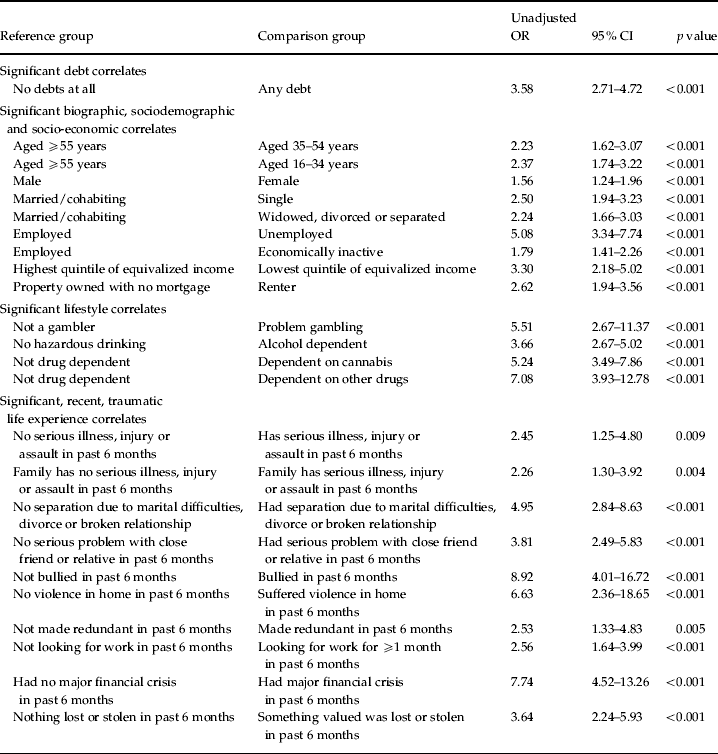
In England, 4.3% of adults had thought about taking their own life in the past 12 months, ranging from 1.8% of men aged ⩾55 years to 7.0% of women aged 35–54 years. In addition to being in debt, there were numerous biographical, sociodemographic, socio-economic factors and lifestyle behaviours that emerged from a univariate logistic regression analysis that increased the odds of suicidal ideation: younger age group, female, single or widowed, divorced or separated, unemployed or economically inactive, problems with gambling, and alcohol and drug dependence. Several stressful life events experienced in the past 6 months were also associated with an increased likelihood of suicidal thoughts: illness or injury to self or family, relationship problems or breakdown, or loss of employment, finances or valued possessions (Table 1).
Correlates (unadjusted odds ratios) of suicidal ideation in the past 12 months

OR, Odds ratio; CI, confidence interval.
Non-significant factors were ethnicity, educational qualifications, death of family member or friend, violence at work or court appearance in past 6 months.
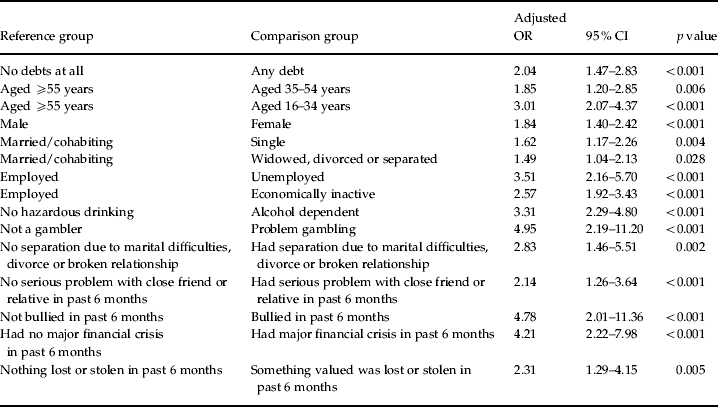
When all of these factors were entered into a multivariable logistic regression model, debt was still a significant correlate [odds ratio (OR) 2.04, 95% confidence interval (CI) 1.47–2.83, p<0.001], as were sex, age, marital status, employment status, alcohol and gambling, relationship break-ups or problems, being bullied, a financial crisis and something valuable lost or stolen (Table 2). The largest OR among the stressful life events was being bullied (OR 4.78, 95% CI 2.01–11.36, p<0.001), and among lifestyle behaviours, problem gambling (OR 4.95, 95% CI 2.19–11.20, p<0.001).
Correlates (adjusted odds ratios) of suicidal ideation in the past 12 months

OR, Odds ratio; CI, confidence interval.
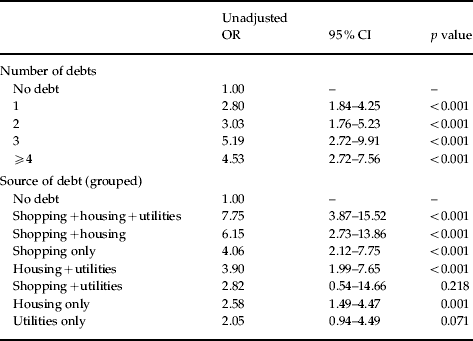
Table 3 shows that the number of debts and the sources of debt have differing associations with suicidal ideation. Focusing first on the 15 individual debt items, those with several debts were more likely to report suicidal ideation than respondents who had just one debt. Hence, the largest ORs were found for those with debts relating to all three main categories: shopping, housing and utilities (OR 7.75, 95% CI 3.87–15.52, p<0.001). Among those with just one category of debt, the largest OR was found in the shopping debt only group (OR 4.06, 95% CI 2.12–7.75, p<0.05).
Specific debt correlates of suicidal ideation in the past 12 months

OR, Odds ratio; CI, confidence interval.
Shopping=credit card, mail order and higher purchase.
Utilities=gas, electricity, water.
Housing=mortgage, rent, council tax.
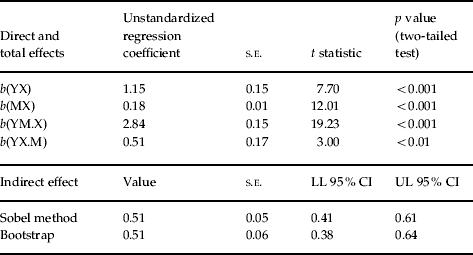
We proposed hopelessness as the mediating variable with debt in the past 12 months as the independent variable and suicidal thoughts as the outcome or dependent variable. In Table 4, b(YX) represents the total effect of debt on suicidal ideation and this was found to be significant (t=7.70, p<0.001). The row b(MX) shows the effect of debt on hopelessness and this is highly significant (t=12.01, p<0.001). The third row b(YM.X) shows, not unexpectedly, that hopelessness does have a marked effect on suicidal thoughts even after controlling for whether or not people are in debt (t=19.23, p<0.001). However, there is also a direct effect of debt on suicidal ideation b(YX.M) even after having controlled for hopelessness (t=3.00, p<0.01). The estimate of the indirect effect of debt on suicidal ideation through the mediator of hopelessness is 0.51 (95% CI 0.41–0.61, p<0.001), assuming a normal distribution. The bootstrapped estimate of the indirect effect not making this assumption is the same as the point estimate computed from the conventional regression analysis of the raw data: 0.51 (95% CI 0.38–0.64).
Effect of hopelessness on the relationship between debt and suicidal ideation

LL, Lower limit; UL, upper limit; CI, confidence interval; s.e., standard error.
X, independent variable (any debt in the past 12 months); Y, dependent variable (suicidal ideation in the past 12 months); M, mediating variable (feelings of hopelessness).
Discussion
The 12-month rate of suicidal ideation by age and sex among the population in England in 2007 has not changed markedly from when it was measured in 16- to 74-year-olds in 2000 (Singleton et al. Reference Singleton, Bumpstead, O'Brien, Lee and Meltzer2001). In men, the prevalence of suicidal thoughts was lowest in the elderly; this corresponds with the most recent suicide statistics for the UK, where men aged ⩾75 years have the lowest rates of suicide and men aged 15–44 years the highest (National Statistics Online, 2010). In women, the highest prevalence of suicidal thoughts occurs in the 35–54 years age band; this overlaps with the age band with the highest rate of suicide (45–74 years). It is noteworthy that these latest suicide statistics show an increase in suicide in 2008 (the first significant increase in 20 years) and that this occurs at a time of economic crisis and financial hardship.
The increased likelihood of suicidal ideation among particular sociodemographic groups (e.g. females, younger age groups, unemployed people) has also been reported in numerous studies (Paykel et al. Reference Paykel, Myers, Lindenthal and Tanner1974; Hintikka et al. Reference Hintikka, Kontula, Saarinen, Tanskanen, Koskela and Viinamäki1998; Thomas et al. Reference Thomas, Crawford, Meltzer and Lewis2002; Gunnell et al. Reference Gunnell, Harbord, Singleton, Jenkins and Lewis2004). The current study also confirms the finding by Jenkins et al. (Reference Jenkins, Bhugra, Bebbington, Brugha, Farrell, Coid, Fryers, Weich, Singleton and Meltzer2008) that debt and poverty (measured by equivalized income where adjustment is made for the ages, relationships and number of people in the household) should be considered separately as risk factors for mental health problems.
The large sample size achieved in the national survey, with the inclusion of numerous risk factors, enables us to hypothesize that unemployment, problem gambling, hazardous drinking, experiencing a financial crisis and having relationship breakdowns can contribute to debt, which in turn can increase the likelihood of suicidal ideation. Conversely, suicidal ideation may have been a contributory factor to losing one's job, problem gambling, drinking too much, experiencing a financial crisis or splitting up with a partner and hence getting into debt. With a cross-sectional study it is not possible to determine the direction of causality.
The strong association of debt and suicidal ideation fits in with the results from studies looking at the circumstances of those who had died by suicide. Yip et al. (Reference Yip, Yang, Ip, Law and Watson2007) found that, in Hong Kong, the source and severity of debt were key factors. Among the reported cases they found that gambling activity was among the main causes of debt accumulation and contributed to about 34% of the total. Business difficulties/failures (11%) and overconsumption of products and services (8%) were the other two important factors. The sources and degree of debt from this study may be particular to Hong Kong. Economic difficulty only contributed a small portion, although nearly half of all suicides occurred in the unemployed.
The contention that debt is more likely to evoke suicidal ideation among particular groups has been put forward by Nock et al. (Reference Nock, Borges, Bromet, Alonso, Angermeyer, Beautrais, Bruffaerts, Chiu, de Girolamo, Gluzman, de Graaf, Gureje, Haro, Huang, Karam, Kessler, Lepine, Levinson, Medina-Mora, Ono, Posada-Villa and Williams2008), who carried out an epidemiological review of risks for suicidal ideation. They concluded that most theoretical models of suicidal behaviour propose a diathesis–stress model in which psychiatric, psychological and biological factors predispose a person to suicidal behaviour, and stressful life events interact with such factors to increase risk. Consistent with such a model, suicidal behaviours are often preceded by stressful events. Debt can certainly be regarded as a continuous source of stress.
The role of hopelessness
Hopelessness is a psychological construct thought to underlie a variety of mental health disorders and there is a strong body of evidence linking hopelessness with suicidal ideation. Although hopelessness is one of the main factors mediating the relationship between depression and suicidal behaviour, it is independently associated with suicidal ideation (Beck et al. Reference Beck, Steer, Beck and Newman1993). In long-term follow-up studies of younger adult psychiatric in-patients, Beck et al. (Reference Beck, Brown, Berchick, Stewart and Steer1990) showed that significant hopelessness is associated with increased risk of eventual suicide. In the current study, although debt has a direct effect on suicidal ideation, there is also a strong indirect effect through hopelessness. This can be regarded as a partial mediation. Although a significant indirect effect supportive of mediation does not prove the pattern of causation, the inverse relationship that suicidal ideation increases the likelihood of debt through hopelessness, although plausible, is counter-intuitive. The mediating effect of hopelessness between debt and suicidal ideation fits in with the findings of Butterworth et al. (Reference Butterworth, Fairweather, Anstey and Windsor2006), who demonstrated a causal relationship between low income and hopelessness, and of Cox et al. (Reference Cox, Enns and Clara2004), who reported that hopelessness was robustly associated with suicidal ideation.
Humiliation, entrapment and hopelessness
The experiences of humiliation and entrapment following severely threatening situations have been shown to increase the risk of depression (Brown et al. Reference Brown, Harris and Hepworth1995). These experiences, in particular entrapment, may also be important in hopelessness; the stronger the perceived entrapment, the higher the level of hopelessness and hence the risk of suicidal ideation or behaviour (Williams & Pollack, Reference Williams, Pollack, Hawton and van Heeringen2000). Defaulting on credit card and hire purchase payments may lead to poor credit ratings and reduced opportunity for further loans, thereby increasing perceived entrapment. Whereas perceived entrapment may be important in understanding the increased odds of suicidal thoughts when in debt and being a problem gambler, humiliation may be the key factor underlying the increased odds of suicidal thoughts when being in debt and recently bullied.
Implications in the current economic crisis
We have shown that personal debt, unemployment and financial crisis are key correlates of suicidal ideation. Pirkis et al. (Reference Pirkis, Burgess and Dunt2000), in a population study in Australia, showed that unemployment was the only significant predictor of suicide ideators progressing to making a suicide attempt in a 12-month period. In addition, there is a well-established link between unemployment and suicide and self-harm (Platt & Hawton, Reference Platt, Hawton, Hawton and van Heeringen2000). The consequences of the current economic crisis may therefore have a serious impact upon the risk of suicide. Jenkins et al. (Reference Jenkins, Bebbington, Bhugra, Brugha, Farrell, Coid, Fryers, Singleton and Meltzer2009 a) argue that the mental health aspects of the public health impact of debt in the general population should be used to inform national policy and that agencies involved with giving loans and managing and recovering debts should be more aware of the mental health consequences of personal debt. Gunnell et al. (Reference Gunnell, Platt and Hawton2009) have also emphasized the importance of social policy measures to improve employment, adequate welfare benefits, and the role of community support agencies. Health-care organizations need to ensure that accessible advice and support is available for at-risk individuals and their families.
In summary, debt and particular sources of debt are key correlates of suicidal behaviour. The clinical implication of this is that the debt profile of individuals needs to be considered. Individuals experiencing difficulties in repaying their housing-related and shopping debts owing to having recently been made unemployed, or having had a relationship breakdown or coping with heavy caring responsibilities, may require psychiatric evaluation in addition to debt counselling.
Declaration of Interest
None.