Introduction
The Global Plan of Action for Animal Genetic Resources states that the wild relatives of domestic animal species require protection (FAO, 2007a). However, all analyses indicate that the conservation status of wild species continues to deteriorate (e.g. Vié, Hilton-Taylor and Stuart, Reference Vié, Hilton-Taylor and Stuart2008; CBD, 2010). It is, therefore, timely to report the current level of extinction risk facing the wild relatives of the main livestock species. This is important for two reasons: first to indicate that the concern over animal genetic resources should not be limited to rare breeds or varieties that have already been domesticated and second, to encourage a formal discussion on ways in which global efforts to conserve animal genetic resources and biodiversity may be harmonized.
Eight years ago, the parties to the Convention on Biological Diversity agreed to reduce the rate of biodiversity loss significantly (CBD, 2003). This is widely known as the 2010 target (see for example Fisher, Reference Fisher2009) and was subsequently included as a target contributing towards the United Nations Millennium Development Goal 7 “Environmental Sustainability” in view of the importance of biodiversity in sustainable development (UN, 2005). Nowhere is this relationship between biodiversity and humans more tangible than in the link between food security and the risk of species extinctions. This is because highly productive breeds of domesticated livestock have replaced local breeds in many parts of the world, leading to a growing concern that genetic resources that may prove vital for safeguarding future food supply are being eroded (FAO, Reference Rischkowsky and Pilling2007b). Such resources reside not only in local breeds, but also in wild relatives.
The “2010 target” of reducing the loss of biodiversity significantly has not been met (CBD, 2010: see also Butchart et al., Reference Butchart, Walpole, Collen, van Strien, Scharlemann, Almond, Baillie, Bomhard, Brown, Bruno, Carpenter, Carr, Chanson, Chenery, Csirke, Davidson, Dentener, Foster, Galli, Galloway, Genovesi, Gregory, Hockings, Kapos, Lamarque, Leverington, Loh, McGeoch, McRae, Minasyan, Morcillo, Oldfield, Pauly, Quader, Revenga, Sauer, Skolnik, Spear, Stanwell-Smith, Stuart, Symes, Tierney, Tyrrell, Vié and Watson2010) and this has led the United Nations Secretary General to call for a new vision for biological diversity for a healthy planet and a sustainable future for humankind. Safeguarding wild relatives of domesticated animals to ensure food security for future generations offers a clear and immediate option to start responding to this call. In order to start this discussion, I review the conservation status of the wild relatives of the five major livestock species and then use poultry to provide a more in-depth example of the conservation status of a group of wild relatives.
Conservation status of wild relatives
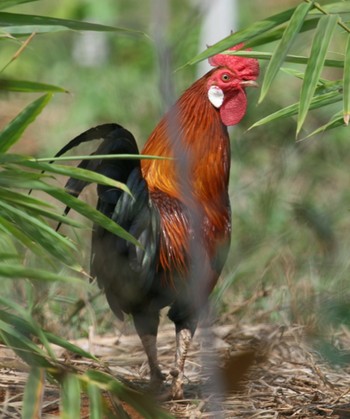
Five livestock animals (cattle, chicken, goat, pig and sheep) account for a significant proportion of the world's meat consumption. The conservation status of the world's wild species is monitored through the authoritative IUCN Red List (see IUCN, 2010). The last major analysis of the list revealed that of the 44 838 species assessed, 16 928 (38 percent) were considered to be threatened with extinction (Vié, Hilton-Taylor and Stuart, Reference Vié, Hilton-Taylor and Stuart2008). All the estimated 5 488 species of mammals have been assessed and at present 21 percent are threatened with extinction and of the 9 990 species of birds, 12 percent are at risk (Picture 1).
Red junglefowl Gallus gallus in Bu Gia Map National Park, Vietnam. Credit: Quang Nguyen Hao.

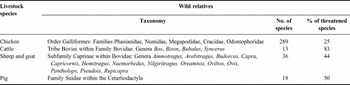
Considering the wild relatives of the five major livestock species, the number of extant wild relatives that are threatened with extinction varies from 44 to 83 percent for the four mammalian livestock species and 26 percent for the chicken (IUCN, 2010; Table 1). These are notably higher than the overall values for mammals (38 percent) and birds (12 percent).
Threat status of the wild relatives of five major livestock species.

Risk of extinction: the wild relatives of the chicken
The chicken has descended from the red junglefowl Gallus gallus, which is one of the most well known of the 50 species of the pheasant that, along with turkeys, partridges, grouse, peafowl, megapodes and cracids make up the Galliformes, an order that contains 289 bird species.
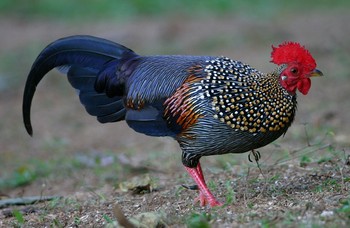
FAO (2009) estimates that there are nearly 17 billion chickens in the world: 2.5 for every person and more than four times the total number of individuals of the other “big five” livestock species (cattle, sheep, goat and pig). The production of poultry is rapidly intensifying and it is the fastest growing subsector in the livestock industry such that in 2007 it accounted for 26 percent of global meat supplies (FAO, 2009). Genetic advances are much faster in animals such as chickens that have short generation times and this has contributed to the commercial poultry industry pursuing technological improvements far more vigorously than other subsectors. All this means that genetic variation is being reduced as high yield strains increasingly dominate with both intensification and expansion of industrialized production (Picture 2).
Grey junglefowl Gallus (Gallus sonneratii) in India. Credit: Clement Francis.

At the same time, rural people are more likely to own poultry and small ruminants rather than larger livestock (FAO, 2009) and so the global distribution of resilient local breeds of poultry may be important in efforts to reduce food insecurity at a local level. Consequently, conserving wild relatives of chickens may serve to maintain and enhance food security at both global and local levels.
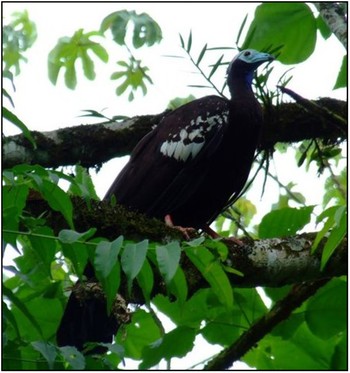
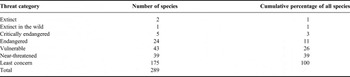
Therefore, it is of considerable concern that a higher proportion of wild relatives of the major livestock species are at risk of extinction than are all mammals and all birds. Analysing extinction risk in more detail for the chicken's wild relatives indicates that there appears to be an ongoing process of extinction: two species have already become extinct (since the baseline year of 1600), one is currently known only in captivity (i.e. considered extinct in the wild) and five are considered to be critically endangered, which means that they have a very high probability of extinction in a very short time period (IUCN, 2010; Table 2) (Picture 3).
Critically endangered Trinidad piping-guan Pipile pipile in the Northern Range, Trinidad. Credit: Kerrie Naranjit.

The pattern of threat in the wild relatives of the chicken (the Galliformes).

The reason for this high level of extinction risk appears to be overexploitation. While the majority of species are subject to some form of negative habitat change because of human activity, it is the degree to which Galliformes are thought to be hunted or their eggs collected that sets them apart. McGowan and Garson (Reference McGowan and Garson2002) reported that overexploitation was a problem for more than 90 percent of the threatened Galliformes because their relatively large size and ecology made them attractive to hunters. Many species also feature in rural traditions, such as feathers of the great argus pheasant Argusianus argus being used in headdresses of the Dyaks of Borneo and the Indian blue peafowl Pavo cristatus important to Hindus as the vehicle of the god Kartikeya, the son of Lord Shiva and Parvati.
Discussion
A higher proportion of wild relatives of the major livestock species are at risk of extinction than for all mammals and birds. Conserving these wild relatives was identified as important in the State of the world's animal genetic resources (FAO, Reference Rischkowsky and Pilling2007b). However, the high level of threat revealed here suggests that the need to pay attention to wild relatives is increasingly urgent.
Analysis of the risk of extinction faced by the wild relatives of the chicken indicates that two species have become extinct and several others are considered to be at high risk. Unless action is taken, it is to be expected that those species with a lower degree of risk will move into higher threat categories.
The year 2010 is the International Year of Biodiversity and with a suite of intergovernmental meetings taking place towards the end of the year, the opportunity must be seized to coordinate our responses with the loss of biodiversity and the reduction in variation that may prove vital for animal genetic resources in the future. Opportunities to develop this coordination include the United Nations high-level biodiversity discussion at the 65th sitting of its General Assembly in September, the 10th Meeting of Parties to the Convention of Biological Diversity in Nagoya, Japan and the 13th Regular Meeting of FAO's Commission on Genetic Resources for Food and Agriculture. Many of the necessary international commitments and agreements are in place that will allow near-term and longer-term targets and goals to be achieved, but there is a clear need for clearer links and stronger coordination.
Acknowledgements
I thank Beate Scherf and Paul Boettcher of the Animal Production & Health Division of the Food and Agriculture Organisation of the United Nations for discussing the relationship between livestock species and their wild relatives.
Statement of interest
The author is Director of an international organization that is dedicated to the conservation of the Galliformes.