INTRODUCTION
Until recently, due to their morphological similarity, it was thought that the genus Macrodon in the south-western Atlantic was composed of a single species (Casatti & Menezes et al., Reference Casatti, Menezes, Menezes, Buckup, Figueiredo and Moura2003). However, recent studies by Santos et al. (Reference Santos, Hrbek, Farias, Schneider and Sampaio2006) and Carvalho-Filho et al. (Reference Carvalho-Filho, Santos and Sampaio2010) found genetic and morphological evidence, respectively, that suggested two distinct species: M. ancylodon (Bloch & Schneider, 1801), which occurs from Venezuela to Bahia State (Brazil) and M. atricauda (Günther, 1880), which occurs from Espírito Santo State (Brazil) to northern Argentina.
Macrodon atricauda (local names include pescadinha, pescada-foguete and pescadinha real) is a commercial species for which the fisheries biology is relatively well known (Yamaguti, Reference Yamaguti1967, Reference Yamaguti1968; Haimovici, Reference Haimovici1998). It is exploited in an industrial trawl fishery in the coastal waters of southern and south-eastern Brazil. Its otoliths are used for ageing the species, since they show alternate opaque and translucent bands, which are evident in both whole and sliced otoliths (Yamaguti & Santos, Reference Yamaguti and Santos1966; Haimovici, Reference Haimovici1988; Cardoso & Haimovici, Reference Cardoso and Haimovici2011). Macrodon ancylodon (local name pescada-gó) also sustains fishing in Pará State (Isaac et al., Reference Isaac, Santo, Bentes, Frédou, Mourão and Frédou2009). Although some aspects of its life cycle have been studied (Camargo & Isaac, Reference Camargo and Isaac2005), its ageing was not consistent when sectioned otoliths were used.
Macrodon ancylodon and M. atricauda are morphologically very similar, although they are genetically distinct (Santos et al., 2006). Reported morphological differences are subtle: the size of the largest canine teeth, the number of soft rays in the fins and the number of lateral line scales with pores (Carvalho-Filho et al., Reference Carvalho-Filho, Santos and Sampaio2010). Otolith shape can also be a species-specific (see examples quoted in Campana & Casselman, Reference Campana and Casselman1993) and has been used to discriminate marine fish species (Härkönen, Reference Härkönen1986; Malcom et al., Reference Malcom, Watson and Heccht1995). The present study investigated the possibility of using the shape of the otoliths as a diagnostic taxonomic character. Our secondary goal was to analyse the suitability of M. ancylodon otoliths for ageing.
MATERIALS AND METHODS
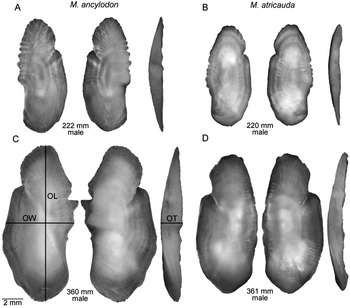
The sagittal otoliths of 44 specimens were examined, including 22 that were collected from artisanal fisheries in Bragança, Pará (00°51′S), in northern Brazil and 22 that were collected from commercial landings in Rio Grande, Rio Grande do Sul (32°12′S) in southern Brazil (Table 1). Total length (TL) was measured between the beginning of the snout and the end of the tail. Otolith weight (OW, g), length (OL, mm), width (OW) and thickness (OT) were measured for comparisons, as shown in Figure 1.
Inner surface (left), outer surface (middle) and dorsal view (right) of the left otoliths of male specimens of Macrodon ancylodon (A) length (L) 222 mm, weight (W) 89 g and of M. atricauda (B) L 220 mm, W 89.3 g; the same images of the right otoliths of male specimens of M. ancylodon (C) L 360 mm, W 372.5 g and M. atricauda (D) L 361 mm, W 384 g. OL, otolith length; OW, otolith width; OT, otolith thickness.

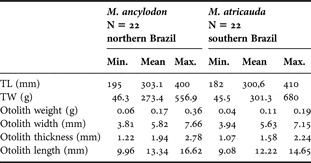
Total length (TL), total weight (TW) and otolith measurements of Macrodon ancylodon and M. atricauda used in growth and shape comparisons.

Min., minimum; Max., maximum.
The right otoliths were sectioned through the nucleus with a Buehler® Isomet® low-speed saw with a high concentration diamond blade, as described by Cardoso & Haimovici (Reference Cardoso and Haimovici2011), and the annual growth rings were identified when viewed.
A discriminant function analysis (DFA) was performed with the measures on otoliths (OL, OW, OT) expressed as ratios of total length of fish, and the weight of the otoliths, as ratios of total weight. Multidimensional scaling (MDS: Clarke & Warwick, Reference Clarke and Warwick2001) was used to visually discriminate the otoliths of each species.
Changes in the shape of the otoliths with growth of both species were analysed through the linear regressions between total length and the length (OL), width (OW) and weight (OW, g) of the otoliths. These regressions were compared with a covariance analysis (Zar, Reference Zar1996), using both species as covariate.
RESULTS
The specimens from northern Brazil measured 195–400 mm and the specimens from southern Brazil measured 182–410 mm (Table 1).
Otolith descriptions: the inner surface of the otoliths of both species are slightly convex; the sulcus, which ranges along most of the inner surface, is open at the anterior end. The ostium is large and rectangular in shape; the tail is deep and curved ventrally with a rounded tip. The dorsal crista is well developed in the central portion of the larger specimens and margins are lobullated in specimens which are smaller than 250 to 300 mm TL. The outer surface was slightly concave in M. atricauda and straighter in M. ancylodon. Lobullation of the dorsal-anterior margin was more pronounced in M. ancylodon.
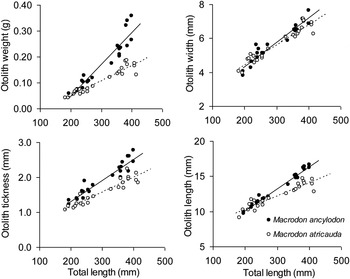
Otoliths in the larger specimens (>300 mm) of Macrodon atricauda were smaller (OL average of 3.7% of TL) and thinner (OL 1.7% of TL) than those of M. ancylodon (OL 4.2% of TL).
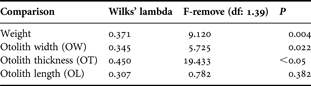
Wilks' lambda and F-remove discrimination coefficients showed that the otoliths of M. ancylodon and M. atricauda were significantly different regarding their weight, width and thickness, while no significant differences were observed in their length (Table 2). The classification matrix of the DFA classified 90.9% of the northern Macrodon otoliths and 100% of the southern Macrodon otoliths accurately.
Wilks' lambda, F-remove scores and probability of the null hypothesis of differences among the otoliths of Macrodon ancylodon and M. atricauda.

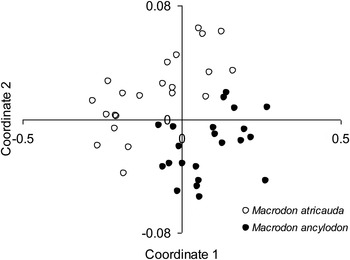
A MDS showed a clear separation between the northern and the southern Macrodon otoliths in two main coordinates (Figure 2).
Otoliths of Macrodon atricauda (○) and M. ancylodon (•) ordered through an analysis of multidimensional scaling on the basis of the otolith weight, otolith width, otolith thickness and otolith length.

Otoliths of M. ancylodon grew significantly more in weight (P < 0.01), length (P < 0.01), width (P = 0.04) and thickness (P < 0.01) than those of M. atricauda (Figure 3). However, differences among specimens less than 250 mm were not so evident, as shown in Figure 1A, B.
Relationship among otolith weight (g), width, thickness and length (mm) and the individuals' total length (mm).

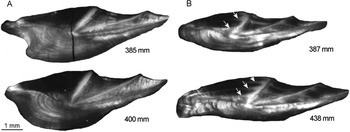
The 22 specimens of M. atricauda from southern Brazil had between one and three alternate opaque bands that were easily observed in the sectioned otoliths (Figure 4B). In contrast, the sectioned otoliths of the 22 M. ancylodon specimens did not show alternation of opaque and translucent bands that could be associated with age (Figure 4A).
Thin sections of right otoliths of two females of Macrodon ancylodon (A) and two females of M. atricauda (B). White arrows indicate the identified annual growth rings.

DISCUSSION
The otoliths of both species grow at different rates: those of Macrodon ancylodon become heavier, wider and thicker than the otoliths of M. atricauda at increasing total length. Differences were more conspicuous in larger specimens (>300 mm), and more subtle in the smaller ones. Although the otoliths of the smaller specimens were more difficult to differentiate by morphometry, the larger concavity of the outer surface and the less pronounced lobullation of the dorsal anterior margin differentiated the otoliths of M. atricauda from those of M. ancylodon.
The sectioned otoliths of M. ancylodon did not show annual rings comparable to those of M. atricauda from southern Brazil. Annual band formation has been traditionally associated with seasonal environmental rhythms and with significant ontogenetic events, such as feeding and reproduction (Green et al., Reference Green, Mapstone, Carlos, Begg, Green, Mapstone, Carlos and Begg2009). Both species have a defined seasonal reproductive cycle (Juras & Yamaguti, Reference Juras and Yamaguti1989; Militelli & Macchi, Reference Militelli and Macchi2004; Camargo & Isaac, Reference Camargo and Isaac2005), which, apparently, does not result in the formation of alternate annual bands on the M. ancylodon otoliths. However, annual temperature fluctuations are very different in the environments of both species: about 10°C in the coastal waters of southern Brazil (Haimovici et al., Reference Haimovici, Castello, Vooren, Seeliger, Odebrecht and Castello1997) and only about 2°C in northern Brazil (Camargo & Isaac, Reference Camargo and Isaac2005). The lack of strong cyclic environmental differences appears to be the explanation for the absence of growth increments in the otoliths of M. ancylodon.
Differences in otolith shape strongly corroborated both genetic and morphological differentiation previously reported and are additional evidence that support the existence of two species of the genus Macrodon: M. ancylodon on the north and M. atricauda on the south of the Atlantic coast in South America.
ACKNOWLEDGEMENTS
L.G.C. was granted a scholarship by the Brazilian Research Council (CNPq) and M.H. was funded by CNPq.