Introduction
The diagnosis of cancer can have a profound impact on a patient's psychosocial state. It is well established that the prevalence of depression is higher among patients with cancer compared to the general population.Reference Waraich, Goldner, Somers and Hsu 1 , Reference Krebber, Buffart, Kleijn, Riepma, De Bree and Leemans 2 Head and neck cancer patients have an even higher rate of depression, ranging from 15 to 54 per cent,Reference Neilson, Pollard, Boonzaier, Corry, Castle and Mead 3 – Reference Barber, Dergousoff, Nesbitt, Mitchell, Harris and O'Connell 5 than non-head and neck cancer patients, ranging from 8 to 24 per cent.Reference Krebber, Buffart, Kleijn, Riepma, De Bree and Leemans 2 The unique ways in which head and neck cancer can interfere with basic human function and challenge the patient's ability to participate in activities so essential to the human experience, such as eating, speaking and breathing, help to explain these higher rates of depression. Beyond negatively impacting quality of life,Reference Kim, Roh, Lee, Lee, Kim and Choi 6 depression in patients with head and neck cancer has been shown to adversely affect length of hospital stays, adherence to treatment and self-care abilities.Reference Hammerlid, Silander, Hörnestam and Sullivan 7 – Reference Beck and Koenig 9 Furthermore, higher suicide rates have been observed relative to the general population, and the rates are among the highest of all populations with medical illnesses.Reference Yu, Mehta, Branovan, Huang and Schantz 10 Recent analyses, both prospective and systematic reviews, have demonstrated that depression decreases overall survival in patients with head and neck cancer.Reference Kim, Roh, Lee, Lee, Kim and Choi 6 , Reference Barber, Dergousoff, Slater, Harris, O'Connell and El-Hakim 11
Despite the high prevalence and important consequences of depression in patients with cancer, several studies have demonstrated that depression is under-diagnosed and under-treated in these populations.Reference Newport and Nemeroff 12 Many barriers to diagnosis have been recognised, including lack of time in a busy oncological setting, inadequate competence in diagnosing and treating depression, lack of specialised training in the specific psychological needs of this patient population, the overlap of depression with somatic symptoms of cancer, and patient reluctance to discuss psychosocial wellbeing.Reference Newport and Nemeroff 12 , Reference Söllner, DeVries, Steixner, Lukas, Sprinzl and Rumpold 13 To address these barriers, comprehensive cancer centres have introduced the use of self-report instruments, which have been validated as effective tools for the universal screening of depression in the cancer population.Reference Krebber, Buffart, Kleijn, Riepma, De Bree and Leemans 2 , Reference Vodermaier, Linden and Siu 14
In the general population, risk factors for developing depression include female sex, marital divorce, unemployment, family history, traumatic life events and chronic medical illness.Reference Hirschfeld, Weissman, Davis, Charney, Coyle and Nemeroff 15 In head and neck cancer specifically, risk factors include female sex, living alone and current tobacco use.Reference Katz, Irish, Devins, Rodin and Gullane 16 , Reference Haisfield-Wolfe, McGuire, Soeken, Geiger-Brown and De Forge 17 It is unknown whether human papillomavirus (HPV) associated oropharyngeal cancer affects the risk for depression. Human papillomavirus associated oropharyngeal cancer has a unique profile with regard to demographic and clinical factors. These patients are more likely than HPV-negative oropharyngeal cancer patients to be male, white and of a younger age, and less likely to use tobacco or alcohol.Reference Gillison, D'Souza, Westra, Sugar, Xiao and Begum 18 Additionally, patient worries regarding the sexual transmission of HPV, the latency of infection and their partner's risk, among other issues, have been postulated to be specific to HPV-associated oropharyngeal cancer.Reference Baxi, Shuman, Corner, Shuk, Sherman and Elkin 19
Although HPV-associated oropharyngeal cancer has a distinct profile and patient concerns, whether this population has a different risk of depression has not been explored. This study aimed to investigate the primary hypothesis that clinico-demographic, social or oropharyngeal cancer disease characteristics, including HPV tumour status, affect a patient's risk for screening positive for depression on a self-report instrument.
Materials and methods
Patient selection
Patients who were diagnosed with oropharyngeal cancer between October 2011 and September 2014, and who completed the 10-item Center for Epidemiologic Studies Depression Scale (‘CES-D 10’), a self-report instrument, before receiving treatment for their disease at Johns Hopkins Head and Neck Surgery at Greater Baltimore Medical Center, were eligible for this study. All patients are requested to complete the survey as part of the clinic check-in process. Patients aged less than 18 years or those with histological diagnoses other than squamous cell carcinoma were excluded from this analysis. This was a single institution retrospective review, which was approved by the hospital institutional review board.
Clinical data
The retrospective abstraction of eligible patients’ medical records was performed. Clinico-demographic variables of interest at the time of diagnosis included: age, gender, race, major co-morbidities (history of stroke, coronary artery disease, diabetes mellitus, other cancer, chronic hepatitis, chronic obstructive pulmonary disease, heart failure, liver failure, chronic kidney disease, rheumatoid arthritis, sarcoidosis or Crohn's disease), number of prescribed medications, use of antidepressants, and whether the patient was being treated for primary or recurrent disease. Social variables of interest included: tobacco use, alcohol use, marital status and employment status. Histopathological variables of interest included HPV tumour status, and tumour–node–metastasis (TNM) classifications and overall stage as defined by the American Joint Committee on Cancer.Reference Edge, Byrd, Compton, Fritz, Greene, Trotti, Edge, Byrd, Compton, Fritz, Greene and Trotti 20
Human papillomavirus tumour status
Human papillomavirus tumour status was determined by HPV in situ hybridisation or p16 immunohistochemistry (an established surrogate marker for HPV in oropharyngeal cancer), as clinically available.Reference Begum, Gillison, Ansari-Lari, Shah and Westra 21 Human papillomavirus tumour status was routinely evaluated for all oropharyngeal cancer cases, in keeping with clinical care.
Depression screening instrument
As part of routine clinic workflow, all patients are asked to complete the Center for Epidemiologic Studies Depression Scale, a 10-item self-report questionnaire developed to screen for depression symptoms experienced in the previous week. This questionnaire is a shorter version of the full 20-item (‘CES-D’) and revised (‘CESD-R’) Center for Epidemiologic Studies Depression Scales.Reference Eaton, Muntaner, Smith, Tien, Ybarra and Maruish 22 , Reference Irwin, Artin and Oxman 23 Each item is scored on a Likert-type scale from 0 to 3, indicating how frequently in the previous week the patient experienced each symptom. For example, for ‘I felt fearful’, a score of 0 represents rarely (less than 1 day), 1 represents sometimes (1–2 days), 2 represents occasionally (3–4 days) and 3 represents all of the time (5–7 days). A cut-off score of 10 constitutes a positive screening result.Reference Bjorgvinsson, Kertz, Bigda-Peyton, McCoy and Aderka 24 , Reference Andresen, Malmgren, Carter and Patrick 25 The 10 questions on the survey are as follows: (1) I was bothered by things that usually don't bother me; (2) I had trouble keeping my mind on what I was doing; (3) I felt depressed; (4) I felt that everything I did was an effort; (5) I felt hopeful about the future; (6) I felt fearful; (7) My sleep was restless; (8) I was happy; (9) I felt lonely; and (10) I could not ‘get going’.
Analysis and statistical methods
Descriptive statistics were reported in terms of numbers and frequencies for categorical variables, and medians and ranges for continuous variables. Chi-square tests were used for categorical data and Mann–Whitney tests were used for the comparison of medians. Simple logistic regression was performed to analyse relationships between clinico-demographic, social or histopathological variables and Center for Epidemiologic Studies Depression Scale responses (using a cut-off value of 10 for positive screening), and findings were reported as odds ratios and 95 per cent confidence intervals. A similar analysis was performed to evaluate associations between variables of interest and responses to individual Center for Epidemiologic Studies Depression Scale items, comparing item scores of 0 or 1 to item scores of 2 or 3, in order to investigate the internal consistency of the screening tool. Two-sided p-values of less than 0.05 were considered statistically significant. Data analysis was performed using Microsoft Excel®, 2010.
Results
Study population
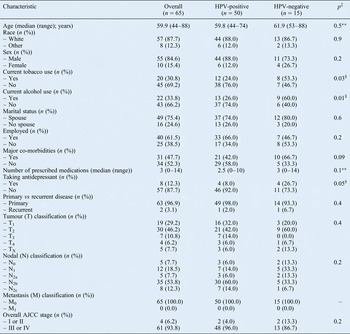
The clinico-demographic, social and histopathological characteristics of the study population are summarised by HPV tumour status in Table I. In total, there were 65 patients with known HPV tumour status who were eligible for analysis. The majority of patients were HPV-positive (n = 50, 76.9 per cent). Median age was 59.9 years (range, 44–88 years). Overall, this population was mostly white (n = 57, 87.7 per cent), male (n = 55, 84.6 per cent) and married (n = 49, 75.4 per cent), with advanced American Joint Committee on Cancer stage (III or IV, n = 61, 93.8 per cent). Most patients (n = 57, 87.7 per cent) were not taking antidepressants, and nearly all (n = 63, 96.9 per cent) were being treated for primary malignancy rather than for recurrent disease. Patients with HPV-associated oropharyngeal cancer were less likely to use tobacco (p = 0.03) or alcohol (p = 0.01) at the time of diagnosis than patients with HPV-negative oropharyngeal cancer. A lower proportion of HPV-associated oropharyngeal cancer patients than HPV-negative oropharyngeal cancer patients reported using antidepressants (8 vs 27 per cent, p = 0.05).

* Excluding four cases with an unknown human papillomavirus (HPV) tumour status.
† Human papillomavirus tumour status determined by p16 immunohistochemistry and/or HPV16 in situ hybridisation.
‡ Determined using the chi-square test, unless otherwise indicated.
** Determined using the Mann–Whitney test.
§ Indicates statistical significance (p < 0.05). SCC = squamous cell carcinoma; HPV = human papillomavirus; AJCC = American Joint Committee on Cancer
Patient characteristics and depression
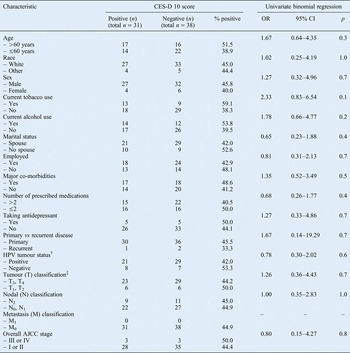
The distribution of clinico-demographic, social and histopathological characteristics of the study population stratified by Center for Epidemiologic Studies Depression Scale screening results are presented in Table II. Overall, 44.9 per cent of the population screened positive for depression, with a questionnaire cut-off value of 10. None of the characteristics analysed were found to be significantly associated with the questionnaire result, including HPV tumour status (p > 0.1 for all).
Characteristics of oropharyngeal scc patients at time of diagnosis by CES-D 10 score*

* Score of 10 or greater is considered positive for depression.
† Determined by p16 immunohistochemistry and/or HPV16 in situ hybridisation, excluding four cases with an unknown HPV tumour status.
‡ Excludes 5 TX cases, in which tumour classification was unknown. SCC = squamous cell carcinoma; CES-D 10 = 10-item Center for Epidemiologic Studies Depression Scale; OR = odds ratio; CI = confidence interval; HPV = human papillomavirus; AJCC = American Joint Committee on Cancer
Patient characteristics and questionnaire domains
Relationships between patients’ clinical characteristics at the time of diagnosis and each individual depression screening questionnaire item were investigated (tables not included). These analyses were not powered to detect true associations, but were nonetheless performed as exploratory analyses. Each Center for Epidemiologic Studies Depression Scale item assesses patients’ feelings in the previous week. Current tobacco use (p = 0.0005), unemployment (p = 0.03) and higher TNM stage (p = 0.03) were associated with the domain of irritability: ‘I was bothered by things that don't usually bother me’. Current tobacco use (p = 0.02) and unemployment (p = 0.01) were associated with the item ‘I felt that everything I did was an effort’. Current tobacco use (p = 0.04), no spouse (p = 0.04) and higher tumour (T) classification (p = 0.04) were associated with the domain of helplessness: ‘I [did not] feel hopeful about the future’. Higher nodal (N) classification (p = 0.04) was associated with the item ‘I felt fearful’. Employment (p = 0.03) was associated with the item ‘I was happy’. Not having a spouse (p = 0.05) was associated with feeling ‘lonely’.
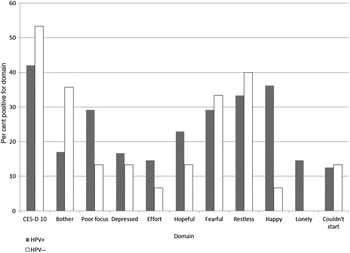
No significant associations were found between individual questionnaire items and other variables of interest, including HPV tumour status, as shown in Figure 1.
Graph showing no associations between human papillomavirus (HPV) tumour status and overall 10-item Center for Epidemiologic Studies Depression Scale (CES-D 10) score and individual domain items. P-values were greater than 0.05 for each comparison. The 10 domain items are as follows: (1) bother – I was bothered by things that usually don't bother me; (2) poor focus – I had trouble keeping my mind on what I was doing; (3) depressed – I felt depressed; (4) effort – I felt that everything I did was an effort; (5) hopeful – I felt hopeful about the future; (6) fearful – I felt fearful; (7) restless – my sleep was restless; (8) happy – I was happy; (9) lonely – I felt lonely; (10) couldn't start – I could not ‘get going’.

Discussion
In this study, the association of clinico-demographic, social and histopathological characteristics among patients with oropharyngeal cancer was evaluated in terms of the risk of depression, as determined by the Center for Epidemiologic Studies Depression Scale self-report instrument. This analysis highlights the high risk of depression among oropharyngeal cancer patients and specifically among HPV-associated oropharyngeal cancer patients. Indeed, 44.9 per cent of patients screened positive for a risk of depression. Of note, there was no association between any clinical or demographic characteristic, including HPV tumour status, and depression screening risk.
The prevalence of patients with oropharyngeal cancer who screen positive for a risk of depression in this study is similar to previous analyses of populations with head and neck cancer of all subsites.Reference Neilson, Pollard, Boonzaier, Corry, Castle and Mead 3 – Reference Barber, Dergousoff, Nesbitt, Mitchell, Harris and O'Connell 5 It is important to reiterate that this prevalence is significantly greater than that for the general population,Reference Waraich, Goldner, Somers and Hsu 1 and for all cancer types on average.Reference Krebber, Buffart, Kleijn, Riepma, De Bree and Leemans 2 An analysis by Tu et al. demonstrated that over 60 per cent of those patients who screen positive for depression are found to have a depressive disorder on psychiatric evaluation with a specialist, with major depressive disorder diagnosed in 22 per cent of cases.Reference Tu, Hsu, Chi, Lin and Yen 26 It has been demonstrated in head and neck cancer populations that pre-treatment depression is significantly associated with worse survival, worse pre-treatment nutrition, lower pre-treatment quality of life,Reference Kim, Roh, Lee, Lee, Kim and Choi 6 worse post-operative functional performance status, lower adjuvant treatment completion rates, longer hospital stay and a higher incidence of narcotic dependence,Reference Barber, Dergousoff, Nesbitt, Mitchell, Harris and O'Connell 5 and is associated with post-treatment depression.Reference Neilson, Pollard, Boonzaier, Corry, Castle and Mead 3 , Reference Adachi, Kimura, Sato, Nagashima, Nakamura and Aleksic 27 , Reference Neilson, Pollard, Boonzaier, Corry, Castle and Smith 28 Given this high prevalence of depression in head and neck cancer patients, and the clinically significant consequences, beyond treating patients known to be depressed, some have advocated the prophylactic treatment of all patients using antidepressant medications.Reference Lydiatt, Bessette, Schmid, Sayles and Burke 29
Despite a distinct clinico-demographic profile and unique concerns regarding the sexual transmission of the aetiological agent, this analysis found no significant difference in Center for Epidemiologic Studies Depression Scale positivity by HPV tumour status. This was true not only for the overall depression screening questionnaire result, using a cut-off value of 10, but also for our exploratory analysis of each individual questionnaire item. Milbury et al. have suggested that HPV-associated oropharyngeal cancer does not confer significantly more psychosocial stress relative to HPV-negative oropharyngeal cancer; these authors found similar distress levels between patients who self-identified as HPV-positive and those who were unsure of their HPV tumour status.Reference Milbury, Rosenthal, El-Naggar and Badr 30 A similar finding was demonstrated in a study that compared major depression rates by HPV tumour status in patients who were undergoing radiotherapy.Reference Hess, Rash, Daly, Farwell, Bishop and Vaughan 31 A smaller proportion of HPV-positive than HPV-negative patients were on antidepressants, yet the risk of depression was similar regardless of HPV tumour status. Therefore, while the possibility of anxieties specific to malignancy caused by sexually transmitted infection and to concerns regarding transmission remains, the risk of depression (as assessed by the available screening tool) is similar.
Our analysis demonstrates no significant difference in risk of depression (as defined by the Center for Epidemiologic Studies Depression Scale) for other clinico-demographic, social or histopathological characteristics in oropharyngeal cancer patients. This result is somewhat unexpected, as a recent analysis demonstrated significant associations between depression and: smoking, alcohol use, T3–4 tumour classification and greater than three prescribed medications.Reference Moubayed, Sampalis, Ayad, Guertin, Bissada and Gologan 32 However, that analysis compared pre-treatment characteristics to post-treatment depression (median follow up of 39 months) using a different self-report instrument, the Hospital Anxiety Depression Scale, in patients with head and neck cancer including all subsites. Employment in particular was shown to be associated with depression and decreased function in German head and neck cancer survivors five years after diagnosis.Reference Koch, Wittekindt, Altendorf-Hoffmann, Singer and Guntinas-Lichius 33 Our exploratory analyses for associations between individual questionnaire items and characteristics found that employment status and tobacco use were associated with three items each.
Overall, the literature on associations between depression and clinico-demographic and social characteristics, such as age, sex, smoking, alcohol use, marital status and employment, have been inconsistent,Reference Neilson, Pollard, Boonzaier, Corry, Castle and Mead 3 , Reference Katz, Irish, Devins, Rodin and Gullane 16 , Reference Haisfield-Wolfe, McGuire, Soeken, Geiger-Brown and De Forge 17 and larger collective analyses would aid investigation of these issues.
We believe that these results emphasise the importance of depression screening tools, including the 10-item Center for Epidemiologic Studies Depression Scale, given that neither socio-demographic nor histopathological factors are associated with depression screening positivity. A standardised screening tool, not patient characteristics, allows the clinician to predict depression in their patients a priori. At our institution, when a patient screens positive for a risk of depression using the 10-item Center for Epidemiologic Studies Depression Scale questionnaire, they are counselled by our oncology social work team, given information about support groups and, if necessary, referred to a mental health provider.
The Center for Epidemiologic Studies Depression Scale is one of the most widely used instruments in the field of psychiatric epidemiology. It was shown to be strongly associated with depression in a meta-analysis of 76 prospective studies evaluating self-report tools.Reference Eaton, Muntaner, Smith, Tien, Ybarra and Maruish 22 , Reference Pinquart and Duberstein 34 The shorter 10-item Center for Epidemiologic Studies Depression Scale was utilised as part of the clinical workflow and was administered as part of routine clinical care for all new patient visits.
-
• Patients with human papillomavirus (HPV) associated oropharyngeal cancer have a distinct clinico-demographic profile
-
• Whether HPV tumour status modulates risk for depression has not been adequately investigated
-
• This study demonstrated a 44.9 per cent prevalence of risk for depression overall
-
• There was no association between any characteristic measured, including HPV tumour status, and depression risk
-
• Regular depression screening is important, as clinico-demographic and histopathological variables are unable to predict depression risk
This study has important limitations, including its retrospective design and psychometric method of only using a self-report screening instrument without confirmation with psychiatric evaluation by a specialist. Nevertheless, this analysis does address a substantial gap in the literature regarding whether the characteristics of oropharyngeal cancer patients are associated with a greater risk of depression, specifically for patients with HPV-associated disease.
The analyses of associations between individual Center for Epidemiologic Studies Depression Scale items and patient characteristics were not sufficiently powered to detect true associations, but were nonetheless performed as exploratory analyses to inform further investigations. Future analyses should follow this population through treatment to investigate how various treatment modalities modulate risk for the HPV-associated oropharyngeal cancer population.