Introduction
The number of people diagnosed with dementia is increasing rapidly. Worldwide prevalence is estimated at 35.6 million people and this number will double every 20 years to 115.4 million in 2050 (Alzheimer Disease International, 2009). In the Netherlands, 230,000 people have dementia, and 35% of them receive 24-hour professional care in nursing homes (Alzheimer Nederland, 2010). Progression of the disease is often accompanied by the occurrence of neuropsychiatric symptoms, such as depression, agitation, anxiety, and psychotic symptoms, with prevalence figures ranging from 1% to 84% (Bakker et al., Reference Bakker, Duivenvoorden, van der, Olde Rikkert, Beekman and Ribbe2010). A study in the Netherlands showed that 30–35% of the people with dementia living in nursing homes display apathy, agitation, and aggressive behavior (Zuidema et al., Reference Zuidema, Koopmans and Verhey2007). This, together with the presence of cognitive and sensory impairments resulting in decreased communicative abilities, can make it very difficult for caregivers to communicate with the people with dementia. Methods that help them to communicate with people with dementia can improve the behavior, mood, and eventually the quality of life of people with dementia (Vasse et al., Reference Vasse, Vernooij-Dassen, Spijker, Rikkert and Koopmans2010).
In a bid to improve communication with – and the quality of life of – people with dementia living in nursing homes, many psychosocial interventions and emotion-oriented care approaches have been developed and implemented in recent decades (e.g. Gibson, Reference Gibson and Bornat1994; Hopman-Rock et al., Reference Hopman-Rock, Staats, Tak and Droes1999; Sloane et al., Reference Sloane2004; Finnema et al., Reference Finnema, Dröes, Ettema, Ooms, Adèr, Ribbe and van Tilburg2005; van Weert et al., Reference van Weert, van Dulmen, Spreeuwenberg, Ribbe and Bensing2005b). Psychosocial methods and emotion-oriented care approaches are characterized by attention to the subjective experiences of people with dementia and their individual ways of coping with their illness (Finnema et al., Reference Finnema, Droes, Ribbe and van Tilburg2000; van Mierlo et al., Reference van Mierlo, van der Roest, Meiland and Droes2010). An example of an emotion-oriented care approach in psychogeriatrics is validation (Feil, Reference Feil1992); an example of a psychosocial intervention is reminiscence therapy (Woods et al., Reference Woods, Spector, Jones, Orrell and Davies2005). In both approaches, there is a strong focus on empathic communication between caregiver and the person with dementia. In addition, the use of music and theatre to optimize the quality of life of people with dementia has been explored (Vink et al., Reference Vink, Birks, Bruinsma and Scholten2004). Receptivity to music remains until the late phases of dementia (Aldridge, Reference Aldridge1996) and drama can facilitate reminiscence and help people with dementia to express their feelings (Sandel and Johnson, Reference Sandel and Johnson1987).
In the Netherlands a new method is being applied to improve the quality of life of people with dementia, called the “Veder method”. This method, developed by a theatre group (Theater Veder), has been widely implemented as a group activity in Dutch nursing homes over the past four years. A total of 882 caregivers on 149 wards were trained in offering the group activity in which theatrical stimuli, such as songs and poetry, are used in combination with elements from successful communication methods in psychogeriatrics, like reminiscence (Woods et al., Reference Woods, Spector, Jones, Orrell and Davies2005), validation (Feil, Reference Feil1992) and neurolinguistic programming (Bandler and Grinder, Reference Bandler and Grinder1975). Costumes, props and recognizable characters are used to create a stage set. When offered as a group activity on nursing home wards, this activity is called a “living-room theatre activity”.
The purpose of the activity is to reduce apathy and to enhance the sense of personal identity and self-esteem of people with dementia by activating their long-term memory. Positive effects on behavior, mood, and quality of life of the people with dementia are expected during and after the living-room theatre activity.
The Veder method is innovative in that it integrates theatrical stimuli with elements from other communication methods used in dementia care, such as reminiscence and validation. Reminiscence and validation are well-known and commonly used psychosocial care methods in dementia care, but scientific evidence on the effectiveness of these methods is still scarce (Finnema et al., Reference Finnema, Droes, Ribbe and van Tilburg2000; Woods et al., Reference Woods, Spector, Jones, Orrell and Davies2005; Droes et al., Reference Droes, van Mierlo, van der Roest and Meiland2010; van Mierlo et al., Reference van Mierlo, van der Roest, Meiland and Droes2010). The integration of different communication methods may increase their effectiveness compared to their use in isolation. Furthermore, the theatrical elements can stimulate the imagination of people with dementia and/or trigger association, improve reminiscence, and stimulate self-expression (Sandel and Johnson, Reference Sandel and Johnson1987; Lepp et al., Reference Lepp, Ringsberg, Holm and Sellersjo2003). Where words are sometimes not available due to decreased language abilities, poems and music have the power to stimulate the imagination of people with dementia and can help them to remember and to interact in a different way, for example by nonverbal communication such as singing, laughing and through nonverbal expression of emotions (Wilkinson et al., Reference Wilkinson, Srikumar, Shaw and Orrel1998).
A living-room theatre activity strongly resembles a reminiscence group activity, because retrieving old memories in a group of people with dementia is the central part of the activity. However, a living-room theatre activity according to the Veder method is different from a regular reminiscence activity because it also integrates other supportive communication methods than reminiscence, such as validation and neurolinguistic programming, with theatrical elements. We hypothesize that people who join an activity according to the Veder method will show more positive effects in terms of behavior, mood and quality of life compared to people who attend a regular reminiscence activity.
The primary aim of this study was to evaluate the added value of the Veder “living-room theatre activity” compared to a regular reminiscence group activity. The study focuses on their effects on the behavior, mood, and quality of life of persons with dementia living in nursing homes, during and shortly after the intervention. A second aim was to investigate whether professional caregivers can achieve the same effects with the Veder method as the professional actors of Theater Veder.
Methods
Design
A quasi-experimental non-equivalent three-group design was used within a psychogeriatric nursing home setting. Three groups were compared: the first two groups joined in a living-room theatre activity according to the Veder method. Experimental group 1 (E1) was exposed to a living-room theatre activity put on by trained professional caregivers. Experimental group 2 (E2) joined a living-room theatre activity offered by professional actors from Theater Veder. The third group of people with dementia joined a reminiscence group session (control group). A reminiscence group activity was chosen as the control intervention because reminiscence groups also focus on memories to stimulate interaction with people with dementia, and are frequently offered in Dutch nursing homes. They therefore seemed suitable as a control intervention to investigate the added value of the theatrical Veder Method.
The wards selected for the Experimental group 1 (E1) were matched with comparable wards for Experimental group 2 (E2) and for the control group (C). Matching took place on severity of dementia (based on Mini-Mental State Examination (MMSE) or Global Deterioration Scale (GDS) scores), composition of nursing staff, and the care model used. Measurements on behavior, mood, and quality of life took place at three time points: (T1) pretest, on a day without a living-room theatre or reminiscence group session, 1–7 days before T2; (T2) during a living-room theatre or a reminiscence group session; and (T3) post-test, one and a half to two hours after the group activities. Measurements were carried out between February and November 2010. Approval for the study was obtained from the Medical Ethical Committee of VU Medical Centre in Amsterdam and supplemented by local feasibility statements from the board of directors of the participating nursing homes.
Participants
Nursing homes
The study took place on 22 wards in 13 Dutch nursing homes willing to cooperate and which met the selection criteria. General selection criteria for all groups were: (1) the presence of a psychogeriatric ward, and (2) the willingness of personnel to join in the research project. An additional criterion for E1 was the presence of personnel who had received coaching by Theater Veder. For the control group (C), the selection criterion was the presence of personnel who had not received any coaching by Theater Veder.
To calculate sample size we conducted a power analysis. To find moderate effects with a significance level of p = 0.05 and a power of 0.8 we needed 64 people for each group (Cohen, Reference Cohen1988).
In four nursing homes the E1 (n = 5) and C groups (n = 4) could be recruited from different wards, as there were two or three comparable wards. In two nursing homes we recruited only E1 groups (n = 3), because the entire nursing staff had been trained by Theater Veder. The control groups (n = 3) were therefore recruited in two other comparable nursing homes with comparable psychogeriatric wards. In two nursing homes the E1 (n = 2) and the C group (n = 2) were recruited from the same psychogeriatric ward because these homes had only one large psychogeriatric ward. In these cases the intervention activities (T2) were organized in a closed room, separated from the living room, and also on different days to avoid contamination of effects. In total, ten experimental E1 and nine C groups were selected in ten different nursing homes. E2 groups (n = 5) were recruited on five wards in three other nursing homes.
Residents
Inclusion criterion for people with dementia (hereafter termed “residents”) was a medical diagnosis of dementia. Exclusion criteria were: very severe hearing impairment/deaf or visual impairment/blind, Korsakov syndrome and being bedridden. Korsakov syndrome was excluded because of the deviating clinical symptoms and process compared to the most common types of dementia such as Alzheimer's disease (AD) and vascular dementia.
Intervention leaders
Trained professional caregivers (n = 20) led the living-room theatre activity according to the Veder method in Experimental group 1 (E1), while professional actors of Theater Veder (n = 10) led the living-room theatre activity in Experimental group 2 (E2). Activity therapists and nurses (n = 11) experienced in running a reminiscence group activity offered this for the control group (C). Inclusion criterion for caregivers leading the living-room theatre activity in E1 was that they had been trained and coached by Theater Veder. Inclusion criterion for those leading the reminiscence activity was experience with leading reminiscence group activities. Exclusion criterion for the control group was having received training and coaching from Theater Veder.
Intervention
People with dementia joined either a living-room theatre activity or a reminiscence activity.
In the E1 group the living-room theatre activities according to the Veder method were organized by two caregivers who had received at least one training and two on-the-job coaching sessions by Theater Veder. In the E2 group, living-room theatre activities were led by two actors of Theater Veder. The training for professional caregivers consisted of teaching the basic principles of the Veder method: a Veder method group activity is built up according to a fixed sequence, beginning with individual contact when welcoming the persons into the group, activating long-term memory, taking a break, activating short-term memory and closing with individual contact to say goodbye. Furthermore, special attention is paid to the use of validation, reminiscence and theatrical stimuli. During the on-the-job coaching sessions the caregivers had to apply the Veder method in a living-room theatre activity. Afterwards, they received feedback from a Theater Veder coach. A living-room theatre activity has a central theme, and every caregiver/actor plays a role which refers to that theme. Costumes, props and recognizable characters are used to create a stage set. Songs and poems are used as well as objects, smells and flavors that refer to the central theme. Communication and reciprocity are used to positively influence behavior, mood and quality of life.
The reminiscence group activity (C) was led by one or two caregivers who were not trained by Theater Veder, but did have experience with running reminiscence group activities. During the reminiscence group activity, one or two caregivers conduct a conversation with residents about a theme that is related to the past. They stimulate the conversation by providing information about the theme, using photographs and other objects and by asking people questions about their experiences in the past. The same verbal and written instructions were given to every caregiver in advance. The researcher (AMvD) discussed the basic principles of reminiscence (Barendsen and Boonstra, Reference Barendsen and Boonstra2008) with the caregivers, such as choosing a central theme and the use of objects and photographs that refer to the chosen theme. For the rest, the caregivers were free to choose the content of the reminiscence activity.
Procedure
The selected nursing homes sent a standard information letter about the study by mail to the legal guardians of all residents meeting the inclusion criteria. This letter asked them to give signed consent for the person with dementia to participate in the study and, more specifically, for (video) observation and medical background information to be collected. A stamped addressed envelope was included for returning the informed consent form; if it was not returned within three weeks, legal guardians were contacted by telephone. Guardians were informed of their right to withdraw the person with dementia from the study at any time. The persons with dementia who were able to communicate verbally were also asked for their (verbal) permission to participate in the study and to be observed. Professional caregivers were informed about the study by the first author (AMvD) and the contact person in the nursing home. Prior to the observations being made, their verbal consent to (video) observation was requested.
The effectiveness of the intervention was studied by observing participants at T1, T2 and T3. One observer observed a maximum of four participants and there were never more than two observers per measurement. The observers were not informed about the goal of the research and had no prior information about which condition they were observing. The observer training consisted of providing background information about dementia, explaining the use of the observation scales, practising the use of the observation scales, rating the same patients on a video recording, and discussing any discrepancies afterwards.
The pre- and post-test observations were performed in the living-room of the nursing home ward. Measurements during the intervention took place in the same living-room or in a special activity room. The observers were seated in a corner, where they were able to see the residents. The intervention was also videotaped allow additional observations afterwards (e.g. compliance with the intervention, inter-rater reliability observations).
Outcome measures
Background characteristics
Sociodemographic and medical background characteristics of residents were collected. Cognitive impairment was measured with the MMSE (Folstein et al., Reference Folstein, Folstein and McHugh1975) administered by the researcher (AMvD) or a research assistant (PvdG or CM) on a different day from the observation days. The Brief Cognitive Rating Scale was assessed by caregivers on the wards. The stage of dementia of each resident was determined using the GDS classification (Reisberg et al., Reference Reisberg, Doody, Stoffler, Schmitt, Ferris and Mobius2003).
Residents’ behavior
To assess the behavior of the residents the extended version of the measuring instrument INTERACT was used (van Weert et al., Reference van Weert, van Dulmen, Spreeuwenberg, Ribbe and Bensing2005a). The extended version of INTERACT consists of 30 items distributed over the subcategories of mood, speech relating to person, speech relating to environment, need for prompting and stimulation level. Of the 30 items, 24 were applicable to this study. In addition, the original INTERACT item “attentive to/responding to/ focused on activity/objects” was divided into two items: “attentive to/ focused on activity /objects” and “responding to activity/ objects”. Moreover, two study-specific items were added in the subcategory mood: “laughing” and “enthusiasm”. The 28 items were scored on a 5-point Likert scale, ranging from (0) “not at all” to (4) “nearly all the time”. The INTERACT was originally designed for the evaluation of snoezelen-sessions (Baker and Dowling, Reference Baker and Dowling1995; van Weert et al., Reference van Weert, van Dulmen, Spreeuwenberg, Ribbe and Bensing2005a) and can therefore also be used to evaluate effects of the time-set activities in our research. Inter-rater reliability (mean Pearson's r) of the INTERACT items was 0.83 (range 0.68–0.99) (van Weert et al., Reference van Weert, van Dulmen, Spreeuwenberg, Ribbe and Bensing2005a).
Overall mood of the residents was measured by scoring a face expression (FACE), based on a 3-point Likert scale (van Weert et al., Reference van Weert, van Dulmen, Spreeuwenberg, Ribbe and Bensing2005a):
 if frown predominated
- if the expression was neutral
- if smile predominated


The inter-rater reliability of FACE was 0.84 (mean Person's r) in the study by van Weert et al. (Reference van Weert, van Dulmen, Spreeuwenberg, Ribbe and Bensing2005a).
Quality of life was measured with the QUALIDEM (Ettema et al., Reference Ettema, Droes, de, Mellenbergh and Ribbe2007a; Reference Ettema, Droes, de, Mellenbergh and Ribbe2007b) a structured observation list for use in residential care settings. The QUALIDEM consists of 37 items describing observable behavior, distributed over nine subscales. These subscales are: care relationship, positive affect, negative affect, restless tense behavior, positive self-image, social relations, social isolation, feeling at home and having something to do. The 4-point scale provides four response options: never, seldom, sometimes and often. The observer is asked to assess the behavior of the person with dementia in the past two weeks. In this study a restricted time period was used because the observations only lasted 30–90 minutes. As they could not be observed properly in the limited time span or in the group activity context, the following four items were removed: “rejects help from nursing assistants”, “appreciates help that he or she receives”, “accepts help” (items of subscale “care relationship”) and “finds things to do without help from others” (item of subscale “having something to do”). Ettema et al. (Reference Ettema, Droes, de, Mellenbergh and Ribbe2007a; Reference Ettema, Droes, de, Mellenbergh and Ribbe2007b) found a sufficient internal consistency (Cronbach's α = 0.59–0.89) and sufficient reliability within the subscales (ρ = 0.60–0.90). Test-retest reliability varied from 0.74 to 0.88.
In addition, involvement of the residents in their environment was measured on a 4-point Likert scale: (0) withdrawn/no contact, (1) alert, short or interrupted involvement, (2) showing concentration but able to be distracted, and (3) highly involved. This scale is derived from the Dutch Dementia Care Mapping scoring list (Beavis et al., Reference Beavis, Simpson and Graham2002).
Data on all mentioned outcome measures were collected at the three measuring moments (T1-T3). Finally, a single question, derived from the RAND-36, was completed verbally by the participants at pre- and post-test to measure perceived quality of life. Answering options ranged from (1) excellent to (5) bad (van der Zee and Sanderman, Reference van der Zee and Sanderman1993).
Quality of performance of the intervention
The adequate application of the Veder method (performance) was measured using an instrument developed in an earlier study (Tol et al., 2009) to measure the quality of the execution of the living room theatre activity (T2) (Performance Veder method, inter-rater reliability = 71.9%). The list consists of 20 items, measured on a 4-point Likert scale (range 1–4). Example of a question in this instrument is “Is the communication (in terms of body language, tone of voice, speed of speech and voice expression) adjusted to the individual?”
In addition, the number of offered theatrical stimuli was scored. Also, the duration of the intervention and the number of people with dementia joining in the intervention were recorded. The video recordings were used to score this list.
Subsequently a list of 14 items was developed for this study to measure performance of reminiscence. This list was based on the basic principles and preconditions of reminiscence (Barendsen and Boonstra, Reference Barendsen and Boonstra2008). An example of a question in this list is “Is there a good balance between asking for and giving information?”
Data analysis
For the data analysis we used the SPSS-Windows 15.0 program and MLwiN Package 2.21. Descriptive statistics were obtained for every group, including loss to follow up, non-response and refusers. To find out if the experimental groups and the control group were comparable on descriptive variables (i.e. age, sex, duration of illness), we used χ2 tests on nominal variables. The Kruskal-Wallis and Mann-Wittney U test were performed to examine differences between groups on ordinal and interval variables. The same statistical tests were used to perform a non-response analysis, in order to analyze the differences between the participants in our study and the group of people with dementia who refused to participate in the study or who did not respond at all. The group that dropped out during the study was also compared with the remaining sample.
Spearman rank correlation coefficients, Mann-Whitney U tests and χ2 tests were calculated between the the outcome measures and the ordinal and nominal variable(s) that differed significantly in the experimental and control groups (p < 0.05) to decide whether these variables had to be treated as confounding variables in the effect analyses. Mann-Whitney U tests were also performed to compare groups on compliance with the intervention.
Inter-rater reliability (IRR) of resident behavior was measured by watching the video recordings. Ten percent of the total number of observations of each individual observer was rated again by a second, independent observer. In this way a total of 109 IRR observations were carried out. Inter-rater reliability was not measured for those behaviors that were observed in less than 2% of the participants (Ford et al., Reference Ford, Fallowfield and Lewis1996). A κ coefficient was calculated between the original score and the second score on the QUALIDEM, INTERACT and involvement. As κ could not be calculated on many items due to empty cells (i.e. insufficient variation in scores), the scores were dichotomised. Values between 0.21 and 0.40 are considered fair, between 0.41 and 0.60 moderate and values > 0.61 good (Altman, Reference Altman1991). For FACE, which has a 3-point scale, a Pearson's correlation was calculated.
Univariate covariance analyses (ANCOVA) were carried out to compare outcome measures at T2 and T3 in the three groups, while the baseline data (T1) and confounding variables were included in the analysis as covariates. This strategy is recommended in small samples (Cohen, Reference Cohen1988). Statistical analyses were corrected for multiple testing with the Bonferroni confidence interval adjustment. Because of the expected added value of the Veder method, we used one-tailed tests with a significance level of 5%. Multilevel analyses were performed on the variables that showed significant differences in the original ANCOVAs. In these analyses in which the control (reminiscence) group was the reference group, baseline data (T1) were included in the analysis to correct for differences between groups at baseline.
Results
Response
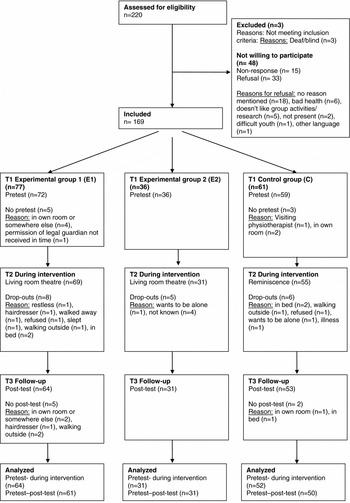
In total, 220 people with dementia were assessed as eligible for the study. Their legal guardians were asked to give written informed consent, of whom 168 (76.8%) responded, 33 (15.0%) refused and 15 (6.8%) did not respond. Reasons for refusal are listed in the flow chart (Figure 1). After receiving the consent, three residents were excluded because it transpired that they did not meet the inclusion criteria. The people not willing to participate (n = 48) were analyzed on demographic characteristics. We found no significant differences between participants and people not willing to participate on age, gender, type of dementia, predominant features and duration of illness. Drop-outs at T2 (experimental (n = 8), control (n = 6)) were compared with the participants of the study on age, gender, education, diagnosis, predominant features, duration of illness and MMSE score. No significant differences were found.
Flow chart of the study

Missing values at pre- and post-test are also listed in Figure 1, as are the reasons for these missing observations.
Background characteristics
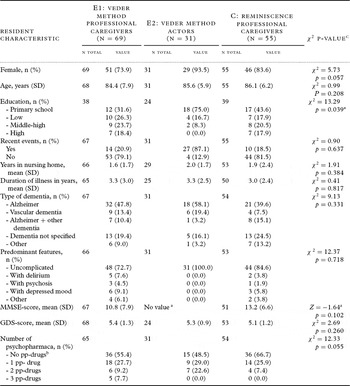
Table 1 summarizes the background characteristics of participants in the two experimental groups versus the control group. It shows significant differences between groups for the variable education level (p<0.05). There were significantly more people who had had only primary education in E2 (75.0%, p < 0.05), but the education level did not correlate significantly with any of the outcome variables. Therefore, education level was not included as a covariate in the analyses.
Background characteristics by treatment group

* Significant on a p = 0.05 level.
a. No MMSE-scores were obtained for people with dementia in Experimental group 2. A Mann-Whitney U test was used to examine differences in MMSE-scores between the control group and Experimental group 1.
b. pp-drugs = psychopharmacological drugs
c. Differences between groups are described in the text
MMSE = Mini-Mental State Examination; GDS = Global Deteriotaion Scale
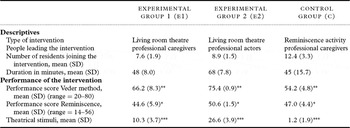
Descriptives and performance of the intervention
Table 2 contains descriptives of the intervention group activities at T2. The intervention for E1 and C were led by professional caregivers. In E2, professional actors led the intervention. Mean duration of the intervention in E1 was 45 minutes, in E2 68 minutes and in C the mean group activity duration was 48 minutes. The performance score of the Veder method ( = adequate performance of the method) was highest in E2, and pairwise comparison showed significant differences between E2 and C and between E1 and C on a p-level < 0.05, in favor of the experimental groups. The performance score of reminiscence differed between groups. However, the difference was significant only between E2 and E1 (p < 0.05) with E2 incorporating more elements of reminiscence. The number of theatrical stimuli was highest in E2 and it was different for all groups. Pairwise comparison showed significant differences between E1-E2, E1-C and E2 –C on a p-level <0.001).
Description of interventions at T2

* p < 0.05 ** p < 0.01 *** p < 0.001 (see text for pairwise comparisons)
Inter-rater reliability
The mean inter-rater reliability (κ) for the QUALIDEM subscales was 0.428 (range 0.315–0.644), for the INTERACT items 0.327 (range 0.119–0.591), and for Involvement 0.372. Inter-observer correlation (mean Pearson's r) for FACE was 0.484.
Outcomes
In 95.2% (118 out of 124) of all cases, the resident was observed by the same person during the three different measurements (T1 to T3).
Pre- and post-test measurements took place at the same time on two different days (length: 90 minutes). At the end of the pre- and post-test observations, the people with dementia were asked a single question regarding their quality of life, unless they were no longer able to communicate verbally (n = 63).
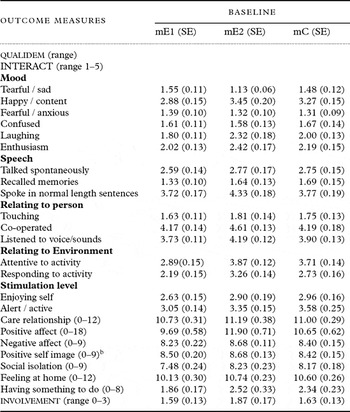
The results of the ANCOVAs indicated that there are no significant differences between groups on 14 INTERACT items: spoke clearly, spoke sensibly, appropriate eye contact, related well, responded to speaking, tracked stimuli, touched appropriately, responding to activity, comments or questions about activities, did things from own initiative, wandering, restless, bored/ inactive, relaxed/ content. No significant differences between groups were found on two QUALIDEM subscales: restless behavior and social relations. Also no differences were found between groups on the FACE scale and self-reported overall quality of life. The table with results of the ANCOVA analysis can be requested from the authors. Table 3 contains the baseline scores of the outcome measures of the multilevel analysis.
Baseline measures (pretest, T1)

mE1 = Mean score Experimental group 1
mE2 = Mean score Experimental group 2
mC = Mean score Control group
SE = standard error
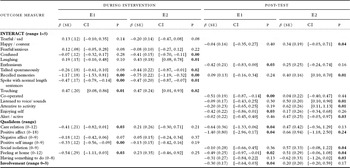
Table 4 contains the variables that showed significant differences between groups in the originally conducted ANCOVAs. Results of the multilevel analysis are presented as the β coefficients, standard errors, confidence intervals and p-values of the outcome measures during the intervention and at post-test. The results of the measurements during the intervention (T2), show significant differences between E1, E2 and the control group on six INTERACT items: confused, laughing, enthusiasm, talked spontaneously, recalled memories, spoke with normal length sentences and touching. Significant effects are found on three QUALIDEM subscales: care relation, positive self-image and feeling at home. During the intervention, persons in E1 showed more touching compared to people in the control group. Persons in E2 were less confused, laughed more and touched more compared to people in the control group. Persons in E1 and E2 recalled fewer memories and spoke less in normal length sentences compared to people in the control group. Furthermore, persons in E2 talked spontaneously less often than persons in the control group. Persons in E1 obtained lower scores on care relation and positive self-image compared to people in the control group, and they showed less behavior expressing that they felt at home.
Effects of multilevel analysis on outcome measures during and after the intervention (significant effects in bold).

E1 = Experimental group 1, theatre living-room activity by caregivers; E2 = Experimental Group 2, theatre living-room activity by professional actors
β = beta coefficient, with control (reminiscence) group as reference group, se = standard error, CI = confidence interval, p = p = value.
Significant effects at post-test (1.5 to 2 hours after the intervention) are found on eight INTERACT items: happy/content, enthusiasm, recalling memories, cooperated, listened to voice/noise, attentive to activity, enjoying self and alert/active. Differences between E1, E2 versus the control group were also found on five QUALIDEM subscales: care relation, positive affect, social isolation, feeling at home and having something to do. At post-test, people in E2 were happier and recalled more memories compared to the control group. They were also more alert and listened better to voice/sounds and were more attentive to activity compared to the control group. Persons in E2 showed less socially isolated behavior and felt more at home than the control group. In contrast, people in E1 were less enthusiastic and cooperative and enjoyed themselves less than the control group after the intervention. People in E1 also had lower scores on positive affect and felt less at home compared to the control group. They also demonstrated less involvement than the control group at post-test.
For a visualization of the outcome measures “Social isolation” and “Alert/active”, see Figures S1 and S2, available as supplementary material attached to the electronic version of this paper at www.journals.cambridge.org/jid_IPG.
Discussion
This study should be viewed as the first exploratory study into the effects of the Veder method on people with dementia and of the feasibility of the intervention. The main aim of our research was to evaluate the added value of the Veder method compared to reminiscence on behavior, mood, and quality of life of people with dementia in nursing homes. First of all, we used observation lists in order to measure the performance of reminiscence and the adequate application of the Veder method. The results show differences between the type of intervention – the Veder method “living-room theatre activity” offered by professional caregivers or actors versus reminiscence. Significant differences on performance scores for reminiscence were found only between experimental groups E1 and E2, in favor of E2. Performance scores of the Veder method were significantly higher for “living-room theatre activities” than for reminiscence activities. In addition, much more use was made of theatrical stimuli in ´living-room theatre” according to the Veder method than in the reminiscence activity. These results indicate that “living-room theatre” according to the Veder method is not only theoretically different from a reminiscence group activity, but also in its actual application in a group activity.
Effects of the living-room theatre activity on behavior, mood, and quality of life of people with dementia were studied during the intervention and at post-test (1.5 to 2 hours after the intervention). Results on outcome measures during the intervention indicate clear added value of a living-room theatre activity when offered by professional actors. People with dementia in this group laughed more during the intervention and were less confused than people in the reminiscence group. Effects on laughing in our study were new, but a decrease in disorientation was also seen in other studies, such as a study on a life review program (Tabourne, Reference Tabourne1995). In E1 and E2, people with dementia showed more “touching” during the intervention compared to people in the control group. In a snoezelen-program care staff behavior showed more “affective touching” (van Weert et al., Reference van Weert, Janssen, van Dulmen, Spreeuwenberg, Bensing and Ribbe2006). However, as far as we know, these effects have not yet been reported in people with dementia. During the intervention, scores on “speech” (e.g. talking spontaneously and recalling memories) were higher in the control group than in the experimental groups. Improvements in speech during the intervention have not been found in earlier studies on reminiscence activities, but were found in studies on movement activation, a resident dog and snoezelen (McCabe et al., Reference McCabe, Baun, Speich and Agrawal2002; van Weert et al., Reference van Weert, van Dulmen, Spreeuwenberg, Ribbe and Bensing2005b). Since stimulating conversation is one of the main goals of reminiscence groups, it is not surprising that the control group had higher scores. A more surprising result is that people in E2 recalled significantly more memories compared to the control group 1.5 to 2 hours after the intervention (at post-test). We did not find a similar effect in other studies. At post-test, people in E2 also showed significantly less socially isolated behavior and more alertness (attentive to activity and “listening to voice/sounds”) compared to the control group. Comparable positive effects on social interaction and social involvement have been found in effect studies on snoezelen, a life review program, movement activation, and meeting centers (Tabourne, Reference Tabourne1995; Dröes and van Tilburg, Reference Dröes and van Tilburg1996; Camberg et al., Reference Camberg1999; Hopman-Rock et al., Reference Hopman-Rock, Staats, Tak and Droes1999; Dröes et al., Reference Dröes, Breebaart, van Tilburg and Mellenbergh2000; Reference Dröes, Meiland, Schmitz and van Tilburg2004; van Weert et al. Reference van Weert, van Dulmen, Spreeuwenberg, Ribbe and Bensing2005b; Fritsch et al. Reference Fritsch, Kwak, Grant, Lang, Montgomery and Basting2009). After the intervention, people in E2 were also happier and showed more instances of behavior expressing they felt more at home compared to the control group. Persons in E1 were less enthusiastic and less able to enjoy themselves at post-test compared to the control group. They felt less at home and were less cooperative than the control group. In terms of clinical relevance, the moderate to large positive effects on laughing during the intervention, and recalling memories, alertness and less social isolation at post-test, can be considered as important added effects of the Veder method. It is promising that the Veder method as applied by actors seems to reduce common problems among people with dementia in nursing homes, such as apathy and social isolation. The lower effects for persons in E1 are probably explained by the fact that E1 had lower reminiscence performance scores than E2, which means that persons in E1 (in which care personnel provided the activity) joined a living-room theatre activity which was performed less adequately compared to E2 (in which professionals actors led the activity). Another important element to consider is that the duration of the living-room theatre activity offered by actors was generally longer than the duration of the interventions offered by caregivers. This also may have contributed to outcome differences in favor of E2.
The second aim of our research was to investigate whether professional caregivers who are trained to apply the Veder method in a group activity can achieve the same outcomes as professional actors. Our study indicates that professional actors achieve different and more positive effects on behavior, mood, and quality of life of people with dementia compared to trained caregivers. Results show differences between people during the intervention on mood (confused, laughing) in favor of those who joined the living-room theatre activity offered by actors. At post-test, people in the “actors group” had better scores on mood (happy), feeling at home, socially isolated behavior and alertness. Several comments are in order regarding these outcomes. During the qualitative evaluation of the intervention with the caregivers, the caregivers leading the living-room theatre activity felt less satisfied about their performance compared to caregivers in the reminiscence group. Caregivers leading the living-room theatre activity reported being nervous due to the research observations being made and the presence of cameras more often than the caregivers leading a reminiscence activity. Some felt uncomfortable and reported that offering a living-room activity was normally not that difficult for them. A reason for this can be that caregivers are more used to leading a reminiscence activity, as reminiscence has been used in the Netherlands for a long time. Caregivers were trained over a relatively short time to perform the living-room theatre activity and it was not given as part of the residents’. There were also disruptions in several living-room theatre activities led by caregivers, e.g. a dentist arriving to collect a resident for treatment and someone starting to drill in the wall outside the activity room.
A few methodological considerations need attention. We used a quasi-experimental three-group design. This carried a risk of biased results due to differences between nursing home wards and residents. In order to improve comparability of the groups and to reduce the risk of effect bias, we globally matched the nursing homes on severity of dementia of residents, composition of nursing staff and the applied care model in advance. Furthermore, differences between groups on baseline characteristics were included in the analyses as covariates.
A second limitation of our study is that the post-test measurement was performed shortly after the intervention. No long-term effects have been studied. As mentioned before, our research was performed in nursing home wards where the Veder method had not yet been implemented as part of regular care. Therefore, we decided to measure only the short-term follow-up (1.5 to 2 hours after the intervention). In future research, longer-term effects could be studied in nursing homes where the Veder method is more structurally implemented within the regular care program.
A third limitation of this study is that the number of participants included in our study was somewhat lower than initially planned, and not equally distributed. Specifically, the group that received the living-room theatre activity offered by professional actors was smaller than the other two groups. This was mainly due to the lack of time to organize the sessions. Because of the small sample, the power of the tests was very small and possible effects may not have been found. The small sample size of this study also affects the generalizability of the results. Differences in groups may not have been found due to lack of statistical power. In addition, the severity of cognitive impairment in the residents may influence the results. We recommend that in future, research groups are defined based on the severity of dementia, and that separate analyses are conducted for these groups.
A fourth limitation of our study is that the inter-rater reliability (IRR) of some items and subscales was low. Therefore, the results should be treated with caution. We must point out that the IRR in previous studies using the same instrument was sufficient to good. The low IRR in our study may have been influenced by the fact that second observations were not performed live, but by watching video recordings afterwards. The quality of these video recordings (i.e. sound and image) was not very good and very different from the “live” observations, which made it difficult for the second observer to score the observation list reliably. To check if the low IRR was due to different methods of observation, it is advisable to test the IRR based on the same observation method in future studies. To maximize the reliability of measurements, each resident was observed by the same person at the three different time points (T1 to T3).
Despite the limitations, our study contributes to the development of evidence-based standardized time-set activities (Livingston et al. Reference Livingston, Johnston, Katona, Paton and Lyketsos2005; Vasse et al. Reference Vasse, Vernooij-Dassen, Spijker, Rikkert and Koopmans2010). This study explored a new psychosocial intervention, since research on interventions in which theatrical stimuli are used to communicate with people with dementia living in nursing homes is scarce (Fritsch et al. Reference Fritsch, Kwak, Grant, Lang, Montgomery and Basting2009). We found positive results of the Veder method intervention on behavior, mood aspects, speech, and social engagement during and after the interventions, which illustrates the importance of organizing group activities in nursing homes. Our results suggest that the professional actors added value to the living-room theatre activity compared to the theatre activities and reminiscence activities offered by trained caregivers. Further research is therefore recommended with larger sample sizes and higher power to study the effects of the living-room theatre activity according to the Veder method as performed by professional actors. In addition, further research is needed on the effects of living-room theatre as performed by caregivers in a later phase of implementation, when caregivers are more skilled at performing living-room theatre. Another recommendation is to investigate the feasibility and effectiveness of using elements of the Veder method in 24-hour dementia care.
Conflict of interest
None.
Description of authors' roles
A.M. van Dijk carried out the data collection, performed statistical analyses of the data and wrote the paper. R.M. Dröes and J.C.M. van Weert designed the study, formulated the research questions, supervised the data collection and data analysis and were involved as co-authors in writing the paper.
Acknowledgments
The authors would like to thank all participants in this study and the personnel of the nursing homes for their cooperation. We thank Prof. Dr. Jos Twisk for his advice regarding the analyses. We also thank Pieter van der Glind, Jasmijn de Baan, Joris Nijman, Maaike Tasma and Christiane Möller for their excellent research assistance. The study was supported by grants from the Ministry of Public Health, Welfare and Sports (Transition Program in Long-term Care).