Implications
Supplementing the sow during gestation and lactation with a yeast cell wall-based product containing a mannan-rich fraction was shown to be an effective nutritional strategy to improve immunity transfer from the sow to piglets. Through nutritional supplementation to the sow, a greater concentration of antibodies was transferred via colostrum and milk to piglets during the critical neonatal period. This enhanced transfer could be expected to improve piglet immunocompetence leading to increased survival rate. In addition, sow diet altered transcript profiles in neonatal intestine to promote proper gut development essential for nutrient absorption suggesting potential long-term performance benefits.
Introduction
Nutritional strategies to improve neonatal animal performance are fundamental to improve overall animal productivity. Low level antibiotics were historically used to improve performance; however, probiotics and prebiotics have gained considerable attention as performance-enhancing alternatives. Alternatives to antibiotic growth promoters include supplemental yeast and yeast derived products that are beneficial to animal health, growth and performance (van der Peet-Schwering et al., Reference van der Peet-Schwering, Jansman, Smidt and Yoon2007; Shen et al., Reference Shen, Carroll, Yoon, Mateo and Kim2011; Zhao et al., Reference Zhao, Jung and Kim2012). Mannan oligosaccharide, a family of yeast cell wall containing a mannan-rich fraction (MRF) derivatives, have gained attention for their value and role in immune modulation in swine species (Nochta et al., Reference Nochta, Tuboly, Halas and Babinszky2009; Czech et al., Reference Czech, Grela, Mokrzycka and Pejsak2010; Che et al., Reference Che, Johnson, Kelley, Van Alstine, Dawson, Moran and Pettigrew2011; Che et al., Reference Che, Johnson, Kelley, Dawson, Moran and Pettigrew2012). Supplementation with MRF has been studied during different life stages of managed animals. Fundamental changes related to immunity transfer and intestinal development are known to occur during the perinatal period that impact neonatal development (Smith and Jarvis, Reference Smith and Jarvis1978). Supplementing maternal diets with MRF has been shown to improve colostrum yield and improve immunoglobulin concentrations during early life in offspring (Crosby et al., Reference Crosby, O’Donnell, O’Doherty, Quinn and Evans2005). Sufficient immunoglobulin G (IgG) in the maternal milk is fundamental to neonatal pigs for the passive transfer of immunity that improves survival (Ye et al., Reference Ye, Tuo, Liu, Simister and Zhu2008). In addition, sow supplementation with MRF has been linked to positive responses in the progeny production performance including decreased incidence of diarrhea (Zanello et al., Reference Zanello, Meurens, Serreau, Chevaleyre, Melo, Berri, D'Inca, Auclair and Salmon2013), increased number of weaned pigs and increased efficiency in weight gain of pigs (Jurgens et al., Reference Jurgens, Rikabi and Zimmerman1997). The objective of our study was to determine the effect of yeast cell wall-based product containing an MRF (Actigen™, Alltech Inc., Nicholasville, KY, USA) supplemented to sows during gestation and lactation on piglet intestinal gene expression.
Material and methods
Animals and diets
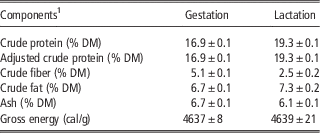
All animal procedures were approved by the contract research facility’s animal care and use committee. Pregnant first parity sows (n=218) were housed in the same building in individual gestation stalls in a commercial swine barn. Sows were blocked by average due date post-breeding and were assigned in a randomized complete block design to receive the gestation and lactation diets (Table 1), with or without MRF (900 mg/kg), representing a total of two dietary treatments. Sows were fed to maintain body condition from 3 to 100 days of gestation. At 100 days of gestation, an additional 0.9 kg/day of feed was offered until parturition. After parturition, feed was provided ad libitum. Sows had ad libitum access to water at all times during the experiment. Gestation and lactation diets provided nutrients that met or exceeded the recommendations of NRC (1998) for pregnant and lactating sows, respectively. A total of 62 milk samples (30 ml) were collected from individual sows during weeks 1 through 4 of lactation.
Proximate analysis of gestation and lactation experimental diets

DM=dry matter.
1 Calculated from the analysis of monthly feed samples. Values are presented as mean±s.e.m. (standard error of the mean).
Newborn piglets plus stillborns were weighed together as a litter. Piglets were fostered within treatment, as necessary, within 24 h after parturition and were weighed together as a new litter. After the post-foster litter weights were recorded, no more movement of piglets was allowed. Piglets were offered standard medicated creep feed starting on day 14 post-farrow.
Gene expression analysis
On day 10 post farrowing, one piglet per sow (n=12 per maternal treatment) was randomly selected and euthanized by blunt force trauma. The digestive tract was dissected and jejunum samples were flash-frozen in liquid N and stored at −80°C until analyzed. Jejunum tissue was homogenized with a Qiagen TissueRuptor (Qiagen, Valencia, CA, USA) and RNA was isolated with a Qiagen RNeasy Mini kit. RNA quantity and quality were assessed with a NanoDrop ND-1000 spectrophotometer (Thermo Scientific, NanoDrop Products, Wilmington, DE, USA) and an Agilent Bioanalyzer (Agilent Technologies, Inc., Santa Clara, CA, USA). Labeled cRNA for all microarrays was made according to package insert procedures for the GeneChip® Expression 3′ Amplification One-Cycle Target Labeling Kit (Affymetrix, Santa Clara, CA, USA). Labeled cRNA was hybridized to Affymetrix Porcine Genome arrays for 16 h at 45°C, followed by washing, staining and finally scanning in an Affymetrix GeneChip® Scanner 3000 7G.
Microarray data from the Affymetrix porcine chips was processed using GeneSpring GX 10.0 (Silicon Genetics, Redwood, CA, USA). Data were normalized and, to minimize the possibility of misleading findings, probe sets with very low signal intensity, which were labeled as ‘Absent’ by the Affymetrix algorithm were excluded from further analysis. The percent of genes expressed on the Porcine Genome Array was calculated using the number of probe sets labeled Present or Marginal based on an applied algorithm. After the data were uploaded to GeneSpring, a t-test was used to identify differentially expressed transcripts. Only genes that differed from the control (P⩽0.01) and had a corresponding signal intensity fold change ⩾1.2 relative to the control were deemed changed; genes not meeting these criteria were excluded from analysis. For analysis of canonical pathways and biological functions, genes that were differentially expressed by supplementation of MRF were uploaded into the Ingenuity® Pathways Analysis software (Ingenuity® Systems Inc., Redwood City, CA, USA).
Data analysis
Sow and sow plus litter were considered the experimental unit in gestation and lactation, respectively. All litter data were adjusted to a common weaning age of 23 days. Separations between production performance variable means were determined according to Student’s t-test analysis by comparing the MRF and control results. Chi-square analysis was used to test for significance between the MRF and control treatments for conception rate. Significant differences were declared at P⩽0.05.
Results
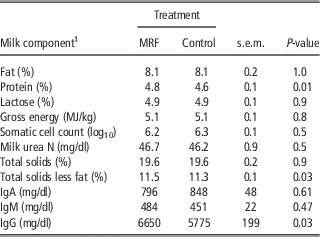
The milk composition from sows in the two experimental treatments showed that fat, lactose, milk energy, somatic cell count, milk urea N and total solids did not differ. However, protein (P=0.01) and total solids less fat (P=0.03) were greater in milk from the sows fed MRF compared with the controls. Milk IgA and IgM concentrations did not differ between the two treatments, but IgG concentration was greater (P=0.03) in the MRF-supplemented group (Table 2).
Milk composition from sows fed gestation and lactation diets supplemented with a yeast cell wall-based product containing an MRF (900 mg/kg) relative to diets without (Control)

MRF=mannin-rich fraction.
1 A total of 62 samples were collected from individual sows during weeks 1 to 4 of lactation. MRF (n=40) and control (n=22).
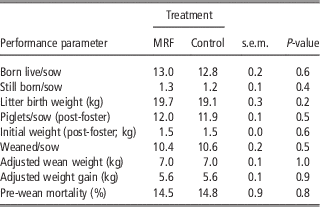
Sow production performance from farrowing to weaning indicated that there were no differences in the number of piglets born alive or dead between MRF-supplemented and control diet fed sows. In addition, there were no differences in the overall litter birth weights between treatments. As designed, post-foster number of piglets per sow and initial weight were similar on both treatments. The number of piglets weaned per sow, adjusted weaning weight, adjusted weight gain and pre-weaning mortality did not differ between treatments (Table 3).
Sow and piglet production performance parameters from birth to weaning

MRF=mannin-rich fraction.
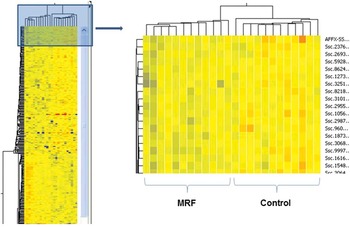
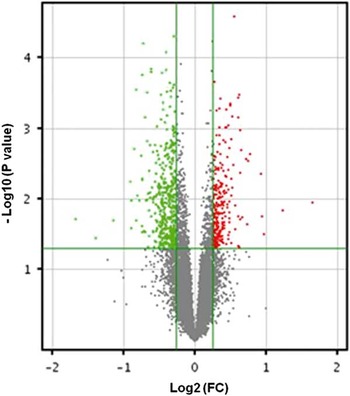
Hierarchical clustering was used to analyze the 24 GeneChips hybridized resulting in two different sets as function of pairwise distance. The separation obtained demonstrated an overall dietary effect as all the samples representing each of the two sets corresponded to the same treatment (Figure 1). Of the 23 000 probe sets present on the Porcine GeneChip, ∼60% of the transcripts were identified as expressed in the jejunum tissue, resulting in a total of 659 (397 down- and 262 upregulated) differentially expressed genes due to the maternal supplementation with MRF relative to the control (Figure 2).
Hierarchical clustering of the 24 swine GeneChips hybridized. The resulting cluster shows two different sets as function of pairwise distance indicating an overall dietary effect.

Volcano plot of the 659 differentially expressed genes in jejunum tissue of piglets from sows fed gestation and lactation diets with mannin-rich fraction (MRF) relative to without MRF. Genes ingreen represent significant downregulated genes and genes in red represent significant upregulated genes (P⩽0.01 and fold change ⩾1.2).

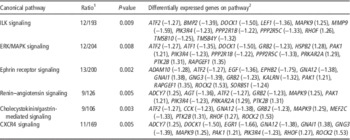
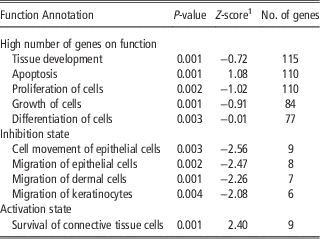
Differentially expressed genes were classified according to canonical pathways and biological functions. Several canonical pathways were found to be enriched based on the ratio of molecules affected and the overall P-value of the pathway (Table 4). The data set revealed different activated pathways that contained from 9 to 13 key genes that were affected by MRF maternal supplementation. The pathways selected included ephrin receptor signaling, cholecystokinin (CCK)/gastrin-mediated signaling and renin–angiotensin signaling among others (Table 4). The top biological functions were selected based on gene enrichment (more than 75 differentially expressed genes representing the function) and activation scores (Z-score). The analysis revealed several enriched functions related to tissue development, apoptosis, proliferation and differentiation of cells. Also different functions were revealed indicating activation (Z-score >2) or inhibition (Z-score<−2) state and predominantly were related to cell migration and survival (Table 5).
Selected canonical pathways in jejunum tissue of piglets.

ILK=integrin-linked kinase; ERK=extracellular signal regulated kinases; MAPK=mitogen-activated protein kinase.
Results are expressed as piglets from sows fed gestation and lactation diets with a yeast cell wall-based product containing a mannan-rich fraction relative to Control.
1 Differentially expressed genes/total number of genes on the pathway.
2 Differentially expressed genes with their respective fold change relative to treatment without MRF.
Selected biological function in jejunum tissue of piglets.

Results are expressed as piglets from sows fed gestation and lactation diets with a yeast cell wall-based product containing a mannan-rich fraction relative to Control.
1 Activation (Z-score >2) or inhibition (Z-score <−2).
Discussion
The current study demonstrates that maternal MRF supplementation during gestation and lactation can alter the intestinal gene expression in the progeny. Supplementing with MRF has previously demonstrated benefits by promoting the proper function of the gastrointestinal tract and indirectly impelling good health and growth (van der Peet-Schwering et al., Reference van der Peet-Schwering, Jansman, Smidt and Yoon2007; Shen et al., Reference Shen, Carroll, Yoon, Mateo and Kim2011; Zhao et al., Reference Zhao, Jung and Kim2012). Our study is in agreement with previous results that reported MRF supplementation increased levels of IgG in sow colostrum, which may enhance piglet performance by improving immunocompetence (Jurgens et al., Reference Jurgens, Rikabi and Zimmerman1997). In mammals such as pigs, neonates are born agammaglobulinemic relying entirely on colostrum consumption to obtain the immunoglobulins for systemic immune protection (Salmon et al., Reference Salmon, Berri, Gerdts and Meurens2009). Immunogolblin G constitutes the major immunoglobulin present in colostrum and milk in pigs and is fundamental for passive immunity transfer (Hurley and Theil, Reference Hurley and Theil2011). The mechanisms by which IgG improves immune function have not been fully elucidated; other factors such as timing and location (in the intestine or in circulation) have an impact. However, our results demonstrate that supplementing the sow during pregnancy and lactation is an effective strategy to increase IgG availability during a fundamental stage of piglet development. Before gut closure (the initial 24 to 36 h after birth), IgG can pass undigested across the gut epithelium, increasing the serum levels in portal circulation (Lecce et al., Reference Lecce, Matrone and Morgan1961; Hardy, Reference Hardy1969; Lecce and Broughton, Reference Lecce and Broughton1973). After gut closure, IgG can remain intact in the gastrointestinal tract and capable of binding to an antigen, functioning as anti-viral or anti-microbial agents and promoting a healthier and more functional gut wall (Jurgens et al., Reference Jurgens, Rikabi and Zimmerman1997). The internalization of IgG decreases over time but is persistent until 2 to 3 weeks after birth (Clarke and Hardy, Reference Clarke and Hardy1971; Leece, Reference Leece1973). In addition to IgG, there are other nutritional components in maternal milk that can affect the neonatal immune system and intestinal development (Simmen et al., Reference Simmen, Cera and Mahan1990; Hanson et al., Reference Hanson, Silfverdal, Stromback, Erling, Zaman, Olcen and Telemo2001; Blum, Reference Blum2006; Newburg and Walker, Reference Newburg and Walker2007). Our study reported a greater percentage of protein and total solids less fat in the milk of the group supplemented with MRF. Although specific amino acid measurements were not performed in our study, increasing the available protein in milk may increase the anabolic effect attributed to muscle and liver protein synthesis supported by the amino acids in the maternal milk q(Frank et al., Reference Frank, Escobar, Suryawan, Kimball, Nguyen, Jefferson and Davis2005). In addition, greater milk protein concentrations have been shown to increase the products of protein digestion that have an influential role in different regulatory systems including immune function, food intake, glucose and lipid metabolism and body weight (Jahan-Mihan et al., Reference Jahan-Mihan, Luhovyy, El Khoury and Anderson2011).
Our gene expression results from the jejunum collected 10 days post-farrowing support mechanisms that can benefit performance later in the life of the piglets as consequence of maternal MRF supplementation. The canonical pathways selected are involved directly in the development, functioning and immunity of the gastrointestinal tract. The integrin-linked kinase (ILK) signaling pathway has been related with the regulation of multiple functions including development, migration, differentiation and proliferation of the intestinal epithelium (Beaulieu, Reference Beaulieu1997; Hynes, Reference Hynes2002). In addition, the mitogen-activated protein kinase (MAPK) and extracellular signal regulated kinases (ERK) pathways also control fundamental processes related to proliferation, differentiation, survival and apoptosis (Waskiewicz and Cooper, Reference Waskiewicz and Cooper1995). Positive activation of these pathways suggest that maternal supplementation with MRF has a positive influence on cellular development of the intestinal tract during the neonatal period. Previous results from neonatal pigs have shown that ILK is crucial in the activation of protein kinase B that further regulated glycogen and protein synthesis (Suryawan and Davis, Reference Suryawan and Davis2005). Furthermore, there is evidence of MAPK regulating intestinal cell differentiation through downstream activation of transcription factors that regulate multiple genes expressed in the intestinal epithelium (Houde et al., Reference Houde, Laprise, Jean, Blais, Asselin and Rivard2001).
Ephrin signaling has been associated with the continuous renewal and integrity of the intestinal epithelium as ephrin receptors closely interact with stem cells, responsible for cell balance of tissue homeostasis (Heath, Reference Heath2010). The activation of the ephrin receptor signaling pathway, as a result of maternal supplementation with MRF, allows a rapid turnover rate maintaining the intestine integrity that is necessary for nutrient absorption. In addition, the renin–angiotensin signaling (RAS) pathway regulates fluid and electrolyte homeostasis in the organism (Crowley and Coffman, Reference Crowley and Coffman2012). However, the role of the RAS pathway is fundamental for the gastrointestinal tract since it controls absorption and could also be involved in the regulation of mucosal function (Fandriks, Reference Fandriks2011). Gastrin and CCK are responsible for the CCK/gastrin-mediated signaling pathway that was activated in our results. Gastrin is responsible for acid secretion and maintenance of the gastric mucosa (Jain and Samuelson, Reference Jain and Samuelson2006) while CCK promotes digestion through different independent mechanisms (Bragado et al., Reference Bragado, Groblewski and Williams1998; Williams, Reference Williams2001; Thomas et al., Reference Thomas, Hellmich, Townsend and Evers2003). Previous results support the importance of CCK and gastrin for the fetal (Xu and Cranwell, Reference Xu and Cranwell1991) and neonatal (Lebenthal and Lebenthal, Reference Lebenthal and Lebenthal1999) gastrointestinal development in pigs.
Signaling of chemokine C-X-C motif receptor 4 (CXCR4), a chemokine receptor in the G protein coupled receptor family, was activated as a consequence of maternal supplementation with MRF. Activation of CXCR4 suggests potential regulation of humoral immunity (Nie et al., Reference Nie, Waite, Brewer, Sunshine, Littman and Zou2004) since this receptor is expressed commonly by immune cells and, in response to binding its ligand SDF-1 (stromal cell derived factor 1), triggers the migration and recruitment of immune cells (Bleul et al., Reference Bleul, Farzan, Choe, Parolin, Clark-Lewis, Sodroski and Springer1996; Cheng et al., Reference Cheng, Zhao, Sun, Hu, Wu, Cen, Wu and Pei2000). The CXCR4 is associated with the differentiation of neural progenitor cells in a swine model, having potential implications in the development of the central nervous system (Schwartz et al., Reference Schwartz, Nethercott, Kirov, Ziaeian, Young and Klassen2005; Yang et al., Reference Yang, Gu, Menges and Klassen2012). In addition, CXCR4 has been associated with IgG serum levels in human studies (Buckner et al., Reference Buckner, Moir, Kardava, Ho, Santich, Kim, Funk, Nelson, Winckler, Chairez, Theobald-Whiting, Anaya-O'Brien, Alimchandani, Quezado, Yao, Kovacs, Chun, Fauci, Malech and De Ravin2013; Uo et al., Reference Uo, Hisamatsu, Miyoshi, Kaito, Yoneno, Kitazume, Mori, Sugita, Koganei, Matsuoka, Kanai and Hibi2013). In a disease setting, IgG and CXCR4 expression is an indicator of intestinal inflammation (Buckner et al., Reference Buckner, Moir, Kardava, Ho, Santich, Kim, Funk, Nelson, Winckler, Chairez, Theobald-Whiting, Anaya-O'Brien, Alimchandani, Quezado, Yao, Kovacs, Chun, Fauci, Malech and De Ravin2013). However, in infants the expression of CXCR4 plays a prominent role in the innate immune system (Shalekoff et al., Reference Shalekoff, Gray and Tiemessen2004). Altogether, our results indicate that IgG mediates the signaling of CXCR4 that can potentially regulate the foundation of the innate immune system in neonatal pigs.
The biological functions analysis revealed several biological functions in the piglet jejunum resulting from maternal MRF supplementation. Evidence of constant cell turnover in the intestinal epithelium was revealed in our study because biological functions like proliferation, differentiation and apoptosis were greatly enriched. The enrichment of these functions is in agreement with previous studies that have shown intestinal development gene expression profiles during early life affected by maternal nutrition during gestation (Meyer et al., Reference Meyer, Neville, Reed, Taylor, Reynolds, Redmer, Hammer, Vonnahme and Caton2013). Our results also reported different functions related to inhibition in cell migration; these functions should be interpreted as regular development as opposed to the process of migration that in most cases is associated with an injury or inflammation response (Heath, Reference Heath1996). Survival of connective tissue was reported to be in an activation state and may represent positive structural development of the intestinal tract (Ishizuya-Oka and Shimozawa, Reference Ishizuya-Oka and Shimozawa1992).
Conclusions
Supplementation of MRF during gestation and lactation in sows increased concentrations of IgG in milk, which can increase passive immunity transfer to the piglets. Overall, there was no effect of maternal supplementation on piglet performance to weaning. Piglets from sows supplemented with MRF showed activation of gene expression pathways involved in tissue development, functioning and immunity in the jejunum. In addition, biological functions indicated cell proliferation and less migration of cells, implying intestinal development and epithelial integrity. Gene expression patterns affected by passive immunity transfer showed beneficial indicators that could benefit animal performance in the long term. Further studies are needed to evaluate piglet performance during and after weaning since this transition represents a period of challenge to the immune system that may further demonstrate the advantages of maternal MRF supplementation.
Acknowledgments
The authors would like to acknowledge Mr Ben Shafer and Ms Marquisha Paul for their technical assistance during sample collection. The authors also declare that the authors might have a potential conflict of interest as they are employed by Alltech Inc. (source of funding).