





Dementia is a neurodegenerative condition characterised by an acquired and progressive loss of cognition across multiple domains severe enough to affect social or occupational function. Reference Arvanitakis, Shah and Bennett1
Although most people with dementia are over 65 years of age, according to the most recent statistics from Alzheimer’s Society, an estimated 70 800 people in the UK have young-onset dementia (YOD) (dementia diagnosis before the age of 65 years). 2 There has been increasing emphasis on timely diagnosis and access to specialist assessment in this population. However, cognitive difficulties in this age group are often multifactorial, and not all reflect a neurodegenerative process. Reference Abdullah, Critchfield, Maltby and Mukaetova-Ladinska3
Across the UK, YOD services vary considerably in structure and remit, ranging from generic ‘memory clinics’ to specialist diagnostic services and those offering ongoing post-diagnostic support. Reference Rayment and Kuruvilla4 Much of the existing literature has focused on the experiences and needs of those who receive a YOD diagnosis, Reference Stamou, La Fontaine, Gage, Jones, Williams and O’Malley5 and far less attention has been paid to the growing number of younger adults seeking help for troubling cognitive symptoms but who do not have YOD.
In recent years, there has been a noticeable increase in younger people presenting with memory and cognitive concerns. This trend is evidenced following the COVID-19 pandemic. Reference Arbula, Pisanu, Bellavita, Menichelli, Lunardelli and Furlanis6,Reference Herrera, Pérez-Sánchez, San Miguel-Abella, Barrenechea, Blanco and Solares7 This growing demand places additional pressure on already stretched services. We therefore undertook a service evaluation to examine how rising volumes are managed and to explore the profiles of those not accepted for assessment.
Aims and objectives
The service evaluation was guided by three main aims:
-
(a) to analyse referral trends over 4 years;
-
(b) to identify reasons for non-acceptance and gaps in existing care pathways, particularly for patients presenting with non-neurodegenerative cognitive difficulties;
-
(c) to evaluate re-referral patterns and eventual diagnostic outcomes pertaining to dementia diagnoses.
Method
Triage process for Young Onset Dementia Assessment Service (YODAS) in Leicestershire Partnership NHS Trust (LPT)
The YODAS in Leicester provides specialist diagnostic assessment for individuals under 65 with suspected dementia. The service generally offers assessments for individuals aged 40–65 but on occasion will also assess those under 40 where there is a known familial form of Alzheimer’s disease. The YODAS team receives referrals from a range of sources. This includes general adult psychiatrists, neurologists and other hospital physicians, but the majority are from general practitioners (GPs). Referrals are made using a primary care service for mental health (PRISM) form for ease of access. The form prompts referrers to consider reasons for referral and to highlight key information that is required; however, it does not invite extensive free-text rationale for referral. These referrals are usually accompanied by cognitive screening results from instruments such as the General Practitioner Assessment of Cognition (GPCOG), Six Item Cognitive Impairment Test (6CIT), Mini Mental State Examination (MMSE) or Addenbrooke’s Cognitive Examination III (ACE-III). YODAS also offers an Advice and Guidance service whereby general practitioners can discuss potential patients prior to referring.
Referrals over the week are collated by dedicated administration staff, a list is produced and the referrals are then discussed in the weekly triage meeting. This is attended by both YODAS team consultant psychiatrists (M.C. and E.B.M.-L.), along with attached resident doctors. Each referral is discussed in turn and available electronic patient records are reviewed, along with any pre-existing neuroimaging. Polypharmacy is considered, along with calculation of anticholinergic burden if relevant. Psychiatric history is considered, with scrutiny of any past or current treatment. Comorbid conditions are also reviewed to consider whether reported cognitive impairment might be attributed to these. Each referral is usually discussed for around 10–20 min, depending on information available. If sufficient information is available and there is a clear rationale to suspect a neurodegenerative dementia, then the patient is added to the assessment list and offered an assessment. This generally consists of a 90 min initial assessment with one of the consultant psychiatrists on the team. When appropriate, neuroimaging (usually magnetic resonance imaging; MRI) is requested before the initial assessment.
If insufficient information is provided to support a suspicion of young-onset neurodegenerative dementia, the referral is not accepted. A letter is sent outlining the reason for non-acceptance, highlighting the nature of the required information, suggesting further treatment or investigation strategies, or signposting the referrer to a more appropriate service. It is these referrals that were not accepted that we considered in the current evaluation.
Service evaluation
We conducted a retrospective review of trends in referrals to YODAS from January 2020 to December 2024. This was followed by a more in-depth analysis of the referrals that were not accepted during a 4-year period (1 August 2019 until 31 July 2023).
Data were extracted from electronic patient records (SystmOne) and referral logs. We collected information on patient demographics and referral sources. We analysed referrals made via email, letters and more formally through the dedicated PRISM referral forms and extracted information relating to cognitive testing and primary diagnosis at the point of referral. We extrapolated information relating to reasons for non-acceptance from the triage discussion documented on patient records as well as by reviewing the letters of non-acceptance sent back to referrers. We tracked whether individuals received a dementia diagnosis either by YODAS or from another service, such as Mental Health Services for Older People (MHSOP) or neurology, up to the data capture date of February 2025.
In the period under review, YODAS did not accept a total of 849 referrals. These referrals equated to 769 patients, as some had been referred repeatedly. We were unable to collect data on 9 of the 769, owing to lack of relevant information. These 9 patients were therefore excluded, giving data on a total of 760 patients. Prior to 2019, when data collection commenced, 51 of these patients had already experienced at least 1 referral that was not accepted.
Statistical analysis
Data collection and analysis was done by two authors (A.K. and T.C.). Analysis was conducted using Microsoft Excel version 2511, Build 16.0.19426.20186 (Microsoft Corporation, Redmond, Washington, USA; https://www.microsoft.com/en/microsoft-365/excel?market=af#Download-the-app), using descriptive statistical methods such as percentages. Independent two-sample t-tests were also used to compare age-related data between men and women to calculate P-values.
Ethical approval
The project, in its initial stages of design, was discussed in a meeting with the WeImproveQ Team within LPT. It was approved and registered as a service development project online through the Audit Management and Tracking (AMaT) platform. The Health Research Authority decision tool (HRA 2018) was used to further determine that the project was not research. Before starting the project, the need for formal ethics committee submission was considered and we were advised by our WeImproveQ Team that this was not required.
Results
Referral trends
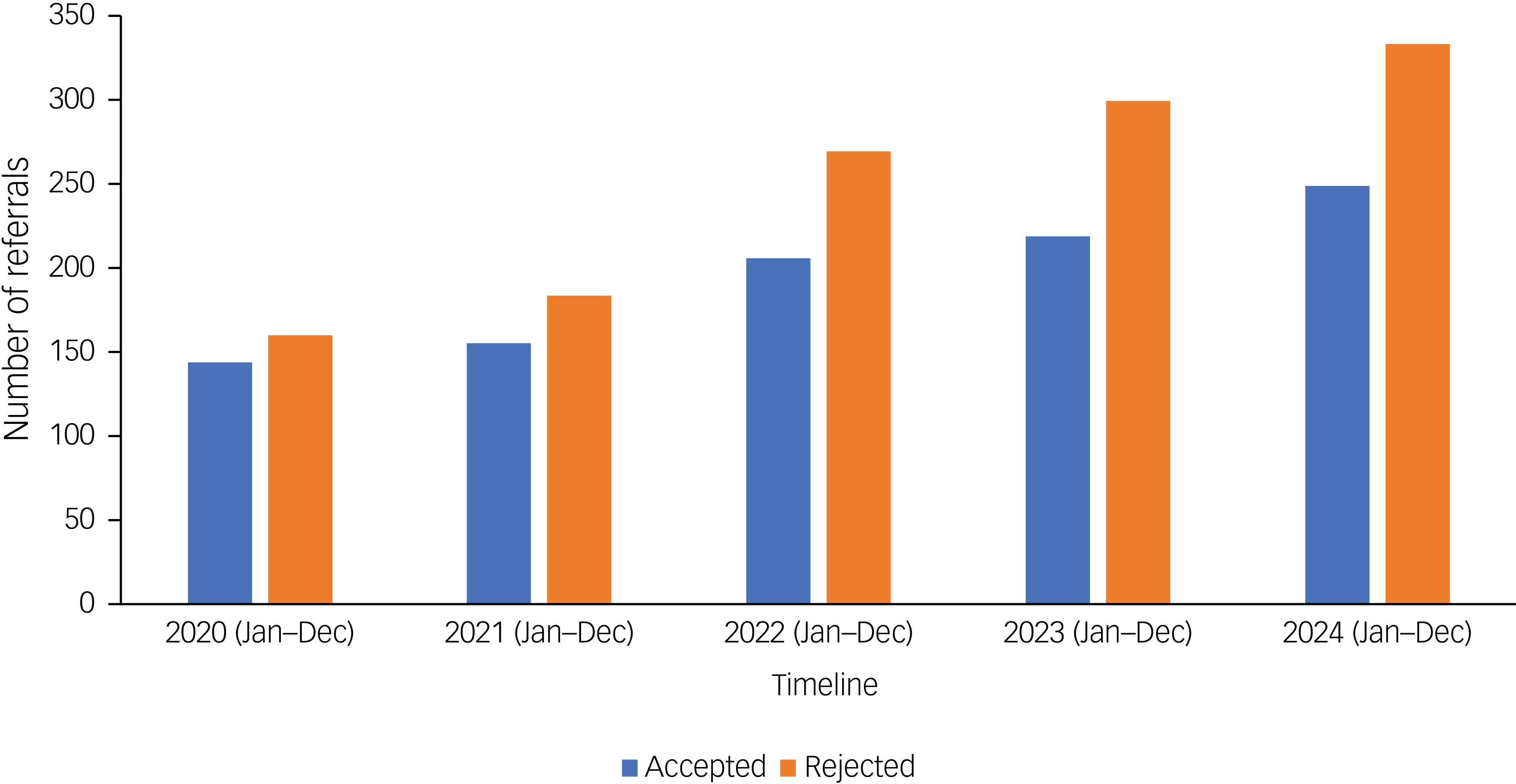
Between 2020 and 2024, total referrals almost doubled, rising from 302 in 2020 to 581 in 2024 (Fig. 1). Despite this increase, the proportion of accepted versus non-accepted referrals remained relatively stable, with only a modest increase in the non-acceptance rate – from 52.6% in 2020 to 57.3% in 2024 – suggesting consistent triage thresholds over time.
Outcomes of referrals (2020–2024) to Leicester Young Onset Dementia Assessment Service (YODAS). Incoming referrals showed a clear upward trend, whereas acceptance and non-acceptance proportions remained largely stable.

Demographics
Of the 760 individuals (non-accepted referrals) included in the service evaluation, 395 (51.9%) were female and 365 (48.1%) were male. At the time of referral, 70 individuals (9.2%) were under the age of 40, with the youngest aged 17 years. The mean age was 53.4 years. An independent samples t-test showed no significant difference in mean age between men and women (men: mean 54.6 years, s.d. = 9.1; women: mean 53.4 years, s.d. = 8.3; t = 1.74, P = 0.083).
Referral source
The majority of non-accepted referrals came from GPs (677; 89.08%), with the next most common referral source being adult mental health services (n = 41; 5.39%), followed by neurology (n = 25; 3.25%).
Cognitive testing
As part of the referral form, YODAS requests a baseline cognitive test to be completed and the score to be included on the referral. The most common test used was the GPCOG, followed by the 6CIT. However, 165 (21.7%) of the non-accepted referrals did not include any form of cognitive screening prior to referral.
Pre-existing diagnoses
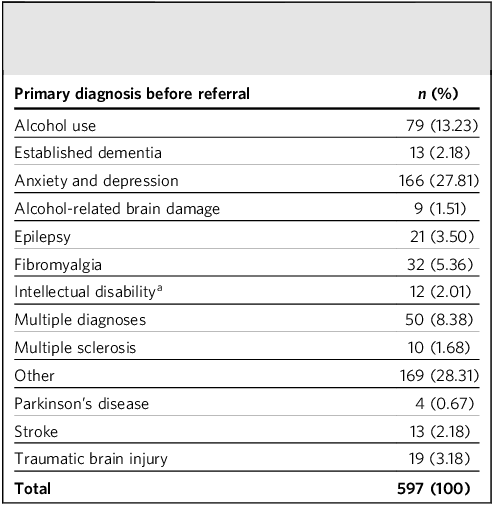
One of the parameters we also reviewed was whether any of the non-accepted referrals had a pre-existing primary diagnosis that could possibly account for their memory problems: 597 of the 760 had a potentially relevant primary diagnosis noted on the referral form (Table 1). The most commonly presenting primary diagnoses were anxiety and depression, alcohol-related conditions, fibromyalgia and traumatic brain injury, with smaller proportions of neurological disorders and established dementia. Categories under ‘other’ included chronic migraine, severe mental illness, delirium, post-craniotomy cognitive change, hypothyroidism and menopause, to name a few.
Primary diagnosis at referral to Leicester Young Onset Dementia Assessment Service (YODAS), 2020–2024

Table 1 Long description
A table titled ‘AQ4’ with primary diagnoses before referral and their corresponding counts and percentages. The table has two columns: Primary diagnosis before referral and n (%). It lists various diagnoses such as Alcohol use, Established dementia, Anxiety and depression, Alcohol-related brain damage, Epilepsy, Fibromyalgia, Intellectual disability, Multiple diagnoses, Multiple sclerosis, Other, Parkinson’s disease, Stroke, and Traumatic brain injury. The total number of cases is 597. Each row provides the count and percentage for each diagnosis. For example, Anxiety and depression has 166 cases (27.81 percent), while Established dementia has 13 cases (2.18 percent). The ‘Other’ category has the highest count with 169 cases (28.31 percent).
a. Intellectual disability is also known as learning disability in UK health services.
Re-referrals
Out of the 760 individuals whose referrals were not accepted, 218 (28.7%) were referred a second time, and another 73 (9.61%) were referred a third time within the 4-year time period. There was an average period of 21 months between the first re-referral and the second. Of the 218 individuals re-referred again, 145 (two-thirds) were accepted.
Reasons for non-acceptance
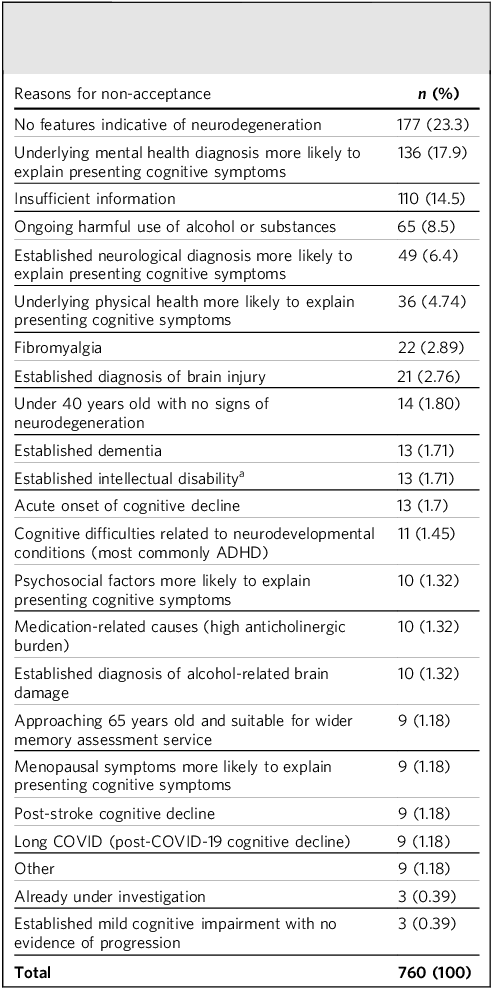
Data were also collected on reasons for non-acceptance. These reasons were stratified into distinct categories. As shown in Table 2, referrals were most commonly not accepted because of absence of features suggestive of neurodegeneration. Of the 110 referrals not accepted because of insufficient information, 65 were re-referred, and 50 of these were subsequently accepted.
Reasons for non-acceptance of referrals Leicester Young Onset Dementia Assessment Service (YODAS), 2020–2024

Table 2 Long description
A table with 20 rows and 3 columns detailing reasons for non-acceptance of referrals to the Leicester Young Onset Dementia Assessment Service. The columns are labeled ‘Reasons for non-acceptance’, ‘n’, and ‘%’. The table lists various reasons for non-acceptance along with the corresponding number and percentage of cases. Notable reasons include ‘No features indicative of neurodegeneration’ with 177 cases (23.3 percent), ‘Underlying mental health diagnosis more likely to explain presenting cognitive symptoms’ with 136 cases (17.9 percent), and ‘Insufficient information’ with 110 cases (14.5 percent). Other reasons include ‘Ongoing harmful use of alcohol or substances’, ‘Established neurological diagnosis more likely to explain presenting cognitive symptoms’, and ‘Underlying physical health more likely to explain presenting cognitive symptoms’, among others.
ADHD, attention-deficit hyperactivity disorder.
a. Intellectual disability is also known as learning disability in UK health services.
Recommendations
For 199 (26%) of those whose referrals were not accepted, YODAS recommended alternative appropriate services. The most common recommendations were referrals to community mental health teams (n = 69; 34.6%), neurology (n = 16; 8%) and alcohol services (n = 14; 7%). Other recommended services included neuropsychiatry, neurorehabilitation and psychology.
Outcomes
Of the 760 referrals not accepted, only 45 individuals (6%) went on to receive a confirmed dementia diagnosis during the analysed period, with 15 individuals re-referred close to the end of data collection time still awaiting assessment or under investigation at the time of data collection. The majority of those who received a dementia diagnosis received it from YODAS, with some outliers diagnosed externally by a GP or the MHSOP (as they were almost 65 years old). In total, 34 individuals had died before at the point of data collection.
Discussion
This service evaluation has quantified the increasing pressure under which Leicester YODAS has been managing, a pressure that continues to escalate. Referrals to YODAS have almost doubled between 2020 and 2024, while service provision capacity has remained unchanged. The rise in referrals locally is reflective of broader national trends, with memory services continuing to see rising volumes of primary care referrals for people under the age of 65. Reference Sikdar, Bhattacharyya and Mukherjee8 This trend may reflect heightened public awareness of dementia, with research showing that 58% of patients and 71% of next-of-kin are concerned that cognitive symptoms of any nature may represent the onset of dementia, thus increasing referrals from the so-called ‘worried well’ population. Reference Sutherland, Kirk, Karunanayake, O’Connell and Morgan9 This has been further exacerbated over the past 5 years by cognitive impairment in post-COVID-19 syndrome (‘long COVID’), Reference Arbula, Pisanu, Bellavita, Menichelli, Lunardelli and Furlanis6,Reference Herrera, Pérez-Sánchez, San Miguel-Abella, Barrenechea, Blanco and Solares7 placing the current service model under sustained and critical pressure.
Across the UK, YOD services vary considerably in structure and scope, ranging from those incorporated within generic all-age ‘memory clinic’ models, to purely diagnostic services, to those offering post-diagnostic follow-up and personalised care planning. Specialist YOD services have consistently been associated with superior patient outcomes, such as improved continuity of care, quality and patient satisfaction. Reference Stamou, La Fontaine, Gage, Jones, Williams and O’Malley5 There is therefore an expectation that these services provide high-quality assessments while also maintaining acceptable waiting times from referral to diagnosis.
Despite this, the period from referral to diagnosis in dementia remains long. Although there is agreement that targeted strategies are urgently needed to improve diagnostic timelines, it is equally important to consider how systems within specialist services are structured to manage increasing referral volumes while maintaining the quality of care expected. This is in line with the recommendations outlined in Royal College of Psychiatrists’ report on mental health service provision for young-onset dementia. 10
A key quantitative indicator of the strain experienced by YOD services is the increase in waiting times. According to the National Audit of Dementia (NAD) Spotlight Audit (2023–24), the mean waiting time from referral to first appointment has increased from 66 to 88 days, and from referral to diagnosis from 124 to 151 days across all dementias. 11 The 2019 benchmark for referral to YOD diagnosis was 13 weeks; Reference Souris12 however, locally, the average wait from referral to first YODAS assessment had increased to 19 weeks by August 2024 (M.C. and E.B.M.-L. personal communication), and continues to rise.
Comprehensive assessment for suspected YOD is inherently resource intensive, requiring multidisciplinary input and a broad differential diagnostic work-up to distinguish between neurological, psychiatric and systemic aetiologies Reference Rayment and Kuruvilla4 An audit of a memory assessment service in Cornwall quantified this workload at approximately 4 h of combined clinical and administrative time per assessment. Reference O’Kelly, Richards and Figueroa Gorospe13 These findings raise an important question regarding sustainability: how can a service designed for a relatively low-prevalence condition maintain assessment quality in the context of increasing demand?
Previous work has suggested a high likelihood of service saturation if strategies for adequate screening were not explored. Reference O’Kelly, Richards and Figueroa Gorospe13 At the same time, the diagnostic complexity of cognitive presentations in younger adults significantly increases the risk of both under- and over-diagnosis, especially where symptoms overlap with pre-existing mental illness, intellectual disability or functional disorders. 10 These challenges have important implications for service efficiency and the appropriate use of specialist resources.
Much of the existing research on YOD services in the UK has focused on the experiences of individuals who ultimately receive a diagnosis of young-onset dementia. However, those who receive a diagnosis represent a relatively small proportion of those referred to specialised memory services. Data from the 2019 National Memory Service Audit indicate that among patients under the age of 65 accepted for assessment by memory services, 23% were diagnosed with dementia. Of those not diagnosed with dementia, 40% received no formal diagnosis, while others were diagnosed with MCI (17%), a primary psychiatric disorder (15%) or functional cognitive disorder (FCD) (6%). Reference Souris12 Multiple local studies further illustrate the heterogeneity of presentations in YOD clinics and the relatively low proportion of referrals that ultimately result in a dementia diagnosis. Reference Sikdar, Bhattacharyya and Mukherjee8 This highlights the critical role of triage and the need to consider outcomes for those who are declined specialist assessment.
This increasing group of individuals with non-organic cognitive complaints, referred to memory services in search of clarification or reassurance, has received little attention. If memory is problematic, there are more frequent concerns about ageing and the potential for dementia, Reference Cahill, Gibb, Bruce, Headon and Drury14 and many have been told that a referral has been made on their behalf to the ‘memory services for younger people’. Uncertainty among clinicians as to the scope of local YOD services creates further variability in referrals. Reference Steiner, Ee, Dubois, MacMillan, George and McBride15
In our region, the service was formally renamed from ‘Young Person’s Memory Service’ to ‘Young Onset Dementia Assessment Service’ (YODAS) in 2018, a change intended to reflect its specialist diagnostic remit. Despite this, it continues to be perceived by both referrers and patients as a generic ‘memory clinic’ for younger people. There is often an expectation that YOD services function as a single, supportive point of contact for all cognitive concerns in individuals under 65 – a perceived ‘one-stop-shop’ model. Reference Steiner, Ee, Dubois, MacMillan, George and McBride15 When this expectation is unmet, outcomes can be disappointing. Many individuals are declined before formal assessment because the likelihood of an underlying neurodegenerative process is considered low, leaving this cohort without clear explanations or defined pathways for addressing their ongoing cognitive difficulties.
Our evaluation identified several gaps in local referral pathways, particularly for individuals whose cognitive symptoms are attributable to non-neurodegenerative causes. There may be opportunities for improved identification and management of alternative conditions such as FCD. Reference Sikdar, Bhattacharyya and Mukherjee8 FCD is frequently encountered in memory clinic populations, is estimated to account for 12–56% of new referrals to specialist memory clinics and remains under-recognised in routine practice. Reference Ball, McWhirter, Ballard, Bhome, Blackburn and Edwards16 Distinguishing FCD from early neurodegenerative MCI has been described as a core challenge in cognitive services, Reference Ball, McWhirter, Ballard, Bhome, Blackburn and Edwards16 increasing the risk of diagnostic uncertainty and inappropriate investigation or management. Reference Cabreira, Frostholm, McWhirter, Stone and Carson17 We find that individuals with FCD then go from pillar to post between different specialties, Reference Ball, McWhirter, Ballard, Bhome, Blackburn and Edwards16 none of which are equipped to treat them.
A substantial number of referrals were not accepted owing to ongoing harmful alcohol consumption, as patients are usually expected to reduce alcohol consumption before a formal cognitive assessment can take place. Although Leicester has an alcohol and drug service (Turning Point), its main objective is behavioural intervention, and there are no clear pathways for the assessment of cognitive impairment arising from chronic alcohol consumption. Similarly, those with a prior diagnosis of alcohol-related brain damage were not accepted into the service in the same context.
The same pattern emerged in referrals for patients with fibromyalgia: cognitive symptoms that featured prominently in these referrals were complaints of fatigue, attention difficulties and mental slowness – symptoms commonly referred to as ‘fibrofog’. Although there was clinical merit in making a diagnosis that such presentations were not neurodegenerative, alternative local pathways for assessment and management for individuals presenting with these cognitive symptoms remain to be developed.
There were further gaps in local neurorehabilitation services and limited awareness of services that existed to support patients with a history of brain injury or post-stroke cognitive decline. In these situations, cognitive problems were more likely related to past neurological events than to a new degenerative process; however, referral to memory services resulted because clear alternative pathways did not exist. All in all, the lack of clear pathways for non-degenerative cognitive disorders has left the memory clinics as a default pathway for any cognitive concern in younger adults.
Follow-up of individuals whose referrals were not accepted by YODAS showed that only 6% subsequently received a diagnosis of dementia, indicating that the majority of those not accepted were appropriately directed away from the specialist neurodegenerative pathway. It is equally important, therefore, that alongside raising awareness and promoting timely referral of young people with memory concerns, clear guidance be developed to ensure that only appropriate patients are referred to specialist secondary care services.
The situation is complicated by the fact that the currently recommended cognitive screening tests for primary care 18 are not validated for use in younger people with suspected YOD. Reference Mukaetova-Ladinska, Abdullah, Critchfield and Maltby19 Instruments such as the GPCOG may also lack validity in culturally and linguistically diverse populations or in individuals with limited literacy, in whom poor performance may reflect sociodemographic factors rather than cognitive decline. Reference Hilsabeck, Benge, Scott, Thotakura, Rana and Schmitz20 Cognitive screening tools also lack discriminant validity in distinguishing depressive cognitive symptoms from early neurodegeneration. Previous local YODAS research demonstrated that incorporating a brief mood measure, such as the four-item Geriatric Depression Scale (GDS-4), into primary care screening may facilitate earlier identification and treatment of depression, reducing unnecessary referrals to memory services. Reference Abdullah, Critchfield, Maltby and Mukaetova-Ladinska3
In November 2022, the Leicester, Leicestershire and Rutland Living Well with Dementia Strategy gathered views from people with young-onset dementia and their carers to inform the Supporting Well Strategy for 2024–2028, including an objective to refresh YOD pathways. 21 It is hoped that the findings of this evaluation will inform ongoing pathway development and integrated care planning.
Lack of scrutiny and adaptation in response to growing referral pressures may lead to saturation in YOD services, even longer waiting times and potentially delayed care for individuals with YOD. We encourage YOD services across the UK to invest in the development of dedicated, consultant-led triage. Moreover, collaboration with partner agencies, including NHS Talking Therapies service, neurorehabilitation services, chronic pain and pain management services, and addiction services, is crucial in developing formal pathways for non-degenerative cognitive disorders.
About the authors
Amna Khalil, MBBS, MRCPsych, is a higher trainee (Specialty Trainee Year 4, ST4) in psychiatry at Kent and Medway Mental Health NHS Trust, Seashells Centre, Sheerness, Kent. Timona Chetty, MBBS, MRCPsych, is a higher trainee (ST4) in psychiatry at The Evington Centre, Leicestershire Partnership NHS Trust, Leicester, UK. Elizabeta B. Mukaetova-Ladinska, MD, MMedSci, PhD, FRCPsych, is Professor in Old Age Psychiatry in the Department of Psychology and Vision Sciences, University of Leicester, and an honorary consultant old age psychiatrist at The Evington Centre, Leicestershire Partnership NHS Trust, Leicester, UK. Matthew Critchfield, MBChB, MRCPsych, is a consultant old age psychiatrist at The Evington Centre, Leicestershire Partnership NHS Trust, Leicester, UK.
Data availability
The data that support the findings of this service evaluation are available on request from the corresponding author M.C. The data are not publicly available as they contain information that could compromise the privacy of patient data.
Acknowledgements
We thank Dr Chidinma Okafor for data collection and Kanta Chauhan for the upkeep of referral records and administrative support for YODAS.
Artificial Intelligence use: No artificial intelligence tools have been used in the research or writing process for this manuscript.
Author contributions
A.K. contributed to formulating the service evaluation questions, gaining approval, designing the questions, collecting the data, analysing the data, and drafting and writing the manuscript. T.C. contributed to data collection, carried out data analysis, and contributed to drafting and revising the manuscript. E.B.M.-L. contributed to the formulation of the evaluation and study design, provided overall supervision and oversight, contributed to writing and critical appraisal of the manuscript. M.C. conceptualised the formulation of the evaluation and study design, participated in data acquisition, provided supervision and oversight throughout the process, contributed to writing and critical review of the manuscript.
Funding
This research received no specific grant from any funding agency, commercial or not-for-profit sectors.
Declaration of interest
M.C. and E.B.M.-L. are both consultant psychiatrists in YODAS. A.K. and T.C. were both employed by Leicestershire Partnership NHS Trust at the time of this evaluation.

 Open access


eLetters
No eLetters have been published for this article.