Being able to attract and retain a mate is of utmost evolutionary significance, because those who are not able to do so are unlikely to have their genetic material represented in future generations. As a consequence, strong selection pressures are exercised on men and women to evolve mechanisms or adaptations that will enable them to be successful in this endeavour (Buss, Reference Buss2017). Examples of such adaptations are mate preferences that enable individuals to screen prospective mates (Buss, Reference Buss1989); emotions such as love, lust and loneliness that motivate individuals to allocate resources in mating effort (Apostolou, Reference Apostolou2016b); and sexual jealousy, which motivates individuals to guard their partners (Buss, Reference Buss2000). The presence of these mechanisms is expected to ensure that most people do reasonably well in the domain of mating, a prediction that does not appear to hold.
More specifically, a recent study found that nearly one in two adults faced difficulties in attracting or retaining mates (Apostolou, Shialos, Kyrou, Demetriou, & Papamichael, Reference Apostolou, Papadopoulou and Georgiadou2018). In the same vein, two different studies found that about one in two singles in the Greek cultural context were involuntary so — they wanted to be in a relationship but they faced difficulties in doing so (Apostolou, Papadopoulou, & Georgiadou, Reference Apostolou, Papadopoulou and Georgiadou2018). Moreover, the high prevalence of singlehood in post-industrial societies (Jones, Reference Jones2012; Saad, Reference Saad2015) is also suggestive of the difficulties that people face in attracting and retaining mates. It has been proposed that the mismatch between ancestral and modern environments has affected several of the adaptations involved in mating, resulting in people experiencing poor mating performance (Apostolou, Reference Apostolou2015a). Recent research has identified several such adaptations, including mechanisms that regulate sexual functioning and mating effort (Apostolou et al., Reference Apostolou, Shialos, Kyrou, Demetriou and Papamichael2018). The purpose of the current research is to advance this line of work by identifying additional predictors of poor mating performance and to estimate its prevalence rate using different samples. We will start by examining why there is a high occurrence of poor mating performance in contemporary societies.
The Evolutionary Origin of Poor Mating Performance
It has been proposed that one reason behind the high prevalence of poor mating performance is the mismatch between ancestral and modern conditions (Apostolou, Reference Apostolou2015a). More specifically, selection forces have adjusted the adaptations involved in mating to function optimally in a specific environment. When the environment changes, selection forces will adjust these adaptations to work optimally in the new setting (Lynch, Reference Lynch2010; Nielsen & Slatkin, Reference Nielsen and Slatkin2013). Nevertheless, this process takes several generations, and in the meantime, there would be many individuals who have adaptations that are not well adapted to the demands of the novel environment, a problem known as evolutionary mismatch (Crawford, Reference Crawford, Crawford and Krebs1998; Li, van Vugt, & Colarelli, Reference Li, van Vugt and Colarelli2018; Maner & Kenrick, Reference Maner and Kenrick2010). How many people are affected depends on how drastic and how recent the change in the domain of mating has been. If the change has been small, it is expected that most adaptations would interact with the novel environment reasonably well, so few people would be affected. On the other hand, if the change in the environment has been substantial, several adaptions may not be able to interact effectively with the very different environment, resulting in many people experiencing poor mating performance.
Furthermore, if the environmental change occurred many generations ago, selection forces would have had sufficient time to adjust the adaptations involved in mating to the new environmental conditions, which means that only a few individuals would experience poor mating performance. On the other hand, if the environmental change was very recent, selection forces would not have had sufficient time to adjust the adaptations to the new conditions, meaning that there would be people who lacked well-adjusted adaptations and who would experience poor mating performance. It has been argued that there has been a recent and drastic change in the domain of mating that is responsible for the high prevalence of individuals who experience poor mating performance (Apostolou, Reference Apostolou2015a).
More specifically, anthropological evidence from contemporary preindustrial societies, along with historical evidence from ancestral preindustrial societies, suggests that the contemporary environment associated with mating is very different from the ancestral environment. In more detail, anthropological evidence indicates that in a preindustrial context, mate choice is typically regulated and individuals are not free to choose their mates, who are chosen by their parents (Apostolou, Reference Apostolou2007, Reference Apostolou2010). Evidence from a sample of 190 contemporary foraging societies indicated that the most frequent mode of long-term mating in about 70% of cases was arranged marriage, while free courtship marriage was a practice in about 4% of the societies (Apostolou, Reference Apostolou2007). Evidence from contemporary preindustrial societies that are based on subsistence agriculture indicated that free courtship marriage was practised in 7% of societies for women and 23% of societies for men, while arranged marriage was the most frequent form of marriage for both sexes (Apostolou, Reference Apostolou2010).
These studies indicate that regulation of mating is typical of preindustrial societies and thus would have been typical of the ancestral ones. Consistent with this argument, one study analysed the historical records of 16 historical preindustrial societies, including Classical Greeks, Imperial Romans and Imperial Chinese, and found that none of the societies had marriage based on free courtship; in 15 of these societies, marriages were arranged, and in the remaining society, the historical sources were not clear about the dominant form of long-term mating (Apostolou, Reference Apostolou2012). A study that employed comparative phylogenetic analyses with the purpose of reconstructing the ancestral human condition provided further support that arranged marriage was typical of ancestral foraging societies (Walker, Hill, Flinn, & Ellsworth, Reference Walker, Hill, Flinn and Ellsworth2011).
Apart from the regulation of mating, male-male competition appears to also characterise preindustrial societies. More specifically, men form coalitions in order to fight other men and monopolise their resources, including women, by force (Ghiglieri, Reference Ghiglieri1999; Tooby & Cosmides, Reference Tooby and Cosmides1988). These conflicts could take the form of small-scale raids but they could also escalate to full-scale wars. Anthropological, historical and archeological evidence indicates that such fights were common in ancestral societies (Bowles, Reference Bowles2009; Keegan, Reference Keegan2004), but are considerably less common in Western societies (Pinker, Reference Pinker2011). Sex differences, such as men being more muscular and more aggressive than women, corroborate further the hypothesis that male-male competition was strong in ancestral human societies (Puts, Reference Puts2010, Reference Puts2016). In contemporary post-industrial societies, male-male competition is much weaker, as men typically do not form coalitions to monopolise access to women by force (Pinker, Reference Pinker2011).
In effect, mechanisms involved in mating have evolved in a context of marriage regulation and forced mating, and may not be able to deal effectively with the demands of the postindustrial context, where mate choice is freely exercised and individuals have to find mates on their own (Apostolou, Reference Apostolou2015a). For instance, as women were controlled by their parents or were monopolised by men, they had limited space to exercise choice. Selection forces on mechanisms that enable women to screen potential mates would have been relatively weak, allowing mutations to accumulate, resulting in considerable variations. In the contemporary context, where mate choice is not regulated or forced, these women would experience poor mating performance. To use another example, high aggression would help ancestral men to secure wives in the ancestral context, but it has the opposite effect in a contemporary context.
It has been proposed that adaptations that are likely to have been affected by the mismatch between ancestral and modern conditions involve mechanisms that regulate sexual functioning (Apostolou, Reference Apostolou2015b, Reference Apostolou2016a, Reference Apostolou2016c), personality traits (Apostolou, Reference Apostolou2016a), flirting skills, mating effort, and attention to looks (Apostolou, Reference Apostolou2015a). Apostolou et al. (Reference Apostolou, Shialos, Kyrou, Demetriou and Papamichael2018) found that nearly one in two individuals experience difficulties in either starting or keeping a relationship, with their mating performances predicted by their level of sexual functioning, self-esteem, self-perceived mate value, pickiness, personality, attention to looks, and mating effort. Another study analysed 13,429 responses from a recent Reddit thread on the question why men were single (Apostolou, Reference Apostolou2018). The responses were classified in 43 broader categories, with the most frequent ones being poor flirting skills, low self-confidence, poor looks, shyness, low effort, and bad experience from previous relationships. The current research aims to advance this line of work by investigating whether emotional intelligence, Dark Triad personality traits, jealousy and attachment are predictors of poor mating performance.
Emotional Intelligence
Emotional intelligence refers to the capacity of individuals to recognise their own emotions and those of others, and adjust their emotions to adapt to specific environments or situations (Mayer, Salovey, & Caruso, Reference Mayer, Salovey and Caruso2004). Such capacity is expected to be associated with better social and intimate relationships. Accordingly, it has been found that higher emotional intelligence is associated with better relationships with intimate partners and family, more successful interpersonal relationships, and less interpersonal aggression and problems (e.g., Mayeret al., Reference Mayer, Salovey and Caruso2004), higher relationship and life satisfaction (e.g., Smith, Ciarrochi, & Heaven, Reference Smith, Ciarrochi and Heaven2008), and prosocial behaviours (e.g., Frederickson, Petrides, & Simmonds, Reference Frederickson, Petrides and Simmonds2012).
The capacity to understand and regulate emotion in the context of intimate relationships has been much less important in the ancestral context, where mate choice was regulated and male-male competition was strong, than in a contemporary context, where mate choice is freely exercised. In particular, the former context usually does not require a prolonged period of flirting, where emotional intelligence would play an important role; in the latter context however, where mating involves a prolonged period of flirting, such a capacity plays a crucial role. The weak selection pressures in the ancestral context on this capacity are likely to have resulted in several individuals today having such an inadequate capacity, resulting in poor mating performance.
The Dark Triad
The Dark Triad refers to a collection of three subclinical, socially aversive traits, namely Machiavellianism, narcissism, and psychopathy, which represent conceptually distinct yet overlapping personality dimensions (Paulhus & Williams, Reference Paulhus and Williams2002). Narcissism is characterised by grandiosity, attention-seeking, feelings of entitlement and superiority, egotism, dominance and a lack of empathy (e.g., Corry, Merritt, Mrug, & Pamp, Reference Corry, Merritt, Mrug and Pamp2008). Machiavellianism is characterised by deception, manipulation and exploitation of others, which stems from a cynical disregard of conventional morality (e.g., Jakobwitz & Egan, Reference Jakobwitz and Egan2006). Psychopathy is characterised by deficits in both self-control (i.e., impulsivity, recklessness, and thrill-seeking) and affect (i.e., callousness), as well as antisocial behaviour (e.g., Lykken, Reference Lykken1995).
Dark Triad traits are considered socially aversive and were found to correlate negatively with global empathy (Ali & Chamorro-Premuzic, Reference Ali and Chamorro-Premuzic2010), honesty-humility (Aghababaei, Mohammadtabar, & Saffarinia, Reference Aghababaei, Mohammadtabar and Saffarinia2014), agreeableness and conscientiousness (Jakobwitz & Egan, Reference Jakobwitz and Egan2006; Jonason, Li, & Buss, Reference Jonason, Li and Buss2010). Therefore, these traits are expected to be particularly impairing in intimate relationships. Lower mating success has been linked with higher levels of psychopathy (Diener & Seligman, Reference Diener and Seligman2002), whereas narcissism has been linked with lower relationship commitment and intimacy (Campbell & Foster, Reference Campbell and Foster2002), as well as with long-term relationship impairment (Campbell & Miller, Reference Campbell and Miller2011; Jonason, Valentine, Li, & Harbeson, Reference Jonason, Valentine, Li and Harbeson2011). It has been argued that these traits exist in the population in a relatively high frequency because they have benefits that balance out their costs (Figueredo et al., Reference Figueredo, Vásquez, Brumbach, Schneider, Sefcek, Tal and Jacobs2006; Jonason, Koenig, & Tost, Reference Jonason, Koenig and Tost2010; Nettle, Reference Nettle2006). For instance, individuals who have such traits may be effective in attracting casual mates, which can balance the cost of not being able to keep them for a long period of time.
We argue that the environmental change in the domain of mating has increased both the prospective benefits from short-term mating, especially in relation to narcissism, and the cost of long-term mating for all three traits. More specifically, those who score high in narcissism are superficially charming, pay considerable attention to their looks, and are social and extraverted (Corry et al., Reference Corry, Merritt, Mrug and Pamp2008). At the same time, parents, who are older and more experienced than their children do not fall for charm, and demand solid proofs before consenting to marriage (Apostolou, Reference Apostolou2014). Similarly, as opposed to their children, parents do not value good looks as much in a prospective in-law (Apostolou, Reference Apostolou2014). Thus, narcissistic individuals would have a limited success in passing parental choice, and as a consequence, they would not be so successful in the ancestral context where marriages were arranged. On the other hand, they can be very effective in attracting short-term mates in the contemporary postindustrial context where people find their own mates.
The sociable nature of narcissists would enable them to meet prospective short-term mates who are in ample supply as they are not kept in confinement, as is usually the case in an arranged marriage context (Apostolou, Reference Apostolou2014). Young and inexperienced individuals who, outside the control of their parents, are driven by libido and love, and who place considerable importance on looks, could easily fall prey to narcissists. In addition, the recency of the environmental change indicates that there has not been sufficient time for mate-seekers to evolve mechanisms that would enable them to screen out narcissists.
In a preindustrial context where individuals are heavily dependent on their spouses for subsistence, social protection mechanisms are not well developed and less emphasis is placed on intimacy, people may tolerate a lack of empathy, neglect, and physical and psychological abuse from their long-term partners. In effect, Dark Triad traits may not have been predictors of mating success in such a context. On the other hand, in a postindustrial context, where much more emphasis is placed on intimacy, individual rights are well protected and people are less dependent for their subsistence on their partners, it will be more difficult for people with Dark Triad traits to keep a relationship. On the basis of these arguments, we predict that the Dark Triad would be a predictor of mating performance. In particular, narcissism would be associated with increased performance in starting a relationship, but narcissism, Machiavellianism, and psychopathy would be associated with poor performance in keeping a relationship.
Jealousy
Jealousy constitutes an adaptation that protects individuals from being cheated, and enables them to keep their partners (Buss, Reference Buss2000). More specifically, people monitor their partners’ behaviour, with clues of infidelity triggering jealousy, which motivates corrective action. For instance, they may terminate a relationship or they may threaten their partners with the termination of the relationship or other consequences. Jealousy may also motivate physical or psychological aggression toward their partners or their partners’ extra-pair mates. Such aggression may make their mates terminate any extra-pair relationships or may act as preventing measure: If people know that their partners would react in this way, they may refrain from cheating in the first place.
The mechanism of jealousy has evolved to serve these goals in a preindustrial context, and may not work optimally in the contemporary one. More specifically, in an ancestral context where individuals were less autonomous and more dependent on their spouses for their subsistence, high levels of jealousy could be tolerated without breaking the relationship. In a postindustrial context, where individuals are more autonomous and less dependent for their subsistence on their partners, an equally high level of jealousy could lead to the termination of the relationship. In the same vein, preindustrial societies tolerate physical aggression against partner. For instance, among many nomadic tribes of North American Indians such as the Blackfeet, in cases of infidelity, an acceptable practice was for husbands to mutilate their wives’ noses (Ewers, Reference Ewers1958). Such jealousy-motivated physical aggression is not tolerated in a postindustrial context, but instead results in adverse consequences for the aggressor. Overall, we predict that, due to the mismatch problem, several individuals would experience non-optimal levels of jealousy that are likely to impair their mating performance.
Attachment
It has been argued that the way children attach to their mothers determines, to some degree, how they attach to opposite-sex partners. In particular, research was initially based on Ainsworth, Blehar, Waters, and Wall's (Reference Ainsworth, Blehar, Waters and Wall1978) three-category typology of attachment styles in infancy — secure, anxious, and avoidant — as well as Hazan and Shaver's (Reference Hazan and Shaver1987) conceptualisation of comparable adult styles in the romantic relationships area. Later studies (e.g., Bartholomew & Horowitz, Reference Bartholomew and Horowitz1991) showed that attachment styles can be better conceptualised in a two-dimensional space. The first dimension, attachment avoidance, reflects the extent to which an individual tries to maintain behavioural independence and emotional distance from partners. The second dimension, attachment anxiety, reflects the degree to which an individual worries that a partner will not be available in times of need. These two dimensions were found to be associated in theoretically predictable ways with relationship quality and adjustment (Mikulincer & Shaver, Reference Mikulincer, Shaver and Zanna2003).
We believe that the way children attach to their parents in early life does not determine the way they attach to opposite-sex partners in adult life. Such a hypothesis would not be compatible with an evolutionary perspective, since it would not make sense for individuals to have evolved so that their early relationships with their mothers would determine their relationships with opposite-sex partners for their entire life (Harris, Reference Harris2009). It is more likely that adaptations that regulate social interaction are responsible for the way that individuals attach to their parents, as well as to intimate partners. In this respect, the research on attachment becomes relevant to the argument put forward in the present study: These adaptations have not been properly optimised for the current mating context, resulting in interaction or attachment with intimate partners that impairs success in intimate relationships.
In a preindustrial context, where no such attention is paid to intimacy, those who are emotionally cold and distant from their partners may suffer few negative consequences in intimate relationships. Actually, it can be argued that such an attachment style would be beneficial. More specifically, in a context of strong male-male competition, this form of attachment would be profitable for men as it would enable them to force sex and better monopolise women. It may have also been optimal for women, who, by not being emotionally involved with their captors, could escape when the opportunity arose and could protect their feelings. On the other hand, in a free-mate choice context, where intimacy is of primary importance in a relationship, avoidant attachment would result in low performance in intimate relationships. Overall, we predict that high scorers in attachment avoidance will experience poor mating performance.
Study 1
The purpose of Study 1 was to estimate prevalence rates of poor mating performance, as well as to test whether mating performance was predicted by emotional intelligence and the Dark Triad traits.
Methods
Participants
For data collection, three research assistants were employed who recruited people who volunteered to take part in a research on intimate relationships (no remuneration was given). The only prerequisite for participation was to be 18 years or older. The study took place in Greece and in the Republic of Cyprus, with the data-collection process lasting about two months. Before they were given the survey, the participants were asked to sign a consent form. Upon completion, participants placed the questionnaire in an unmarked envelope and sealed it. In the current study, 831 Greek and Greek-Cypriots participated (414 women, 417 men). The mean age of women was 31 (SD = 10.8), and the mean age of men was 32.7 (SD = 11). Moreover, 34.8% of the participants were single, 30.4% were in a relationship, 28.4% were married, and 6.3% were divorced.
Materials
The survey consisted of four parts. In the first part, participants were given the mating performance instrument developed by Apostolou et al. (Reference Apostolou, Shialos, Kyrou, Demetriou and Papamichael2018). This instrument is a five-item scale designed to measure how well individuals perform with regard to starting and keeping intimate relationships using a 5-point Likert scale (1 = strongly disagree to 5 = strongly agree). In the second part, the Short Dark Triad was given, a measure that consists of 27 items that are rated on a 5-point Likert-type scale (1 = strongly disagree to 5 = strongly agree; Jones & Paulhus, Reference Jones2014). This brief measure was chosen to prevent participants’ fatigue and drop-out rates, and because of its superior reliability and construct validity (Jones & Paulhus, Reference Jones2014). Prior to commencing this survey, the English original instrument was translated in the Greek language using the forward and backward translation method, and it was pilot tested.
In the third part, the Trait Emotional Intelligence Questionnaire — Short Form was used, which consists of 30 items that are rated on a 7-point Likert scale (1 = strongly disagree to 7 = strongly agree; Petrides & Furnham, Reference Petrides and Furnham2006). This instrument has been translated to Greek, and studies showed good reliability and validity for usage in Greek samples (Stamatopoulou, Galanis, & Prezerakos, Reference Stamatopoulou, Galanis and Prezerakos2016). As above, this instrument was chosen on the basis of its good psychometric properties to prevent participants’ fatigue and reduce drop-out rates. Finally, in the last part, demographic information was collected (i.e., sex, age, marital status). The order of presentation of the first three parts was counterbalanced across participants.
Results
Prevalence
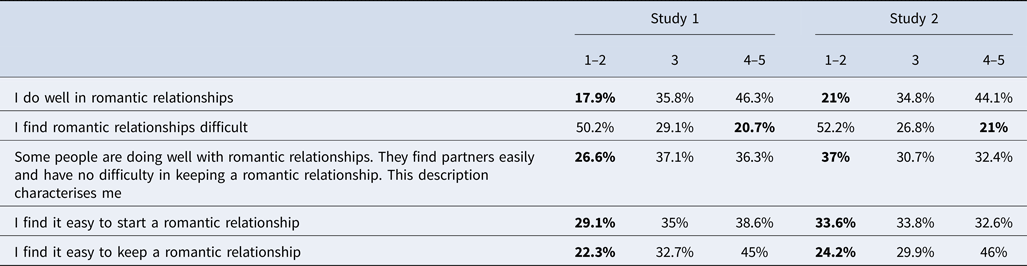
To begin with, we attempted to estimate the prevalence rates of poor mating performance by calculating the frequencies of participants’ answers for the mating performance instrument. From Table 1, we can see that about one in five participants indicated that they found intimate relationships difficult. Furthermore, about 29% indicated that they found it difficult to start a relationship and about 22% found it difficult to keep a relationship. We also calculated that 27.2% of the participants answered ‘1’ or ‘2’ (indicating low performance) in at least one of the two questions about starting and keeping a relationship. Finally, 12% answered ‘1’ or ‘2’ in both questions. Thus, 39.2% of the participants indicated difficulties in at least one domain of mating performance.
The Prevalence Rates of Mating Performance in Study 1 and 2

Note: The percentages indicating poor performance are in bold type.
Contingencies
For the purpose of testing our hypotheses, we ran an analysis of covariance (ANCOVA). This statistical tool was deemed appropriate because it would enable us to predict one continuous variable from one or more continuous and categorical independent variables. Accordingly, the mating performance was entered as the dependent variable, the sex was entered as a categorical independent variable, and age, emotional intelligence, narcissism, Machiavellianism, and psychopathy were entered as continuous independent variables. The results indicated that there was a significant effect of emotional intelligence, F(1,807) = 10.39, p = .001, ηp2 = .013, with a positive coefficient (.117), suggesting that higher emotional intelligence was associated with higher performance in mating. Moreover, there was a significant effect of narcissism, F(1,807) = 24.77, p < .001, ηp2 = .030, with a positive coefficient (.279), suggesting that higher scorers had higher performance in mating. No other significant effects were produced.
We repeated the analysis for starting a relationship. As before, there was a significant effect of emotional intelligence, F(1,807) = 7.11, p = .008, ηp2 = .009, with a positive coefficient (.152), suggesting that higher emotional intelligence was associated with higher performance in starting a relationship. In addition, there was a significant effect of narcissism, F(1,807) = 11.81, p = .001, ηp2 = .014, with a positive coefficient (.303), suggesting that higher scorers had higher performance in starting a relationship. No other significant effects were produced.
The analysis was repeated for keeping a relationship. As above, there was a significant effect of emotional intelligence, F(1,807) = 13.34, p < .001, ηp2 = .016, with a positive coefficient (.186), suggesting that higher emotional intelligence was associated with a higher performance in keeping a relationship. Furthermore, there was a significant effect of narcissism, F(1,807) = 5.01, p = .024, ηp2 = .006, with a positive coefficient (.303), suggesting that higher scorers had higher performance in keeping a relationship. In addition, there was a significant effect of psychopathy, F(1,807) = 3.61, p = .048, ηp2 = .004, with a negative coefficient (-.126), suggesting that higher scorers experience lower performance in keeping a relationship. No other significant effects were produced.
Study 2
The main purpose of Study 2 was to estimate prevalence rates of poor mating performance, as well as to test whether mating performance was predicted by jealousy and attachment styles.
Methods
Participants
The data-collection process was similar to the one employed in Study 1. In addition, the research took place in Greece and in the Republic of Cyprus, and the data-collection process lasted approximately two months. In this study, 527 Greek and Greek-Cypriots participated (323 women, 204 men). The mean age of the women was 29.5 (SD = 10.3), and the mean age of the men was 30 (SD = 9.7). Moreover, 41.5% of the participants were in a relationship, 24.4% were married, 20.7% were single, and 2.6% were divorced.
Materials
The survey consisted of four parts. In the first part, participants were given the mating performance instrument developed by Apostolou et al. (Reference Apostolou, Shialos, Kyrou, Demetriou and Papamichael2018). In order to measure adult attachment, we employed the Experiences in Close Relationships (ECR) scale, which is a 36-item, self-report attachment measure (Brennan, Clark, & Shaver, Reference Brennan, Clark, Shaver, Simpson and Rholes1998). The measure can be used to create two subscales, namely Avoidance (or Discomfort with Closeness and Discomfort Depending on Others) and Anxiety (or Fear of Rejection and Abandonment). Participants’ responses were measured in a 7-point Likert scale: 1 = strongly disagree to 7 = strongly agree).
In the third part, in order to measure jealousy, we employed a seven-item instrument. In particular, we employed a shorter version of an instrument developed by Pines and Aronson (Reference Pines and Aronson1983), from which we dropped the items that were predominantly related to how participants would see the jealousy of their partners, as we did not consider these items relevant to our hypotheses. Participants’ responses were measured in a 7-point Likert scale, with higher scores indicating more jealousy. In the last part, demographic information was collected (i.e., sex, age, marital status). The order of presentation of the first three parts was counterbalanced across participants.
Results
Prevalence
For the purpose of estimating the prevalence rates of poor mating performance, we calculated the frequencies of participants’ answers to the mating performance instrument. From Table 1 we can see that about one in five participants indicated that they found intimate relationships difficult. Also, about 34% indicated that they found it difficult to start a relationship and about 24% that they found it difficult to keep a relationship. Furthermore, we estimated that 29.2% of the participants answered ‘1’ or ‘2’ (indicating low performance) in at least one of the two questions about starting and keeping a relationship. Finally, 14.2% answered ‘1’ or ‘2’ in both questions. Thus, 43.4% of the participants indicated difficulties in at least one domain of mating performance.
Contingencies
For the purpose of testing our hypotheses, we ran an ANCOVA, where mating performance was entered as the dependent variable, and sex, age, jealousy, avoidance, and anxiety were entered as the independent variables. The results indicated that there was a significant effect of jealousy, F(1,450) = 6.53, p = .011, ηp2 = .014, with a negative coefficient (-.069), suggesting that higher scorers experienced lower mating performance. Moreover, there was a significant effect of avoidance, F(1,450) = 137.09, p < .001, ηp2 = .234, with a negative coefficient (-.422), suggesting that higher scorers experienced lower mating performance. No other significant effects were produced.
We repeated the analysis for starting a relationship. As before, there was a significant effect of avoidance, F(1,450) = 52.78, p < .001, ηp2 = .104, with a negative coefficient (-.404), suggesting that higher scorers experienced lower performance with respect to starting a relationship. No other significant effects were produced. Moreover, we repeated the analysis for keeping a relationship. As above, there was a significant effect of avoidance, F(1,450) = 56.36, p < .001, ηp2 = .113, with a negative coefficient (-.410), suggesting that higher scorers experienced lower performance with respect to keeping a relationship. No additional significant effects were produced.
Discussion
Consistent with our original hypotheses, we found that across two independent studies about 40% of participants experienced poor performance in either starting or keeping an intimate relationship, or in both domains. Furthermore, emotional intelligence, Dark Triad traits, jealousy and attachment style were found to be significant predictors of mating performance. In particular, higher emotional intelligence and narcissism were associated with higher performance in mating, while higher psychopathy, jealousy and an avoidant attachment style were associated with lower mating performance.
Emotional intelligence was a significant predictor of average mating performance, as well as of starting and of keeping a relationship. The effect sizes indicated that emotional intelligence had a higher impact on keeping than on starting an intimate relationship. The effect size suggested further that emotional intelligence had a limited impact on mating performance. We would expect, however, that this trait would have a higher impact on mating performance. One possible explanation is that a moderate score in this domain is sufficient for achieving a good performance in mating, and there are only few people who score below this level. Future research needs to examine the relationship between emotional intelligence and mating performance further.
Consistent with our original hypothesis, high scorers in narcissism indicated a higher performance in starting a relationship, but as opposed to our original hypothesis, high scorers also indicated a higher performance in keeping a relationship. One possible explanation for the latter finding is that it would be hard for narcissists to admit that they were not good at starting and keeping a relationship, so they indicated higher performance than is actually the case. This being so, higher performance in starting a relationship probably constitutes an amalgam of narcissists being good at starting relationships and of exaggerating their performance. On the other hand, the higher performance in keeping a relationship is probably the result of the exaggeration bias. To control for this bias, future studies may attempt to estimate mating performance by asking close friends and relatives about participants’ performance rather than participants themselves.
With respect to Machiavellianism and psychopathy, we found that only the latter had a negative effect on keeping an intimate relationship. Yet, the effect was at the significance level, and future research needs to replicate it in different samples. In general, the effect sizes suggested that the impact of Dark Triad traits on mating performance was limited. Still, as discussed above, such low effect may partially be explained by high scorers in these traits who misreport their mating performance. Accordingly, future replication with different research methods that would partially control for these limitations is necessary for understanding better the impact of Dark Triad traits on mating performance.
Consistent with our hypothesis, higher scores in jealousy were associated with lower mating performance. The effect size indicated that the impact of jealousy on mating performance was small. One possible explanation is that participants underestimated their level of jealousy. Another possibility is that in the current population, the prevalence of those who scored sufficiently high in jealousy for it to have noticeable effects on their mating performance was relatively low. Future research that would potentially employ different instruments and methods should examine the effect of jealousy further.
Our results indicated that avoidant attachment had a negative impact on general mating performance, as well as on starting and on keeping a relationship. The effect sizes indicated that this attachment style had a substantial impact on mating performance; that is to say, high scorers were likely to exhibit a substantial decrease in their mating performance. This negative effect was found in both starting and keeping a relationship, suggesting that this style does not have an advantage in one area that balances its disadvantage in the other. As discussed in the introduction, such attachment style could had been beneficial in an ancestral environment where male-male competition was strong, but is harmful in a contemporary environment where individuals have to choose their own mates.
It is important to state that the effects we have found in the current research can only be partially attributed to the evolutionary mismatch. In particular, there are good theoretical reasons to believe that certain traits such as low empathy, which potentially impair success in intimate relationships, have nevertheless been selected because of benefits that balanced such costs (Jonason et al., Reference Jonason, Koenig and Tost2010; Nettle, Reference Nettle2006). As discussed in the introduction, the evolutionary mismatch may have affected the costs and benefits of these traits in the contemporary environment; yet, even without the existence of this mismatch, we would expect these traits to be present in the contemporary populations. For instance, low empathy would enable exploitation of others in ancestral and contemporary environments, which would balance the costs of poor mating success. We have argued that the latter costs were probably lower in ancestral environments, allowing for a higher prevalence rate of this trait; still, even if they were equal to contemporary costs, we would expect that there would still be sufficient benefits to allow this trait to be present in the population, albeit in lower frequencies.
The high prevalence rate of poor mating performance found in this study is consistent with the findings of a different study (Apostolou et al., Reference Apostolou, Shialos, Kyrou, Demetriou and Papamichael2018), and suggest that it is a common problem in post-industrial societies. We have argued that the commonness of this problem is explained by the recent and drastic evolutionary change in the environment in the domain of mating. Given the complexity of the phenomenon, other factors may also be at play. Despite the explanation that can be adopted, it is a fact that a large proportion of adult population experiences poor performance in this domain. Such poor performance can be associated with negative feelings, such as anxiety, depression and loneliness (Apostolou, Reference Apostolou2016b), which may in turn result in poor performance in other domains, such as work life. For instance, a recent study found that poor performance in mating was associated with negative feelings such as loneliness and lower life satisfaction (Apostolou, Shialos, & Georgiadou, Reference Apostolou, Shialos and Georgiadou2019).
When engaged in mating, people can employ different strategies: They can employ a short-term strategy that involves having multiple casual mates without investing much in these relationships, and a long-term one that involves having few mates and investing heavily in the children coming from these relationships. They may also adopt a mixed strategy where individuals engage in both short-term and long-term mating, either at different stages in their lives — a short-term one when they are young and a long-term one when they are older — or simultaneously engage in a committed relationship but exploit any opportunities for casual sex (Buss & Schmitt, Reference Buss and Schmitt1993).
In this respect, the finding that a lot of people do poorly in one domain and not in another may reflect the adoption of different strategies. For instance, people who adopt a short-term mating strategy do not need to be good at keeping a relationship, so they do poorly in it. People who adopt a long-term mating strategy do not need to be particularly good at starting an intimate relationship because their success does not depend on how many relationships they can have. In this interpretation, poor performance in starting or keeping an intimate relationship could be better explained by the adoption of different mating strategies rather than the mismatch problem. People who face difficulties in both starting and keeping an intimate relationship would struggle in adopting any mating strategy and thus will be likely to experience reduced reproductive success. The high prevalence rates, with about one in three in the current research being in this scenario, could be explained by the mismatch between ancestral and modern conditions.
The current research is not without limitations. As discussed above, people may not report their scores accurately. Also, this study took place in a specific cultural setting, and the effects we have found may vary with the cultural context. Therefore, further replication in different cultural settings is necessary. Furthermore, we have employed specific instruments to measure our independent variables. Although these instruments enjoy good psychometric properties, they still have limitations. For instance, jealousy was measured using a continuous scale instrument, but people's responses may differ if a categorical instrument is used (Bendixen, Kennair, & Buss, Reference Bendixen, Kennair and Buss2015). Accordingly, future research needs to replicate our findings using different instruments for measuring the independent factors.
Furthermore, we have measured perceived mating performance, which is subject to personal biases. For instance, people may overestimate or underestimate how well they are doing in this domain. Accordingly, future research may attempt to replicate our findings using more objective measures of mating performance, such as number of past intimate relationships. Last but not least, our research employed non-representative samples, so its conclusions cannot be readily generalised to the population. Accordingly, future studies need to replicate our results in more representative samples.
Performance in the domain of mating is a complex phenomenon with many factors predicting it. The current research identified several such factors, but considerable more research is necessary for additional factors to be identified.
Author ORCIDs
Menelaos Apostolou, 0000-0002-0685-1848
Financial support
This research received no specific grant from any funding agency, commercial or not-for profit sectors.
Conflict of interest
None
Ethical standards
The authors assert that all procedures contributing to this work comply with the ethical standards of the relevant national and institutional committees on human experimentation and with the Helsinki declaration of 1975.