I. INTRODUCTION
Photocatalytic degradation of organic pollutants by semiconductor photocatalysts has a great potential to be a beneficial technology to protect our environment. TiO2, WO3, ZnO, and their complex are commonly used as semiconductor oxide photocatalytic materials. Reference Yin, Dai and Niu1–Reference Kubacka, Fernandez-Garcia and Colon4 With further study, researchers continue developing new photocatalytic materials, such as layered, tunnel, molecular sieve photocatalysts and assembled nano-semiconductor photocatalytic materials. In recent years, the metal tungstate photocatalyst has attracted widespread interests. Among the tungstate family, ZnWO4 has been reported to be valuable for photodegradation of organic pollutants. Instead of using a single photocatalyst, the coupling with other semiconductors, metals, or molecules to form heterojunction structures has been found to be significantly benefited to enhance the photocatalytic activity. Reference Yu, Chen, Philip, Wang, White and Sun5–Reference Nagirnyi, Jonsson, Kirm, Kotlov, Lushchik, Martinson, Watterich and Zadneprovski8 Murcia Lopez et al. Reference Murcia Lopez, Hidalgo, Navio and Colon9 investigated that Bi2WO6/TiO2 composite photocatalyst exhibited a higher degradation rate than that of single TiO2 because of the higher efficiency of charge carriers' separation. Ivana et al. Reference Ivana, Validzic and Radenka10 have developed a new low temperature synthesis method for preparation of ZnO/ZnWO4 rod-like particles in nanometer size under mild experimental conditions. He et al. Reference He, Wang and Xu11 reported that Bi2WO6/ZnWO4 composite exhibited a better UV light photocatalytic activity compared to individual ZnWO4 nanorods. Thus, ZnWO4 can serve as a good substrate to form a composite photocatalyst.
At the same time, bismuth-based photocatalysts have received a lot of attention in environmental remediation over the past few years. Among which, Bi2O2CO3, Reference Liu, Wang, Huang, Yang, Zhang, Qin and Dai12–Reference Chen, So, Yang, Deng, Che and Sun16 one of the layered oxide family with characteristic structures of alternative stacking of (Bi2O2)2+ layers, was found to exhibit high photocatalytic activity. Cheng et al. Reference Cheng, Huang, Yang, Wang, Qin, Zhang and Dai17 first found that Bi2O2CO3 has a good effect on degradation of methyl orange (MO) in aqueous solution under UV light irradiation.
In this work, the Bi2O2CO3/ZnWO4 composite photocatalysts were synthesized by a mixed calcination method after hydrothermal process. The x-ray diffraction (XRD), scanning electron microscopy (SEM), transmission electron microscopy (TEM), high-resolution TEM (HRTEM), x-ray photoelectron spectroscopy (XPS), and diffuse reflectance spectrum (DRS) data of the as-obtained Bi2O2CO3/ZnWO4 composite photocatalysts have been studied. Especially, the photocatalytic activities of the Bi2O2CO3/ZnWO4 composites for photodecomposing methylene blue (MB) were investigated. The enhanced photocatalytic activities and photoinduced charge transfer properties were also discussed.
II. EXPERIMENTAL SECTION
A. Synthesis of ZnWO4 sheets
Zinc nitrate hexahydrate (Zn(NO3)2·6H2O, 5 mmol) and sodium tungstate (Na2WO4·2H2O, 5 mmol) were added to 60 mL deionized water under stirring at room temperature. Before adding into a 100 mL Teflon-lined autoclave, the solution was vigorously stirred for 30 min. Then the autoclave was heated at 180 °C for 24 h in the vacuum oven under its own pressure. After cooling to room temperature naturally, the white precipitate was washed with ethanol two times and with distilled water three times. Finally, the sample was collected and dried at 50 °C for 6 h.
B. Synthesis of Bi2O2CO3 nanoparticles
Urea (CH4N2O, 8 mmol) and bismuth nitrate (Bi(NO3)3·5H2O, 5 mmol) were added to 40 mL deionized water under stirring at room temperature. The following hydrothermal process is the same with that of ZnWO4.
C. Synthesis of Bi2O2CO3/ZnWO4 composite photocatalysts
The as-obtained ZnWO4 and Bi2O2CO3 were mixed together with a molar ratio of 0.15, 0.25, 0.3, and 0.5. Then, the above mixture was ground evenly. After calcining in a muffle furnace for 2 h below 300 °C, the Bi2O2CO3/ZnWO4 was obtained.
D. Characterization
Power XRD experiment was conducted on an XD-3 powder diffraction instrument with monochromatized Cu Kα radiation (λ = 1.5406 nm) at a setting of 40 kV and 40 mA. And the scanning rate and range were 0.02° (2θ)/s and 10–70°, respectively. The morphology and microstructure were investigated by an S-4300 SEM (Hitachi, Tokyo, Japan) and H-800 TEM (Hitachi), respectively. XPS with Al Kα x-rays (ht = 1486.6 eV) irradiation operating at 150 W (XPS: Thermo ESCALAB 250, Shanghai, China) was used to examine the surface properties of the samples. UV-vis diffuse reflectance spectra were recorded on a Cary 5000 (Varian Inc., Palo Alto, CA) spectrophotometer.
E. Photocatalytic evaluation
The photocatalytic activities of the samples were evaluated by the degradation of the MB under ultraviolet light irradiation of a 300 W high-pressure lamp (λ = 365 nm). Powder photocatalyst (50 mg) was dispersed in 100 mL of MB solution (1 × 10⁻⁵ mol/L, pH = 6). Before illumination, the suspensions were vigorously stirred for 30 min to ensure the establishment of an adsorption–desorption equilibrium between the photocatalyst powder and MB. Afterward, the suspensions were exposed to UV light irradiation under magnetic stirring, and 2 mL of the suspensions was taken in centrifuge tubes at selected intervals, respectively. Then, the catalysts in the mixture were removed by centrifugation (5000 r/min, 5 min). Finally, the UV-vis spectra of the centrifuged solution were recorded by a UV-5500PC (produced by Shanghai Wuxiang Company, Shanghai, China).
III. RESULTS AND DISCUSSION
A. Characterization of composite photocatalysts
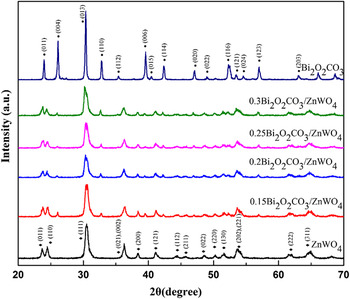
The XRD patterns of Bi2O2CO3, ZnWO4, and Bi2O2CO3/ZnWO4 composite photocatalysts are shown in Fig. 1, respectively. The pure ZnWO4 crystallizes in a monoclinic structure. When the molar ratio of Bi2O2CO3/ZnWO4 is increasing from 0.15 to 0.3, the diffraction peaks of orthorhombic Bi2O2CO3 were intensified gradually, whereas the peak intensity of ZnWO4 decreased. No impurity peak was found in Bi2O2CO3/ZnWO4 composites, suggesting that the composites have a pure two-phase composition: Bi2O2CO3 and ZnWO4.
XRD patterns of pure ZnWO4, Bi2O2CO3, and the Bi2O2CO3/ZnWO4 composites with different molar ratios of ZnWO4 versus Bi2O2CO3, respectively.

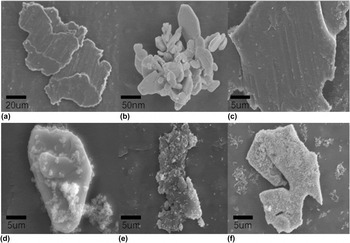
Figure 2 shows the SEM images of ZnWO4, Bi2O2CO3, and Bi2O2CO3/ZnWO4 composite photocatalysts. Compared with smaller-sized Bi2O2CO3 nanoparticles, the pure ZnWO4 displayed a sheet-like morphology. From the images, the nanoparticles were uniformly distributed on the surface of ZnWO4 plates. With the increase of the Bi2O2CO3/ZnWO4 photocatalysts' molar ratio from 0.15 to 0.3, the number of Bi2O2CO3 nanoparticles on ZnWO4 plates also increased, which is in accordance with the results from XRD. It is interesting to note that no individual Bi2O2CO3 nanoparticle in a dispersed way was found in the solution through ultrasonic treatment for preparation of SEM grids. The phenomenon indicates that the small Bi2O2CO3 nanoparticles were firmly attached on the ZnWO4.
SEM images of the as-obtained samples: (a) ZnWO4, (b) Bi2O2CO3, (c) 0.15 Bi2O2CO3/ZnWO4, (d) 0.2 Bi2O2CO3/ZnWO4, (e) 0.25 Bi2O2CO3/ZnWO4, and (f) 0.3 Bi2O2CO3/ZnWO4.

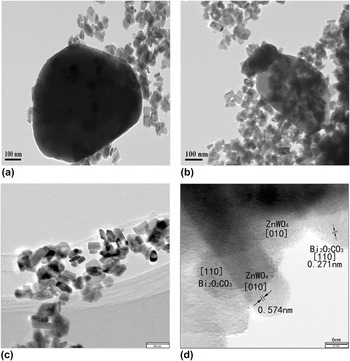
The TEM images in Figs. 3(a)–3(c) show that the small Bi2O2CO3 nanoparticles were uniformly distributed on the surface of a ZnWO4 sheet. And the ZnWO4 sheet is so thin that we can see the Bi2O2CO3 nanoparticles under it clearly. Meanwhile, the high-magnification HRTEM image of 0.25 Bi2O2CO3/ZnWO4 is shown in Fig. 3(d). The lattice-resolved HRTEM image indicates that the spacing of the lattice is 0.574 and 0.271 nm as seen in Fig. 3(d), which is consistent with the spacing of [010] of ZnWO4 and [110] of Bi2O2CO3, respectively. It is obvious to demonstrate that the hierarchical heterojunction composites between ZnWO4 and Bi2O2CO3 were formed.
(a–c) TEM and (d) HRTEM images of the as-obtained sample of 0.25 Bi2O2CO3/ZnWO4.

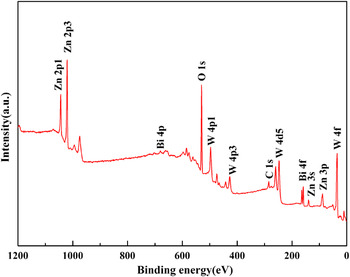
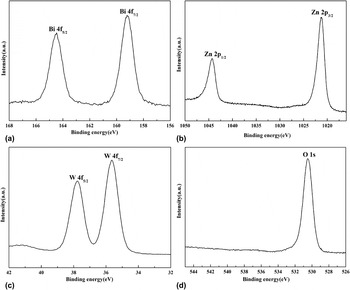
The surface composition and metal oxidation state of the as-prepared composites were further analyzed by XPS. As shown in Fig. 4, the 0.25 Bi2O2CO3/ZnWO4 samples are composed of Bi, Zn, W, O, and C. The C 1s peak at a binding energy of 284.92 eV is attributed to the signal from contaminant carbon Reference Wang, Wu and Liu18 and the carbon of carbonate in Bi2O2CO3. Reference Chen, Yin, Luo, Huang, Zhang, Hong and Au19 A high-resolution XPS spectrum of the Bi 4f peak is shown in Fig. 5(a). The binding energies of the Bi 4f 7/2 and Bi 4f 5/2 orbitals are 159.22 and 164.47 eV, respectively, which are the characteristics of Bi3+ in the achieved samples. Figure 5(b) shows the high-resolution XPS spectrum of the Zn 2p region, and the peaks at 1021.32 and 1044.37 eV are ascribed to the Zn 2p 3/2 and Zn 2p 1/2 photoemissions, respectively. The peaks at 35.67 and 37.77 eV are assigned to W 4f 7/2 and W 4f 5/2, respectively, as shown in Fig. 5(c). Quantitative analysis demonstrates that the surface atomic ratio of Bi/Zn is 54%, approximately equal to the expected value of 50%. Therefore, it can be inferred that the 0.25 Bi2O2CO3/ZnWO4 composite photocatalyst has been successfully synthesized by a mixed calcination method after hydrothermal process. This result is in good agreement with the XRD results (Fig. 1).
Typical XPS survey spectra of 0.25 Bi2O2CO3/ZnWO4.

High-resolution XPS spectra of 0.25 Bi2O2CO3/ZnWO4: (a) Bi 4f; (b) Zn 2p; (c) W 4f; and (d) O 1s.

For semiconductors, the UV absorption near band edge follows the equation.
 $${\rm{\alpha }}hv = {\left( {{\rm{\alpha }}hv - {E_{\rm{g}}}} \right)^n}\quad ,$$
Where α, h, v, and E g are the absorbance, Planck’s constant, photon frequency, and photonic energy band gap, respectively. The parameter n is a pure number associated with different types of electronic transitions: n = 1/2, 2, 3/2, or 3 for direct-allowed, indirect-allowed, direct-forbidden, or indirect-forbidden transitions, respectively. Reference Montini, Gombac, Hameed, Felisari, Adami and Fornasiero20,Reference Yayapao, Thongtem, Phuruangrat and Thongtem21 In this experiment, ZnWO4 belongs to direct-allowed semiconductors and Bi2O2CO3 is a kind of indirect-allowed semiconductors.
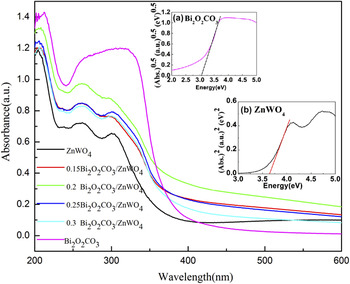
Figure 6 shows the typical UV-vis absorption spectra of as-synthesized samples. A pure Bi2O2CO3 sample can absorb UV light with wave lengths less than 380 nm, while the absorption edge of ZnWO4 is located at 410 nm due to its band gap transition. Reference Sun, Fan, Li, Cheng, Li and Zhao7 It is also shown that an absorption edge of Bi2O2CO3 photocatalyst is at 380 nm. Figure 6 shows that the UV-vis spectra of Bi2O2CO3/ZnWO4 composite photocatalysts are dominated by the major phase, ZnWO4, as would be expected. And the red shift in Bi2O2CO3/ZnWO4 composite may be related with the excitons partial leakage into the Bi2O2CO3 matrix. A similar phenomenon was also observed. Reference He, Wang and Xu11 In the Bi2WO6/ZnWO4 system, the absorption peaks for the Bi2WO6/ZnWO4 nanoparticles and nanorods shift slightly to a longer wave length compared with the pure ZnWO4 sheets.
UV-vis diffuse reflectance spectra of ZnWO4, Bi2O2CO3, 0.15 Bi2O2CO3/ZnWO4, 0.2 Bi2O2CO3/ZnWO4, 0.25 Bi2O2CO3/ZnWO4, and 0.3 Bi2O2CO3/ZnWO4.

B. Photocatalytic activity
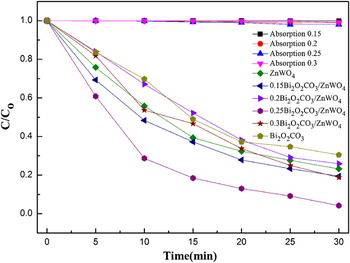
The degradation of MB under UV light irradiation over ZnWO4, Bi2O2CO3, and Bi2O2CO3/ZnWO4 composites was investigated as shown in Fig. 7. The absorption experiment (the same amount of powder photocatalyst (50 mg) was dispersed into the same volume (100 mL) of MB solution, but put in the dark environment) shows that the absorption of MB by the as-prepared photocatalysts can be negligible. The results indicate that most Bi2O2CO3/ZnWO4 composite photocatalysts possess higher activities than that of pure Bi2O2CO3 and pure ZnWO4. As shown in Fig. 7, the 0.25 Bi2O2CO3/ZnWO4 sample exhibits the highest photocatalytic activity in all the samples, and MB was almost decomposed in 30 min. With the increase of Bi2O2CO3/ZnWO4 molar ratio to 0.3, the photocatalytic activities of Bi2O2CO3/ZnWO4 composites were reduced. But it still maintains higher photocatalytic activities compared with pure ZnWO4 and Bi2O2CO3. These results indicate that the enhanced photocatalytic activities can be obtained through constructing Bi2O2CO3/ZnWO4 heterojunction, which are beneficial for the photoinduced electron–hole pairs separation and transport of charge carriers as discussed below.
Photocatalytic degradation of MB (1 × 10⁻⁵ mg/L, 100 mL) by different photocatalysts under UV light irradiation, where C is the absorption intensity of MB at the maximum wave length of 665 nm irradiated by different time and C 0 is the absorption intensity of MB after the adsorption–desorption equilibrium on photocatalyst before irradiation.

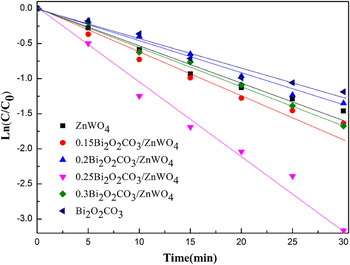
To compare the degradation rate quantitatively, the pseudo-first-order kinetic curves of MB photodegradation were also plotted (Fig. 8). As shown in Fig. 8, the experimental data obviously show that the apparent rate constant k is 0.0535, 0.0621, 0.0454, 0.1057, 0.0558, and 0.0423 min−1 for pure ZnWO4, 0.15, 0.2, 0.25, 0.3 Bi2O2CO3/ZnWO4, and pure Bi2O2CO3, respectively. Thus, 0.25 Bi2O2CO3/ZnWO4 shows the highest photocatalytic activity, which is about 1.7 and 2.3 times that of pure ZnWO4 and Bi2O2CO3, respectively.
Kinetic fit for the degradation of MB under UV light irradiation.

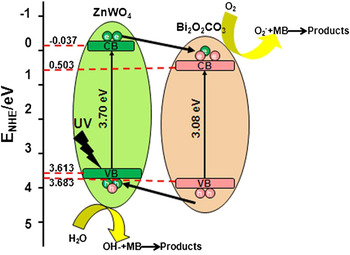
When the semiconductor is irradiated with light, the photogenerated electrons and holes transfer to the surface to react with the adsorbed reactants. And the migration direction of the photogenerated charge carriers depends on the band edge position of semiconductors. The conduction band (CB) and valence band (VB) potential of ZnWO4 and Bi2O2CO3 can be calculated by the following equations Reference Butler and Ginley22,Reference Huang, He, Lin, Kang and Zhang23 :
 $${E_{{\rm{VB}}}} = X - {E_{\rm{e}}} + 0.5{E_{\rm{g}}}\quad ,$$
 $${E_{{\rm{CB}}}} = {E_{{\rm{VB}}}} - {E_{\rm{g}}}\quad ,$$
Where X is the absolute electronegativity of the semiconductors, which is defined as the geometric average of the absolute electronegativity of the constituent atoms; E e is the energy of free electrons on the hydrogen scale (E e = 4.5 eV); E VB is the VB edge potential; and the E g is the band gap of the semiconductor. In our tests, the measured E g values of ZnWO4 and Bi2O2CO3 are 3.70 and 3.28 eV, respectively, as shown in Figs. 6(a) and 6(b). And the X values of ZnWO4 and Bi2O2CO3 are approximately 6.313 and 6.543 eV, respectively, according to the above equations. On the basis of the above data, the top of the VB and the bottom of the CB of ZnWO4 are calculated to be 3.613 and −0.037 eV and the VB and CB of the Bi2O2CO3 are estimated to be 3.583 and 0.503 eV, respectively. The energy band structures of ZnWO4 and Bi2O2CO3 are schematically illustrated in Fig. 9.
Band structure diagram and electron–hole separation of Bi2O2CO3/ZnWO4 composite.

On the basis of the above data, it is believed that in the Bi2O2CO3/ZnWO4 composite system, ZnWO4 may supply photoinduced charges for the photocatalytic process, and the interface between Bi2O2CO3 and ZnWO4 inhibits the recombination rate of photoinduced charge carriers. Under UV light irradiation, ZnWO4 and Bi2O2CO3 would be excited simultaneously and generate electron–hole pairs. On the one hand, the CB-electrons (ZnWO4) easily flow into the CB edge of Bi2O2CO3 through the interface because the CB edge of ZnWO4 is higher than that of Bi2O2CO3. On the other hand, because the VB edge level of Bi2O2CO3 is lower than that of ZnWO4, holes in the VB edge of Bi2O2CO3 will transfer to that of ZnWO4 by the control of the interface. As a result, VB holes with strong oxidation power can cast off from the pair recombination and be available to oxidize the pollutants, which support the results that the Bi2O2CO3/ZnWO4 composite exhibits higher photocatalytic activities than the pure ZnWO4 and pure Bi2O2CO3. The enhanced photocatalytic activities of 0.25 Bi2O2CO3/ZnWO4 composite are mainly attributed to the effective separation of photoinduced electron–hole pairs. From Fig. 7, we can see that the pure ZnWO4 possesses higher photocatalytic activity than the pure Bi2O2CO3. So, there must exist an appropriate molar ratio of the Bi2O2CO3/ZnWO4 heterojunction, which can satisfy the most effective separation of photoinduced electron–hole pairs. When the molar ratio of Bi2O2CO3/ZnWO4 was lower than 0.25, the amount of ZnWO4 may be not enough to achieve the most effective separation of photoinduced charge carriers. Nevertheless, too much relatively low-efficiency Bi2O2CO3 in the heterojunctions will result in the low photocatalytic activity. Thus, the optimum molar ratio is 0.25. In addition, the UV-vis diffuse reflectance spectra of 0.25 Bi2O2CO3/ZnWO4 (Fig. 6) were located in a moderate place, which can not only ensure enough absorption of UV light, but also reduce the recombination of photoinduced electron–hole pairs resulted from a relatively narrow band gap. Above all, the 0.25 Bi2O2CO3/ZnWO4 composite photocatalyst exhibits the highest activity.
IV. CONCLUSIONS
The Bi2O2CO3/ZnWO4 composites were successfully synthesized by mixed grinding calcination method for the first time. The as-prepared Bi2O2CO3/ZnWO4 composites were composed of Bi2O2CO3 nanoparticles grown on the primary ZnWO4 sheets. Almost all the composites exhibit enhanced photocatalytic activities in the degradation of MB under UV light irradiation. When the molar ratio of Bi2O2CO3/ZnWO4 is 0.25, the highest photocatalytic activity is observed. The enhanced activities of Bi2O2CO3/ZnWO4 composites are attributed to the effective separation of photoinduced electron–hole pairs and the low recombination rate of charge carriers. The results provided here were expected to be useful for further improvement of Bi2O2CO3 and ZnWO4 photocatalytic performances.
ACKNOWLEDGMENTS
This work was supported by the National Natural Science Foundation of China (Grant No. 51302251), the Fundamental Research Funds for the Central Universities (2652013052), the special co-construction project of Beijing city education committee, and the Key Project of Chinese Ministry of Education (No. 107023).