


Introduction
Homework in CBT
Cognitive behavioural treatments for anxiety disorders typically consist of once-a-week hour-long sessions. However, homework between sessions is commonplace (Kazantzis et al. Reference Kazantzis, Lampropoulos and Deane2005), with 98% of therapists surveyed in a retrospective study reporting the regular use of it with clients (Kazantzis & Deane, Reference Kazantzis and Deane1999). Beck et al. (Reference Beck, Rush, Shaw and Emery1979, p. 272) claim homework is ‘an integral, vital component of treatment ... that improves level of functioning, changes attitudes, and gives a feeling of gratification’. In general, studies report that homework completion has significant positive correlations with positive effects on therapy outcome, across different anxiety disorders and homework types (Kazantzis et al. Reference Kazantzis, Deane and Ronon2000; Anand et al. Reference Anand, Sudhirm, Math, Thennarasu and Reddy2011) that remain at 1-year follow-up (Edelman & Chambless, Reference Edelman and Chambless1995). Within CBT, CBT with homework leads to better outcomes compared to CBT without homework (Kazantzis et al. Reference Kazantzis, Whittington and Dattilio2010; Mausbach et al. Reference Mausbach, Moore, Roesch, Cardenas and Patterson2010).
However, homework compliance rates can be less than 50% (Bryant et al. Reference Bryant, Simons and Thase1999), with some studies reporting levels as low as 12% compliance (Carroll et al. Reference Carroll, Nich and Ball2005). Dunn et al. (Reference Dunn, Morrison and Bentall2002) analysed reasons given by patients for not completing homework and found that lack of motivation, forgetting the assignment, its difficulty, not understanding the rationale for the work, and a lack of perceived benefits were commonly cited.
Methods to improve homework compliance have largely centred on improving accessibility. Aguilera & Munoz (Reference Aguilera and Munoz2011) reported that daily text messages inquiring about thoughts and emotions were received positively by clients and led to a 65% response rate; however, we note their sample was only 12 adults and there was no control condition. A case study demonstrated how motivational interviewing alongside CBT, in the form of a decisional balance exercise of the pros and cons of staying depressed and anxious, increased the clients homework completion as they better understood and resolved ambivalence (Westra, Reference Westra2004). Helbig & Fehm (Reference Helbig and Fehm2004) surveyed 77 CBT therapists, asking them to recall two patients’ homework assignments and completion rates. Homework compliance positively correlated with the provision of a written note or homework worksheet. However, regression analysis showed that the clients’ motivation for therapy was a better predictor than note-taking for homework compliance. Glenn et al. (Reference Glenn, Golinelli, Rose, Roy-Byrne, Stein, Sullivan, Bystritsky, Sherbourne and Craske2013) have categorized barriers to homework compliance as either client related or therapy/therapist related. The aforementioned work can be seen as addressing client issues such as a lack of motivation or forgetting. In terms of therapy-related barriers, reviewing previously assigned homework by a therapist has been shown to increase completion rates (Bryant et al. Reference Bryant, Simons and Thase1999).
Such literature therefore seems to pay attention to client-related issues around accessibility and motivation. By contrast, other aspects reported by Dunn et al. (Reference Dunn, Morrison and Bentall2002) such as not understanding the rationale and finding it too difficult have been relatively overlooked. Indeed it may be that problems with shared understanding of the nature of the homework might cross both categories of client- and therapist-related issues.
Research has tended to focus on quantity rather than quality when analysing the correlated relationship between homework compliance and therapeutic outcomes (Kazantzis et al. Reference Kazantzis, Deane and Ronon2000; Mausbach et al. Reference Mausbach, Moore, Roesch, Cardenas and Patterson2010). However, Schmidt & Woolaway-Bickel (Reference Schmidt and Woolaway-Bickelt2000) report that within a sample of adults with panic disorder, clients’ rating of homework quality is a better predictor of outcome than quantity of homework completed. The authors suggested that clients with positive therapeutic outcomes showed both greater levels of cognitive understanding and emotional processing regarding their homework. The hypothesized mechanism underlying this correlation is emotional processing. Emotional processing occurs when newly discovered information at odds with existing belief systems evokes a new accompanying emotional experience which strengthens the learning cycle. Ultimately, clients experiencing emotional processing may be afforded the gratification and benefits of therapy alluded to by Beck et al. (Reference Beck, Rush, Shaw and Emery1979) as maladaptive beliefs are challenged and new adaptive beliefs are believed and felt.
Compassion focused therapy (CFT)
Gilbert (Reference Gilbert2009) refers to clients who understand new messages in therapy (e.g. through thought challenging, new ways of acting) intellectually, but do not feel them emotionally. Worse still this rational-emotional dissociation can trigger feelings of vulnerability (Stott, Reference Stott2007). Potentially helpful new learning therefore becomes undermined while positive clinical change is hampered.
CFT (Gilbert, Reference Gilbert2009) features a ‘three circles’ model of affect regulation in which distinct evolutionary-based threat, drive and soothing systems are in reciprocal activation. How emotions are regulated is thought dependent upon which affect system one is predominately influenced by at the time. In short, the threat system aims to defend the self and is associated with the flight, fight and freeze responses. The drive system is associated with goal-directed behaviour, which can lead to a sense of reward. However, negative emotions such as frustration and disappointment are experienced if goals are not achieved. The soothing system is associated with understanding, commitment, kindness, acceptance, compassion and a sense of interpersonal safety.
For many people, their threat and drive systems are highly developed, at the expense of their soothing systems. As such anxiety and anger are readily experienced in the face of setbacks, with feelings of kindness towards attempts to cope with life's difficulties taking second (or third!) place. Developing compassion for oneself (and receiving it from others) has been proposed as a means of addressing such problems by bringing the three emotional systems into a more balanced state. This balancing effect of compassion can be cultivated through exercises and techniques such as imagery, letter writing, and meditation (Gilbert, Reference Gilbert2009).
Frames of (personal) reference and zones of proximal development
A frame of reference can be defined as ‘the context, viewpoint, or set of presuppositions within which a person's perception and thinking seem always to occur, and which constrains selectively the course and outcome of these activities’ (Bullock et al. Reference Bullock, Bullock, Stallybrass, Trombley and Eadie1988). In other words, a frame of reference is a complex set of assumptions which we use to in order to create personal meaning out of what we perceive.
Piaget's stages of development (Piaget, Reference Piaget1973), theories of stereotyping from social psychology (Zimbardo & Leippe, Reference Zimbardo and Leippe1991), and cognitive reappraisal from cognitive theory (Beck, Reference Beck1991) all contribute to the concept of frames of reference. Piaget's notion of assimilation is that we use existing knowledge to make sense of new experiences in the world, even if it leads to a distortion of the information (Festinger, Reference Festinger1957). Piaget's notion of accommodation is that in circumstances that are very different and do not fit into existing schemas, we accommodate by creating new schemas. Beck (Reference Beck1991) developed cognitive therapy based on the tenet that it is not the event that causes an emotional response but instead it is how we cognitively frame what has happened. Zimbardo & Leippe (Reference Zimbardo and Leippe1991) suggested that assimilation processes dominate regarding objects or people. Thus, we may tend to categorize by what we already know (i.e. our existing frame of reference) rather than make changes to our knowledge system to accommodate difference.
Using clients’ frames of reference has long been known to help ensure that therapist and client work within the ‘zone of proximal development’, which has been defined as ‘the distance between the actual developmental level as determined by independent problem solving and the level of potential development as determined through problem solving under guidance’ (Vygotsky, Reference Vygotsky1978, p. 86). When attempting to support someone in their particular zone Silver (Reference Silver2011) suggests that their current knowledge needs to be known, that new information is related to their current knowledge, and that new information is broken down into small parts with opportunities for feedback. Learning about the client's current knowledge and various frames of reference is a key part of an assessment that informs the intervention and its implementation.
Case study
Background
Mrs S is an 83-year-old White British woman, referred to a local older adult psychology service for anxiety management work, specifically in relation to an impending major surgery. She came to therapy with a diagnosis of a mild cognitive impairment as neuropsychometry had indicated a relative impairment in memory and processing speed. She did not have family nearby and was widowed 8 years ago. She described herself as having always been ‘a worrier’ and self-report placed her in the moderate range for anxiety. Her self-reported confidence in being able to cope with her operation was 30%. She stated that her confidence needed to be above 50% in order for her to proceed with surgery.
Method
A case study method allows for an in-depth observation of the patterns of within-subject change as the client moves through their treatment (Nock et al. Reference Nock, Michel, Photos, Herson and Gross2008). To observe patterns of change, a balance has to be found so as not to impede on the client's therapeutic experience. As such, in the case to be discussed, the standardized Beck Anxiety Inventory (BAI; Beck et al. Reference Beck, Epstein, Brown and Steer1988) was completed at the start and end of treatment, alongside subjective reports taken every 2 weeks of the client's confidence managing their anxiety. It was felt that this was adequate for the purpose of observing clinical change before and after the reformulation and intervention. However, it is acknowledged that concepts of compassion and ratings of therapeutic alliance were not measured due to the constraints of routine clinical practice. Mrs S attended all eight sessions arranged. The reformulation and re-intervention occurred at session 3 and was used until the end of therapy.
The emotional experience of homework practice
Due to Mrs S's memory difficulties, flash cards were used during therapy to help her remember the work between sessions and also reinforce key coping messages that had been devised. However, she reported that she ‘felt worse for looking at the flashcards when at home’, even though they helped her within sessions. Understandably then, she was reluctant to continue with this aspect of treatment when at home. This was problematic as it was needed to facilitate the generalization of learning from therapy to everyday life and the upcoming operation.
The barrier here, to homework completion and therefore to its intended effect, was not that Mrs S misunderstood the content of the cards or why they might be helpful, but rather that she did not experience the sense of support we believe needed for each message to lead to the practice of new coping skills. In essence, she did not feel the intended encouragement behind each message, but instead experienced negative emotions as she felt she was doing the tasks incorrectly. For example, a card featuring an outline of a psychological model of panic led to her feeling a sense of stupidity for not easily understanding what was happening to her in that moment. A card featuring a cognitive distraction technique led to a sense of failure as she experienced a well known feeling of not being able to master new skills, a feeling rooted in a lifetime of academic underachievement and current memory impairment. Cards featuring encouraging and motivational phrases led to sense of being unworthy and a feeling of hopelessness as the ideas clashed with her self-critical thoughts such as ‘I don't deserve to feel better as I can't motivate myself’.
The above experiences were understood in terms of Mrs S's active belief, at the time, that she could not ‘master’ any skills. Within sessions, this belief could be challenged and overcome, possibly due to Mrs S's experience of a supportive other (i.e. the therapist). However, the negative belief went unchallenged when on her own, leading to Mrs S being unable to make use of the techniques outlined on the flash cards.
Mrs S's frames of reference
Mrs S confided that she was a self-confessed ‘soap addict’ and it quickly became apparent that many of her frames of reference were associated with her understanding of what she had seen on television. For example, when talking about how a friend had recently treated her, she likened it to a popular plot in the soap ‘Emmerdale’. She also likened her bereaved husband to a character in the same soap.
Characters from soap operas tend to be caricatures, exhibiting a few defining personality traits or emotional profiles which remain stable throughout each episode. Studies have shown that complex interpersonal emotions are identified and recalled by people as young as 8 years old when talking about the TV they had viewed (Knowles & Nixon, Reference Knowles and Nixon1990; Calvert & Kotler, Reference Calvert and Kotler2003), especially when the programme is perceived as realistic (Huston et al. Reference Huston, Wright, Alvarez, Truglio, Fitch and Piemyat1995). A randomized control study demonstrated that young adolescents generalized to everyday life the emotional lessons they learnt from family-based soap operas (Weiss & Wilson, Reference Weiss and Wilson1996). As there is limited research on similar themes within adult samples, it is only possible to extrapolate to an adult population and Mrs S's case specifically. However, it seemed that for Mrs S TV soaps provided an existing framework to utilize as we sought to encourage both emotional processing and the accommodation of new information discovered in therapy within her home practice.
Reformulation and revised intervention
Ideas from CFT (Gilbert, Reference Gilbert2009) were used to think about Mrs S's response to her struggle with homework. Not readily engaging with the contents of a flashcard could be interpreted as a failure, be experienced as disappointment with oneself and so feel potentially threatening as the threat system was most active. At the point of reformulation, which was after three of the eight sessions arranged, Mrs S's self-reported anxiety according the BAI remained within the moderate range and her rating of confidence to manage an operation was up to 35%.
As Gilbert (Reference Gilbert2009) postulates is common, Mrs S understood new messages in therapy intellectually, but was not feeling them emotionally when on her own. This was triggering feelings of vulnerability and inadequacy. In this way, Mrs S was becoming disheartened with the lack of clinical change to her symptoms. When formulating this homework practice dilemma (i.e. something designed to be helpful was actively a hindrance), it was agreed to work on Mrs S's struggle in treatment, using compassionate imagery. Mrs S's reformulation suggested that by fostering affiliative ‘soothing’ emotions through visualization and personification, her flashcards could feel more supportive, be used to elicit positive change and lead to a sense of gratification when engaged in home practice on her own.
The reformulation predicting that personalizing the cards using characters from Emmerdale (Mrs S's favourite soap) would support her home practice of in-session therapy skills and improve their quality and usefulness. The emotional intention behind each homework task was matched up with particular soap characters associated with relevant soothing system-based emotions or qualities. The intention behind each flashcard was linked to a character whom Mrs S thought symbolized it in personality. The characters were also picked for their general sense of positive regard and understanding. Thus, the flashcard messages were amended so that they might be assimilated (rather than accommodated) and fit into a more familiar frame of reference, in this case a soap opera. The soap opera would provide characters perceived as supportive others who could give Mrs S the confidence to challenge her negative belief.
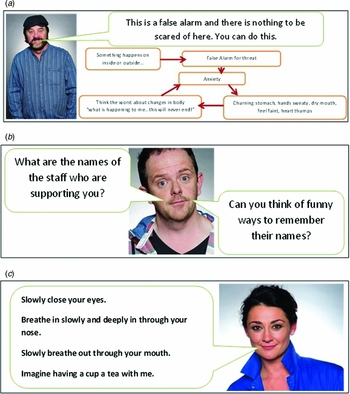
The revised intervention included a guided imagery practice within sessions and self-led imagery at home. Gilbert's format of compassionate imagery uses sensory qualities of sight, sound, and touch to build an image in mind (Gilbert, Reference Gilbert2010). Due to the limited number of sessions available for the intervention, imagery focused on experiencing compassion from others as she had demonstrated an openness to this within the therapy sessions from the support of the therapist. Mrs S was encouraged to bring to mind the visual qualities of the character on the flash card, for example a welcoming smile or sparkling eyes. She then included the sound qualities of the voices of the characters and phrases they would likely say. Finally she added touch sensations of being hugged or having her hand held. The imagery was supported by Mrs S having the flash cards to hand should she find herself distracted by negative thoughts. The flash cards now included a photo of the desired characters with speech bubbles stating the key messages.
Example: revised flashcards
Figure 1 a illustrates a flash card outlining a brief model of panic linked to Zak Dingle, as he was perceived by Mrs S as wanting to ‘protect’ her (Fig. 1 a). (The makers of Emmerdale describe Zak Dingle as a caring grandfather, protective father and a devoted husband.)
(a) A flash card outlining a brief model of panic linked to Zak Dingle, as he was perceived by Mrs S as wanting to ‘protect’ her. (b) A flash card suggesting simple distraction techniques linked to Dan Spencer due to his sense of fun, thus giving the message that this strategy was a good thing to do. (c) A circular breathing exercise was linked by Mrs S to Moira Barton as she ‘liked her voice as it sounded kind and caring’.

Figure 1 b shows a flash card suggesting simple distraction techniques, linked to Dan Spencer due to his sense of fun, thus giving the message that this strategy was a good thing to do. (The makers of Emmerdale describe Dan Spencer as having a good heart, being fun and having a great sense of humour.)
Figure 1 c shows a circular breathing exercise linked by Mrs S to Moira Barton, as she ‘liked her voice as it sounded kind and caring’. (The makers of the soap describe the character as strong and feisty but always fair, with a huge heart and great compassion.)
Outcome and discussion
Outcomes of the re-intervention
Mrs S's relationship to the materials substantially changed over time from her initially feeling reluctant to use them outside of therapy due to experiencing a sense of failure when doing so. At the end of therapy she reported ‘I take the cards with me everywhere so I can use them wherever I am.’ From week 4 of the re-intervention, she recorded using the cards and accompanying imagery on most days.
After the re-intervention Mrs S described how the flash cards made her ‘feel better about herself and more supported’, evidencing a difference in quality of practice. Her comments suggest that home practice had become a gratifying emotional experience (Beck et al. Reference Beck, Rush, Shaw and Emery1979), perhaps as she experienced the cards and imagery via the soothing system as opposed to the threat system as she had previously done so. More functional and positive cognitive beliefs about mastery were also reported, such as ‘I can do this’ and ‘I will be able to cope with the future’, seemed to be activated as she was supported in her practice within her zone of proximal development in regards to her ability for experiencing compassion within the soothing system.
Her confidence that she would be able to undergo the operation increased from 30% initially to 75% at the end of our intervention (above the 50% threshold set at the beginning of therapy) and went above the target threshold on week 6 (3 weeks after the re-intervention). At the end of therapy her anxiety was in the mild range according to the BAI, down from the moderate range at the start of therapy.
Conclusions
In this article, it is suggested that client relative threat, drive and soothing system processing impacts on the way homework tasks are interpreted. It is speculated that by focusing on the affect and intention behind what were originally designed as helpful strategies, client engagement and experienced quality of homework can increase. In the case example shared knowledge frameworks such as TV characters were used to channel positive emotions and intentions via imagery within the client's zone of proximal development. As TV is a common form of entertainment within the UK (Telescope, 2013), it is likely that other adults and children may benefit from using TV-related frames of reference to encourage both the emotional processing and the accommodation of new information in therapy.
There is a lack of research which has specifically explored the manner in which flashcard-type home practice is interpreted and perceived by clients. There is also a paucity of research examining the impact that such differences have on homework compliance and subsequent treatment outcomes. As such, these areas may be ripe for future investigation to continue the exploration of what works for whom and why specific interventions may be variably effective for different clients. In Mrs S's case it was found that it was not what was done, it was the way that it was done (and that's what got results!).
Summary of key points
-
• It is suggested that client relative threat, drive and soothing system processing, from CFT (Gilbert, Reference Gilbert2009), impacts on the way homework tasks are interpreted.
-
• It is speculated that by focusing on the affect and intention behind what is originally designed as helpful homework practice, client engagement and experienced quality of homework can increase, which in turn improves therapy outcomes.
-
• The relevance of identifying shared knowledge frameworks, such as TV characters, is highlighted to channel positive emotions and intentions via imagery while working within the client's zone of proximal development. This can improve the cognitive and emotional processing of homework needed for new learning to be assimilated into existing knowledge frameworks.
Ethical standards
The authors assert that all procedures contributing to this work comply with the ethical standards of the relevant national and institutional committees on human experimentation and with the Helsinki Declaration of 1975, as revised in 2008.
Acknowledgements
The authors thank ‘Mrs S’ for allowing us to write up these details of her intervention. At the time of writing she is still waiting to have surgery. D. Harris thanks S. Hiskey for his clinical supervision and support.
This research received no specific grant from any funding agency, commercial or not-for-profit sectors.
Declaration of Interest
None.
After reading this paper the reader will have an understanding of:
-
(1) The importance of clients’ relative threat, drive and soothing system processing on the way homework tasks are interpreted.
-
(2) The utility of focusing on the affect and intention behind homework assignments to improve client engagement with and quality of homework practice.
-
(3) The relevance of identifying shared knowledge frameworks such as TV characters to channel positive emotions and intentions via imagery.



Comments
No Comments have been published for this article.