


Introduction
It is estimated that one in six people have ‘common’ mental health problems such as anxiety and affective disorders at any one time (ONS, 2000). However, up to a third of people with mental health problems go untreated in the community (Goldberg & Huxley, Reference Goldberg and Huxley1992). The Camberwell Needs for Care Survey concluded that only 28% of the need for depression treatment and only 13% of the need for anxiety treatment is ever met (Bebbington et al. Reference Bebbington, Marsden and Brewin1997). To improve patient access and choice, there has been a recent surge in the development of self-help materials. National clinical guidelines in the UK and elsewhere support the use of self-help approaches, with a particular emphasis on cognitive-behavioural techniques as the treatment of choice for anxiety and depression (e.g. NICE, 2004). However, an early study of self-help materials found that less than 10% of self-help materials had actually undergone any form of outcome evaluations (Quackenbush, Reference Quackenbush1991).
The efficacy of bibliotherapy and other self-administered approaches has been assessed with meta-analyses (Gould & Clum, Reference Gould and Clum1995; Marrs, Reference Marrs1995; Newman et al. Reference Newman, Erikson, Pzeworski and Dzus2003; den Boer et al. Reference den Boer, Wiersma and Van Den Bosch2004). Such analyses have found self-help approaches to yield moderate to large effect sizes comparable to those of therapist-administered treatment for a range of anxiety disorders, such as panic (Gould et al. Reference Gould, Clum and Shapiro1993; Hecker et al. Reference Hecker, Losee, Fritzler and Fink1996) and agoraphobia (Ghosh & Marks, Reference Ghosh and Marks1987). For example, Gould & Clum (Reference Gould and Clum1995) found anxiety disorders especially amenable to self-help approaches with a moderate treatment effect size. Some researchers (e.g. Watkins & Williams, Reference Watkins and Williams1998; Whitfield et al. Reference Whitfield, Hinshelwood, Pashley, Campsie and Williams2006), have found CBT self-help approaches to be as popular as traditional face-to-face CBT therapy when completion rates are compared, suggesting that patients are as likely to persist in self-help interventions as they are to traditional treatment approaches.
Despite the above successes, there are certain limitations of the approach to self-help and its evaluation. The majority of research seeks to evaluate physical symptom reduction, yet few studies have evaluated levels of functioning and the development of positive beliefs that aid coping in the long term. Additionally, treatment approaches tend to be disorder-specific, rather than treating and evaluating a range of, often comorbid, anxiety disorders.
The current research aimed to investigate the efficacy of a bibliotherapy manual and to explore its effects on functioning and coping abilities. The manual that was used in this study is Coping with Fear and Phobias: A Step-by-Step Guide to Understanding and Facing Your Anxieties (Mansell, Reference Mansell2007). The book incorporates first- and second-wave cognitive behavioural models (e.g. Clark, Reference Clark1986; Clark & Wells, Reference Clark, Wells, Heimberg, Liebowitz, Hope and Schneier1995; Wells, Reference Wells1997; Ehlers & Clark, Reference Ehlers and Clark2000) with ‘third-wave’ approaches, incorporating concepts of mindfulness, acceptance, commitment and compassionate mind (Hayes & Strosahl, Reference Hayes and Strosahl1999; Hayes et al. Reference Hayes, Follette and Linehan2004; Gilbert, Reference Gilbert2005). It also utilizes the framework of control theory in an accessible manner, by exploring processes of control, conflict and encouraging consideration of higher-level goals (Mansell, Reference Mansell2005). Its aim is to enhance coping with fear, phobias and anxiety across a spectrum of mental health problems, consistent with the view that the processes that maintain psychopathology are shared across disorders, i.e. transdiagnostic (Harvey et al. Reference Harvey, Watkins, Mansell and Shafran2004). Readers are informed about anxiety and how it is maintained, and helped to self-monitor their progress using a ‘ten-step-plan’. Using the plan, readers are helped to systematically face a graded hierarchy of feared experiences, including their own feelings, thoughts, imagery and memories. Readers are also encouraged to monitor their coping beliefs within the book at frequent intervals using the Seven Helpful Beliefs Scale (SHB; Mansell, Reference Mansell2007), and guided in developing their own strengths and resources in line with their chosen values.
Study 1
Introduction
This first study conducted a randomized controlled trial, adopting a minimal guided approach to self-help, with telephone and email contact, in a sample of undergraduate students with subclinical symptoms. It was predicted that after 1 month of reading the self-help book, participants would show a reduction in their main phobia, global phobic symptoms and general distress and functioning was expected to increase compared to pre-treatment and waiting-list control group scores.
Method
Participants
Recruitment
Participants came from responders to a university advertisement of a treatment research study advertising a self-help treatment for fears, phobias and anxiety. Exclusion criteria were age <18 years and receiving therapeutic input for anxiety symptoms prior to consent. However, individuals were not required to avoid any other forms of treatment once they had agreed to participate in the study. No screening procedures were used.
Fifty-four participants commenced the study, 51 completed post-treatment measures and 40 were retained for follow-up.
Demographic details
The majority of participants were female (n = 51, 94%), compared to only three (6%) males. All 54 (100%) participants were single. At the time of study, the majority of participants reported that they lived with friends or lodgers (n = 43, 80%). Seven (13%) participants lived with parents, three (6%) lived with their partner/spouse and one participant (2%) lived alone. All participants were second-year undergraduate psychology students who were offered credits for their participation. In addition to their studies, 29 (54%) participants were employed, compared to 25 (46%) who were unemployed. The mean age of participants was 20.17 years (s.d. = 3.13). Age did not differ significantly between participant groups (experimental group: mean = 20.40, s.d. = 3.16; waiting-list control group: mean = 19.97, s.d. = 3.15; F 1,52 = 0.26, n.s.). All participants received the intervention, but the waiting-list group did so after 1 month.
Materials
Participants’ cognitive style, symptoms and functioning were assessed at pre-treatment, post-treatment and at 1 month's follow-up.
Standardized measures
The Depression, Anxiety and Stress Scale (DASS-21; Henry & Crawford, Reference Henry and Crawford2005) produces a total score to measure ‘general psychological distress’ with possible scores ranging from 0 to 63. Lower scores indicate higher levels of functioning. Internal consistency in this sample (α) was 0.85. The Fear Questionnaire (FQ1; Marks & Mathews, Reference Marks and Mathews1979) was used to assess the extent to which participants were disturbed by phobic symptoms and how much they would avoid specific situations on a likert-type scale (from 0 ‘would not avoid it’ to 8 ‘always avoid it’). This scale initially asks the participant to report the fear that they would like to be treated. The questionnaire also contains a subscale to assess the extent to which an individual is troubled by phobias (range 0–48) and single items to rate the main phobia, other situations and the overall state of current phobic symptoms (all 0–8). The total possible scores range from 0 to 192. Higher scores reflect greater severity of phobic symptoms (α in this sample was 0.81). The Work and Social Adjustment Scale (WASA; Marks, Reference Marks1986) was used to assess the impact of anxiety upon general functioning across five areas, i.e. work, home, social, leisure, and relationships. Items were reversed so that higher scores showed higher levels of functioning. Possible scores range from 0 to 40 (α in this sample was 0.77). All questionnaires in this sample have an α coefficient >0.7, taken as an indication of reliability (A. Parker & N. Dagnall, unpublished data). It was therefore assumed that all outcome measures are reliable.
Several additional measures of cognitive processes were assessed for further analyses but are not be reported here for the sake of brevity; the full dataset is available from the authors.
Non-standardized measures
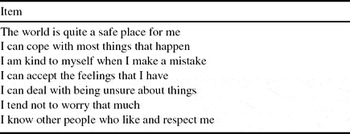
The SHB is a newly published 7-item scale, whereby an individual is asked to rate (in percentages) the extent to which they believe given statements to be true, e.g. acceptance of emotions, their perceived safety and beliefs about the world and the future. This scale is reproduced in Table 1. The mean score of all items was calculated for each participant (α in this sample was 0.88).
The Seven Helpful Beliefs Scale
Rate (in percentages) how much you believe each item to be true with 0% meaning you do not believe the statement at all and 100% meaning you are completely sure you believe the statement

Two further measures developed for the study were a demographic information sheet and an evaluation form, allowing the participants to evaluate the book and provide feedback.
Procedure
On receipt of informed consent, participants were randomly allocated to either the first experimental group (n = 25) or the waiting-list control group (n = 29). Each participant completed the standardized measures within a private room within the university before they were informed to which group they had been allocated to. The experimental group was offered a taught introduction to the book and given guidance on how to best make use of the book (lasting approximately 10 min). During the treatment period, the experimenter phoned participants after 1 week and after 3 weeks to enquire how they were progressing with the book and answer any questions they may have. This conversation was timed and lasted no more than 5 min. Both groups were asked to meet with the researcher in 1 month's time. The control group now formed the second experimental group and were given an introduction and a copy of the book. The first experimental group were asked to complete post-treatment measures and the evaluation form and were given credits for their participation. Both groups were asked whether they had accessed any form of therapy or treatment during the previous month (including access to self-help books) which was recorded, but did not affect their applicability for the study. One participant in the waiting-list control group reported to have accessed individual therapy during the waiting period, which continued for the duration of the study. It was decided that the most conservative decision would be to keep the participant in the study. No other participants in either group reported access to any other forms of therapeutic input.
Participants were contacted by email for the follow-up assessment. The first experimental group was asked to complete the follow-up questionnaires and evaluation form and then debriefed. The second experimental group was asked to complete the post-treatment questionnaires at this time. One month later, participants in this group were asked to repeat the questionnaires and evaluation form. They were then debriefed and offered credits for their participation.
Results
Pre-intervention/wait
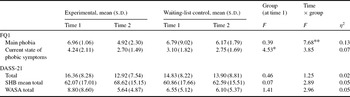
A range of responses was found for participants' main phobia (FQ1, item 1) that they wanted treating. Twenty-eight (52%) participants reported a phobia that was classified as a specific phobia, e.g. spiders, heights; 10 (19%) participants reported a form of blood injury phobia; six (11%) participants reported a social anxiety, and 10 (19%) participants had ‘other’ anxieties that included fear of failure, putting on weight, feeling tense, and being attacked. A multivariate analysis of variance (MANOVA) was calculated to compare differences on the self-report scales between groups prior to treatment. As shown in Table 2, the groups were comparable, since the pre-treatment measures did not differ significantly between treatment groups. All p values >0.05, with the exception of ‘state of phobic symptoms’; a subcategory of FQ1, whereby p = 0.04. The scores showed that the current state of phobic symptoms was better in the waiting-list control group at baseline than in the experimental group.
Study 1: descriptive statistics for experimental and waiting-list control groups at each time period and time × group interactions

FQ1, Fear questionnaire; DASS-21, Depression, Anxiety and Stress Scale; SHB, Seven Helpful Beliefs Scale; WASA, Work and Social Adjustment Scale.
*p < 0.05, **p < 0.01.
Compliance with book and study duration
One month after participants had been given a copy of the self-help book, the participants’ (n = 51) compliance was assessed. Participants were asked ‘How many chapters did you read?’ The majority of participants (n = 31, 61%) stated that they had read every chapter; 16 (31%) had read over half of the book; the remaining four (8%) had read more than four chapters.
Experimental versus control group comparison
Repeated-measures 2 × 2 (group × time) ANOVAs were calculated to analyse the efficacy of treatment between the experimental group and the waiting-list control group (see Table 2 for descriptive statistics including effect sizes). The interactions were significant for the main phobia (FQ1, item 1; see Table 2), revealing a medium effect size. Paired-samples t tests were calculated to compare differences on main phobia between treatment groups from time 1 to time 2. A significant effect was found for the experimental group for the main phobia (t 23 = 4.80, p < 0.001), and a trend was found for the waiting-list control group (t 28 = 1.27, p = 0.06). The other interactions were not significant, with the current state of phobic symptoms (subscale of FQ1) showing a medium effect size and the SHB, WASA and general psychological distress (DASS-21) scales showing small effect sizes.
Participants' evaluations
The evaluation form was designed to assess participants' satisfaction with the new intervention. Ninety percent of participants said they would recommend the book to a friend with only 2% saying they would not while 8% were unsure. Participants were also asked how much they felt they had learned about fear, phobias and anxiety. No participants said they had learnt nothing. Eight percent felt they had learnt a great deal, 53% said they had learnt a large amount and 39% said they had learnt a moderate amount or a little. Participants’ coping was also assessed in this way, in addition to the SHB. Twenty-four percent said the book had helped them to cope with their fear, phobias and anxiety a large amount or a great deal, 55% said it helped them a moderate amount and 22% said it helped them a little. No participants said that it had not helped their coping at all.
Open-ended questions were also used, to determine what participants thought was most helpful and least helpful or unhelpful about the book. On the whole, participants found the case studies, the brief mindfulness relaxation techniques and the ten-step plan most helpful. Many also reported that they found the book easy to understand and found the emphasis on anxiety being ‘normal’ helpful. However, participants’ opinions varied; as some participants found these aspects of the book to be either unhelpful or least helpful.
Discussion
This study aimed to discover if bibliotherapy is an efficacious approach for reducing the symptoms of anxiety and the intensity of cognitive processes, adopting a minimal guided approach in a non-selected sample. It was hypothesized that after 1 month of reading the book, the symptoms of anxiety and ratings for ‘main phobia’ (FQ1, item 1) and the current state of phobic symptoms (subscale of FQ1) would significantly decrease and levels of functioning (WASA) would increase, compared to the pre-treatment baseline measures and waiting-list control group.
Results showed that after 1 month of reading the book, participants’ avoidance of their main phobia (FQ1, item 1) decreased significantly, compared to the waiting-list control group. A medium effect size for the interaction was also found in participants’ current state of phobic symptoms (subscale of FQ1) but the remaining, generic measures, only showed (non-significant) small effect sizes.
Further research of the self-help book would help to clarify the question of whether therapist contact is necessary for treatment gains. As a further improvement to the appropriateness of the sample, it was also deemed important to select participants who reported at least a moderate level of phobic symptoms.
Study 2
Introduction
Study 2 aimed to improve on Study 1 by investigating whether a non-guided approach to bibliotherapy, with no therapist contact, could produce similar positive effects for fears and phobias. A follow-up comparison was also be added to see what natural changes may occur if participants are left over time and to see if effects of treatment are maintained.
It was hypothesized that 1 month after reading the book participants’ symptoms of anxiety, ratings for main phobia (FQ1, item 1) and the current state of phobic symptoms (subscale of FQ1) would significantly decrease and levels of functioning (WASA) and coping (SHB) would increase, compared to pre-treatment and waiting-list control group scores.
Method
Participants
Recruitment
Participants were responders to posters displayed on the university campus advertising a study evaluating a self-help book for fears, phobias and anxiety. Participants were eligible for the study if they were not currently receiving treatment for their anxiety and if they reached at least 4 on a scale measuring avoidance of their main phobia (FQ1, item 1; Marks & Mathews, Reference Marks and Mathews1979). Thirty-three participants agreed to participate in the study. Two dropped out post-treatment because they had received additional treatment during this period and one had not read the self-help book. One more participant was lost at follow-up as they could not be contacted.
Demographic details
The majority of participants were female (n = 30), compared to only three male participants. Age did not differ significantly between participant groups (experimental group: mean = 21.82; waiting-list control group: mean = 18.81; t 30 = 1.7, n.s.).
Materials
All participants received a copy of the self-help book, but the waiting-list control group received it at the end of the study.
Participants were asked to complete several questionnaires at each assessment stage: pre- and post-intervention/wait and follow-up. These were identical to those administered in Study 1. Participants also received the same questionnaires to obtain demographic information and evaluation feedback about the self-help book.
Procedure
Once participants' eligibility had been confirmed and consent obtained, participants were randomly allocated to either the waiting-list control group (n = 16) or the experimental group (n = 17). Participants were invited to attend three meetings in a private room at the university: pre-intervention/wait at the beginning of the study, post-intervention/wait 4 weeks later and follow-up after another 4 weeks. The majority of participants attended the meetings in small groups; however, a minority had individual meetings to suit their availability.
The waiting-list control group, pre-wait, completed the questionnaires prior to being informed of the group to which they were to be allocated. It was emphasized that although they would not receive the book at this stage they would receive a copy at the end of the study. They completed the questionnaires again post-wait, and finally at follow-up, at which stage they received their copy of the book and were debriefed.
The experimental group, pre-intervention, completed the questionnaires and at this stage received their copy of the book. They were told that the book is a self-help manual designed to help people cope with their fears, phobias and anxieties. It is based on traditional treatment methods but is only expected to work if it is read and the activities completed. Post-intervention they returned to complete the questionnaires again along with the evaluation form and at follow-up they completed the questionnaires again and were debriefed.
Results
Pre-intervention/wait
Participants presented with a range of different fears and phobias that they wanted treating. The top two over the whole sample were classed as specific phobias: spiders (30%) and heights (9%). The top three fears in the experimental group were spiders/insects (24%), compulsive behaviours (12%) and dogs (12%). The top two in the control group were spiders (38%) and heights (13%).
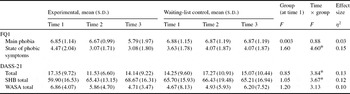
One-way analyses of variance (ANOVA) were conducted to compare differences on the questionnaires between treatment groups prior to treatment. As Table 3 shows, the groups were comparable as they did not differ significantly on any of the measures administered at pre-intervention/wait (all p values > 0.05).
Study 2: descriptive statistics for experimental and waiting-list control groups at each time period and time × group interactions

FQ1, Fear questionnaire; DASS-21, Depression, Anxiety and Stress Scale; SHB, Seven Helpful Beliefs Scale; WASA, Work and Social Adjustment Scale.
*p < 0.05.
Pre-intervention/wait analysis aimed to see if there were any significant differences between the treatment groups. Kolmogorov–Smirnov tests of normality were conducted on the data. Some of the tests produced significant results, indicating data was significantly different from the normal distribution. No suitable non-parametric tests were available, therefore an attempt was made to transform the data to enable the use of parametric tests. Further normality tests on the transformed scores still found the data were significantly different from the normal distribution, therefore it was necessary to apply parametric tests on the original data in order to conduct a controlled analysis (ANOVA).
Experimental versus waiting-list control group
A 3 × 2 (time × group) mixed-design ANOVA was conducted to analyse treatment effects over time between the treatment groups. The interactions were significant for the current state of phobic symptoms (subscale of FQ1: F 2,52 = 4.60, p = 0.02); general psychological distress (DASS-21: F 2,54 = 3.84, p = 0.03); and coping (SHB: F 2,54 = 3.67, p = 0.03). Each of these interactions was of medium-to-large effect size. The only small effect size involved the main phobia. Paired-sample t tests were calculated for each of the significant interactions to see if there was an effect of time in the treatment groups. For the current state of phobic symptoms (subscale of FQ1), a significant effect of time was found for the experimental group between pre- and post-intervention scores (t 14 = 3.29, p = 0.01), and pre-intervention and follow-up scores (t 12 = 3.81, p = 0.002). A significant effect was also found for participants’ coping (SHB) in the experimental group between pre- and post-intervention (t 14 = −2.27, p = 0.04), and pre-intervention and follow-up (t 13 = −2.41, p = 0.03). There were no other significant effects of time in the groups.
Trends towards significant interactions were also found for participants’ functioning (WASA: F 2,54 = 3.13, p = 0.05). Paired-samples t tests found that there was a difference in scores for the experimental group between pre-intervention and follow-up (t 13 = 2.43, p = 0.03).
Compliance with book and study duration
One month after receiving the book, participants in the experimental group had their study compliance assessed by enquiring how much of the self-help book they had read. Five (33%) participants stated they had read the whole book, four (27%) participants had read 6–11 chapters, four (27%) participants had read three chapters and two (13%) participants had read only two chapters or less.
Evaluations
Participants in the experimental group completed an evaluation about the self-help manual 1 month after receiving it. Participants reported similar positive responses as in Study 1 about how much they had learned about fears, phobias and anxiety, how much the book had helped them to cope with their fear, phobia or anxiety and the most helpful and least helpful aspects of the book.
Discussion
This study aimed to extend Study 1 by evaluating the self-help book for fears, phobias and anxiety, adopting a non-guided approach and providing a follow-up assessment comparing the experimental group to the waiting-list control group. It was predicted that participants in the experimental group would show a reduction in avoidance of their main phobia (FQ1, item 1) with additional reductions in their general psychological distress (DASS-21) and improvements in levels of functioning (WASA) and coping (SHB). These predictions were in contrast to smaller changes predicted in the waiting-list control group.
Significant reductions were found in participants’ current state of phobic symptoms (subscale of FQ1) 1 month after reading the book and this was maintained at the 1-month follow-up. Significant improvements were also found in participants’ coping, as measured by the SHB (Mansell, Reference Mansell2007) and this was also maintained at the 1-month follow-up. This is supported by the participants’ own qualitative reports of how much they felt the book had helped them to cope with their fears, phobias and anxiety. A significant interaction also found that participants’ ratings of general psychological distress (DASS-21) was different over time for the experimental and waiting-list control groups; however, post-hoc tests found that the difference over time in the groups individually was not significant. An improvement was also found in participants in the experimental group levels of functioning (WASA). These interactions each showed medium to large effect sizes in contrast to the main phobia that showed a small effect size in this study.
A non-guided approach to self-help in this case did not help to reduce participants’ avoidance of their main phobia. However, it did appear to help reduce factors associated with their phobia: current state of phobic symptoms, general psychological distress and coping.
General Discussion
Two studies were conducted to evaluate a new self-help book for fears, phobias and anxiety disorders. Study 1 adopted a minimal guided approach to the study, whereas Study 2 used a non-guided approach, giving participants no professional help in their treatment.
Participants in both studies reported a range of phobias to target using the self-help treatment, covering a range of domains familiar to clinical studies. The phobic symptoms of this non-selected sample were comparable to that of phobic patient groups [FQ Main phobia, Study 1: mean = 6.9, FQ Main phobia, Study 2: mean = 6.9, FQ Main Phobia, Marks & Mathews (Reference Marks and Mathews1979): mean = 7]. Considering the maximum score for the main phobia item is 8, the non-selected student samples have identified objects of fear that they avoided to a great extent. This supports the use of this sample.
Study 1 found that when adopting a minimal guided approach to bibliotherapy the participants had a significant reduction in the avoidance of their main phobia (FQ1, item 1) as well as reductions in the current state of their phobic symptoms (subscale of FQ1) and impairment of functioning (WASA). Study 2 found that when adopting a non-guided approach to bibliotherapy the participants had reductions in their current state of phobic symptoms (subscale of FQ1), general psychological distress (DASS-21) and impairment of functioning (WASA) and improvements were found in levels of coping (SHB). Positive changes in both studies were found in the experimental group in contrast to the waiting-list control group.
These studies provide preliminary support for a modest effect of bibliotherapy in a subclinical population. The results suggest that a non-guided approach is beneficial for treating additional symptoms associated with anxiety but a guided approach is needed to treat the main phobia.
Strengths and limitations
This study used a randomized controlled design and the second study provided a follow-up comparison to see if the effects of treatment were maintained after the initial treatment period. Good completion and satisfaction rates were also obtained in the evaluation, supporting this self-help manual as an accepted form of treatment for anxiety.
Only psychology students participated in these studies in return for credits for their participation, which could affect their motivation to complete the study. Psychology students may also have prior knowledge of CBT so may display smaller pre-/post-treatment effects than non-psychology students. Males were under-represented in both studies, which could be a reflection of the gender ratio of psychology students. Both studies also had limited sample sizes which could influence the smaller effects or lack of effects found in some of the measures; however, this cannot be assumed. The study was also conducted within a limited time period, giving participants only 1 month to read the book and apply the techniques. Patients in Fletcher et al.'s (Reference Fletcher, Lovell, Bower, Campbell and Dickens2005) study reported that they felt 12 weeks was too soon to evaluate their progress and this study gave participants only 4 weeks, suggesting that over a longer period of time greater effects may be found. The sample for Study 2 were required to exceed a minimum threshold for their phobia scores, so that we could be assured that the participants had a genuine need for self-help. However, as it contrasted with the selection strategy for Study 1, it may have confounded some of the comparisons made between the two studies.
Regardless of these limitations, significant treatment effects were found. However, stronger support may be found if these aspects are improved.
Clinical and research implications
Bibliotherapy is one of the most widely available forms of self-help treatment. However, relatively few of the bibliotherapy manuals have been evaluated in controlled trials to support their effectiveness. These studies provide support for the use of this manual for treating fears, phobias and anxiety disorders from a transdiagnostic perspective. The effects were also found in a non-selected sample which may indicate a prevalence of anxiety in the general population and the greater need for evaluating the self-help treatments readily available.
Significant treatment gains were found in these studies not only for the treatment of the main phobia (FQ1, item 1) but also for the associated symptoms of anxiety. This not only provides support for the treatment of the symptoms but also the possible use of such treatments as a preventative measure: preventing the development of disorders in high-risk populations or preventing the development of subclinical problems to clinical disorders or as relapse prevention by using the manual as homework between therapy sessions or post-treatment. Long waiting lists are also a problem in the treatment of psychological disorders and the positive effects of the manual support the possibility of using it as a pre-treatment aid, to give patients some level of support while they wait for a more high-intensity level treatment. It is thought that using self-help in this way may also have a priming effect (Fletcher et al. Reference Fletcher, Lovell, Bower, Campbell and Dickens2005) where patients have a greater understanding of their treatment and are more readily prepared for it. Self-help is also a good way of promoting independence and self-management of the patients’ own treatment which can help to improve recovery by reducing dependence on the clinician and the need for contact with clinicians to make patients well.
These questions are important given the recent increase of stepped-care approaches to psychological treatment. Further research needs to be done looking at the different deliveries of self-help treatment: varying levels of guidance, computerized self-help and the guidance that may be required through this. Knowing the effects that different levels have could help to treat patients more effectively by providing them with the right intensity of treatment for the severity of their symptoms.
Acknowledgements
The authors thank OneWorld Publications for allowing the use of the book for research prior to publication. Dr Warren Mansell is supported by ESRC Grant RES-060-25-0044.
Declaration of Interest
Dr Warren Mansell is the author of the self-help book being evaluated.
Learning objectives
(1) To become aware of the utility of bibliotherapy for anxiety based on a cognitive behavioural rationale.
(2) To identify the importance of self-help materials that are not diagnosis-specific in allowing wider accessibility and an emphasis on the cognitive and behavioural processes that maintain psychological distress.
(3) To become aware of the emerging evidence base for a transdiagnostic self-help guide for anxiety and related problems.



Comments
No Comments have been published for this article.