1. INTRODUCTION
The study of laser–plasma interaction has gained heights with the advent of ultraintense and ultrashort laser pulses by chirped pulse amplification technique. The interaction of intense laser beam in plasma leads to a number of potential applications in laser-driven fusion (Tabak et al., Reference Tabak, Hammer, Glinsky, Kruer, Wilks, Woodworth, Campbell, Perry and Mason1994; Deutsch et al., Reference Deutsch, Furukawa, Mima, Murakami and Nishihara1996; Winterberg, Reference Winterberg2008; Lalousis et al., Reference Lalousis, Foldes and Hora2012), laser-charged particle acceleration (Tajima & Dawson, Reference Tajima and Dawson1979; Sarkisov et al., Reference Sarkisov, Bychenkov, Novikov, Tikhonchuk, Maksimchuk, Chen, Wagner, Mourou and Umstadter1999; Gupta & Suk, Reference Gupta and Suk2007; Uhm et al., Reference Uhm, Nam and Suk2012), high harmonic generation (Parashar, Reference Parashar2009; Askari & Azish, Reference Askari and Azish2011), X-ray lasers (Burnett & Corkum, Reference Burnett and Corkum1989; Lemoff et al., Reference Lemoff, Yin, Gordon, Barthy and Harris1995; Glenzer & Redmer, Reference Glenzer and Redmer2009; Lourenco et al., Reference Lourenco, Kowarsch, Scheid and Wang2010), new radiation sources, and other applications (Milchberg et al., Reference Milchberg, Durfee and Mcllrath1995; Parashar et al., Reference Parashar, Pandey and Tripathi1997; Liu & Tripathi, Reference Liu and Tripathi2001; Mulser & Bauer, Reference Mulser and Bauer2004; Hora, Reference Hora2007). The laser beam propagation upto several Rayleigh lengths is an essential requirement for the success of all these applications. However, the propagation of laser beam in plasma is inhibited by natural diffraction. The plasma being a non-linear medium counterbalances this effect by non-linear self-focusing mechanism. Self-focusing is genuinely a non-linear phenomena which arises due to ponderomotive force-type non-linearity, relativistic-type non-linearity, collisional-type, and ohmic heating-type non-linearity. The non-linearity affects the propagation characteristics of laser beam in plasma. Relativistic self-focusing (RSF) was first introduced by Hora, Litvak, and Max (Hora, Reference Hora1969; Litvak, Reference Litvak1969; Max, Reference Max, Arons and Langdon1974). They revealed that RSF occurs due to relativistic increase in mass of electron and redistribution of plasma density under the action of pondermotive force. Classically, RSF has been thoroughly studied in homogeneous and inhomogeneous plasma by many researchers (Upadhyay et al., Reference Upadhyay, Tripathi, Sharma and Pant2002; Varshney et al., Reference Varshney, Qureshi and Varshney2006; Singh et al., Reference Singh, Aggarwal and Gill2009; Sharma & Kourakis, Reference Sharma and Kourakis2010).
Recently, the interaction of laser beam with quantum plasmas has emerged as an interesting topic of research due to their applications in modern technology such as dense astrophysical and cosmological environments (Benvenuto & De Vito, Reference Benvenuto and De Vito2005; Harding & Lai, Reference Harding and Lai2006), nanoscale electronic devices (Wei & Wang, Reference Wei and Wang2007), quantum dots (Shpatakovskaya, Reference Shpatakovskaya2006), relativistic effects in laboratory plasmas (Marklund & Shukla, Reference Marklund and Shukla2006; Shukla & Eliasson, Reference Shukla and Eliasson2007), metallic nanoparticles, and fast ignition (Jung, Reference Jung2001; Barnes et al., Reference Barnes, Dereux and Ebbensen2003; Azechi, Reference Azechi2006; Ozbay, Reference Ozbay2006). The quantum effects interplay when de Broglie wavelength of the neighboring particles becomes comparable to the average interparticle distance. This comes into being in a high-density and low-temperature plasma which obeys Fermi–Dirac statistics instead of classical Maxwell–Boltzman statistics. In recent investigations made by various researchers, it has been well established that quantum effects can enhance laser beam focusing comparative to the classical case of reference. Patil et al. (Reference Patil, Takale, Navare, Dongare and Fulari2013) reported the RSF of Gaussian laser beam in cold quantum plasma. They observed that quantum effects play a vital role in beam focusing and adds to self-focusing in addition to relativistic effects. Further, laser beam in quantum plasma oscillates with more frequency and lesser laser amplitude making quantum plasma as an efficient non-linear medium. In similar investigation, Patil and Takale (Reference Patil and Takale2013) studied the self-focusing of Gaussian laser in X-ray regime in thermal quantum plasma. They have employed Maxwell's equation and quantum fluid model to study the beam dynamics. Habibi and Ghamari (Habibi & Ghamari, Reference Habibi and Ghamari2012) studied the stationary self-focusing of Gaussian laser beam in relativistic cold quantum plasma using upward plasma density ramp. In their study, they found that the quantum effects and upward density ramp together causes sharp focusing and higher oscillations in comparison to classical relativistic (CR) plasma. In another work, Habibi and Ghamari (Habibi & Ghamari, Reference Habibi and Ghamari2011) studied non-stationary self-focusing of intense laser beam in cold quantum plasma using density ramp. They found stronger focusing at the rear of the pulse than at the front. Moreover, better focusing is observed due to the influence of quantum term as compared with CR plasma. In the similar investigations made by Zare et al. (Reference Zare, Yazdani, Rezaee, Anvari and Sadighi-Bonabi2015), they have studied the RSF of Gaussian X-ray laser beam in thermal collisionless quantum plasma in the presence of density ramp. They observed that laser self-focusing occurs earlier in denser plasma environment resulting in smaller spot size in comparison to classical regime. Kumar et al. (Reference Kumar, Aggarwal, Richa and Gill2016) revisited the Patil et al. (Reference Patil, Takale, Navare, Dongare and Fulari2013) problem by considering ponderomotive and relativistic effects together. They observed that laser propagation can be significantly enhanced by considering relativistic and ponderomotive effects in cold quantum plasma rather than in CR regime. All these investigations have been done using well-understood Paraxial ray approximations. However, Aggarwal et al. (Reference Aggarwal, Kumar, Richa and Gill2017) studied the self-focusing and self-phase modulation of intense laser beam in weakly relativistic and ponderomotive regime by considering quantum effects using global variational approach. The results obtained show stronger self-focusing under the combined effect of both cold quantum plasma and relativistic ponderomotive non-linearity. From further findings, it is concluded that regularized phase undergoes maximum negative shift for the above-mentioned non-linearity. The magnetic field modifies the quiver motion of electrons by adding cyclotron frequency ωc = eB/m (where e, m are the charge and mass of the electron and B is the magnetic field and ωc is the cyclotron frequency) to the natural frequency of oscillating electrons during laser beam propagation. Thus, modifying the non-linear current density and therefore the dispersive properties of the medium changes.
Rathore and Kumar (Reference Rathore and Kumar2016) have recently discussed the ponderomotive self-focusing of laser beam in magnetized quantum plasma with kinetic theory approach under quantum hydrodynamic model. With the above motivation, we have studied the self-focusing of Gaussian laser beam in weakly relativistic magnetized cold quantum (WRMCQ) plasma using well-known paraxial ray approximation. To the best of our knowledge, the key role of magnetic field in relativistic cold quantum plasma has not been studied so far in weakly relativistic regime. The results are further compared with weakly relativistic cold quantum (WRCQ) plasma on setting ωc/ω o → 0 and weakly relativistic magnetized plasma (WRM) for δ → 0.
The paper is organized as follows: in Section 2, we have derived the non-linear plasma permittivity for WRMCQ case. In Section 3, we have studied the evolution of beam width parameter of laser beam using Schrodinger wave equation, and lastly in Section 4, the results are depicted in the form of graphs and discussed subsequently.
2. FORMALISM
In this section, we develop the formalism to investigate the propagation of laser beam of Gaussian profile in weakly relativistic magnetized cold quantum plasma in cylindrical coordinate system. We have assumed initial electron density n
o
in the absence of the laser beam. The linearly polarized laser pulse is assumed to be propagating along the z-axis with angular frequency ω
o
. A static magnetic field
 $B_o \hat z$
is taken along the direction of propagation of the beam. The electric field amplitude of laser beam can be expressed as
 $$E(r,z) = A(r,z)\exp [ - \iota ({\rm \omega} _o t - kz)],$$
where
 $A^2 \vert_{z = 0} = A_{oo}^2 \exp ( - r^2 /r_o^2 )$
is the initial intensity distribution of the beam propagating along the z-axis. Here, r
o
is the initial beam width and A
oo
is the axial amplitude at the central position z = 0.
 $k = ({\rm \omega} _o /c)\sqrt {{\rm \epsilon} _o} $
is the wave propagation constant and c is the speed of the light in vacuum. The field distribution A(r, z) for z > 0 is given by
 $$A^2 (r,z) = \displaystyle{{A_{oo}^2} \over {\,f^2}} \exp \left[ { - \displaystyle{{r^2} \over {r_o^2 f^2}}} \right].$$
In the present case, pulse duration is assumed to be shorter than the electron response time. Therefore, the non-linear contribution due to ponderomotive force can be neglected. Thus, the relativistic non-linearity and longitudinal magnetic field are the only factors responsible for the occurrence of self-focusing. The effective electron density “n e” arising from these factors is given by
 $$n_{\rm e} = \displaystyle{{n_o} \over {{\rm \gamma} (1 - ({\rm \omega} _{\rm c} /{\rm \gamma \omega} _o ))}}.$$
Here, ωc is the cyclotron frequency and γ is the modified relativistic factor, which can be obtained iteratively for (ωc/γω o ) <1 as (Pandey & Tripathi, Reference Pandey and Tripathi2009; Gill et al., Reference Gill, Kaur and Mahajan2010)
 $${\rm \gamma} = \left[ {1 + A^2 + 2A^2 \left( {\displaystyle{{{\rm \omega} _{\rm c}} \over {{\rm \omega} _o}}} \right)\left( {\displaystyle{1 \over {\sqrt {1 + A^2}}}} \right) + 3A^2 \left( {\displaystyle{{{\rm \omega} _{\rm c}} \over {{\rm \omega} _o}}} \right)^2 \left( {\displaystyle{1 \over {1 + A^2}}} \right)} \right]^{1/2}. $$
The general form of effective dielectric constant of the plasma medium can be written as
 $${\rm \epsilon} = {\rm \epsilon} _o + {\rm \epsilon} _2 (EE^* ),$$
where ε o is the linear part of the dielectric constant and can be written as
 $${\rm \epsilon} _o = 1 - \displaystyle{{{\rm \omega} _{\rm p}^{\rm 2}} \over {{\rm \omega} _o^2}}, $$
ωp = (4πn o e 2/m)1/2 is the plasma frequency, e and m are the electronic charge and mass, respectively. ε2 (EE*) represents the non-linear part of the plasma permittivity comprising of magnetized cold quantum plasma and is given by (Jung & Murakami, Reference Jung and Murakami2009; Kumar et al., Reference Kumar, Aggarwal, Richa and Gill2016).
 $${\rm \epsilon} _2 (EE^* ) = \displaystyle{{{\rm \omega} _{\rm p}^{\rm 2}} \over {{\rm \omega} _o^2}} \left( {1 - \displaystyle{{n_{\rm e}} \over {n_o}} (1 - \displaystyle{{\rm \delta} \over {\rm \gamma}} )^{ - 1}} \right).$$
here
 ${\rm \delta} = 4{\rm \pi} ^4 h^2 /m^2 {\rm \omega} _o^2 {\rm \lambda} ^4 $
is the parameter which is a function of quantum wavelength, h is the planck's constant and λ is the wavelength of the laser beam. Equation (7) represents the nonlinear part of the dielectric constant which is function of intensity. It is noticed that the linear part of the dielectric constant is intensity-independent, as appears in the equation for dynamics of self-focusing as multiplicative constant in Eq. (16). On the other hand, intensity-dependent non-linear part takes part in self-focusing of laser beam in a dynamic way during its transit through the plasma. In the paraxial ray approximation
 $(r^2 \ll r_0^2 f^2 )$
, ε2 (EE*) is Taylor expanded around r = 0 as follows
 $$\eqalign{{\rm \epsilon }_2(EE^*) = {\rm \epsilon }_2(r = 0) - \displaystyle{{r^2} \over {r_o^2 }}\Phi (EE^*),} $$
where
 $$\eqalign{ \Phi &= \displaystyle{{A_{oo}^2 } \over {2f^4}}\displaystyle{{{\rm \omega }_{\rm p}^{\rm 2} } \over {{\rm \omega }_o^2 }}\displaystyle{1 \over {{\rm \gamma }_o^3 }}\displaystyle{1 \over {(1 - ({\rm \omega }_{\rm c}/{\rm \gamma }_o{\rm \omega }_o))}}\left( {1 - \displaystyle{{\rm \delta } \over {{\rm \gamma }_o}}} \right)^{ - 2}\left( {1 - \displaystyle{{{\rm \omega }_{\rm c}{\rm \delta }} \over {{\rm \gamma }_o^2 {\rm \omega }_o}}} \right) \cr &\times\left[ {1 + \displaystyle{{{\rm \omega }_{\rm c}} \over {{\rm \omega }_o}}\displaystyle{1 \over {\sqrt {1 + (A_{oo}^2 /f^2)} }}\left( {2 - \displaystyle{{A_{oo}^2 /f^2} \over {1 + (A_{oo}^2 /f^2)}}} \right)}\right. \cr &+ \left.3\displaystyle{1 \over {1 + (A_{oo}^2 /f^2)}}{\left( {\displaystyle{{{\rm \omega }_{\rm c}} \over {{\rm \omega }_o}}} \right)}^2\left( {1 - \displaystyle{{A_{oo}^2 /f^2} \over {1 + (A_{oo}^2 /f^2)}}} \right) \right],}$$
where γ o is the relativistic factor defined at r = 0 and is given by
 $$\eqalign{{\rm \gamma} _o &= \left[ {1 + \displaystyle{{A_{oo}^2} \over {\,f^2}} + 2\displaystyle{{A_{oo}^2} \over {\,f^2}} \left( {\displaystyle{{{\rm \omega} _{\rm c}} \over {{\rm \omega} _o}}} \right)\left( {\displaystyle{1 \over {\sqrt {1 + (A_{oo}^2 /f^2 )}}}} \right)}\right. \cr &+ \left. 3\displaystyle{{A_{oo}^2} \over {\,f^2}} \left( {\displaystyle{{{\rm \omega} _{\rm c}} \over {{\rm \omega} _o}}} \right)^2 \left( {\displaystyle{1 \over {1 + (A_{oo}^2 /f^2 )}}} \right) \right]^{1/2}. }$$
3. SPOT SIZE EVOLUTION
For the spot size evolution, we start with the Maxwell's equations governing the non-linear wave equation, which oversees the propagation of Gaussian laser beam in the plasma. The non-linear wave equation is given by
 $$\displaystyle{{\partial ^2 {\rm E}} \over {\partial z^2}} + {\rm \alpha} \nabla _ \bot ^2 {\bf E} + \displaystyle{{{\rm \omega} _o^2} \over {c^2}} {\rm \epsilon} {\bf E} = 0,$$
where α = (1/2)(1 + ε
op
/ε
ozz
) and ε
ozz
= 1 − (ωp/ω
o
)2. Here ε
op
= ε
o
+ ε2 (r = 0), substituting for E in Eq. (10) and by using WKB (Wentzel-Kramers-Brillouin) and slowly varying envelope approximation, one can neglect
 $\partial ^2 {\bf A}/\partial z^2 $
. The quasioptic equation reduces to
 $$- 2\iota k\displaystyle{{\partial A} \over {\partial z}} + {\rm \alpha} \nabla _ \bot ^2 A - \displaystyle{{r^2} \over {r_o^2}} \displaystyle{{{\rm \omega} _o^2} \over {c^2}} \Phi A = 0,$$
where
 $\nabla _ \bot ^2 A$
represents spatial dispersion of the beam in transverse direction. The last term is a non-linear term and is responsible for the compression of the beam. The relative competition between a spatial dispersion term and a non-linear term will decide the focusing and defocusing of laser beam. Further, following the approach given by Akhmanov et al. (Reference Akhmanov, Sukhorukov and Khokhlov1968) and developed by Sodha et al. (Reference Sodha, Ghatak and Tripathi1976), one may express the complex amplitude of the electric vector A(r, z) as
 $$A(r,z) = A_o (r,z)\exp [ - {\rm \iota} k(z)S(r,z)],$$
where A
o
(r, z) and S(r, z) are the real functions of space variables z and r. In order to obtain the coupled set of equations for S and
 $A_0^2 $
, we substitute for A(r, z) from Eq. (12) into Eq. (11). Separating the real and imaginary parts of the resulting equation, we get
 $$2\displaystyle{{\partial S} \over {\partial z}} + \left( {\displaystyle{{\partial S} \over {\partial r}}} \right)^2 - \displaystyle{\alpha \over {k^2 A_o}} \left( {\displaystyle{{\partial ^2 A_o} \over {\partial r^2}} + \displaystyle{1 \over r}\displaystyle{{\partial A_o} \over {\partial r}}} \right) + \displaystyle{{r^2} \over {r_o^2}} \displaystyle{\Phi \over {{\rm \epsilon} _o}} = 0$$
and
 $$\displaystyle{{\partial A_o^2} \over {\partial z}} + \displaystyle{{\partial S} \over {\partial r}}\displaystyle{{\partial A_o^2} \over {\partial r}} + {\rm \alpha} A_o^2 \left( {\displaystyle{{\partial ^2 S} \over {\partial r^2}} + \displaystyle{1 \over r}\displaystyle{{\partial S} \over {\partial r}}} \right) = 0.$$
Expanding eikonal S(r, z), in paraxial ray approximation as
 $$S(r,z) = \displaystyle{{r^2} \over 2}{\rm \beta} _o (z) + S_o (z),$$
where β
o
(z) = (2/f)(1/(1 + ε
op
/ε
ozz
))(df/dz) and
 ${\rm \beta} _0^{ - 1} $
is elucidated as the radius of the curvature of the beam. S
o
(z) is a constant related to the phase and is not required in further analysis.
Substituting
 $A_o^2 (r,z)$
and S(r, z) from Eqs. (2) and (15), respectively, in Eq. (13) and equating the coefficients of r
2 on both sides and using ξ = z/R
d
, where
 $R_d = kr_o^2 $
, one can obtain the equation of dimensionless beam width parameter f as
 $$\eqalign{ {{d^2 f} \over {d\xi ^2}} &= {{{\rm \alpha} ^2} \over {\,f^3}} - {{{\rm \alpha} R_d^2} \over {{\rm \epsilon} _o}} f*{{A_{oo}^2} \over {2f^4}} {{{\rm \omega} _{\rm p}^{\rm 2}} \over {{\rm \omega} _o^2}} {1 \over {{\rm \gamma} _o^3}} {1 \over {(1 - ({\rm \omega} _{\rm c} /{\rm \gamma} _o {\rm \omega} _o ))}}\left( {1 - {{\rm \delta} \over {{\rm \gamma} _o}}} \right)^{ - 2} \left( {1 - {{{\rm \omega} _{\rm c} {\rm \delta}} \over {{\rm \gamma} _o^2 {\rm \omega} _o}}} \right) \cr &\times\, \left[ {1 + {{{\rm \omega} _{\rm c}} \over {{\rm \omega} _o}} {1 \over {\sqrt {1 + (A_{oo}^2 /f^2 )}}} \left( {2 - {{A_{oo}^2 /f^2} \over {1 + (A_{oo}^2 /f^2 )}}} \right)}\right. \cr &\left. +\, 3{1 \over 1 + (A_{oo}^2 /f^2 )} \left( {{\rm \omega}_{\rm c} \over {\rm \omega} _o} \right)^2 \left( 1 - {{A_{oo}^2 /f^2} \over {1 + (A_{oo}^2 /f^2 )}} \right) \right].}$$
4. NUMERICAL RESULTS AND DISCUSSION
Equation (16) is the second-order non-linear differential equation that governs the dynamics of the beam width parameter f as a function of the normalized distance of propagation ξ. The first term on its righ-hand side is the diffractional term, which has its origin coming from Eq. (11) and is responsible for the divergence of the laser beam. The second term being non-linear in character results in self-focusing. There is a relative competition between the diffractional and non-linear terms. The fate of the laser beam further depends upon the several parameters such as plasma density (ωp), relativistic factor (γ), contribution of cold quantum plasma (δ), and relative value of magnetic field (ωc/ω0). All these parameters determines the beam dynamics of laser beam in the presence of externally applied magnetic field. As the analytical solution of Eq. (16) is not possible, we seek help of numerical techniques to find the solution. The following set of laser and plasma parameters is considered: ω o = 1.778 × 10²⁰ rad/s, r o = 0.002 cm, λ = 0.0106 nm, n o = 3.14 × 1018 cm−3, and ωc/ω o = 0.1 − 0.5.
It is to be understood that the non-linear term increases as the plasma permittivity increases. Obviously, we explore the combined effect of static magnetic field and cold quantum plasma when Gaussian laser beam propagates in such a non-linear medium. Numerical computation is performed and results are plotted in the form of graphs. Critical curves are obtained when laser beam travels in self-trapped mode. This can be done by setting f = 1 and vanishing of left-hand side of the Eq. (16).
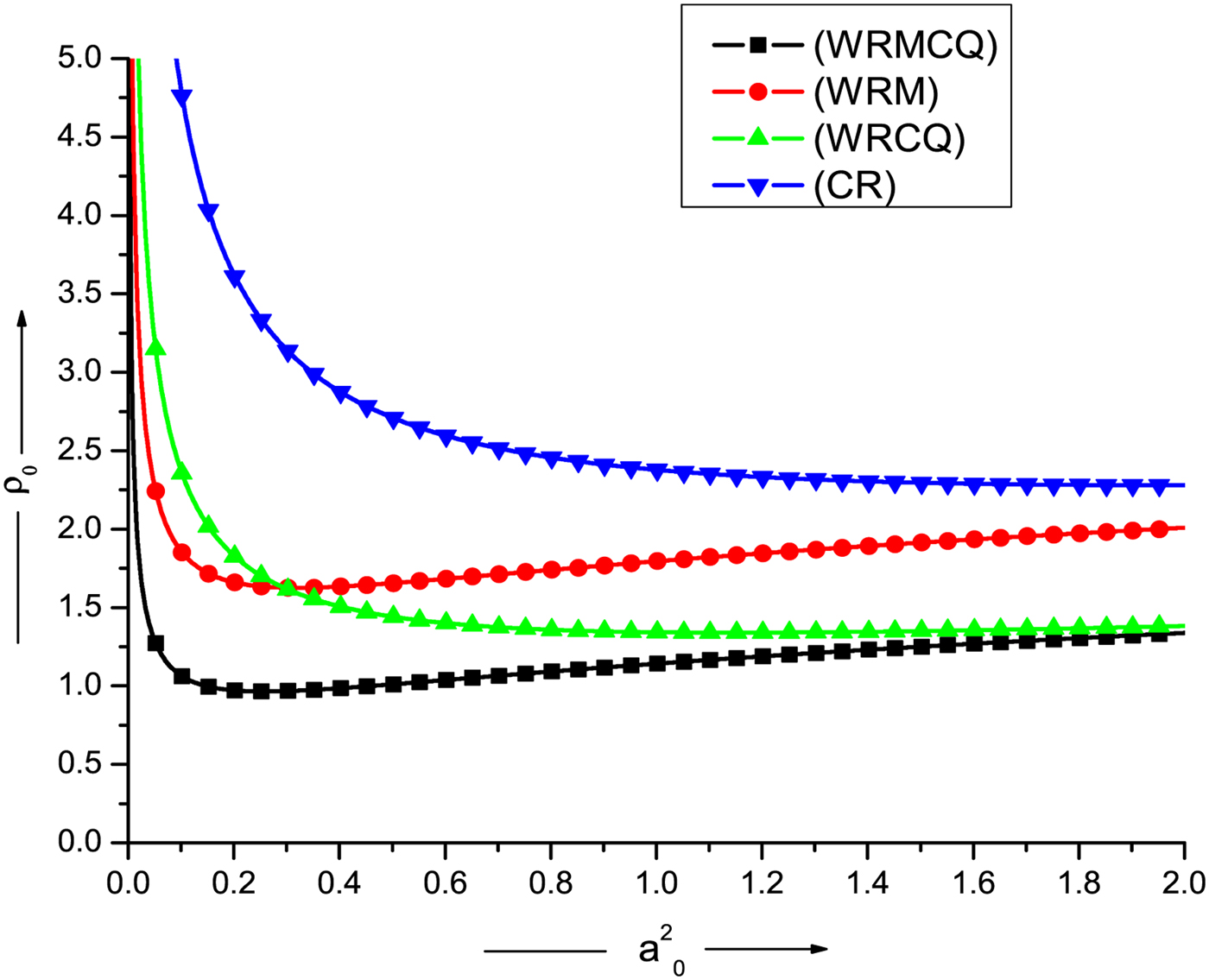
Figure 1 depicts the plot of critical curve (
 $a_o^2, {\rm \rho} _o $
) for weakly relativistic magnetized cold quantum (WRMCQ) plasma, weakly relativistic magnetized (WRM) plasma, and weakly relativistic cold quantum (WRCQ) plasma as well as for classical relativistic (CR) case of reference. By neglecting the quantum effects (δ → 0), the equilibrium beam radius can be plotted for weakly relativistic magnetized (WRM) plasma. Similarly, ωc/ω0 → 0 leads to WRCQ case and by putting δ → 0 and ωc/ω0 → 0 for CR case of reference. As apparent from the graph, with increase of
 $a_o^2 $
, there is a monotonic fall in the equilibrium beam radius initially. The equilibrium beam radius falls faster for WRMCQ plasma as compared with WRM, WRCQ, and CR cases. The magnetic field enhances the plasma permittivity and there is thus a wide range of laser intensities which can be focused in the case of WRMCQ plasma. Obviously, the non-linearity is strongest for WRMCQ plasma, weaker for WRM and WRCQ plasma model, respectively, and weakest for CR case. Therefore, self-focusing region is varied accordingly, that is, maximum for WRMCQ plasma and minimum for CR case.
Critical curves in (
 $a_o^2, \rho _o $
) plane for weakly relativistic magnetized cold quantum (WRMCQ) plasma, weakly relativistic magnetized (WRM), weakly relativistic cold quantum (WRCQ), and classical relativistic (CR) cases. The parameters are, λ = 0.0106 nm, ωc/ω
o
= 0.5, r
o
= 0.002 cm, and n
o
= 3.14 × 1018 cm−3.

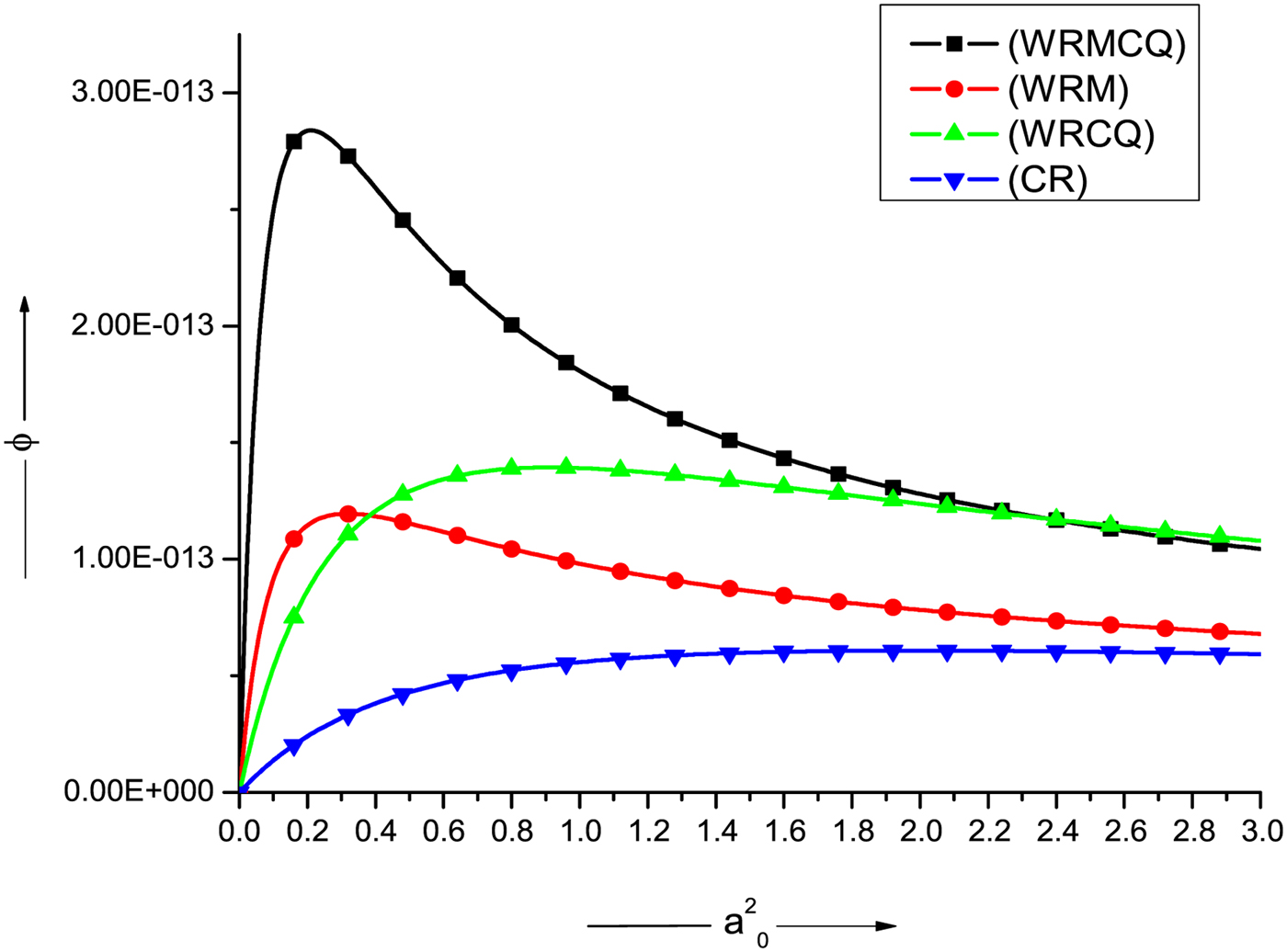
Figure 2 exhibits the graph of non-linear plasma permittivity Φ as a function of intensity for four cases of plasma model. The inclusion of magnetic field in cold quantum plasma acts as a catalyst, thereby improving the possibility of self-focusing. Thus, it leads to suitable conditions required for self-focusing in a WRM plasma. However, saturation achieved in case of WRCQ is quite delayed, therefore, enhanced self-focusing length is observed. Obviously, the combined role of cold quantum plasma and magnetic field in non-linear plasma permittivity is to assist laser beam in setting earlier self-focusing as evident from Figure 4. From Figure 2, it is observed that the magnetic field enhances the non-linear term, thus increasing the focussed region of WRMCQ and WRM plasma model as compared to WRCQ and CR case of reference.
Variation of non-linear plasma permittivity Φ against intensity parameter for WRMCQ, WRM, WRCQ, and CR cases, and other parameters being same as mentioned in the caption of Figure 1.
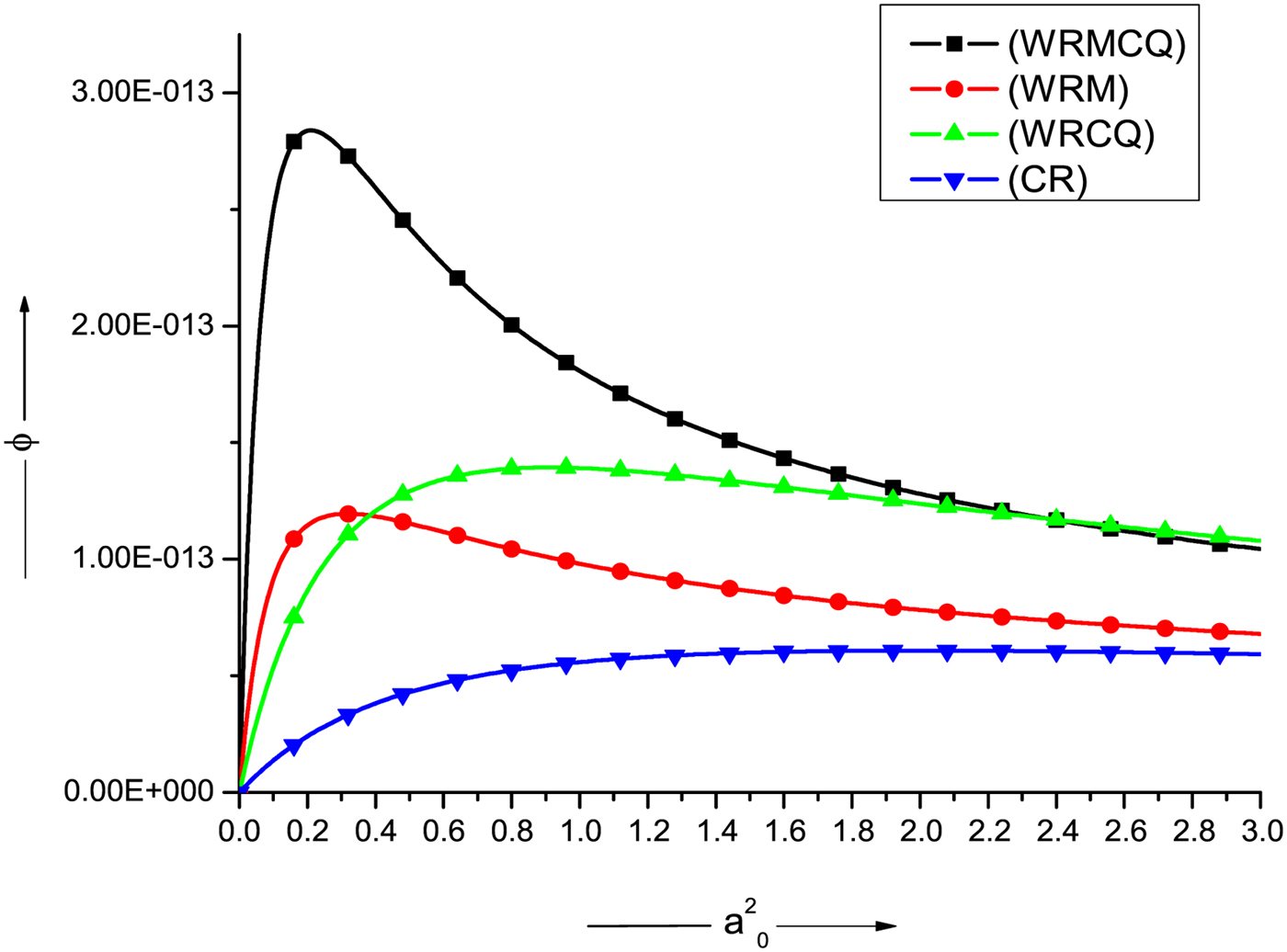
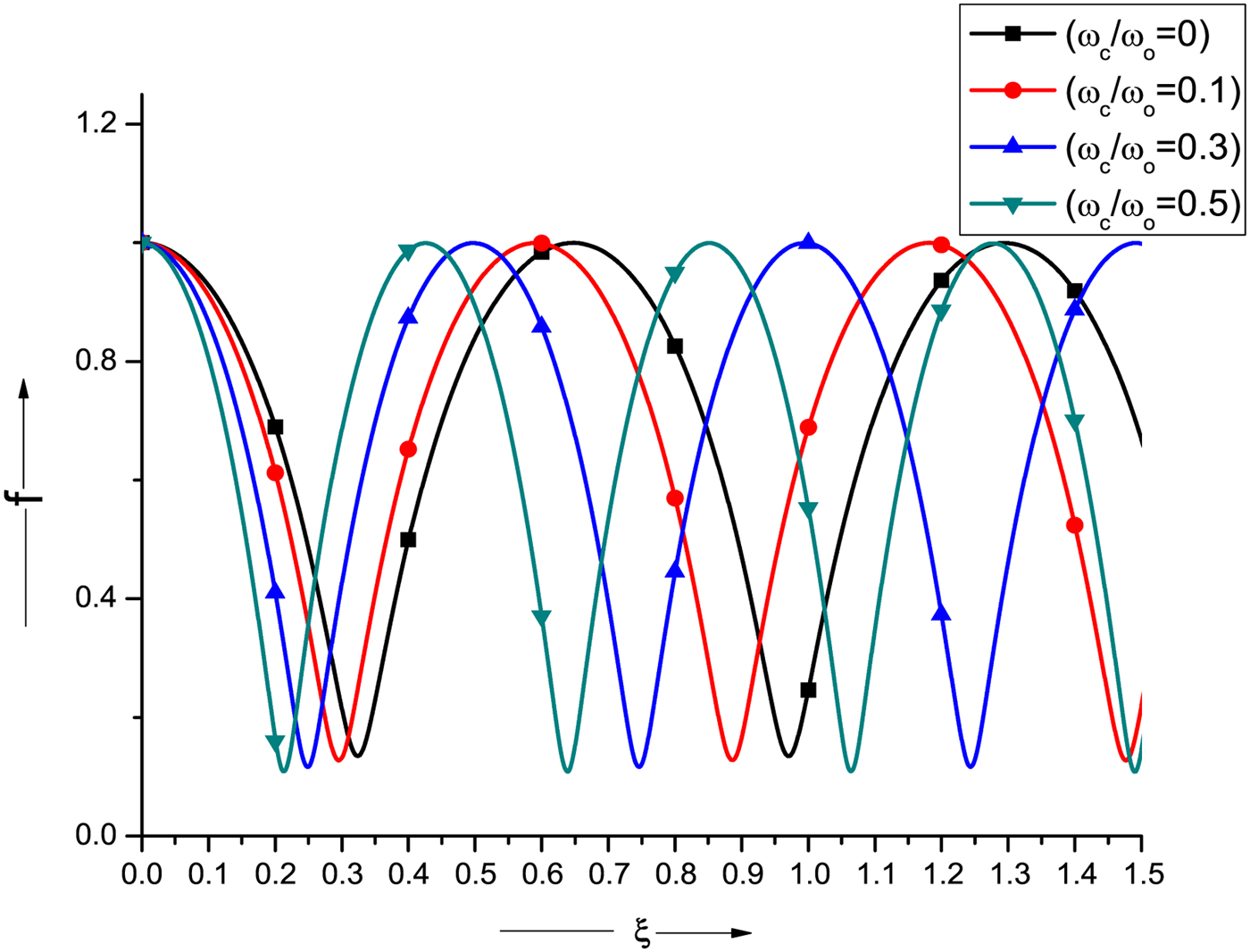
Figure 3 represents the variation of beam width parameter f with normalized distance of propagation ξ for different values of ωc/ω o . It has been found that self-focusing starts earlier with increase in magnetic field. For ωc/ω o = 0.5, the self-focusing is strongest. This is due to the fact that non-linear term increases with increasing magnetic field by accelerating the electrons in the relativistic factor γ. Our results are thus in agreement with the results obtained by Vij et al. (Reference Vij, Gill and Aggarwal2016) wherein the role of magnetic field is seen to enhance the self-focusing and self-compression mechanism.
Variation of beam width parameter f with normalized propagation distance ξ for different values of ωc/ω o and other parameters being same as mentioned in the caption of Figure 1.

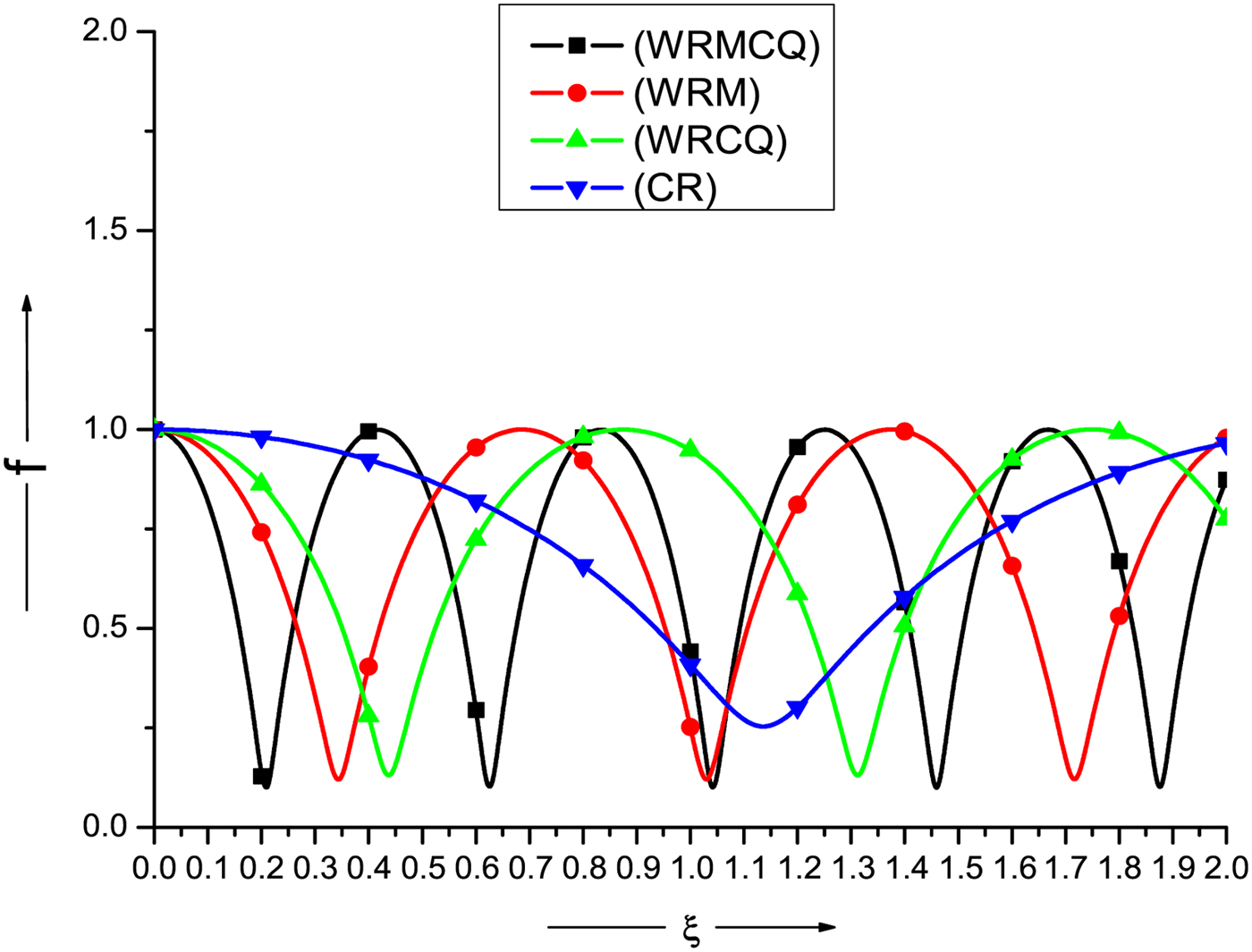
Figure 4 represents the variation of beam width parameter f with normalized distance of propagation ξ for different cases of plasma models, that is, WRMCQ, WRM, WRCQ, and CR cases of references. The self-focusing observed is stronger in the case of WRMCQ plasma due to enhancement in non-linear plasma permittivity. The results are consistent with Figures 1 and 2. Periodic focusing is observed due to the dominance of non-linear refraction term over diffraction term. The self-focusing length is considerably decreased with the combined effect of magnetic field and cold quantum plasma. The results are improved over the previous model studied by Kumar et al. (Reference Kumar, Aggarwal, Richa and Gill2016) in their (Fig. 2). The beam width parameter also decreases in WRMCQ plasma and WRM (with magnetic field) in comparison to WRCQ and CR cases (without magnetic field) as apparent from the figure. The present results and analysis may be useful in understanding the mechanism of laser beam propagation in non-linear medium where the role of quantum plasma is envisaged.
Variation of beam width parameter f with normalized propagation distance ξ for WRMCQ, WRM, WRCQ, and CR cases of references, and other parameters being same as mentioned in the caption of Figure 1.

5. CONCLUSIONS
In the present manuscript, the authors have studied the self-focusing of Gaussian laser beam in weakly relativistic magnetized cold quantum (WRMCQ) plasma. Following conclusions are highlighted:
-
1. The non-linearity and self-focusing is strongest in case of weakly relativistic magnetized cold quantum (WRMCQ) plasma model as compared with weakly relativistic magnetized (WRM) plasma, weakly relativistic cold quantum (WRCQ) plasma, and classical relativistic (CR) cases of references.
-
2. Quantum plasma plays a significant role in additional self-focusing over CR case of reference.
-
3. Laser propagation can be enhanced with the addition of magnetic field contribution in cold quantum plasma.
ACKNOWLEDGMENTS
The author's Vimmy Goyal, Harish Kumar, and Richa are thankful to the RIC of I.K Gujral Punjab Technical University, Kapurthala (India) for their support.