Complex cardiac conditions seen in patients with heterotaxy syndrome often require functionally univentricular palliation. The Fontan procedureReference Fontan and Baudet1 has become the most widely used palliation for functionally univentricular physiology. Early survival has improved for those patients with heterotaxy, but remains poorer than for other patients with functionally univentricular hearts converted to the Fontan circulation.Reference Bartz, Driscoll and Dearani2 Analysis of a series of patients with heterotaxy reported from a single centre showed that late morbidity and mortality remain substantial after conversion to the Fontan circuit.Reference Bartz, Driscoll and Dearani2 This and similar studies, however, have been limited by their retrospective designs and the relatively small numbers of patients seen in single centres. There are few data comparing the functional outcomes of long-term Fontan survivors with and without heterotaxy. The Pediatric Heart Network conducted a cross-sectional study evaluating the clinical state of 546 children and adolescents, 42 with heterotaxy, surviving after the Fontan procedure.Reference Sleeper, Anderson and Hsu3 Here we report findings from that study regarding medical history, health state, and ventricular performance in the patients with heterotaxy, and compare them to corresponding data in those without heterotaxy.
Methods
The Fontan Cross-Sectional Study was established by the Pediatric Heart Network, which consists of 7 centres in the United States and Canada, and a Data Coordinating Center at the New England Research Institutes, funded by the National Heart, Lung, and Blood Institute of the National Institutes of Health. The network was established to develop evidence-based recommendations for children with cardiac disease.Reference Mahony, Sleeper and Anderson4 All centres obtained local approval from their Institutional Review Board or Ethics Committee before initiating the study, and written informed consent was obtained for all subjects, either from a parent or legal guardian, or from the subject if of legal age. Assent of the subjects was also obtained as dictated by local guidelines.
Those enrolled in the study were required to be between the ages of 6 and 18 years at the time of enrollment, to have undergone conversion to the Fontan circulation using any technique at least 6 months prior to enrollment, to agree to, and have the ability to complete an echocardiogram, a parent report health status questionnaire, and blood testing, and to have planned or ongoing cardiac care at the study centre that would allow completion of testing within three months of enrollment. Patients were excluded from enrollment if they exhibited a non-cardiac medical or psychiatric disorder that would prevent successful completion of planned testing, or that would invalidate the results of testing, if they were participating in another ongoing or planned research protocol, if there was lack of fluency in reading by the primary giver of care in both English and Spanish, or if they were pregnant at the time of enrollment, or planned pregnancy prior to completion of testing.Reference Sleeper, Anderson and Hsu3
In all, we screened the records of 1,078 children who had been converted to the Fontan circulation, and 831 (77%) were potentially eligible for the study. Potentially eligible children were contacted, and 638 (77%) of these were fully eligible. The rate of consent was 86%, with 546 patients enrolled by the prespecified end date of April 30, 2004. The cardiac anatomy of all patients was classified using uniform tables for coding. The anatomic coding table included a section for heterotaxy syndrome with additional sub-grouping as described by the Society for Thoracic Surgeons.Reference Jacobs and Mayer5 The echocardiographic core laboratory reviewed anatomic coding and further classified patients based on the ventricular dominance of their hearts into primarily left ventricular, primarily right ventricular, or mixed ventricular arrangement.Reference Sleeper, Anderson and Hsu3 Of the 546 enrolled patients, 42 (8%) were identified with heterotaxy. Amongst those with heterotaxy, 25 (60%) could be identified with polysplenia, and 11 patients (26%) were identified with asplenia. The remaining 6 patients had inadequate information convincingly to define between polysplenia or asplenia.
Our analysis compared the 42 patients classified with heterotaxy to the 504 patients having lateralized arrangements with regards to medical history, state of health, measures of exercise capacity using bicycle ergometry, levels of brain natriuretic peptide, measures of ventricular function and size and performance by echocardiography and cardiac magnetic resonance imaging, and assessment of rhythm by electrocardiography. Given the available number of patients, separate analyses comparing the subsets of patients with right or left isomerism were not undertaken.
A detailed review of the medical records was performed to abstract data regarding demographics, underlying cardiac anatomy, characteristics from interim surgical and interventional catheterization procedures, complications, clinical states prior to conversion to the Fontan circuit, the type of Fontan connection, presence or absence of fenestration, concomitant procedures, immediate complications, hospital course and state at discharge following conversion, and outcomes during follow-up, including the most recent testing and clinical assessment.
We used three measures to determine the state of health, namely the Child Health Questionnaire Parent Report form, the Child Health Questionnaire Child Report form, and the Congenital Heart Adolescent and Teenager questionnaire. The Parent Report Child Health Questionnaire measures the physical and psychosocial wellbeing, such as emotional, behavioural, and social issues, of children aged from 5 to 18 years,Reference Landgraf6 and was completed by the parent for all enrolled subjects. For subjects aged 10 to 18 years, the patient completed both the Child Report Child Health Questionnaire and the Congenital Heart Adolescent and Teenager questionnaires. The Child Report Child Health Questionnaire measures similar domains to the Parent Report form, but does not provide summary scores. The Congenital Heart Adolescent and Teenager questionnaire is a quality of life instrument specific for children aged 10 to 18 years with congenital cardiac disease (McCrindle, personal communication) and consists of 5 domains.
Data are summarized using frequencies, medians with interquartile ranges, and means with standard deviations as appropriate. A Fisher exact test was used when comparing the distributions of a categorical variable. The Wilcoxon rank sum test and Student’s t-test were used for comparison of the distribution of continuous variables between the two groups with and without heterotaxy. Age adjustment for differences in outcome because of heterotaxy was conducted using analysis of covariance and multinomial multivariate logistic regression, depending on outcome.
Results
Overall characteristics
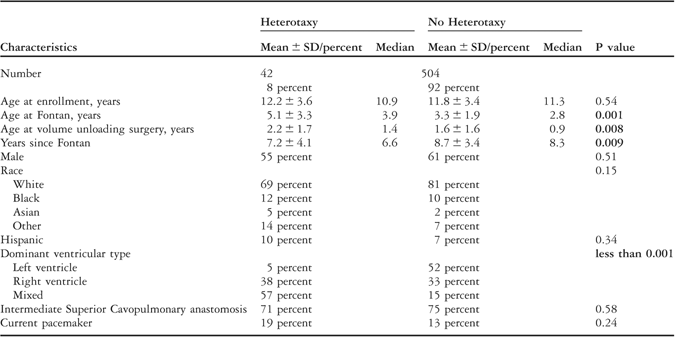
The characteristics of the patients are shown in Table 1. The two groups were enrolled at similar ages, but those with heterotaxy had initial volume-unloading surgery, and were converted to the Fontan circuit, at significantly later ages. Amongst the patients with heterotaxy, only 5% had dominant left ventricles, with 38% having dominant right ventricle, and 57% said to have ventricles of mixed morphology, due to the presence of lesions such as unbalanced atrioventricular septal defects with common atrioventricular junctions, which was different compared to the remainder of the cohort (P less than 0.001). There were no differences in the proportions of gender, race or ethnicity, history of intermediate superior cavopulmonary anastomosis, and presence of pacemakers at the time of the study.
Characteristics of Pediatric Heart Network Fontan Cross-Sectional study patients with and without heterotaxy.

Characteristics prior to conversion to the Fontan circulation
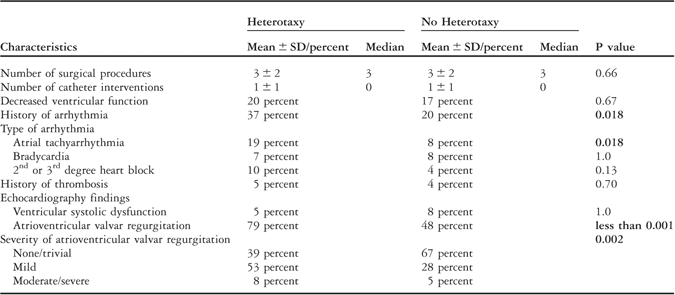
Table 2 summarises medical history prior to the Fontan operation. The proportions of surgical and catheter interventions undertaken prior to conversion did not differ for those with or without heterotaxy. Those with heterotaxy were more likely to have undergone previous surgery to the pulmonary veins (21% versus 0.4%). A history of arrhythmia (P equal to .018), primarily atrial tachyarrhythmia, was more likely in those with heterotaxy, while high-grade atrioventricular block was not. Atrioventricular valvar regurgitation prior to conversion to the Fontan circulation was more prevalent (P less than 0.001), and more severe (P equals 0.002), in those with heterotaxy. A history of echocardiographically determined ventricular dysfunction, and history of thrombosis, was rare prior to the Fontan surgery, and not different between the groups. Certain variables in medical history were so infrequent that no analysis between groups was performed. These included ventricular tachyarrhythmia, and history of stroke, which were each prevalent in only 3% of the entire enrolled cohort.
Medical history prior to conversion to the Fontan circulation.

Characteristics and outcomes after conversion to the Fontan circulation
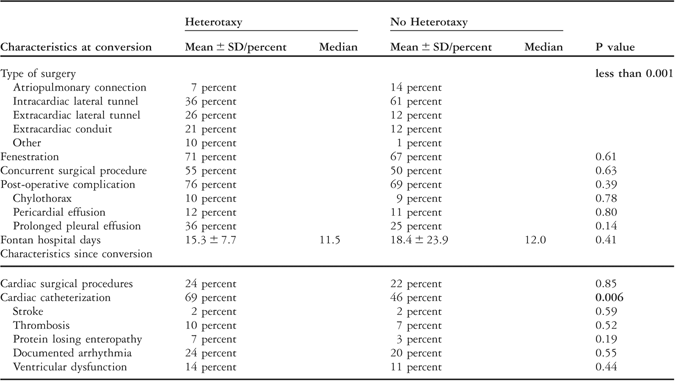
The technique used to create the Fontan circulation differed between the groups (P less than 0.001), and that difference persisted after adjusting for age at conversion to the Fontan circuit (P equal to 0.001). In general, extracardiac total cavopulmonary connections were more prevalent, and use of the intracardiac lateral tunnel was less prevalent in those with heterotaxy. There were no differences in the proportion of patients with fenestrations in the Fontan circuit, or in the frequency or type of postoperative complications. Neither was there any difference in the length of stay following the Fontan procedure, with medians of 11.5 versus 12 days for those with heterotaxy as opposed to those without, respectively (Table 3). Interventions at catheterization were performed more often after the Fontan operation in those with heterotaxy, at 69% versus 46% (P equal to 0.006). No differences were seen, however, in the incidence of stroke, thrombosis, protein losing enteropathy, arrhythmia and ventricular dysfunction between the groups subsequent to conversion to the Fontan circuit.
Medical history before and after conversion to the Fontan circulation.

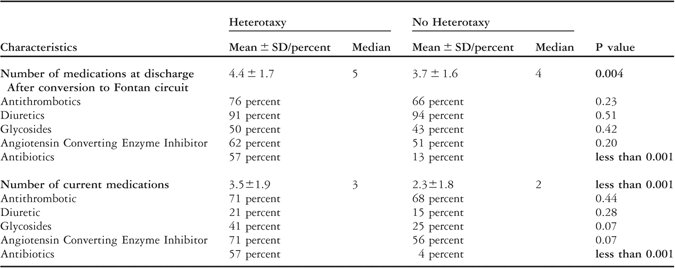
Patients with heterotaxy were taking a greater total number of medications at discharge after the Fontan surgery, and at the time of the cross-sectional study (Table 4). At the time of discharge after creation of the Fontan circuit, this overall difference in use of medications for those with and without heterotaxy was due almost entirely to use of antibiotics in those with heterotaxy, at 57% versus 14% (P less than 0.001). At the time of enrollment in the study, however, the difference in medications was due to a combination of more antibiotics, at 57% versus 4% (P less than 0.001), and greater use of glycosides and inhibitors of angiotensin converting enzyme in the patients with heterotaxy.
Use of medications.

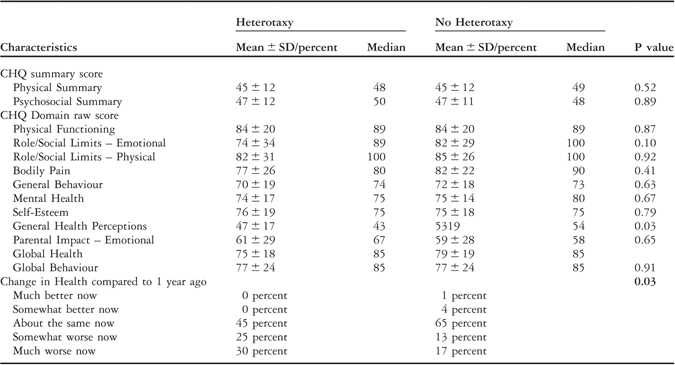
Of 537 patients with parent-reported measurements of the state of health of their children, 41 had heterotaxy syndrome. The domain scores, domain z-scores, and summary scores were not significantly different for those with heterotaxy, except more parents of children with heterotaxy thought the state of health of their children with heterotaxy was worse than 1 year previously, (P equals 0.029). (Table 5).
Parent completed Child Health Questionnaire.

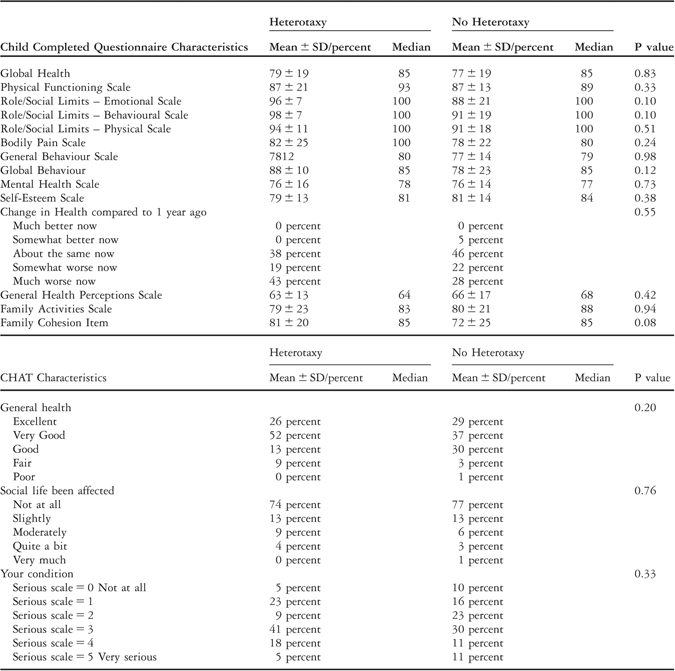
Of the patients older than 10 years, 329 completed the child-reported Child Health Questionnaire, and 22 had heterotaxy syndrome. There were no significant differences in the 14 domain scores by group. (Table 6) For 326 patients older than 10 years who completed the self-reported congenital heart adolescent and teenager questionnaire, 23 had heterotaxy syndrome. The majority of patients reported their general health to be excellent or very good, and their social life to be unaffected by their disease. No difference was seen related to the presence of heterotaxy.
Child Completed Child Health and Congenital Heart Adolescent and Teenager Questionnaire.

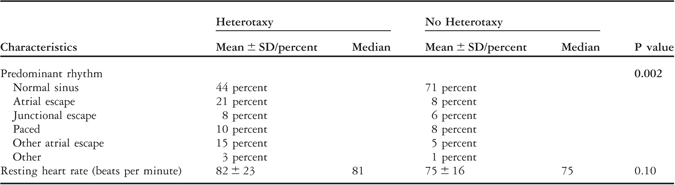
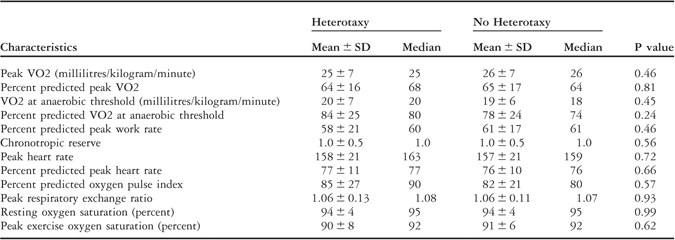
With regard to the electrocardiographic findings, 44% of those with heterotaxy had a predominant sinus rhythm, significantly lower than the 71% in the remainder, with p equal to 0.002 (Table 7). The average resting heart rate, and the average peak heart rate, along with the proportional predicated peak heart rate during exercise testing (Table 8), did not differ for those with or without heterotaxy. Exercise performance was lower than that seen in normal patients, but did not differ between the groups (Table 8).
Analysis of electrocardiographic findings.

Results of exercise testing.

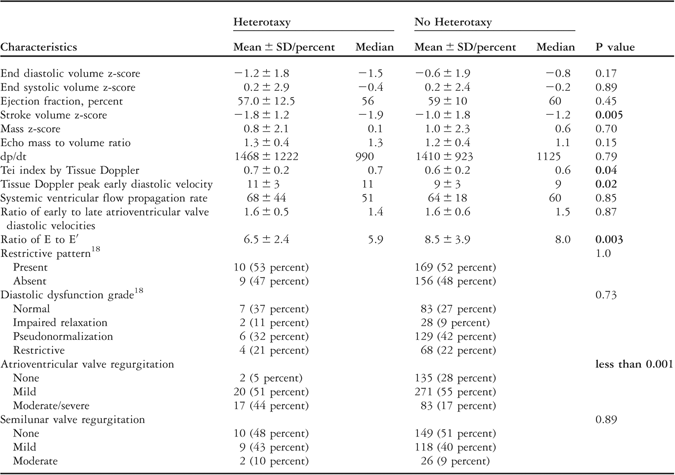
Table 9 shows the results of echocardiography between the groups. Patients with heterotaxy syndrome had poorer indexed stroke volume (P equals 0.005), higher Tei index by tissue Doppler (P equals 0.038), higher tissue Doppler peak early diastolic velocity (P equals 0.018), and a lower E to E′ ratio (P equals 0.003). Patients with heterotaxy were much more likely to have a common atrioventricular valve, at 69% versus 3%, and were more likely to have moderate or severe atrioventricular valvar regurgitation (44% versus 17%, P less than 0.001). For the overall Fontan study cohort, there was a strong association between the presence of common atrioventricular valve and severity of atrioventricular regurgitation (P equals 0.001). This association was also observed in the heterotaxy subgroup, but the sample size was too small to demonstrate a significant association. Variables in cardiac magnetic resonance imaging did not differ according to the presence or absence of heterotaxy syndrome. The sample available for analysis was limited to 10 patients with heterotaxy among a total of 161 subjects with acceptable measurement derived using magnetic resonance imaging. Levels of brain natriuretic peptide measured in the serum at the time of the cross sectional study did not differ between those with and without heterotaxy, with medians of 18 versus 13 picograms per decilitre (P value equals 0.4).
Echocardiographic results.

Discussion
Despite the generally reported poor outcomes from initial functionally univentricular palliation, there remains a group of survivors with heterotaxy who require further surgical procedures, culminating in conversion to the Fontan circulation.Reference Azakie, Merklinger, Williams, Van Arsdell, Coles and Adatia7 An increasing number of patients have now survived such conversion, so that assessment of their functional outcome, and comparison of those with and without heterotaxy, is now possible.
In this study, we have assembled a profile of the medical history, and prospective assessment of functional state and markers of ventricular performance, in patients with heterotaxy after the Fontan procedure, and compared these findings to those assembled for Fontan patients without heterotaxy. Not surprisingly, some important differences were seen in cardiac anatomy. Predominant left ventricular morphology was less frequent, and right and mixed morphologies more frequent, in those with heterotaxy. These patients were also more likely to have a common atrioventricular valve. Atrioventricular valvar regurgitation as assessed by echocardiography was more prevalent and more severe. These findings are consistent with previous reports on the anatomy of heterotaxy syndrome. The majority of patients with isomerism of the right atrial appendages, and a significant portion of those with isomerism of the left atrial appendages, are known to have common atrioventricular junctions and right dominant ventricles.Reference Van Praagh, Keane, Lock and Fyler8 Common atrioventricular valves have been shown in previous reports to be more likely to be incompetent than normal tricuspid or mitral valves, particularly in patients undergoing functionally univentricular palliation.Reference Mahle, Cohen, Spray and Rychik9 The increased severity of atrioventricular valve regurgitation in this population may reflect poorly on long-term viability of the dominant ventricle.
Regarding the surgical procedures, patients with heterotaxy were older as a group at the time of operation, and more likely to have undergone creation of an extracardiac Fontan circuit. Since the venous anatomy is often complex in patients with heterotaxy syndrome, it is not surprising that they are more likely to undergo extra-cardiac baffling, so as to avoid venous obstruction within the heart. In addition, the later date of completion of their Fontan circuits may reflect delay because of the complexity of their disease.
Patients with heterotaxy were less likely to be in sinus rhythm, and more likely to have had atrial arrhythmias. Patients with heterotaxy syndrome are known to have abnormal conduction. Those with isomerism of the right atrial appendages have dual sinus nodes, while those with isomerism of the left atrial appendages often have no identifiable sinus node.Reference Smith, Ho and Anderson10 Junctional rhythm is, therefore, common in heterotaxy syndrome. Supraventricular tachycardia has been reported in up to one-quarter of patients with isomerism of the right atrial appendages, presumed to be due to nodal macro-reentry. In addition, sinus nodal dysfunction in those with isomerism of the left atrial appendages, may present as sinus bradycardia, junctional rhythm, or some combination of the two abnormal rhythms.Reference Wu, Wang and Lin11
Despite obvious anatomic differences, and some differences in echocardiographic assessment and state of cardiac rhythm, there were no important differences in exercise performance, levels of brain natriuretic peptide in the serum, or state of health assessed by parental or self-reported questionnaires between the patients with and without heterotaxy.
A comparative study spanning 30 years of experience has recently been reported from the Mayo Clinic for a cohort of patients with heterotaxy.Reference Bartz, Driscoll and Dearani2 Questionnaires were available for review in 41 of 81 surviving patients with heterotaxy who underwent a Fontan operation. This population differed considerably from our cohort, having a median age at conversion to the Fontan circuit of 9 years, with a range from 2 to 35 years, and with a shorter median follow up of 4.5 years since conversion to the Fontan circuit. Many differences were present in surgical technique, including only 4% having fenestrations placed during the Fontan procedure. Atrioventricular valvar regurgitation, and ventricular morphology, nonetheless, were comparable with our findings. Another study recently compared a cohort of 62 patients with heterotaxy with 123 patients not having heterotaxy.Reference Kim, Kim, Lim, Lee and Lee12 Cardiac morphology was similar to our study. Other similarities to our findings included an increased incidence of arrhythmias and atrioventricular valvar regurgitation in those with heterotaxy. Previous evaluations of patients with heterotaxy subsequent to conversion to the Fontan circulation have lacked systematic and protocolized assessments of echocardiographic findings, exercise and rhythm. Furthermore a limited amount of data exists using validated instruments to assess state of health as used in our cross-sectional study, and related to variables in the medical history and laboratory findings.Reference McCrindle, Williams and Mitchell13 The focus and novelty of our project, namely to establish the current state of health and function for these patients, made up only a small portion of the studies of previous cohorts.
Our study is limited, however, to patients who survived beyond early childhood. It does not reflect, therefore, the entire spectrum of patients born with heterotaxy syndrome and having complex cardiac conditions requiring functionally univentricular palliation. Furthermore, ours was a cross-sectional as opposed to a longitudinal study, negating the opportunity to collect information concerning mortality, or any changes in strategies of management, over time. We combined all patients with heterotaxy, and compared them with the cohort having lateralized arrangements. We did not, therefore, investigate any differences between the subsets of patients having heterotaxy. It is also possible that the findings from the 42 patients with heterotaxy evaluated in our study may not be representative of all survivors of conversion to the Fontan circuit with heterotaxy syndrome, and that they may have limited power to detect differences from patients without heterotaxy. Our study involved children and adolescents, so that differences which may not impact well-being until the third of fourth decade of life could not be detected.
Initial surgical palliations for patients with heterotaxy requiring univentricular palliation have been characterized by high mortality and unfavourable survival in the midterm.Reference Gilljam, McCrindle, Smallhorn, Williams and Freedom14, Reference Hashmi, bu-Sulaiman, McCrindle, Smallhorn, Williams and Freedom15 It has been speculated that the improvements in survival and functional outcomes for patients with functionally univentricular physiology palliated by conversion to the Fontan circulation may not translate to those patients with heterotaxy syndrome. Surgical modifications producing the Fontan circuit have now been compared across surgical eras, revealing improved early survival, even in those with heterotaxy.Reference Bartz, Driscoll and Dearani2, Reference Gentles, Gauvreau and Mayer16, Reference Stamm, Friehs and Duebener17 Despite obvious anatomic differences, and some differences in echocardiographic findings and state of cardiac rhythm, our study suggests that patients born with heterotaxy are not functionally different from others surviving conversion to the Fontan circulation, at least in the first decade after the operation. Whether these differences will reflect on later outcomes and state of health is yet to be determined.