Writing assignments are common in most political science courses. If nothing
else, they serve the purpose of allowing instructors to exercise their
evaluative power in assigning grades. All too often, however, they fail to
transcend this purpose. As a result, both students and instructors often
view each student paper as a private communication between the two parties—a
work with no future and an audience of one (Zeiser
1999; Fulwiler 1982).
In contrast, professors typically prepare their own writing in hopes of
reaching a wider, professional audience. Academics understand that writing
is not just a means of displaying what one has learned; it is itself a
learning process. If students' writing and publishing experiences could be
brought to resemble more closely those of their teachers and academic
mentors, they would likely enjoy some of the same benefits. It was this line
of thought that prompted us, in the fall of 1999, to begin a student journal
to showcase exemplary student writing on politics. Now entering its seventh
year of production, and with a staff of a dozen student editors, our annual
issue averages 150 pages, contains approximately seven to 10 peer-reviewed
articles (the acceptance rate is around 30%), and also includes a wide
variety of other types of political pieces ranging from article, book, and
film reviews to political poetry and photography.
Benefits of a Student Journal
Benefits to Students as Authors
Academics know from experience how useful the process of writing,
rewriting, polishing, and responding to criticism and feedback is,
not only in improving the quality of a particular paper but also in
improving and deepening one's understanding of the subject matter in
question. Extending this logic to students, the most valuable
writing assignments will be those that move beyond reliance on the
single-draft assignment and instead require engagement in a writing
and revision process that includes intense evaluation and feedback
from one or more readers (Bob 2001; Zeiser 1999). Preparing a manuscript for
publication affords students just such an opportunity.
Unlike the typical writing assignment, which is a solitary enterprise
with a fixed termination date (so that instructor comments and
suggestions are more often than not regarded as irrelevant),
preparing a paper for publication is a communal project, generally
requiring several rounds of criticism and response between editors
and authors. Student authors do not go through the revision process
alone; rather they receive personalized, detailed feedback from
student editors on how to strengthen their papers.
The opportunity to present the results of their efforts to peers, and
the knowledge that their work will undergo public scrutiny,
motivates students to expend considerably higher levels of effort
than they otherwise would. Indeed, publication seems to increase the
sense of ownership that student authors feel in regards to their own
work. Their work is no longer just an assignment prepared for the
instructor, but rather a public record of the students' own ideas,
thoughts, arguments, and original findings or analysis. Student
authors have told us they feel a remarkable sense of accomplishment,
satisfaction, and enthusiasm for writing that goes well beyond the
pleasure of receiving a good grade or praise from an instructor.
Finally, student authors benefit from citing their publications on
resumes and graduate and law school applications. In fact, several
previous students report that these publications have been a key
factor in their success in obtaining jobs upon graduation.
Benefits to Students as Editors
The benefits for student editors are even more profound than those
enjoyed by authors. Student editors assess each paper closely and
offer the student author detailed feedback, a process which arguably
requires more of the student editors than of the student authors.
They must consider multiple aspects of the paper, including many
which they may rarely have explicitly considered in their role as
student writers: Is the theme of the paper appropriate for the
journal (that is, is it about politics or political science)? Is the
purpose of the paper clear? Are the arguments and evidence clearly
presented and thoroughly developed? Is there a clear and logical
flow of ideas and arguments throughout the paper? Does the
conclusion fit the data? Is the paper properly cited and in the
prescribed style? Are there grammar or punctuation problems? And so
on.
Of course, it is not enough that students uncover difficulties in the
papers they are assigned. The second and more important component of
their task is to suggest solutions and to do so in a diplomatic
manner. For example, an editor who has diagnosed a particular
argument as weak must be able to explain where precisely the
argument fails. Providing possible solutions, and doing so in a
tactful manner, develops student editors' diplomacy skills in
dealing with their peers—skills that will also be invaluable in the
workplace.
Through this process student editors and student authors grow to
appreciate and understand the role of diligent redrafting to improve
a paper. They see how an author's arguments develop, thinking
clarifies, and knowledge of their subject matter deepens because of
the process of revision. The ultimate lesson is that effective
writing and critical thinking both improve with effort. Finally, the
particular advantage of this process is that students learn lessons
actively, by doing, rather than passively, by being told.
Benefits to Students as Readers
Once the journal is published and distributed, its benefits extend
beyond the student authors and editors. The journal exposes its
student audience to the diverse and interesting range of topics and
approaches that our discipline addresses and utilizes. Furthermore,
the journal exposes students to the exemplary work of their peers,
which can serve as useful models to students in preparing papers for
specific courses. Instructors can best illustrate their guidelines
and expectations by assigning the published student papers
originally written in their courses. Students can turn to the
journal with confidence knowing that they have a quality example of
the type of paper they are expected to produce. As Londow (1993, 529) notes: “Above all, students need
models of the kinds of writing they are being asked to do;
here, past successful student papers are invaluable.”
Organizing and Producing a Student Journal of Politics
Early in the development of Studium we decided that building a
course around the production of the journal would best capitalize on the
hands-on nature of student organizations while maintaining the educative
process of the classroom. Integrating the journal production process
into a course experience is best organized around several key steps: 1)
selecting and evaluating the journal staff and selecting collaborators,
2) soliciting and selecting papers and other work, 3) editing the
selected papers, 4) locating funding for the journal, 5) promoting and
distributing the journal, and, finally, 6) scheduling journal
production.
1. Selecting and Evaluating the Journal Staff and Selecting
Collaborators
In addition to two instructors, our journal staff consists of 12 to
15 students. Students enroll in this course for three units in the
fall and three in the spring semester, with faculty permission. We
recruit students through our other courses, most often by showing
past issues as examples. Students who have previously served on our
journal staff have also recruited interested students. Finally,
other faculty encourage students to consider becoming members of the
staff.
Most of our student editors are learning how to edit for the first
time. For this reason, and to capitalize on the highly interactive
nature of small groups, we decided that it was necessary to keep the
size of the course small—10 to 15 students. Each year our staff
consists primarily of juniors and seniors, but we often have one or
two graduate students involved as well. The students are primarily
political science majors, but we also have one or two journalism and
English majors involved each year.
The journal staff meets weekly through the academic year to carry out
the necessary tasks to produce the journal, which are described in
the sections below. At the beginning of the year students are
assigned or volunteer for particular tasks, and are assigned
deadlines. This assignment process is typically done on the basis of
each student's abilities. For example, students with a background in
editing take on more work during the editing stage of journal
production. Students with public relations or communications
backgrounds organize the paper solicitation campaign and promote the
journal. Students with strong computer skills update and maintain
the journal webpage. And so on. Students are evaluated on the
successful and timely completion of their assigned tasks. While this
evaluation is a necessary component of a course, the weekly meetings
are run much like those of a student organization, where task
assignment is made on a rolling basis and students report on their
progress. The faculty supervisors preside over these weekly meetings
much as faculty would in a graduate seminar. However, it is also
necessary to run some meetings more like a classroom or workshop in
order to teach the skills needed to review, select, and, finally, to
edit the papers.
In addition to involving students as journal staff, the production of
the journal also relies upon collaboration with students through
several other courses at the university. Each year our class
collaborates with an introductory-level graphic design class. Our
journal staff, serving as “clients,” describes our needs for a cover
design to the “freelance” design students who produce sample cover
designs. Our journal staff then selects a favorite cover design each
year for the journal. Recently, we have also begun collaborating
with a senior-level graphic design course to produce promotional
materials such as posters. Finally, we have collaborated with
English editing courses to assist with the editing process.
2. Soliciting and Selecting Papers and Other Work
One of our most difficult tasks has been getting students to submit
their work. Often the best student writers are the most reluctant to
submit. Students also have a narrow conception of what constitutes
“political” work. Thus, students from other disciplines (including
history, philosophy, and sociology, among others) may be writing
papers that include substantial political components and yet fail to
see Studium as an appropriate venue for their work.
Similarly, students whose work is primarily creative (for instance,
poets or photographers) sometimes falsely assume that our editors
are interested only in traditional research papers. Moreover, most
students, and particularly those in the social sciences, are not
familiar with the importance of publication. To combat this
situation, we must actively solicit submissions. Some of our
solicitation is done through the typical means available to us at
the university—the university paper, the university web page, tables
in the student union, and posters and flyers. However, the most
effective method is for journal staff and political science
instructors to approach students directly. Our journal staff visits
numerous courses to explain the submission process and discuss the
various benefits of publication for student authors. Instructors
identify their top student writers and encourage them to submit. We
typically receive approximately 40 submissions each year; without
this sort of direct faculty involvement, the number would be
significantly smaller.
Although the final submission deadline is the end of the fall
semester, the selection process begins as soon as the first few
submissions arrive. We introduce students to this process by
reviewing the submissions (in a blind review) and discussing as a
group the criteria for a well-written paper. Such criteria include:
Is there a clear thesis? Is the paper/work political in nature and
why? Does the paper properly credit sources? And so forth.
By the end of October, we have developed and discussed our criteria
for review and students have begun to review early submissions.
Papers attaining a sufficiently high level of quality—those
publishable with, at most, very minor copyediting—are marked as
accepted (though no acceptance decisions are announced until after
the final submission deadline). A somewhat larger group of initial
submissions are rejected outright. The remaining papers are those
that are judged to have substantial merits but which nonetheless
require a significant amount of revision. These are assigned to
various staff editors. The editors then contact the authors and
offer them a chance to revise and resubmit their papers for final
consideration.
In the journal's first few years, the selection process did not begin
until the submission deadline had passed. However, with a
substantial number of papers coming in at the end of the fall
semester, this policy created a tremendous amount of work for
Studium staff in the interval between their mid-January
return to campus and the mid-March formatting deadline. The entire
review and selection process, author revisions, final editing, and
layout all needed to be completed during this relatively short
period. The solution was obvious: begin the review of early
submissions as they arrived. As a result, though we still face a bit
of a deadline crunch in spring semester, it is far less challenging
and stressful than it used to be.
3. Editing the Selected Papers
Once the list of accepted papers is finalized, we usually have three
weeks to devote to editing and revision. Each staff member is
assigned one or two papers to edit. Editors work closely with
student authors, explaining the editing process and assisting with
revisions. The amount of editing required varies significantly: some
papers require almost none, while others need significant changes in
the areas of grammar, style, formatting, fact-checking, and
citations.
After editing the papers, we pass the electronic files on to a
graphic designer at the university whom we pay to format the
journal. These files must be delivered to the formatter in
mid-March, approximately six weeks after the beginning of the spring
semester.
Our current practice is to do all of our own editing for the journal.
Initially, we collaborated with an editing class, but we soon found
that our deadlines made this difficult, and, more importantly, that
farming out the editing of some of our most critical work provided
no benefit to the journal staff. Feedback from previous student
journal staff has consistently reinforced that students build their
own writing skills through the process of reviewing and assisting
with the revision of their peers' papers. Moreover, we usually have
one or two students from the departments of journalism and English
who have taken editing courses, and who are thus assigned a larger
role in this process, including conducting workshops and assisting
other students.
4. Funding the Journal
The main costs of the journal involve its formatting and printing. We
use formatters at the university, which cost from $300 to $500,
depending upon the size of the journal and how many graphics are
involved. The cost of the university's printing service ranges from
$2,000 to $3,000 for around 200 copies of the journal, again
depending upon the size and graphics involved. Consequently, our
highest budget has been around $3,500, which makes the student
journal a fairly low cost activity when compared to other student
organizations—debate teams, for instance—which often involve travel
and other substantial costs. Nonetheless, funding will be an issue
at many universities. During our first two years we managed on a
shoestring budget, funding the project through a small grant from
our department and by selling copies of the journals. In our third
year, we successfully applied for a renewable grant from our
university's instructionally related activities fund that covers all
of our production costs.
5. Promoting and Distributing the Journal
Most of our promotion is still done by word of mouth, which is fairly
effective given our needs and the size of our student community.
Most particularly, many students are exposed to the journal by
professors who choose to use it in their classrooms as a model for
effective student writing. Right now, the journal is utilized in a
handful of courses, but now that the full journal is available
online (www.csuchico.edu/pols/studium), we
hope that it will come to be used in a greater number and variety of
courses.
Copies of the journal are distributed to all department of political
science faculty and many students in the department. The journal is
also available at both the campus bookstore and the university
library. Distribution to student authors and other directly involved
students takes place at a journal release party held at the end of
the year. In the future, we hope to be able to provide free copies
of the journal to alumni of the department.
6. Scheduling Journal Production
Our experience strongly suggests that in order to make the production
of the journal an educative process that involves students as
journal staff and collaborates with other courses, the production
must be a year-long process. Consequently, the production of
Studium begins in September and ends in early May. The
students work independently and with each other in weekly meetings
to complete all tasks and meet deadlines in accordance with the
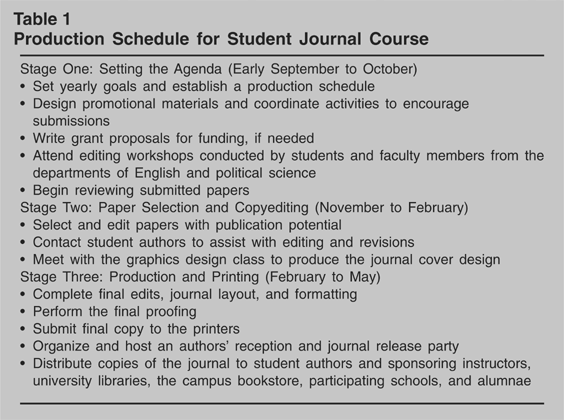
schedule (see Table 1).
Production Schedule for Student Journal Course
The first stage of production is extremely demanding. In the
classroom, student editors attend weekly editing workshops to
prepare for the challenging tasks of reviewing, evaluating,
selecting, and editing the submissions. Outside the classroom, they
are involved in hands-on activities to promote the journal and
encourage student submissions from across the disciplines. Student
editors design posters and electronic announcements, write press
releases, visit classrooms, and arrange promotion tables at campus
events and in the student union. They also plan and coordinate the
activities of the other parties involved in journal production,
including the public relations, graphic design, and formatting
student groups.
The second stage of production is somewhat more relaxed and the
activities of the editorial staff more concentrated. The primary
duties are to select the final papers, choose a cover design, and
begin editing the selected papers.
During the third stage of production the demands intensify. The
student editors collaborate with the student authors and assist them
with the editing of their papers and any needed revisions. They
finish editing individual papers, lay out the journal, and then edit
the entire product. Then they submit the journal to the formatters,
proof the formatters' work, and finally submit the journal to the
printers. In the meantime, the student editors make the final
preparations for the authors' reception and journal release party.
This year-long production process is necessary to provide the full
educative benefits to the student editors. Indeed, even with the
entire academic year at our disposal, we still feel the pressure of
deadlines, particularly from February to May. However, this deadline
pressure only contributes to the hands-on nature of the project and
prepares students for the world beyond school.
Biography
Sharon A. Barrios received her Ph.D. from Princeton University and is
currently an associate professor at California State University, Chico.
She teaches courses in public administration, organization theory, and
American government. She has published articles on bureaucratic
discretion, power, and autonomy; local economic development; and
literary moral education.
Lori M. Weber received her Ph.D. from University of Colorado at Boulder
and is currently an associate professor at California State University,
Chico. Her research interests are political participation, deliberative
democratic theory, electronic democracy, political tolerance and hate
politics. She teaches political methodology and public opinion courses.
Currently, she is involved in an NSF-funded research project based at
Carnegie Mellon University that investigates deliberation and political
communication over the Internet.