



1. Introduction
Binary stars are no longer regarded as special cases but as the dominant channel of stellar evolution. Surveys of stellar multiplicity using spectroscopy, astrometry, and photometry consistently show that
 $\sim50\%$
of stars in the Milky Way are in binaries, with multiplicity fractions of more than 70% for massive O- and B-type stars (Sana et al. Reference Sana2012; Duchene & Kraus Reference Duchene and Kraus2013; Chen, Liu & Han Reference Chen, Liu and Han2024). This statistical fact implies that most stars do not evolve in isolation but interact with companions during their lifetimes.
Historically, the importance of binary interactions was recognized early. The “Algol paradox” revealed that in some binaries the less massive component appears more evolved than the more massive star, a situation that can only be produced by mass transfer and mass-ratio reversal. Since then, it has become clear that a wide variety of stellar exotica—blue stragglers, hot subdwarfs (sdB/sdO), cataclysmic variables, X-ray binaries, and Type Ia supernova progenitors—owe their origin to binary interactions.
In the modern era, binaries are central to frontier areas of astrophysics. Gravitational-wave detections by LIGO/Virgo of BH–BH, NS–NS, and BH–NS mergers confirm predictions from binary population synthesis. Hot subdwarfs explain the ultraviolet upturn in elliptical galaxies, a phenomenon not captured by single-star models. Double white dwarfs (DWDs) are expected to dominate the mHz gravitational-wave band, making them prime targets for space-based detectors such as LISA, TianQin, and Taiji.
Han et al. (Reference Han, Ge, Chen and Chen2020) reviewed the general picture of binary population synthesis. They plotted a binary evolutionary tree, depicting how various exotic stars are formed. The tree can be much larger and much more complicated, and more channels can be added. The tree includes the formation of many binary-related objects, e.g. barium stars (Ba), black holes (BH), blue stragglers (BS), carbon enhanced metal poor stars (CEMP), cataclysmic variables (CV), double compact objects (DCO), fast radio bursts (FRB), gamma ray bursts (GRB), helium or carbon oxygen white dwarfs (He/CO-WD), helium stars (He-Star), high mass X-ray binaries (HMXB), low-or intermediate mass X-ray binaries (L/IMXB), neutron stars (NS), hot subdwarf O/B stars (sdO/B), supernovae Ia (SN Ia), supernovae II (SN II), symbiotic stars (Symb), Thorne-Zytkow object (TZO), white dwarfs (WD).
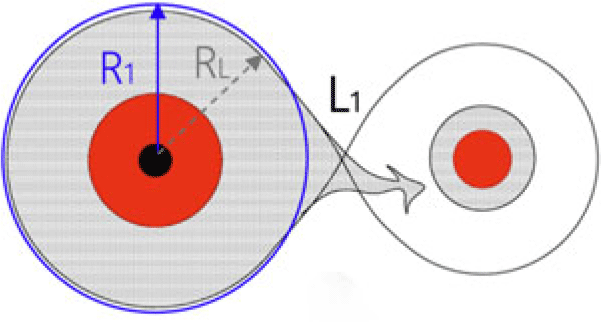
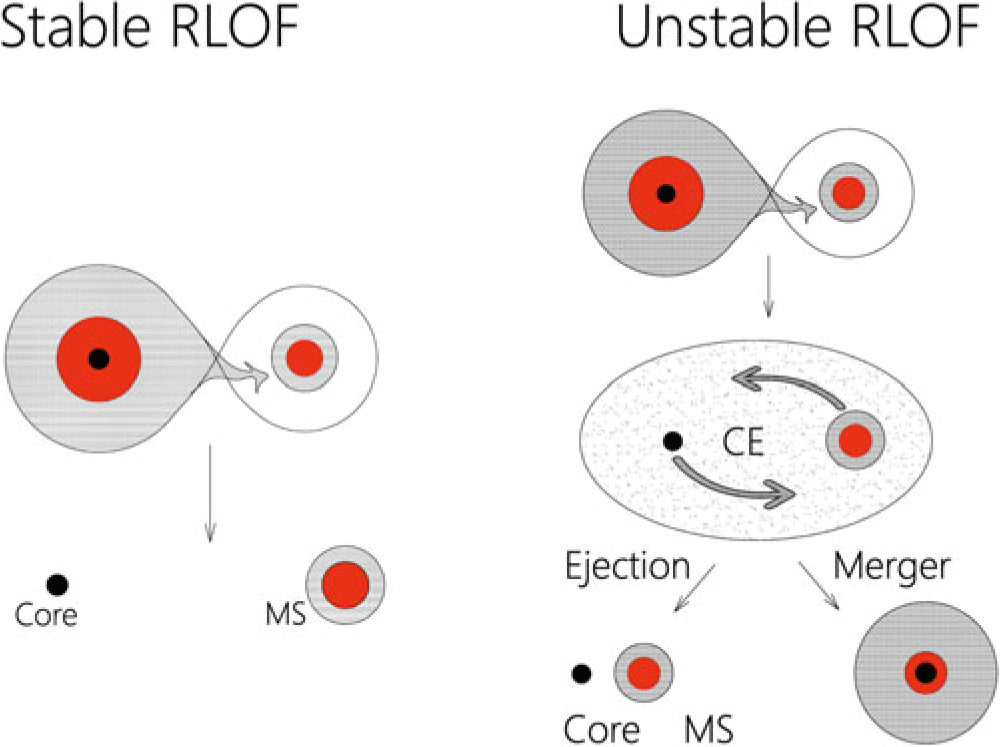
Despite decades of work, two fundamental uncertainties remain: the stability of mass transfer and the physics of CE ejection. When a star fills its Roche lobe, mass is transfered from the donor to the gainer, which is denoted as Roche lobe overflow (RLOF) (See Fig. 1). If RLOF is stable, binaries survive and evolve gently. If unstable, a CE forms, which may eject the envelope to leave a close binary, or merge (See Fig. 2). The dividing line between these outcomes — set by critical mass ratios — is poorly known. Similarly, CE ejection efficiency, usually parameterized by
 $\alpha$
, is uncertain and may depend on binary parameters.
A schematic diagram of Roche lobes and Roche-lobe overflow, where
 $R_1$
is for the stellar radius, and
 $R_{\rm L}$
for the Roche lobe radius, and
 $L_1$
for the inner Lagrangian point.

A diagram for stable and unstable mass transfer in binary systems. The left panel shows stable mass transfer, which results in the formation of a wide compact binary system. The right panel shows unstable mass transfer, which leads to common envelope (CE) evolution. If the CE can be ejected, a tight compact binary is formed, otherwise the two stars coalesce and form a rapidly rotating single star

2. Fundamentals of Binary Interactions
2.1. Roche Geometry
The Roche potential describes the effective potential in a corotating binary (See Fig. 1). The equipotential surface through the inner Lagrangian point
 $L_1$
defines the Roche lobes. When the donor star expands to fill its Roche lobe, RLOF begins. Eggleton’s approximation provides a widely used radius:
 \begin{equation}\frac{R_{\rm L}}{a}=\frac{0.49\,q^{2/3}}{0.6\,q^{2/3}+\ln(1+q^{1/3})},\end{equation}
where
 $q=M_1/M_2$
is the mass ratio,
 $M_1$
the donor and
 $M_2$
the accretor, and a the orbital separation.
2.2. Cases of Mass Transfer
The standard classification for mass transfer is as follows.
-
• Case A: RLOF during core-H burning (main sequence). Often stable.
-
• Case B: RLOF during H-shell burning (subgiant/Hertzsprung gap). Stability depends on envelope structure and q.
-
• Case C: RLOF on RGB or AGB. Deep convective envelopes were believed to often lead to CE, but we will show later in this talk that this is not true.
2.3. Timescales
Three timescales govern binary interaction:
 \begin{align}t_{\mathrm{dyn}} &\sim \sqrt{\frac{R^3}{GM}},\end{align}
 \begin{align}t_{\mathrm{KH}} &\sim \frac{GM^2}{RL},\end{align}
 \begin{align}t_{\mathrm{nuc}} &\sim \frac{E_{\mathrm{nuc}}}{L}.\end{align}
RLOF on
 $t_{\mathrm{nuc}}$
is gentle; on
 $t_{\mathrm{dyn}}$
it is unstable. Angular-momentum losses (gravitational radiation, magnetic braking) and winds also modulate RLOF.
3. Stability of Mass Transfer
3.1. Classical Picture:
 $\zeta_\star$
vs.
$\zeta_{\rm L}$


Stability is set by the donor’s structural response to mass loss versus the Roche-lobe response (See Fig. 1):
 \begin{equation}\zeta_\star=\left(\frac{{\rm d}\ln R_\star}{{\rm d}\ln M_\star}\right),\qquad\zeta_{\rm L}=\left(\frac{{\rm d}\ln R_L}{{\rm d}\ln M_\star}\right).\end{equation}
If
 $\zeta_\star\gt\zeta_{\rm L}$
, the donor contracts relative to its Roche lobe and mass transfer stabilizes. Hjellming & Webbink (Reference Hjellming and Webbink1987) used condensed polytropes to infer
 $q_c\sim 0.6 - 1 $
for convective donors, implying many giants should plunge into CE immediately. This view underpins many earlier BPS studies but neglects detailed stellar structure.
3.2. Adiabatic Mass-Loss Models
In order to investigate the criterion for the instability of mass transfer in binary stars, Ge and his collaborators (Ge et al. Reference Ge, Webbink, Chen and Han2010, Reference Ge, Webbink, Chen and Han2015, Reference Ge, Webbink, Chen and Han2020) have developed an adiabatic mass-loss model. The basic assumption is that the donor star loses mass so quickly that the stellar structure does not have time to thermally adjust. The process is nearly instantaneous compared to the star’s thermal timescale, so the response is adiabatic. The equation of mass conservation and the equation of momentum conservation are kept unchanged in their model,
 \begin{equation}\frac{{\rm d}m}{{\rm d}r}=4\pi r^2\rho, \qquad \frac{{\rm d}P}{{\rm d}r}=-\frac{Gm\rho}{r^2}\end{equation}
However, the energy transport equation is substituted by entropy equation, where entropy profile within the star remains fixed during the mass removal, and the energy production equation is substituted by chemical equation, where the compositions of each element remains fixed.
 \begin{equation}\frac{{\rm d}s}{{\rm d}t}=0, \qquad \frac{{\rm d}X}{{\rm d}t}=0\end{equation}
With the model, we can calculate how the radius of the star changes with an adiabatic mass loss, and consequently we can obtain
 $\zeta_{\rm ad}$
. By comparing
 $\zeta_{\rm ad}$
with
 $\zeta_{\rm L}$
, we obtain the critical mass ratio
 $q_{\rm ad}$
, above which mass transfer is dynamically unstable. Figure 3 shows the critical mass ratio for donor stars with various masses and with various radii in the main sequence, in the Hertzsprung gap, in the red giant branch (RGB) and in the asymptotic giant branch (AGB). We see that
 $q_{\rm ad}$
is very much different from that derived from polytropic model. It varies with stellar masses and stellar radii. More notably, the mass transfer for red giant donors are more likely to be stable than that from polytropic model. About half of the red giant binaries will experience stable Roche lobe overflow, in contrast to that almost all the red giant binaries would experience unstable mass transfer and CE evolution from the polytropic model.
Critical mass ratio
 $q_{\rm ad}$
from Ge’s adiabatic mass loss model (Ge et al. Reference Ge, Webbink, Chen and Han2010, Reference Ge, Webbink, Chen and Han2015, Reference Ge, Webbink, Chen and Han2020). The abscissa is for stellar radius and ordinate for
 $q_{\rm ad}$
. The donor star’s mass is indicated for each line in solar unit, and red horizontal lines are from polytropic model. The figure is after Han et al. (Reference Han, Ge, Chen and Chen2020)

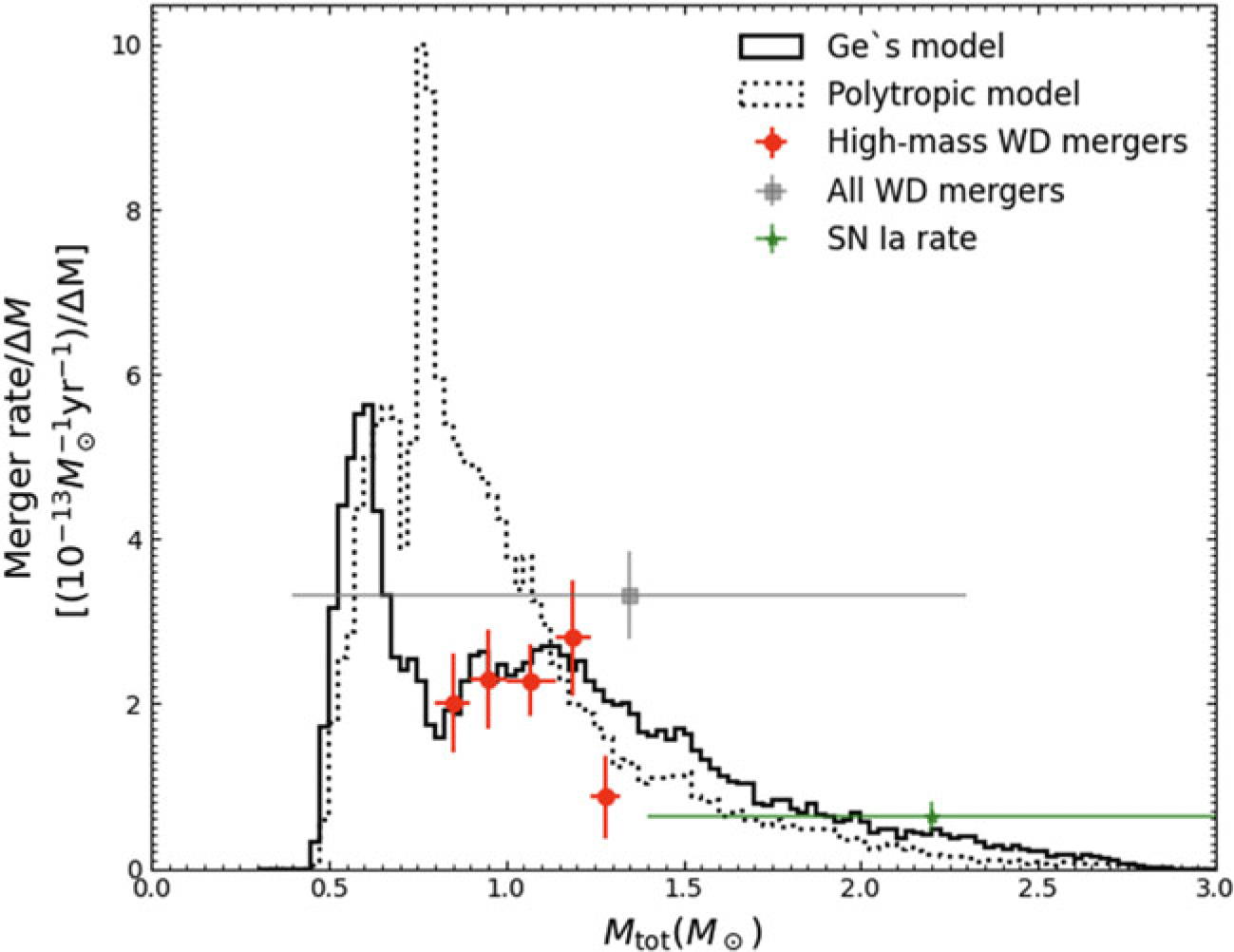
Adotping Ge’s adiabatic mass loss model, Li et al. (Reference Li2023) investigated the formation for double white dwarfs, or the so called double degenerates (DDs). As mass transfer for red giant binaries are more stable than that from the polytropic model, and as a consequence, a large fraction of DDs are from stable RLOF + CE channel. In this channel, the first mass transfer is stable to produce a wide WD system, and the 2nd mass transfer is unstable, resulting in the formation of a CE and the CE ejection leads to the formation of close DDs. Such a channel is not realized from a polytropic model. The DDs from such a channel have a mass ratio
 $\sim 1$
, which has been confirmed by later observations. Fig. 4 shows the merger rate of DDs as a function of the merger mass. We see that the rate from Ge’s model matches the observations much better.
Merger rate as a function of the merger mass for all DD mergers. Black solid line is for Ge’s model, and dotted line for polytropic model, symbols with error bars are observations. The figure is adapted from Li et al. (Reference Li2023)

3.3. Thermal-Equilibrium Mass Loss
Ge and his collaborators (Ge, Webbink & Han Reference Ge, Webbink and Han2020) have also developed a thermal equilibrium mass-loss model, which is appropriate when mass transfer proceeds on the donor’s thermal (Kelvin-Helmholtz) timescale. They assume that the donor star remains in hydrostatic equilibrium, but not strict thermal equilibrium. They fix the time derivative of specific entropy (
 ${\rm d}s/{\rm d}t$
) with mass coordinate to preserve the donor’s initial thermal disequilibrium, and composition is frozen to avoid artificial mixing. This allows them to model how a star readjusts when mass loss proceeds at or below the thermal rate, i.e., intermediate between nuclear and dynamical timescales. With this model, we can calculate how the radius of a star changes when a mass loss is on a thermal time scale.
Now we have the following exponents,
 \begin{equation}\zeta_{\rm ad}=\frac{{\rm d}\ln R_1}{{\rm d}\ln M_1}\Big|_{\rm ad},\qquad\zeta_{\rm th}=\frac{{\rm d}\ln R_1}{{\rm d}\ln M_1}\Big|_{\rm th},\qquad\zeta_{\rm L}=\frac{{\rm d}\ln R_L}{{\rm d}\ln M_1}\Big|_{\rm RLOF}.\end{equation}
If
 $\zeta_{\rm L} \gt \zeta_{\rm ad}$
, the mass transfer proceeds on dynamical timescale. If
 $\zeta_{\rm ad} \gt \zeta_{\rm L} \gt \zeta_{\rm th}$
, the mass transfer occurs on thermal timescale. Finally, if
 $\zeta_{\rm L} \lt (\zeta_{\rm ad}, \zeta_{\rm th})$
, the mass transfer is stable and proceeds on a nuclear timescale.
Fig. 5 is adapted from Ge, Webbink & Han (Reference Ge, Webbink and Han2020), showing possible evolution channels on the critical mass ratio vs. the initial stellar radius diagram. The diagram shows that a binary may experience nuclear timescale mass transfer, thermal timescale mass transfer, dynamical mass transfer, delayed dynamical mass transfer. A binary can be detached during mass transfer, or in contact, or CE via dynamical mass transfer, CE via delayed dynamical mass transfer, CE before dynamical mass transfer.
Possible evolution channels on the critical mass ratio vs. the initial stellar radius diagram. Adapted from Ge, Webbink & Han (Reference Ge, Webbink and Han2020)

4. Common Envelope Evolution
4.1. Physical Picture and Outcomes
Dynamically unstable RLOF engulfs the companion within the donor’s envelope. Drag extracts orbital energy and angular momentum, shrinking a rapidly. Outcomes: (i) envelope ejection
 $\Rightarrow$
tight post-CE binary; (ii) merger
 $\Rightarrow$
single rejuvenated or peculiar star.
4.2. Numerical Simulations: State of the Art
Significant progress has been made for the 3D SPH simulations of the CE evolution. The simulations reveal plunge-in, partial envelope ejection, and complex outflows. However, CE spans densities
 $10^{-10}$
–
 $10^{11}\,\mathrm{g\,cm^{-3}}$
, temperatures
 $10^3$
–
 $10^{11}$
K, and many decades of spatial/temporal scales—beyond current compute to treat self-consistently with radiation, recombination, dust, and MHD. Nevertheless, simulations support the qualitative CE picture and motivate variable efficiencies.
4.3. Energy (
$\alpha$
) Formalism

In the binary population synthesis studies (BPS), CE evolution is treated via a parameterization way, in which the energy (
 $\alpha$
) formalism is widely adopted to calculate the final outcomes of CE evolution. The
 $\alpha$
-formalism balances lost orbital energy with envelope binding energy (Webbink Reference Webbink1984):
 \begin{equation}\alpha_{\rm CE}\left(\frac{GM_{\rm c}M_2}{2a_{\rm f}}-\frac{GM_1M_2}{2a_{\rm i}}\right)=E_{\mathrm{bind}},\end{equation}
with
 $E_{\mathrm{bind}}\simeq GM_1M_{\mathrm{env}}/(\lambda R)$
. Here
 $\lambda$
encodes structure and may vary strongly with evolutionary state;
 $\alpha_{\rm CE}$
is an efficiency (not necessarily
 $\le1$
if recombination or other sources assist).
4.4. Angular-Momentum (
$\gamma$
) Prescription

The
 $\gamma$
-formalism tracks fractional angular-momentum loss instead of energy. Motivated by some DWDs, it is occasionally used in BPS but lacks a universal physical basis.
4.5. Refined Energy (
$\beta$
) Prescription

Ge and his collaborators (Ge et al. Reference Ge2022, Reference Ge2024a) introduced a
 $\beta$
-prescription as a way to describe the efficiency of common envelope (CE) ejection, closely related to the traditional
 $\alpha$
-formalism but derived from a more realistic treatment of the donor’s binding energy. Instead of adopting a fixed
 $\lambda$
, they compute the binding energy directly and self-consistently from stellar models, including both gravitational and internal (thermal + recombination) energy, and accounting for the donor’s structural response to mass loss. They then tried to constrain the
 $\beta_{\rm CE}$
parameter of common envelope evolution (CEE) using short-period hot subdwarf B (sdB) binaries with white dwarf companions (See Han et al. (Reference Han, Podsiadlowski, Maxted, Marsh and Ivanova2002) for the formation scenarios of sdB stars). By applying the well-established orbital period-white dwarf mass relation, they are able to backtrack and constrain the progenitor masses and evolutionary stages of these systems. This allows for a more precise determination of the CEE efficiency parameter, here denoted as
 $\beta_{\rm CE}$
. Analyzing seven sdB+WD binaries with well-determined orbital inclinations, they find an average
 $\beta_{\rm CE} \approx 0.32$
, consistent with previous work, but also reveal that
 $\beta_{\rm CE}$
is not a universal constant. Instead, it depends on the initial mass ratio of the binary, with lower-mass progenitors requiring smaller efficiencies and higher-mass progenitors larger ones. These results refine our understanding of how common envelopes are ejected, supply important constraints for binary population synthesis.
Ge and collaborators (Ge et al. Reference Ge2023, Reference Ge2024b) applied the critical mass ratios derived from their adiabatic and thermal-equilibrium mass-loss models to the study of intermediate-mass X-ray binaries (IMXBs) and high-mass X-ray binaries (HMXBs), and found good agreement with the observed mass-ratio distributions.
4.6. Observational Evidence of CE and Its Ejecta
The common-envelope (CE) phase is short-lived and violent, it is a challenge to observe it happening directly. But there is a lot of indirect observational evidence for CE ejection, from both populations of binary systems and transient events. Serendipitously, Li et al. (Reference Li2022) detected an ejecting envelope of a recent CE event.
Close white-dwarf binaries (WD+WD, WD+MS, WD+sdB, WD+NS) are surviving post-CE binaries. Their orbital separations are far too small to have formed via normal stellar evolution. CE ejection is the only viable channel to shrink a system from AU scales down to hours or days. X-ray binaries and millisecond pulsar binaries are compact systems, which require drastic orbital shrinkage consistent with CE evolution. Close binary central stars (orbital periods of hours to days) are frequently observed inside planetary nebulae (PNe), and the nebula itself is interpreted as the ejected common envelope.
Ivanova et al. (Reference Ivanova2013) proposed that luminous red novae (LRN) are the signature of common envelope events. During a CE ejection, recombination energy is released while the ejected matter cools. The light curve width, the peak magnitude of a CE ejection event, as well as the expected colors, light-curve shapes, ejection velocities, and event rate, match those of LRNs. Blue ring nebula around TYC 2597-731-1 is interpreted as a merger remnant with expanding bipolar structures (Hoadley et al. Reference Hoadley2020). ALMA water fountains exhibit collimated molecular outflows compatible with CE ejection (Khouri et al. Reference Khouri2021).
Li et al. (Reference Li2022) have detected an envelope ejected recently. They report that J1920-2001 is a rare Roche lobe-filling binary system consisting of a hot subdwarf O star (sdO) and a white dwarf (WD) (See Fig. 6). The system has a short orbital period of 3.5 hours, shows measurable orbital shrinkage, and exhibits clear evidence of mass transfer via an accretion disc around the WD. Detailed spectroscopy and photometry reveal the sdO’s physical parameters, the presence of an accretion disc, and notably blueshifted Ca II absorption lines that the authors interpret as from a recently (
 $\sim$
10 000 yr) ejected common envelope, providing rare observational evidence of this elusive evolutionary phase. This system thus serves as a valuable laboratory for studying common-envelope evolution.
A schematic diagram showing the sdO binary system J1920-2001. The sdO fills its Roche lobe, transferring its mass to its WD companion. A disc is around the WD, an envelope is around the binary system, with an expanding velocity of
 $\sim 200 \, {\rm km\,s^{-1}}$
.

4.7. Ubiquitous circumbinary matter in hot subdwarfs
Li et al. (Reference Li2025) have detected ubiquitous circumbinary matter in hot subdwarfs formed from common-envelope ejections. They analyzed 727 hot subdwarf candidates from the LAMOST-LRS survey. Because sdB stars are too hot to show intrinsic calcium absorption, the detection of Ca II K lines (3934 Å) in their spectra must come from either the interstellar medium (ISM) or from circumstellar/circumbinary material (CSM). They performed Gaussian fits to Ca II K absorption features, and reddening estimates from both 3D dust maps and SED fitting were compared to distinguish between ISM and CSM. By this method, they identified 145 sdB stars with Ca II K absorption stronger than expected from ISM alone, indicating circumbinary remnants of CE ejections. The Ca II K absorption features match systemic velocities of sdB binaries, showing that the material is gravitationally bound to the system.
This work provides the first large-sample evidence that circumbinary material from CE ejections is common and long-lived in hot subdwarfs. It strengthens the link between CE evolution and the formation of compact binaries and offers direct observational constraints on CE models.
5. Conclusions
The stability of mass transfer is a cornerstone in binary evolution theory, and we have recently revised the criterion governing this process, leading to improved predictions of whether interacting binaries evolve stably or undergo a dynamical common-envelope (CE) phase. In addition, we report direct observational evidence of CE ejection, a long-hypothesized but rarely confirmed outcome of unstable mass transfer. Analysis of hot subdwarf stars further reveals that circumstellar material originating from CE ejections is not only ubiquitous but also long-lived, persisting as circumbinary structures throughout the subdwarf evolutionary phase. These results provide critical constraints on binary interaction physics, confirm the role of CE ejection in compact binary formation, and establish that remnants of the CE can remain bound to the system, thereby influencing its subsequent evolution.
Acknowledgements
This work is supported by National Natural Science Foundation of China (grant nos 12288102, 12125303, 12090040/3, 12403040), National Key R&D Program of China (grant no. 2021YFA1600401/3), the International Centre of Supernovae (no. 202201BC070003), Yunnan Key Laboratory (no. 202302AN360001) and the ‘Yunnan Revitalization Talent Support Programme’ Science & Technology Champion Project (no. 202305AB350003). We also acknowledge the science research grant from the China Manned Space Project with no. CMS-CSST-2021- A10.
 R1
 RL
 L1

 qad
 qad


 ∼200kms−1


