In recent decades, the child welfare system in Spain has undergone several wide-ranging changes affecting its functioning, its agents, and the relative strength of different placement types (Amorós & Palacios, Reference Amorós and Palacios2004; De Paúl, Reference De Paúl2009; León, Reference León2012). Various studies have expanded our knowledge of the different childcare placements, and have drawn comparisons between them (Amorós, Palacios, Fuentes, León, & Mesas, Reference Amorós, Palacios, Fuentes, León and Mesas2003; Del Valle, Bravo, & López, Reference Bravo and Del Valle2009; Del Valle, López, Montserrat, & Bravo, Reference Del Valle, López, Monserrat and Bravo2008; Jiménez & Palacios, Reference Jiménez and Palacios2008; Palacios, Moreno, & Román, Reference Palacios, Moreno and Román2013). Still, it remains the case that few studies have compared the results of the three main childcare placements in which a boy or girl is separated from his/her family of origin: adoption, kinship care, and residential care. That is true of the Spanish literature (Fernández-Molina, Del Valle, Fuentes, Bernedo, & Bravo, Reference Fernández-Molina, Del Valle, Fuentes, Bernedo and Bravo2011) and that of other countries (Heflinger, Simpkins, & Combs-Orme, Reference Heflinger, Simpkins and Combs-Orme2000). Furthermore, Spain is especially suitable for this kind of research because it has, paradoxically, similarly high rates of international adoption and institutional care placements (Browne, Reference Browne2005). On the other hand, the overall incidence of family foster care is much lower than that of adoption or institutional care placement (Jiménez & Palacios, Reference Jiménez and Palacios2008; Palacios & Amorós, Reference Palacios and Amorós2006), whether in non-kin or kin families. Kinship care is the most common family foster care placement in Spain, representing around 80% of reported cases (Del Valle & Bravo, Reference Del Valle and Bravo2003; Del Valle et al., Reference Del Valle, López, Monserrat and Bravo2008; Jiménez & Palacios, Reference Jiménez and Palacios2008).
Many researchers have tried to identify the risk factors characteristic of the population of children who pass through the child welfare system, relating them to past experiences of adversity and the obvious discontinuity – psychological, educational, and social – these boys and girls undergo while transitioning between family situations, or between family and institutional settings (Amorós & Palacios, Reference Amorós and Palacios2004; Jiménez & Palacios, Reference Jiménez and Palacios2008; Molero, Moral, Albiñana, Sabater, & Sospedra, Reference Molero, Moral, Albiñana, Sabater and Sospedra2007; Rushton, Mayes, Dance, & Quinton, Reference Rushton, Mayes, Dance and Quinton2003; Simmel, Brooks, Barth, & Hinshaw, Reference Simmel, Brooks, Barth and Hinshaw2001; van der Vegt, van der Ende, Ferdinand, Verhulst, & Tiemeier, Reference van der Vegt, van der Ende, Ferdinand, Verhulst and Tiemeier2009). They have identified certain risk factors having to do with adverse circumstances during pregnancy, like prenatal maltreatment, maternal substance abuse, and maternal stress (Crea, Barth, Guo, & Brooks, Reference Crea, Barth, Guo and Brooks2008; Palacios & Jiménez, Reference Palacios and Jiménez2009; Rutter & O’Connor, Reference Rutter and O’Connor2004); and during the perinatal period, such as low birth weight, premature birth, and neonatal drug withdrawal (Oliván, Reference Oliván2005; van der Vegt et al., Reference van der Vegt, van der Ende, Ferdinand, Verhulst and Tiemeier2009). More often, the literature alludes to postnatal factors prior to foster care or adoption, including childhood maltreatment experiences (Grotevant et al., Reference Grotevant, van Dulmen, Dunbar, Nelson-Christinedaughter, Christensen, Fan and Miller2006; van der Vegt et al., Reference van der Vegt, van der Ende, Ferdinand, Verhulst and Tiemeier2009); developmental delay (Jiménez & Palacios, Reference Jiménez and Palacios2008; Juffer & van IJzendoorn, Reference Juffer, van IJzendoorn, Wrobel and Neil2009; Palacios, Sánchez-Sandoval, León, & Román, Reference Palacios, Sánchez-Sandoval, León, Román, Berástegui and Gómez-Bengoechea2008); stays in institutional care, sometimes longer than desirable or with a very low quality of basic care (Rutter, Reference Rutter1998); number of past foster care placements (Palacios & Jiménez, Reference Palacios and Jiménez2009; Simmel, Barth, & Brooks, Reference Simmel, Barth and Brooks2007); and at what age, sometimes quite late, a childcare placement began (Berástegui, Reference Berástegui2005; Jiménez & Palacios, Reference Jiménez and Palacios2008; Simmel, Brooks, Barth, & Hinshaw, Reference Simmel, Brooks, Barth and Hinshaw2001). In addition, some studies have reported (Hernández-Muela, Mulas, Téllez de Meneses, & Roselló, Reference Hernández-Muela, Mulas, Téllez de Meneses and Roselló2003; Oliván, Reference Oliván2005) chronic or viral illness among these children, often requiring hospitalization and acute care, and different forms of disability (Fernández-Molina, Reference Fernández-Molina, Berástegui and Gómez-Bengoechea2008) that require greater parental dedication and can become a risk factor if parents do not have access to the educational resources and support needed for at least adequate care.
In most cases, such studies have identified isolated risk factors that are involved in psychological adjustment during childhood. Nevertheless, in recent years, they have placed greater emphasis on examining the influence of risk factors overall, through cumulative or additive processes. Along those lines, the cumulative model proposes that it is the sum of adverse experiences that determines risk in terms of behavioral and psychological adjustment in children, independently of the factors comprising that accumulated adversity. One of the first authors to propose a cumulative risk model was Rutter (Reference Rutter1985), and subsequent research has extensively expanded on and replicated that focus (Atzaba-Poria, Pike, & Deater-Deckard, Reference Atzaba-Poria, Pike and Deater-Deckard2004; Jiménez, Mata, León, & Muñoz, Reference Jiménez, Mata, León and Muñoz2013; León, Reference León2011; Sameroff & Fiese, Reference Sameroff, Fiese, Shonkoff and Meisels2000; Sameroff, Gutman, & Peck, Reference Sameroff, Gutman, Peck and Luthar2003; van der Vegt et al., Reference van der Vegt, van der Ende, Ferdinand, Verhulst and Tiemeier2009).
In addition to the above, children and adolescents in the child welfare system often exhibit behavioral adjustment and psychological problems (Del Valle, López, Monserrat, & Bravo, Reference Del Valle, López, Monserrat and Bravo2008; Fernández-Molina et al., Reference Fernández-Molina, Del Valle, Fuentes, Bernedo and Bravo2011; Jiménez & Palacios, Reference Jiménez and Palacios2008; Simmel, Brooks, Barth, & Hinshaw, Reference Simmel, Brooks, Barth and Hinshaw2001; Sonuga-Barke, Schlotz, & Kreppner, Reference Sonuga-Barke, Schlotz and Kreppner2010; Vanderfaeillie, van Holen, Trogh, & Andries, Reference Vanderfaeillie, van Holen, Trogh and Andries2011). Such issues are apparent even when youths fostered by non-kin are compared to those fostered by kin. While there is not solid consensus among researchers about this, various studies have demonstrated that children in non-kin foster care exhibit fewer behavioral problems (Jiménez & Palacios, Reference Jiménez and Palacios2008; Keller et al., Reference Keller, Wetherbee, Le Prohn, Payne, Sim and Lamont2001).
Several studies have also shown that certain experiences, and children’s early adversity levels, can influence their recovery and subsequent levels of adaptation and psychological adjustment (Palacios & Jiménez, Reference Palacios and Jiménez2009; Rutter, Reference Rutter1998). Nevertheless, despite the great many adverse circumstances and risk factors present in the early histories of boys and girls in the child welfare system, the literature to date indicates that a high percentage of them recover well –physically, socio-emotionally, and in terms of cognitive development – and they usually adjust well to adoption or foster care placement (Jiménez & Palacios, Reference Jiménez and Palacios2008; Juffer & van IJzendoorn, Reference Juffer, van IJzendoorn, Wrobel and Neil2009; Palacios, Román, & Camacho, Reference Palacios, Román and Camacho2011; Rutter & the ERA Study Team, Reference Rutter2010). Furthermore, numerous studies have observed that family foster care and adoption are linked to better adaptation and adjustment in boys and girls than institutional care placement, even when the youths begin with similar adversity levels (Juffer & van IJzendoorn, Reference Juffer, van IJzendoorn, Wrobel and Neil2009; Palacios, Reference Palacios2003; Palacios, Moreno, & Román, Reference Palacios, Moreno and Román2013; Román, Reference Román2010; Tizard & Hodges, Reference Tizard and Hodges1990).
With all that in mind, the present study will analyze two important aspects of the trajectory of children who pass through the child welfare system, having received one of three different placements: adoption, kinship care, or institutional care. First, we will analyze the youths’ early histories prior to their current placement, and identify experiences of adversity and clear discontinuity in their lives. Second, we will study their current levels of psychological adjustment and the presence of certain problems. Ergo, this study’s main objective is to identify the adversity profiles of children in different childcare placements and then relate those to current psychological adjustment.
Method
Participants
The sample was comprised of 230 boys and girls living in Andalusia, a region in southern Spain. It included groups of children residing in institutional care facilities (n = 50), non-kin foster care (n = 28), kinship care (n = 54), and a final group of international adoptees from Russia (n = 40). The study also included a control group from a normative sample of families with children (n = 58). The children participating were 4 to 10 years old at the time of the study, with an average age of 6.5 years (M = 78 months; SD = 18.103). The gender distribution of the total sample was 43.5% girls (n = 100) and 56.5% boys (n = 130). That gender ratio was highly consistent across groups, except among international adoptees; in that group, boys were overrepresented, which is typically true of international adoptions from the Russian Federation. That being said, differences between groups in gender distribution were not statistically significant. As for level of education, the proportion of families in the control group with higher education was 53.4%, while for the set of international adoptees and children in family foster care (this information was not available for children placed in institutional care), it was 36.9%. The differences were significantly larger when groups of children with different childcare placements were analyzed separately. 82.5% of adoptive families had received higher education, compared to 32.1% of non-kin foster families and 5.6% of kin foster families. That is consistent with the usual characteristics of such families.
Instruments
In order to explore – from a cumulative point of view – early adversities in boys and girls in the child welfare system, prior to their current placement, we created an early adversity index comprised of ten variables that reflect the severity of documented situations of suffering these children have experienced. As mentioned above, most research in this population has shown such situations to be both prevalent and related to the child’s difficulty adapting to his/her childcare placement. The index included: childhood maltreatment and having experienced multiple comorbid types of it, chronic and/or viral illness, prenatal drug/alcohol exposure, developmental delay, history of institutional care, disability, and birth problems. Information from the youths’ early histories came from their child welfare system records and from adoptive parent or caregiver interviews. Each variable was scored as either present (1) or absent (0), except that institutional and family foster care history were scored 0 to 2 depending on the number of prior residential or family foster care placements (0 = none; 1 = one foster care placement; 2 = two or more foster care placements). The lowest possible score was 0; the highest was 12.
To assess psychological adjustment and the incidence of problems among these children, we utilized the Spanish version of the Strengths and Difficulties Questionnaire (SDQ; Goodman, Reference Goodman1997). It has 25 items, gets administered to parents or guardians, and taps behavioral adjustment in children. It is comprised of five scales with five items each. The questionnaire covers both strengths (Prosocial) and difficulties (Emotional Problems, Conduct Problems, Hyperactivity, and Peer Problems). Here are some sample items: “Often loses temper” (Item 5, Conduct Problems scale); “Helpful if someone is hurt, upset, or feeling ill” (Item 9, Prosocial scale); “Easily distracted, concentration wanders” (Item 15, Hyperactivity scale). Scores on each of the five scales range from 0 to 10. Total difficulties scores are computed by adding all the individual scale scores except Prosocial, so difficulties scores range from 0 to 40 points. Cronbach’s alpha coefficient for total difficulties was .75. The present research employed the official copyrighted version of the SDQ published at the website.
Procedure
We applied the inclusion criterion that all boys and girls who participated are between 4 and 10 years of age. Adoptive families were recruited via two Spanish organizations that work with adoptions from Russia. Most of the adoptive and foster families the research team contacted agreed to participate. Only 10 adoptive families and 5 foster families declined to participate, and that was mainly due to difficulty finding an interview time and day that was convenient for the family, or to unforeseen problems (for example, the death of a relative). The regional government of Andalusia granted us permission to identify and contact the foster families and institutional care facility residents who were ultimately included in the sample. To form a control group, we contacted 10 schools from different neighborhoods in Seville, each representing a different socioeconomic status. After seeking families’ collaboration, participants were randomly selected. To participate in the study, boys and girls in the control group could not have had any contact with the child welfare system. Ten percent of families in the control group who received the letter declined to participate in the study. Since the opt-out rate was so low, we did not specifically study it, so we cannot be sure that those who opted out and those who chose to participate are totally comparable. On a different note, to collect information about each child’s early history and adjustment at home, or to the institution where they resided, his/her primary caregiver was interviewed. In institutional care facilities, personnel identified the caregiver with the closest relationship with the boy or girl, and that person was interviewed. A group of specially trained psychologists were in charge of conducting parent interviews and collecting data.
The test of psychological adjustment (SDQ) could not be administered to one disabled youth. Additionally, there were three youths living in institutional care facilities whose caregivers did not complete it.
The Research Ethics Committee at the University of Seville approved this research project, in keeping with Spanish and European Union norms governing research in human subjects.
Data analysis was conducted in SPSS version 22.
Results
As Table 1 illustrates, the average age at which these youths received their current childcare placement was approximately three and a half years old (43.74 months), and was significantly different in each of the groups studied, F(3,171) = 30.179 p < .001. The boys and girls living in institutional care facilities were placed latest (63.73 months), followed by those in non-kin foster care, and by a large margin, adoptees. On the other extreme were children in kinship care, who were placed at barely two years old on average (24.04 months).
Also appearing in Table 1, the average duration of current childcare placements was under three years. Nevertheless, that duration, also differed significantly across groups, F(3,171) = 28.670 p < .001. The group of youths in kinship care had been placed for the longest time, over four years on average (49.76 months). They were followed by the adoptees, which had been placed for 10 months less than the kinship care group. They were followed closely by the children in non-kin foster care, who had been placed with their foster families an average of 35.57 months. The most recently placed were youths were in institutional care, with an average duration just over one year (13.76 months). Post hoc comparisons (Scheffe’s test) between groups found to be statistically significant appear in Table 1.
Children’s Average Age (in Months) When Current Placement Began, and Duration of Placement

Note: Means between groups with the same superscript (a, b, c, d) are significantly different with p ≤ .05.
Boys and Girls’ Early Adversities
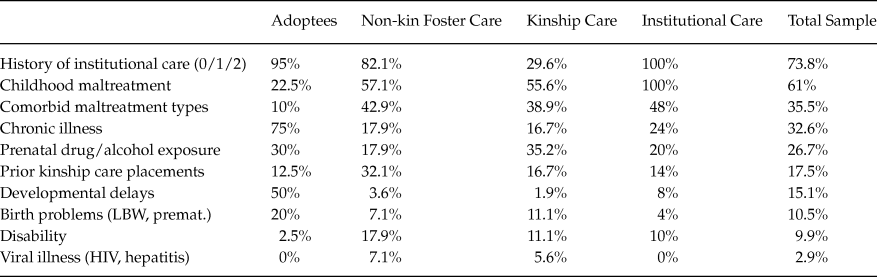
Predictably, boys and girls in our study had a history of severe difficulties prior to their current childcare placements. As Table 2 points out, the incidence of past institutional care (73.8%) and the incidence of childhood maltreatment (61.0%) were noteworthy. Furthermore, we found that 35.5% of these children had suffered multiple forms of maltreatment simultaneously, 32.6% had a chronic illness (for example, respiratory or intestinal disease), and a quarter (26.7%) had prenatal drug/alcohol exposure. Also, 17.5% of these children had previously been placed in kinship care, 15.1% were developmentally delayed, 10.5% had birth problems like low birth weight or premature birth, and 9.9% had some type of disability. Viral diseases like HIV and hepatitis were present in a small subset of these boys and girls as well, which will be further explored below.
Children’s Early Adversity According to Childcare Placement (as a Percentage)

As conveyed in Table 2, in adoptee profiles, past institutional care placements were prominent, along with illness and developmental delay at the time of adoption. Among institutional care cases, history of institutional care and childhood maltreatment were ubiquitous. Children in non-kin foster care had the highest incidence of prior kinship care placement and the highest incidence of disability. Finally, the highest percentage of children in kinship care had prenatal drug/alcohol exposure and the lowest proportion of past institutional care placements.
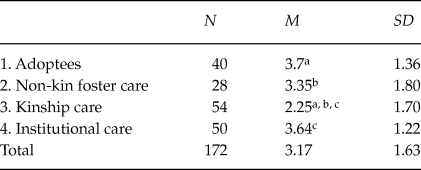
Further analysis revealed that these children had accumulated a considerable number of risk factors (M = 3.17; SD = 1.63). For example, 21% of them (n = 36) had accumulated five or more adversity variables prior to their current placements. Scheffé post hoc tests indicated differences between groups, the kinship care group having experienced significantly less adversity than the other groups, F(3, 171) = 9.803 p < .001 (see Table 3). On the other end of the spectrum, adoptees and institutional care facility resident shad the highest adversity scores. In our comparison of the kinship care and non-kin foster care groups, the effect size could be considered moderate (d > .50), and when we compared children in kinship care to adoptees and institutional care cases, the effect size was large (d > .80).
Children’s Early Adversity Index Scores According to Placement Group

Note: Mean between groups with the same superscript (a, b, c, d) are significantly different (p ≤ .05).
Effect size: 2–3, d > .50; 1–3, 3–4, d > .80.
Psychological Adjustment in Boys and Girls
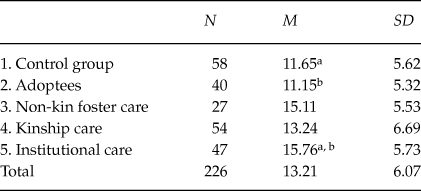
In terms of adjustment, as depicted in Table 4, institutional care facility residents scored highest on the difficulties scale, followed by those in non-kin foster care, F(4, 225) = 5.200 p < .001. Scheffé post hoc tests indicated the differences were significant when institutional care cases were compared to the control group, and to adoptees.
In that first comparison, the effect size was moderate (d > .50), where as in the second, when institutional care cases were compared to adoptees, the effect size was large (d > .80).
Total Difficulties Scores (SDQ) According to Placement Group

Note: Mean between groups with the same superscript (a, b, c, d) are significantly different (p ≤ .05).
Effect size: 1–5, d > .50; 2–5, d > .80.
The mean total difficulties score on the SDQ was slightly over 13 points, which is the upper limit for scores considered normative on this test. Thus, even though adoptees and children in the control group had psychological adjustment scores within the normative limits, children placed in institutional care or non-kin foster care scored at the test’s cut-off (14–16) and near the clinical range (17–40).
When we analyzed scores on the SDQ’s different subscales, we found statistically significant differences between groups on all scores except peer problems (see Table 5). We observed that the incidence of emotional problems, F(4, 225) = 7.067 p < .001, and the incidence of conduct problems, F(4, 225) = 8.018 p <.001, were significantly higher among the boys and girls placed in institutional care. However, children in non-kin foster care scored the highest on the hyperactivity subscale, F(4, 225) = 3.9 82 p = .004. Last, on the prosocial subscale, youths in institutional care scored significantly lower than the other groups, F(4, 225) = 13.424 p < .001. When we controlled for the effect of the children’s age when their current placement started, and for the duration of that placement, the results were unchanged. Nevertheless, comparative data from ANOVAs were included to conserve our comparison to the control group, who were not affected by the study’s covariables.
The Different Groups’ Scores on SDQ Subscales

Note: Mean between groups with the same superscript (a, b, c, d) are significantly different (p ≤ .05).
Relationship between Early Adversity and Current Psychological Adjustment
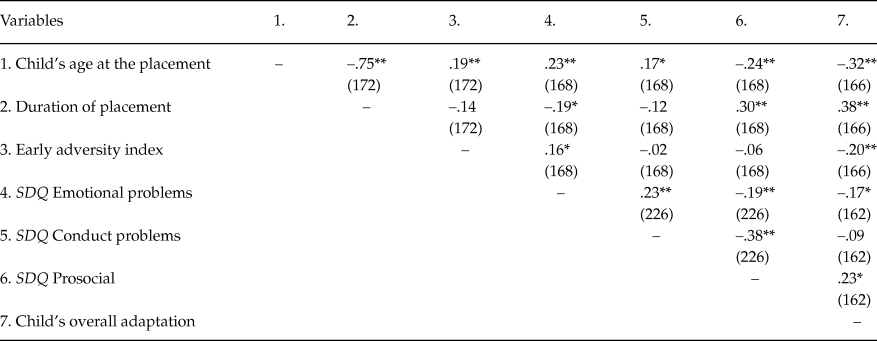
Regarding the relationship between adversity and psychological adjustment, as Table 6 shows, statistically significant correlations were found.
Correlations between Placement Age, Placement Duration, Overall Adaptation, Early Adversity Index, and SDQ Scores

Note: *p ≤ .05; **p ≤ .01. In parentheses the number of subjects of each correlation.
First of all, the adversity index was significantly, negatively correlated with children’s overall adaptation to their placements (r = –.20, p ≤ .01, n = 166) according to the information provided by their parents, foster parents, caregivers, or educators. Accordingly, the poorest adaptation was linked to the highest early adversity level, and the best adaptation to the lowest early adversity level. Furthermore, a moderate to low – but statistically significant – correlation was observed between children’s age when their current childcare placement began, and the adversity they encountered (r = .19, p ≤ .01, n = 172). The older a child was, the higher his/her adversity level, and vice versa. Finally, a low but significant correlation was observed between adversity index and emotional problems in these children (r = .16, p ≤ .05, n = 168).
As for their psychological adjustment, statistically significant correlations were only observed in our analyses of the following SDQ subscales: emotional problems, conduct problems, and prosocial. Scores on emotional problems (r = .23, p ≤ .01, n = 168) and conduct problems (r = .17, p ≤ .05, n = 168) correlated with the age at which their current placement began such that the later the children were placed, the more problems they had. Next, we observed a significant, negative correlation between the incidence of emotional problems and the duration of current childcare placement (r = –.19, p ≤ .05, n = 168) such that the occurrence of emotional problems tended to be lower the longer the child had been placed, and higher the more recently they were placed. The correlation between emotional problems and overall adaptation to one’s childcare placement (r = –.17, p ≤ .05, n = 162) was also negative, but not as strong. On another note, prosocial scores were negatively correlated with the age at which the current placement began (r = –.24, p ≤ .01, n = 168) such that later-placed children tended to have lower prosocial scores and vice versa. Conversely, duration of placement was positively correlated (r = .30, p ≤ .01, n = 168) with children’s overall adaptation (r = .23, p ≤ .01, n = 162). Finally, in addition to the correlations detailed above, we wish to emphasize that overall adaptation to childcare placement was negatively correlated with the age at which the current placement began (r = –.32, p ≤ .01, n = 166), and positively correlated with that placement’s duration (r = .38, p ≤ .01, n = 166).
Discussion
This study’s main objective was to ascertain the adversity profiles of children in different childcare placements and analyze their relationship with subsequent psychological adjustment. With respect to early adversity profiles, the data indicate that as expected, boys and girls in different childcare placements experienced a significant amount of adversity prior to placement. One noteworthy finding was that over 20% had experienced five or more variables, which could be considered a very large dose of adversity. What stood out in these early adversity profiles overall were stints in institutional care facilities and childhood maltreatment as an antecedent, often more than one form concurrently. Also, these data were predictable in that past research has indicated that in Spain and other countries where children arrive through international adoption, the first option in most cases is placement in some institution, so by the time they are adopted or placed in foster care, they have often lived in multiple institutional care facilities (Amorós & Palacios, Reference Amorós and Palacios2004; Bravo & Del Valle, Reference Del Valle, Bravo and López2009; Palacios, Reference Palacios2003). On the other hand, the most common reason why boys and girls end up in state custody is childhood maltreatment (Palacios, Jiménez, Oliva, & Saldaña, Reference Palacios, Jiménez, Oliva, Saldaña, Rodrigo and Palacios1998). Less often, these children’s records indicated a history of chronic illness and in even fewer cases, viral contagious disease. More than a quarter of the total sample had prenatal drug/alcohol exposure, which was likely related to the aforementioned illnesses, birth problems such as premature birth and low birth weight, and the disabilities exhibited by some. Considering this context of adversity, it is not surprising that some of these children exhibited physical and psychological developmental delays that can become an obstacle to adaptation and recovery down the line (Jiménez & Palacios, Reference Jiménez and Palacios2008; Juffer et al., Reference Juffer, Palacios, Le Mare, Sonuga-Barke, Tieman, Bakermans-Kranenburg and Verhulst2011; Palacios et al., Reference Palacios, Sánchez-Sandoval, León, Román, Berástegui and Gómez-Bengoechea2008).
Our data also emphasize the different nuances of this overall adversity profile that emerge when each childcare placement is examined. For instance, the following antecedents characterized adoptee profiles: institutional care, illness, and developmental delay; that is consistent with earlier research findings (Hernández-Muela et al., Reference Hernández-Muela, Mulas, Téllez de Meneses and Roselló2003; Palacios et al., Reference Palacios, Sánchez-Sandoval, León, Román, Berástegui and Gómez-Bengoechea2008). In every single case studied, youths in institutional care lived in a different facility previously. Institutional care residents were also distinct for experiencing childhood maltreatment most often and most intensely. On another note, the highest proportion of children in non-kin foster care had previously lived in kinship care (Palacios & Jiménez, Reference Palacios and Jiménez2009). The non-kin foster care group also had the highest incidence of disability. Finally, the kinship care profile had a remarkably high percentage of children with prenatal drug/alcohol exposure and the least history of institutional care placements, which earlier research findings support (Palacios & Jiménez, Reference Palacios and Jiménez2009). Aside from the adversity features these boys and girls all have in common, it seems clear that the nature and intensity of these variables, and their interaction over time, play an important role that the research has yet to determine. Each childcare placement entails a different trajectory of adversity that may be tied to patterns of subsequent adaptation and psychological adjustment (Lee, Seol, Sung, & Miller, Reference Lee, Seol, Sung and Miller2010).
From the perspective of accumulation, our data suggest differences between the different childcare placement groups in how much adversity they had experienced. The boys and girls in kinship care had the lowest adversity exposure of all. Research findings (Palacios & Jiménez, Reference Palacios and Jiménez2009) have revealed that in such cases, most boys and girls are moved into kinship care directly from their families of origin at a very early age. That may protect them from certain adverse experiences that are commonplace in other childcare trajectories. Although the differences were not statistically significant, our data indicate that institutional care cases and international adoptees had the highest adversity exposure. Various studies have likewise found that those groups’ profiles prior to current placement are the most negative due to a high accumulation of past difficulties and adverse life circumstances (Palacios, Reference Palacios2003; Rutter, Reference Rutter1998).
With regard to psychological adjustment, average SDQ scores indicate that on the whole, boys and girls in this study exhibited adjustment within the normative range, yet quite close to the test’s cut-off points. That is nonetheless good news considering their trajectories of early adversity. Analyzing the different groups’ psychological adjustment profiles individually, the data indicate statistically significant differences between them. We found that problems and difficulties were more numerous among children placed in institutional care and non-kin foster care; but differences were only significant when institutional care cases were compared to adoptees and to the control group. Youths in institutional care scored within the normative range for the test, but quite close to the clinical range. Even though children in Spanish institutions receive very high-quality care and assistance, our data confirm earlier research findings in Spain and other countries in indicating that they exhibit poorer psychological adjustment than children in other placements, like adoption (Bravo & Del Valle, Reference Del Valle, Bravo and López2009; Fernández-Molina et al., Reference Fernández-Molina, Del Valle, Fuentes, Bernedo and Bravo2011; Palacios, Reference Palacios2003). Furthermore, despite early difficulties, our data show that current psychological adjustment in adoptees was within the normative range and on par with boys and girls in the control group. That demonstrates the true strength of this childcare placement and is, again, excellent news for adoptees and adoptive families. When we analyzed results on the SDQ subscales, the data were aligned with past research findings, except in the case of emotional problems. Children in the control group scored significantly higher than adoptees on emotional problems, although their scores were still within the normative range. This may reflect a tendency to normalize this type of reaction and symptomatology on the part of adoptive families.
Our results highlight the weak relationship between a child’s early adversity experiences and his/her current psychological adjustment, which we expected given how much time had passed since placement, children’s tremendous capacity for adaptation, and that these placements were made as protective measures. That weak relationship was reflected in the parents’ and caregivers’ appraisals of youths’ overall adaptation to their placements, and in the occurrence of emotional problems, in both cases more positive the lower a child’s early adversity was. On a different note, like in past studies (Gunnar, van Dulmen, & The International Adoption Project Team, Reference Gunnar and van Dulmen2007; León, Reference León2011; Merz & McCall, Reference Merz and McCall2010; Palacios & Jiménez, Reference Palacios and Jiménez2009), our data demonstrate that a child’s age of placement and recency of placement both influence his/her behavioral and emotional adjustment and overall adaptation to placement. Our data also indicate the group with the most difficulties, and most in need of support, were boys and girls in institutional care, followed by those in non-kin foster care. In the latter case, even though foster care families’ social and educational status was high, other research in Spain (Palacios & Jiménez, Reference Palacios and Jiménez2009) has found that these children are placed much later than those in kinship care, accumulate a history of placements in residential and/or family foster care, and experience considerable discontinuity in the transition between family contexts, which can negatively affect adaptation.
Even though children in kinship care had the lowest early adversity exposure of all the adoption and foster care placements studied, their psychological adjustment was worse than adoptees’. These results, too, are consistent with past research findings in Spain (Palacios et al., Reference Palacios, Sánchez-Sandoval, León, Román, Berástegui and Gómez-Bengoechea2008; Palacios & Jiménez, Reference Palacios and Jiménez2009). In Spain and beyond, research findings have highlighted the positive aspects of kinship care (for example, maintaining family ties and preserving ethnic and cultural identity), as well as its shortcomings, which mainly have to do with caregivers’ older age, certain social problems, or inadequate education and support on the part of the child welfare system (Amorós & Palacios, Reference Amorós and Palacios2004; Cuddeback, Reference Cuddeback2004; Ehrle & Geen, Reference Ehrle and Geen2002). This could explain why kinship care’s relatively better start than other childcare placements (like adoption) does not bear the desired continuity. Clearly these results should be interpreted as a wake-up call to improve upon the education and support currently provided to these families.
The present study had certain limitations. First and foremost among them, the composition of these groups of children in terms of age and sex was not entirely homogenous. Second, the analysis lacked a multivariate approach due to small sample sizes and co linearity between certain variables. Finally, one limitation affecting all studies in this field is the dearth of high-quality, sufficiently detailed information in the early histories of boys and girls who pass through the child welfare system.
In closing, those limitations notwithstanding, some directions for intervention can be deduced from this study’s results. First, we must emphasize how important it is to prevent situations of risk and adversity that impact childhood. Second, family foster care and adoption should be considered before resorting to residential care; and third, the child welfare system should strive to maintain continuity across a child’s placement/s and transition/s to avoid accumulation of changes and childcare placements.
This study is part of a larger project funded by the Spanish Ministerio de Ciencia e Innovación (SEJ2006–1221 and PSI2010–19287) and the Junta de Andalucía (SI-059/07). It would not have been possible without the collaboration of Jesús Palacios, who directs part of that project.