Introduction
The evolution of the spermatheca in female insects effectively uncoupled fertilization from insemination and gave rise to novel forms of intersexual conflict (Eberhard, Reference Eberhard1996). Once females achieved postcopulatory control over sperm utilization, mating per se was no longer a guarantee of paternity for males. Sperm competition and cryptic female choice became important selective forces shaping the evolution of secondary male strategies to influence sperm usage patterns in females (Parker & Simmons, Reference Parker and Simmons1989; Eberhard, Reference Eberhard, Choe and Crespi1997; Simmons & Siva-Jothy, Reference Simmons, Siva-Jothy, Birkhead and Moller1998; Fisher et al., Reference Fisher, Double, Blomberg, Jennions and Cockburn2006). Consequently, males of polyandrous insect species evolved a diversity of tactics to foil male competitors (e.g., sperm removal), reduce female receptivity, prevent females from remating (e.g., mate guarding, mating plugs) and stimulate female oviposition and hence rapid sperm utilization (reviewed by Eberhard, Reference Eberhard1996; Gillott, Reference Gillott2003; Wedell, Reference Wedell2005). A variety of compounds generally referred to as ‘seminal fluid proteins’ (SFPs) are produced in insect male accessory glands (Chen, Reference Chen1984) and can have a wide range of physiological effects on females, ranging from fecundity and fertility stimulation to reduction of female receptivity (Avila et al., Reference Avila, Sirot, LaFlamme, Rubinstein and Wolfner2011). When sperm competition is intense, or when male ejaculates contain nutrients or expensive-to-produce SFPs, the costs of ejaculate production can be much higher than once assumed by the ‘sperm is cheap’ hypothesis of sexual differentiation (Bonduriansky, Reference Bonduriansky2001; Lupold et al., Reference Lupold, Manier, Ala-Honkola, Belote and Pitnick2010; Perry & Rowe, Reference Perry and Rowe2010; Avila et al., Reference Avila, Sirot, LaFlamme, Rubinstein and Wolfner2011). Furthermore, it has been argued theoretically that if fecundity stimulation by males is sufficiently strong, it will actually attenuate sperm competition among males because those mating with promiscuous females ‘cooperatively’ fertilize more eggs than those who inseminate monogamous females (Alonzo & Pizzari, Reference Alonzo and Pizzari2010).
Aphidophagous coccinellids are known to obtain fitness benefits from multiple matings (Quinones Pando et al., Reference Quinones Pando, Chavez-Sanchez and Tarango Rivero2001; Omkar & Srivastava, Reference Omkar and Srivastava2002; Omkar & James, Reference Omkar and James2005; Omkar & Pervez, Reference Omkar and Pervez2005; Bind, Reference Bind2007; Omkar et al., Reference Omkar, Singh and Mishra2010a), particularly when females mate with multiple males (Majerus, Reference Majerus1994; Omkar & Mishra, Reference Omkar and Mishra2005a; Srivastava & Omkar, Reference Srivastava and Omkar2005; but see Haddrill et al., Reference Haddrill, Shuker, Mayes and Majerus2007). Although many species produce a spermatophore in the bursa copulatrix of the female (e.g., Obata, Reference Obata1987; Omkar & Mishra, Reference Omkar and Mishra2005b), others such as Cheilomenes sexmaculata (F.) and Coelophora saucia (Mulsant) engage in direct sperm transfer (Omkar et al., Reference Omkar, Singh and Pervez2006) and there is variation in this regard even within coccinellid sub-families (e.g., Fisher, Reference Fisher1959; Katakura et al., Reference Katakura, Nakano, Hosogai and Kahono1994; Kaufmann, Reference Kaufmann1996). Among spermatophore-forming species, females may or may not eject and consume the spermatophore following termination of copula (e.g., Obata, Reference Obata1987; Perry & Rowe, Reference Perry and Rowe2010), raising the possibility of a male nutritional contribution, or ‘nuptial gift’. However, Eberhard (Reference Eberhard, Choe and Crespi1997) argues that allohormonal substances in male seminal products tend to have more important effects on female reproduction than nutritional contributions and a study by Perry & Rowe (Reference Perry and Rowe2008) suggests that spermatophore consumption by coccinellid females yields little, if any, nutritional benefit. Wilson et al. (Reference Wilson, Tufton and Eady1999) attributed elevated fecundity resulting from multiple matings in two bruchid species to the action of ‘oviposition stimulants’ delivered by males, rather than any nutritional donation and similar female benefits from multiple matings have been demonstrated for Coccinella septempunctata (Bista & Omkar, Reference Bista and Omkar2012).
If ejaculates are costly to produce, the virility of coccinellid males should decline as a function of repeated matings, and that could result in diminished fecundity and/or fertility in their mates. Furthermore, if male seminal products mediate paternal effects, there may be a reduction in offspring quality as a function of paternal mating history. The present study used two congeneric ladybird species, C. septempunctata (L.) and Coccinella transversalis F., to test whether increased male mating activity would affect either the quantity or quality of progeny while controlling for effects of both male and female age. Both species co-occur widely throughout Asia where C. septempunctata contributes to control of aphids on many herbaceous crops (Hodek, Reference Hodek, Hodek and Honek1996; Hodek & Michaud, Reference Hodek and Michaud2008), with C. transversalis more specific to legumes and mustards (Hodek, Reference Hodek, Hodek and Honek1996; Yadav et al., Reference Yadav, Yadav, Yadav and Katiyar2011). However, females of C. septempunctata eject and consume spermatophores, whereas females of C. transversalis eject, but do not consume them, providing an opportunity to control any nutritional effects of spermatophore consumption.
On the basis of the foregoing, we propose two hypotheses with respect to the influence of male virility on female fertility and progeny fitness. We hypothesize that female fecundity and fertility should decline with increasing history of sexual activity in her mate, on the assumption that female reproductive stimulation will represent a physiological expense for males. Second, we hypothesize that some measures of progeny fitness should diminish with increasing history of paternal sexual activity, assuming that there are paternal effects on offspring quality.
Materials and methods
Insects
Adults of C. septempunctata and C. transversalis (n∼50 of each species) were collected from agricultural fields around Lucknow, Uttar Pradesh, India, brought to the laboratory and used to establish stock colonies in climate-controlled growth chambers. Physical conditions were set at 27±1 °C, 65±5% RH and 14L:10D photoperiod. Adult beetles were sexed, paired in plastic Petri dishes (9.0 × 2.0 cm) and fed cowpea aphids, Aphis craccivora Koch, reared in a glasshouse on cowpea plants, Vigna unguiculata L. All egg clusters were collected daily and isolated in Petri dishes (as above) until hatching. Upon eclosion, larvae were transferred to plastic beakers (14.5 × 10.5 cm), 10 per beaker and provisioned with an ad libitum supply of A. craccivora on cowpea shoots that were replenished daily until the larvae pupated. Adults for use in experiments were isolated individually in Petri dishes upon emergence and fed cowpea aphids ad libitum, refreshed daily.
Experimental protocol
Behavioural observations were made on a laboratory bench at 25±2 °C under fluorescent lights; otherwise all experimental insects were held under the same physical conditions as the stock colony. In order to determine the effect of mating history on male mating behaviour, maternal reproduction and progeny development, four types of mate crosses (n=10 each) were conducted with both C. septempunctata and C. transversalis:
(A) 10-day-old virgin female × 10-day-old virgin male.
(B) 10-day-old virgin female × 10-day-old male mated once (on day 9).
(C) 10-day-old virgin female × 10-day-old male mated twice (on days 8 and 9).
(D) 10-day-old virgin female × 10-day-old C. transversalis male mated five times (on days 5–9); 12-day-old C. septempunctata mated five times (on days 7–11).
In a normal mating sequence, males of C. septempunctata initiate a series of vertical thrusting movements with the abdomen (strokes) shortly after genital contact is established with the female. These are followed by wriggling movements (a gentle forward and backward movement of the abdomen with a simultaneous side-to-side component) and then by a series of shaking bouts (rapid lateral oscillations of the abdomen separated by resting intervals. Strokes and wriggling movements are observed only during the initial stages of mating. The mating behaviour of C. transversalis is similar in all respects, but lacks the period of vertical strokes.
All matings were subject to continuous direct observation and the following data were recorded: The initial latent period [=time from genital contact to first stroke (C. septempunctata), or to first wriggling movement (C. transversalis)]; number of strokes (C7); number of wriggling movements; total duration of wriggling movements; number of shaking bouts; total duration of shaking bouts; duration of resting intervals between bouts; terminal latent period (period from last shaking bout until pair separation); and total mating duration (period from initial genital contact until pair separation).
At the end of each mating, the female was isolated in a Petri dish (as above) with an ad libitum supply of A. craccivora replenished daily, and her eggs were collected daily for the next 20 days. All the eggs were incubated until eclosion and rates of hatching were recorded. Ten larvae were selected from each experimental female over the first two days of her reproduction and reared to follow progeny development. Neonates were transferred to plastic beakers (14.5 × 10.5 cm, 10 per beaker) covered with muslin secured with a rubber band and provisioned daily with an ad libitum supply of cowpea aphids on plant shoots. Developmental time (from egg to adult emergence) and stage-specific mortality data were recorded for each replicate.
Statistical analysis
All data were subjected to regression analysis and trend lines were fit using non-linear regression; in all cases, quadratic equations provided lines of best fit.
Results
C. septempunctata
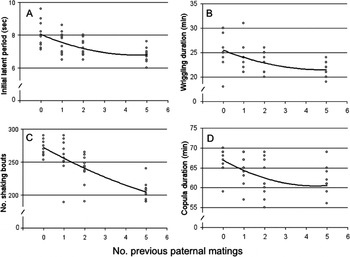
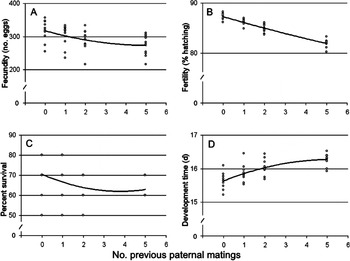
There was a significant effect of male mating history on length of the initial latent period (F 1,37 = 10.79, P < 0.001, R 2 = 0.368); more matings resulted in shorter initial latent periods (fig. 1a). Male mating history did not affect the number of strokes prior to wriggling (F 1,37 = 1.56, P = 0.224, means±SE = 101.6±5.03). However, more matings decreased the duration of wriggling movements (F 1,37 = 6.22, P = 0.005, R 2 = 0.252, fig. 1b) and the number of shaking bouts (F 1,37 = 30.06, P < 0.0001, R 2 = 0.619, fig. 1c). There was no effect of male mating history on either the time spent in resting intervals between shaking bouts (means±SE = 22.0±0.9, 21.4±1.0, 21.4±1.2 and 18.4±2.2 min for 0×, 1× 2× and 5×mated males, respectively; F 1,37 = 2.82, P = 0.072), or in the duration of the terminal latent period (means±SE = 22.9±0.6, 22.8±0.8, 22.5±0.7 and 22.1±0.6 s for 0×, 1×, 2× and 5×mated males, respectively; F 1,37 = 0.32, P = 0.729), but more previous male matings diminished the duration of copula overall (F 1,37 = 5.71, P = 0.007, R 2 = 0.236, fig. 1d). Preoviposition periods (means±SE) averaged 4.0±0.2, 3.7±0.4, 3.8±0.2 and 4.5±0.3 days for females mated to males with 0, 1, 2 and 5 previous matings, respectively (F = 1.29; df = 3,36; P = 0.176). The number of eggs laid by females over a 20-day period declined as the mating history of their males increased (F 1,37 = 4.97, P = 0.012, R 2 = 0.212, fig. 2a) and so did their fertility (F 1,37 = 146.19, P < 0.0001, R 2 = 0.888, fig. 2b).
Quadratic regression of various components of male mating behaviour for 10 day-old C. septempuntata males of different mating histories (5 × mated males were 12-day-old) mated with virgin 10-day-old females. See text for behaviour definitions.

Quadratic regression of reproductive data and development of progeny produced during the first five days of oviposition by 10-day-old C. septempuntata females mated as virgins with 10-day-old males of different mating histories (5 × mated males were 12-day-old).

Immature survival (from eclosion to adult emergence) appeared to decline as a function of paternal mating history, but the regression was not significant (F = 1.92; df = 3,39; P = 0.144; fig. 2c). However, more paternal matings significantly increased total developmental time of progeny (F 1,37 = 20.02, P < 0.0001, R 2 = 0.520, fig. 2d), due to increases in the duration of the incubation period (F 1,37 = 8.05, P = 0.001), the first instar (F 1,37 = 6.06, P = 0.005), and the fourth instar (F 1,37 = 4.57, P = 0.017).
C. transversalis
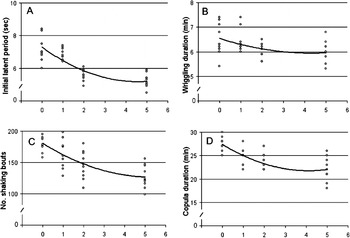
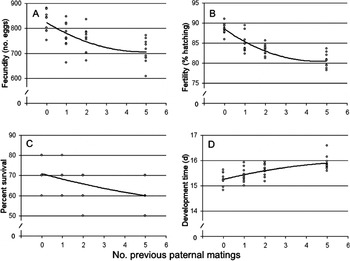
There was a significant effect of male mating history on length of the initial latent period (F 1,37 = 39.10, P < 0.0001, R 2 = 0.679); more matings resulted in shorter initial latent periods (fig. 3a). More matings decreased the duration of wriggling movements (F 1,37 = 4.06, P = 0.025, R 2 = 0.18, fig. 3b) and the number of shaking bouts (F 1,37 = 20.62, P < 0.0001, R 2 = 0.527, fig. 3c) and resulted in longer periods spent in resting intervals (means±SE = 12.0±0.1, 12.2±0.2, 12.4±0.1 and 12.5±0.1 min for 0×, 1×, 2× and 5×mated males, respectively; F 1,37 = 5.34, P = 0.009, R 2 = 0.224). The total duration of copula decreased as the number of previous male matings increased (F 1,37 = 21.26, P < 0.0001, R 2 = 0.535 fig. 3d), although there was no effect of mating history on the terminal latent period (means±SE = 8.1±0.3, 8.6±0.3, 8.4±0.2 and 7.8±0.3 min for 0×, 1×, 2× and 5×mated males, respectively; F 1,37 = 1.97, P = 0.154). There was a tendency for preoviposition period (means±SE) to lengthen as the number of previous male matings increased from 0 to 5 (1.9±0.3, 2.4±0.3, 2.9±0.3 and 3.1±0.5), but means did not differ significantly (F 3,39 = 2.31, P = 0.093). As in C. septempunctata, the number of eggs laid by females in a 20-day period declined as the mating experience of their males increased (F 1,37 = 15.81, P < 0.0001, R 2 = 0.461, fig. 4a) and so did their fertility (F 1,37 = 54.57, P < 0.0001, R 2 = 0.747, fig. 4b).
Quadratic regression of various components of male mating behaviour for 10-day-old C. transversalis males of different mating histories mated with virgin 10-day-old females. See text for behaviour definitions.

Quadratic regression of reproductive data and development of progeny produced during the first five days of oviposition by 10-day-old C. transversalis females mated as virgins with 10-day-old males of different mating histories.

Immature survival (1st instar to adult) diminished as the number of paternal matings increased (F 3,39 = 4.60, P = 0.008, fig. 4c). More paternal matings also increased total developmental time of progeny (F 1,37 = 15.76, P < 0.0001, R 2 = 0.460, fig. 4d), due largely to increases in the duration of the incubation period (F 1,37 = 12.12, P < 0.001), and the fourth instar (F 1,37 = 6.42, P = 0.004).
Discussion
The fecundity and fertility of females of both species were affected by paternal mating history, as hypothesized, indicating that male sexual activity diminishes male virility as reflected in female reproductive success. Notably, between-treatment variation in number of shaking bouts, duration of wriggling behaviour and overall duration of copula mirrored variation in female fecundity and fertility, suggest that these male behaviours correlate with male mating effort and differences in female reproductive performance. In both species, the number of shaking bouts was diminished by approximately 30% in 5 × mated males compared with virgins, although the corresponding reduction in female fecundity was proportionally greater in C. transversalis, the more fecund species.
Insect seminal fluids are very complex and may contain a large number of substances (Reinhardt et al., Reference Reinhardt, Wong and Georgiou2009). If males use seminal fluids to stimulate female reproductive activity, these products may become depleted in males over the course of multiple matings. Alternatively, depletion of sperm itself might contribute to the observed results, if sperm have a direct stimulatory effect on female reproductive processes. Heifetz et al. (Reference Heifetz, Tram and Wolfner2001) used mutant males of Drosophila melanogaster deficient in male accessory gland proteins and/or sperm to demonstrate that both factors exert complimentary effects on the onset and rate of female oogenesis. In subsequent work, Heifetz & Wolfner (Reference Heifetz and Wolfner2004) demonstrated different neurological responses of the female reproductive tract to sperm, accessory gland proteins and either mechanical mating stimulation or some other unknown seminal fluid component. Since the duration of copula and numbers of shaking bouts in these Coccinella spp. also diminished as a function of previous matings, tactile stimulation of the female would also have been reduced and, if such stimulation has neurosecretory consequences, this may have contributed also to the reduced reproductive success of females mated to non-virgin males.
The similarity of responses in both species suggest the observed effects on female reproduction are not related to spermatophore consumption, as C. transversalis females do not consume them, even though those of C. septempunctata do. Previously, Omkar et al. (Reference Omkar, Singh and Pervez2006) examined mating duration in C. sexmaculata and C. saucia and found that preoviposition periods became shorter and fecundities increased as females were permitted to mate for longer periods, suggesting a progressive transfer of seminal fluids to the female during copula. In the latter species, female fecundity was also shown to decline as a function of male age at mating (Omkar et al., Reference Omkar, Singh and Mishra2010b), suggesting that male virility declines with age. Perry & Rowe (Reference Perry and Rowe2010) showed that low-condition Adalia bipunctata L. males produced ejaculates with higher relative sperm content, suggesting they reduced non-sperm components of seminal fluid more than sperm under conditions of resource limitation. If non-sperm components of seminal fluids are more costly to produce than the sperm itself, depletion of these materials may limit coccinellid male fertility more than the rate of spermatogenesis. Such is the case for the bed bug, Cimex lectularius L. (Reinhardt et al., Reference Reinhardt, Naylor and Siva-Jothy2011) despite a very different fertilization mechanism (traumatic insemination).
Although it would make sense for coccinellid females to lay only eggs that have sperm available to fertilize them, they do not have perfect control over the fertilization process. For example, a short (10 s) period of mating in C. sexmaculata and C. saucia is not enough to permit sperm transfer in these species and yet it still stimulates some oviposition of infertile eggs by females (Omkar et al., Reference Omkar, Singh and Pervez2006). The observed changes in egg fertility as a function of increased male mating history in these experiments may reflect either qualitative (sperm viability) or quantitative (sperm number) effects, or some combination thereof. Repeated matings may also deplete males of factors associated with sperm activation, storage, or nourishment (Poiani, Reference Poiani2006). Yaginuma et al. (Reference Yaginuma, Mizuno, Mizuno, Wada, Hattori, Yamashita and Happ1996) demonstrated that structural proteins of the Tenebrio molitor L. spermatophore and associated sugars may be implicated in both the activation of sperm in the bursa copulatrix of female, and their subsequent nourishment in the spermatheca. Other studies have identified sex peptides of male origin in Diptera and Lepidoptera that trigger neuroendocrinal responses in females (Chen et al., Reference Chen, Strumm-Zollinger, Aigaki, Balmer, Bienz and Bohlen1988; Hanin et al., Reference Hanin, Azrielli, Applebaum and Rafaeli2012; LaFlamme et al., Reference LaFlamme, Ram and Wolfner2012). Work on both Danaus plexippus (L.) (Herman, Reference Herman1993) and Tribolium castaneum (Herbst) (Parthasarathy et al., Reference Parthasarathy, Tan, Sun, Chen, Rankin and Palli2009) has implicated juvenile hormone as an important factor mediating the expression of accessory gland proteins and their resulting effects on female fertility. The present results indicate that Coccinella spp. males are able to affect female fertility and fecundity, presumably for their own benefit, but this capacity is significantly diminished as a function of mating activity.
Male mating history also had effects on offspring fitness, although the magnitude of the effects were not great, indicating paternal effects on offspring survival and development that are likewise diminished as a function of male sexual activity. The trend towards a reduction in progeny survival by about 10% after five paternal matings was significant only in C. transversalis, due to high within-treatment variation in C. septempunctata (figs 2c and 4c). However, there was a significant increase in the developmental time of offspring in both species with increased paternal matings (figs 2d and 4d), suggesting that seminal fluids contain allohormonal factors that either serve to accelerate offspring development directly, or trigger maternal responses that have this effect. Although the difference in developmental time across treatments was slightly less than one day in both species, even small delays in development can have negative consequences for aphidophagous coccinellids. Fast progeny development is especially important to parental fitness in these species because developmental time is negatively correlated with body size and larvae must exploit ephemeral prey, usually aphids, to achieve a critical pupation weight within a narrow time window (Kindlmann & Dixon, Reference Kindlmann and Dixon1993).
Most studies of transgenerational phenotypic plasticity in insects have examined maternal effects, the epigenetic mechanisms whereby females can affect phenotype development in their progeny. Although the existence of maternal effects has been recognized for nearly 80 years (Dobzhansky, Reference Dobzhansky1935), it is only since the publication of Mousseau & Fox (Reference Mousseau and Fox1998) that they have become the focus of significant research attention, especially in insects (Fox & Mousseau, Reference Fox, Mousseau, Mousseau and Fox1998; Mousseau et al., Reference Mousseau, Uller, Wapstra and Badyaev2009). However, paternal effects have received less attention, despite the fact that male insects often influence female reproductive physiology (reviewed in Ridley, Reference Ridley1988; Alexander et al., Reference Alexander, Marshall, Cooley, Choe and Crespi1997), and hence potentially the development of their progeny. For example, female condition had no effect on progeny body size in the neriid fly Telostylinus angusticollis (Enderlein), but the offspring of high-condition males were larger than those of low-condition males (Bonduriansky & Head, Reference Bonduriansky and Head2007). The herbivorous coccinellid Epilachna paenulata Germar synthesizes defensive alkaloids which both parents contribute to the eggs (Camarano et al., Reference Camarano, Andres and Carmen2009). Previous studies on Coleomegilla maculata (DeGeer) and Hippodamia convergens Guerin-Meneville have demonstrated effects of maternal age on progeny development and examined how maternal body size can act as a constraint on these signals (Vargas et al., Reference Vargas, Michaud and Nechols2012a, Reference Vargas, Michaud and Necholsb, Reference Vargas, Michaud and Necholsc). However, since body size was manipulated simultaneously in both males and females in these studies, it seems likely that paternal effects contributed at least partly to some results, such as the rapidly declining fertility observed in pairs of small H. convergens beetles (Vargas et al., Reference Vargas, Michaud and Nechols2012b).
The multiple effects of male factors on female fecundity, fertility and progeny fitness may select abilities in coccinellid females to distinguish male mating status and discriminate, either overtly or cryptically, in favour of virgin males. Female coccinellids often exert mate preference based on genetic or phenotypic criteria (O'Donald & Majerus, Reference O'Donald and Majerus1984; Wang et al., Reference Wang, Michaud, Zhang, Zhang and Liu2009; Wang et al., Reference Wang, Michaud, Tan, Murray and Zhang2013) and when subclasses of males are disfavoured, this can theoretically lead to differential patterns of male investment in sperm versus seminal fluids (Cameron et al., Reference Cameron, Day and Rowe2007). Similarly, if matings exact a cost in terms of male virility, we might expect selection of males to discriminate female mating status and adjust their mating effort accordingly. Since some sperm mixing occurs within multiply-mated coccinellid females (de Jong et al., Reference de Jong, Brakefield and Geerinck1998; Haddrill et al., Reference Haddrill, Shuker, Amos, Majerus and Mayes2008) males may invest more reproductive effort in virgins than in previously mated females. Future experiments could test for male age-mating status interactions and effects of male condition on paternal effects. Furthermore, body size has a range of reproductive consequences in coccinellids (e.g., Vargas et al., Reference Vargas, Michaud and Nechols2012a, Reference Vargas, Michaud and Necholsb, Reference Vargas, Michaud and Necholsc) and its possible effects on male virility have not yet been explored. Subsequent experiments could test for effects of body size on male virility and for abilities of both sexes to detect the mating status of sexual partners and alter reproductive investment accordingly.
Acknowledgements
The authors thank the Department of Higher Education, Government of Uttar Pradesh, for financial assistance under the Centre of Excellence Programme. MB was supported by a fellowship from the University Grants Commission, Government of Nepal contribution number 13-147-J of the Kansas State Agricultural Experiment Station.