


“We have the obligation to invent another world”
On 29 March 2009, just a few months before his death, Brazilian theatre practitioner and author of the influential Theatre of the Oppressed (1974), Augusto Boal, was appointed Global Ambassador for the International Theatre Institute (ITI) at the United Nations Educational, Scientific, and Cultural Organization (UNESCO) in Paris. A couple of days earlier, on 27 March, he gave a speech—his last public one—on the occasion of World Theatre Day in which he unapologetically reaffirmed his utopian conviction that “another world is possible”:
Seeing the world beyond appearances, we see oppressors and oppressed in all societies, ethnicities, genders, classes, and castes; we see an unjust and cruel world. We have the obligation to invent another world because we know that another world is possible. But it is up to us to build it with our hands—stepping into the scene, onstage and in life. (2009a) Footnote 1
By 2009, “another world is possible” (an expression that goes back to the Zapatistas) had become one of the main slogans of the Left in Latin America, as exemplified by the World Social Forum, whose first edition took place in Porto Alegre, Brazil, in 2001. After Boal’s death, the slogan would be taken up in anticapitalist protests all over the world, from those following the global crisis of 2008 (which Boal mentioned in his speech) to the more recent ones following the police killing of George Floyd in 2020. This conviction was especially powerful in Boal’s home country, which had hosted the first three editions of the WSF and where former union leader Luiz Inácio Lula da Silva of the Workers’ Party (PT), of which Boal was a member, Footnote 2 was at the time serving his second term as Brazil’s president—something truly unprecedented in the history of the country.
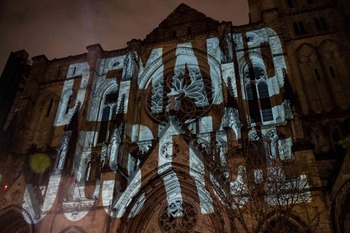
Projection-intervention by the art-activist collective The Illuminator. Imagine Repair public event at the Cathedral of St. John the Divine, 23 April 2022. (Photo by Desiree Rios; courtesy of Marianne Hirsch)

The election of Jair Bolsonaro as president in 2018 in the aftermath of the 2016 right-wing coup that impeached Lula’s successor, Dilma Rousseff, consolidated the reemergence of the Far Right in Brazil approximately three decades after the end of the military regime of 1964–1985. Daily life changed for Brazilians. The combination of Bolsonarismo with the environmental crisis, as evidenced by the collapse of the Brumadinho dam in 2019 (in which the worst affected were black and poor inhabitants of the area) and, a year later, the Covid-19 pandemic (which disproportionately affected Brazil’s most vulnerable populations) has made Boal’s “another world” seem impossible and an increasingly unjust world inevitable. Understandably, the response of many to this combination has been fatalism. Boal’s contemporary and comrade Paulo Freire wrote about a type of fatalism born of “hopelessness and despair […] in which it is impossible for us to gather the strength that is indispensable to our struggles to recreate the world” (1992:10). Freire believed that succumbing to this “pessimistic” and “paralyzing” fatalism had serious repercussions for the Left (10) because it meant “ceas[ing] to be utopian” and inadvertently “identif[ying] with the Right” by echoing a different type of fatalism ([1970] 1972:71), namely the “neoliberal fatalism” of those who claimed that “change is always difficult, almost impossible, if the change in question is in favor of the poor” (2000:125). As Freire noted, this fatalism was so pervasive in Latin America in the 1990s at the height of neoliberalism that it could be heard in everyday expressions such as, “It’s sad, but, what can we do? This is what reality is” (78), and “reality is the way it is, there is no use in fighting” (60).
Kathi Weeks refers to this fatalism as the neoliberal version of “an anti-utopianism of the Right” Footnote 3 that “alternates between [two] basic options, an anti-utopianism fueled by a sense of liberalism under threat and one born of a sense of its dominance [,…] between the claim that there should be no alternative and the assurance that there is no alternative” (2011:181). I believe that what we have recently been facing (especially in Brazil) is the resurgence of a “neoconservative,” neofascist “anti-utopianism of crisis […] fueled by a sense of liberalism under threat” (181), Footnote 4 as indicated by the rise of the Far Right and its accompanying anticommunism, encapsulated, for instance, in the Bolsonarista slogan “A nossa bandeira jamais será vermelha” (Our flag will never be red)—which is not an “assurance that there is no alternative” but a “claim that there should be no alternative” (Weeks Reference Weeks2011:181), otherwise there would be no need for fascism’s “ultimate protection of propertied society against radical change,” to borrow Raymond Williams’s formulation (1966:231). Footnote 5 At the same time, there is a pessimistic, paralyzing fatalism resulting from the injustices and catastrophes that keep piling up around us, a “fatalism in which there is no room for utopia” (Freire Reference Freire1992:168). This fatalism pervades many who think that there should be an alternative to this capitalist world, but who risk identifying with the Right by echoing “the conclusion that there is no alternative” (Weeks Reference Weeks2011:181), so “there is no use in fighting” (Freire Reference Freire2000:60). Although this fatalism is understandable in our moment, its conclusion tends to lead only to resignation.Footnote 6
Robert McInnis in Transformation of Objects. Rehearsals for Change workshop at the Cathedral of St. John the Divine, 16 October 2021. (Photo by Desiree Rios; courtesy of Marianne Hirsch)

The recent victory of Lula in the 2022 elections rekindles the utopian belief that a just world is possible, especially in the context of what some understand to be a left-wing turn in Latin America. At the same time, the 58 million votes received by Bolsonaro (after the four catastrophic years of his administration) and the election of many candidates aligned with Bolsonarismo to congress and to the government of key states such as Minas Gerais and São Paulo suggest that the Far Right that rose in Brazil around 2014–15 has gained rather than lost ground. In his first speech after losing the election, Bolsonaro affirmed that “the Right has really emerged in our country. Our robust representation in congress shows the strength of our values: God, nation, family, and freedom. We have created many leaders across the country. Our dream is more alive than ever” (2022). Bolsonaro’s speech exemplifies the antiutopianism of a Right whose “dream” is that there should never be an alternative to capitalism. It may be true that Bolsonaro overstates the strength of the Far Right in Brazil, as some commentators have suggested, and that the majority of his 58 million voters are not supporters of fascism. Still, in a country ravaged by a decades-long fascist regime that ended less than 40 years ago, 58 million people were willing to vote for a fascist (as many had already done in 2018) to keep Lula and the Workers’ Party from being reelected, a horrific fact that cannot be overstated.
How can we not succumb to pessimistic fatalism when, faced with the consolidation of the Far Right and the resultant exacerbation of the injustices of this capitalist world, we feel that there is no use in fighting because another world seems impossible? Footnote 7 I want to suggest here that certain techniques from Boal’s Theatre of the Oppressed (TO)—two in particular: the game Transformation of Objects Footnote 8 and the technique from Image Theatre named Image of Transition—offer us a way to exercise a type of utopianism that provides an alternative to the pessimistic fatalism that threatens to take over many of us at a time not unlike the period of the rise of fascism in Latin America in the 1970s, when Boal and Freire, like many others, at some point must have felt that another world was impossible.
“Utopianism is the general label for a number of different ways of dreaming or thinking about, describing or attempting to create a better society” (Sargent Reference Sargent1998). The first thing to say about utopianism, then, is that there is a difference between utopia as a “fictional place, usually a society, that is better than the society in which the author lives and which functions as a criticism of the author’s society,” and utopianism as a “wa[y] of dreaming or thinking about […] a better society” (Sargent Reference Sargent1998). From the period when the Far Right took power in Brazil in the 1960s to his death in the 1990s, Freire dedicated a considerable portion of his work to the elaboration of a type of utopianism, or what he called “prophetic thought, which is also utopian” (2000:118). Like everything else in his work, it is difficult to pin down this prophetic, utopian thought. Nevertheless, throughout his writings, it appears as a way of thinking about a better world—one radically different from the “perverse […] capitalist world” (1992:180)—that negotiates the relationship between present and future in the form of “the denunciation of how we are living and the annunciation of how we could live” (Freire Reference Freire2000:118–19). Freire’s prophetic, utopian thought, then, does not “announce what will necessarily happen, but what may or may not happen. Its announcement is not fatalistic or deterministic,” because it views the future not as “inexorable,” but “problematic” (119), that is, as open to different possibilities. “There are different possible futures,” none of which is inevitable (119). Although this is “a hopeful mode of thought” (119), it “is not necessarily a source of optimism,” to borrow from Michael Löwy’s analysis of Walter Benjamin (2005:110): “as the history of the twentieth century abundantly illustrates,” as does the history of the 21st century and our moment, seeing the future as “problematic” means seeing it as possibly even more unjust and cruel than the present; it means “taking into account the possibility—though not the inevitability—of catastrophes on the one hand and great emancipatory movements on the other” (110).
When I say that certain techniques from TO offer us a way to exercise utopianism, I mean the kind of utopianism elaborated by Freire. Freire’s utopianism has roots in at least two traditions. The first is the tradition of prophetic eschatology, which, according to Martin Buber, is distinguished from apocalyptic eschatology by their respective views of the future as “established from the beginning” and “immutably fixed” (1957:201; 1949:10) in the apocalyptic view, and as “not fixed” (1957:198) in the prophetic one. For Buber, this difference derives from the role each of these forms of eschatology ascribes to us in “the redemptive process” (1949:10): while prophetic eschatology sees us as “participants” whose “decisions and deeds” have a decisive effect “in the preparing of Redemption” (10), apocalyptic eschatology sees us as mere “tools” whose “decisions are only sham struggles” (1949:10; 1957:201). The second tradition is a strain of Marxism that has privileged what José Carlos Mariátegui (one of its earliest proponents in Latin America) referred to as its “voluntarist character” (1996:155), that is, its focus on the “creative power” of revolutionary subjects (158) rather than “of the immanent laws of capitalist production itself” (Marx [Reference Marx and Fowkes1867] 1990:929) as the decisive factor in bringing about social change. This strain of Marxism is thus fundamentally opposed to a “fatalistic Marxism” (Geoghegan Reference Geoghegan1987:59), according to which the demise of capitalism would be an inevitable outcome, which, for Freire, amounted to a “liberatory fatalism” of the Left (1992:51). In Buber’s account, the apocalyptic kind of eschatology found its secularized expression in Marxism, which, as he noted, “is not to say that no prophetic element is operative here—it has only been overpowered by the apocalyptic” (1949:10). For Buber, “Marx’s view of the future,” which “has erroneously been ascribed a prophetic origin,” was “an optimistic modern apocalyptic” (1957:203), even if he conceded that Marx’s writings sometimes displayed “flashing sparks of the prophetic fire” (204). Whereas Buber’s account draws a line between the prophetic and Marxist traditions, Freire’s writings bring them together as compatible and capable of producing a mode of utopianism alight with “flashing sparks” of both prophetic eschatology and voluntaristic Marxism that powerfully sets itself “against any kind of fatalism” of both the Right and the Left (Freire Reference Freire2000:119).
Freire argued that this mode of utopianism had to “express itself […] in the praxis” of leftist groups so as to sharpen their antagonism to the Right, since, he believed, one fundamental “difference between the two groups stems from the utopian nature of the revolutionary groups, and the impossibility of the Right to be utopian” ([1970] 1972:71). Footnote 9 As evidenced by Boal’s TO, Freire’s claim can be extended to artistic praxis. Freire’s utopianism “expresses itself” in TO, and, what is more, the game Transformation of Objects and the technique Image of Transition can be understood as parts of a theatrical practice through which we exercise a type of utopianism that stands in opposition to the anti-utopianism of the Right in its neoliberal and neofascist iterations, and we do so with our bodies “stepping into the scene” (Boal Reference Boal2009a). One powerful contribution of TO is a practice through which we repair our utopian conviction that there is use in fighting because the world should and can be different at the very moment the Right tries to convince us of the opposite. Boal was vocal about his admiration for Freire, Footnote 10 and many critics have recognized the parallels between their work (see Boal [Reference Boal1996] 2020:10), Footnote 11 including, at least in one case, with some reference to “utopia” (see Vittoria Reference Vittoria, Howe, Boal and Soeiro2019). Nevertheless, the affinity between TO and the utopianism elaborated by Freire has not received much attention. Footnote 12 It is an affinity that can be tracked back from Boal’s last public speech in 2009 to the birth of TO in the 1970s.
This utopianism has proved relevant beyond Brazil. In 2021–2022, I was a graduate fellow for the New York City–based Zip Code Memory Project: Practices of Justice and Repair (ZCMP), a public humanities project in which a group of participants from different neighborhoods and of different ages, races, ethnicities, and socioeconomic backgrounds sought to find community-based ways to memorialize the losses resulting from the pandemic. Throughout the project, one of the losses many of us referred to was the loss of a sense of an open future, and, as a result, of hope in the possibility of creating a more livable and just world. In workshops that used Boal’s TO—specifically Transformation of Objects and Image Theatre—we exercised a Freirean utopianism that helped repair this loss. The project provides a basis for my argument that the exercise of utopianism through TO repairs our sense of the future as open to alternatives, thus potentially sustaining hope and activist engagement in times of fatalism.
“Latin America is a red continent: rivers of blood”
In 1971, Boal was arrested, tortured, and forced into exile. Footnote 13 He spent the next five years in Argentina until the Far Right seized power in 1976, as it had done in Brazil in 1964, and he left for a “second exile,” this time in Europe (Boal Reference Boal1979:17). Fascism was spreading, and it seemed to follow Boal. In 1972, he went to Chile for the celebration of the 50th anniversary of the Communist Party (PCCh). In 1973, he went to Peru to work in the Programa de Alfabetización Integral (ALFIN) of the then left-wing government. By 1975, both Chile and Peru had suffered right-wing coups and were part of the US-backed Operation Condor designed to keep Latin American countries from becoming “new Cubas” and pave the way for the neoliberal policies that would ravage the continent for decades—in other words, to ensure that there would be no alternative to capitalism.
As Boal wrote in the 1970s, “aí nasceu o Teatro do Oprimido!” (this is where Theatre of the Oppressed was born!) (1979:17). Footnote 14 All forms of theatre that make up TO, he explained,
were invented as an aesthetic and political response to the terrible repression that now exists in that bloodied continent, where dozens of men and women are daily murdered by the military dictatorships that oppress so many peoples, where people are shot down on the streets and driven away from public squares, where popular proletarian and peasant, student, and artistic organizations are systematically dismantled and destroyed, where their leaders are arrested, tortured, murdered or exiled. (17)
To illustrate the “terrible repression” underway in the “bloodied continent” of Latin America at the time, Boal listed a series of atrocities. One of these atrocities stands out: “a musician had his arms cut off in the Estadio Nacional of Chile” (17). The unnamed musician was Victor Jara, a member of the PCCh who had been involved in the campaign that led to the election of Salvador Allende in 1970 and who was murdered by Augusto Pinochet’s regime on 16 September 1973. Footnote 15 The murder of Jara, like that of so many other fellow leftist artists, must have deeply affected Boal. Footnote 16 Jara was the artistic director of the celebration of the 50th anniversary of the PCCh in which Boal participated in 1972. Boal wrote a piece about this event titled “Teatro de massas. Militantes atores ou atores militantes?” (Theatre of Masses. Actors Militants or Militants actors?; 1972) in which he referred to Allende as “comrade President of the Republic” and stated that “for a communist, it will be hard to forget the closing act of the 50th anniversary of the Party, which took place in the afternoon of 8 January 1972 at the Estadio Nacional” (1979:108)—the exact same place where, a year later, “thousands were arrested, hundreds were killed,” Jara among them, and where “the Chilean democracy [was] buried” ([2000] 2014:346).
TO was “born” in a moment that was hardly conducive to utopianism—when, in fact, the possibility of a “red” Latin America following the revolution in Cuba in 1959 and the victory of Allende in Chile in 1970 was so violently repressed that Latin America (to use Boal’s haunting image) became a very different “Red” continent: “A América Latina é um continente vermelho: rios de sangue” (Latin America is a red continent: rivers of blood; 1979:18). Footnote 17 In other words, TO was born at a moment characterized by a right-wing anti-utopianism that was fueled not by a sense of liberalism’s dominance (as was its later neoliberal version) but by a sense of liberalism under threat—the threat of communism (Weeks Reference Weeks2011:181). The claim made by this anti-utopianism in slogans such as “O Brasil não será uma nova Cuba” (Brazil will not be a new Cuba)—which was displayed in the Marcha da Família com Deus pela Liberdade in 1964, Footnote 18 and which, like many others, has reappeared in right-wing demonstrations in Brazil—was not that “there is no alternative” to capitalism (the slogan itself implied that Cuba was an alternative) but that “there should be no alternative” (Weeks Reference Weeks2011:181). In precisely this context of anti-utopianism, Boal affirmed that it was possible and necessary to change the world (1979:20), and “make this earth finally livable” ([1974] 1975:109). Not unlike now, with white supremacy on the rise, the growing environmental crisis, the persistence of Covid, and the ongoing threat of nuclear war, a livable earth must have seemed an unrealizable dream in a context of widespread torture and murder perpetrated by fascist regimes. Still, at a period when many understandably felt fully “surrounded by present time, without seeing anything beyond” ([2000] 2014:341), the utopian prospect of a livable earth may have spurred Boal to keep going during an unlivable moment in Latin American history.
As he stated multiple times, for Boal “The role of utopias is not to be reached: it is to stimulate us to try harder and go further” ([1992] 2002:10); they do “not exist for us to reach, but as inspiration, for us to pursue” (2006:81); “It does not matter that we never reach utopia because there is always another one further away: let’s walk toward it—that’s life, and it is better than standing still, passively watching the carriage go by, because doing so makes our legs go rusty!” (2009b:34). Like a lot of Boal’s writings, these excerpts stylistically resemble manifestos, which Weeks characterizes as a “utopian form of writing” whose primary role, like the role of utopias, is “to provoke desire for, imagination of, and movement toward a different future” (2011:213), as exemplified by Boal’s use of “the manifesto’s characteristic pronoun ‘we’” (Lyon Reference Lyon1991:104), especially in declarative sentences that almost sound like ultimatums (Weeks Reference Weeks2011:215)—“We have the obligation to invent another world,” as he put it in his speech (2009a). Like TO itself, Boal’s manifesto-like excerpts “concentrat[e] on the agents who could bring an alternative into being” (Weeks Reference Weeks2011:215)—“the changers of society,” as he put it, borrowing from Bertolt Brecht (Boal [Reference Boal1977] 1982:22). Footnote 19
Moreover, Boal and Freire use the term “utopia” interchangeably with “dream”: “we have to dream […and] fight for the dream to get there or at least as close as possible” (2008:61). Whether or not we can get there or at least get close is uncertain. Implied in these excerpts, then, is the recognition that “there is movement between the impossible and the possible,” as John Storey puts it, and that what produces this movement and “ultimately define[s]” these categories (2019:7) and the “boundary” between them is our struggle for change (6). Here we see a parallel between Boal’s and Freire’s writings on utopias and dreams. For both, engaging in utopianism is a “necessary political act” (Freire Reference Freire1992:91), because it stimulates us to fight for a different world and, in the process, potentially change some of the unjust conditions in which we live. Footnote 20
Boal’s writings reveal some of the ways in which utopianism negotiates the relationship between present and future. One way is in the form of a negotiation between utopia as “end or goal” and “process and project” (Weeks Reference Weeks2011:224–25). Boal’s use of terms like “reach,” “go further,” “pursue,” and “walk toward” suggests an understanding of utopia as a goal, yet his emphasis is less on the achievement of utopian goals and more on the process of pursuing those goals to create social change. A second is in the form of a negotiation between two functions of utopianism, one of “negation” and the other of “affirmation” (Weeks Reference Weeks2011:204): the “estrangement function” seeks to “undercut the present social order’s ascribed status as a natural artifact, necessary development, and inevitable future” (205); the “provocation function” seeks “to provoke the desire for, imagination of, and movement toward a different future” (213). Boal’s writings indicate an emphasis on the provocation function of utopianism. However, the Transformation of Objects game is an example of how TO also performs the estrangement function, in this case by undercutting the familiar status of everyday objects.
“The world is not. The world is being”
According to Boal, Transformation of Objects “is based on the statement by Bertolt Brecht that there are many objects in a single object, if the final goal is revolution; but there will be no objects in any object if this is not the final goal” ([1977] 1982:89). Footnote 21 The game is simple. Participants sit or stand in a circle (depending on the space, whether chairs are available, etc.). The facilitator presents an everyday object to the group such as a plastic water bottle and places it on the ground in the center of the circle. Then, the facilitator says, “this bottle is not a bottle, so what will it be?” (Boal Reference Boal1998:216). Taking turns, participants go to the center of the circle and, using only their bodies and without speaking or making any sounds, assume a posture or perform an action through which the bottle is transformed into something else. Once many possibilities of transformation have been explored, the bottle is replaced by another object (for example, a chair), and the game restarts. As the game progresses, the facilitator increases the challenge by placing more than one object in the center of the circle (a bottle and a chair) and asking participants to transform both objects at the same time.
What do we need in order to transform the object? As indicated by Boal’s inclusion of this game in the category Exercises of Imagination ([1977] 1982:40), we need to use our imagination: “the objects are no longer only what they have always been, but become what our memory and imagination allow us to create—they are what we want them to be and not what they objectively are” (Boal [Reference Boal1996] 2020:107). But imagining a new object is not enough to transform the one in front of us. We have to step into the center of the circle and use the object in relation to our body to build a static or dynamic image of the new object for the other participants (1998:216). In other words, we have to “build it with our hands—stepping into the scene” (2009a). Footnote 22 For Boal and Freire, when we combine our imagination and intervention, we practice utopianism. The capacity to look at a chair and imagine another object, or a whole other entity like a person, is the capacity to look at the world we live in and imagine the world we would like to live in. Our imagination enables us to look at a chair and picture it as something else, but only our intervention can enact the change, in the same way that only our fight for the dream of a just world can make it come true. The ambition of TO is to promote social change “indirectly” by changing those “who will act in real life”—“the changers of society” (Boal [Reference Boal1977] 1982:22). One way in which Transformation of Objects can change us, or at the very least affect us, is by stimulating these two capacities, imagination and intervention, so we can use them in our life.
Why is this game important? As participants point out, we are so familiar with a plastic water bottle that, when the facilitator first shows it to us, it is hard to regard it as an object that “has many objects in it”—a bottle is a bottle, period. The problem with this way of regarding things is that it echoes the neoliberal fatalism according to which change is difficult “because reality is the way it is” (Freire Reference Freire2000:125). If “reality is the way it is,” what can we do about the unjust conditions in which we live? We at best deplore but still accept them as things we cannot change, rather than rebel against them as things we cannot accept and need to fight to change—to paraphrase Angela Davis’s oft-quoted formulation. Against the neoliberal maxim that the world “is the way it is,” Freire set the utopian one that “The world is not. The world is being” (2000:79). Boal echoed this maxim, stating that “In Theatre of the Oppressed, we must show that things are not, but are being. Nothing is, everything is being” ([1974] 2013:213–14). In other words, in TO we must perform the estrangement function of utopianism, showing that things such as a plastic water bottle “are not, but are being.” Transformation of Objects is a perfect example of this. It starts with the facilitator’s estrangement gesture of presenting the bottle as not a bottle, thus releasing it from the “stamp of familiarity” and “turning it into something that [can] be altered” (Brecht [Reference Brecht and Willett1964] 1996:192)—“this bottle is not a bottle”; it is being a bottle, which means it can be something else, “so what will it be?” (Boal Reference Boal1998:216). This question, open-ended and in the future tense, poses a problem for us to tackle with our imagination and intervention. As we use these capacities to change the bottle into an infinity of things, we regard it not as something that is, but as something that is being, and thus can be different. If we can change an object, why do we feel we cannot change the unjust conditions in which we live, but have to resign ourselves as if they could never be otherwise?
Seeing Transformation of Objects as a game that makes the “changeability of things” its lesson sheds light on the statement that Boal attributes to Brecht (Benjamin [Reference Benjamin and Bostock1966] 1998:74), in which the relation between social change (and, even more so, the utopian “final goal” of revolution) and whether “there are many objects in a single object” may seem arbitrary. If we regard an object as unchangeable, how can we regard social conditions and society as a whole as changeable, and how can we believe that a just world is possible? If our goal is the transformation of this capitalist world into a truly livable one, we have to regard it as changeable, and we have to learn and relearn to do so throughout our life. In 2014, Julian Boal suggested that “perhaps what Theatre of the Oppressed has to offer right now is […] a practice with which we see the world as transformable” (in Reis Reference Reis2014). This is crucial in times of fatalism, when we feel that things will never change. “Those still alive,” Brecht urges us in his 1933 poem “In Praise of Dialectics,” “can’t say ‘never’” (1997:151), as do the Bolsonaristas who claim that “our flag will never be red.” Transformation of Objects is a simple game, but we need practices that help us “see the world as transformable” instead of succumbing to the feeling that the world “is the way it is” and there is no use in fighting.
In one of the workshops of the Zip Code Memory Project (ZCMP), Diana Taylor made the following comment after we played Transformation of Objects:
How do we imagine a way forward and then get there? We are transforming an object, but how do we articulate what is happening now in our lives and what we consider the real stumbling blocks or obstacles? This exercise seems the most lucid and simplest way of inviting us to envision, imagine, and articulate. (in ZCMP Reference Canal2022)
Moreover, this game is an invitation for us to exercise utopianism. But Transformation of Objects is only the start of this invitation. The question of how to articulate “what is happening now in our lives” and how to imagine a “there” that is different from “here” and “ways forward” requires that we turn to the form of TO known as Image Theatre.
“The image of something that really happened”
In 1973, Boal went to Peru to participate in the ALFIN literacy program of the then left-wing government. For Boal it was “an experience of popular theatre” that became the most important chapter of Theatre of the Oppressed. In Peru, Boal encountered a challenge, namely “the vast number of languages and dialects spoken by its inhabitants” ([1974] 1975:124). In the face of this challenge, he strengthened his notion of theatre as an artistic language made of “words, colors, forms, movements, sounds, etc.” (171) that could be learned and used by anyone (126), and developed one of the most important forms of TO, Image Theatre. Footnote 23 Through Image Theatre, participants can express their collective opinion about a theme not by speaking, but by using the bodies of other participants to create a set of three images: the real image, the ideal image, and the image of transition.
In this technique, called Image of Transition, Footnote 24 a participant volunteers to be the sculptor, and uses the bodies of other participants to create a “base image” of the given theme (1979:138). Footnote 25 If the group disagrees with the image, another participant creates a different one, and so on (one person at a time) until someone creates an image of the theme with which the whole group agrees. If the group partially agrees with an image, they may alter this “base image” until they fully agree with it. The image with which the group fully agrees is the real image, which, according to Boal, “is always the representation of an oppression” (138), or, put differently, of “a reality we want to transform” because it is unjust, intolerable, unacceptable ([1974] 1975:144). Then, participants create the ideal image, “in which the oppression has disappeared, and that represents the society we desire to build, the dream: an image in which the current problems have been overcome. They are always images of peace, tranquility, love, etc.: ideal image” (1998:6). Ideal images are utopian images, or, to borrow from Buber, “utopian picture[s…of] ‘what should be’” (1949:7). But, whereas Buber’s “utopian pictures” are “pictures […] of something not actually present but only represented” (7), ideal images complicate this distinction because they give “physical representation” or “sculptural concretion” to something that does not exist (“the society we desire to build”) and yet becomes present to the senses (and open to the intervention) of participants (Boal [Reference Boal1974] 1975:144). Rather than detailed blueprints of a desired society, ideal images are images that “desire a future. Desire, imagine. Image[s] of the desire” (Boal [Reference Boal1996] 2020:33). Footnote 26 Lastly, participants create an image of transition that shows how to go from the real to the ideal image—“we have a reality we want to transform; how do we transform it?” (Boal [Reference Boal1974] 1975:144). One at a time, participants may change whatever they deem necessary in the real image “to visually show how it will be possible, starting from this concrete reality, to create the reality we desire” (1998:6). The participants who are not acting as sculptors “must say whether they think each of the solutions is realizable or magical (that is, fantastical, impossible to realize!), but without speaking, since the discussion must be carried out only through images” (244). Going back to Taylor’s comment, we can think of the real image as the image of a “stumbling block or obstacle” we are currently facing and need to overcome; the ideal image as the image of a different, more just “there” we want to get to; and the image of transition as the image of “a way forward” (in ZCMP Reference Canal2022). Footnote 27
As a “concrete example” of the use of this technique in his work in Peru, Boal shared the story of “a young literacy instructor who lived in a small pueblo, called Otusco,” and who was invited to show the other participants what her village was like:
In Otusco, before the current revolutionary government, there was a peasant revolt; the latifundistas (who no longer exist in Peru) arrested the rebel leader, took him to the central square of the village and, in front of everyone, castrated him. The young woman from Otusco created the image of the castration […] A terrible, tragic, pessimistic, defeatist image, but, at the same time, the image of something that really happened. When she was asked to show how she would like her village to be, the young woman created an image of people who loved each other, who worked, in short, a happy and contented Otusco. First the real image, then the ideal image. ([1974] 1975:144–45)
This image of torture must have deeply resonated with Boal, given his own experience with torture just a few years earlier. Many images of being in prison, Boal wrote, “are archived in my memory” ([2000] 2014:314) and stamped “in the retina, never to be erased!” (321), such as the image of “Albertina, my first wife, imprisoned, relearning to walk” after being tortured (317). Along with the image of Jara, the musician who was tortured to death in the Estadio Nacional of Chile, the real image created by the woman from Otusco later became part of Boal’s list of atrocities that exemplified the “terrible repression” (1979:17) that was his impetus for creating TO. In writing about the woman from Otusco, Boal seems to have viewed the “terrible, tragic, pessimistic, defeatist image” of Otusco as representative of the “abominable procedure” of torture practiced by the fascists across the continent (Boal [Reference Boal2000] 2014:320). Similarly, the image of “a happy and contented Otusco” can be seen as the ideal image of “a happy and contented” Latin America, which, at the time, must have seemed a “magical,” unreachable dream. Boal shared five images of transition created by participants. In one of them, a woman showed the five men who in the real image were kneeling down with their hands tied behind their backs as if they had freed themselves, then attacked and captured their perpetrators ([1974] 1975:146). In addition to making these figures the agents of the transformations that happened in the image of transition, the young woman made one of them “go to all the other participants, clearly indicating that, in her opinion” (as in Boal’s) “social transformations are carried out by the people as a whole, and not just by a vanguard” (146). Footnote 28
What is striking about the real image of Otusco is that it is an image of the past. Although Boal insisted that “Theatre of the Oppressed does not present images of the past, but prepares models of action for the future” (1979:20), Footnote 29 the young literacy instructor created the image of something “archived in [her] memory” that had happened in the past ([2000] 2014:314), and could not be altered. In this case, the creation of images of transition became an exercise in “reinvent[ing] the past” (Boal [Reference Boal1996] 2020:34), in imagining how something that actually took place could have happened differently. This technique thus helps us articulate a past instance of injustice not “as a fatality, as Destiny” ([1974] 1975:142), but, as Williams puts it in relation both to theatrical and social tragedies, as a “tragedy that could have been avoided but was not avoided” (1966:203). Footnote 30 As Williams noted, “We have to see not only that suffering is avoidable, but that it is not avoided” (202–03), which we saw worldwide during the pandemic. The Image of Transition technique gives us a way to do this, and to counter “tragic acceptance” or “resignation” with indignation (199). The real image of Otusco is “terrible, tragic,” but “No one should cry over the fatality” that befell the rebel leader; “they should cry of anger” against the latifundium system and those who defend it (Boal [Reference Boal1974] 1975:110), as against the fascist regime that murdered Jara. Finally, this technique gives us a chance to “fuse memory and imagination—which are two indissociable psychic processes—to, in the present, reinvent the past and invent the future” (Boal [Reference Boal1996] 2020:44) at a moment when the present seems to inevitably lead to a future of even greater injustice. “This is where the immense and powerful force of theatre resides” (Boal [Reference Boal1996] 2020:44).
“Separated and alone in our own despair”: Illustrating “Covid” Using Other People’s Bodies. From left, clockwise: Linda Aristondo, Erachie Brown, Alo Gorozpe, Guilherme Meyer, Nancy Ko, Mariana Tchen, Maday Sarmiento, and Alcira Forero-Pena. Rehearsals for Change workshop at the Cathedral of St. John the Divine, 30 October 2021. (Photo by Desiree Rios; courtesy of Marianne Hirsch)

“We are not alone. We are here together”
A very different example of the use of Image Theatre comes from the ZCMP. In performance artist and activist George Emilio Sanchez’s Rehearsals for Change workshop in October 2021, participants created images of “Covid” using Boal’s technique of “Illustrating a Theme Using Other People’s Bodies” (1998:239), Footnote 31 which precedes and provides the basis for Image of Transition (244). As in Image of Transition, a participant volunteers to be the sculptor, and uses the bodies of other participants to create the image of “a theme proposed by the group” (239). If needed, participants take turns acting as the sculptor, and the other participants may alter the image until the group arrives at a “collective image of the theme” (239). Unlike Image of Transition, this “collective image of the theme” does not have to be “the representation of an oppression” ([1974] 1975:138).
In one of the images for the “Covid” theme, created by Leah Elimeliah, eight people sit on the ground in a circle. They all face the outside of the circle, with their backs turned to the center, and hold their heads down with both hands. “They are all together,” yet “separated” and “alone,” as Alena Lipatnikova and Ethel Croskey described (in ZCMP Reference Canal2021b). I was one of the participants in the circle, and I could not see anyone around me. No one could. We were in the same circle, but without any contact, each of us “separated and alone in our own despair,” as Elimeliah put it (in ZCMP Reference Canal2021b). This image is a great example of what Boal calls “signaletic gestures” (2009b:40), in which signifier (holding one’s head down with both hands) and signification (despair) are indissociable (1998:233). The image recalls sculptures of “despair” such as those by Auguste Rodin and Hugo Robus. The key difference is that in the living sculpture of “Covid” created by participants of the ZCMP there are multiple figures “separated and alone in [their] own despair” (in ZCMP Reference Canal2021b).
“A warm cocoon of safety and resilience”: Illustrating “Covid” Using Other People’s Bodies. Julie Apostolou (lying) and Pablo Kemezis (sitting). Rehearsals for Change workshop at the Cathedral of St. John the Divine, 24 October 2021. (Photo by Desiree Rios; courtesy of Marianne Hirsch)

This image of “Covid” was not meant to be a real image, yet it is a “terrible, tragic, pessimistic, defeatist image” of “a reality we want to transform” (Boal [Reference Boal1974] 1975:144–45). The despair to which it gives form has been exacerbated by the intense social isolation to which many of us were subjected throughout the pandemic, and which was not only not avoidable but necessary to contain the spread of the virus and avoid an even greater amount of death and suffering. At the same time, this despair was a result of the avoidable and not avoided catastrophe that engulfed cities like New York, which became a “dystopia of wailing ambulance sirens” and “refrigerator trucks loaded with bodies” (Fisher, Wilson, and Hernández Reference Fisher, Wilson and Hernández2020). Whenever we heard sirens during the first workshops of the ZCMP, when it seemed that we were past the worst, everyone became slightly uneasy. The sadness and fear we all felt had stayed with us and the deep sense of despair articulated in this image from the workshop cannot be separated from the avoidable and not avoided dystopia of the pandemic.
This living sculpture of “Covid” can also be understood as the real image of a despair that preceded the pandemic and is directly related to the rise of the Far Right in places like the US and Brazil and the Far Right’s neglect of the environmental crisis and promotion of white supremacy. When we look at this image and the bodies’ gestures of despair, we remember that (in the US, for instance) this has been a dystopian period not only because of the pandemic, but because of the election of Donald Trump in 2016; the Unite the Right rally in Charlottesville in 2017; the synagogue shooting in Pittsburgh in 2018; the police killings of Breonna Taylor and George Floyd in 2020; the increase of racist violence (especially against Asians and Asian Americans) and gender violence during the pandemic; the increasingly severe California wildfires of the past few years—and this list of atrocities, like Boal’s list in the 1970s, goes on. This technique of Image Theatre gave us a tool to collectively articulate the despair of the pandemic, and, more broadly, the fatalism of this dystopian moment as a product of injustice.
Unfortunately, we did not have the time to proceed from Illustrating a Theme Using Other Peoples’ Bodies to Image of Transition in the ZCMP. But, if we take this as a real image of “Covid” and use “the speculative imagination” of utopianism (Weeks Reference Weeks2011:219), what could have been its ideal counterpart? Perhaps it could have been similar to another one of the images of “Covid” from the ZCMP, created and described by Nazia Malik as the image of “a warm cocoon of safety and resilience” (2022). As Carl Medina put it, it shows “one person comforting another person who is lying on top of them,” the “idea of comforting” (signification) given by “the gentle holding of the other person” (signifier) (in ZCMP Reference Canal2021a). Julie Apostolou, who was held in this position by Pablo Kemezis, expressed feeling comforted and protected (in ZCMP Reference Canal2021a)—a reminder that such acts are real even if they take place within a theatrical technique. Footnote 32 When I shared a photo of the image with Malik months after the workshop, the first thing she wrote back was, “Thanks for sharing this image with me. I feel so comforted by it” (2022). Perhaps the ideal image of “Covid” could have looked like one of the circles formed in our workshops, in which we stood close together facing the center (and thus each other), with arms around or locked with those of the people next to us. In stark contrast to the circle of people “separated and alone in [their] own despair,” in these circles we connected through touch and formed a “warm cocoon of safety and resilience” of not two but several people holding one another, an image in which the circle of despair has been transformed into a circle of “radical bonding” (in Contreras Reference Contreras2022).Footnote 33
Person to Person. From left: Guilherme Meyer and Yves Dossous. Rehearsals for Change workshop at the Cathedral of St. John the Divine, 30 October 2021. (Photo by Desiree Rios; courtesy of Marianne Hirsch)

What could have been the image of transition, which shows how it would be possible to transform the “current reality” into the “reality we desire” (Boal Reference Boal1998:6)? Perhaps an image in which each of the eight people in the real image places a hand on the arm of someone next to them, as Nkem Stanley-Mbamelu did with Andres Fluffy Aguilar in one of our workshops before hugging him—an act of “attuned touch” (Kolk Reference Kolk2014:253) that could begin to transform the circle of despair. In the game Person to Person, pairs of participants join specific body parts until they are tangled together, while in the Circle of Knots, groups of participants entangle their hands and then (without letting go of each other’s hands) try to undo the knot. These and other games from TO provide glimpses of an image of transition that could change the circle of despair, just as they gave us playful ways to begin to repair the isolation to which many of us had been subjected and to establish the trust and connection necessary to form the circles of radical bonding. How do we imagine a way forward from the despair that many of us have been experiencing and try to get to a “there” that is different from this dystopian “here,” in the face of which we risk succumbing to the conclusion that there is no use in fighting when we so urgently need to do so? The images of “Covid” and other moments in our workshops suggest that we can begin with what María José Contreras said in one of the circles—“Feel the body of who is beside us. We are not alone. We are here together” (2021).
“We have to dream with our eyes open”
Boal’s 1992 campaign for vereador of Rio de Janeiro was at a time when Brazil, and Latin America more broadly, was being submerged under what he referred to as the neoliberal “tsunami” of privatizations ([1996] 2020:74), which led to a loss of hope in the prospect of a better future for the country and continent. Against this fatalism, the pamphlet of Boal’s campaign, whose slogan was “The Courage to Be Happy,” asserted the utopian conviction that, “when we decide to take our destiny into our hands,” we can create a world with “pleasure, work and bread” for all (20). In utopian fashion, Boal affirmed that “refus[ing] what we hate” is crucial but it must be combined with dreaming with a desired outcome or else a different “future will not come and we will be stuck forever in this present of anguish, insecurity and fear” (20). TO, he went on, is powerful because it gives us a way “to dream with our eyes open” (20). This is especially true of Image Theatre, through which we create images of “the society we desire to build: the dream” (1998:6). Boal’s unapologetic defense of utopianism in the pamphlet distributed during his campaign for vereador is striking not only because it refused to be submerged under the “tsunami” of neoliberal fatalism of the time, but because it intersected with the development of Legislative Theatre, a then new form of TO created to have more direct and “practical effects” on social conditions ([1996] 2020:53) by “channel[ing] all the creative energy sparked” in participants by TO into efforts to change unjust laws and create more just ones (46). Whereas TO seeks to spark participants’ “desire for transformation,” Boal explained, “Legislative Theatre seeks to go beyond and transform this desire into legislation” (58–59).
The Circle of Knots. From left: Sandra Long, Thomonique Moore, Ana Ofelia Rodriguez, Pablo Kemezis, and Carl Medina. Rehearsals for Change workshop at the Cathedral of St. John the Divine, 24 October 2021. (Photo by Desiree Rios; courtesy of Marianne Hirsch)

When read in conjunction with his campaign pamphlet, Boal’s statement on the difference between TO and Legislative Theatre evokes Image Theatre. If the ideal images give form to our utopian desire to invent a different future, as I have argued, then perhaps there is a way to go beyond a technique like Image of Transition and utopian desire into what Weeks terms “utopian demands.” Utopian demands are characterized by a tension between its two constituent terms, because, while utopia “points toward the broader social horizon of a future that is always beyond our grasp,” demand “directs our attention to the present, to the specific desires that can be named and the definite interests that can be advanced” (Weeks Reference Weeks2011:219). This is something TO shares with utopian demands, because it too has to negotiate “the speculative ideals of utopia” that infuse Image Theatre and “the pragmatism of demands” that is at the heart of Legislative Theatre (219). According to Weeks, a utopian demand should “direct our attention to the present” (219), but also:
point toward the possibility of a break, however partial, with the present. It must be capable of cognitively reorienting us far enough out of the present organization of social relations that some kind of critical distance is achieved and the political imagination of a different future is called to work […T]he demands that merit the label “utopian” […] are necessarily larger in scope than their formulation as policy proposals would initially indicate. None of its supporters presumed that wages for housework would signal the end of either capitalism or patriarchy. But they did hope the reform would bring about a gendered system characterized
by a substantially different division of labor and economy of power, one that might give women further resources for their struggles, make possible a different range of choices, and provide discursive tools for new ways of thinking and imagining. (220)
Another good example is the demand to defund the police, which spread in the global uprisings of 2020. As Angela Davis argues, “the call to defund the police is […] an abolitionist demand,” and it
is not simply about withdrawing funding for law enforcement and doing nothing else […but] about shifting public funds to new services and new institutions—mental health counselors, who can respond to people who are in crisis without arms. It’s about shifting funding to education, to housing, to recreation […] It’s about learning that safety, safeguarded by violence, is not really safety. (in Democracy Now Reference Now2020)
The demand to defund the police can therefore be understood as a utopian demand that focuses on redirecting public funds while gesturing to a broader abolitionist future built on a radically different understanding of safety.
The final public event of the ZCMP included the projection by the art-activist collective The Illuminator of a demand for justice on the façade of the Cathedral of St. John the Divine, which echoed the uprisings of 2020 (“What do we want? Justice. When do we want it? Now”). The idea was to hold a workshop prior to this event in which we were going to move from Illustrating a Theme Using Other People’s Bodies to Image of Transition to create the set of three images and use them (especially the ideal image of “what we want”) as a springboard to develop a demand (or series of demands) together. The workshop never came to fruition. I can’t help but wonder what we would have come up with had we held that workshop. Boal’s statement about the transformation of “desire into legislation” and his campaign pamphlet suggest that Image of Transition may offer us a tool to “dream with our eyes open” ([1996] 2020:33) and transform utopian desire into utopian demand. If this could be done, then Image Theatre would not only give us a practice through which to exercise utopianism, but also to channel utopianism into the formulation of specific demands for social justice that activists can organize around and fight for.


 Open access

