1. Introduction
This article is about performances of live electronic music which take place in unusual locations. I use un-usual to refer to buildings and spaces that have not been designated as concert venues, as well as outdoor urban and rural settings. These sites range from retired industrial structures, visually stimulating landscapes, architecture with unique acoustic properties (see, e.g., Figure 1), natural environments, or places of cultural or historical significance.
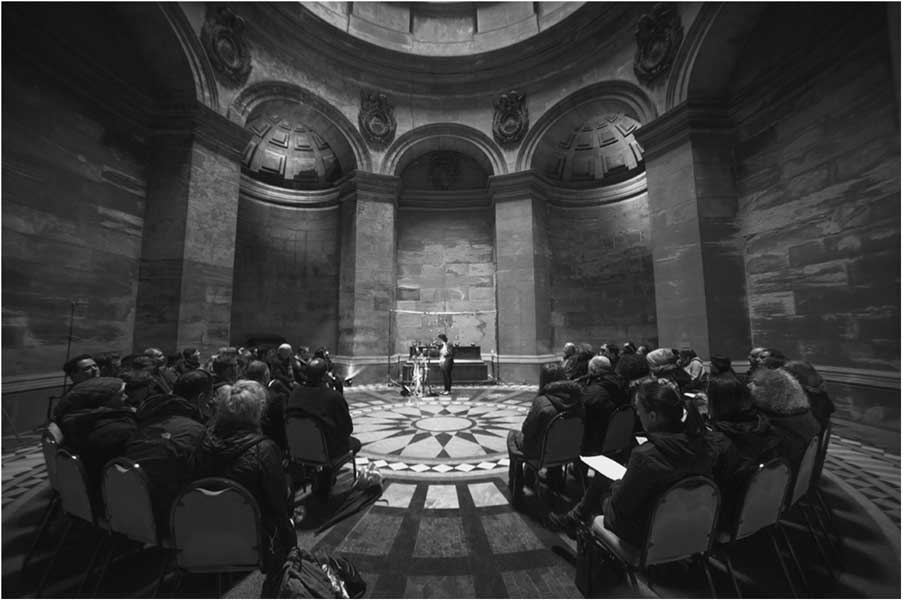
A site-responsive performance inside Hamilton Mausoleum, Scotland.

Common to the plurality of practices that will be addressed is the theme that sound is produced in response to certain perceived attributes of a particular site. These features may be acoustic, environmental, historic and, perhaps, even imagined. Furthermore, performances may be spontaneous or carefully planned in advance. Limited right of way or access may force the performance event to be somewhat guerrilla in execution. Another situation may require repeated visits to a particular site in order to allow for exploration, experimentation, the analysis of particular characteristics, or developing relationships with relevant social groups. This process can take many years, or may happen over a short period of time.
Of this type of contextual practice, Brandon LaBelle claims that the ‘methodologies produce artwork that, rather than separate itself from the space of its presentation, aims to incorporate it into the work, from material, such as architectural features, to informational, as in the governing curatorial premise behind an exhibition or larger social and cultural conventions’ (LaBelle Reference LaBelle2006: xi). LaBelle argues that it is no coincidence that the realm of sound art has continued to expand – since its beginnings in the 1960s – in congruence with the move away from material things to environments that has taken place within the arena of site-specific visual arts (LaBelle Reference LaBelle2006). Sound has the capacity to reflect its environment, and can simultaneously be both confined by it and able to escape from it.
Site-specific art has its origins within the minimalist sculpture of the late 1960s, where viewers were made to consider the relationship between objects and how they were positioned and perceived within a space. What is common to the types of contextually aware performances that will be discussed is that they afford the opportunity to explore the relationships between sound (and music), the environment in which it is heard (or made) and the people who hear (or make) it. However, as Christoph Cox suggests, visual and textual theory does not adequately describe the non-representational nature of sound (Cox Reference Cox2011). The term site-specific has become increasingly ambiguous and exploited, being ‘uncritically adopted as another genre category by mainstream art institutions and discourses’ (Kwon Reference Kwon2004: 1). If we follow Cox and consider sound to be non-representational, then these narratives – concerning objects in space – are perhaps unhelpful in describing what goes on during a musical performance.
Christopher Small describes music as activity, and suggests that musical meaning is formed within sets of relationships between agents and the environment (Small Reference Small1998). I compare this relational interpretation of musical practices with Nicolas Bourriaud’s understanding of socially engaged art as based around human interaction within a particular social context (Bourriaud Reference Bourriaud1998). Bourriaud posits the constructed or reflected participant experience as central to the work. I will demonstrate ways in which what I define as site-responsive live electronic music – particularly works which involve improvisation – can cultivate nuanced and diversified modes of participation for audiences.
2. Music in Spaces
Site-specificity in sound is an open and not yet fully explored field. (Rodrigues, Wanderley and Ferreira-Lopes Reference Rodrigues, Wanderley and Ferreira-Lopes2013: 393)
The term site-specific has been used to describe a variety of arts practices ranging from sculpture, installation, dance, theatre and, more recently, sound art. Describing something as site-specific implies that the work has been made to be experienced at a particular location. Recent usage suggests a tendency to refer to spaces which are explicitly not recognised as cultural institutions (Aitchison Reference Aitchison2005). In the case of sound art and music, this would be spaces which are not traditional concert halls or music venues.
Ironically, this connotation leads to the exclusion of several important site-specific musical works. One of the most ambitious of such endeavours within Western art music’s history is the Edgard Varèse–Iannis Xenakis–Le Corbusier collaboration which involved the composition of Poème électronique (Varèse 1958) for the Philips Pavilion in Brussels. Under the coordination of Xenakis, Varèse was instructed to compose a work which would fully engage with the uniqueness of the physical structure. The piece was meant to show off its acoustic capacities, enhanced through the use of effects such as echo and reverberation, and by sending audio through hundreds of carefully positioned loudspeakers. The Poème created the illusion of moving trajectories of different sound sources around the hyperbolic-parabolic curves of the structure (Ouzounian Reference Ouzounian2013). Despite criticisms that referred to the overpowering nature of the event, for Varèse ‘this work represented the culmination of a lifelong pursuit to add a “fourth dimension” to music: the spatial projection of sound’ (Ouzounian Reference Ouzounian2013: 75).
Reciprocally, the architecture itself had been conceived in such a way as to engender an impressive multisensory experience. The space had been equipped with technology that would allow for sound to move around and wash over its audiences, as well as offer multiple visual elements consisting of lighting and projections. Faced with the task of the post-war rejuvenation of their company, the Philips organisation had devised a memorable piece of advertising at the 1958 World’s Fair beyond anything that a regular display of their commercial electrical products could offer. This is a clear example of where a site-specific musical performance can take place within a building that has been created deliberately for the purpose of hosting such a piece. Furthermore, the building itself has become culturally significant through these events. The Philips Pavilion is certainly a unique case. The building was demolished the year after it was constructed, which poetically alludes to the temporary nature of many site-specific art works. Interestingly, its conception actually precedes the era usually referred to as being that of the origin of the first site-specific art, namely the period of minimalist sculpture from the late 1960s (Kaye Reference Kaye2000).
In addition to the mutually affecting relationship between the musical and the architectural construction, the experience of Poème électronique was also tied to the precise layout of clusters of loudspeakers within the space (Ouzounian Reference Ouzounian2013). There exist several concert halls, many of which are housed within university campuses, which offer the potential for highly specialised sound spatialisation. One such venue is the György Ligeti hall inside the MUMUTH building at the University of Music and Performing Arts Graz (KUG). The space offers several reconfigurable architectural and technical components including ‘height-adjustable floor elements throughout the entire hall, a variable room acoustics system, a state-of-the-art lighting system, and an audio system with 105 built-in loudspeakers of which 33 can be positioned automatically’ (Dombois and Eckel Reference Dombois and Eckel2012).
Where once the European experimental music studios would offer technical equipment for composition that was unique to their institutions, these studio-cum-concert-halls offer composers a chance to create in the same space that their work will be presented. In these cases, due to the bespoke speaker configurations that are available, the compositional process becomes structurally coupled to the space. Works created in the Ligeti hall have been therefore both composed and simultaneously installed: ‘instead of attempting to solve the problem of composing sonic space independently of a particular performance venue (which is one of the utopian ventures of spatialisation research), the project explores the idiosyncrasies of a unique setup through a technique called on-site composition’ (Dombois and Eckel Reference Dombois and Eckel2012).
Mailis Rodrigues suggests that sound spatialisation techniques deal with the diffusion of sound within a space as the output of sonic processes (Rodrigues et al. Reference Rodrigues, Wanderley and Ferreira-Lopes2013). She argues that this is the opposite of site-specificity which ‘cannot be added after the composition of the sound, since when sound is generated it already incorporates place characteristics’ (Rodrigues et al. Reference Rodrigues, Wanderley and Ferreira-Lopes2013: 395). As these conditions are both potentially possible within the same piece, it does not seem constructive to try to determine whether or not a piece is actually site-specific. Again the term itself seems to be unhelpful when describing music. The performance of works which use spatialisation always occur in relation to the specific arrangement of loudspeakers or performers within that particular space. Of course this can be made more explicit in the case of live diffusion where the sound projectionist works to optimise the spatial components of a fixed composition. Individual sounds, phrases, or sonic gestures are delivered to loudspeakers that have been arranged in a particular configuration, often surrounding the audience. The purpose of this practice is to enhance the spatial information encoded within the sound through its projection into a particular space.
Numerous composers have used space as an integral part of their work without being tied to a particular location. For example, Henry Brant’s spatial ensemble compositions, which call for performers to be strategically positioned throughout a concert hall, fall into this category. Brant’s Mass in Gregorian Chant for Multiple Flutes (Brant 1984) has been performed in places as diverse as ‘a hotel ballroom in Washington, D.C., at the National Flute Association convention in 1992, Seattle’s Saint James Cathedral (as an actual part of the Mass), and at the Boeing Museum of Flight, always with an uncanny magical effect’ (Brant 1984: liner notes). Brant worked by calculating the affordances of each space in advance, often through discussions with the venue staff. Interestingly, he would only need to make a few minor dynamic adjustments during rehearsals once inside the actual performance space (Amirkhanian Reference Amirkhanian2001).
3. Sound, Relations and Materialism
It is clear that within the past few decades of composition there has been significant activity around the exploration of Varèse’s fourth dimension of music. Research into sound spatialisation continues to produce more sophisticated, immersive and constructed sonic environments. The term site-specific seems to be accurate in describing the coupling of space and sound within some of the works discussed above whilst simultaneously excluding them based on its casual usage in recent years as a marketing term for works held outside of cultural institutions (Kwon Reference Kwon2004; Aitchison Reference Aitchison2005). With the term often employed without critical discourse, Miwon Kwon points out that ‘if the aesthetic and political efficacy of site-specific art has become insignificant or innocuous in recent years, it is because it has been weakened and redirected by institutional and market forces’ (Kwon Reference Kwon2004: 1).
Site-specific art originated from the idea that the art object would be presented within a space (often a gallery) in such a way that the piece would cease to hold its meaning if the materials were moved elsewhere. Perhaps the most disruptive pieces of this era were Richard Serra’s process works. Splash Piece: Casting (1969–70), for example, involved molten lead, which cooled, splattered and smeared over the walls and floor of the exhibition space, explicitly merging the artist’s material with the site of its presentation (Kwon Reference Kwon2004). This non-representational sculptural object was not simply offered to the viewer on a plinth. Rather, works of this period forced new perceptive experiences on their audiences, calling them to question the relationships between object and space. These works invited ambulatory movement from observers. This embodied experience allowed them the possibility to view the work from different perspectives and change their own position in space as part of the observation process (LaBelle Reference LaBelle2006).
Similar developments occurred within sound art from the same era. Erik Satie had suggested using music as background ambience in the early twentieth century with his highly repetitive furniture music (Satie 1917). Several decades later, John Cage reconsidered this idea and developed it as part of his compositional strategy (Rodrigues et al. Reference Rodrigues, Wanderley and Ferreira-Lopes2013). For Cage, of course, it was the sound of the background that became part of the music itself: a total sound-space made up of ‘worldly sound’ (Cox Reference Cox2011: 155). This blurring of the boundaries between music and the environment asked similar questions of the listener as site-specific art did of the observer. Audiences were prompted to consider the relationships between sound and space through a phenomenological approach.
Cox argues that despite its growth as a field in the early twenty-first century, sound art in general remains ‘profoundly undertheorized, [having] … failed to generate a rich and compelling critical literature’ (Cox Reference Cox2011: 145). He attributes to R. Murray Schafer the identification of two antipodean ways in which music is understood to be non-representational, either as the ‘subjective eruption of raw emotion’ or ‘the discovery of the objective sonic properties of the universe’ (145). However, rather than being caught between this dualism of extremes, Cox offers a theory of sonic materialism which acknowledges that while ‘musical composition and sound installation are … historically situated and socially embedded practices that are culturally meaningful’ (148), sound is something that comes into being within a continuum of vibrational events. Sound, in this view, comprises invisible forces which emerge through movements that occur within the world. Sound is defined as ‘material flux’ (157), and can be experienced as events in time, distinct from its sources.
Cox’s Deleuze-influenced sonic materialism suggests the possibility of sound events occurring as energies or intensities in time. It draws upon the fleeting relationships that occur between things moving in the environment. Cage’s total sound-space includes all sound events that occur, whether they are heard or not. Salomé Voegelin similarly describes a ‘Continuum of Sound through a sonic materialism into music and finally into the inaudible’ (Voegelin Reference Voegelin2014: 5). Sound art transmutes sonic matter through different processes and effects, yet sound survives these changes. The idea of sound as flux, dependent on motion to bring it into being, seems to align with Small’s concept of musicking (Small Reference Small1998) which posits music as an activity, something that people do. Musicking occurs when relationships are formed between people, sounds and spaces. Small demonstrates how partaking in musicking requires an awareness of the types of relationships that are validated when we do so: it is important to be mindful of the fact that, for example, a concert held in a symphony hall enforces particular hierarchical social structures – between conductor and instrumentalist; between audience and performers; between venue staff and concert goers.
Around the same time that Small published these ideas, Bourriaud formalised the notion of relational aesthetics (Bourriaud Reference Bourriaud1998) as an attempt to theorise current participatory art practices that were heavily concerned with social complexity, rather than the production of objects. While relational aesthetics was born out of the site-specific ideas concerning the perspective of the observer in relation to objects, it goes beyond this by adopting social relationships themselves as the medium. The type of practice that it deals with ‘is capable of revealing the ideological structures undergirding the institutional frameworks within which the audience lives, works, and views art’ (Cooper Reference Cooper2009: 336). Bourriaud sought to find a way to understand these ‘elusive … process-related or behavioural’ (Bourriaud Reference Bourriaud1998: 7) art works while actively departing from art history theory of the 1960s.
These works involve engagement from participants, usually beyond detached observation, and this can be established in numerous ways within a single work. With the goal of mending the ‘relational fabric’ (Bourriaud Reference Bourriaud1998: 36) of our social existence, these installations or exchanges assert that ‘the sphere of human relations have now become fully-fledged artistic “forms”’ (28). Marriage, divorce, working in a supermarket, or setting up meetings with strangers, all become fodder for artistic appropriation. Rirkrit Tiravanija’s untitled (free/still) (1992/1995/2007/2011) famously exemplifies these ideas. When first presented in 1992, the artist transformed a New York gallery into a kitchen where food was served to visitors free of charge. Diners not only ventured to the gallery to be spectators, but became part of the artwork itself as they ate and conversed with friends, or made new acquaintances. Sophie Calle’s work Take Care of Yourself (2007) involved inviting members of the public to comment on and analyse a very personal email that she had received involving the dissolution of an intimate relationship. Bourriaud refers to these types of encounters and forged relationships with strangers as collaborations.
4. Embracing a Site-Responsive Practice
The notion of relational aesthetics suggests work which unfolds and takes place as a set of relationships that are played out over time. The temporal and ephemeral nature of such works, formed out of interactions between participants in a particular scenario, resonates with Small’s idea of music as something that happens through the negotiations of people with and within a space. A site-responsive sound art practice both acknowledges and allows for investigation of these dynamic relationships. While many derivations of the terminology site-specific, such as site-sensitive (Aitchison Reference Aitchison2005), have come into use among artists, I suggest that the term site-responsive best captures the notion of music-as-action-in-the-world that I will now discuss.
The recent trend towards site-specific sound art has perhaps emerged from the fact that live electronic music is often performed in ‘immutable space[s] that already exist, perhaps having been built a century earlier’ (Blesser and Salter Reference Blesser and Salter2007: 128). The performance situation can enforce restrictions upon both the spatial projection of sound and the relationship between performer and audience. The laptop performer can be found isolated, centre stage in a symphony hall. The hybrid pianist feels a disconnect between the sound coming from the acoustic piano and that of the ceiling-mounted loudspeakers in a black-box theatre (Hayes Reference Hayes2013). The beat-based live coder nods awkwardly in front of a room full of static, seated audience members. Aside from the few studios that have been designed for its creation and reception, live electronic Western art music has no architectural home.
Every musical performance incorporates a unique combination of ‘spatial and social environment … [where] the complex interplay of performer, instrument, audience and context presents itself as a vehicle for constant re-adjustment and negotiation for the performative bodies’ (Schroeder and Rebelo Reference Schroeder and Rebelo2009: 138). A vocalist will adjust their embouchure and invoke different overtones within their palette depending on whether they are in a large reverberant hall, or a small theatre. If we allow that the properties of a space include its equipment, a live electronics performer working with, for example, real-time sampling techniques of acoustic instruments will have to compensate for polar pattern and frequency response of microphones, as well as differences in types and location of loudspeakers.
It seems obvious to point out, then, that musicians are constantly responding to the spaces and situations in which they perform. In the case of live electronic music, this scenario is problematised by the lack of standardisation between equipment in performance spaces. Furthermore, often the choice of venue is based on logistical or financial determinants, rather than aesthetic suitability. In my own performance history, covering a decade of live electronic musicking, I have been asked to perform in a range of scenarios that have presented many challenges. Venues are often fashioned into existence on an ad hoc basis: even during major festivals these have included shop fronts, remote barns and concert hall foyers. Even at established concert spaces, staff may not be familiar with particular practices: in-house engineers often do not have experience of the technical demands of live electroacoustic music.
A live electronic performance practice demands that the performer be able to respond to the specificities of a given situation. But rather than attempt to control the particulars of a performance environment, I suggest that it is fruitful to embrace the improvisational nature of such work. A site-responsive sound art practice recognises the complex dynamic relationships at play within a performance, and explores them in ways that may offer participatory and socially engaged experiences. It acknowledges sonic material as an environment ‘made from the invisible relationships of visual objects that have lost their names and purpose in the evenness of sonic materiality’ (Voegelin Reference Voegelin2014: 99).
5. Case Studies: Sounding Out Spaces
Sounding Out Spaces is an ongoing series of site-responsive performances which investigate the ideas that have been outlined above. The project, which began in 2014, aims to develop a methodology for both spontaneous and planned works that explore relationships between agents within a particular location. My own artistic practice has involved performing live electronic music for over a decade. It has evolved through the insights and challenges that I encountered in the move from my previous training on the acoustic piano to the worlds of analogue and digital sound. I enjoy working with both existing and self-designed hardware and software. I configure many components to be mutually affecting, often connecting analogue synthesisers to laptops, drum machines to voice processors, and so on. I sculpt sound using repurposed game controllers and I often program my software to produce unpredictable results that I must respond to as an improviser. In my research I have sought ways to improve my relationship with these instruments by exploring and augmenting their physicality (Hayes Reference Hayes2013), and focusing on multisensory, enactive interfaces (Hayes Reference Hayes2015) for musical expression.
Tom Davis proposes that Bourriaud’s relational aesthetics can be used to further support John Bower’s notion of ‘performance ecologies’ (Bowers Reference Bowers2003: 48). Performance ecologies are forged out of improvised assemblages of materials and practices, and acknowledge the importance of the social within collaborative musical performance. Davis suggests that through performance ecosystems we may view ‘music creation as a participatory act that reflects the social act of being in the world and the timely dimensions of perceiving the world’ (David Reference Davis2011: 122). My own practice – particularly that which involves collaborative improvisation using technology – aligns with this relational concept. However, as Georgina Born notes, most auto-ethnographic accounts of improvised music do not go beyond discussing the ‘microsocialities of musical practice – which represent only the most obvious manifestations of a social aesthetics in improvised musics’ (Born Reference Born2015: 56).
I discuss Sounding Out Spaces within the context of performance ecologies, but with a view to addressing the limited modes of engagement with the social sphere that Born crucially highlights. The project comprises multiple approaches to performing in non-traditional spaces. I offer an account of my use of technology here not as ‘inevitably innovative, and as affording “radical” or unheard-of possibilities’ (Waters Reference Waters2011: 95), but rather as a set of materials and processes that can be used to perturb, excite, and bring about sound events.
As discussed above, musicians constantly respond to the acoustic properties of a space during performance, adjusting their playing according to the subtleties that they may encounter. By working with microphones, loudspeakers and live electronic processes, the sound artist can augment this practice, making audible – though an embodied performance practice – certain potential phenomena that a particular space might afford. Writing of Alvin Lucier’s work, LaBelle describes this as ‘performing without catharsis the hidden phantasms that come to mark the body: sound and space are wed … by corporealizing architecture’ (LaBelle Reference LaBelle2006: 104). Lucier’s I Am Sitting in a Room (Lucier 1969) sees the recording of his voice transmute from spoken word to an audible architecture. The impact of space upon the sound is revealed to the listener over numerous iterations through time.
The most recent work in the Sounding Out Spaces series is 15 Seconds (2015), for voice and live electronics, which took the form of four solo performances inside Hamilton Mausoleum in Scotland (Figure 1), as part of the Sonica Festival. The mausoleum is a fertile site in terms of both its unique acoustic properties and the rich cultural heritage that it boasts. The large domed structure was commissioned by Alexander, 10th Duke of Hamilton, who had it constructed as his final resting place. It was completed in 1858, after his death. The Duke had envisaged the mausoleum to be a place of quiet worship. Unbeknown to him, the architectural design actually presented several acoustic phenomena which gave completely the opposite effect. Until recently, the building held the record for the longest echo of any man-made structure at fifteen seconds.Footnote 1 A further acoustic corollary of the architecture is the phenomenon of whispering-gallery waves, where sound travels around the circular walls of the chapel, permitting almost private whispered conversations to be held across the space at any two points on its circumference. While these acoustic attributes offer exciting possibilities for sound artists, they rendered the building inadequately noisy for the intended quiet prayer.
In the same way that I repurpose technology within my performance ecologies (often using gaming devices as enactive interfaces), I repurposed the architecture of the mausoleum as a space to accumulate sound and carry it upwards towards the domed skylight. Inside the circular chapel, the audience sat in three curved rows with my performance arena making up a complete circle (Figure 2). Four loudspeakers were positioned outside this circle facing outwards and upwards. This layout reinforced not only the symmetry of the space, but also the ritualistic nature of the chapel. Exploring the paralinguistic features of utterances as a starting point in each performance, I responded to the acoustic as well as historic characteristics of the chapel (Movie example 1).
The symmetrical, almost ceremonial, layout of the audience.

But the event itself did not begin and end with the performance alone: the journey for the participants began when they were transported by bus to the mausoleum. After this, they became initiated into the narrative of the site by receiving a historically informative tour of the crypt below the chapel before the performance. While this project did not involve any musical or sonic contributions from the audiences, they participated in the event by actively exploring the space before and after the actual music. They were invited to ask questions, take photographs of the architecture, and several remained in the chapel after the performances to try out the acoustic phenomena themselves by singing and throwing sounds into the space. A site-responsive practice develops transferrable techniques in terms of both performance strategies and finding ways to encourage audiences to be more aware of their own presence and participation at a site.
Working in such acoustically unique spaces requires time. Development periods of several weeks or more may be desirable but are not usually feasible. The case of the mausoleum was particularly challenging as the building had been closed to the public for several months before the event due to safety concerns involving parts of its structure. Fortunately, I had been able to access the site two years earlier as part of a New Radiophonic Workshop excursion led by sound artist and musician Yann Seznec. Together with sound designer Varun Nair, they created several impulse responses of the space.Footnote 2 In the short time available inside the chapel, I was able to improvise with my hybrid analogue/digital electronic system which gave me some insight into how a future performance might work. With the impulse responses providing a simulated acoustic reconstruction through the technique of convolution reverb (Roads Reference Roads1993), I was able to compose and rehearse for the event without being present in the space itself.
When it came to the actual concerts two years later, the closure of the space and financial restrictions meant that I had very little time to test out the responsive composition. Yet, this short amount of rehearsal time was immensely valuable: ‘even one or two days of working in a space with a customisable diffusion system should make a significant difference to the quality of musical results’ (Stefani and Lauke Reference Stefani and Lauke2010: 252). When working with impulse responses – or simulated digital reverbs – of a sonically unusual space it is easy to underestimate its actual acoustic character. Recalling a rehearsal several years earlier at the Elektronmusikstudion in Stockholm for the 2012 Norbergfestival, I had not anticipated the full acoustic impact of the inside of the former iron mine complex at Mimer. The performance space, Mimerlaven, boasted thick concrete walls, steel structures, and a seven second natural reverb. This was augmented by an extensive loudspeaker system including six large subwoofers at the bottom of the space. During rehearsals I had asked my collaborator to reduce the amount of digital reverb being applied to our sound because it was distracting. When we finally came to perform in the space, I realised that I had drastically underestimated the visceral and volatile sonic character of the building (Movie example 2).
In site-responsive performance, participation may be active or passive, intentional or even unwitting. Innocent (2014) was a spontaneous event, performed inside the Innocent Railway Tunnel, Edinburgh. The railway had become defunct by 1845 and the route was later converted into a shared foot and cycle path. The site was appealing due to the obvious reverberations that are offered by a tunnel. The mechanical sound of passing bicycles was sampled using microphones placed at the sides of the path. The sounds were processed and sent back into the space via loudspeakers, blending the sonic traces of past cyclists with the sound of present ones. Relationships were forged between people in the present and recent-past, and between sound events which were brought into being through these relationships that emerged over time.
Another impromptu performance with more of a poetically serendipitous participation is Landfill_2 (2014), which was enacted near the still-active processing plant of a decommissioned landfill in West Lothian, Scotland. The machinery continuously emits audible oscillations and hums. The performance involved closely listening to the patterns of these drones and highlighting and perturbing them with simple oscillations from a portable analogue synthesiser (Sound example 1). In addition to this very meditative, yet simple engagement with the sonic environment, an unexpected participant joined in this very private ritual: a dirt bike rider appeared in the distance and began to loop in a wide circumference around where I was stationed. The engine of the vehicle provided a third layer of oscillations, which, unbeknownst to the rider, provided a welcomed sense of movement through space (see Sound example 1: 5′09″–6′51″).
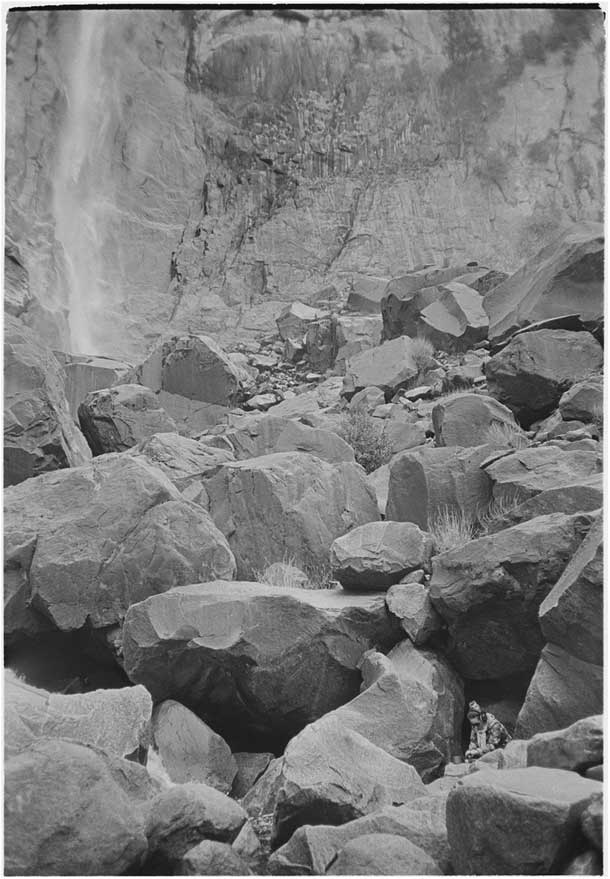
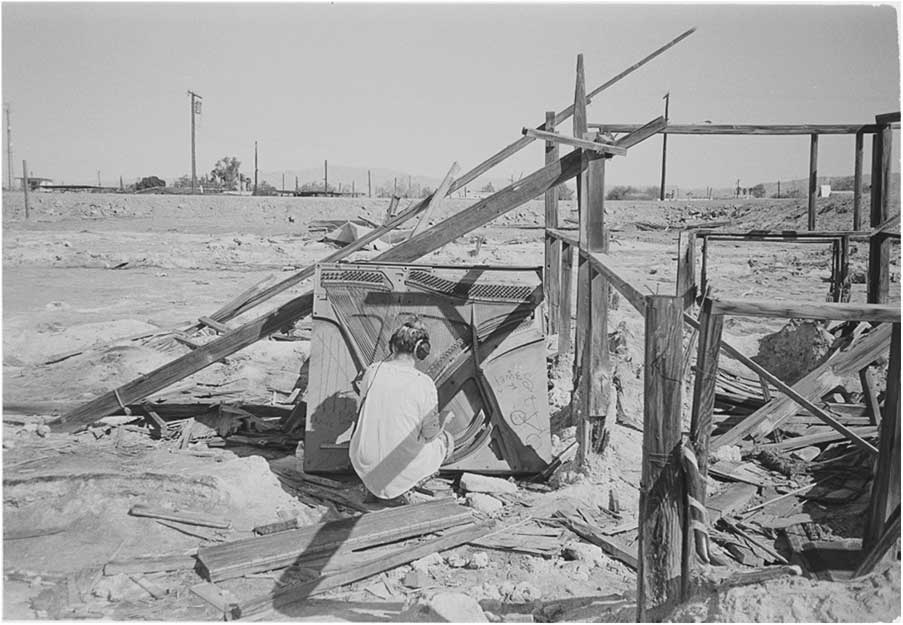
I have found that often the simplest forms of electronic sound seem to be the most appropriate material for site-responsive improvisation with nature. In Bridalveil (2015), I respond to one of the waterfalls in Yosemite National Park, working only with white noise and filters (Figure 3). Natural phenomena such as water and wind become improvisation partners, providing energetic collaborators to negotiate with. The unpredictable and the serendipitous make regular appearances in site-responsive performance. As improvisers it is important to be able to respond to these scenarios, and moreover, recognise when to leave behind pre-planned ideas. For example, Scorched Earth (2015), a performance at the man-made environmental disaster of the Salton Sea in California, involved no use of electronic instruments at all. Finding by chance a battered piano frame (Figure 4) on the decaying and salt-encrusted coastline provided an ample sounding board to participate in the already active sound environment with birds, freight trains, and planes (Movie example 3).
Responding to a waterfall with filtered white noise at Yosemite National Park.

Performing on a found piano frame at the Salton Sea, California.

Bennett Hogg discusses the importance of practitioners who ‘participate in … a broader set of cultural practices in which the imperial power of “the human” over the rest of the world is shifting in favour of what we might call a more ecosystemic engagement’ (Hogg Reference Hogg2013). He argues that the sound artist must be fully aware of their own existent and often audible position in an environment. When I first encountered Bridalveil Fall, I climbed over many rocks to get as close as possible to the powerful flow, and started to improvise with my analogue synthesiser. I immediately noticed how particular the characteristics of the environmental sound were. I had to sit for some time to discover the most suitable filter frequencies and low-frequency oscillation speeds. I wanted to blend my sound with the hissing and crashing of the waterfall, to pick out and highlight certain characteristics, and play around them. I could only learn what was appropriate over time, by listening, experimenting, and improvising with the environment itself.
In Lucky Dip (2015), audience members were offered multiple modes of participation within the sound-environment field. Taking place during a busy arts festival that was hosting several site-specific multimedia works, the piece consisted of live electronic music that could be experienced both underwater in a large swimming pool, and above the water through loudspeakers. A total of nine performances took place over the course of the three-day festival in Phoenix, Arizona. Self-built hydrophones were positioned in the pool so that the movement of participants could be made audible and be further transformed using digital signal processing. This layering of possible experiences set up various mutually affecting relationships within the environment and provided different points of access to the piece. Some participants chose to lie in the pool and let their ears move in and out of the water; others preferred to listen purely through air, but were able to hear the movement of those in the water. Here, the multisensory experiential modes are not enforced, but are optional, subtle and dynamic. This exemplifies the link between audience participation and site-responsiveness: the piece could be performed in other similar sites, but this type of performance ecosystem affords participation that gives agency to the listener (through multiple modes of listening chosen by participants, ability to affect the sound and so on).
In all of these pieces, the relationships that come about are ‘necessarily temporal’ (Cooper Reference Cooper2009: 337). As a sound artist, improvising in this given environment, I am able to bring into being certain events. When I leave the landfill site, the machinery will continue to hum and oscillate. In the final mausoleum performance, in addition to the elements mentioned, I also had to respond to the sound of the wind trying to push through the doors of the chapel, and the rain dripping down from the fractured ceiling into the reverberant space. Even when the doors are shut to the ears of the public, the mausoleum is sonically activated from time to time by the movement of wind and water. Weather, according to Tim Ingold, is the unremarkable term that describes the fundamental matter that we perceive in: ‘we do not hear rain, but hear in it. Thus wind, sunshine and rain, experienced as feeling, light and sound, underwrite our capacities, respectively, to touch, to see and to hear’ (Ingold Reference Ingold2007: 12). By rejecting the idea that sound is an object of our perception, and that it is instead experiential – or what we hear in – Ingold asserts the in-flux and ever-moving character of sound. A site-responsive practice acknowledges the human presence within ever-shifting environments.
6. Documentation and (Re)presentation
At the time of writing, Sounding Out Spaces is archived in the form of a websiteFootnote 3 with low-fidelity recordings, analogue (and sometimes digital) photography and video. Although the audio recordings have been broadcast on analogue radio in the UK and the Netherlands, these are solely documents of the performance events and can only give some suggestion of the actual piece. They are severed from the multisensory environment of the real world in which they took place. Other public (re)presentations make this point explicit. For example, Scorched Earth has been reinterpreted for live performance using the video and audio material in collaboration with a dance improviser. A remix of the audio recording was also presented in an audio booth at ohrenhoch, der Geräuschladen, Berlin, which has been designed to enable listeners to feel the bass frequencies through their feet. This echoes the ideas of Hogg, who describes his work as part of the Landscape Quartet as a move away from soundscape composition in the traditional sense of collecting field recordings, which then would be organised into compositions and later presented in a concert setting: ‘rather than bringing home pristine lumps of the world in the form of environmental sound recordings I needed to be going out into it with my knowledge, skills, ideas, and technologies, improvising with the world, being a part of it, not collecting abstractions destined only to be used in representations’ (Hogg Reference Hogg2013).
However, one noteworthy approach to the (re)presentation of a site-responsive performance was offered at Newcastle University as part of a symposium on the Landscape Quartet. Flautist and improviser Sabine Vogel presented a work which had been enacted during several visits to a patch of moorland during a three-day residency at Allenheads Contemporary Arts in Northumberland. When presented to an audience within the university building, we were guided through an embodied experience which superimposed certain environmental attributes of the original location onto the new space. Sabine played one of her flutes as she ascended a long staircase. We were moved to follow, climbing uphill. Arriving at the top, the scene consisted of a wide video projection of the original performance and multiple speakers positioned through the space to give the impression of the open plane. The space was noticeably unheated. On reflection upon the original performance, Vogel writes, ‘I played along with the bansuris and I played with the wind, with the cold and the landscape’ (Vogel Reference Vogel2014). The multisensory approach to the presentation of the documentation offered a participatory engagement with the sentiment of the work.
7. Conclusion
I have described the site-responsive performance of live electronic music as a set of practices that attempt to build upon the idea that performance always occurs in response to a given context. It offers a way to draw attention to the complex and dynamic relationships that are at play between audiences, performers and environments. This suggests a more consciously engaged type of practice due to the fact that the performer must explore and respond to the acoustic, social, or cultural possibilities of a site. The case studies presented illustrate some preliminary explorations of these ideas. The techniques used include spending time exploring the unique properties of a site, revisiting it over time and developing a portable setup that can be used without mains electricity. These methods can be transferred to other places which, along with the problematic usages of the term site-specific discussed earlier, supports their definition as site-responsive. Future work will explore more sophisticated uses of technology, focusing on portability and renewable energy sources.
But participation in site-responsive performance is not just for the performer. Through careful consideration of which sites are selected, audiences may be offered multiple ways in which to participate in the musical activity, thus avoiding ‘the silent, non-participative, uni-directional attention of concert listening, and its derivatives, [which] is in fact quite untypical of how we normally perceive and behave towards sound’ (Hogg Reference Hogg2013). This suggests that a site-responsive practice has the potential to offer highly accessible and inclusive experiences, something that has been an important component of my own practice for many years (Hayes Reference Hayes2015). Despite the potential for social engagement, it is important to note Clare Bishop’s warnings about the often ‘feel-good’ but uncritical (Bishop Reference Bishop2004: 79) nature of participatory art of relational aesthetics. If we are to explore and engage with particular sites and social groups, it is important to ask what our involvement will actually contribute to these communities.
Acknowledgements
My gratitude to Tobias Feltus for his collaboration on Sounding Out Spaces. Images by Kevin TJ Curtis (Figure 1), Tommy Ga-Ken Wan (Figure 2), and Tobias Feltus (Figures 3 and 4).
Supplementary Material
To view supplementary material for this article, please visit https://doi.org/10.1017/S1355771816000364