1. Introduction
Light and matter modify each other wherever they interact, namely during propagation of an electromagnetic wave in a medium of non-vanishing mass density. Reciprocal modifications of matter and light are mostly due to electrons, which rapidly oscillate under the action of the electromagnetic field and re-irradiate electromagnetic waves, whose spectrum may differ from the incident one. In the case of intense laser–plasma interactions, electromagnetic fields can reach very high amplitudes and, on the other hand, a large fraction of electrons are free from atomic bonds. Further, free electrons in a plasma respond to the light field not only individually, but also collectively. The collective electron response (or plasma response) is related to the free electron density
 $n_{e}$
. For the laser light the crucial parameters are its pulsation
 ${\it\omega}_{0}$
and its intensity
 $I_{L}$
. In a plasma of electron temperature
 $T_{e}$
, the mean (peak value of the distribution) velocity of electrons (thermal velocity) is
 $v_{T}=(2k_{B}T_{e}/m)^{1/2}$
, where
 $k_{B}$
and
 $m$
are the Boltzmann constant and electron mass, respectively, while the quiver velocity of the electron motion under the action of the oscillating electric field
 $E_{0}$
is
 $v_{q}=eE_{0}/m{\it\omega}_{0}$
, where
 $e$
is the electron charge. In most of the cases we consider in this paper
 $v_{T}<v_{q}$
; then the electron velocity distribution is far from the thermal one. The basic theory of self-phase modulation (SPM) can be found in textbooks devoted to non-linear optics (Shen Reference Shen1984). As far as the relativistic electron velocity is concerned, we will mostly devote our attention to laser–plasma interaction at electromagnetic fields comparable with the ionization threshold, which induce sub-relativistic
 $v_{q}$
. Though in some experiments described below the laser intensity was definitely relativistic, we will see that SPM produced by fast ionization can still be important when the intensity decreases down to sub-relativistic values. Nevertheless, relativistic SPM (RSPM) in plasma has its own specific interest, as proved experimentally and numerically by Watts et al. (Reference Watts, Zepf, Clark, Tatarakis, Krushelnik, Dangor, Allot, Clarke, Neely and Norreys2002). An impressive amount of literature also evidences the role that phase modulation for ultra-short and high-intensity lasers plays in practical applications of these lasers, such as electron acceleration and X-ray generation. This important field is beyond the limited view of this paper and deserves a more extended review.
The refractive index of the plasma being
 ${\it\mu}=(1-{\it\omega}_{p}^{2}/{\it\omega}_{0}^{2})^{1/2}$
, where
 ${\it\omega}_{p}=(n_{e}e^{2}/{\it\epsilon}_{0}m)^{1/2}$
, the propagation of the laser light depends on the local plasma density
 $n_{e}$
. As described in the next section, the local variation of
 $n_{e}$
on a time scale comparable with the laser wave period
 $T_{0}=2{\rm\pi}/{\it\omega}_{0}$
induces a consequent spectral change of the laser light. Usually such fast
 ${\it\mu}$
-variations are directly or indirectly produced by the action of the intense laser light on the medium and the process is then called SPM. Beside laser–plasma interaction, SPM has been studied theoretically and experimentally in a variety of contexts and in some cases it has been used for important applications. In particular, it has been successfully exploited to produce laser pulses of ultra-broad band and to chirp laser pulses: both processes are part of the very powerful technique called chirped pulse amplification (CPA) (Strickland & Mourou Reference Strickland and Mourou1985), the mother technique for all the lasers delivering femtosecond pulses of peak power in the multi-TW to PW range (Danson et al.
Reference Danson, Hillier, Hopps and Neely2015).
As most of the powerful lasers are operating around the visible range from near IR to near UV (
 ${\it\omega}_{0}\approx 10^{15}~\text{s}^{-1}$
,
 $T_{0}\approx 10^{-14}~\text{s}$
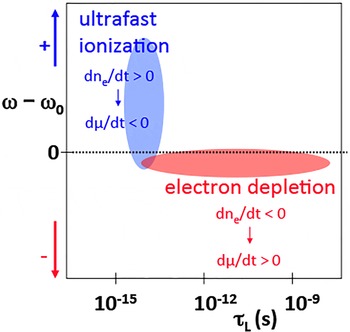
), we can basically distinguish two ranges of laser pulse durations
 ${\it\tau}_{L}$
(see figure 1). In the first range, the left-hand region of the graph in figure 1, the intense electric field of sub-picosecond pulses of ultra-high intensity can ionize matter in a time comparable with the wave period. This is usually the dominant effect, which can lead to SPM of the laser light with an overall shift towards higher frequency (up shift or blue shift) sometimes a considerable fraction of the original laser frequency. In the second range, extending from picosecond to multi-nanosecond pulses, the ionization time is usually much longer than the laser wave period but, later on, still during the laser pulse,
 $n_{e}$
can decrease very rapidly (electron depletion) inside the region of interaction, due to laser-driven ponderomotive forces and/or hydrodynamic expansion. This kind of process can lead to SPM with spectral changes in the laser frequency, mostly towards lower frequency (down shift or red shift).
SPM in plasmas: dominant frequency shift versus laser pulse duration for laser wavelength in the visible range or nearby.

In contrast to the layout of figure 1, pioneering observations and studies (Yablonovich Reference Yablonovich1974a
,Reference Yablonovich
b
) on SPM in laser–plasma interaction were performed more than 40 years ago with nanosecond pulses and revealed up shift of the laser light frequency. The reason is that in those experiments a powerful IR
 $\text{CO}_{2}$
laser was used, whose wavelength is
 $10.6~{\rm\mu}\text{m}$
. Such a wavelength, much larger than for lasers operating in the visible range or nearby, has two consequences. First, there is a net increase in the quiver velocity
 $v_{q}$
of the electrons at the same laser intensity; second, the larger wave period
 $T_{0}$
makes it non-negligible with respect to the avalanche growth time (after which the free electron density
 $n_{e}$
is almost reached), estimated of the order of
 ${\it\tau}_{AV}\leqslant 10^{-12}~\text{s}$
. In fact, a careful spectroscopic investigation (Yablonovich Reference Yablonovich1974b
) allowed the observation of a net frequency up shift of the laser light producing optical breakdown in both helium and nitrogen.
To conclude this Introduction, it has to be said that, besides SPM, a detailed control of the spectrum of intense laser pulses interacting with a plasma can be of primary importance in many applications, including laser fusion, as recently demonstrated by the sophisticated and very effective technique employed at National Ignition Facility (NIF) (Lindl et al. Reference Lindl2012) for the ultimate laser energy balance into the hohlraum cavity, via parametric instabilities, by introducing small frequency differences between beams (Moody et al. Reference Moody2014).
Section 2 of this paper provides some theoretical concepts accounting for SPM actions. Then we review a number of sample experiments performed with lasers of wavelength ranging from 0.53 to
 $1.06~{\rm\mu}\text{m}$
, in order to show how SPM can modify the spectrum of intense laser light interacting with a plasma. Section 3 is devoted to long (nanosecond and picosecond) pulse interactions, while § 4 deals with short (sub-picosecond) pulse interactions. Section 5 accounts for recent observations of a large blue shift produced by SPM during propagation of intense femtosecond laser pulses. Comparison between tests performed at different regimes of interaction may be useful, though this paper does not pretend to be an exhaustive review of the topic.
2. Conceptual background
This section does not provide a full theoretical discussion of SPM and consequent complex phenomena which can occur in a laser pulse propagating in a plasma, but simply introduces a basic conceptual background in order to appreciate the experimental evidence presented below.
When electromagnetic radiation propagates in a medium whose refractive index changes significantly on the characteristic times of the order of its own oscillation period, its frequency also changes. This is clear if we consider the definition of the electromagnetic wave angular frequency
 ${\it\omega}$
as the time derivative of the wave phase
 ${\it\phi}$
.
 $$\begin{eqnarray}\displaystyle \left.\begin{array}{@{}c@{}}\displaystyle {\it\phi}=k_{0}\int _{0}^{z}{\it\mu}(z,t)\,\text{d}z-{\it\omega}t,\\ \displaystyle {\it\omega}=-\frac{\text{d}{\it\phi}}{\text{d}t},\\ \displaystyle {\it\omega}-{\it\omega}_{0}=-k_{0}\int _{0}^{z}{\it\mu}(z,t)\,\text{d}z.\end{array}\right\} & & \displaystyle\end{eqnarray}$$
In the case where these refractive-index changes are induced by the radiation itself, the phenomenon is named SPM. This happens for example during propagation of an intense laser beam in a dielectric or plasma medium. In a homogeneous medium, in which the refractive index increases in time, the SPM produces a shift towards lower frequencies, while if the index of refraction decreases the shift occurs towards higher frequencies.
 $$\begin{eqnarray}\displaystyle \left.\begin{array}{@{}c@{}}\displaystyle \frac{\text{d}{\it\mu}}{\text{d}t}>0\rightarrow \text{red shift},\\ \displaystyle \frac{\text{d}{\it\mu}}{\text{d}t}<0\rightarrow \text{blue shift.}\end{array}\right\} & & \displaystyle\end{eqnarray}$$
In the case of interest for this paper, namely the propagation of intense laser pulses in plasma, the refractive index to be considered is
 $$\begin{eqnarray}\displaystyle {\it\mu}=\left(1-\frac{n_{e}}{n_{c}}\right)^{1/2}, & & \displaystyle\end{eqnarray}$$
where
 $n_{c}={\it\epsilon}_{0}m{\it\omega}_{0}^{2}/e^{2}$
is the critical density.
In this case the SPM effect depends on the time derivative of the electron density as follows:
 $$\begin{eqnarray}\displaystyle \left.\begin{array}{@{}c@{}}\displaystyle \frac{\text{d}{\it\mu}}{\text{d}t}=-\frac{1}{2{\it\mu}n_{c}}\frac{\text{d}n_{e}}{\text{d}t},\\ \displaystyle \frac{\text{d}n_{e}}{\text{d}t}>0\rightarrow \text{blue shift (ionization)},\\ \displaystyle \frac{\text{d}n_{e}}{\text{d}t}<0\rightarrow \text{red shift (electron density decrease).}\end{array}\right\} & & \displaystyle\end{eqnarray}$$
These refractive-index variations can be induced by the laser pulse via different mechanisms. Generally for nanosecond pulses the local variation of the electron plasma density (and consequently of its refractive index) is induced by the ponderomotive forces, which expel the electrons from the regions at higher electromagnetic energy density. Ponderomotive forces originate from the quivering motion of electrons under laser irradiation and depend on the laser intensity gradient as
 $$\begin{eqnarray}\displaystyle \boldsymbol{F}=-\frac{e^{2}}{2{\it\varepsilon}_{0}mc{\it\omega}^{2}}\boldsymbol{{\rm\nabla}}I. & & \displaystyle\end{eqnarray}$$
In the relativistic regime the ponderomotive forces can be expressed in the simple form
 $$\begin{eqnarray}\displaystyle \boldsymbol{F}=-mc^{2}\boldsymbol{{\rm\nabla}}\langle {\it\gamma}\rangle , & & \displaystyle\end{eqnarray}$$
where the electron Lorentz factor
 ${\it\gamma}$
depends on the laser intensity via the relativistic parameter
 $a_{0}$
:
 $$\begin{eqnarray}\displaystyle \left.\begin{array}{@{}c@{}}\displaystyle a_{0}=\frac{eE}{m{\it\omega}c}=8.5\times 10^{-10}{\it\lambda}_{{\rm\mu}\text{m}}I_{\text{W}\;\text{cm}^{-2}}^{1/2},\\ \displaystyle {\it\gamma}=\left(1+\frac{{\it\alpha}a_{0}^{2}}{2}\right)^{1/2},\quad {\it\alpha}=1\text{ (lin. pol.)};2\text{ (circ. pol.).}\end{array}\right\} & & \displaystyle\end{eqnarray}$$
On a longer time scale, the refractive index may increase locally as a result of hydrodynamic expansion of the regions of the plasma in which the laser has deposited some of its energy. In this case the increase of the refractive index is due to a rarefaction of the plasma density.
In the case of femtosecond laser pulses the physical mechanisms that can lead to a rapid change in the electron density are, in addition to the above-mentioned ponderomotive one, the instant ionization induced by the intense laser pulse electric field, as well as purely relativistic effects.
The latter include the relativistic self-focusing, which takes place for laser power overcoming the critical value
 $$\begin{eqnarray}\displaystyle P_{cr}\approx 17\frac{n_{c}}{n_{e}}GW, & & \displaystyle\end{eqnarray}$$
and the change of the refractive index due to the electron mass increase produced by its relativistic quivering motion under direct laser irradiation.
 $$\begin{eqnarray}\displaystyle \left.\begin{array}{@{}c@{}}\displaystyle {\it\mu}=\left(1-\frac{n_{e}}{n_{c}{\it\gamma}}\right)^{1/2}\rightarrow \frac{\text{d}{\it\mu}}{\text{d}t}=\frac{n_{e}}{2{\it\mu}n_{c}{\it\gamma}^{2}}\frac{\text{d}{\it\gamma}}{\text{d}t},\\ \displaystyle \frac{\text{d}{\it\gamma}}{\text{d}t}>0\text{ red shift (laser pulse rise)},\\ \displaystyle \frac{\text{d}{\it\gamma}}{\text{d}t}<0\text{ blue shift (laser pulse descent)}.\end{array}\right\} & & \displaystyle\end{eqnarray}$$
These two effects generally occur at the same time, both inducing a variation of the refractive index of the plasma, which follows temporally and spatially the trend of the laser intensity.
3. Evidence for SPM in plasmas with ‘long’ pulses
Intense nanosecond pulses have been largely used to investigate laser-stimulated parametric instabilities relevant to inertial confinement fusion (ICF). A class of these instabilities may produce a significant amount of backscattering, detrimental for an efficient coupling of the laser light with the coronal plasma surrounding the shell (containing the fuel) to be partially ablated in order to compress the fuel itself (Atzeni & Meyer-Ter-Vehn Reference Atzeni and Meyer-Ter-Vehn2004). In the meantime, spectroscopy of the backscattered light provides valuable information on the laser–plasma interaction conditions. In particular, stimulated Brillouin scattering (SBS) reaches a high degree of reflectivity backwards: for this reason it has been carefully studied for decades and a number of beam-smoothing techniques have been tested in order to depress its detrimental action (Lehmberg & Obenschain Reference Lehmberg and Obenschain1983; Kato et al.
Reference Kato1984; Coe et al.
Reference Coe, Afshar-rad, Desselberger, Khattak, Willi, Giulietti, Lin, Yu and Danson1989). The typical signature of backward SBS (B-SBS) is a red shift due to the energy lost by the laser electromagnetic wave to excite the ion acoustic wave (IAW) involved in the process. In its simplest form, the expected relative shift of the scattered light pulsation
 ${\it\omega}_{B}$
is, for plasma density well below the critical density,
 $({\it\omega}_{B}-{\it\omega}_{0})/{\it\omega}_{0}\approx -2c_{s}/c$
, where
 $c_{s}$
and
 $c$
are the sound and light speeds, respectively. In many cases, however, the spectrum can be complicated by the concurring action of other effects, including the plasma motion leading to an additional Doppler effect or excitation of non-linear IAW (Casanova et al.
Reference Casanova, Laval, Pellat and Pesme1985). Usually time-resolved spectroscopy is very useful in order to discriminate among the different effects contributing to the overall spectrum. Nevertheless, time-resolved spectra of B-SBS laser light obtained from an experiment of intense laser interaction with a pre-formed under-dense plasma (Afshar-rad et al.
Reference Afshar-rad, Coe, Giulietti, Giulietti and Willi1991) could not be explained by considering only the effects mentioned above. Let us briefly describe those experimental conditions. The under-dense plasma was pre-formed with the exploding-foil technique by irradiating a thin aluminium foil with a pair of opposite laser pulses (
 ${\it\lambda}_{0}=530~\text{nm}$
,
 ${\it\tau}_{L}=0.6~\text{ns}$
FWHM). The heating laser intensity on target was
 $I_{h}\approx 10^{14}~\text{W}~\text{cm}^{-2}$
, producing a near-cylindrical plasma of millimetre size 1–2 ns after irradiation (Willi et al.
Reference Willi, Basset, Giulietti and Karttunen1989). A third laser pulse with the same parameters was delayed from 1.2 to 1.8 ns after heating and sent into the pre-formed plasma from a direction which made the Doppler shift negligible. This probe pulse was tightly focused at a nominal intensity
 $I_{p}$
up to
 $10^{15}~\text{W}~\text{cm}^{-2}$
. The plasma parameters were
 $T_{e}\approx 700~\text{eV}$
,
 $n_{e}\approx 0.16n_{c}$
at 1.2 ns and
 $T_{e}\approx 500~\text{eV}$
,
 $n_{e}\approx 0.08n_{c}$
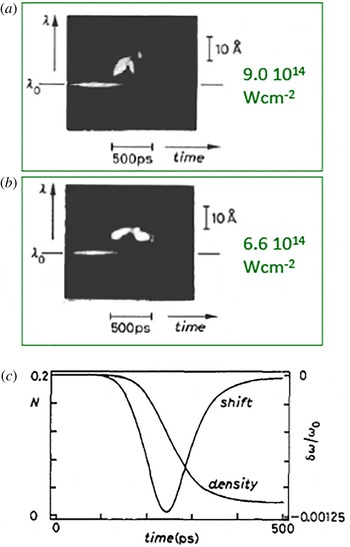
at 1.8 ns. Figure 2(a,b) shows two time-resolved spectra of the backscattered probe pulse, both with a heating–probing delay of 1.8 ns. The delay and shift of the backscattered probe were measured from the position of a fiducial visible as a straight line on the left bottom of each picture. The probe intensity
 $I_{p}$
was varied by about 30 % between the two pulses.
SPM signature in spectra of laser light backscattered by SBS process (images from Afshar-rad et al. (Reference Afshar-rad, Coe, Giulietti, Giulietti and Willi1991)). (a,b) Time-resolved spectra of the backscattered probe pulse. (c) Numerical simulation of the shift dynamics during electron density depletion.

The occurrence of SPM was inferred from both the large red shift and the chirping of the spectrum. In fact, the maximum shift observed would require plasma temperatures (2.5 and 4.0 keV, respectively) definitely too high with respect to the temperature of about 1 keV expected from hydrodynamic simulations. Further, the chirping shape of the spectrum cannot be explained with SPM in a medium of decreasing electron density (increasing refractive index). This condition is the same used to produce chirped pulses for CPA lasers (Strickland & Mourou Reference Strickland and Mourou1985). In the case of Afshar-rad et al. (Reference Afshar-rad, Coe, Giulietti, Giulietti and Willi1991), the electron density decreases locally due to the convergent action of ponderomotive forces and hydrodynamic pressure, both expelling electrons from the region of laser–plasma interaction. In fact, at the laser beam boundary the field gradient
 $\boldsymbol{{\rm\nabla}}E$
is quite high and the ponderomotive (PM) force on electrons
 $F_{pm}\approx -\boldsymbol{{\rm\nabla}}\langle E^{2}\rangle$
is expulsive. At the same time the plasma temperature, being maximum on the laser beam axis, leads to an over-pressure with respect to the background, expelling electrons and ions. This latter has a slower action, which however can produce effects in a time comparable with PM forces in case of a thin interaction region (e.g. filaments). A rough simulation of the process with the consequent spectral evolution is shown in the graph in figure 2(c). The frequency shift, always negative, reaches its maximum when the derivative
 $\text{d}n_{e}/\text{d}t$
is maximum and then decreases to the minimum value, which is merely due to the SBS process. The maximum red shift observed was found to be consistent with the action of SPM (see theory in the previous section) in the given condition of laser–plasma interaction for both levels of intensity of figure 1. Also, the steeper chirping observed at higher intensity is consistent with theory.
Another interesting SPM-driven spectral modification was observed in the time-resolved spectra of the second harmonic generated by plasma interaction with intense nanosecond laser pulses. In that experiment (Giulietti et al.
Reference Giulietti, Biancalana, Borghesi, Chessa, Giulietti and Schifano1994), a laser pulse (
 ${\it\tau}_{L}=3~\text{ns}$
FWHM,
 ${\it\lambda}_{0}=1064~\text{nm}$
, line width
 ${\approx}7\times 10^{-2}~\text{nm}$
) was focused, at a nominal intensity of
 $I\approx 10^{14}~\text{W}~\text{cm}^{-2}$
, on a plastic foil target (
 $1~{\rm\mu}\text{m}$
thick). The plastic foil exploded in a plasma whose density at the peak of the laser pulse was
 $n_{e}\approx n_{c}/4$
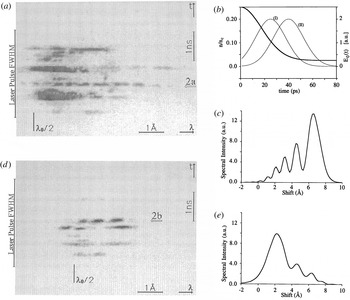
. The laser operated in single-transverse but multi-longitudinal mode. As a consequence, the pulse was spiky in time, with spike duration of about 50 ps, due to mode beating. That spiky structure is visible in the two time-resolved spectra reproduced in figure 3(a,d). Each spike is broadened and red shifted with respect to the second-harmonic line
 ${\it\lambda}_{0}/2$
(line width
 ${\approx}4\times 10^{-2}~\text{nm}$
when generated by a KDP crystal). Many spikes are also spectrally modulated. Shift, broadening and modulation vary spike by spike.
SPM signature in spectra of forward-emitted second harmonic of laser light (images from Giulietti et al. (Reference Giulietti, Biancalana, Borghesi, Chessa, Giulietti and Schifano1994)).

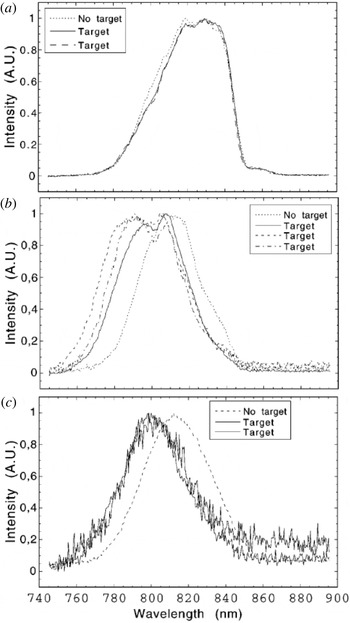
Blue shift of laser light transmitted by an over-dense laminar plasma (images from Giulietti et al. (Reference Giulietti, Gizzi, Giulietti, Macchi, Teychenné, Chessa, Rousse, Cheriaux, Chambaret and Darpentigny1997)). Laser intensity:
 $3\times 10^{18}~\text{W}~\text{cm}^{-2}$
(a);
 $4\times 10^{17}~\text{W}~\text{cm}^{-2}$
(b);
 $5\times 10^{16}~\text{W}~\text{cm}^{-2}$
(c).

All those spectral features were consistently explained in terms of SPM of the laser light interacting spike by spike with a filamentary plasma. In fact, in the same experiment there was clear evidence, during propagation, of a transition from a quasi-smooth laser spot to a cluster of filaments (Biancalana et al. Reference Biancalana, Borghesi, Chessa, Deha, Giulietti, Giulietti, Gizzi and Willi1993). Each of these light filaments produces in turn plasma filaments of temperature higher than the background, whose density decreases considerably in a few tens of picoseconds. There is then a complicated interplay between temporal (spikes) and spatial (filaments) structures in which each spike can interact with a filament at a different stage of its evolution (decreasing electron density). This situation was simulated numerically, as shown in figure 3(b,c,e). The interaction produces a general red shift and broadening but spectral details, including modulations, vary spike by spike according to the particular stage of the interacting filaments (Biancalana et al. Reference Biancalana, Borghesi, Chessa, Deha, Giulietti, Giulietti, Gizzi and Willi1993).
4. Evidence for SPM in plasmas with ‘short’ pulses
After the CPA technique (Strickland & Mourou Reference Strickland and Mourou1985) made available intense ultra-short laser pulses, the study of non-linear effects during propagation in a plasma achieved unprecedented results. Opposite to the case of nanosecond and picosecond pulses we have considered in the previous section, SPM is now mostly driven by ultra-fast ionization rather than by hydrodynamics or ponderomotive forces. The electric field of the laser wave can reach such high values that massive ionization can occur in a time comparable with an optical cycle.
In a rather puzzling experiment, propagation of a femtosecond laser pulse through an over-dense (
 $n_{e}>n_{c}$
) plasma was demonstrated at an intensity exceeding
 $5\times 10^{16}~\text{W}~\text{cm}^{-2}$
, while at
 $3\times 10^{18}~\text{W}~\text{cm}^{-2}$
the layer became almost transparent (Giulietti et al.
Reference Giulietti, Gizzi, Giulietti, Macchi, Teychenné, Chessa, Rousse, Cheriaux, Chambaret and Darpentigny1997). A number of model explanations (Teychenné et al.
Reference Teychenné, Giulietti, Giulietti and Gizzi1998; Yu et al.
Reference Yu, Sheng, Yu, Zhang, Jiang and Xu1999; Cairns, Rau & Airila Reference Cairns, Rau and Airila2000) were proposed for this striking result, which remained somehow controversial (Gibbon Reference Gibbon2005). The laser pulse (
 ${\it\lambda}_{0}=815~\text{nm}$
,
 ${\it\tau}_{L}=30~\text{fs}$
) was focused onto a 100 nm thick plastic foil at different power levels, so that the intensity on target varied from
 $5\times 10^{16}$
to
 $3\times 10^{18}~\text{W}~\text{cm}^{-2}$
. The spectra of the transmitted laser pulse showed different features at different intensities, as presented in figure 4. At the lowest intensity of
 $5\times 10^{16}~\text{W}~\text{cm}^{-2}$
(figure 4
c), a small fraction of transmitted light shows a spectrum blue shifted and well reproducible shot by shot. At an intermediate intensity of
 $4\times 10^{17}~\text{W}~\text{cm}^{-2}$
, it is still blue shifted but less reproducible shot by shot. At the highest intensity of
 $3\times 10^{18}~\text{W}~\text{cm}^{-2}$
, the spectrum of the highly transmitted light is almost un-shifted. The spectral observations at low and intermediate intensities were explained in terms of SPM consequent to fast ionization. At the highest intensity full ionization was reached very early in the pulse and most of the pulse passed through the plasma already ionized with almost no spectral effects. The most stable effect was observed at
 $5\times 10^{16}~\text{W}~\text{cm}^{-2}$
. Considering the plasma layer thickness and the measured shift, an ionization time of the order of 20 fs could be estimated, comparable with the pulse duration. In other words, at that intensity almost all the pulse contributed to the SPM action. At intermediate intensity the mean ionization time could be estimated to be of the order of 13 fs and variations shot by shot were attributed to the threshold condition of that intensity with respect to the over-dense transparency.
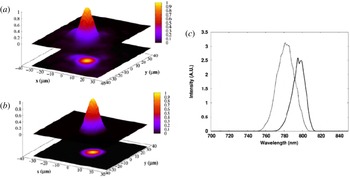
A blue shift was also observed after propagation of an intense ultra-short laser pulse through a millimetric under-dense plasma (Giulietti et al.
Reference Giulietti2006). The laser pulse (
 ${\it\lambda}_{0}=800~\text{nm}$
,
 ${\it\tau}_{L}=60~\text{fs}$
) was focused at a nominal intensity of
 $3\times 10^{18}~\text{W}~\text{cm}^{-2}$
in a helium jet and propagated along 3 mm of gas whose density was
 $10^{19}~\text{atoms}~\text{cm}^{-3}$
. A crucial role was played by the plasma formed in the gas by the amplified spontaneous emission (ASE) prior to the arrival of the main pulse. On its arrival, the intense femtosecond pulse interacts with such partially ionized, hollow pre-formed plasma, whose main actions on the pulse are shown in figure 5.
Spatial filtering (a,b) and blue shift (c) of the laser pulse after propagation in a helium jet (images from Giulietti et al. (Reference Giulietti2006)). The original pulse shape and spectrum are top colour image and right-hand plot in the graph, respectively.

The two false-colour intensity plots on the left-hand side of figure 5 show how the original pulse cross section (a) with its aberrations is cleaned up (b) by the interaction with the pre-plasma, acting as a spatial filter. Figure 5(c) compares the original laser spectrum (solid line) with the spectrum modified by the propagation. The mean spectral values calculated for the transmitted light over 27 shots gave a shift of
 ${\it\delta}{\it\lambda}=-15.0\pm 2.6~\text{nm}$
and a bandwidth of
 ${\rm\Delta}{\it\lambda}=50\pm 7~\text{nm}$
. These values are again consistent with the effect of SPM, but at an intensity lower than the nominal intensity of the femtosecond pulse. The complex scenario of the interaction in presence of the plasma pre-formed by the ASE did not allow accounting quantitatively for the observed spectral features.
5. Observation of extreme blue shift
A recent experiment (Giulietti et al. Reference Giulietti2013) allowed observing a SPM-driven progressive laser-frequency up shift up to unprecedented values. The observation was indirect, through Thomson scattering of the laser light during the propagation, but this method provided a unique opportunity to ‘see’ the evolution of the laser spectrum in time and in space. Observation of a large blue shift with ultra-short pulses is not new. Before the two works (Giulietti et al. Reference Giulietti, Gizzi, Giulietti, Macchi, Teychenné, Chessa, Rousse, Cheriaux, Chambaret and Darpentigny1997, Reference Giulietti2006) described in § 4, an early paper (Le Blanc et al. Reference Le Blanc, Sauerbrey, Rae and Burnett1993) reported the first clear evidence of a blue shift of a femtosecond pulse propagating in a dense gas. Some spectral measurements were performed in conditions of interest for laser-driven particle acceleration in plasma (Koga et al. Reference Koga, Naumova, Kando, Tsintsadze, Nakajima, Bulanov, Dewa, Kotaki and Tajima2000; Giulietti et al. Reference Giulietti2006, Reference Giulietti2013). In this condition Giulietti et al. (Reference Giulietti2013) reported a 40–50 nm upshift, which was attributed to SPM through a combined effect of ionization and filamentation. Thomas et al. (Reference Thomas, Mangles, Najmudin, Kaluza, Murphy and Krushelnick2007) analysed spatially resolved spectra of laser light scattered sideward from a laser-driven electron accelerator. Operating at relativistic intensity, they found that Raman scattering is dominant over Thomson scattering. The experiment we are going to describe (Giulietti et al. Reference Giulietti2013) was somehow complementary to the one of Thomas et al. (Reference Thomas, Mangles, Najmudin, Kaluza, Murphy and Krushelnick2007). In fact, it studied the propagation of the pulse at non-relativistic intensity, when Thomson scattering is the dominant source of side scattering with respect to Raman scattering.
In the experiment of Giulietti et al. (Reference Giulietti2013), a linearly polarized laser pulse (
 ${\it\lambda}_{0}=800~\text{nm}$
,
 ${\rm\Delta}{\it\lambda}=13~\text{nm}$
,
 ${\it\tau}_{L}=65~\text{fs}$
, 2 TW peak power) was focused on a nitrogen jet and crossed the gas along 1.5 mm approximately. A plasma was formed of electron density
 $5\times 10^{19}~\text{cm}^{-3}$
. A few hundred
 ${\rm\mu}\text{m}$
beyond the focus, the pulse propagated for about
 $200~{\rm\mu}\text{m}$
in a regime of self-focusing, reaching the intensity needed for an effective electron acceleration. The colour image produced with the light scattered (and collected at
 $90^{\circ }$
, perpendicular to the polarization) by Thomson scattering (Gizzi et al.
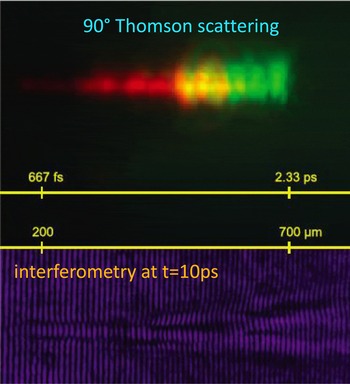
Reference Gizzi, Cecchetti, Giulietti, Giulietti, Koester, Labate, Levato and Pathak2011) is shown in figure 6(top portion): it depicts the evolution of the pulse during its propagation (pulse coming from the left-hand side) when the intensity has dropped well below the values needed for acceleration, due to both laser depletion and de-focusing. At this intensity, estimated between
 $10^{17}$
and
 $10^{16}~\text{W}~\text{cm}^{-2}$
, the ionization time is comparable with the pulse duration and the SPM reaches its maximum effect.
Figure 6 is supported by two self-consistent scales, both having as origin
 $t=x=0$
the entrance of the pulse in the gas. The top one is a time scale and is referred to the time-resolved Thomson image, showing the spectra evolution in real time with a resolution of less than 100 fs. The other scale is spatial and can be referred to both the Thomson image and the interferogram taken with a probe pulse delayed by 10 ps with respect to the main pulse. The interferogram is shown only to give an idea of the electron density distribution modified by the laser pulse propagation. It confirms the stage of de-focusing which empowers the maximum effect on the pulse spectrum.
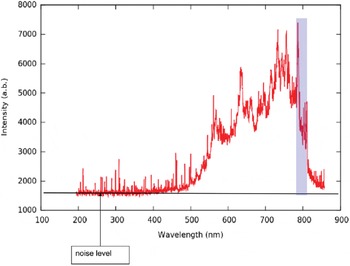
The diagram of figure 7 shows the spectrum, integrated in time and space, of the light emitted sideward by Thomson scattering. The very large bandwidth of this spectrum is the result of a long-time action of SPM, as shown in figure 6(top portion), producing an extreme up shift and broadening. The maximum blue shift observed here is about
 $-300~\text{nm}$
, with the impressive mean shifting rate of
 $0.3~\text{nm}~\text{fs}^{-1}$
or
 $1~\text{nm}~{\rm\mu}\text{m}^{-1}$
path. Such a huge shifting rate may deserve consideration also for practical applications.
Extreme blue shift of laser light during ultra-fast ionization of nitrogen (top) and interferogram of the plasma (bottom) (images from Giulietti et al. (Reference Giulietti2013)). The laser pulse propagates from left to right.

Overall spectral content of the Thomson-scattered laser light integrated in both space and time with respect to the time-resolved image of figure 6(top portion). The rectangular feature at 800 nm accounts for the original laser bandwidth (image from Giulietti et al. (Reference Giulietti2013)).

Though impressive, the spectrum and image in figures 6 and 7 provide only indirect evidence of the SPM action and do not provide a direct measurement of the final spectrum of the laser pulse. To get such information and compare it with the data provided by Thomson scattering, an ad hoc simulation was performed with the numerical two-dimensional PIC (particle-in-cell) code CALDER, in a version (Nuter et al. Reference Nuter, Gremillet, Lefebvre and Martin2011) including an ionization module to account also for effects generated by the ultra-fast ionization process.
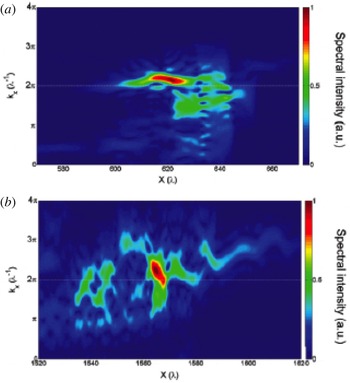
Numerical simulation of the laser pulse spectral evolution (images from Giulietti et al. (Reference Giulietti2013)). Each snapshot shows the spectrum of the pulse at a given stage of its propagation, namely the intensity distribution displayed in space (units of laser wavelength, origin at the pulse entrance in the plasma) and wave vector (units of reciprocal wavelength;
 $k=2{\rm\pi}$
corresponds to the original central frequency of the laser spectrum).

Figure 8 reproduces two frames from that simulation. In the frame (a), the laser spectrum is shown at about 0.5 mm from the pulse entrance in the gas. At this time the laser intensity is very high due to self-focusing. The most intense part of the pulse is already slightly blue shifted. At larger distances (later-time propagation) the laser intensity decreases below
 $10^{17}~\text{W}~\text{cm}^{-2}$
and the leading edge of the pulse faces an increasing blue shift. This latter dominates the spectrum of the pulse at its exit from the plasma as shown in figure 8(b). The first part of the pulse is blue shifted, due to SPM during the fast ionization of the gas. The second part of the pulse is also affected by the interaction with the plasma wave and faces both blue and red shifts. The net effect on the pulse is a considerable shortening (from 65 to 20 fs) supported by its huge broadening (from 13 to 180 nm). The final spectrum is peaked at
 $+600~\text{nm}$
(from the original 800 nm) with a tail extending up to 500 nm, consistently with the integrated spectrum of figure 7.
6. Conclusions
From the pioneering works of Eli Yablonovich (more that 40 years ago) to recently, a number of experimental works proved and defined the role of SPM in the spectral changes occurring to pulsed laser light while interacting with a plasma. Though we limited our consideration to a few works performed at moderate laser intensities, the spectral effects of SPM on the laser pulse are quite impressive and sometimes spectacular. Laser wavelength and pulse duration are fundamental parameters to determine the dominant spectral effect of SPM, determining completely different regimes of interaction and eventually opposite effects. Our sampling, non-exhaustive paper clearly proves these circumstances. In particular, an extremely large blue shift of the laser spectrum can be produced by ultra-fast ionization when the intensity lies in the range at which the ionization time of the medium is comparable with the laser pulse duration. The role of fast ionization at sub-relativistic intensity is fully confirmed by PIC simulations. The time- and space-resolved spectral characterization of the propagating pulse provide unique information on the physics of laser–plasma interaction. Finally, let us notice that the reproducible, massive spectral shift we recently observed can be in principle used to manipulate the spectral content of an ultra-short pulse of high power.
Acknowledgements
The authors acknowledge their colleagues’ contributions from ILIL-INO@CNR Campus, Pisa, Italy, SLIC@CEA, Saclay, France, LOA/Ensta@Ecole Polytechnique, Palaiseau, France, Central Laser Facility@RAL, Didcot, UK and from the INFN Strategic Project PLASMONX@LNF, Frascati, Italy. They also acknowledge financial support from the CNR-funded Italian Research Network ELI-Italy and from the INFN-funded (CN5) project ‘Gamma-ray emitter from self-injected Thomson scattering’ (g-RESIST). The work at ILIL was carried out in the framework of the CNR High Field Photonics Unit (MD.P03.034).