

Introduction
Being in work and saving for later life can make the difference between an older individual being financially secure in old age or facing a risk of poverty (Hall & Keohane, Reference Hall and Keohane2016). For working-age individuals, such financial preparedness can take the form of belonging to a workplace pension scheme and having additional financial arrangements in place, such as a personal pension scheme or having non-pension savings or investments (Buscha et al., Reference Buscha, Gorman, Sturgis and Zhang2023; Foster & Heneghan, Reference Foster and Heneghan2018). Previous research in the UK has shown that working-age Bangladeshi and Pakistani individuals are less likely than White British individuals to be members of a workplace pension scheme (Vlachantoni et al., Reference Vlachantoni, Feng, Evandrou and Falkingham2015). In addition, research has evidenced the interaction between gender and ethnicity, and its negative impact on women’s pensions (Ginn & Arber, Reference Ginn and Arber2001). However, an up-to-date examination of the more complex interplay between ethnicity, gender and other demographic, health and socio-economic characteristics has been lacking.
This paper uses data from the UK Household Longitudinal Study (UKHLS) to examine ethnic differentials in two parts. Firstly, the analysis explores trends between 2009 and 2023 in the ethnic differences in pension membership using a range of indicators, focusing on the interaction between ethnicity and gender. The analysis then uses data from 2023 to explore the importance of ethnicity in individuals’ chances of being members of a workplace pension scheme; or being members of a personal pension scheme, typically organised by individuals themselves and offered by pension providers; or expecting to use savings or investments beyond pensions in retirement. We focus on individuals aged forty-five to sixty-four for two reasons. Individuals in this age group still have the potential to earn and make pension-related decisions for their later life, and they are also more likely to belong to a workplace pension scheme, which is important for the analysis in this paper. The next section discusses existing literature on ethnic and gender differentials in pension membership, followed by a discussion of the UK policy context specifically for workplace pensions.
Ethnic and gender differentials in employment and pension membership
Ethnic differentials in pension membership originate in differences in the level and nature of employment over the life course. At the same time, research has evidenced the impact of individuals’ health on their employment (Bryan et al., Reference Bryan, Rice, Roberts and Sechel2022; van Rijn et al., Reference van Rijn, Robroek, Brouwer and Burdorf2014). For migrants, the timing of their migration is also related to their workplace pension eligibility and arrangements. Such differentials can accumulate across the life course, resulting in an ‘ethnic penalty’ in pension entitlement, lower financial resources and a higher risk of poverty (Vlachantoni et al., Reference Vlachantoni, Feng, Evandrou and Falkingham2017). Historically, relative to White persons, persons from Black or minority ethnic communities have been less likely to be economically engaged (Zwysen et al., Reference Zwysen, Di Stasio and Heath2021). More recently, the Office for National Statistics (ONS) noted that employment rates for members of Black and minority ethnic groups are still lower than those of White groups (Office for National Statistics, 2023). Explanations for ethnic differences in employment are complex and point to the combined effect of a lower level of English language fluency (Schmaus, Reference Schmaus2019), lower levels of educational qualifications and cultural norms that affect individuals’ engagement in the formal labour market, particularly among women (Berthoud, Reference Berthoud1998). Other research suggests that ethnic disparities in state pension income, variations in labour market activity, the pay gap between ethnic groups and obstacles to joining workplace pension schemes contribute to the ethnic pension gap (The People’s Pension, 2024). Such factors point to structural disadvantages and discrimination experienced by members of minority ethnic communities in the labour market (Longhi and Brynin, Reference Longhi and Brynin2017). Analysis by the Institute of Fiscal Studies has shown that gaps in workplace pension participation between White employees and employees from a Pakistani or Bangladeshi background cannot be explained by differences in earnings, age, sex, education or the characteristics of the job or their employer, whereas religious beliefs appear to be a stronger explanatory factor of such differentials (Cribb et al., Reference Cribb, O’Brien and Sturrock2025).
Existing research has evidenced the effect of women’s typical caring roles and atypical employment patterns on their pension entitlements (Silcock et al., Reference Silcock, Popat and Pike2016), the relationship between living arrangements and pension planning (Joseph & Rowlingson, Reference Joseph and Rowlingson2012) and the challenges faced by women with disrupted career trajectories in terms of pension planning (Foster & Heneghan, Reference Foster and Heneghan2018). In addition, the gender pay gap continues to exacerbate gender gaps in lifetime earnings, directly affecting women’s pension accumulation, while the interaction of ethnicity and gender can result in further adverse effects for women’s pension arrangements across their life course and in later life (Pensions Policy Institute, 2025; Wilkinson & Adams, Reference Wilkinson and Adams2024). Women from Pakistani and Bangladeshi communities are the least likely to be in paid work, to benefit from workplace pensions and to be eligible for state pensions (Vlachantoni et al., Reference Vlachantoni, Feng, Evandrou and Falkingham2017). In addition, women are less likely than men, regardless of their educational attainment, to accumulate private pension wealth (Ginn & Foster, Reference Ginn and Foster2023 and references therein).
The importance of savings, investments and subjective financial wellbeing
Previous research with respondents from minority ethnic groups has highlighted that different types of investment across the life course and in later life can ‘offset’ gaps in pension entitlement (Khan, Reference Khan2012). Although ethnic differentials that affect working-age individuals’ chances of working for an employer who offers a pension scheme are known (Steventon & Sanchez, Reference Steventon and Sanchez2008), the interaction of ethnicity and gender over time has not been considered in depth. The relationship between subjective wellbeing and individuals’ savings behaviour is complex, as individuals who have savings are more likely to report better wellbeing outcomes (Martin & Hill, Reference Martin and Hill2015), while happier individuals are more likely to live longer, and therefore save more for their retirement (Lee et al., Reference Lee, James, Zevon, Kim, Trudel-Fitzgerald, Spiro and Kubzansky2019). Recent research by Basabreen (Reference Basabreen2025) analysed data from the Understanding Society Survey between 2010 and 2018 and showed that income and job satisfaction are positively associated with savings behaviour. At the same time, subjective financial wellbeing is important in maintaining overall wellbeing across the life course and in later life (Arber et al., Reference Arber, Fenn and Meadows2014).
The policy context for workplace pensions
The modern British pension system is characterised by a contributory flat-rate state pension of a relatively low value and a public earnings-related scheme with additional top-up benefits for low-income individuals (Silcock et al., Reference Silcock, Popat and Pike2016). Individuals on middle or high incomes can also save for later life through personal pensions, arranged by themselves or their employer (Department for Work and Pensions, 2025b). Research by Suh (Reference Suh2022) has highlighted the importance of adequate saving at earlier ages (i.e. thirty to forty-nine years) (Suh, Reference Suh2022). The phased introduction of Automatic Enrolment (AE) from 2011 automatically enrols individuals aged twenty-two and above in workplace pensions who earn at least £10,000 annually, and aims to encourage younger individuals to commence financial planning for their retirement at a low cost.
Since the introduction of AE, about 88 per cent of eligible employees (20.4 million) in the UK participate in workplace pensions (Department for Work and Pensions, 2023), and AE has proven effective in reducing disparities in enrolment by age, occupation and income. However, specific demographic characteristics are highlighted as impacting AE, with 17 per cent of employed women not meeting the AE criteria (compared to 8 per cent of men) (Wilkinson & Adams, Reference Wilkinson and Adams2024), and Pakistani/Bangladeshi individuals showing the lowest participation rate across all ethnic groups at 74 per cent, albeit also showing the greatest increase in participation between 2011 and 2022, as AE took effect and coverage of workers of small employers expanded (Department for Work and Pensions, 2023). Recent analysis has shown that 16 and 24 per cent of eligible employees from a Pakistani and Bangladeshi background, respectively, opt out of their workplace pension plan, compared to 10 per cent of White employees (Cribb et al., Reference Cribb, O’Brien and Sturrock2025).
The research questions addressed in this paper are:
-
1. How have workplace pension membership and personal membership varied by ethnic group and gender among adults aged forty-five to sixty-four years from UKHLS-2009 (wave 1) to 2023 (wave 13) in the context of automatic enrolment?
-
2. Focusing on the most recent data available (2023):
-
a) How are ethnicity and gender associated with workplace pension membership, taking into account other socio-economic, demographic and health characteristics?
-
b) How are ethnicity and gender associated with personal pension membership, and how do they expect to use savings or investments (other than pensions) for retirement?
-
c) How are indicators of subjective financial wellbeing associated with individuals’ propensity to be members of a personal pension scheme, and how do they expect to use savings or investments (other than pensions) for retirement?
-
Conceptualising the importance of ethnicity and gender in affecting workplace and personal pension membership, and expecting to use non-pension savings/investments
In Figure 1, we conceptualise gender and ethnicity as characteristics associated with individuals’ employment patterns, which directly relate to one’s workplace pension membership, but also relate to individuals’ personal pension membership and expectation to use non-pension savings/ investments in retirement. Other demographic (e.g. migration history), socioeconomic (e.g. housing tenure) and health characteristics (e.g. self-rated health) are also taken into account, drawing on existing research that has emphasised their importance in this area (e.g. Vlachantoni et al., Reference Vlachantoni, Feng, Evandrou and Falkingham2015).
Factors associated with workplace and personal pension membership, and expectation to use non-pension savings/investments.

Figure 1. Long description
The figure shows the relationship between individuals’ characteristics, including gender, ethnicity, socio-economic status, health and subjective wellbeing on the one hand, and individuals’ employment, workplace pension membership, personal pension membership and havings savings or investments in later life.
Methods
Data source
The paper uses data from wave 12 (collected between 2020 and 2022) and wave 13 (collected between 2021 and 2023) of the UKHLS, a longitudinal survey of approximately 40,000 households in the UK which began in 2009 (University of Essex, 2023). This dataset is ideal for our analysis, as it includes an Ethnic Minority Boost Sample of at least 1,000 members of five ethnic groups: Indian, Pakistani, Bangladeshi, Caribbean and African. The analytical sample for each part of the analysis differs depending on the valid responses to the variables of interest. Ethical permission for the secondary data analysis was obtained from the University of Southampton. Table S1 shows that the UKHLS sample closely mirrors the ethnic composition of the UK Census 2021.
Outcome measures of pension membership
A workplace pension is a way of saving for retirement arranged by the employer (Department for Work and Pensions, 2025c). Workplace pension membership (No = 0, Yes = 1) was assessed using four survey questions, which are nested: being in paid work (No = 0; Yes = 1); among those in paid work, being an employee (No = 0; Yes = 1); among employees, working for employer with a workplace pension scheme; (No = 0; Yes = 1); and among those working for such an employer, being a member of such scheme (No = 0; Yes = 1) (see Figure S1). As these survey responses are self-reported, we are not able to assess whether all respondents asked such questions were eligible for work-based pensions, and this limitation is discussed at the end of the paper. The information about workplace pension membership was asked in wave 12, which is used for this part of the analysis.
Personal pensions are pensions that individuals manage for themselves, and which are separate from the state pension (Department for Work and Pensions, 2025a). Personal pension membership is derived from the following question in wave 13: ‘Other than your main employer pension scheme, are you currently a member of any personal pension scheme or do you currently contribute to any personal pension scheme?’ (No = 0; Yes = 1).
The outcome variable ‘savings or investments (other than pension)’ is derived from the following question in waves 2–11: ‘Do you expect to use savings or investments to provide for your retirement?’ (No = 0; Yes = 1), and the following question in wave 13: ‘Apart from pensions, are you likely to use savings or investments (other than pension) to provide money in later life?’ (No = 0; Yes = 1).
Predictor variables
Ethnicity and gender are key variables in the analysis. Gender is an important predictor of pension membership, both individually and when it interacts with ethnicity (Vlachantoni et al., Reference Vlachantoni, Feng, Evandrou and Falkingham2015 and references therein). Ethnicity was recorded according to the respondents’ self-report of their ethnic group into White British (includes British, English, Scottish, Welsh, Northern Irish), Other White (includes Irish, Gypsy or Irish traveller, any other White background), Indian, Pakistani, Bangladeshi, Chinese, Other Asian, Black (includes African/Caribbean/any other Black background), Mixed (includes White and Black Caribbean/White and Black African/White and Asian/any other Mixed background) and Arab & Other ethnic groups (see Table S1).
Socio-economic characteristics
Individuals’ socio-economic characteristics can directly relate to their pensions and other financial plans. Housing tenure has an impact on individual health, social security and welfare (Stevenson et al., Reference Stevenson, Aalabaf, Babad, Billig, Goldman, Grenham and Gutterman2019), while high house prices have a crowding-out effect on pension saving for middle-earning employees (Crawford & Simpson, Reference Crawford and Simpson2020). Housing tenure was recoded as: own outright; own with mortgage; social rent; rent privately; others (Waine, Reference Waine2006). Education has an evidenced impact on individuals’ type of employment in the UK (Paterson, Reference Paterson2022). We used the respondents’ highest educational qualification, which was recoded as: degree or higher; A-level; General Certificate of Secondary Education (GCSE); other qualification; no qualification. Drawing on existing research, which has used income quintiles to represent the income distribution (Cribb et al., Reference Cribb, Emmerson, Johnson and Karjalainen2024), we derived an income quintiles variable from the total household net income, divided by the size of the household, and distinguished between households in the bottom two and the top three quintiles of the income distribution. The use of quintiles, and the comparison between the top and bottom of the distribution, allows us to explore the socio-economic characteristics associated with membership of different types of pension schemes. The derived variable Job type was recoded as: educational/sport; public administration; health services; banking; transports/ trade; agriculture/construction/ industrial; did not work last week (but has a job); and others. Finally, we used income support receipt (No/Yes) as an indicator of lower socio-economic status.
Demographic characteristics
Age was recoded into two groups (forty-five to fifty-four and fifty-five to sixty-four-year-old adults) to capture the effect of an individual’s proximity to retirement on their pension and other financial arrangements. We acknowledge that there is variation in the retirement age within this study population, and that the state pension age is currently increasing; however, the distinction between individuals in mid-life (forty-five to fifty-four) and those closer to retirement (fifty-five to sixty-four) allows us to examine patterns of pension membership for two age groups that are central to our analysis. Legal marital status (married/ cohabiting; widowed; divorced/ separated; single or never married) is included as research has shown that married men and women are more likely to participate in pension schemes than their unmarried counterparts (Dushi & Iams, Reference Dushi and Iams2013). At the same time, living with one’s spouse or civil partner was used to incorporate the relevance of one’s living arrangements on their pension and other financial arrangements (Joseph & Rowlingson, Reference Joseph and Rowlingson2012). Finally, previous research has documented a strong link between households with three-plus children and poverty (Resolution Foundation, 2024), as such, we have included the number of children in the analysis as: No children, 1–2 children, 3+ children.
Individuals’ migration history, for example the timing of their arrival in the UK, directly affects the amount of time they have been living in the UK, and by extension, their employment patterns and workplace pension eligibility (Allmark, Reference Allmark2010; Vlachantoni et al., Reference Vlachantoni, Feng, Evandrou and Falkingham2015). The migration history variable allows us to examine the relevance of the migration timing into the UK by those born abroad but who migrated between 1930 and 1969; 1970–1999, and 2000–2020, compared to those who were born in the UK (non-migrants). The place of residence (urban or rural) variables allow us to take into account nation-level and regional differences in pension membership (Zhang et al., Reference Zhang, Wang, Li and Wang2023).
Health characteristics
Individuals’ self-reported health is a commonly used indicator in social, clinical and epidemiological research and a reliable health indicator among older adults (Akhtar et al., Reference Akhtar, Saikia and Muhammad2023). Self-reported general health (SRH) was recoded into two categories: good (excellent, very good, good) and poor (fair, poor). The variable indicating the report of any long-standing illness/disability was recoded as: No/Yes. We also included indicators of health satisfaction (satisfied; neutral; dissatisfied) and general mental health in our analysis, to obtain a broader picture of individuals’ wellbeing. The General Health Questionnaire (GHQ) screens for general psychiatric illness and is a widely used self-report measure of non-psychotic mental illness (Donath, Reference Donath2001). The GHQ-12-caseness scale (score ranging from 0 to 12) was recoded into two categories: score < 3 (no risk of mental illness); and score > 3 (risk of mental illness).
Subjective financial wellbeing indicators
Indicators of individuals’ subjective wellbeing, measured through a range of dimensions, have been shown to accurately reflect the quality of individuals’ lives in different domains (Diener et al., Reference Diener, Inglehart and Tay2013). Previous research on measuring subjective financial wellbeing has pointed to a range of indicators (Fan & Henager, Reference Fan and Henager2022), of which we used two in our analysis: income satisfaction coded as: satisfied; neutral; dissatisfied; and the respondents’ subjective financial situation in the present (comfortable; just about getting by; difficult) in the present.
Statistical analysis
In the first part of the analysis of trends between 2009 and 2023 we calculate the percentage distribution by ethnic group and gender of: those being in paid work; among those in paid work, being an employee; among employees, working for an employer who offers a workplace pension; among those working for such an employer, being a member of such scheme; being a member of a personal pension scheme; and expecting to use non-pension savings/ investments in retirement. Chi-square values were applied to each outcome variable to examine significant associations. We conducted a variance inflation factor (VIF) analysis to investigate multicollinearity, which did not detect any issues with the models (see Tables S5–S10). In the second part, the multivariate analysis focusing on wave 13 used a binary logistic regression approach, which is widely used in this topic area (Akhtar et al., Reference Akhtar, Saikia and Muhammad2023; Vlachantoni et al., Reference Vlachantoni, Evandrou, Falkingham and Gomez-Leon2020, Reference Vlachantoni, Falkingham, Evandrou and Qin2023). For each regression, the odds ratio indicates the change in the odds of having the outcome (e.g. personal pension membership) relative to the reference group while holding the control variables constant. The analyses are performed in STATA (version 18.5) (StataCorp, 2023), and figures are generated in R software (version 4.3.1) using the ggplot2 package (Wickham & Chang, Reference Wickham and Chang2011).
The equation of the final model for personal pension membership is:
-
•
 $$\eqalign{ & {{Y}} = {{Logit}}\,\left( {{{P}} = {{personal}}\;{{pension}}\;{{membership}}} \right) \cr & = {{log}}{{{P}} \over {1 - {{P}}}} = {{a}} + {{{b}}_1}{{*\,Ethnicity}} + {{{b}}_2}*{{Housing}}\;{{tenure}}\,\cr & {{ + }}\;{{{b}}_{{3}}}*{{Educational}}\;{{qualifications + }}{{{b}}_{{4}}}*{{Income}}\;{{quintiles}} \cr & \;{{ + }}\;{{{b}}_{{5}}}*{{Job}}\;{{type}}\;{{ + }}\;{{{b}}_{{6}}}\,*{{Income}}\;{{support}}\;{{ + }}\;{{{b}}_{{7}}}\,{{*\,Any}}\;{{savings}}\;{{/}}\;{{investments}} \cr & \;{{ + }}\;{{{b}}_{{8}}}*{{Gender}}\;{{ + }}{{{b}}_{{9}}}*{{Age}}\;{{group \,+\, }}{{{b}}_{{{10}}}}*{{Migration}}\;{{history}} \cr & \;{{ + }}\;{{{b}}_{{{11}}}}*{{Number}}\;{{of}}\;{{children}}\;{{ + }}\,{{{b}}_{{{12}}}}*{{SRH}}\;{{ + }}\,{{{b}}_{{{13}}}}*{{SFS}}\;\left( {{{present}}} \right) \cr}$$

The equation of the final model for expecting to use non-pension savings/ investments in retirement is:
-
•
$$\eqalign{ & {{Z}} = {{Logit}}\,\left( {{{S}} = {{Any}}\;{{savings}}/{{investments}}} \right) \cr & = {{log}}{{{S}} \over {1 - {{S}}}} = {{a}} + {{{b}}_1}{{*\,Ethnicity}} + {{{b}}_2}*{{Any}}\;{{personal}}\;{{pension}}\;{{membership}} \cr & \;{{ + }}\,{{{b}}_{{3}}}*{{Housing}}\;{{tenure}}\;{{ + }}{{{b}}_{{4}}}*{{Educational}}\;{{qualifications}} \cr & \;{{ + }}\,{{{b}}_{{5}}}*{{Incomequintiles}}\;{{ + }}{{{b}}_{{6}}}*{{Job}}\;{{type}}\;{{ + }}\;{{{b}}_{{7}}}*{{Income}}\;{{support}} \cr & \;{{ + }}\;{{{b}}_{{8}}}*{{Gender}}\;{{ + }}\;{{{b}}_{{9}}}*{{Marital}}\;{{status}}\;{{ + }}\;{{{b}}_{{{10}}}}*{{SRH}} \cr & \;{{ + }}\,{{{b}}_{{{11}}}}*{{Income}}\;{{satisfaction}}{\mkern 1mu} {{ + }}\;{{{b}}_{{{12}}}}*{{SFS}}\;\left( {{{present}}} \right) \cr & {{+ }}\,{{{b}}_{{{13}}}}*{{Ethnicity}}*{{Gender}} \cr}$$

where ‘
 ${{P}}$
’ is the probability of the occurrence of event ‘
 ${{Y}}$
’, ‘
 ${{S}}$
’ is the probability of the occurrence of event ‘
 ${{Z}}$
’, ‘a’ is the constant coefficient and ‘b’ is the coefficient associated with the independent variable, where the odds change with unit increases in the independent variable. If ‘b’ is positive, the odds ratio (OR) will increase, as this factor will be >1, whereas if ‘b’ is negative, the OR will decrease, as this factor will be <1. When ‘b’ is zero, the factor exponential of ‘b’ is one and the odds remain unchanged (Ali et al., Reference Ali, Akhtar, Chauhan, Malik and Singh2023).
Results
Trends and ethnic patterns of workplace pension membership, personal pension membership and expecting to use non-pension savings or investments in retirement
Figure 2 presents the trends and patterns in being in paid work; among those in paid work, being an employee; among employees, working for an employer with a workplace pension scheme; among working for such an employer, being a member of such scheme, personal pension membership, and savings or investments among adults aged forty-five to sixty-four in the UK between 2009 and 2023. Where cell sizes were too small to conduct the analysis, smaller ethnic groups have been merged (e.g. Pakistani and Bangladeshi individuals). In column [a], compared to respondents from all other ethnic communities, individuals from Bangladeshi and Pakistani communities showed the lowest proportion of being in paid work, although for both genders, such proportions have increased since 2009. There is a noticeable downward trend among men in paid work, observed elsewhere (Office for National Statistics, 2024). Among those in paid work (column [b]), individuals from Pakistani/Bangladeshi communities are less likely to work as employees, and such an ethnic gap is mainly due to men’s patterns. Column [c] shows a clear increasing trend in the proportion of employees working for an employer with a workplace pension scheme.
Trends and patterns of workplace pension membership and personal pension membership among adults aged forty-five to sixty-four years by ethnicity and gender in the UK (2009–2023).
Source: Authors’ calculation using UKHLS (wave1-13; 2009–2023).

Figure 2. Long description
The figure shows ethnic and gender differentials in individuals’ employment trends, working as an employee, working for an employer who offers a pension scheme and being a member of a workplace pension scheme, as well as being a member of a personal pension scheme between 2009-2023.
The red vertical line indicates the introduction of the AE scheme, while the blue vertical line indicates the end of the full roll-out of the scheme across employers of all sizes. Although also following an increasing trend, the merged Pakistani/Bangladeshi group appears to lag behind all other ethnic groups in this indicator (80 per cent compared to more than 90 per cent in other groups), mostly due to male patterns. Column [d] shows an increasing convergence of all ethnic groups in terms of being a member of a workplace pension scheme, although among women there has been some ethnic disparity since 2018. Except for women from Bangladeshi communities, respondents from all ethnic groups show increasing personal pension membership (column [e]). Men and women from Chinese communities are the most likely to have personal pension membership (60–70 per cent compared to less than 50 per cent among all other groups).
Descriptive statistics of the study population
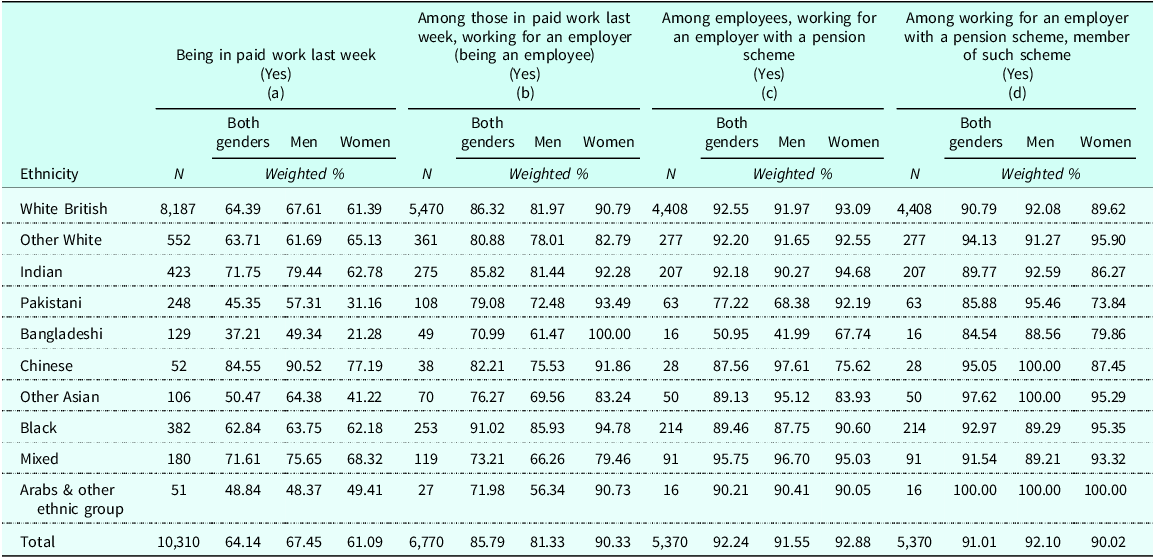
The second part of our analysis focuses on the latest data available for each outcome variable (either wave 12 or 13). Table 1 presents the percentages by ethnic group and gender of being in paid work; among those in paid work, being an employee; among employees, working for an employer who offers a workplace scheme; and finally, being a member of such a scheme. Individuals from Bangladeshi and Pakistani communities fare the worst in all four outcomes. However, the results for the outcome (being a member of a workplace pension scheme) were not statistically significant (Table S8).
Descriptive statistics of the study population among adults aged 45–64 in the UK using UKHLS-Wave 12 (2020–2022)

Table 1. Long description
The table shows ethnic and gender disparities in terms of being in paid work, working as an employee, working for an employer who offers a pension scheme, and being a member of a workplace pension scheme among adults aged between 45-64, between 2020-2022, using UKHLS data. For example, women are generally less likely than men to be in paid work and to have workplace pension membership, and women from Pakistani and Bangladeshi communities fare the worst.
Source: Authors’ calculation.
Notes: White British ethnic category includes British/English/Scottish/Welsh/Northern Irish; Black ethnic category includes African/Caribbean/Any Other Black background; Other White ethnic category includes Irish/Gypsy traveller/Irish traveller/Any Other White background; Mixed ethnic category includes White and Black Caribbean/White and Black African/White and Asian/Any Other Mixed background.
Significance levels: (a) All p < 0.001 and N = 10,310 cases; (b) both genders & men have p < 0.001, women p < 0.05 and N = 6,770 cases; (c) both genders & men have p < 0.001, women p < 0.05 and N = 5,817 cases; (d) all are statistically insignificant. Here, N is the total sample number (unweighted).
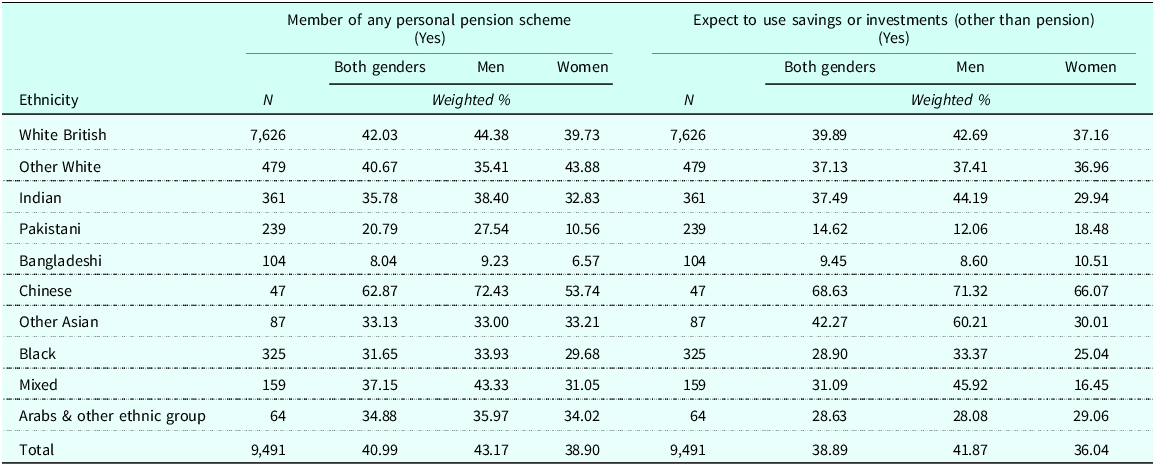
Descriptive statistics of the study population among adults aged 45–64 in the UK using UKHLS-Wave 13 (2021–2023)

Table 2. Long description
The table shows ethnic and gender disparities in terms of having personal pension membership, and expecting to use savings or investments in later life, among adults aged between 45-64, between 2020-2022. Women are generally less likely than men to have personal pension membership and to expect to use savings and investments, and those from Pakistani, Bangladeshi and Mixed ethnic backgrounds fare the worst.
Source: Authors’ calculation.
Notes: White British ethnic category includes British/English/Scottish/Welsh/Northern Irish; Black ethnic category includes African/Caribbean/Any Other Black background; Other White ethnic category includes Irish/Gypsy traveller/Irish traveller/Any Other White background; Mixed ethnic category includes White and Black Caribbean/White and Black African/White and Asian/Any Other Mixed background.
Significance levels: Both genders, p < 0.000; Men, p < 0.000; Women, p < 0.000; N = 9,491 cases. Here, N is the total sample number (unweighted).
Table 2 presents the percentage distribution of personal pension membership and non-pension savings or investments among adults aged forty-five to sixty-four by gender. Men and women from Bangladeshi communities are the least likely to be members of a personal pension scheme (8 per cent), followed by individuals from Pakistani (21 per cent), Black (32 per cent), Indian (36 per cent) and Arab & Other communities (35 per cent), while persons from Chinese communities are the most likely (63 per cent). Gender differences permeate these results: women are less likely than men to have a personal pension in all groups, except women from Other White, Other Asian and Arab & Other ethnic communities. Individuals from Bangladeshi communities also show the lowest proportion in terms of expecting to use non-pension savings/ investments in retirement (9 per cent), followed by those from Pakistani (15 per cent), Arab & Other (29 per cent), Black (29 per cent) and Mixed communities (31 per cent), while individuals from Chinese communities are the most likely (79 per cent). Women are less likely than men to expect to use such investments across all groups, with the most significant gender difference in the Indian and Mixed groups (for example, 44 per cent among men and 30 per cent among women from Indian communities).
Factors associated with being in paid work as an employee and working for an employer with a pension scheme
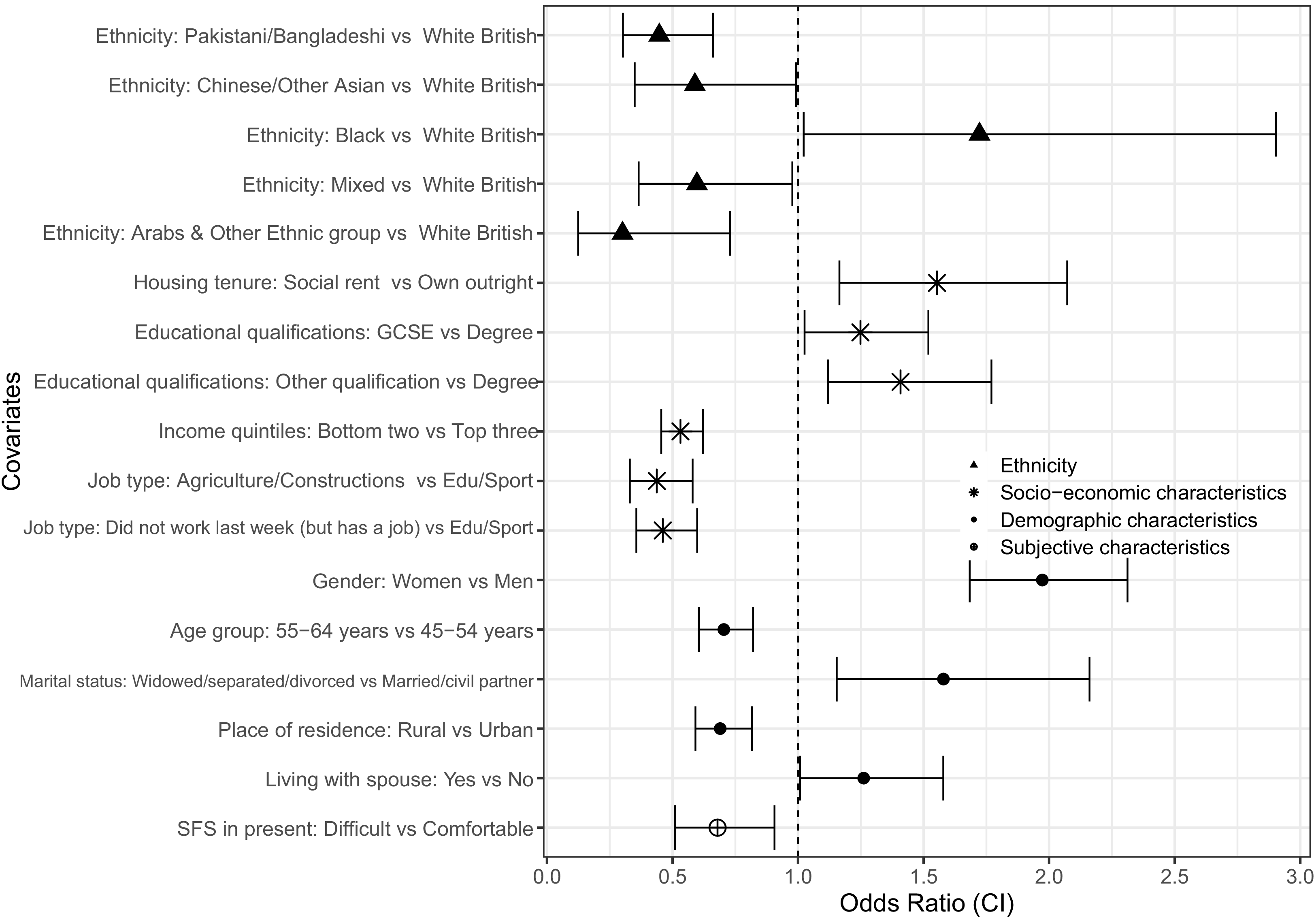
We analysed the importance of ethnicity in predicting various employment outcomes among the working-age population. After controlling for other variables, ethnicity is a statistically significant predictor for all outcomes except for workplace pension membership. Figure 3 shows that among those in paid work, individuals from Pakistani/Bangladeshi (46 per cent), Mixed (40 per cent) and Arab & Other ethnic communities (69 per cent) are significantly less likely to work as employees, compared to White British individuals. Figure 4 indicates that individuals from Pakistani/Bangladeshi communities are 63 per cent less likely to work for an employer with a pension scheme compared to White British individuals. The detailed regression results for all four outcomes are shown in Tables S5–S8.
Binary logistic regression results of working as an employee among adults aged forty-five to sixty-four years in the UK.
Source: Authors’ calculation using UKHLS (wave 12; 2020–2022).
Notes: N = 6,770 cases; All the variables are statistically significant at 1 per cent and 5 per cent level of significance.
GCSE-General Certificate of Secondary Education; SFS-Subjective financial situation.

Figure 3. Long description
Figure showing binary logistic regression results of working as an employee among adults aged 45-64 in the UK, between 2020-2022. For example, individuals from Pakistani and Bangladeshi communities are statistically significantly less likely to be working as en employee than their White British counterparts.
Binary logistic regression results of being an employee working for an employer with a pension scheme among adults aged forty-five to sixty-four years in the UK.
Source: Authors’ calculation using UKHLS (wave 12; 2020–2022).
Notes: N = 5,817 cases; All the variables are statistically significant at 1 per cent and 5 per cent level of significance.
SFS-Subjective financial situation.

Figure 4. Long description
Figure showing binary logistic regression results of working for an employer who offers a pension scheme among adults aged 45-64 in the UK, between 2020-2022. For example, individuals from Pakistani and Bangladeshi communities are statistically significantly less likely to be working for such an employer compared to their White British counterparts.
Factors associated with being a member of a personal pension scheme
Figure 5 presents the binary logistic regression results of being a member of a personal pension scheme among adults aged forty-five to sixty-four years in the UK, using data from wave 13 (detailed results in Table S9). Controlling for other variables, individuals from Bangladeshi and Pakistani communities are 74 and 44 per cent, respectively, less likely to have personal pension membership compared to individuals from White British communities. In contrast, those from Other White and Chinese communities are 27 and 157 per cent, respectively, more likely to have such membership. Socio-economic factors were also strongly linked with personal pension membership. Individuals who owned their home with a mortgage are 15 per cent more likely to have personal pension membership than those who own their home outright, while those socially renting are 39 per cent less likely. The odds of personal pension membership were lower among individuals with lower educational qualifications compared to those with a degree, while individuals in the bottom two income quintiles were 20 per cent less likely to have personal pension membership compared to individuals in the top three quintiles. Those working in agriculture/construction/industrial sectors were more likely to have personal pension membership than those working in education/sport; while those receiving income support were 63 per cent less likely than those who do not have such membership. Individuals who did not work last week (but have a job) were 76 per cent less likely to have a personal pension compared to those working in education/sport, while those expecting to use non-pension savings/ investments in retirement were 48 per cent more likely to have personal pension membership than those with no such expectation.
Binary logistic regression results of being a member of a personal pension scheme among adults aged 45–64 years (2021–2023).
Source: Authors’ own calculation using UKHLS (wave 13; 2021–2023).
Note: N = 9,491 cases. All the variables are statistically significant at 1 per cent and 5 per cent level of significance.
GCSE-General Certificate of Secondary Education; SFS-Subjective financial situation.

Figure 5. Long description
Figure showing binary logistic regession results of being a member of a personal pension scheme among adults aged 45-64 in the UK, between 2021-2023. For example, Other White individuals are more likely than White British individuals to have such membership, while Pakistani and Bangladeshi individuals are less likely.
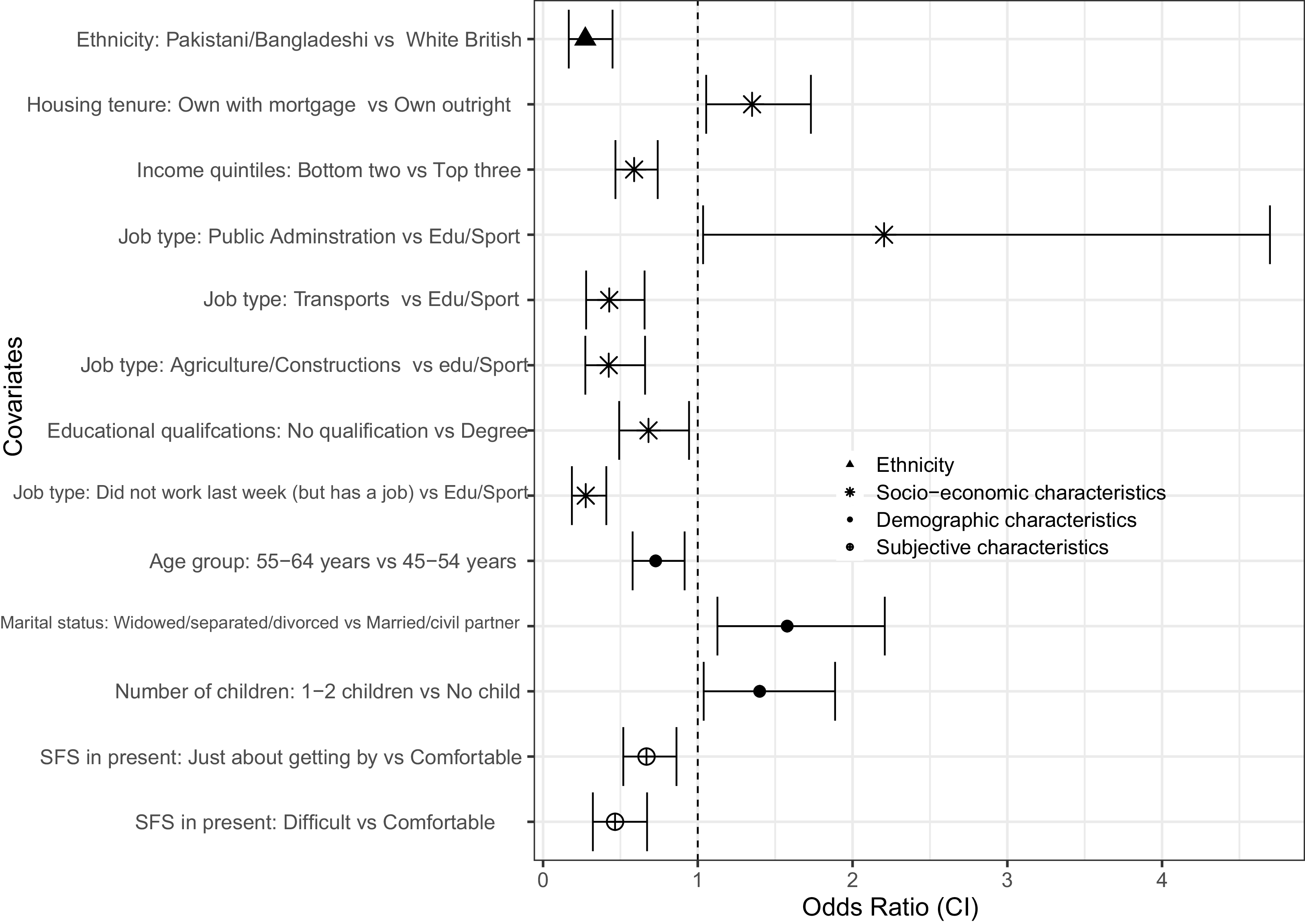
Age is also important, with those aged fifty-five to sixty-four being 27 percent less likely than those aged forty-five to fifty-four to be members of a personal pension scheme. Individuals who came to the UK between 1970 and 1999 and between 2000 and 2020 were 31 and 38 per cent, respectively, less likely to have personal pension membership than those born in the UK. Those with one to two children were 25 per cent more likely to have a personal pension than those with no children. Persons with poor SRH were 18 per cent less likely to have personal pension membership than those with good SRH.
Finally, individuals who were just about getting by financially in the present were 13 per cent less likely than those feeling financially comfortable to have personal pension membership.
Factors associated with expecting to use savings or investments (other than pension) in retirement
Figure 6 presents the likelihood of expecting to use non-pension savings/investments in retirement among adults aged forty-five to sixty-four years in the UK, using wave 13 (detailed results in Table S10). Consistent with the descriptive analysis, individuals from Pakistani and Bangladeshi communities were 63 and 59 per cent, respectively, less likely to expect to use such savings/investments, controlling for other variables, whereas those from Chinese and Mixed ethnic communities were 389 and 92 per cent, respectively, more likely than individuals from White British communities to expect to use such savings. Women were 19 per cent less likely than men to expect to use savings/investments in retirement, while divorced/widowed/separated persons were 21 per cent less likely to expect to use such savings compared to married/civil partnered persons. In terms of health status, individuals with poor SRH were 34 per cent less likely to expect to use savings/investments compared to those with good SRH. Individuals with any personal pension membership were 49 per cent more likely to expect to use savings/investments in retirement compared to those without such membership. However, individuals owning their home with a mortgage, renting socially or privately, and residing in other types of housing tenure were 57, 76, 63 and 76 per cent, respectively, less likely to expect to use savings/investments than homeowners. Higher educational qualifications were associated with such an expectation, as those with GCSE qualifications, other qualifications, or no qualifications were 39, 42 and 28 per cent less likely to expect to use savings/investments compared to those with a degree, while those in the bottom two quintiles were 24 per cent less likely to expect to use savings/investments than those in the top three quintiles. Persons working in public administration, banking/financial services or the agriculture/construction/industrial sectors were 28, 153 and 21 per cent, respectively, more likely to expect to use savings/investments than those working in education/sport. Finally, those receiving income support were 49 per cent less likely to expect to use savings/investments in retirement than those who did not receive income support. Tables S2 and S3 show the relationship between ethnicity and all socio-economic variables.
Binary logistic regression results of expecting to use savings or investments (other than pensions) in retirement among adults aged forty-five to sixty-four years (2021–2023).
Source: Authors’ own calculation using UKHLS (wave 13; 2021–2023).
Notes: N = 9,491 cases. All the variables are statistically significant at 1 per cent and 5 per cent level of significance.
GCSE-General Certificate of Secondary Education; SFS-Subjective financial situation.

Figure 6. Long description
Figure showing binary logistic regression results of expecting to use savings or investments in retirement among adults aged 45-64 in the UK, between 2021-2023. For example, Pakistani and Bangladeshi individuals are less likely than White British individuals to expect to use such savings or investments in retirement.
Subjective indicators were significantly associated with expecting to use non-pension savings/investments in retirement. Individuals who felt neutral or were dissatisfied with their income were 40 and 33 per cent, respectively, less likely to expect to use savings/investments compared to those who were satisfied. Those who just about got by or experienced a difficult financial situation in the present were 61 and 80 per cent, respectively, less likely to expect to use savings/investments compared to those reporting financial comfort. The analysis of interaction effects showed that women from mixed ethnic communities were 68 per cent less likely than men from White British communities to have such an expectation.
Discussion and conclusion
In this paper, we aimed to empirically investigate how ethnicity interacts with gender and other individual characteristics and how it relates to working-age individuals’ workplace, personal pension membership, and individuals’ expectations to use non-pension savings/investments in retirement. With such evidence, the paper informs broader debates about the combined ethnic/gender penalty in social policies (Cribb et al., Reference Cribb, O’Brien and Sturrock2025). Our findings indicated that, controlling for other variables, ethnicity is associated with workplace pension membership, as individuals from Bangladeshi and Pakistani communities fare worse than individuals from other ethnic groups in terms of being in paid work, working as an employee, and working for an employer who offers a workplace pension scheme. Such findings are in line with previous research (Vlachantoni et al., Reference Vlachantoni, Evandrou, Falkingham and Gomez-Leon2020); however, our empirical analysis is contextualised in the broader policy context of the introduction of AE, which sheds new light on persistent ethnic and gender gaps in pension membership. Gender continues to permeate ethnic gaps, with women faring consistently worse than men, in line with earlier research (Collins, Reference Collins2020; Ginn & Foster, Reference Ginn and Foster2023). The trends of workplace pension membership shown in our analysis shed new light on the increasing proportions among men and women aged forty-five to sixty-four, albeit with ethnic and gender differences persisting. Our analysis adds greater detail and empirical evidence to the government’s own assessment of the impact of the AE scheme (Department for Work and Pensions, 2018, 2023). The paper also makes use of nationally representative data to contribute to academic knowledge about how ethnic inequalities are shaped within societies and welfare systems, and used to inform policy.
Important ethnic gaps remain in the pension system, with the merged Pakistani/Bangladeshi group lagging behind other ethnic groups, mostly due to male patterns. Such gap may continue to exist as a result of the combined effect of low awareness of the long-term benefits of belonging to a workplace pension (Adami, Reference Adami2022), a lower socio-economic status within the labour market (Longhi & Brynin, Reference Longhi and Brynin2017), or an active preference not to have pension membership (Cribb et al., Reference Cribb, O’Brien and Sturrock2025; Khan, Reference Khan2012). Empirical evidence lends support to this argument, noting that more than 40 per cent of working-age persons believe that pensions would not be around in thirty years (Cribb et al., Reference Cribb, Emmerson, Johnson and Karjalainen2024). Our analysis showed that ethnicity is important in terms of being in paid work, working as an employee and working for an employer who offers a pension scheme; however, not in terms of being a member of a workplace scheme. This highlights the importance of ethnicity in all the stages preceding the point of working for an employer with a workplace scheme.
Beyond workplace pensions, our paper also adds unique evidence to the literature in terms of how ethnicity and gender are associated with personal pension membership and individuals’ expectation of using non-pension savings and investments in retirement. Individuals from Pakistani and Bangladeshi communities, and particularly women among them, are far less likely to have personal pension membership or to expect to use non-pension savings/investments in retirement, further exacerbating their pension disadvantage. At the same time, the proportion of individuals with personal pension membership has increased significantly since 2020, and industry stakeholders note increasing awareness of the importance of such pensions among younger cohorts (LGIM, 2023). At the other end, individuals from Chinese communities, and particularly men among them, fare the best in terms of these two indicators, which merits further investigation in terms of individuals’ and families’ motivations, financial planning for later life and the impact of their migration patterns (Song & Liang, Reference Song and Liang2019). Existing research using different data has shown that men from Chinese communities in the UK have experienced the greatest improvement in their employment status and savings since the mid-1990s (Gough & Adami, Reference Gough and Adami2013).
There are certain limitations to our analysis. Our key pension measures of different types of pension membership, and expecting to use non-pension savings in retirement, are useful in identifying ethnic/gender differences, but they are less informative of individuals’ actual incomes in later life. This limits our ability to comment on whether individuals from different ethnic communities live on sufficient incomes. In addition, pension scheme membership does not equate with actively contributing to such a scheme, nor does it tell us about the level of contributions (if any). We are also not able to assess whether respondents who self-report their workplace pension membership are in fact eligible for such pensions. There are also limitations relating to the UKHLS data. Firstly, the key questions of working for an employer with a workplace pension scheme and being a member of such a scheme are asked every two years in the UKHLS, which means that the most recent information for these variables, both for the trend and the multivariate analyses, was drawn from wave 12. Secondly, the suite of pension membership variables we included in the analysis was not uniformly available across all waves. For example, the variable on expecting to use non-pension savings or investments in retirement was not included in waves 1 and 12 of the UKHLS, while the question on whether respondents were members of a personal pension scheme was not asked in waves 1, 11 and 12. Thirdly, we acknowledge that our depiction of the relationship between income and a binary variable of life satisfaction is a rather simple one: more detailed examinations of this relationship can be found in economics literature such as FitzRoy and Nolan (Reference FitzRoy and Nolan2022). Fourthly, in several points of our analysis, we ran into small sample sizes for different ethnic groups, and in some cases, there were no respondents from specific ethnic groups. Like many colleagues working in this field, we addressed this empirical challenge by merging respondents from certain ethnic groups where possible and reasonable (e.g. Pakistani with Bangladeshi, Chinese with Other Asian); however, we appreciate that this method is not ideal in understanding differences between distinct ethnic groups. Further efforts to ensure the representation of all ethnic groups in national surveys can address this limitation and augment research efforts to understand ethnic differentials.
From a policy perspective, the findings in this paper point to the continued importance of ethnicity and gender in terms of individuals’ workplace and personal pension membership, and their expectations of using non-pension savings/investments in retirement. Although there are positive trends in terms of individuals from minority ethnic communities benefitting from the AE scheme, and from personal pension membership, nevertheless there remain persistent ethnic gaps in pension membership, and persistent gender gaps within ethnic groups, with individuals and particularly women from Pakistani and Bangladeshi communities consistently faring worse. Workplace pensions, as well as non-pension wealth and investment, continue to be important for individuals’ financial wellbeing across the life course. Going forward, lowering the £10,000 threshold for AE eligibility to the lower earnings limit for National Insurance (currently £6,240 per year) has been estimated to bring more than 1.2 million workers into the AE scheme, 15 per cent of whom come from minority ethnic communities (The People’s Pension, 2024). The People’s Pension has also highlighted that requiring pension contributions from the first pound earned, rather than from the lower earnings limit, would positively affect low earners, many of whom come from minority ethnic communities (Ibid). In addition, the Pensions Policy Institute has called for the AE eligibility criteria to widen in order to include individuals with multiple jobs, as currently 79 per cent of multiple jobholders qualify for AE compared to 87 per cent of the full population of employees (Pensions Policy Institute, 2022). Such changes would result in more inclusive workplace pensions for individuals from all ethnic groups.
Previous research has shown that although workplace pensions are generally efficient in reducing the risk of old-age poverty, they are nevertheless less effective in alleviating poverty among the most vulnerable groups in the population (Kuitto et al., Reference Kuitto, Madia and Podesta2023). A separate set of policy implications from this paper rests with addressing the ethnic gaps in terms of being in paid work and working as an employee, where cultural values are important (Zwysen et al., Reference Zwysen, Di Stasio and Heath2021). Research has shown that it is not only lower labour market participation rates which create a policy challenge, but also the fact that individuals from minority ethnic groups tend to work in lower-paid occupations and, in some cases, are affected by discrimination which is difficult to quantify (Lancee, Reference Lancee2021; Longhi & Brynin, Reference Longhi and Brynin2017). Such issues point to more structural constraints, where targeted approaches as outlined by Longhi and Brynin (Reference Longhi and Brynin2017), are called for, including: the identification and removal of barriers to the entry of persons from minority ethnic communities into higher-paid occupations, raising educational attainment among specific groups and conducting further research into unexplained ethnic/gender pay gaps.
Supplementary material
The supplementary material for this article can be found at https://doi.org/10.1017/S0047279426101585
Data availability statement
The present study has used secondary data from the UK Data Service (UKDS) archive. The UKDS is the largest digital repository for quantitative social sciences and humanities research data in the United Kingdom. This data is free, requires registration and can be accessed using the link https://ukdataservice.ac.uk
Financial support
The research for this paper was funded by the Economic and Social Research Council (ESRC), Grant Reference ES/W012529/1.
Competing interests
The author(s) declare none.
Ethical standards
All ethical permissions have been obtained from the University of Southampton with ERGO no 81703.




 Open access

