LANGUAGE CONTACT AND THE QUANTITATIVE PARADIGM
The quantitative paradigm was designed to analyze linguistic variation. This approach begins with the linguistic variable—one or more ways of saying the same thing—and uses rigorous scientific method to determine what influences the occurrence of one variant over another. The statistical validity of the results depends upon the application of the Principle of Accountability (PofA) (Labov, Reference Labov1972), which states that all occurrences and nonoccurrences of a variable must be analyzed.
Although a qualitative approach offers valuable insights, alone it is not suitable for analyzing variation. Conclusions reached qualitatively are generally logically sound, but many have not held up to quantitative scrutiny.Footnote 1 The discrepancy between conclusions reached via these two methods is because the relative, and sometimes interacting, influences of the factors conditioning variation are masked when the PofA is not applied. Given this limitation, I argue that qualitative data alone are insufficient for evaluating variation, which can only properly be understood via accountable, quantitative analysis. Therefore, it is reasonable (necessary) to seek to confirm qualitative conclusions regarding variation via quantitative analysis.Footnote 2
One area where quantitatively untestedFootnote 3 accounts of variation abound is language contact (despite the admirable efforts of, for example, Ruth King [2000] and Shana Poplack [e.g., 1993, 1997]). A major debate in the field, and the subject of many of these untested accounts, concerns the causes of and constraints on structural borrowing, with particular attention to the relative weights of internal and external (that is, linguistic vs. social/demographic) factors. This article quantitatively evaluates some widely accepted, qualitatively based proposals regarding factors conditioning structural borrowing.
The rest of the article is organized as follows. I begin by defining structural borrowing. I enumerate my objections to qualitative approaches and the benefits of strictly applying the PofA to language contact data. I then introduce and motivate the specific contact situation under study, the corpus, the dependent linguistic variable, and the social and linguistic factors considered. I describe the innovation to variationist methods used, present results, and discuss their implications for the fields of language contact and sociolinguistics.
DEFINITIONS
Structural borrowing is the adoption of structural material of one language (language A, or source language) by speakers of another language (B, or recipient language) and used productively in B as part of B.Footnote 4Structural material is any nonlexical aspect of language, including bound, functional morphemes,Footnote 5 and it is “adopted” when it becomes productive in the recipient language.Footnote 6 To identify a borrowing, then, we need real-time evidence and a measure of productivity. There will be no trace of a form in precontact B, but after contact begins, a borrowing consists of a form attributable to A used productively in B.Footnote 7 I describe the measure of productivity in the Methodology section.
WHY EXISTING PROPOSALS ARE INSUFFICIENT
Three aspects of previous analyses of structural borrowing are problematic. The first is how linguistic factors purported to affect structural borrowing are identified, defined, and supported. Many “universals of borrowing” were proposed without benefit of the PofA, but because a “universal” process applies always (invariably), one cannot be identified unless both occurrences and nonoccurrences are counted. Other universals, such as “structural compatibility” are only vaguely defined.
The second problematic aspect is the claim, led by Thomason and Kaufman (Reference Thomason and Kaufman1988), that social factors can explain all structural borrowing. The existence of counterexamples to all proposed linguistic constraints, they argue, proves that those constraints are invalid. This position is weak on several grounds. First, the idea of violable constraints is widely accepted in linguistics (e.g., Prince & Smolensky's [Reference Prince and Smolensky2002] Optimality Theory, first developed in the early 1990s), so it is not a given that one counterexample invalidates a constraint. Second, even if we assume that the linguistic constraints remain valid, despite the existence of counterexamples, Thomason and Kaufman's position is that social factors outweigh linguistic ones in conditioning structural borrowing, but all available quantitative studies contradict this. For example, in monolingual communities, linguistic factors are stronger than social and stylistic factors in conditioning linguistic variation (Preston, Reference Preston1991). Similarly, in the available quantitative studies of contact situations, the structures of the languages in contact (linguistic factors) determine the possible linguistic outcomes of contact-induced change, and individual speakers' sociolinguistic histories (social factors) place speakers within those bounds (Silva-Corvalán, 1994, 1995).
The third troubling aspect revolves around Thomason and Kaufman's borrowing scale, which is probably both the most cited and most criticized tenet of contact theory. In “Predicting extent and kinds of interference” (1988:46, emphasis mine), Thomason and Kaufman provide a rubric in which levels of contact intensity (e.g., a scale from “casual” to “extreme cultural pressure”) are intended to indicate what types of borrowing (lexical, structural) are possible and the extent to which they will occur. The authors created the schema by first identifying a certain type and amount of lexical or structural borrowing, then describing the sociohistorical circumstances of the contact situation in which it occurred, but they later note, “Promising sociohistorical generalizations that might help to distinguish cases of moderate structural borrowing from those of heavy structural borrowing are hard to establish” (1988:94, emphasis mine).Footnote 8 Some studies have attempted to provide quantitative support for Thomason and Kaufman (e.g., Hauge, Reference Hauge2002), but they have done so backwards. They assume that the presence of certain types of borrowings is, in itself, evidence of a particular level of intensity of contact, which does not hold given the way the scale was constructed. Ultimately, the scale is circular—intensity of contact is meant to predict the degree of borrowing possible, but the scale is employed by assuming that a given level of intensity exists when certain types of contact-induced structural change are observed.
Generally, then, my objections to Thomason and Kaufman's scale are philosophical—to say that more intense contact leads to more intense structural borrowing is logical, but lacks predictive force as long as we cannot objectively measure contact intensity and show that increasing levels of structural borrowing are statistically correlated with increases in contact intensity.
BENEFITS OF APPLYING QUANTITATIVE METHODS AND THE PRINCIPLE OF ACCOUNTABILITY
The problems presented in the previous section can be addressed via an accountable, quantitative analysis. Carefully redefining the proposed linguistic factors to make them quantifiable also eliminates vagueness, and the subsequent application of the PofA allows “universality” to be assessed. The question of whether linguistic or social factors are stronger is straightforwardly answered by the statistics—the range of VARBRUL weights for each factor group is a direct measure of that group's strength. Finally, Thomason and Kaufman's borrowing scale can be tested by objectively measuring contact intensity, and attempting to statistically correlate it to types of borrowings. One accountable, quantitative analysis cannot definitively solve these problems, but after more such studies, a pattern should emerge. Investigating structural borrowing quantitatively requires the PofA and related variationist methods to be applied in a unique manner, described in the following sections.
THE CONTACT SITUATION, DATA, AND VARIABLES
Contact situation
Because one of my goals is to assess the effects of different linguistic structures and different social circumstances on structural borrowing, I selected the contact situation on the Caribbean islands of Aruba and Curaçao,Footnote 9 where Papiamentu (Iberian creole), Dutch, Spanish, and English (American and Caribbean varieties) are in contact. I take Papiamentu as the recipient language for borrowings from any or all of the other language varieties.Footnote 10 The role of linguistic structure can be assessed because borrowings can come from four structurally distinct language varieties. The roles of social/demographic factors can be assessed because the social circumstances of Aruba and Curaçao are distinct and have each undergone drastic changes in the 20th century.
The corpus
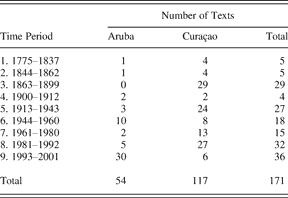
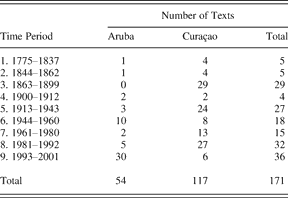
The real-time data used in the present study come from 171 written texts,Footnote 11 54 from Aruba and 117 from Curaçao (Table 1). Papiamentu stabilized during the first part of the 18th century, and creolization was complete by the early 18th century (Munteanu, Reference Munteanu1996). The earliest extant text is from 1776. Thus, any foreign forms that first appear in the 19th or 20th centuries are borrowings, not the result of creolization.Footnote 12
Number of texts according to period and island
Textual data is supplemented with sociolinguistic interviews recorded by the author in 2003 (50 from Aruba, 52 from Curaçao) with speakers aged 18 to 82. Assuming no major changes in an individual's grammar after age 20 (Labov, Reference Labov1994; Sundgren, Reference Sundgren2002), interviews provide evidence for Papiamentu as spoken from 1941 to 2003. The analysis here largely reflects forms as used in the texts; interviews were only used to confirm the findings in texts and to fill in information for those periods when a sufficient number of texts was unavailable.Footnote 13
The verb phrase as a locus for the dependent variable
To obtain an accountable analysis of structural borrowing, the PofA must be applied at a structural level. I focus on a structural subsystem—verbal morphologyFootnote 14—in which borrowing is comparatively difficult (e.g., Campbell, Reference Campbell, Aertsen and Jeffers1993; Thomason & Kaufman, Reference Thomason and Kaufman1988), but has been observed in Papiamentu (e.g., Dijkhoff, Reference Dijkhoff2000; Munteanu, Reference Munteanu1996; Sanchez, Reference Sanchez2000, Reference Sanchez, Johnson and Sanchez2002, Reference Sanchez2005a, Reference Sanchez and Wagner2005b, Reference Sanchez, Deumert and Durrleman2006; Wood, Reference Wood1971). I propose the following variable rule:
An element of verbal morphology is borrowed.
The dependent variable is whether or not a form or function from the verbal morphology of Dutch, Spanish, or English is borrowed into Papiamentu.
To evaluate whether or not form and function are borrowed separately, they are coded separately. I distinguish between the phonological form of a morpheme and the function or grammatical category it represents.Footnote 15 For periphrastic forms, I distinguish among the phonological form of lexical items comprising the periphrasis, their lexical meaning, and the function expressed by the entire periphrasis so that I can distinguish among a calque (a borrowing of the framework or template of a periphrasis expressed via phonological forms from the recipient language), borrowing of a phonological form, borrowing of a function represented by a single form or periphrasis, or any combination. For example, the Dutch passive is composed of the passivizing verb worde, which has the lexical meaning “become,” and a past participle. The phonological form worde with its function as a passivizer may be borrowed, creating a syntactic passive where none existed before. The phonological form worde may be borrowed as a marker of an existing passive construction. A passivizer may be calqued on the lexical meaning “become” and its passivizing property adopted, or a calque of worde may be used as a marker of an existing passive construction.
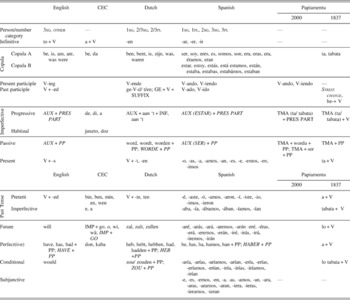
The list of possible borrowings, all commonly usedFootnote 16 elements of the verbal paradigms of Dutch, Spanish,Footnote 17 English, and Caribbean English Creole (CEC), is given in Table 2. Abstract structural elements and functions are indicated by CAPS, phonological forms are in normal font, and periphrasis templates are in CAPS and ITALICS. In the far right column of Table 2 are forms used in the Papiamentu verb system in 1837. Many of these can be traced to a foreign source, incorporated during creolization in the 17th century. To the left of that are foreign forms used productively in 2000. All 1837 forms are still in use in 2000, and none of the 2000 forms were productive in 1837. Where both columns are filled, the 1837 form is currently used in addition to the newer, borrowed form.
Verbal morphemes of the languages in the contact situation

Note: AUX = auxiliary, IMP = imperfective, INF = infinitive, PL = plural, PP = past participle, PRES PART = present participle, SG = singular, TMA = tense, mood, aspect marker (includes Papiamentu ta, tabata, a, and lo, unless otherwise specified), V = verb.
When one language does not make a distinction made by another, there is no line dividing the categories in Table 2 for the language without the distinction. When a language does not mark something marked by another language, the relevant space is filled with a dash(—). Finally, the categories listed are those overtly marked by at least one language, and they are listed as marked (e.g., as a combined tense/aspect category).Footnote 18 There are 191 possible borrowings: 21 from English, 22 from CEC, 38 from Dutch, and 110 from Spanish.Footnote 19
Social/demographic variables
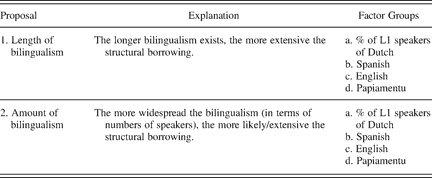
Table 3 lists quantifiable social factors purported to influence structural borrowing.Footnote 20 “Intensity of contact” is indicated by “length” and “amount of bilingualism” (Table 3; 1 and 2, respectively) (Thomason, Reference Thomason2001; Thomason & Kaufman, Reference Thomason and Kaufman1988; for quantitative studies, see Mougeon & Beniak, Reference Mougeon, Beniak, Guy, Feagin, Schiffrin and Baugh1996; Nagy, Reference Nagy, Boberg, Meyerhoff and Strassel1997; Silva-Corvalán, 1993, 1994). The census provides no statistics on bilingualism, but historical and ethnographic studies show that bilingualism increased as the population of L1 speakers of other languages increased in the 20th century (Fouse, Reference Fouse2002; Goslinga, Reference Goslinga1979, Reference Goslinga1990; Green, Reference Green1974; Hartog, Reference Hartog and Verleun1961a, Reference Hartog1988; Haviser, Reference Haviser1991; Klomp, Reference Klomp and van der Elst1986; Pietersz, Reference Pietersz1985). I assume that the proportion of L1 speakers of a language indicates the “amount of bilingualism” in that language, and “length” can be measured by assuming that bilingualism began when appreciable numbers of L1 speakers of a language first immigrated (weight of “2” or more, explanation follows).Footnote 21
Social factors that may influence structural borrowing
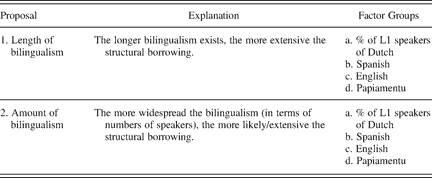
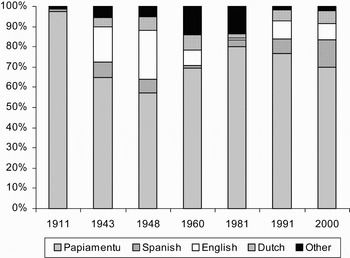
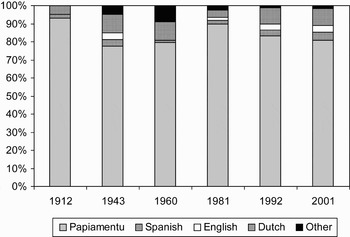
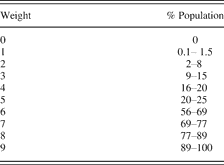
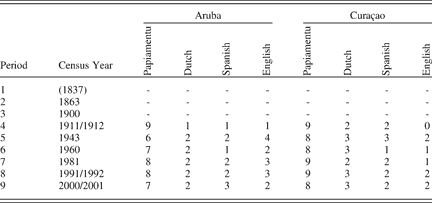
To quantify demographic changes, or amount of bilingualism, I assigned a weight (0–9) according to the estimated number of L1 speakers of each language (Table 3; a–d). Table 4 shows how the weights were assigned, and Table 5 shows the specific weight assigned to each language in each period. Periods were determined as follows: periods 1 and 2 are separated by several years for which no texts are extant. The breaks after periods 2 and 3 are marked by major social events (emancipation, and the turn of the 20th century). Breaks between the 20th century periods correspond to years in which census data was collected. For example, period 4 ends in 1912, when the first modern census was taken; period 5 ends in 1943, when the second census was taken, and so on. Relative changes in language contact during the 20th century are shown in Figures 1 and 2; population figures are given in Tables 6 and 7 (Alofs & Merkies, Reference Alofs and Merkies2001; Central Bureau of Statistics, 1993a, 2001a, 2002a; Central Bureau voor de Statistiek, 1983, 1994; Goslinga, Reference Goslinga1990; Hartog, Reference Hartog1961c; Hawley, Reference Hawley1960; Hiss, Reference Hiss1943; Pietersz, Reference Pietersz1985).
Proportion of Aruban population by “language used most often at home.”

Proportion of Curaçao population by “language most spoken at home.”

Assignment of weights to population
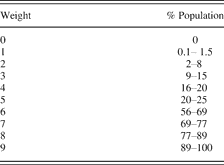
Weights assigned for proportions of native speaking populations of each of the four major languages spoken on Aruba and Curaçao
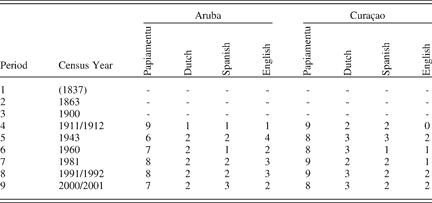
Note: Data for 1911–1960 are estimates of “language most spoken at home” based on census reports of “nation of birth”; data for 1981–2000 are based on census reports of “language most spoken at home.” “Other” languages include Haitian Creole French, Portuguese, and Chinese, as well as “language not known or not reported.” In periods 4, 8, and 9, Aruba and Curaçao conducted their respective censuses in successive years.
Total population of Aruba in the 20th century

Total population of Curaçao in the 20th century

Linguistic variables
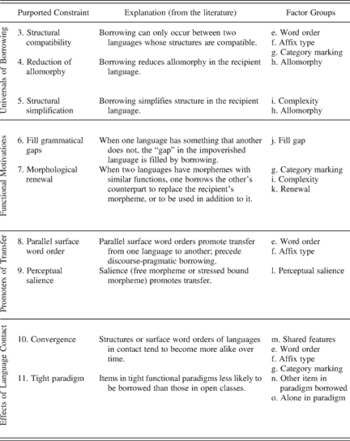
Linguistic variables chosen for study (Table 8) were gleaned from work in language contact, second language acquisition, historical and comparative linguistics, and related fields. They were proposed in the literature as structural universals (Table 8; 3–5), functional motivations for borrowing (Table 8; 6–7), or as descriptions of transfer (Table 8; 8–9) or contact-induced change (Table 8; 10–11). I included all factors that I could reliably quantify in order to test the logical possibilities as per the PofA. Below, I explain the factors as proposed in the literature and the factor groups I used to quantify them (Table 8; e–o). In most cases, I quantified factors with one or more independent factor groups; several of the groups I created are used to quantify multiple proposals from the literature.
Linguistic factors that may influence structural borrowing

Three borrowing universals are proposed in the literature. “Structural compatibility” (Table 8; 3) (Aitchison, Reference Aitchison1981; Allen, Reference Allen1980; Bickerton, Reference Bickerton1981; Ebert, Reference Ebert1978; Jakobson, Reference Jakobson1938; Meillet, Reference Meillet1921; Vachek, Reference Vachek and Malmberg1972; Weinreich, Reference Weinreich1953) is tested via three factor groups (Table 8; e, f, g). In “word order” (Table 8; e), I code for whether or not Papiamentu and the source language have the same word orderFootnote 22 surrounding a possible borrowing (compared by grammatical category or sentential role, as appropriate) as in (1) and (2). Languages with the same word order as Papiamentu are bolded.
(1) Progressive Papiamentu TMA MARKER + VERB + [OBJ] + [adverb]
Spanish AUX (ESTAR) + VERB-PRESPART+ [OBJ]
English AUX (BE) + VERB-PRESPART + [OBJ]
Dutch AUX (BEN) + [OBJ] + aan het + VERB (INF)
CEC TMA MARKER (DE, DI, A) + VERB + [OBJ]
(2) Copula A Papiamentu SUBJECT + COPULA + PREDICATE
Spanish SUBJECT + COPULA + PREDICATE
English SUBJECT + COPULA + PREDICATE
Dutch SUBJECT + ADJ/NOUN + COPULA
CEC SUBJECT + COPULA + PREDICATE
In (1), Spanish, English, and CEC share word order with Papiamentu. The Dutch OBJECT and preposition aan het “on the” intervene between the auxiliary and verb in main clauses, making the word orders of Dutch and Papiamenetu different.Footnote 23 In (2), only the Dutch surface form in main clauses (SUBJECT + PREDICATE + VERB) is different from Papiamentu, which is SUBJECT + COPULA + PREDICATE.
In “affix type” (Table 8; f), I code for whether the foreign morpheme is free or a bound prefix or suffix.Footnote 24 In “category marking” (Table 8; g), I code for whether or not Papiamentu and the source language mark grammatical categories in the same way (e.g., Spanish verbal morphology marks first, second, and third person singular and plural; Papiamentu marks none of these). This is a binary category.
The second proposed universal, “reduction of allomorphy” (Table 8; 4) (Coteanu, Reference Coteanu1957; Heath, Reference Heath1978; Maher, Reference Maher1985; Vogt, Reference Vogt1948 Weinreich, Reference Weinreich1953; see Bubenik, Reference Bubenik and Matras1995, for counterargument), is tested via “allomorphy” (Table 8; h). I code for whether borrowing of a morpheme would result in a reduction in allomorphy, the same amount of allomorphy, or increased allomorphy.
The final universal, “structural simplification” (Table 8; 5), is simply a more general statement of allomorphy. It is tested via (h) and an additional group, “complexity” (Table 8; i), which marks whether the borrowing of a morpheme would result in the introduction of an additional grammatical category, an additional distinction within a grammatical category, or no new distinction.
Two functional motivations of borrowing were proposed: that a grammatical gap is filled by borrowing, and that borrowing serves as a kind of morphological renewal. A grammatical gap occurs when one language expresses a grammatical category or distinction that another does not. “Fill grammatical gap” (Table 8; 6) (Campbell, Reference Campbell1987; Campbell & Mithun, Reference Campbell and Mithun1981; Hale, Reference Hale, Kinkade, Hale and Werner1971; Heath, Reference Heath1978; Hill & Hill, Reference Hill and Hill1981; Karttunen, Reference Karttunen, Steever, Walker and Mufwene1976; Mithun, Reference Mithun and Traugott1980; Vachek, Reference Vachek and Malmberg1972; see Brody, Reference Brody1987:508, for counterargument) is tested via “fill gap” (Table 8; j). Here (examples (3)–(5)), I code foreign morphemes as (a) expressing a category or distinction that Papiamentu does not express specifically and explicitly in any way (italicized),Footnote 25 (b) expressing a category or distinction morphologically that Papiamentu expresses in an alternate (nongrammaticalized) way (i.e., with adverbs; underlined), or (c) expressing a category or distinction morphologically that Papiamentu also expresses morphologically (variably or always; bolded). The remaining examples are those in which neither Papiamentu nor the other language expresses a category morphologically (e.g., person/number in the Papiamentu and CEC verb phrases); in some cases, neither language expresses the category at all.
(3) PROGRESSIVE Papiamentu TMA + VERB + [OBJ] + [adverb]
Spanish AUX (ESTAR) + VERB-PRESPART+ [OBJ]
English AUX (BE) +VERB-PRESPART
Dutch AUX (BEN) +[OBJ] + aan het + VERB (INF)
CEC TMA (DE, DI, A) + VERB
(4) PERSON/NUMBER Papiamentu NO MARKING ON VERB
Spanish 1SG, 1PL, 2SG, 3SG, 3PL
English 3SG, OTHER
Dutch 1SG, 2/3SG, 2/3 PL
CEC NOMARKING ON VERB
(5) Copula (A) Papiamentu SUBJECT + COPULA + PREDICATE
Spanish SUBJECT + COPULA + PREDICATE
English SUBJECT + COPULA + PREDICATE
Dutch SUBJECT + ADJ/NOUN + COPULA
CEC SUBJECT + COPULA + PREDICATE
For a borrowed morpheme to result in “morphological renewal”, it should replace a native form without introducing additional distinctions or nuances, and it should be of the same type as the native form (i.e., a bound form should replace a bound form; a prefix should replace a prefix, etc.). “Morphological renewal” (Table 8; 7) (Heath, Reference Heath1978; Lightfoot, Reference Lightfoot, Hornstein and Lightfoot1981; Sommerfelt, 1980; Thomason & Kaufman, Reference Thomason and Kaufman1988; Weinreich, Reference Weinreich1953) is thus tested via two factor groups previously proposed, (g) and (i), and “renewal” (Table 8; k). In (k), I code for whether the foreign morpheme (a) has no Papiamentu counterpart, (b) is synonymous with a native form of a different type, or (c) is synonymous with a native form of the same type.
Factors that promote transfer may lead to borrowing (Siegel, Reference Siegel1999). “Parallel surface word order” (Table 8; 8) (Prince, Reference Prince1988) is said to promote transfer. It is defined here by the previously specified factor groups (e) and (f). “Perceptual salience” (Table 8; 9) (Siegel, Reference Siegel1999, Reference Siegel2003) holds that salient items are transferable and, therefore, borrowable. I test this via the binary factor group “perceptual salience” (Table 8; l), where free and stressed bound morphemes are salient.
Other contact situations have exhibited convergence and the effects of paradigmatic coherence. “Convergence” (Table 8; 10) (Aikhenvald, Reference Aikhenvald2002; Gumperz & Wilson, Reference Gumpertz, Wilson and Hymes1971; Hock, Reference Hock1986; Lindstedt, Reference Lindstedt, Gilbers, Nerbonne and Schaecken2000; Mougeon & Beniak, Reference Mougeon and Beniak1991; Silva-Corvalán, 1994), the falling together of surface word orders, is tested via “shared features” (Table 8; l), and three previously proposed groups (e), (f), (g). In (m), I code for whether one, two, or three languages in the contact situation have a morphological form marking a particular function. Two languages are said to have a form marking the same function if and only if the languages are structurally compatible with each other, but not necessarily with Papiamentu (as per the criteria used to test “structural compatibility” [Table 8; 3 (e), (f), (g)]) with respect to the morphemes in question. As we can see in example (1), English and Spanish both mark the progressive and are both structurally compatible with each other (with respect to this feature), so in this case, two languages in the contact situation are said to share features.
Finally, I consider the possible effects of “paradigmatic coherence” (Table 8; 11). Van Hout and Muysken (Reference Van Hout and Muysken1994) found that (nominal) functional items in tight paradigms (e.g., pronouns, as opposed to the general class of nouns) are more difficult to borrow than items in broader classes. Here I examine verbal morphology, where almost all the items may be said to belong to tight paradigms. Given Van Hout and Muysken's findings, perhaps items alone in a paradigm are easier to borrow, or perhaps items in a tight paradigm are borrowed together. Perhaps both are true. I consider the following question: To what extent are the set of morphemes that mark the same tense/aspect category in one language likely to be borrowed together? This is tested via two additional, binary factor groups: “other item in paradigm borrowed” (n) and “alone in paradigm” (o). In (n), another item in the tense/aspect paradigm of the same language is borrowed or not. In (o), the item in question is alone in the paradigm or not.
METHODOLOGY
As per the PofA, occurrences and nonoccurences of the dependent variable were considered. I coded each foreign form in Table 2 as “not borrowed” or “borrowed” (used productively). Productive means occurring at least three times in one text or one or more times per text in at least three texts during a given period. Additionally, for bound morphemes, productive means the morphemes are found with more than one verb.Footnote 26 Previous work suggests that speakers on Aruba and Curaçao use separate dialects (Howe, Reference Howe1994; Kouwenberg & Murray, Reference Kouwenberg and Murray1994; Kouwenberg & Muysken, Reference Kouwenberg, Muysken, Arends, Muysken and Smith1994; Munteanu, Reference Munteanu1996; Ratzlaff, Reference Ratzlaff1992), so I ran data from the two islands separately.Footnote 27
Most variationist analyses count tokens, or every instance of a particular morpheme (Paolillo, Reference Paolillo2002). However, this investigation deals with possible types of borrowings from among the entire system of verbal morphology, so each of the 191 forms in Table 2 were coded as borrowed or not once (i.e., as types) per period, for a total of 1719 tokens from 9 periods.Footnote 28 The data (1528 tokens per island—excluding tokens in the first [control] time period in which there were no borrowings) were analyzed with the Goldvarb 2001 statistical program (Robinson, Lawrence, & Tagliamonte, Reference Robinson, Lawrence and Tagliamonte2001).
RESULTS
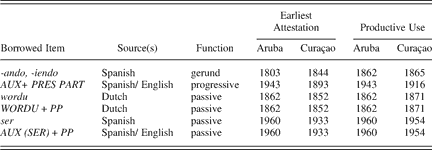
The following forms were borrowed: gerundive -ando and -iendo, the periphrastic progressive AUXILIARY + PRESENT PARTICIPLE (6), the passivizing verbs wordu and ser, and the passive constructions WORDU + PAST PARTICIPLE (7) and AUX (SER) + PAST PARTICIPLE (8) (Table 9). The constructions AUX + PRESENT PARTICIPLE and AUX + PAST PARTICIPLE exist in both English and Spanish with progressive and passive functions, respectively. When Papiamentu speakers use one of these constructions productively, I counted it as a borrowing from both the English and Spanish periphrasis templates.Footnote 29 This makes a total of nine borrowed items (two bound morphemes, two free morphemes, one periphrastic template from one language, and two periphrastic templates each common to two languages in the contact situation).
(6) Nos ta yegandofin di aña…
we IMP arrive-GER end of year…
“We are approaching the end of the year …“(92:1).
(7) … diferente vez el a hay'é na peligro di ser maltratápa pueblo.
different time he PERF find-himself in danger of be mistreated by village
“… different times he (fiscal leader of the colony) found himself in danger of being mistreated by the people.” (Hoyer, Reference Hoyer1933:24).
(8) E naseemeentoe di Hesoe Kriestoe ta worde célébraarpa noos dia di fieesta…
the birth of Jesus Christ IMP PASS celebrate by our day of celebration…
“The birth of Jesus Christ is celebrated by our day of celebration” (Kuiperi, Reference Kuiperi1862:16).
Earliest attestations and first productive uses of borrowed items on Aruba and Curaçao
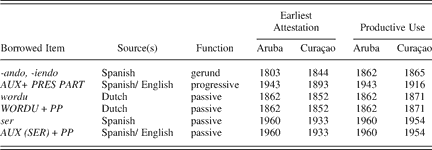
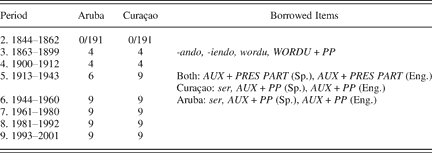
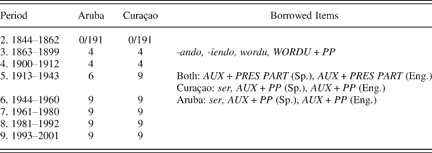
Table 10 shows borrowings per island for each of eight periods (excluding the earliest, which was included to show postcreolization, precontact Papiamentu). The borrowed items (n = 9) are the same on both islands, though some were integrated (became productive) later on Aruba than on Curaçao. Once a foreign form becomes productive, it remains productive.Footnote 30
Borrowings per period per island
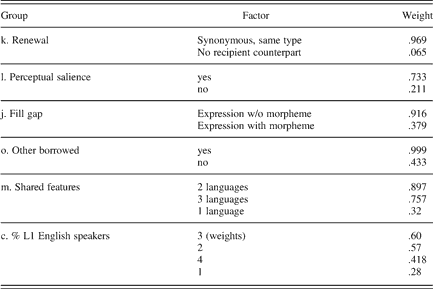
We begin with the constraint model for Aruba (Table 11). The items in verbal morphology favored for borrowing are synonymous with native morphemes (k), perceptually salient (l), belong to the same paradigm as other borrowed items (o), and are shared by more than one language in the contact situation (m). “Fill gap” (j) was also significant, but the factor indicating that a grammatical gap is filled by borrowing was excluded from the statistical analysis (knockout). Instead, borrowing is favored when one language expresses something (periphrastically, e.g., with adverbs) that the other language expresses via morphological encoding; in this case, the morphological encoding is likely to be borrowed. This could be characterized as “grammaticalization (of an existing structural distinction) via a foreign morpheme” (Bybee, Perkins, & Pagliuca, Reference Bybee, Perkins and Pagliuca1994). The “fill gap” factor is always a knockout. Hereafter, when the factor group “fill gap” is significant, it is the “expresses without morpheme” factor that favors borrowing.
Goldvarb results for Aruba
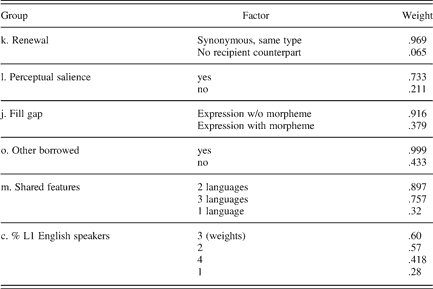
Note: Log likelihood = −61.792; Input = 0.000; χ2 per cell = 0.5343
The weakest constraint deals with L1 English speakers (c), but is more likely related to “length” rather than “amount of bilingualism.” Table 4 shows a weight of “1” in 1911, “4” in 1943, then “2” or “3” for every census year after that (regarding proportion of L1 English speakers on Aruba). If we take these numbers as a measure of “amount of bilingualism,” we would have to say that borrowing is favored with 2–15% of English speakers, but disfavored with more or fewer English speakers. If they instead refer to “length of bilingualism,” we can say that borrowing is more likely to occur after longer periods of contact, which is a more reasonable claim, and which adds weight to the idea proposed by Thomason (Reference Thomason2001), among others, that the length of time that speakers are bilingual may affect structural borrowing.
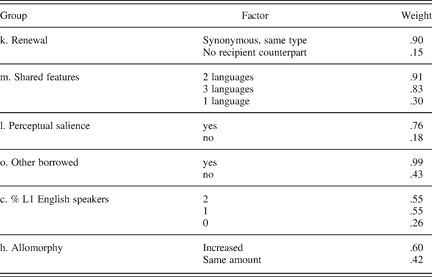
Table 12 gives significant constraints for Curaçao. Borrowing is favored in forms synonymous with some form of the same type in Papiamentu (k), constructions shared by two or more languages in the contact situation (excluding the recipient language) (m), perceptually salient forms (l), forms in paradigms with other borrowed forms (o), and forms that produce increased allomorphy (h). Only one nonlinguistic factor group was significant: “% L1 English speakers” (c). Borrowings are favored in periods with weights of “1” or “2,” or 1943 and every census year after that for Curaçao. As with the Aruba data, this more likely refers to “length” rather than “amount of bilingualism.”
Goldvarb 2001 results for Curaçao
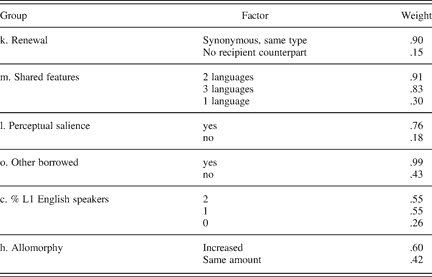
Note: Log likelihood = −59.380; Input = 0.001, χ2 per cell = 0.5279
Some factors and factor groups were excluded from the statistical analysis because they showed insufficient variation for evaluation by the program (knockouts). Because my purpose is to uncover constraints on borrowing, and because a factor with no rule applications indicates that some constraint on rule application is never violated in this data, I discuss the eliminated factors, which I argue represent strong constraints on morphological borrowing.Footnote 31
As mentioned earlier, in “fill gap” (j), there are no cases of borrowings that fill a grammatical gap in this data, despite the presence of 15 gaps (4 between Papiamentu and English, 4 gaps with Dutch, 6 with Spanish, and 1 with CEC). There are no cases where an abstract verb category (i.e., person or number marking) was borrowed (k); 11 of these could have been borrowed. Finally, there were no borrowings when the source and recipient languages did not have the same word orders surrounding the possible borrowing (e) (of 104 cases with different word orders). Because this factor group is binary, the entire group was excluded from statistical analysis, but in the other cases, only the specific factors mentioned were excluded.
Two nonlinguistic factors were excluded due to insufficient variation: time period 1 (1775–1837) and CEC. Period 1 reflects precontact Papiamentu when borrowings were not expected. The lack of borrowings from CEC suggests that prestige may be a relevant factor. Caribbean English Creole (“village talk”) is the only language variety in the contact situation that is consistently viewed negatively. Speakers of this variety are strongly linguistically insecure, though they refer to “village talk” fondly and continue to speak it. That Papiamentu speakers do not borrow from CEC suggests that speakers do not borrow from a language that is uniformly perceived negatively. However, the borrowings from Spanish, Dutch, and English suggest that borrowing is possible if a language has any sort of prestige, even if it is not uniformly or always considered prestigious.Footnote 32
CONTRIBUTIONS OF THE PRINCIPLE OF ACCOUNTABILITY
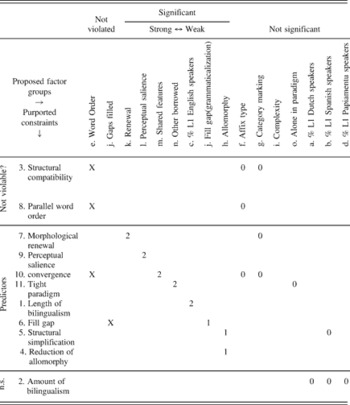
Table 13 summarizes the findings for systematic borrowing and their relationship to the constraints proposed in the literature. Factors marked with “X” were never violated, those with “2” were significant for both Aruba and Curaçao, those with “1” were significant for only one island, and those with “0” were not significant. The statistically significant factors support the following proposed constraints on borrowing: morphological renewal, perceptual salience, convergence, other paradigm-member borrowed, and length of bilingualism. Grammatical gaps were not filled by borrowings, but foreign forms were adopted and grammaticalized. Finally, morphological borrowing leads to increased, rather than decreased, allomorphy. In this section, I show how these results address the problems with previous analyses presented in the “Why existing proposals are insufficient” section.
Proposed factors and significance of factor groups

Note: Proposed factor groups are ranked from left to right in order of strength as determined by subtracting the lowest factor weight from the highest within each factor group. When a factor group was significant in two models, the strengths were added together. “Shared features” and “other borrowed” tied. Nonsignificant items are in the bottom row and far right columns.
Types of linguistic factors proposed
Of the three borrowing universals proposed, none were significant as proposed in the literature. One factor group evaluating “structural simplification” was significant because “increased allomorphy” (as opposed to proposed “decreased”) favors borrowing. Clearly, none of these are truly universal characteristics of structural borrowing.
Increased allomorphy deserves further consideration, however. This factor is only significant when an increase in allomorphy makes the recipient language isomorphic with all three of the other languages in the contact situation. This is an increase in “complexity” only from the perspective of the grammar of a monolingual speaker of the recipient language, but 80% of L1 Papiamentu speakers are fluent in four languages. Thus, this apparent increase in complexity in a monolingual grammar could really be a simplification for the multilingual speaker. In other words, convergence may serve to lighten the multilingual speaker's cognitive load.Footnote 33 This claim should be addressed in more detail in future work. Here, however, I can provide preliminary support for it if I can show that multilingual speakers are more likely to use the specific forms that increase allomorphy, -ando, -iendo, wordu, and the progressive and passive constructions that contain them. Indeed, I have shown in previous work that younger speakers, who are more likely to be multilingual, are more likely to use progressive -ndo (Sanchez, Reference Sanchez2005a). Passive wordu is not frequent enough in speech to be analyzed quantitatively, but in texts, it occurs most frequently in periods when L1 Dutch speakers are numerous (Sanchez, Reference Sanchez2005a).
Two functional motivations were proposed, but only “morphological renewal” was signficant—the existence of a foreign form synonymous with a native form of the same morphological type promotes borrowing. Although no grammatical gaps were filled by borrowings here, foreign forms were grammaticalized. These motivations for borrowing can be interpreted in terms of transfer. Andersen's (Reference Andersen, Gass and Selinder1983) “Transfer to Somewhere” principle requires that speakers identify an equivalence point common to both of their languages in order for something to be transferred from one to the other. Such an equivalence point can be found for “morphological renewal” and for “grammaticalization via a foreign morpheme,” but by the very definition of “grammatical gap,” such an equivalence point cannot exist, which may explain why “fill gap” does not occur.
Factors that promote transfer appear to promote borrowing. “Perceptual salience” was significant. “Parallel word order” was a knockout, but was unviolated: all borrowings found here had parallel word orders in the source and recipient languages. Factors associated with contact-induced change are also significant. “Convergence” and “tight paradigm” are both significant. This means that shared features in languages in contact are likely to be transmitted to another, and although items in a tight paradigm are difficult to borrow, when they are borrowed, they are borrowed together.
Prevalence of linguistic factors
Here we saw that linguistic factors primarily determine what morphemes get borrowed. There is no strong evidence that social factors play a deterministic role in borrowing, apart from the existence of contact, which is an inescapably social fact.
The only significant external factor appears to be “length of bilingualism,” but this finding is indirect. Assuming that it is significant, it is a quantitatively weaker influencer of borrowing than the linguistic factors discussed. This goes against Thomason and Kaufman's view of the deterministic role of social factors in contact-induced change but has the advantage of showing that linguistic and social constraints in contact situations operate exactly as they do in monolingual situations (i.e., with linguistic factors quantitatively outweighing social ones [Preston, 1991]), which is a more satisfying finding for the study of linguistic variation (see Sanchez, Reference Sanchez2005a, for further similarities).
Thomason and Kaufman's borrowing scale
Contrary to Thomason and Kaufman's proposal, most social and demographic factors were not selected as significant at the systemic level. More specifically, Thomason and Kaufman attribute a causal role to “intensity of contact” as reflected in “amount and degree of bilingualism,” but here “amount of bilingualism” (Table 8; 2) was not selected as significant, and “degree of bilingualism” could not be quantified due to lack of data. Only percentage of L1 English speakers, a possible measure of “length of bilingualism,” was significant. Proponents of Thomason and Kaufman may argue that this contact situation is not “intense” enough to show social factors overriding linguistic ones, but without an objective measure of “intensity,” there is no way to settle the matter.
If Thomason and Kaufman's scale is to be useful, for example, to predict what kinds of borrowing may occur in a certain kind of contact situation, there needs to be some objective measure of intensity, and the scale should hold up to quantitative scrutiny. With the measure of intensity that I used, the scale is not supported quantitatively, and although this measure may not be the best estimator of contact intensity, I am not convinced that other data would lead to different results, given that linguistic factors are shown here to condition the borrowing and integration of foreign forms so overwhelmingly.
DISCUSSION AND CONCLUSIONS
Relationship of form and function
There is much controversy surrounding the borrowability of “pure” structure, or architectural aspects of grammar unaccompanied by (morpho-) phonological form. Can structure be borrowed by itself, or must it always be accompanied by some concrete lexical item or morpheme? In this aspect, the value of the variationist approach is clear: a methodical, quantitative examination of all the abstract categories of the verb systems of these languages shows no cases of transmission of abstract elements alone. Even though I found that abstract grammatical categories cannot be borrowed (or at least are not borrowed here), the morphophonological encoding of such a category can be borrowed when that category is independently expressed in the recipient language. Previously, I defined structural borrowing broadly to include any nonlexical aspect of linguistic structure, such that the borrowing of a bound, functional morpheme constitutes structural borrowing. In saying so, I assumed that the abstract function represented by the morpheme is borrowed with the morpheme. Here, however, the morphological encoding of structure was borrowed separately from the abstract structure it represents. Thus, it appears that in some cases, the borrowing of even bound, functional morphemes may be largely lexical.Footnote 34
Methodological innovation
Typically, the PofA is applied to a variable rule describing a specific and limited set of linguistic variants, such as the deletion of word-final -t/-d in English (Guy, Reference Guy and Labov1980). However, because the selection of structural elements for borrowing occurs at the systemic level, I have attempted to apply the PofA systemically as well. I proposed a variable rule, stating that an element of a linguistic subsystem is borrowed, then I looked for occurrences and nonoccurrences of each element in the subsystem (Table 2) in diachronic data.
Conclusions
Borrowing is shown here to happen only under specific linguistic circumstances, with one relevant social factor. Borrowing universals and functional motivations are, generally speaking, not valid constraints in this contact situation, at least as they were proposed in the literature. However, factors affecting transfer or contact-induced change are significant. (Note that many in the latter group came from other quantitative studies.) Thus, it is structural factors, not social ones, that play a deterministic role in borrowing.
These findings are surprising: I expected some combination of linguistic and social factors to be significant, as is typical of the conditioning of variation and change in monolingual communities. However, the overwhelming presence of linguistic factors in the constraint model indicates that structural considerations are paramount in determining what structure eventually is borrowed. In other work, I have shown how borrowed forms can become sensitive to social factors over time, and in these cases, variables show the same sociolinguisitc patterns found in monolingual situations (Sanchez, Reference Sanchez2005a). Only one of the earliest borrowings showed stylistic variation (Sanchez, Reference Sanchez2005a). I argue that Preston's (1991) hierarchy of conditioning factors (linguistic >> social/status >> stylistic) can be applied to structural borrowing temporally: borrowing is based on linguistic factors. Once a borrowing becomes a productive part of the grammar of the recipient language, it may become sensitive to social status, but will vary only inasmuch as linguistic factors permit variation. Finally, an integrated foreign form that varies by status (e.g., has become a sociolinguistic “indicator”) may then be socially evaluated and subject to stylistic variation (e.g., transition to “marker” status). The amount of stylistic variation will be contained within the status variation, which is itself contained within the bounds of the linguistic variation.
DIRECTIONS FOR FURTHER RESEARCH
I tackled only one subsystem of structure here. Investigations of all levels of structure will provide a better picture of structural borrowing, but this very proposal introduces additional methodological issues. Should all levels/subsystems of structure be considered on par with each other or as separate units? I assumed here that all structural elements of the verbal morphology and the phonological forms that represent them have an equal chance at being borrowed. Can phrase structure patterns or verb movement rules be considered in the same model as morphology? Can nominal morphology be combined in a model with verbal morphology even though the two types by definition do not apply to the same structures? Additionally, there is the question of contact intensity: What is the best objective measure of intensity of contact? Does proportion of L1 speakers work or is something else more appropriate? Solving these problems will expand our knowledge of grammar and contribute what is known about structural borrowing.