




No CrossRef data available.
Explanatory Typologies in Qualitative Studies of International Politics
Published online by Cambridge University Press: 17 May 2005
Abstract
Explanatory typologies are powerful tools in the qualitative study of international politics. They are likely to be most valuable when scholars systematically apply shared techniques. This article provides an account of analytic steps used in working with typologies, and an accessible vocabulary to describe them. These analytic steps are illustrated with concrete examples drawn from prominent versions of offensive structural, defensive structural, and neoclassical realism. Five forms of cell compression—rescaling and indexing, as well as logical, empirical, and pragmatic compression—are considered, along with the drawbacks associated with each. The expansion of a partial typology and the rediscovery of deleted cells are also discussed. Finally, the article considers the potential drawbacks of a typological approach, and argues that scholars must be mindful of the risks of reification and of relabeling anomalies.I am especially grateful to David Collier for extensive critiques of several drafts of this article. Stephen G. Walker, Miriam Fendius Elman, James Mahoney, Gary Goertz, Reilly O'Neal, John Gerring, Bear Braumoeller, Lisa Martin, two anonymous reviewers, and the participants at the January 2004 Institute for Qualitative Research Methods at Arizona State University provided valuable comments. An earlier version of this article was presented at the 2004 Annual Meeting of the American Political Science Association. Ryan Davis, Michael Jensen and Mallory Hutchison provided greatly appreciated research assistance. Templates for dichotomous and trichotomous four-variable property spaces are available from colin.elman@asu.edu.
Information
- Type
- Research Article
- Information
- Copyright
- © 2005 The IO Foundation and Cambridge University Press
Until recently, political scientists took an approach to qualitative methods reminiscent of Molière's prose-speaking Monsieur Jourdain: ever present in application, but with little or no conscious preparation. Qualitative methods were absorbed by reading books and articles that used them.1
The same mix of ubiquity and indifference characterized the use of typologies, and their associated property spaces, in the qualitative study of international politics.Thanks in no small part to the efforts of King, Keohane, and Verba, and to the vigorous debates that their 1994 volume sparked, the discipline has revisited the need for formal training in qualitative methods.2
For example, by February 2005 nearly 300 graduate students had attended training institutes run by the Consortium for Qualitative Research Methods (see 〈http://www.asu.edu/clas/polisci/cqrm〉). In a related development, the petition creating the American Political Science Association (APSA)'s organized section on qualitative methods collected more than one thousand signatures, including those of twenty-eight APSA presidents and seven APSR editors. By the end of its first full year, the new section was the seventh largest of the thirty-four organized sections, with more than 740 members.
See, for example, Van Evera 1997; Gerring 2001; Brady and Collier 2004; and George and Bennett 2005. For similar developments in comparative-historical research, see Mahoney and Rueschemeyer 2003.
See George and Bennett 2005; and Bennett 1999b for outstanding exceptions to this observation.
There is, in fact, a deep disconnect between the widespread but often implicit employment of explanatory typologies, and the rarity with which available typological techniques are deliberately considered and applied. Occasionally, theorists will take a more explicit approach, but even then the disconnect is evident, with techniques being recreated without reference to extant but now obscure texts. Sartori is right to suggest that in methodology to “rediscover the ‘forgotten known’ is just as important as to discover (anew) an unknown.”5
Sartori 1994, 14.
This article considers some of the benefits of using explanatory typologies in the qualitative study of international politics. It then discusses two techniques employed in refining typologies: compression and expansion. Compression facilitates working with multivariable explanatory typologies that would otherwise be too large and complex to be helpful. Expansion allows the analyst to discover missed combinations and suppressed assumptions, and to identify important cases.6
Lazarsfeld 1937; Lazarsfeld and Barton 1965; and Barton 1955 prefer the labels “reduction” and “substruction” to compression and expansion.
Walt 1987 provided the first complete statement of balance of threat theory. Walt later applied the theory to other geographical regions, and to other substantive research questions. See especially Walt 1988, 1991, 1992a, 1992b, 1996, and 2000. Mearsheimer 2001 provides a book-length treatment of the theory previewed in Mearsheimer 1990, 1994/1995, and 1995.
The article then analyzes Schweller's neoclassical balance-of-interests theory.10
In contrast to Walt and Mearsheimer, Schweller explicitly derives a typology, employing some of the procedures described in this article. I use Schweller's theory to illustrate two potential pitfalls of employing explanatory typologies. The first is a form of reification, where the labels given to a typology's categories displace the underlying theory from which the typology was derived. The second occurs when empirical puzzles for a theory are disguised by adding cells that name, but do not explain, the aberrant predictions. This amounts to the semantic relabeling of anomalies, not the development of better theory. One possible solution to this problem is to require that the theoretical move that generates the additional dimensions in the property space do more than just address the puzzle, but also provide added value. Philosophers of science, however, disagree about how that value should be measured.Explanatory typologies are an inseparable part of the qualitative study of international politics. Given this close connection, the procedures described in this article may seem habitual, even intuitive. Notwithstanding this seeming familiarity, there are significant advantages to proceeding more self-consciously. Reconnecting with the logic that underlies and justifies current practices in working with typologies will encourage rigor, enhance transparency, and increase the likelihood of producing cumulative results.
Explanatory Typologies
Typologies have a distinguished history in the social and natural sciences, and discussions of what they are and how they work have generated a large body of literature.11
For overviews and reviews see, for example, Capecchi 1968; Nowotny 1971; Marradi 1990; Bailey 1972, 1973, 1992, and 1994; and Tiryakian 1968.
McKinney 1957, 300, and 1969, 4, n. 1.
For example, both Hempel (1965b, 160) and Bailey (1973, 20–21) note an overlap between their readings and Becker's (1940) “constructed types.” Similarly, McKinney (1950, 235, n. 1, and 1954, 139, n. 1) follows Becker's usage of constructed types as incorporating or referring to the earlier terms “ideal” and “pure” types.
To that end, wherever possible, I have attempted to use ordinary language labels for the methods discussed. Sometimes this means choosing from among several alternative words used by different methodologists to describe the same thing (for example, the “classificatory” role of typologies); sometimes modifying a methodologist's term (for example, changing “empirical functional reduction” to “empirical compression”); and sometimes replacing it entirely with a different label (for example, substituting “expansion” for “substruction”).
This article focuses on what I will call explanatory typologies, by which I mean multidimensional conceptual classifications based on an explicitly stated theory.15
The approach to typologies taken in this article partly parallels Watkins' (1953) reading of Weber's “individualistic” ideal types. See also McIntosh 1977, 267, n. 11; and Lindbekk 1992, 292–95. For different interpretations of ideal types, see Albrow 1990; Burger 1987, 160–67; 2001; Clarke 2001; Hekman 1983; and Rogers 1969. It is also sympathetic to, but goes beyond, Stinchecombe's (1987, 43–47) description of type-concepts and typologies. The approach is also consistent with that taken by Ragin (2000, 76–87) but without adopting his Boolean data analytic strategy of qualitative comparative analysis (QCA) or fuzzy sets (Ragin 2000, 120–45; and Ragin 1987). While Ragin's QCA and fuzzy sets methods are intriguing, the purpose of this article is more modest: to reacquaint international relations theorists with the methodological underpinnings of their already used but taken-for-granted ways of doing business.
Lazarsfeld 1937, 120.
Goals of typologies

In an explanatory typology, the descriptive function follows the conventional usage, but in a way that is heavily modified by its theoretical purposes. The constituent attributes are extracted from the variables of a preexisting theory. The dimensions of the property space (its rows and columns) reflect alternative values of the theory's independent variables, so each cell in the space is associated with predicted values of the theory's intervening or dependent variables.18
See McKinney (1950, 238, and 1954, 164–69) on the relationship between theories and typologies. Note, however, that McKinney's “constructive typologies” are not always, or perhaps not even usually, theoretical in the sense used in this article. For example, while McKinney (1954, 195, and 1966, 63) acknowledges that typologies can be derived from theories, he also suggests (1966, 63) that they can most usefully be constructed directly from the particularities of a historical situation.
The classificatory function of typologies determines to which “type” a case can be characterized as belonging. Beginning with a typology, empirical data is coded as falling into one cell or another, guiding scholars to answer the question “What is this a case of?” The property space can be used to map, and compare, a population of cases by their respective scores on the component attributes of the typology. In explanatory typologies, the classificatory function focuses exclusively on evidence that can arbitrate the theoretical claims being made. For example, analysts may investigate a case to determine whether there is the anticipated congruence between its scores on the typology's dimensions, and the predictions made in the cell in which the case is expected to belong. In addition, as noted below, the analyst can use the location of cases in different cells as a guide to making the most productive comparisons for testing the underlying theory.
An explanatory typology is based on an explicitly stated preexisting theory.19
In this regard, explanatory typologies can be strongly contrasted with purely inductive typologies, which begin with data, and seek to group observations on the basis of the similarities that they share. See Bailey 1994, vol. 6.
I am grateful to an anonymous reviewer for suggesting this point. On the benefits of formal models, see Powell 2002; and Bueno de Mesquita and Morrow 1999, 56–57.
Notwithstanding the potential overlap with formal modeling, the focus in this article is on how explanatory typologies can be helpful to qualitative scholars, who have traditionally combined ordinary language theorizing with the intensive study of a small number of cases using comparative-case, process-tracing, and congruence-testing methods. Qualitative scholars can enhance both the development and testing of their theories with a more self-conscious application of typological procedures. With respect to theory development, typologies are complementary to specifying configurative or conjunctive causation,21
Ragin 2000, 67–82. See Brady 2002 for an outstanding review of different models of causal inference.
Bennett 1999a, 9. See also Bennett and George 2001, 138.
On such phenomena, see Pierson 2000 and 2003; Mahoney 2000; Buthe 2002; Thelen 2003; and Aminzade 1992. On typologies and time, see Nowotny 1971.
See Munck 2004, 111; Nowotny 1971, 6–11; Bennett 1999, 21; Rogowski 2004, 7; McKeown 2004, 13; Eckstein 1975, 117–20; and Przeworski and Teune 1970, 32–39.
Tetlock and Belkin 1996, 4. See also Fearon 1991; and Hempel 1965b, 164–65.
Two qualifications should be underscored regarding claims for the usefulness of explanatory typologies. First, the leverage gained from expanding or compressing a property space is limited by the quality of its underlying theory. A major strength of an explanatory typology is the requirement that scholars work through the logical implications of the underlying theory when its variables take on different values. It follows that typologies based on logically inconsistent theories are unlikely to have helpful substantive content. The theories I use as examples in this article derive from the ordinary language realist tradition, a genre that has been subjected to considerable logical criticism.26
See, for example, Fearon 1995; and Powell 2002. I am grateful to an anonymous reviewer for bringing this problem to my attention.
See Walt 2002 for a defense of the continuing relevance of realist theories, and Walt 1999 for critiques of formal modeling. See Bueno de Mesquita and Morrow 1999; Martin 1999; Niou and Ordeshook 1999; Powell 1999; and Zagare 1999 for responses to Walt's critiques.
The second caveat is that including too many variables and/or increasing the number of categories encompassing particular variables may result in a typology that is too large to be useful. For example, coding a four-variable typology trichotomously instead of dichotomously raises the number of cells from sixteen to eighty-one (34), and increasing the number of dichotomous variables from four to six results in sixty-four cells (26).28
Bailey 1994, 4.
For example, Copeland's (2000) dynamic differentials theory can be read as including as many as nine causal factors. Even coded dichotomously, a complete representation of those nine variables would require 512 cells.
Explanatory typologies are likely to be most valuable in the qualitative study of international politics when scholars self-consciously employ typological techniques. To date, the subfield has lacked an account of what analytic moves are available, an accessible vocabulary to describe them, and concrete examples of how these techniques can be applied. The next two sections of this article build on Lazarsfeld and Barton to develop procedures for manipulating explanatory typologies, looking first at techniques for compression, and then for expansion.
Compressing the Number of Cells in a Property Space
Lazarsfeld, building on Hempel and Oppenheim, provided the seminal discussion of the different techniques for compressing a property space, later developing them further with Barton.30
See Lazarsfeld 1937; Hempel and Oppenheim 1936; Lazarsfeld and Barton 1965; and Barton 1955. Although the primary purpose of this and the next section is to demonstrate typological techniques, the examples also illustrate some of the advantages of explanatory typologies for qualitative analysis that are mentioned in the preceding section.
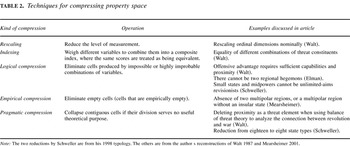
Techniques for compressing property space

Building on Waltz's version of balance of power theory,33
Walt's balance of threat theory expands the number of causal variables.34Walt 1991, 54, argues that because “capability” in Waltz's theory is also a composite variable, his expansion of the independent variable does not lead to a loss of parsimony.
See Walt 1987, 21–28, and 1991, 54.
A potential problem with Walt's theory is that while he notes the direction in which increasing capabilities, proximity, aggressive intentions, and offensive advantage will move the overall level of threat, he provides only limited guidance on how different combinations of the four attributes work together.36
The four elements can be regarded as independent variables, and the resulting level of threat as an intervening variable, in balance of threat theory. Alternatively, the elements can be seen as level 2 independent variables, and threat as a level 1 independent variable. See Goertz and Mahoney forthcoming.
Walt 1987, 23, 25.
By defining the basic hypotheses in terms of threats rather than power alone, we gain a more complete picture of the factors that statesmen will consider when making alliance choices. One cannot determine a priori, however, which sources of threat will be most important in any given case; one can say only that all of them are likely to play a role. And the greater the threat, the greater the probability that the vulnerable state will seek an alliance.38
Ibid., 26.
The issue of how to aggregate different levels of the four threat elements can be addressed by following Barton39
and expanding the elements into a two-dimensional property space.40Expansion is described in detail in the following section.

Walt's composite threat variable
Rescaling
The number of cells can be reduced by lowering the number of attributes for one or more of the theory's variables represented in the property space. For example, as shown in the comparison between Figures 1 and 2, changing the level of measurement in a four variable model from trichotomous ordinal to dichotomous reduces the number of cells from eighty-one to sixteen.41
One thing to keep in mind when reducing the number of attributes is that each cell in the typology becomes more inclusive, hence potentially grouping cases which may not fit comfortably together.42For discussions of the closely related issues of conceptual differentiation and stretching, see Sartori 1970; Collier and Mahon 1993; Collier and Levitsky 1997; Collier and Adcock 1999; Sartori 1984; and Gerring 1999. On the connection between concepts and classification, see Hempel 1965a, 138–139, 146–148.

Walt's composite threat variable configured dichotomously
Indexing
Barton observes that where multiple attributes “express essentially the same underlying characteristic or have their effects in the same direction” one can “give each category on each dimension a certain weight, and add these together to get index scores for each cell.”43
Barton 1955, 46.
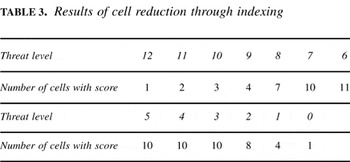
An example index is provided in Figure 1, which is based on the decision to weight the high-mid-low ranks on capabilities and proximity as 3, 2, and 1; and intentions and offense-defense balance as 3, 0, and −1.44
Although the assigned numbers are arbitrary, they do reflect the verbal descriptors for the hypothesized values of each variable. Weak and distant states represent some threat and hence are given low but positive scores, whereas benign intentions and defense dominance are assigned negative scores.
Bailey 1994, 28.
Obviously, although illustrative, this result applies only to this particular example. The number of cells resulting from the reduction will depend on the weighted scores assigned to the high-mid-low ranks.
Results of cell reduction through indexing

Indexing presents more complex difficulties than its seeming simplicity would suggest. What is the appropriate weight for the high-mid-low rank on each attribute? Do low ranks offset high ranks on other attributes? Are all the attributes equal, or should some be weighted more heavily? Perhaps most importantly, indexing presupposes that equal scores are equivalent. It may be that interaction effects between the different variables render this assumption problematic, particularly if the constitutive elements work through different causal pathways.47
Barton 1955, 47.
Walt 1987, 28–32, and 1991, 53.
Indexing is an admittedly blunt and arbitrary tool, and the results necessarily rest on a host of predicate choices and assumptions. It is also likely that the index will be of limited use, as well as aesthetically unattractive, to a qualitative analyst. However, the assignment of numerical weights to different codings on each dimension, and struggling with whether it is appropriate to assume that equal total scores represent the same outcome, may force the analyst to confront theoretical complexities, ambiguities, and lacuna. In this sense, contemplating reducing a typology using a composite index may be more helpful than the index itself.
Logical Compression
There may be a connection between two or more of the typology's dimensions such that some combinations are logically impossible or highly improbable. If so, one can delete these cells.49
See Lazarsfeld 1937, 126; and Lazarsfeld and Barton 1965, 173.
Walt 1987, 24.
See the discussion below on Schweller 1998 for another example of logical compression.
Empirical Compression
Some combinations of variables may be logically possible or not highly improbable, but there may nevertheless be no empirical examples of those combinations. If so, one may be able to delete these cells from the typology.52
See Bailey 1994, 27; Barton 1955, 46, 49; and Marradi 1990, 144.
Pragmatic Compression
Using pragmatic compression, “certain groups of combinations are contracted to one class in view of the research purpose.”53
Lazarsfeld and Barton 1965, 174. See also Lazarsfeld 1937, 128; Bailey 1994, 27; Barton 1955, 45–46; and Marradi 1990, 144.
In earlier presentations of balance-of-threat theory, I included geographic proximity as another element of threat. Because a state's geographic location is not affected by a revolution, I have omitted it from this discussion, although I would expect states to be more sensitive to revolutions near their own borders than to ones at a distance.54
Walt 1996, 19, n. 3. In effect, variables that were independent variables in The Origins of Alliances are reconfigured as intervening variables in Revolution and War. Because it does not vary with revolution, Walt has no interest in proximity in the context of this particular study. It should be noted that Walt's argument is not wholly conclusive for removing proximity from the Revolutions and War property space. As the last clause of this quotation suggests, even if it does not vary with the main independent variable, proximity remains a threat determinant. Alternatively, contra Walt, proximity could be seen as varying with revolution if an expansionist revolutionary state encroaches on intervening territory.
Similarly, other theorists revisiting an expanded typology based on Walt's composite threat are likely to focus on cells that cover hypotheses of interest.55
See the discussion on Schweller 1998 below for another example of pragmatic reduction.
See, for example, Lynn-Jones 1995 and 2001; Biddle 2001; and Glaser and Kaufmann 1998.
See, for example, Glaser 1994/1995 and 1997; Mastanduno 1997; and Midford 2002.
See, for example, Paul 1994.
In sum, many-celled typologies can be reduced in size using one or more of these techniques. These compressions are not cost-free, and some come freighted with significant analytic consequences. For instance, rescaling or simplification of dimensions may lead to the unfortunate grouping of cases; empirical compression discounts the value of using the property space to construct counterfactual propositions; and indexing “washes out” the potential diversity in seemingly equivalent causal pathways. The point is not that these techniques should not be used, but that they should be employed with an appreciation of the associated costs.
Explanatory typologies can be constructed directly from a theoretical statement. They can also be rebuilt from analyses that already use a typology that has previously been minimized. The next section considers the technique of expanding a property space from such a partial typology.
Expanding Property Space
Expansion (what Lazarsfeld calls “substruction”)59
Lazarsfeld 1937, 132.
Ibid.
Expansion allows analysts to spot important combinations of attributes that were overlooked in the partial typology, and to draw attention to cases that need further attention.61
Barton 1955, 53.
Ibid., 50.
Mearsheimer's The Tragedy of Great Power Politics provides an opportunity to demonstrate the expansion of a larger property space from the informal use of types that are described as possessing particular attributes.63
Mearsheimer 2001. By contrast, Schweller's typology, which is discussed in the next section, could be used as an example of reinflating a formally reduced typology. Schweller's pragmatically reduced eight cells could be rebuilt to the original eighteen to see if this differentiation provides additional explanatory leverage.
Mearsheimer 2001, 32–36. Mearsheimer does not predict that states are “mindless aggressors so bent on gaining power that they charge headlong into losing wars or pursue Pyrrhic victories.” Ibid., 37.
Ibid., 140–45.
Ibid., 5, 403, n. 5.
Laying out the explanatory typology implicit in The Tragedy of Great Power Politics demonstrates a lacuna in Mearsheimer's theory and provides an opportunity for additional analytic moves.67
The discussion of expansion that follows—and especially of cells (13) and (14) of the resulting typology—is drawn from Elman 2004, which is mainly concerned with European responses to a rising U.S. in the nineteenth century. Elman 2004 does not, however, discuss cells (11), (12), (16), (17), and (18), which are covered in this section.
Mearsheimer 2001, 181–209.
Ibid., 126.
Ibid., 126–28, 261–64.
Ibid., 42.
Ibid., 141.
Mearsheimer's The Tragedy of Great Power Politics

Exploring the typology implicit in The Tragedy of Great Power Politics demonstrates a key omission in Mearsheimer's discussion of extra-regional behavior. While plainly predicting that regional hegemons will be robust offshore balancers, Mearsheimer is much less clear on whether the same holds true for continental and island great powers. Although suggesting that great powers “strive to prevent rivals in other regions from gaining hegemony,”73
Ibid.
Ibid., 251.
The explanatory typology in Mearsheimer's version of offensive realism can be further extended and clarified by undertaking three separate operations, which together result in a more complete property space: adding a fourth category of state; expanding the typology to include different extra-regional contexts; and working through the logical implications of the theory for each of the cells in the larger property space.
Mearsheimer's account of offensive realism distinguishes between three kinds of state: continental great powers, island great powers, and regional hegemons. This list is missing a fourth, important category: a great power that is the only local state with significant resources. Under these circumstances, such a state will try to expand to dominate the region, even if it is an island state. While Mearsheimer does not name this category, he does describe at least one example in his case study narrative, that of Japan in Northeast Asia between 1900 and 1945.75
Note that Japan belongs in this category, even though it is also an island (and therefore potentially an insular) state. If there are no powerful states on the continent, there is no defensive force to multiply, and hence water has no “stopping power.” Accordingly, an insular state that is the only great power in the region will eschew the modesty of offshore balancing and seek regional dominance for itself. See Mearsheimer 2001, 264–65.
As well as adding the fourth category of sole great power, the property space can also be enlarged by adding the different strategic circumstances that a state might face when it is operating outside of its own region. The process takes the different categories of state, and recasts them as extra-regional contexts. For example, a state that is one of several continental powers in its region might be operating in another region that has several continental powers with or without an island state, a single great power, or a regional hegemon. This expansion adds four columns for “other regions,” resulting in an additional sixteen cells.
The expanded property space is shown in Table 5. The cells in the 4 × 5 matrix that are shaded gray can be deleted using empirical compression. In the modern era there have been no cases of multipolar regions without an insular offshore power. Accordingly the second column—cells (5), (6), (7), and (8)—can be deleted in its entirety. Similarly, there have been no examples of multiple multipolar regions, and hence cells (9) and (10) in the third column can also be deleted. Neither have there been cases of two isolated great powers, so cell (15) is empty.76
It would be possible to make a weak argument that U.S.-Japanese relations between 1880 and 1900 might populate this cell, because Japan could be coded as having reached great power status, and the United States as not yet achieving regional hegemony. This is the only modern dyad that might remotely fit in cell (15). See Ragin 2000, 80, on setting criteria for determining whether a cell is empirically empty.
If Mearsheimer is correct that balancing is inefficient, and regional hegemons suffer from the same inefficiencies as other great powers, then cell (20) should instead be deleted using empirical compression.
Expanded typology of state behavior predicted under different distributions of power

The final operation in developing this larger property space is to work through offensive realism's logic for each of its cells. While some of the predictions overlap with Mearsheimer's, others disagree. Mearsheimer argues that the stopping power of water makes global hegemony impossible, with the corollary hypothesis that the best a state can hope for is to be the only regional hegemon anywhere in the world. But a second corollary of a regionally focused offensive realism is that local power considerations will dominate a state's calculations. This second corollary makes little difference when it comes to in-regional behavior, and hence Mearsheimer's and the extended version of the theory overlap in their predictions for states' in-regional behavior. Accordingly, cells (1), (2), and (4) of the larger typology agree with Mearsheimer's predictions for the local behavior of continental and island great powers and regional hegemons. While the extended version adds the in-regional behavior of a sole great power, the prediction in cell (3) that states such as the United States will expand to fill the vacuum in their own region is entirely consistent with the thrust of Mearsheimer's other in-regional predictions.
Because the extended version of offensive realism gives precedence to local power considerations, however, it clarifies Mearsheimer's predictions regarding extra-regional behavior. Island states should not balance against rising states in other regions. As shown in cells (14) and (18), a regionally focused version of offensive realism predicts that island states have positive incentives to support, not block, the emergence of a regional hegemon in another neighborhood. Taking Anglo-American relations as an example, Britain's main concern should have been of a continental hegemon emerging in its own region. Because an American regional hegemon would share Britain's fear of a European hegemon, the British could rely on the United States to serve as balancer-of-last-resort. Hence, conducting an extra-regional campaign against the Americans made no sense, because it would misdirect British resources away from local balancing, as well as rob the island state of an inevitable future ally.
While Mearsheimer is also unclear on whether continental great powers engage in extra-regional balancing, the extended version of offensive realism suggests that this ambiguity is more justifiable. As noted in cells (13) and (17), structure is indeterminate, providing cross-cutting incentives for and against extra-regional intervention by continental states. Although a continental great power may not be in favor of another state achieving or retaining regional hegemony elsewhere, it will not care enough to deflect resources that could otherwise be used in its bid for local dominance, commit resources that should be used to block another local power from achieving regional hegemony, or so provoke the extra-regional would-be hegemon that it throws its weight on the side of the state's local enemies. Offensive realism makes no determinate predictions about what a continental state will do regarding an extra-regional rising great power or hegemon, unless it folds in much more information about local conditions.
Cell (11) suggests that an isolated state will largely ignore what is going on elsewhere in the world to concentrate on achieving regional hegemony in its own backyard. The expectation is that the state will forego using force abroad, instead choosing to consolidate its hold over the region in which it is situated. The relative quiescence of the United States outside of the North American continent in the nineteenth century fits the prediction made in this cell. Cell (19) provides an important exception to this “no extra-regional involvement” rule: the would-be hegemon has a strong incentive to attempt to neutralize a regional hegemon elsewhere, to forestall their anticipated offshore balancing. Japan's preemptive attack on the United States in 1941 might fit in this cell.
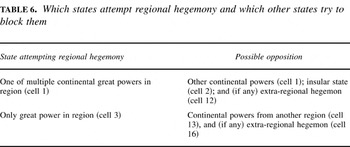
Cells (12) and (16) cover cases in which a regional hegemon acts to prevent a state from achieving dominance in another region. Cell (12) looks at cases where the other region has multiple great powers and an insular state. Offensive realism anticipates that when a continental great power threatens to dominate the other region, the extra-regional hegemon should buck-pass to the in-region insular state. When it is clear that the insular state is not up to the job, the hegemon will intervene as a balancer-of-last-resort.78
Ibid., 141.
Ibid., 328.
Summarizing the steps I have taken so far, the process took three categories of states described in Mearsheimer's theory and added a fourth: sole great powers. These categories were then used as the basis to differentiate between extra-regional contexts. The resulting twenty cells were partially compressed using a combination of logical and empirical compression. The remaining property space exhaustively presents the offensive realist combinations that are likely to be populated by cases in the modern era. This extended property space can be used to suggest, inter alia, the structural conditions that made U.S. regional hegemony possible, and why other states are very unlikely to succeed in the near future. As noted in Table 6, a state is most likely to achieve regional hegemony in the modern era if it is the only great power in its neighborhood; if continental great powers elsewhere decline to intervene; and if there is no regional hegemon elsewhere in the world. If these three conditions are met, then local supremacy is possible.
Which states attempt regional hegemony and which other states try to block them

In the preceding sections, I describe and demonstrate techniques for expanding and compressing the cells that constitute their associated property spaces. In the next section, I consider two potential problems with using explanatory typologies. The first is a form of reification, where the labels given to a typology's categories displace the underlying theory from which the typology was derived. The second is where empirical puzzles for a theory are disguised by adding cells that name, but do not explain, the aberrant predictions.
Pitfalls in Property Space: Reification and Puzzle Relabeling
Schweller's Deadly Imbalances,80
a leading work in the neoclassical realist research program, is an unusually explicit use of typologies in the study of international relations.81Rose 1998. This brief summary does not include a discussion of tripolarity, an important part of Schweller's explanation for World War II. It was excluded as not being directly germane to the discussion of Schweller's property space. This decision is supported by the fact that Schweller himself published separate stand-alone articles of his typological material and the tripolarity part of his argument. See Schweller 1993 and 1994.
Building on the classical realist tradition, Schweller constructs a typology based on two dimensions: (1) the state's relative capabilities; and (2) its interests, expressed as its view of the current distribution of power, that is, whether it supports the status quo. Relative capabilities are measured as a ratio variable, with “each Great Power … weighted according to its relative share of the total resources of the major-power subsystem.”82
Schweller 1998, 17.
Ibid., 23–24.
Schweller then takes the twenty cells produced by his two ordinal dimensions and compresses them using reduction techniques.84
Ibid., 84–89.
As noted above, it would be possible to introduce auxiliary hypotheses that would allow for small powers to be unlimited revisionists.

Schweller's balance-of-interests typology
In a powerful rhetorical move, Schweller names these eight state types after animal species that, at least in the popular imagination, exhibit similar behaviors to those predicted by his theory.86
Schweller 1998, 84–89.

Cases in Schweller's typology
Although an important explicit use of typological techniques, Schweller's approach also points to some potential problems. My reading of Schweller is that he intends to construct an explanatory typology, in which different values of the theory's two variables (together with its constants, which include the anarchic international system and unit rationality) produce different predictions of state behavior. While acknowledging and applauding the persuasive leverage gained from giving his types animal names that strongly reflect the expected state behavior, it is likely that this naming encourages a form of reification.87
On the dangers of reification see Bailey 1994, 15; Tiryakian 1968, 179; and McKinney 1954, 148–49.
A different concern is that five of the seven types that are of any explanatory significance in Schweller's typology vary on the interests axis. So the answer to the question “why do states behave like they do?” would largely be answered based on how strongly they support or oppose the status quo. There are two related issues at play here: the nontautological operationalization of intentions; and explanation versus post-hoc labeling. The first issue goes to whether it is possible to measure state interests without referencing the state behavior that one is trying to explain. Intentions are much harder to gauge than capabilities, and one cannot use the dependent variable to operationalize them. It is obviously of little value to say that one knows Germany was an unlimited-aims revisionist because it unwisely invaded the Soviet Union and then use the coding “unlimited-aims revisionist” to explain the attack. This can be construed as a data problem and hence as potentially solvable if freestanding measures of intentions are available.
The second and more difficult challenge is whether Schweller's typology is explanatory, or is instead a form of semantic relabeling that displaces questions without answering them.88
Vasquez 1997 makes a similar critique.
This kind of “iteration” between theory and evidence is often prescribed (see, for example, Bates et al. 1998, 16; and Morrow 2002, 187–88) and hence the problem is likely to arise often.
The best-known discussion of this issue is Lakatos 1970. See also Elman and Elman 2002 and 2003.
Consider the property space expansion covered in the problem shift from Waltz's 1979 neorealism to Schweller's 1998 neoclassical realism. Insofar as Waltz's international political structure constrains great powers' behavior, they are likely to be status quo great powers.91
This was the central insight in Schweller 1996.
Note that Waltz's (1979, 72) theory “is written in terms of the great powers of an era.” Hence all the states in the theory would be on the top line (that is, he does not differentiate between differentially endowed poles: a state is either a great power and therefore a pole, or it is not). In addition, because structural constraints discourage power maximizing behavior, in the absence of untheorized nonstructural motives, Waltz's great powers all fall in the single, top right-hand cell in Schweller's typology.
One way of addressing this problem (that is, to demonstrate that Schweller is engaging in more than just a relabeling exercise) is to adopt a form of what Musgrave calls the historical approach to confirmation of a scientific theory.93
Musgrave 1974, 3, 7. See also Worrall 1978b, 321; and Mayo 1996, 254–56. It should be noted that the historical approach to confirmation looks for different categories of predictions, not evidence that predicted values of the same dependent variable are repeated in additional cases. To be sure, recurring tests of the same proposition are valuable because they offer evidence about whether a prediction is empirically accurate. As Jervis (1985, 146) notes, “Scholars often look at many cases to see if a proposed generalization fits the data. [But t]his is a form of confirmation, not the discovery of new facts.”
Philosophers of science disagree on which standard of novelty to apply, that is, they differ on the answer to the question: “novel compared to what?” Potential answers to that question include: strict temporal novelty, Lakatos 1970, 118; Zahar 1973, 101; Worrall 1978a, 46, 66, n. 7; Frankel 1979, 24; Gardner 1982, 2; Nunan 1984, 275; and Hands 1991, 96; new interpretation novelty, Lakatos 1970, 188; Koertge 1971, 171, n. 5; Musgrave 1974, 11; Nunan 1984, 275; and Carrier 1988, 20; heuristic novelty, Zahar 1973, 101; and Lakatos and Zahar 1975, 376, n. 65; and background theory novelty Musgrave 1974, 15–16; 1978, 185; Worrall 1978b, 321–22; and Mayo 1996, 208.
A detailed consideration of whether Schweller's theoretical amendments provide nontautological operationalizations of intentions or make novel predictions goes beyond the purposes of this article, but it should be noted that his more recent work makes considerable advances on both fronts. For example, Schweller's current book project investigates the domestic political reasons for why states react to external threats, and in particular for why they sometimes fail to respond with appropriately vigorous balancing.95
Conclusion
In this article, I have pursued three objectives: (1) to argue that explanatory typologies are powerful tools in the qualitative study of international politics, and that they are likely to be most valuable when scholars self-consciously employ typological techniques; (2) to build on Lazarsfeld and Barton to provide an account of available techniques, an accessible vocabulary to describe them, and concrete examples of how the procedures can be applied; and (3) to argue that scholars using typologies must be mindful of the risks of reification and puzzle relabeling.
The five forms of typological reduction demonstrated here are complementary means to compress a many-celled property space into a more manageable configuration. Each of the techniques comes with associated costs. Rescaling a property space may group disparate cases. Indexing attaches numerical scores to unlike variables, and asserts that equal scores reflect equivalent outcomes. Logical compression is perhaps the least problematic of the five techniques, but its availability depends on the underlying theory. Even where it is appropriate, not many cells may be deleted. For example, logical compression deleted only one of the cells in the expanded property space representing Mearsheimer's typology, and only two in Schweller's typology. In addition, logical compression can be reversed by adding auxiliary hypotheses to the underlying theory. Empirical compression is likely to be more generally applicable, but has much greater data requirements, is susceptible to measurement error, and undercuts counterfactual speculation. Finally, pragmatic compression's extreme flexibility allows for a wide range of different configurations, but has the drawback that the typology is likely to be limited to the immediate research purpose at hand. In one sense this becomes less problematic as the techniques are used more self-consciously, since a pragmatically compressed space can be reexpanded if the research purpose changes.
The expansion of property space from types with particular attributes, or from a previously reduced typology, provides theorists with an opportunity to find important combinations that were overlooked in the original analysis, and to focus attention on cases that require additional attention. As the reconstruction of the typology associated with Mearsheimer's The Tragedy of Great Power Politics shows, expansion usually also requires some compression before the reinflated property space can be sensibly used. Here, cutting the number of extra-regional cells by half allows theorists to focus on the remaining eight cells to find phenomena of interest.
Because explanatory typologies are derived from underlying theories, they should be permanently open to being reconfigured as the theories change. This suggests two dangers. First, cell names should not become so reified that scholars lose sight of the underlying theory from which the explanatory typology was derived. Second, redrawing a property space to accommodate an empirical anomaly, in effect finding a cell it can call home, will not always be evidence of a constructive theoretical amendment. The historical approach to confirmation suggests that some further value should be added.
While international relations theorists commonly employ explanatory typologies in their analysis of international politics, the subfield has not paid sufficient attention to the logic that underlies and justifies that usage, or to the different techniques that are available for expanding and compressing property space. Explanatory typologies are powerful tools, and a more self-conscious approach will encourage rigor, enhance transparency, and increase the likelihood of producing cumulative results.
References
REFERENCES
Albrow, Martin.
1990.
Max Weber's Construction of Social Theory.
New York:
St. Martin's Press.
Aminzade, Ronald.
1992.
Historical Sociology and Time.
Sociological Methods and Research
20 (4):456–80.Google Scholar
Bailey, Kenneth D.
1972.
Polythetic Reduction of Monothetic Property Space.
Sociological Methodology
4:83–111.Google Scholar
Bailey, Kenneth D.
1973.
Monothetic and polythetic typologies and their relation to
conceptualization measurement, and scaling.
American Sociological Review
38 (1):18–33.Google Scholar
Bailey, Kenneth D.
1992.
Typologies. In
Encyclopedia of Sociology, edited by
Edgar F. Borgatta and
Marie L. Borgatta,
2188–94.
New York:
Macmillan.
Bailey, Kenneth D.
1994.
Typologies and Taxonomies: An Introduction to Classification
Techniques.
Thousand Oaks, Calif.:
Sage Publications.
Barton, Allen H.
1955.
The concept of property-space in social research. In
Language of Social Research, edited by
Paul F. Lazarsfeld and
Morris Rosenberg,
40–53.
Glencoe, Ill.:
Free Press.
Bates, Robert H.,
Avner Greif,
Margaret Levi,
Jean-Laurent Rosenthal, and
Barry R. Weingast.
1998.
Analytic Narratives.
Princeton, N.J.:
Princeton University Press.
Becker, Howard.
1940.
Constructive Typology in the Social Sciences. In
Contemporary Social Theory, edited by
Harry E. Barnes,
Howard Becker, and
Frances Bennett Becker,
17–46.
New York:
D. Appleton-Century.
Bennett, Andrew.
1999a.
Causal Inference in Case Studies: From Mill's Methods to Causal
Mechanisms.
Paper presented at the 96th Annual Meeting of the American
Political Science Association, September, Atlanta, Ga.
Bennett, Andrew.
1999b.
Condemned to Repetition: The Rise, Fall, and Reprise of
Soviet-Russian Military Interventionism 1973–1996.
Cambridge, Mass.:
MIT Press.
Bennett, Andrew,
Aharon Barth, and
Ken Rutherford.
2003.
Do We Preach What We Practice? A Survey of Methods in Political
Science Journals and Curricula.
PS
36 (3):373–78.Google Scholar
Bennett, Andrew, and
Alexander George.
2001.
Case Studies and Process Tracing in History and Political Science:
Similar Strokes for Different Foci. In
Bridges and Boundaries: Historians, Political Scientists and the
Study of International Relations, edited by
Colin Elman and
Miriam Fendius Elman,
137–66.
Cambridge, Mass.:
MIT Press.
Biddle, Stephen.
2001.
Rebuilding the Foundations of Offense-Defense Theory.
Journal of Politics
63 (3):741–74.Google Scholar
Brady, Henry E.
2002.
Models of Causal Inference: Going Beyond the Neyman-Rubin-Holland
Theory.
Paper presented at the 16th Annual Meeting of the Political
Methodology Group, July, Seattle, Wash.
Brady, Henry, and
David Collier, eds.
2004.
Rethinking Social Inquiry: Diverse Tools, Shared Standards.
Lanham, Md.:
Rowman and Littlefield.
Bueno de Mesquita, Bruce, and
James D. Morrow.
1999.
Sorting Through the Wealth of Notions.
International Security
24 (2):56–73.Google Scholar
Burger, Thomas.
1987.
Max Weber's Theory of Concept Formation.
Durham, N.C.:
Duke University Press.
Burger, Thomas.
2001.
Ideal Types: Conceptions in the Social Sciences. In
International Encyclopedia of the Social and Behavioral
Sciences, edited by
Neil J. Smelser and
Paul B. Baltes,
7139–42.
New York:
Elsevier.
Buthe, Tim.
2002.
Taking Temporality Seriously: Modeling History and the Use of
Narrative as Evidence.
American Political Science Review
96 (3):481–93.Google Scholar
Capecchi, Vittorio.
1968.
On the Definition of Typology and Classification in
Sociology.
Quality and Quantity
2 (1–2):9–30.Google Scholar
Carrier, Martin.
1988.
On Novel Facts: A Discussion of Criteria for Non-ad-hoc-ness in the
Methodology of Scientific Research Programmes.
Zeitschrift für allgemeine Wissenschaftstheorie
19 (2):205–31.Google Scholar
Clarke, S.
2001.
Idealization, Abstraction and Ideal Types. In
International Encyclopedia of the Social and Behavioral
Sciences, edited by
Neil J. Smelser and
Paul B. Baltes,
7142–48.
New York:
Elsevier.
Collier, David, and
Robert Adcock.
1999.
Democracy and Dichotomies: A Pragmatic Approach to Choices about
Concepts.
Annual Review of Political Science
2:537–65.Google Scholar
Collier, David, and
Steven Levitsky.
1997.
Democracy with Adjectives: Conceptual Innovation in Comparative
Research.
World Politics
49 (3):430–51.Google Scholar
Collier, David, and
James E. Mahon.
1993.
Conceptual ‘Stretching’ Revisited: Adapting Categories
in Comparative Analysis.
American Political Science Review
87 (4):845–55.Google Scholar
Copeland, Dale.
2000.
The Origins of Major War.
Ithaca, N.Y.:
Cornell University Press.
Eckstein, Harry.
1975.
Case Study and Theory in Political Science. In
Handbook of Political Science, edited by
Fred Greenstein and
Nelson Polsby,
79–137.
Reading, Mass.:
Addison-Wesley.
Elman, Colin.
2004.
Extending Offensive Realism: The Louisiana Purchase and
America's Rise to Regional Hegemony.
American Political Science Review
98 (4):563–76.Google Scholar
Elman, Colin, and
Miriam Fendius Elman.
2002.
Appraising Progress in International Relations Research: How Not to
Be Lakatos Intolerant.
International Studies Quarterly
46 (2):231–62.Google Scholar
Elman, Colin, and
Miriam Fendius Elman, eds.
2003.
Progress in International Relations Theory: Metrics and Methods of
Scientific Change.
Cambridge, Mass.:
MIT Press.
Fearon, James D.
1991.
Counterfactuals and Hypothesis Testing in Political Science.
World Politics
43 (2):169–95.Google Scholar
Fearon, James D.
1995.
Rationalist Explanations for War.
International Organization
49 (3):379–414.Google Scholar
Frankel, Henry.
1979.
The Career of Continental Drift Theory: An Application of Imre
Lakatos' Analysis of Scientific Growth to the Rise of Drift
Theory.
Studies in History and Philosophy of Science
10 (1):21–66.Google Scholar
Gardner, Michael R.
1982.
Predicting Novel Facts.
British Journal for the Philosophy of Science
33 (1):1–15.Google Scholar
George, Alexander L., and
Andrew Bennett.
2005.
Case Studies and Theory Development in the Social Sciences.
Cambridge, Mass.:
MIT Press.
Gerring, John.
1999.
What Makes a Concept Good? A Criterial Framework for Understanding
Concept Formation in the Social Sciences.
Polity
31 (3):357–93.Google Scholar
Gerring, John.
2001.
Social Science Methodology: A Criterial Framework.
Cambridge:
Cambridge University Press.
Glaser, Charles L.
1994/1995.
Realists as Optimists: Cooperation as Self-Help.
International Security
19 (3):50–90.Google Scholar
Glaser, Charles L.
1997.
The Security Dilemma Revisited.
World Politics
50 (1):171–201.Google Scholar
Glaser, Charles L., and
Chaim Kaufmann.
1998.
What Is the Offense-Defense Balance and Can We Measure It?
International Security
22 (4):44–82.Google Scholar
Goertz, Gary, and
James Mahoney.
Forthcoming.
Two Level Theories and Fuzzy Sets.
Sociological Methods & Research.
Hands, D. Wade.
1991.
Reply to Hamminga and Maki. In
Appraising Economic Theories: Studies in the Methodology of Research
Programs, edited by
Neil de Marchi and
Mark Blaug,
91–102.
Brookfield, Vt.:
Edward Elgar.
Hekman, Susan J.
1983.
Weber's Ideal Type: A Contemporary Reassessment.
Polity
16 (1):119–37.Google Scholar
Hempel, Carl G.
1965a.
Fundamentals of Taxonomy. In
Aspects of Scientific Explanation and Other Essays in the Philosophy
of Science, edited by
Carl G. Hempel,
137–54.
New York:
Free Press.
Hempel, Carl G.
1965b.
Typological Methods in the Natural and Social Sciences. In
Aspects of Scientific Explanation and Other Essays in the Philosophy
of Science, edited by
Carl G. Hempel,
155–71.
New York:
Free Press.
Hempel, Carl G., and
P. Oppenheim.
1936.
Der Typusbegriff im Lichte der Neuen Logik.
Leiden, Netherlands:
A. W, Siythoff.
Jervis, Robert.
1985.
Pluralistic Rigor: A Comment on Bueno de Mesquita.
International Studies Quarterly
29 (2):145–49.Google Scholar
King, Gary,
Robert O. Keohane, and
Sidney Verba.
1994.
Designing Social Inquiry: Scientific Inference in Qualitative
Research.
Princeton, N.J.:
Princeton University Press.
Koertge, Noretta.
1971.
Inter-Theoretic Criticism and the Growth of Science. In
Boston Studies in the Philosophy of Science, Volume 8: PSA
1970, edited by
Roger C. Buck and
Robert S. Cohen,
160–73.
Dordrecht, Netherlands:
Reidel.
Lakatos, Imre.
1970.
Falsification and the Methodology of Scientific Research
Programmes. In
Criticism and the Growth of Knowledge, edited by
Imre Lakatos and
Alan Musgrave,
91–196.
New York:
Cambridge University Press.
Lakatos, Imre, and
Elie Zahar.
1975.
Why Did Copernicus' Research Programme Supersede
Ptolemy's? In
The Copernican Achievement, edited by
Robert S. Westman,
354–83.
Berkeley:
University of California Press.
Lazarsfeld, Paul F.
1937.
Some remarks on the typological procedures in social
research.
Zeitschrift für Sozialforschung
6:119–39.Google Scholar
Lazarsfeld, Paul F., and
Allen H. Barton.
1965.
Qualitative Measurement in the Social Sciences: Classification,
Typologies, and Indices. In
The Policy Sciences, edited by
Daniel Lerner and
Harold D. Lasswell,
155–92.
Stanford, Calif.:
Stanford University Press.
Lindbekk, Tore.
1992.
The Weberian Ideal-Type: Development and Continuities.
Acta Sociologica
35 (4):285–97.Google Scholar
Lynn-Jones, Sean M.
1995.
Offense-Defense Theory and Its Critics.
Security Studies
4 (4):660–91.Google Scholar
Lynn-Jones, Sean M.
2001.
Does Offense-Defense Theory Have a Future?
Working Paper.
Montreal, Canada:
Research Group in International Security (REGIS)/Groupe
d'étude et de recherche sur la sécurité
internationale (GERSI).
Mahoney, James.
2000.
Path Dependence in Historical Sociology.
Theory and Society
29 (4):507–48.Google Scholar
Mahoney, James, and
Dietrich Rueschemeyer, eds.
2003.
Comparative-Historical Analysis in the Social Sciences.
Cambridge:
Cambridge University Press.
Marradi, Alberto.
1990.
Classification, Typology, Taxonomy.
Quality and Quantity
24 (2):129–57.Google Scholar
Martin, Lisa L.
1999.
The Contributions of Rational Choice: A Defense of Pluralism.
International Security
24 (2):74–83.Google Scholar
Mastanduno, Michael.
1997.
Preserving the Unipolar Moment: Realist Theories and U.S. Grand
Strategy after the Cold War.
International Security
21 (4):49–88.Google Scholar
Mayo, Deborah G.
1996.
Error and the Growth of Experimental Knowledge.
Chicago:
University of Chicago Press.
McIntosh, Donald.
1977.
The Objective Bases of Max Weber's Ideal Types.
History and Theory
16 (3):265–79.Google Scholar
McKeown, Timothy J.
2004.
Case Studies and the Limits of the Statistical Worldview.
In
Rethinking Social Inquiry: Diverse Tools, Shared Standards,
edited by
Henry E. Brady and
David Collier,
139–67.
Lanham, Md.:
Rowman and Littlefield.
McKinney, John C.
1950.
The Role of Constructive Typology in Scientific Sociological
Analysis.
Social Forces
28 (3):235–40.Google Scholar
McKinney, John C.
1954.
Constructive Typology and Social Research. In
An Introduction to Social Research, edited by
John T. Doby,
139–98.
Harrisburg, Penn.:
Stackpole.
McKinney, John C.
1957.
The Polar Variables of Type Construction.
Social Forces
35 (4):300–6.Google Scholar
McKinney, John C.
1966.
Constructive Typology and Social Theory.
New York:
Appleton-Century-Crofts.
McKinney, John C.
1969.
Typification, Typologies and Sociological Theory.
Social Forces
48 (1):1–12.Google Scholar
Mearsheimer, John J.
1990.
Back to the Future: Instability in Europe After the Cold War.
International Security
15 (1):5–56.Google Scholar
Mearsheimer, John J.
1994/1995.
The False Promise of International Institutions.
International Security
19 (3):5–49.Google Scholar
Mearsheimer, John J.
2001.
The Tragedy of Great Power Politics.
New York:
Norton.
Midford, Paul.
2002.
The Logic of Reassurance and Japan's Grand Strategy.
Security Studies
11 (3):1–43.Google Scholar
Morrow, James D.
2002.
International Conflict: Assessing the Democratic Peace and
Offense-Defense Theory. In
Political Science: State of the Discipline, edited by
Ira Katznelson and
Helen V. Milner,
172–96.
New York:
Norton.
Munck, Gerardo.
2004.
Tools for Qualitative Research. In
Rethinking Social Inquiry: Diverse Tools, Shared Standards,
edited by
Henry E. Brady and
David Collier,
105–21.
Lanham, Md.:
Rowman and Littlefield.
Musgrave, Alan.
1974.
Logical versus Historical Theories of Confirmation.
British Journal for the Philosophy of Science
25 (1):1–23.Google Scholar
Musgrave, Alan.
1978.
Evidential Support, Falsification, Heuristics, and
Anarchism. In
Progress and Rationality in Science, edited by
Gerard Radnitzky and
Gunnar Andersson,
181–201.
Dordrecht, Netherlands:
Reidel.
Niou, Emerson M. S., and
Peter C. Ordeshook.
1999.
Return of the Luddites.
International Security
24 (2):84–96.Google Scholar
Nowotny, Helga.
1971.
The Uses of Typological Procedures in Qualitative Macrosociological
Studies.
Quality and Quantity
6 (1):3–37.Google Scholar
Nunan, Richard.
1984.
Novel Facts, Bayesian Rationality, and the History of Continental
Drift.
Studies in History and Philosophy of Science
15 (4):267–307.Google Scholar
Paul, T. V.
1994.
Asymmetric Conflicts: War Initiation by Weaker Powers.
New York:
Cambridge University Press.
Pierson, Paul.
2000.
Increasing Returns, Path Dependence, and the Study of
Politics.
American Political Science Review
94 (2):251–67.Google Scholar
Pierson, Paul.
2003.
Big, Slow-Moving, and … Invisible: Macro-Social Processes in
the Study of Comparative Politics. In
Comparative Historical Analysis in the Social Sciences, edited
by
James Mahoney and
Dietrich Rueschemeyer,
177–207.
Cambridge:
Cambridge University Press.
Powell, Robert.
1999.
The Modeling Enterprise and Security Studies.
International Security
24 (2):97–106.Google Scholar
Powell, Robert.
2002.
Game Theory, International Relations Theory and the Hobbesian
Stylization. In
Political Science: The State of the Discipline, edited by
Ira Katznelson and
Helen V. Milner,
755–83.
New York:
Norton.
Przeworski, Adam, and
Henry Teune.
1970.
The Logic of Comparative Social Inquiry.
New York:
Wiley Interscience.
Ragin, Charles. C.
1987.
The Comparative Method: Moving Beyond Qualitative and Quantitative
Strategies.
Berkeley:
University of California Press.
Ragin, Charles. C.
2000.
Fuzzy Set Social Science.
Chicago:
University of Chicago Press.
Rogers, Rolf E.
1969.
Max Weber's Ideal Type Theory.
New York:
Philosophical Library.
Rogowski, Ronald.
2004.
How Inference in the Social (but Not the Physical) Sciences
Neglects Theoretical Anomaly. In
Rethinking Social Inquiry: Diverse Tools, Shared Standards,
edited by
Henry E. Brady and
David Collier,
75–83.
Lanham, Md.:
Rowman and Littlefield.
Rose, Gideon.
1998.
Review Article: Neoclassical Realism and Theories of Foreign
Policy.
World Politics
51 (1):144–72.Google Scholar
Sartori, Giovanni.
1970.
Concept Misformation in Comparative Politics.
American Political Science Review
64 (4):1033–53.Google Scholar
Sartori, Giovanni.
1984.
Guidelines for Concept Analysis. In
Social Science Concepts: A Systematic Analysis, edited by
Giovanni Sartori,
15–85.
Beverly Hills, Calif.:
Sage Publications.
Sartori, Giovanni.
1994.
Compare Why and How: Comparing, Miscomparing and the Comparative
Method. In
Comparing Nations: Concepts, Strategies, Substance, edited by
Mattei Dogan and
Ali Kazancigil,
14–34.
Cambridge, Mass.:
Blackwell.
Schweller, Randall L.
1993.
Tripolarity and the Second World War.
International Studies Quarterly
37 (1):73–103.Google Scholar
Schweller, Randall L.
1994.
Bandwagoning for Profit: Bringing the Revisionist State Back
in.
International Security
19 (1):72–107.Google Scholar
Schweller, Randall L.
1996.
Neorealism's Status-Quo Bias: What Security Dilemma?
Security Studies
5 (3):90–121.Google Scholar
Schweller, Randall L.
1998.
Deadly Imbalances: Tripolarity and Hitler's Strategy of World
Conquest.
New York:
Columbia University Press.
Schweller, Randall L.
Forthcoming.
Unanswered Threats: Political Constraints on the Balance of
Power.
Princeton, N.J.:
Princeton University Press.
Stevens, S. S.
1946.
On the Theory of Scales of Measurement.
Science
103 (2684):677–80.Google Scholar
Stevens, S. S.
1951.
Mathematics, Measurement, and Psychophysics. In
Handbook of Experimental Psychology, edited by
S. S. Stevens,
1–49.
New York:
John Wiley.
Stevens, S. S.
1959.
Measurement, Psychophysics, and Utility. In
Measurement: Definitions and Theories, edited by
C. West Churchman and
Philipburn Ratoosh,
18–63.
New York:
John Wiley.
Stinchecombe, Arthur L.
1987.
Constructing Social Theories.
Reprint, originally published 1968 by Harcourt, Brace &
World.
Chicago:
University of Chicago Press.
Tetlock, Philip E., and
Aaron Belkin.
1996.
Counterfactual Thought Experiments in World Politics: Logical,
Methodological and Psychological Perspectives. In
Counterfactual Thought Experiments in World Politics, edited
by
Philip E. Tetlock and
Aaron Belkin,
1–38.
Princeton, N.J.:
Princeton University Press.
Thelen, Kathleen.
2003.
How Institutions Evolve: Insights from Comparative-Historical
Analysis. In
Comparative-Historical Analysis in the Social Sciences, edited
by
James Mahoney and
Dietrich Rueschemeyer,
208–40.
Cambridge:
Cambridge University Press.
Tiryakian, Edward A.
1968.
Typologies. In
International Encyclopedia of the Social Sciences, edited by
David L. Sills,
177–86.
New York:
Macmillan.
Van Evera, Stephen.
1997.
Guide to Methodology for Students of Political Science.
Ithaca, N.Y.:
Cornell University Press.
Vasquez, John A.
1997.
The Realist Paradigm and Degenerative versus Progressive Research
Programs: An Appraisal of Neotraditional Research on Waltz's
Balancing Proposition.
American Political Science Review
91 (4):899–912.Google Scholar
Walt, Stephen M.
1987.
The Origins of Alliances.
Ithaca, N.Y.:
Cornell University Press.
Walt, Stephen M.
1988.
Testing Theories of Alliance Formation: The Case of Southwest
Asia.
International Organization
42 (2):275–316.Google Scholar
Walt, Stephen M.
1991.
Alliance Formation in Southwest Asia: Balancing and Bandwagoning in
Cold War Competition. In
Dominoes and Bandwagons, edited by
Robert Jervis and
Jack Snyder,
51–84.
New York:
Oxford University Press.
Walt, Stephen M.
1992b.
Alliances, Threats, and U.S. Grand Strategy: A Reply to Kaufman and
Labs.
Security Studies
1 (3):448–82.Google Scholar
Walt, Stephen M.
1996.
Revolution and War.
Ithaca, N.Y.:
Cornell University Press.
Walt, Stephen M.
1999.
Rigor or Rigor Mortis? Rational Choice and Security Studies.
International Security
23 (4):5–48.Google Scholar
Walt, Stephen M.
2000.
Containing Rogues and Renegades: Coalition Strategies and
Counterproliferation. In
The Coming Crisis: Nuclear Proliferation, U.S. Interests, and World
Order, edited by
Victor A. Utgoff,
191–226.
Cambridge, Mass.:
MIT Press.
Walt, Stephen M.
2002.
The Enduring Relevance of the Realist Tradition. In
Political Science: State of the Discipline, edited by
Ira Katznelson and
Helen V. Milner,
197–230.
New York:
Norton.
Waltz, Kenneth N.
1979.
Theory of International Politics.
Reading, Mass.:
Addison-Wesley.
Watkins, J. W. N.
1953.
Ideal Types and Historical Explanation. In
Readings in the Philosophy of Science, edited by
H. Feigl and
M. Brodbeck,
723–43.
New York:
Appleton-Century-Crofts.
Worrall, John.
1978a.
The Ways in Which the Methodology of Scientific Research Programmes
Improves on Popper's Methodology. In
Progress and Rationality in Science, edited by
Gerard Radnitzky and
Gunnar Andersson,
45–70.
Dordrecht, Netherlands:
Reidel.
Worrall, John.
1978b.
Research Programmes, Empirical Support and the Duhem Problem:
Replies to Criticism. In
Progress and Rationality in Science, edited by
Gerard Radnitzky and
Gunnar Andersson,
321–38.
Dordrecht, Netherlands:
Reidel.
Zahar, Elie.
1973.
Why Did Einstein's Programme Supersede Lorentz's?
British Journal for the Philosophy of Science
24 (2):95–123.Google Scholar

Goals of typologies
Techniques for compressing property space

Walt's composite threat variable

Walt's composite threat variable configured dichotomously
Results of cell reduction through indexing

Mearsheimer's The Tragedy of Great Power Politics

Expanded typology of state behavior predicted under different distributions of power
Which states attempt regional hegemony and which other states try to block them

Schweller's balance-of-interests typology

Cases in Schweller's typology
 You have
Access
- 219
- Cited by