


INTRODUCTION
Classification is a basic human behavior (Reference Bowker and StarBowker & Star, 1999) and a foundational aspect of social life (Reference Durkheim and MaussDurkheim & Mauss, 1963 [1903]). By defining categories and assigning individuals to them, differences “among persons, roles, groups, and other formations in complex societies” are recognized and given material force (Reference StarrStarr, 1992, p. 263). Although such classifications may be perceived as codifying natural differences, they are social constructs that both reflect and create social reality (Reference BourdieuBourdieu, 1984, Reference Bourdieu1996). For example, race (Reference Bowker and StarBowker & Star, 1999; Reference StarrStarr, 1992), gender (Reference MeadowMeadow, 2010), illness and disability (Reference FoucaultFoucault, 1965 [1961]; Reference Saatcioglu and SkrticSaatcioglu & Skrtic, 2019), and criminality (Reference Durkheim and TreviñoDurkheim, 1983 [1900]), are all social categories for which the boundaries and assignments have evolved.
As social institutions and bureaucracies generate and enforce a widening array of classifications, classification structures have become increasingly significant (Reference FoucaultFoucault, 2005 [1970]). Social classifications, including those encoding educational attainment (Reference WeedenWeeden, 2002), engagement with the criminal justice system (Reference SuttonSutton, 2000), and financial credentials (Reference Fourcade and HealyFourcade & Healy, 2013), create a social and moral order that is consequential for social outcomes (Reference Bowker and StarBowker & Star, 1999). Moreover, these classification systems are increasingly integrated in ways that extend their impact (Reference GustafsonGustafson, 2009; Reference JacobsJacobs, 2015; Reference Stuart, Armenta and OsborneStuart et al., 2015), a trend that is only likely to increase with technological innovations (Reference Kleinberg, Ludwig, Mullainathan and SunsteinKleinberg et al., 2018).
While the reach of these classification systems is expansive, their impact is not the same for all groups. Individuals from high-status groups are more likely to be present within social institutions that engage in social classification, are more able to lobby these organizations from the outside, and are better equipped to influence assignment processes (Reference Saatcioglu and SkrticSaatcioglu & Skrtic, 2019). As a result, high-status groups are likely to dominate the creation and implementation of classification systems, making them a mechanism through which social and economic inequalities are reproduced.
In this article, we focus specifically on the way in which social classifications are embedded within law and reify social and economic inequalities. While sociolegal scholars have explored this phenomenon across a range of settings, we lack a unifying theoretical framework. In this article, we address this need, using the concept of marginalized legal categories to describe how law denigrates certain individuals or groups by incorporating systems of social classification into law.
To illustrate this concept, we investigate the legal classification structure embedded within the laws of intestacy. These laws govern the distribution at death of all property not subject to a will or other transfer or ownership arrangement. Given that more than half of American adults lack a will (Reference DiRussoDiRusso, 2009; Reference Taylor PoppeTaylor Poppe, 2020), the application of these laws is widespread. As we illustrate below, these laws encode a system of kin classification that rests on assumptions about family structure that do not adequately reflect many contemporary family arrangements. These laws have tangible consequences for the distribution of assets, favoring some family forms over others and potentially serving as a mechanism for wealth inequality.
LEGAL CLASSIFICATION
Sociolegal scholars have long recognized law's capacity to reproduce inequality through categorization (Reference Marx and TreviñoMarx, 1983 [1841]). Our focus in this article is on instances in which this occurs through state recognition of social classifications. While such “official classifications” may appear natural or objective, they are socially constructed (Reference StarrStarr, 1992, p. 264; Reference Asad and ClairAsad & Clair, 2018). As with all social classifications, they are also inherently ordered, prioritizing some groups or individuals over others (Reference StarrStarr, 1992). Those categories of individuals or groups that are disadvantaged by legal classifications we term marginalized legal categories.
In our “law-thick” world (Reference HadfieldHadfield, 2010, p. 152), such marginalization through classification has the potential to be particularly consequential. Legal classifications routinely determine the allocation of material resources (Reference StarrStarr, 1992). In addition, legal classifications may also impact access to benefits and resources indirectly. For example, the legal categorization of gender has implications for social outcomes in domains ranging from employment to housing to health (Reference ClarkeClarke, 2019), in addition to its effect on individual identity (Reference MeadowMeadow, 2010). Legal classifications regarding criminality and immigration status not only have obvious direct effects on access to economic resources, jobs, and citizenship, but the burdens of these classifications are also distributed unequally across racial and ethnic groups, indirectly linking legal categories to racial and ethnic disparities in health and well-being (Reference Asad and ClairAsad & Clair, 2018). Furthermore, legal classifications can also engender stigma or bestow approbation (e.g., Reference SpitkoSpitko, 1999) through the expressive function of law (Reference SunsteinSunstein, 1996).
Despite appearances, such classifications are not objective but rely on normative assumptions about social groups. For example, attitudes about gender are coded within occupational classifications (e.g., Reference England, Herbert, Kilbourne, Reid and MegdalEngland et al., 1994) and moral judgments about worthiness of poor families are intertwined with categories in social welfare policies (Reference SteenslandSteensland, 2006). Because higher social status is associated with control over the design and implementation of legal categories, individuals and groups that are marginalized by legal categories are likely to be socially disadvantaged more generally. While legal engagement and collective action (Reference McCannMcCann, 1994) can mediate these outcomes, inequalities in access all but ensure that the law remains a site of privilege (Reference GillesGilles, 2016), leading to the reification of inequality structures.
Our more particular focus in this article is on the marginalization of certain family structures through the legal classification of the family. The implications of this classification are wide-reaching, affecting areas ranging from eligibility for government benefits (Reference LindLind, 2004; Reference Moffitt, Phelan and WinklerMoffitt et al., 2020) to criminal law (Reference Markel, Collins and LiebMarkel et al., 2009; Reference MurrayMurray, 2009) to zoning (Village of Belle Terre v. Boraas). While the “dominant, legitimate definition of the normal family,” as explicitly defined by law, may appear “natural because it presents itself with the self-evidence of what ‘has always been that way,’ [it] is a recent invention…and is perhaps fast disappearing” (Reference BourdieuBourdieu, 1996, p. 19). The “family,” as we understand it, is a function of social reality but also contributes to its creation, thus reproducing the social order (Reference BourdieuBourdieu, 1996). By excluding some forms of intimate relationships from the definition of family or differentiating between family forms in the assignment of social benefits, the law disadvantages some family structures through the classification process (Reference CarboneCarbone, 2011; Reference Fellows, Johnson, Chiericozzi, Hale, Lee, Preble and VoranFellows et al., 1998; Reference FinemanFineman, 1993; Reference Grossman and FriedmanGrossman & Friedman, 2011; Reference Ristroph and MurrayRistroph & Murray, 2010). We term those family structures that are disadvantaged by law marginalized family structures. In the next section, we illustrate this concept in the context of the laws of intestacy.
MARGINALIZED LEGAL CATEGORIES AND INTESTACY
Although sociologists have recognized the salient role of legal classifications of the family within the laws of intestacy (e.g., Reference BeckertBeckert, 2004), the scope of this phenomenon and its social and economic implications remain understudied. In this section, we provide an overview of these laws, describe how the legal classifications embedded within them marginalize certain family forms, and consider the prevalence, distribution, and consequences of these marginalized family structures.
The laws of intestacy
All property rights lapse at death, and all property—whether personal belongings, interests in land, or financial assets—must be transferred.Footnote 1 While some individuals take affirmative action during life to control this process by executing a valid will or other estate planning instruments, many do not. Assets that are held jointly or are subject to so-called will substitutes like revocable trusts and beneficiary designations, are transferred at death outside of the probate process (Reference LangbeinLangbein, 1984; Reference SitkoffSitkoff, 2014). However, all other property is subject to the jurisdiction of the probate courts, which oversee its distribution pursuant to the laws of intestacy. More than half of adults are intestate (Reference DiRussoDiRusso, 2009; Reference Taylor PoppeTaylor Poppe, 2020), and studies of probate court records find that as many as 40% of probate estates involve intestate decedents (Reference HortonHorton, 2015). For a significant portion of Americans, it is the laws of intestacy that will determine who receives their property after they die and in what shares.
The laws of intestacy also have effects beyond directing the distribution of the property of intestate decedents. These laws fill gaps in estate planning instruments, meaning that they also impact the distribution of property subject to wills or will substitutes (Reference SitkoffSitkoff, 2014). In addition, in deciding whether wills or other estate planning instruments are the result of undue influence, fraud, or mistake, courts often measure the document's distributive scheme to that mandated by intestacy. Those that hew more closely to the “natural” distribution mandated by intestacy are more likely to be respected (Reference GaryGary, 2002). Moreover, default rules can cast a shadow that affects behavior (Reference Mnookin and KornhauserMnookin & Kornhauser, 1979); the default rules of intestacy are the backdrop against which all estate planning occurs. These laws describe “what the majority of dying men would probably want, and what society would want them to want” (Reference FriedmanFriedman, 1966, p. 364, emphasis added). Thus, the laws of intestacy transfer not only property, but also social values across generations (Reference FriedmanFriedman, 1966).
The structure of intestacy law
Each state has its own intestacy laws, but the states generally follow a similar structure (see Reference SchoenblumSchoenblum, 2018 for a 50-state survey). This structure creates a legal ordering of family relations, prioritizing certain legally recognized kin over others in the distribution of property. As Reference BeckertBeckert (2004, p. 11) writes, intestacy law “can be understood as a system of kinship classification whose development reflects changing claims of solidarity within the family system.” In this section we consider the underlying principles embedded within this system, as well as the values they represent.
The laws of intestacy provide for distributions among a decedent's intestate heirs. These are a decedent's spouse, descendants (children, grandchildren, great-grandchildren, etc.), parents, siblings, and then more remote relatives, generally in this order. For example, in the vast majority of states, if a decedent is survived by his or her spouse but has no living descendants or parents, all property is given to the decedent's spouse, regardless of the presence of siblings, grandparents, or more remote relatives (Reference SchoenblumSchoenblum, 2018).Footnote 2 If a decedent has no living relatives within a defined level of relation, his or her property escheats—is transferred to the state.
Marginalized legal categories in intestacy
This structure incorporates several guiding principles that define the boundaries of the legal category of “intestate heirs” and assign material benefits among those that fall within the category. Undergirding these principles are the needs of traditional marital families. In the paragraphs that follow, we show how each of these principles, by prioritizing the needs of traditional families, marginalizes alternative family structures. In doing so, we illustrate how the composition of the household—which is an important indicator of interdependency—is often at odds with the assumptions of the laws of intestacy.
First, only legally recognized kin are eligible to be classified as intestate heirs, regardless of the composition of the household. Where the household is comprised solely of kin—such as in a traditional marital family—there is no need to recognize nonkin relationships. Yet the effect on nonmarital families is significant: while a spouse will inherit, a nonspouse intimate partner within a household is not afforded inheritance rights under intestacy laws. Similarly, other nonkin members of a household are also excluded under intestacy.
Second, the degree of relationship determines the priority of potential intestate heirs. The laws of intestacy prioritize relatives of a closer degree who are not part of the decedent's household at the time of death over more remote kin who are present in the household. For example, a child of the decedent who is not a resident in the household is entitled to inherit over a grandchild who is.Footnote 3 Where household structure mirrors kin relationships through marriage, blood, or adoption, prioritizing inheritance by degree of relationship captures meaningful distinctions. However, in nontraditional families, degree of kinship may not be consistent with lived experience.
Finally, the laws of intestacy do not take into account an individual's legal competency to own property in making distributions. As a result, minors are eligible to inherit, even when this requires the establishment of a legal guardianship or other administrative mechanism to manage the inheritance. State intestacy laws vary as to whether they provide for distributions to a decedent's surviving descendants when there is also a surviving spouse who is also a parent of the descendants (Reference SchoenblumSchoenblum, 2018). In states that provide for such distributions, all family structures—including traditional marital families—may face the administrative hurdles resulting from inheritance by minors. However, traditional marital families avoid this issue in the many states where all property passes to the surviving spouse. When that spouse dies, presumably later in life, the property descends to the children who are then adults, avoiding the issue. Thus, single parents or those in nonmarital partnerships are more likely to experience the administrative hurdles associated with the distribution of property to minors surviving descendants under the laws of intestacy.
These laws marginalize alternative family structures through the definition of heirs, the prioritization of heirs, and the imposition of administrative hurdles. As a result, the laws of intestacy—whose primary objective is to distribute a decedent's assets according to his or her probable intent (Reference SitkoffSitkoff, 2014; but see Reference HirschHirsch, 2004)—may not carry out the desires of decedents with family structures that differ from the traditional marital family form (Reference Fellows, Johnson, Chiericozzi, Hale, Lee, Preble and VoranFellows et al., 1998; Reference Johnson and RobbennoltJohnson & Robbennolt, 1998; Reference Wright and SternerWright & Sterner, 2017). Moreover, through their expressive function (Reference SpitkoSpitko, 1999), these laws communicate to the public that these family structures are unworthy of legal recognition. As with other social classifications that are innately ordered (Reference StarrStarr, 1992), intestacy's prioritization of traditional marital families inherently marginalizes other family forms.
The prevalence, distribution, and consequences of marginalized family structures
The law's preference for traditional family structures is at odds with the growing prevalence of nontraditional families (e.g., Reference CahnCahn, 2019; Reference GaryGary, 2002, Reference Gary2012; Reference Wright and SternerWright & Sterner, 2017). The composition and membership of many contemporary families defy marital and blood relations, and/or extend beyond household boundaries (Reference Brown and ManningBrown & Manning, 2009; Reference CherlinCherlin, 2010). Traditional marital families are in decline (Reference FurstenbergFurstenberg, 2014), and shares of cohabiting and single-headed households have increased (Reference Smock and SchwartzSmock & Schwartz, 2020; Reference SteplerStepler, 2017). The result is that a full 51% of adults today are not living with a spouse (Reference Smock and SchwartzSmock & Schwartz, 2020). Likewise, the share of nonmarital childbirths has increased over time, from roughly 5% of all births in 1960 to close to 40% of all births in the 2010s (Pew Research Center, 2015). More grandparents are raising grandchildren (Reference Casper, Florian, Brandon, Meyer and Abdul-MalakCasper et al., 2016) and an estimated one in three children live in a household with a grandparent, aunt, uncle or other extended relative at some point during their childhood (Reference CrossCross, 2018). These concurrent trends in US family demography suggest that the kinds of family structures deprioritized by the laws of intestacy are quite prevalent.
However, these structures are unlikely to be randomly distributed among the population. High-status groups are more likely to be part of traditional family structures and processes such as marriage and marital childbearing (Reference BlossfeldBlossfeld, 2009). Wealth and education are increasingly important predictors of who gets married, creating a class divide in marital partnerships (Reference CherlinCherlin, 2010; Reference SchneiderSchneider, 2011). In contrast, nontraditional household and family structures are more common among lower socioeconomic status groups (Reference Cherlin and SeltzerCherlin & Seltzer, 2014), with multigenerational and/or extended family households often serving as economic buffers (Reference ReyesReyes, 2019). Race and ethnicity also play a role, with Black–White differences in marriage rates at all levels of education (Reference Raley, Sweeney and WondraRaley et al., 2015), and multigenerational households more common among Black, Hispanic, and immigrant families (Reference Cohen and CasperCohen & Casper, 2002; Reference ReyesReyes, 2019).
Because the distribution of family forms is socially patterned, the distribution of family structures marginalized by the laws of intestacy also likely varies in systematic ways. As a result, the average efficacy of intestacy laws may vary across sociodemographic status groups. This raises the possibility that the laws of intestacy may violate individuals' rights to equal protection under the law by systematically failing to meet the needs of certain sociodemographic groups (Reference CahnCahn, 2019, fn 50).
However, even if this is true, the effects might be mediated. First, if individuals with family structures that differ from the traditional marital family form do not hold assets requiring probate administration, the laws of intestacy may still have expressive effects, but will not materially affect distributions. This would occur if individuals with such family structures lacked wealth to pass on at death or if the wealth they owned was subject to a will or will substitute.Footnote 4
While a growing body of legal scholarship challenges the design of the laws of intestacy in light of changing patterns of family formation (e.g., Reference CahnCahn, 2019; Reference Crawford and InfantiCrawford & Infanti, 2014; Reference GallanisGallanis, 2004; Reference GaryGary, 2002, Reference Gary2012; Reference SpitkoSpitko, 1999; Reference WaggonerWaggoner, 2015; Reference Wright and SternerWright & Sterner, 2017), detailed demographic analysis of their application is limited. Thus, several questions remain unanswered. How prevalent are family structures that are marginalized by the laws of intestacy, and how are they distributed across the population? Do individuals within such marginalized family structures hold financial assets that would give effect to the laws of intestacy? How likely is it that individuals with these family structures who do hold financial assets avoid the reach of intestacy through wills or will substitutes?
DATA AND METHODS
Data
To address these questions, we rely on data from the 2016 Survey of Consumer Finances (SCF). The SCF is a cross-sectional, nationally representative survey conducted every 3 years. This survey is well suited to our analysis because it provides detailed information on respondents' family structure and assets. There is one respondent per household, and individual- and family-level measures are collected. It oversamples wealthy households to provide sufficient representation and provides weights to account for differential selection into the sample. Although surveys often have significant item nonresponse on financial topics, the SCF works to reduce this in a number of ways, including multiple phases of contact with respondents (Reference KennickellKennickell, 2004, Reference Kennickell2009). Any remaining item nonresponse is accounted for using a specific multiple imputation process developed for the survey (Reference KennickellKennickell, 1998).
Family structures marginalized by intestacy. Using SCF data on kinship and household composition, we identify families at risk of marginalization by intestacy through (i) the exclusion of household members, (ii) the prioritization of kin who reside outside of the household over individuals within the household, and (iii) mandated distributions to minors whose receipt may impose administrative hurdles.
First, we examine marital and parental status to determine whether each respondent has a spouse or children. We are also able to determine whether the respondent has a living parent from two questions about whether the respondent's mother and father are still living. In this way, we are able to identify key kin relationships, even if they extend beyond the household. Then we turn to the SCF's extended roster of relationships within the household. This allows us to determine whether parents and children reside within the respondent's household.Footnote 5 It also indicates whether a nonmarital partner, extended family, and/or nonkin are living with the respondent. In this roster, extended family includes siblings, aunts/uncles, cousins, nieces/nephews, and other relatives of the respondent. For nonkin, the SCF roster separately lists friends, roommates, and paid help. However, in the public SCF, the nonkin category collapses these three options into one. To better identify individuals within this category who are “like family,” we make use of the SCF's primary economic unit (PEU) designation,Footnote 6 which identifies individuals who are part of the household economic unit and are “financially interdependent” with the respondent. The SCF excludes paid help from the PEU, and roommates or boarders who pay their own way are also excluded from this designation. This allows us to identify nonkin living in the household who have an economic reliance on the respondent but are ineligible to inherit under the laws of intestacy.
Asset holdings. Assets are a key set of variables regarding the potential tangible consequences of intestacy law. We consider four assets: money in bank accounts, retirement wealth, market wealth, and home ownership. Bank accounts refer to any accounts owned by the respondent, whether they are checking or savings accounts; it excludes accounts held by other members of the household unless they are jointly owned with the respondent. Retirement wealth includes IRAs and Keogh accounts and pensions. Market wealth includes ownership of stocks, mutual funds, bonds and/or certificates of deposit.
Demographics. Finally, our analyses account for key demographic factors that shape both family structure and assets holdings. We identify the net worth quintile for each family, defined as total assets minus total debts. For this measure, we use the total net worth calculations provided by the survey administrators. Education is a four-category measure of respondents' highest level of educational attainment: High School or Less (reference group), Some College, 4-Year College, and College Plus. We also account for respondents' age (continuous measure), sex (female = 1, male = 0), and self-reported race/ethnicity. Most respondents in the SCF are men (73%) because the SCF designates men as the “head of household” (respondent) within heterosexual couples. In the public dataset, race and ethnicity are restricted to White (reference), Black, and Hispanic, with all other responses coded as Other. Some demographic measures in the SCF are collected for the respondent but not for other household members. Our results below speak to demographic trends in family structure by respondent's characteristics for age, education, and race/ethnicity, and may not reflect the characteristics of others in the household.
Data limitations. While the SCF offers several key benefits for addressing our research questions, there are some limitations. First, although the SCF provides information on asset ownership, it does not make a distinction between sole or joint ownership of real property or investment accounts. In addition, the SCF identifies respondents' region, but does not provide their state of residence.
Our final analytic sample consists of 6248 respondents. All analyses use relevant multiple imputation techniques, and all descriptive statistics are weighted to account for selection into the sample.
Analytic strategy
Using these data, we first provide descriptive analysis of the prevalence of various forms of family structures that are marginalized by the laws of intestacy. Then, we use regression analysis to estimate differences in the predicted probability of having such a family structure across sociodemographic status groups. We further refine our analysis by taking into account differential life expectancy. Because the laws of intestacy are default rules that apply only when an individual dies intestate with assets that must be distributed by the probate court, we then undertake a series of analyses designed to determine the potential impact of the patterns we observe. First, we investigate whether individuals in family structures marginalized by the laws of intestacy have assets that could subject their estates to the laws of intestacy. Next, we consider whether individuals in such family structures are likely to have wills or will substitutes that would avoid the application of intestacy laws.
FINDINGS
Prevalence of family structures marginalized by intestacy laws
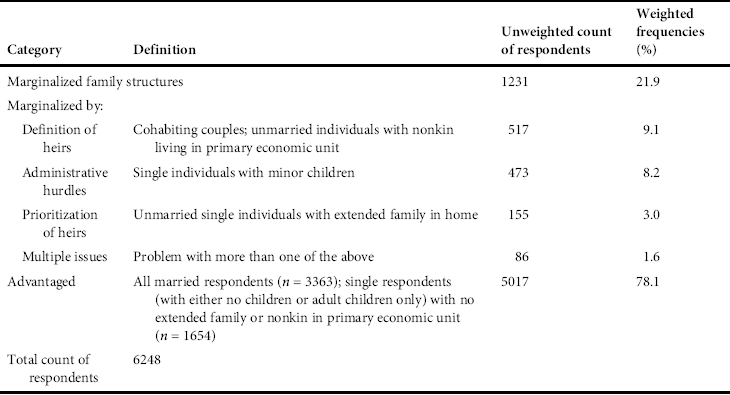
Table 1 reports the prevalence of family structures that are marginalized and advantaged by the laws of intestacy. Weighted frequencies indicate that the majority of American families (78%) have family structures that are well matched to the intestacy's kin-based definition of intestate heirs and the default prioritization of spouses, then children, then other extended family members. This includes all households headed by two married partners (47% of households) and single individuals who do not have extended kin or nonkin in the home, and thus are not economically responsible for others within the household (31%). This latter category includes single parents with adult children; because distributions to adult children do not require the establishment of a guardianship, as may be required for transfers to minors, the dispositions mandated by intestacy do not involve the imposition of administrative hurdles.
Prevalence of family structures marginalized and advantaged by intestacy

Note: Frequencies are weighted to adjust for unequal selection into the sampling frame and nonresponse.
The remaining 22% of American families, however, have family structures that are marginalized by the laws of intestacy. Recognizing that intestacy laws can marginalize family structures in several ways, Table 1 also presents the prevalence of family structures that are marginalized through the definition of heirs, the prioritization of heirs, or the imposition of administrative hurdles.
Nine percent of American families are marginalized through the definition of heirs. This category primarily includes nonmarital cohabiting couples (93% of families in this category). By classifying only legally recognized kin as potential intestate heirs, the laws of intestacy exclude these partnerships. Moreover, both cohabiting individuals and unmarried single individuals who have economically dependent nonkin living in their household (e.g., close friends) may also not be well served by the current laws of intestacy because these nonkin would not be recognized in the event of their death. Single individuals with economically dependent nonkin account for 7% of families in this group.
Intestacy's prioritization of heirs marginalizes unmarried heads of household where extended family is living in the household and relying on them for shared housing and/or economic resources in some capacity. Family members of a closer degree of kinship who live elsewhere are prioritized in intestacy, which may leave these dependent extended family members behind. Three percent of American families fall into this category.
Because the laws of intestacy do not account for heirs' legal capacity to own property in directing distributions, family structures that result in inheritance by minor children raise administrative hurdles, as legal structures must be put in place to manage the inherited property on behalf of the minor. For this reason, single individuals with minor children who die intestate are likely to encounter administrative hurdles. Eight percent of American families are single heads of households with minor children.
Finally, through this classification process, we estimate that close to 2% of American families have family structures that may present multiple issues with default laws.Footnote 7 This includes, for example, single parents of minor children with extended family living in their home. If these individuals die intestate, there may be both administrative hurdles and problems with prioritization of kin.
The distribution of family structures marginalized by intestacy laws
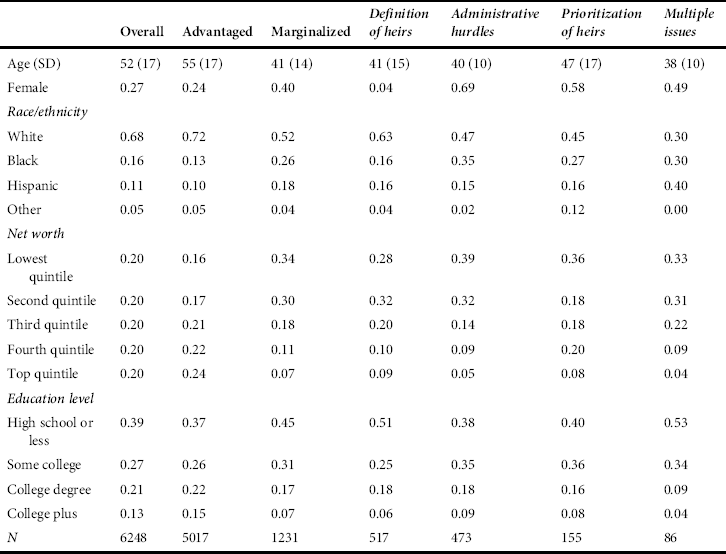
We next assess the distribution of family structures that are marginalized by the laws of intestacy across the population. As Table 2 indicates, such family structures are associated with race, wealth, and education. Higher shares of Black and Hispanic individuals and lower shares of white individuals have family structures that are marginalized by the laws of intestacy, relative to these social groups' distribution within the population. Such marginalized family structures are more prevalent among individuals with lower net worth and lower education levels. However, these family structures are not solely found at the lower end of the socioeconomic distribution. A full 36% of the family structures that are marginalized by the laws of intestacy occur in middle- or high-net worth families, and 24% occur in families where the individual of interest has a college degree or more. The results underscore that family structures across the socioeconomic and demographic spectrum can be marginalized by the laws of intestacy.
Sociodemographic distribution of family structures

Note: Statistics are weighted to adjust for unequal selection into the sampling frame and nonresponse.
Table 2 also shows that there is demographic variation in the ways that family structures are marginalized by the laws of intestacy. There is a very small share of female respondents who are classified as having problems with definition of heirs, namely cohabiting couples, which is a function of the SCF design: the survey interviews one respondent per household, and by default this is the male partner in heterosexual couples. Relative to other categories, there is a higher share of White individuals and lower share of Black individuals whose family structures are disadvantaged due to the definition of heirs. The majority of individuals facing potential administrative hurdles (single heads of households with minor children) are female, aligning with work that shows that the majority of single parents are mothers. Across all four subcategories there remains substantial heterogeneity across net worth and education categories, suggesting that legal marginalization can occur across the socioeconomic distribution.
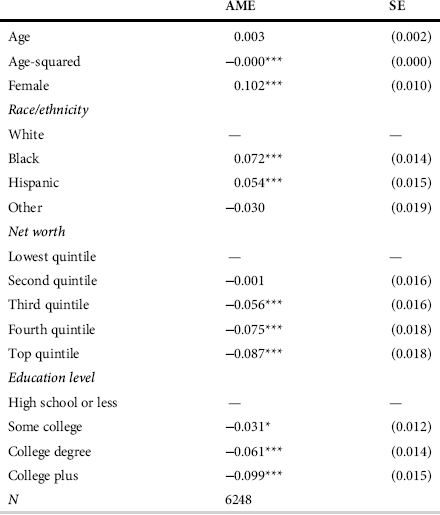
Next, using logistic regressions, we find that the predicted probability of belonging to a family structure marginalized by the laws of intestacy substantively varies by socioeconomic and demographic characteristics. These regressions estimate the degree to which race/ethnicity, net worth, education level, age, age-squared, and gender contribute to the likelihood of belonging to a family structure disadvantaged by intestacy laws, and use a binary measure of marginalization as the dependent variable (where 1 = marginalized family structure, and 0 = advantaged family structure). We do not separately consider subcategories indicating the manner in which family structures are disadvantaged under intestacy law as outcomes. We present results in Table 3 using average marginal effects, which show the average change in predicted probability when a continuous independent variable increases by one unit or a categorical variable moves from 0 to 1, with all other variables as observed. For example, in Table 3 above, the AME for gender indicates that the predicted probability of having a family structure marginalized by the laws of intestacy is 0.102 higher for women than it is for men.
Average marginal effects for logistic regression predicting marginalized family structure

Note: Regression is unweighted. Age, sex, race/ethnicity, and education level refer to the family reference person in the survey.
*p < 0.05; ***p < 0.001.
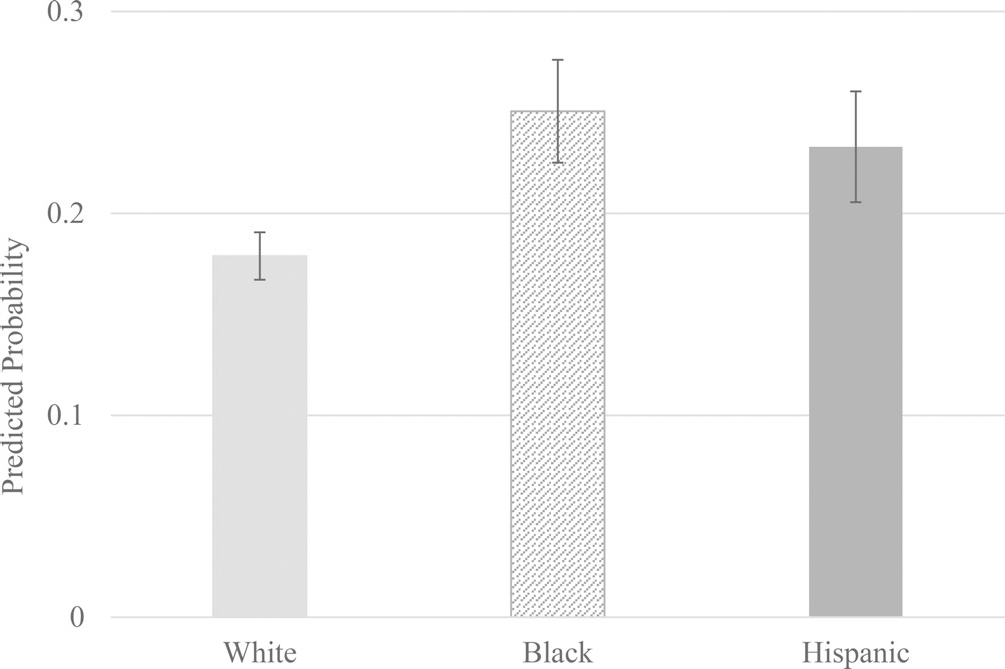
Average marginal effects for education and net worth show that the predicted probability of a family structure being marginalized by intestacy law is negatively associated with higher levels of both; as levels of education and net worth increase, the probability of having a marginalized family structure declines significantly. In addition, Black and Hispanic individuals are significantly more likely to have family structures that are disadvantaged by intestacy laws relative to whites. Figure 1 highlights this fact by showing the predicted probabilities with all other variables as observed: the predicted probability of having a family structure marginalized under intestacy for whites is 0.17, but is around 0.25 for Blacks and Hispanics, a statistically significant difference (p < 0.001).
Predicted probability of having a marginalized family structure, by race/ethnicity Note: N = 6248. Regressions are unweighted and conditional on net worth, education, age, age-squared, and gender. Error bars represent 95% confidence intervals. “Other” race category not shown

The above empirical analysis accounts for key socioeconomic and demographic factors that can impact family structure. However, family structures change over the life course (e.g., Reference Hofferth, Goldscheider, Shanahan, Mortimer and JohnsonHofferth & Goldscheider, 2016; Reference Killewald, Pfeffer and SchachnerKillewald et al., 2017). As a point-in-time analysis, we cannot speak to how the family structures of these individuals will look at the time of death, when the laws of intestacy, if applicable, would be given effect. We can, however, link individuals to estimated life expectancies of US adults to present estimates that account for variation in the likelihood of death. As a final step in assessing the prevalence and distribution of family structures disadvantaged by the laws of intestacy, we develop weights based on the 2015 life expectancy rates by age, race/ethnicity, and gender per 100,000 people (Reference Arias and XuArias & Xu, 2018). Individuals with lower estimated survival rates based on these factors are upweighted to more accurately reflect their higher likelihood of death based on these demographic characteristics. This reorients our regression analysis to more accurately represent varying mortality risks across the population.
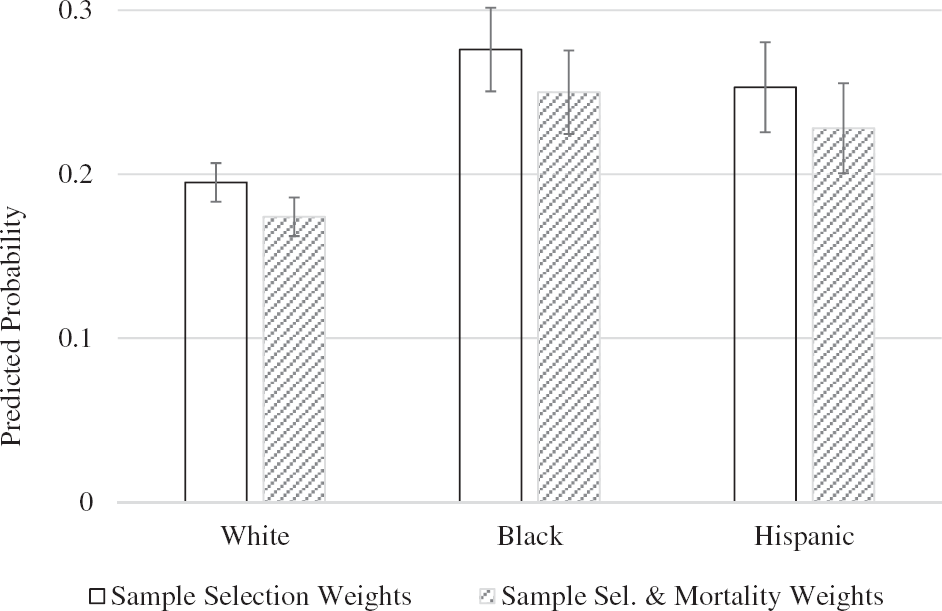
We find that the weighted analyses, which account for both selection into the sample and life expectancy, are not substantively different from our findings above. We reestimate Tables 2 and 3 using these weights for White, Black, and Hispanic individuals (individuals who identify their race/ethnicity as “Other” are excluded from this supplemental analysis because their life expectancy rates are unknown). Descriptive statistics that account for both selection into the sample and life expectancy for this subsample (N = 5927) show that family structures disadvantaged under intestacy continue to account for about 20% of American families. For example, Appendix A presents a comparison of the weighted and unweighted predicted probabilities of having a family structure marginalized by the laws of intestacy by race and ethnicity, and differences are neither substantively nor statistically significant. Because we control for age, race/ethnicity and gender in all models, we proceed without weighting for life expectancy in our analysis.
Consequences of family structures marginalized by the laws of intestacy
Although we have established the prevalence of family structures whose needs are not prioritized by the laws of intestacy, the material impact of intestacy's legal classification system depends on several factors. In this section, we evaluate whether individuals whose family structures differ from the traditional marital family form in the ways described above hold assets that could be subject to the laws of intestacy and whether they have will substitutes to avoid intestacy.
Family structures marginalized by intestacy laws and asset holdings. The above findings suggest that intestacy may generate problematic situations for a substantial proportion of the population, and especially among people of color. However, if individuals in this situation lack assets to transfer at death, the problem is moot. To investigate this possibility, we assess a variety of financial and real property holdings.
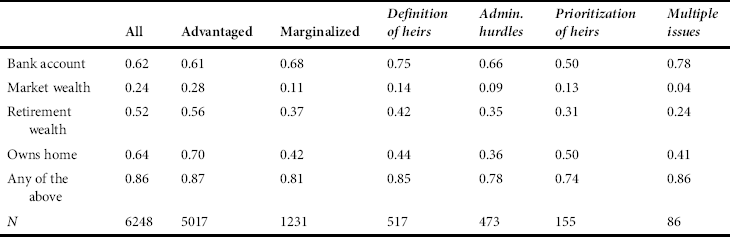
Table 4 provides details on the descriptive relationship between family structure and assets held. These descriptive results underscore that individuals across family structures hold real or financial assets that would need to be distributed upon death. Bank account ownership rates are similar across individuals with advantaged and marginalized family structures (61% and 68% of individuals have an account, respectively). Although having market wealth, retirement wealth and/or owning a home is less prevalent among individuals with marginalized family structures, it is not insignificant. About 42% of individuals with marginalized family structures own a home, 37% have retirement wealth, and 11% have market wealth. Asset holdings remain common across subgroups of marginalized family structures. For example, 75% of individuals with family structures that may have issues with definition of heirs (e.g., cohabiting partners) report having at least one bank account, and over 40% report having retirement wealth and owning their home. Finally, looking at all four asset types together, 81% of individuals with marginalized family structures hold at least one of these assets, with subgroup frequencies ranging from 74% to 86%. This further supports the notion that, in the absence of a will or will substitute, the majority of individuals with marginalized family structures could encounter intestacy issues on key assets that they hold.Footnote 8
Asset ownership across family structures

Note: Statistics are weighted to adjust for unequal selection into the sampling frame and nonresponse.
Avoiding intestacy through will substitutes. Recall that intestacy laws are default rules. By executing a will, holding property jointly, or transferring property at death via a beneficiary designation form, individuals avoid intestacy—and many problematic distributions it engenders. Will substitutes like joint account ownership, joint property holdings, or beneficiary designations are accessible mechanisms for avoiding intestacy. But, the availability of these options varies by family structure. For instance, individuals with sole ownership of a home may not be able to avoid intestacy, likely the case for many cohabiting or single individuals who have sole ownership of property.
Due to data limitations, we are unable to parse out sole and joint ownership of property and market wealth, but we can examine joint ownership of bank accounts, which has significant variation across family structures. We find that while 50% of individuals with advantaged family structures report having a joint bank account with a family member (including spouses), just 14% of those with marginalized family structures report the same. Not surprisingly, given the relevance of family structure for property ownership, this varies across method of marginalization. For instance, only 7% of individuals with potential administrative hurdles have a joint account, but about 26% of individuals with potential problems with definitions of heirs have a joint account.
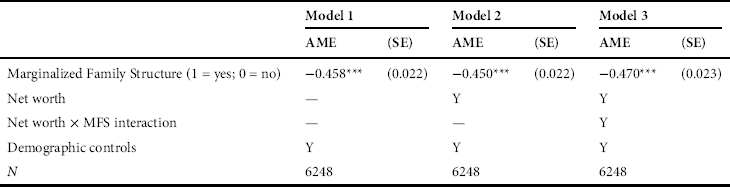
To empirically assess the availability of will substitutes for bank accounts by family structure, we employ a two-stage Heckman probit model that first accounts for whether an individual reports having any bank account (1 = yes, 0 = no), conditional on age, gender, race/ethnicity, education, and net worth. This first stage model is important because we are examining the probability of having a will substitute for a particular asset (money in an account) and need to account for differential selection into ownership of that asset. Then, in the second stage model, we estimate the probability of having a joint bank account (1 = yes, 0 = no) by family structure, first controlling for age, race/ethnicity, gender. We next include net worth quintiles as socioeconomic mediators in the second stage model, and finally, in a third model, we interact net worth with marginalized family structure. Table 5 reports results as average marginal effects of marginalized family structures on joint bank account ownership, conditional on having any bank account.
Predicted probability of having will substitute for bank accounts, average marginal effects

Note: Regressions are unweighted, AMEs are conditional on selection into owning any bank account. Selection model (not shown) estimates probability of any bank account conditional on education, net worth, race/ethnicity, age, age-squared, and gender. Demographic controls for second-stage model are race/ethnicity, age, age-squared, and gender.
*** p < 0.001.
Table 5 shows that families with structures that are deprioritized by the laws of intestacy are substantively and significantly less likely to have joint accounts, which serve as workarounds for intestacy. Even after accounting for the moderating impacts of net worth and education, Model 3 reports that individuals with such structures are about 47 percentage points less likely to have a joint bank account (p < 0.001) relative to their peers with family structures that are consistent with intestacy's assumptions regarding traditional marital family form.
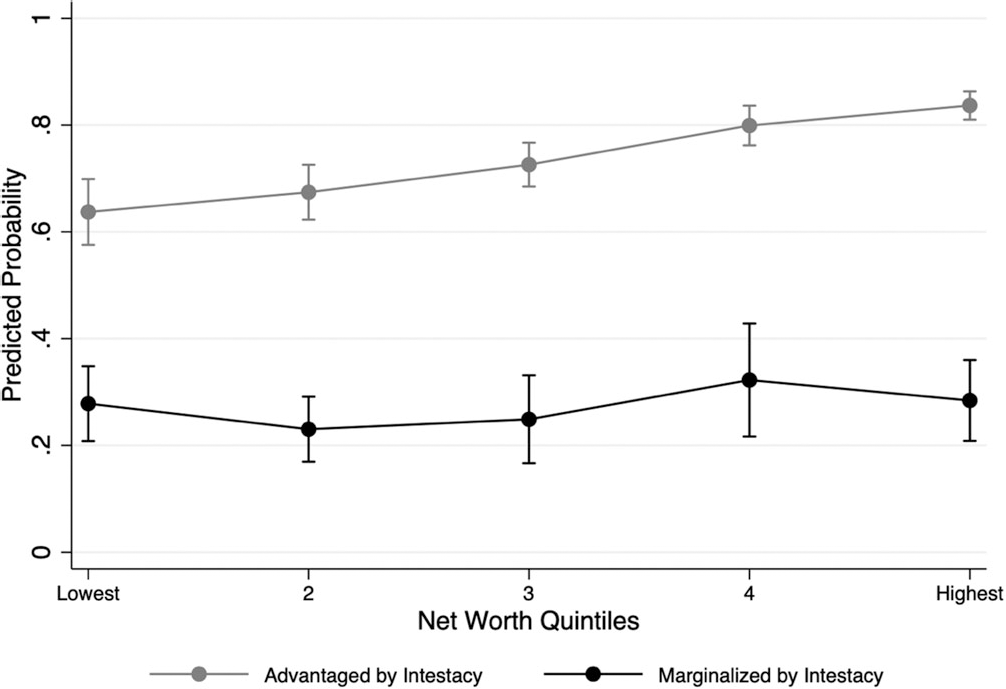
The differences in the predicted probability of having a will substitute via joint bank account ownership, conditional on owning any bank account, are consistent across the socioeconomic spectrum. Figure 2 presents predicted probabilities for individuals with disadvantaged and advantaged family structures over net worth quintiles, using the full model (Model 3 in Table 5). For individuals with nonmarginalized family structures, such as those who are married, the predicted probability of joint account ownership modestly increases across quintiles and ranges from 0.64 to 0.84, with those in the highest net worth quintile statistically more likely to have a joint account compared to those in the bottom two net worth quintiles (p < 0.05). In contrast, for individuals with marginalized family structures, the predicted probability of having a joint account remains flat and low, at around 0.23–0.32 for all quintiles.
Predicted probability of joint account ownership, by family structure and net worth quintile Note: N = 6248. Figure derived from Model 3 in Table 5. Predicted probabilities conditional on owning a bank account. Error bars represent 95% confidence intervals

For individuals whose family structures are marginalized by the laws of intestacy, the predicted probability of having an alternative to intestacy is, at every level, substantively and significantly lower than that of individuals with family structures that are advantaged under these laws. This figure underscores that individuals already well served by default intestacy rules are also more likely to have will substitutes that would allow them to avoid intestacy, at least for bank accounts. In contrast, individuals for whom intestacy may not align with desired distribution of assets are the ones who are may be less able to avoid intestacy because of the way their assets are structured.
Thus, our findings identify both direct and indirect consequences of family structure on the distribution of assets under intestacy. First, as shown in our earlier analyses, family structure is linked to potential problems with asset distributions under intestacy. Second, we show that variation in family structure is connected to how assets are held, producing unequal access to a key tool that people can use to avoid these default distributions.
Accounting for probability of having a will. A key limitation to the SCF data is that the survey does not ask respondents whether they have a will. Thus, while our analyses are representative of the US adult population and robust to variation in life expectancy across sociodemographic groups, we cannot distinguish between those who do and do not have wills. Existing empirical scholarship on patterns of testacy does not fully account for heterogeneity in family patterns, leaving open the possibility that individuals with nontraditional families use wills to avoid the negative implications of intestacy. However, empirical scholarship on patterns of intestacy suggest that this is unlikely. Rates of intestacy are higher among younger individuals and those with less wealth, lower incomes, and lower levels of education (Reference Taylor PoppeTaylor Poppe, 2020)—characteristics that are also associated with a greater likelihood of nontraditional family formation.
DISCUSSION
Our results offer the first national assessment of the prevalence of family structures that are marginalized by the laws of intestacy. We find that one in five American families have such a family structure. Although these family structures appear across socioeconomic and demographic groups, Black and Hispanic individuals and those with lower levels of net worth and education are more likely to have such structures.
Moreover, as expansive as this estimate of the prevalence of marginalized family structures is, it is likely a conservative measure. Blended families are another reality that the law has struggled to address (Reference MahoneyMahoney, 1995), including the laws of intestacy (e.g., Reference Wright and SternerWright & Sterner, 2017). We find that about 26% of currently married Americans were married previously, which may further complicate their testamentary desires, especially if they have children.Footnote 9 In addition, family structures that are deprioritized by the laws of intestacy may intersect with other marginalized legal categories, such as those indicating certain citizenship statuses, to generate additional tensions between the laws of intestacy and the realities of modern families (Reference HackerHacker, 2017).
Importantly, we find that many individuals whose family structures are marginalized under the laws of intestacy have assets in the form of bank accounts, market wealth, retirement wealth, and/or property. The need to distribute such property at death confirms the potential material significance of the laws of intestacy. Though will substitutes like joint bank accounts provide an alternative to intestacy, individuals with marginalized family structures across all levels of net worth are significantly less likely to have such an alternative. Findings from other scholarship also suggest that these individuals may be less likely to have wills. Together, these results indicate that legal marginalization may have tangible consequences on individuals' ability to distribute assets upon death in accordance with their personal definition of family.
These results are particularly important in light of the role that the laws of succession play in maintaining economic inequalities. By establishing the right to transfer property at death, the laws of succession—of which the laws of intestacy are part—make possible the intergenerational transmission of wealth through inheritance. As Reference FriedmanFriedman (1966, p. 352) writes, “The very existence of a stable upper class as opposed to a merely wealthy class presupposes the existence of a method of devolution of property at or before death.”
Indeed, the stability of wealth within families, and wealth inequality across families, is perpetuated in part by intergenerational transfers (Reference Adermon, Lindahl and WaldenströmAdermon et al., 2018; Reference Killewald and BryanKillewald & Bryan, 2018; Reference KotlikoffKotlikoff, 1988; Reference Wolff and GittlemanWolff & Gittleman, 2014), with inheritance as a key mechanism for keeping wealth within the family (Reference KohliKohli, 2004). Significant socioeconomic and demographic variation in who receives these transfers and their value contributes to ongoing wealth inequalities (Reference Mckernan, Ratcliffe, Simms and ZhangMckernan et al., 2014; Reference Pfeffer and KillewaldPfeffer & Killewald, 2018; Reference SzydlikSzydlik, 2004). Despite this, the legal processes through which such transfers occur have remained largely understudied.
By investigating one such process, this article identifies a further mechanism of inequality. Prior research underscores the relevance of family structure for wealth holdings (Reference HaoHao, 1996), with marriage as wealth-enhancing relative to other family forms (Reference HaoHao, 1996; Reference Hirschl, Altobelli and RankHirschl et al., 2003; Reference ZagorskyZagorsky, 2005). Our findings describe how family structure also matters for the legal process through which intergenerational transfers occur.
For example, within the household, we restrict our analysis to the PEU, indicating economic interdependence among the household members. For traditional marital families, the household economic unit falls within the kin structure assumed by intestacy. We illustrate that this is not the case for many marginalized family structures, which include members in the economic unit who are not recognized or prioritized by intestacy (e.g., cohabiting partners). This presents a potential double disadvantage: under current intestacy laws, family forms already economically marginalized in terms of their ability to accumulate wealth may also be unable to distribute the wealth they do have among those individuals who rely on them economically.
In addition, the distributions mandated by intestacy can have other detrimental economic consequences. For example, we find that 42% of individuals with marginalized family structures own real property, which may be at risk of being distributed to multiple heirs in the absence of a will or will substitute. Scholars suggest that the forced disaggregation of property among multiple heirs under the laws of intestacy deepens economic inequalities (Reference StrandStrand, 2010). Recent research has found that this is an issue that disproportionately affects Black and poor individuals because fewer individuals in these social groups have made wills to avoid intestacy (Reference MitchellMitchell, 2014). Real property held together by numerous relatives can result in legal burdens that make it difficult to sell the property or result in undervalued forced sales (Reference MitchellMitchell, 2014; Reference StrandStrand, 2010). Other problems can arise because there is a lack of a clear title; for instance, some families with property held this way were ineligible for disaster assistance after Hurricane Katrina because they did not have a title to prove ownership (Reference DeatonDeaton, 2012).
That said, because we are not observing the administration of decedents' estates, we are unable to measure the ultimate impact of the laws of intestacy on individuals with marginalized family structures. Empirical research on probate estates finds that the property of many decedents is transferred informally outside of the formal legal process (Reference HortonHorton, 2015). Moreover, surviving family members may effectively negate a dispositive scheme mandated by law (Reference Cahn and ZeittlowCahn & Zeittlow, 2015). In this way, the laws of intestacy represent an interesting twist on the familiar distinction between law on the books and law in action. Unlike many phenomena of interest to sociolegal scholars where the failure of law to live up to its intended purpose has detrimental consequences, the laws of intestacy may be an instance in which individuals obtain more favorable outcomes as a result of a gap between the law in action and the law on the books. On the other hand, it is also possible that the laws of intestacy have additional unintended negative consequences beyond those considered here.
Additional investigation is needed to better understand the consequences of the laws of intestacy and the burdens imposed by the probate process, particularly given the unequal distribution of these burdens across different family forms. Such research could also help to inform current efforts to reform the laws of intestacy. Legal scholars have offered critical evaluations of existing law (Reference Crawford and InfantiCrawford & Infanti, 2014) and have proposed revisions to the existing structure of intestacy (e.g., Reference GallanisGallanis, 2004; Reference GaryGary, 2000; Reference SpitkoSpitko, 1999), advocated for a shift from a rule-based system to one that incorporates a greater degree of judicial discretion (Reference GaryGary, 2012), and suggested the potential for the development of personalized defaults using big data (Reference Porat and StrahilevitzPorat & Strahilevitz, 2014). Some reforms are in progress. For example, the Uniform Partition of Heirs Property Act, which is being adopted in an increasing number of states (Uniform Law Commission, 2020a), addresses many of the issues associated with shared ownership of inherited property noted above. And, the Uniform Law Commission is currently evaluating the economic rights of unmarried cohabitants (Uniform Law Commission, 2020b). Our findings offer important insights regarding the relative prevalence of potential pathways of marginalization under the current laws, which could help to inform these efforts.
Another approach to addressing the issues we identify is to increase the use of testamentary instruments or will substitutes among those with marginalized family structures. Estate planning allows individuals to control the disposition of their property at death, and those who lack access to such tools are denied access to this important form of self-determination. Given the dispositions mandated under intestacy, such planning is likely to be particularly consequential for individuals with marginalized family structures. This article illustrates why intestacy represents a potential form of inequality in access to civil justice and exemplifies one way in which inequalities in Americans' access to ex ante legal assistance (Reference HadfieldHadfield, 2010) can result in unequal outcomes under the law. To address this need, scholars have suggested ways to increase access to estate planning, including easing the formalities required to make a valid will (Reference Boni-SaenzBoni-Saenz, 2018; Reference Crawford and InfantiCrawford & Infanti, 2014), allowing the use of government-generated testamentary schedules (Reference WeisbordWeisbord, 2012) or by loosening restrictions on the unauthorized practice of law to encourage the expansion of online providers of basic estate planning instruments (e.g., Reference Barton, Estreicher and RadiceBarton, 2016). This article supports the need for such interventions.
This scholarship also suggests several additional areas for future scholarship. First, it highlights the relevance of the laws of succession for sociolegal scholarship on the relationship between social and legal change. Law is an observable manifestation of social phenomena (Reference DurkheimDurkheim, 1997 [1893]), with the laws of intestacy serving as a measurable indicator of social norms regarding the family (Reference FriedmanFriedman, 2009). Future scholarship might investigate more deeply the ongoing dynamic between social and legal change in this area. In addition, our investigation of the laws of intestacy illustrates the relevance of these legal provisions for economic transfers. Reference SwedbergSwedberg (2003) has called for a sociology of economic law, and this article highlights the ways in which legal classifications constrain inheritance, which can have long-term economic consequences for families. Finally, this research also contributes to broader questions about the policy implications of changing patterns of household formation (Reference Cherlin and SeltzerCherlin & Seltzer, 2014).
Moving beyond marginalized family structures in particular to the analytic framework of marginalized legal categories more generally, the article illustrates the relevance of blackletter law for sociolegal scholarship. Sociolegal scholarship was born out a desire to understand the social implications of law in action (Reference ErlangerErlanger, 2015). Many areas of substantive law have been neglected by the field, but are ripe for reclamation (Reference Levitsky, Best and GarrickLevitsky et al., 2018). The framework of marginalized legal categories reveals how social norms are encoded into the law and highlights a path forward for sociolegal scholarship.
Moreover, the concept of legally marginalized categories provides a framework around which scholarship investigating the phenomenon of legal classification across substantive areas can be united. Sociolegal scholarship has long recognized the importance of classification, but has lacked a unifying framework that bridges substantive areas. With this concept, scholars can both compare and contrast marginalization in varied domains and identify points of intersection wherein marginalization within one domain may lead to marginalization in others. Importantly, this framework also directly connects the law to inequality by not only highlighting groups whose needs are deprioritized by the law but also underscoring the material consequences of that denigration. Law and society scholars are uniquely suited to address this mechanism of inequality “hidden” within law itself.
ACKNOWLEDGMENTS
The authors would like to thank Julia Chen and Allyssa Scheyer for their valuable research assistance and the anonymous reviewers and colleagues at the University of California, Irvine School of Law and the University of Wisconsin-Madison for their helpful comments on earlier drafts. They also received valuable input from conference participants at the annual meetings of the Population Association of America and the Law and Society Association.
APPENDIX A.
Predicted probability of marginalized family structure by race/ethnicity, by application of weights for life expectancy Note: N = 5927. Both regressions are weighted to account for selection into the sample, are conditional on net worth, education, age, age-squared, and gender. This comparison excludes individuals whose race/ethnicity is identified as “Other” in the Survey of Consumer Finances (SCF) (because racial/ethnic group life expectancy cannot be evaluated). Unfilled bars reflect values not weighted for mortality risk; shaded bars reflect analysis incorporating weights for mortality risk. Error bars represent 95% confidence intervals


 Open access

