





Introduction
Latest developments in artificial intelligence (AI) have raised concerns about whether AI will replace human creativity and, consequently, whether designers will continue to remain relevant for the development of environments, products, and services in the near future (Irbite and Strode, Reference Irbite and Strode2021). However, recent research exploring designer–AI interaction in generative tasks identifies AI as an agent that assists rather than replaces in the design process (Chiou et al., Reference Chiou, Hung, Liang and Wang2023; Kalving et al., Reference Kalving, Colley and Häkkilä2024; Tang et al., Reference Tang, Ciancia, Wang and Gao2024). This perspective has contributed to a reframed understanding of AI in design, shifting from a tool-based view (Sarkar, Reference Sarkar2023) toward models of human-computer collaboration (Cabrera et al., Reference Cabrera, Perer and Hong2023), human–AI cooperation (Li et al., Reference Li, Huang, Liu and Zheng2022), and human-AI symbiosis (Mahmud et al., Reference Mahmud, Hong and Fong2023). These models describe designer–AI interaction as a strategic partnership where parties bring forth their strengths in achieving common goals (Stylos, Reference Stylos, Moutinho, Cavique and Bigné2023), a synergy where they leverage their strengths for heightened efficiency (Zhang and Yin, Reference Zhang and Yin2024), and a symbiosis where parties develop each other into smarter agents over time (Jarrahi, Reference Jarrahi2018). Although the view prevails that AI and humans still need time and new methods to learn each other’s languages (Tang et al., Reference Tang, Ciancia, Wang and Gao2024), such perspectives ease earlier anxieties about AI replacing designers and also position AI as a self-directed, adaptive assistant contributing meaningfully to both the process and outcomes of design (Zeytin et al., Reference Zeytin, Kösenciğ and Öner2024).
AI’s contributions to the design process include taking over chores and speeding up steps (Altavilla and Blanco, Reference Altavilla and Blanco2020) such as gathering information and analyzing data, carrying out specific acts not typically part of designer skill sets such as programming (Alexander, Reference Alexander and Cross1984), identifying potential issues affecting the development cycle early on in the process (Tholander and Jonsson, Reference Tholander and Jonsson2023), generating alternatives through diversification and variation (Gmeiner et al., Reference Gmeiner, Yang, Yao, Holstein and Martelaro2023; Liang, Reference Liang2024), and decision making through filtering and selecting solutions (Chung and Choi, Reference Chung and Choi2022). These capabilities point to a transformative effect on how design processes are conducted (Adeleye, Reference Adeleye2024), the qualities the outputs will possess (Irbite and Strode, Reference Irbite and Strode2021), the skill sets future designers will need (Singh and Duo, Reference Singh, Duo, Vasant, Shamsul Arefin, Panchenko, Thomas, Munapo, Weber and Rodriguez-Aguilar2023), and what the role of designers will become (Seidel et al., Reference Seidel, Berente, Lindberg, Lyytinen and Nickerson2018) within AI-integrated design processes.
This article adopts a collaborative perspective on AI and addresses a gap in the literature around how professional designers integrate AI tools into their workflows across different stages of the design process, examined through research that adopts a theoretical framework based on the double-diamond design model (Design Council, 2025). This model represents the design process as two sequences of divergence and convergence: the first for problem exploration and framing, and the second for solution exploration and naming. Within this structure, divergent and convergent thinking are iterative and interdependent, supported by analytical reasoning and synthesizing abilities, capacities often considered fundamental to design thinking (Tovey, Reference Tovey, Garner and Evans2012; Goldschmidt, Reference Goldschmidt2016).
The research combines a survey for gathering information on the types of AI tools that designers use in their professional practices, with think-aloud interview sessions for observing and interactively discussing the designers’ engagement with AI tools. The responses collected from the survey identify AI usage for different designerly functions, while findings from the sessions reveal how designers interact with AI tools, complementing written statements with observed engagements and providing an integrated perspective on the topic. As a contribution, the research reveals how designers plan, manage, and make decisions with AI support beyond idea generation, as well as suggesting insights into the attitudes, communication styles, and interactions that designers display in the way they engage with AI.
The research is conducted among professional designers in Türkiye, preferred for their competence in designerly skills, expertise in domain-related knowledge, and experience in implementing AI tools in their professional practices with access to tools, methods, and know-how in product development sectors. While the research is contextually localized, the findings may still be of interest to a wider design community, given the parallel structures of design education in Türkiye with international higher education systems (see Er et al., Reference Er, Korkut and Er2003; Şatır, Reference Şatır2006; Hasdoğan, Reference Hasdoğan2009; Irkdaş Doğu et al., Reference Irkdaş Doğu, Timur Öğüt and Er2015; Korkut et al., Reference Korkut, Hasdoğan and Öztürk Şengül2023), and the alignment of the conduct of professional design practices with that of international counterparts, as both are fundamentally based on the same core design development processes (see Özcan, Reference Özcan2009; Tezel, Reference Tezel2011; Hasdogan, Reference Hasdogan2012; Ünsal, Reference Ünsal2018; Kaygan et al., Reference Kaygan, İlhan and Oygür2020; Kesdi and Kaygan, Reference Kesdi and Kaygan2025).
The article first reviews the literature on design process, design thinking, creativity, and AI in design, followed by a review of research carried out on the topic. The methodology section presents the research questions and outlines the methodology for data collection and analysis, followed by the presentation of the findings with discussions on how AI integration aligns with stages of the double-diamond design model. The article concludes by addressing the research questions and shares suggestions for further research.
Design process, design thinking and creativity
Design is related to a series of activities defining a process as well as its outcomes, conducted for product renewal, development, or innovation (McKay, Reference McKay, Garner and Evans2012). The design process typically initiates with a brief outlining a design problem and proceeds through various stages to reach a possible solution (Collier, Reference Collier, Gardner and Evans2012). These stages incorporate activities such as planning, managing, researching, developing, testing, and production set-up that run conjointly or in parallel with design-related activities, allowing the analysis of the design situation and synthesis of all related information toward a final design output. Independent of context, designing involves multiple tasks to achieve its goals (Roozenburg and Eekels, Reference Roozenburg and Eekels1995; Pahl and Beitz, Reference Pahl and Beitz1996) and imposes cognitive, physical, and psychological loads on the designer (Hong et al., Reference Hong, Hakimi, Chen, Toyoda, Wu and Klenk2023). While design problems and goals frequently shift, how designers deal with ill-structured problems and the ambiguity associated with them remains unique (Cross, Reference Cross2006; Lawson and Dorst, Reference Lawson and Dorst2009). Designers’ work is characterized by continuous processes of understanding, reasoning, imagining, ideation, decision-making, and elaboration (Lawson, Reference Lawson2005; Cross, Reference Cross2011). These activities are central to what has been called designerly thinking, requiring a mindset that believes in growth and includes being empathetic, analytical, critical, experimental, collaborative, and creative. Designerly thinking is based on the parallel dichotomies of divergent-convergent, reflective-impulsive, and verbal-non-verbal thinking, using the language of drawings in reflecting visual thinking (Tovey, Reference Tovey, Garner and Evans2012).
Although the design process is mostly represented as a linear model, the interplay of the activities in the stages requires iterations that allow diverging for exploration and then converging for detailing and development, giving it a cyclic nature. The double-diamond model (Design Council, 2025) is often referred to in the design thinking literature as a useful representation of the design process, with two consecutive phases of divergence and convergence. The first diamond involves discovering and defining the problem, while the second involves developing and delivering the solution. In the discover phase, information on the problem area is collected and expanded (divergence), while in the following define phase, the design challenge is identified by narrowing down this information (convergence). In the develop phase, the solution space is widely explored through ideation (divergence), followed by the deliver phase, where the solution space is narrowed down toward a final solution through development and detailing (convergence).
Creativity is generally associated with the qualities of the final design outcome, defined through its novelty, originality, and value (Roy, Reference Roy2004; Tovey, Reference Tovey, Garner and Evans2012), as well as its functionality (Gero and Maher, Reference Gero, Maher, Gero and Maher1993). However, research shows that how problems are explored, defined, and addressed, as well as how solutions are explored and synthesized, also require creative engagement (Maher et al., Reference Maher, Poon, Boulanger, Gero and Sudweeks1996; Dorst and Cross, Reference Dorst and Cross2001; Lawson, Reference Lawson2005). Cross (Reference Cross1997, p. 427) explains creativity in design as the achievement of the “creative leap,” a shift in the perspective on the problem space resulting in a new insight on the solution space bridging the two, and indicates that this is more concerned with the design process and requires deliberate effort. To begin with, designers need to transform poorly defined problems into well-defined ones, as design problems are typically ill-structured (Simon, Reference Simon1973). Each design problem represents a new domain of inquiry, and designers act as researchers in framing the problem in their own understanding (Cross, Reference Cross2006). Design problems are solution-dependent, which calls for the need to extend and explore the solution space, as exploring solutions is often the means for understanding the problem (Dorst and Cross, Reference Dorst and Cross2001; Cross, Reference Cross2021). The problem and the solution co-evolve through iterations carried out in a series of divergence–convergence (Dorst and Cross, Reference Dorst and Cross2001; Goldschmidt, Reference Goldschmidt2016), aligning the explorative nature of the design process with the double-diamond model. Experience (Lawson, Reference Lawson2005) and expertise (Simon, Reference Simon and Kuhn1985; Lawson and Dorst, Reference Lawson and Dorst2009) influence this process and its outcomes, as they contribute to generating, accumulating, and using knowledge, as well as acting upon it and making evaluations. This explorative nature of design is why it has been considered a class of problem solving, and has laid the foundation for considering AI in designing as a mode of search (Gero, Reference Gero and Dartnall1994, Reference Gero2007). This, in turn, led to the development of symbolic search computation, generating formulations of designing, also reformulating the search space. The developments have resulted in a dynamic and prescriptive growing body of design space that changes continuously with new knowledge and new requirements generated through designing activities and their outputs each time (Gero, Reference Gero2007).
Amabile’s and Mueller (Reference Amabile, Mueller, Zhou and Shalley2008) componential theory of creativity emphasizes three within-individual components as influencers: domain-related skills (including expertise), creativity-relevant processes (cognitive and personality related for novel thinking), and task motivation (intrinsic motivation other than interest, enjoyment or a sense of challenge). The model suggests a fourth component that is outside the individual, the environment, and the social environment in particular, that supplies the individual with diverse stimulus mechanisms through different viewpoints, ideas, information, supervision, encouragement, and collaboration. This model suggests that creativity is shaped not only by individual capabilities but also by environmental and contextual factors, including tools and technologies. This opens up a conceptual space for AI integration in the creative process. According to Simon (Reference Simon and Kuhn1985) creative acts are the same as those required for intelligent acts, as both involve thinking in the form of reading, writing, assembling, storing, and comparing symbols in relational structures and branching the outcomes, making creativity computer-programmable for intelligent behavior. As such, AI systems now seem to have the ability to make connections across unexpected and multiple solution spaces for synthesis, bringing them closer to displaying the ability to make the creative leap in the design process (Sankar and Sen, Reference Sankar and Sen2025).
Artificial intelligence in design
Artificial intelligence, broadly defined, refers to systems capable of fulfilling human needs by processing information, identifying problems, and offering responses based on learned data (Buchanan, Reference Buchanan2006). The quality and scope of the data pool is crucial to AI’s functionality, since it shapes the generated output. AI systems are categorized by their cognitive capacities: Artificial Narrow Intelligence (ANI) handles specific tasks (e.g., chatbots); Artificial General Intelligence (AGI) performs a wide range of tasks and acts like human memory and reasoning; and Artificial Super Intelligence (ASI) is a hypothetical future form that exceeds human capabilities (Zohuri and Rahmani, Reference Zohuri and Rahmani2023).
The way AI operates is defined by the algorithms. Rule-based systems follow predefined “if-then” rules and are effective for planned tasks such as the systems that take necessary actions when the conditions are met (Fry, Reference Fry2018). On the contrary, machine learning (ML) automates decisions and optimizes their performance by being exposed to data (Stryker and Belcic, Reference Stryker and Belcicn.d.). ML has three main approaches: supervised, reinforcement, and unsupervised learning, each with distinct strategies for training on data. Deep learning, a subfield of ML, uses artificial neural networks that are modelled after human cognition. Furthermore, foundation models such as generative AI (GAI) and large language models (LLMs) make it possible for the autonomous generation of novel content. LLMs such as generative pretrained transformers (GPTs) are AI models that can generate human-like conversations, with the ability to assist with decision making, support creativity and prototype (Ege et al., Reference Ege, Øvrebø, Stubberud, Berg, Elverum, Steinert and Vestad2025).
Computer-aided design software has long supported designers with tasks such as creating, modifying, and analyzing designs. Recently, generative AI has emerged not only as a facilitator, but also as a potential partner in ideation, offering new ways in creative processes. Acknowledging that design problems are often complex, open-ended and composed of independent components, the designer’s task additionally includes setting priorities (Lawson, Reference Lawson2005). Generative AI is specifically valuable in this context for its capacity to automate repetitive tasks and produce unique and unexpected outcomes, enabling a shift from individual creativity to co-creative partnerships (Kalving et al., Reference Kalving, Colley and Häkkilä2024).
Active ideation refers to collaboration between humans and computers, where AI contributes by generating ideas, suggesting alternatives, and challenging assumptions, while designers curate, filter, and refine them (Sankar and Sen, Reference Sankar and Sen2025). Designers’ expertise and active engagement help overcome ideation problems such as fixation, mental blocks, and cognitive fatigue. Besides visual thinking, designers also utilize verbal thinking in ideation and construct linguistic queries for information retrieval. In this context, with the ability to be trained to align with human values, conversational AI supports natural language interactions, responding to verbal queries and generating meaningful content and prompts to ensure coherence of the conversations and outputs generated in response (Sankar and Sen, Reference Sankar and Sen2025).
Humans and AI collaborating as partners for creative products form creative systems. In creative systems, AI is a means of generating novel creative products with value, supporting human creativity, and collaborating with the user for a shared creative product combining the creative abilities of both parties (Davis et al., Reference Davis, Hsiao, Popova, Magerko, Zagalo and Branco2015). When humans and AI act as colleagues pursuing the same goal, the system is referred to as a co-creative system (Davis, Reference Davis2013). In processes led by co-creative systems, interaction and adaptability are important, as sometimes the human will want to lead, and other times the human will want AI to lead while conducting independent search (Rezwana and Maher, Reference Rezwana and Maher2023).
Rezwana and Maher’s (Reference Rezwana and Maher2023) Co-Creative Framework for Interaction Design (COFI) describes interaction in co-creative systems occurring as between human and AI collaborators, and with the shared creative product. Interaction between collaborators is affected by collaboration style and communication style (Rezwana and Maher, Reference Rezwana and Maher2023). Collaboration style incorporates participation style (parallel working, turn-taking), task distribution (same task, divided task), timing of initiative (pre-planned, spontaneous), and mimicry (mimicked response, improvisational response). Communication style may be human-to-AI intentional, human-to-AI consequential, or AI-to-human, through various modes such as text, visual, voice, gaze, facial expression, haptic, or direct manipulation, used individually or in combination. Interaction with the shared creative product is characterized by creative processes and the creative product (Rezwana and Maher, Reference Rezwana and Maher2023). Creative processes are activities followed for generating, evaluating and defining. The creative product is affected by the contribution types made by both parties (bringing new elements, extending, transforming, or refining existing elements), and contribution similarity (degree of divergence or convergence of the contributions made).
Research in the field
Numerous studies investigate the role of AI tools in design processes. Khanolkar et al. (Reference Khanolkar, Vrolijk and Olechowski2023) state that most AI-based methods are applied during the conceptual and preliminary stages of design, a key reason for this being the availability of open datasets that provide the necessary design-related information for AI to work with. Tang et al. (Reference Tang, Ciancia, Wang and Gao2024) interviewed seven designers on their recollections of their design processes, based on the double-diamond design model, revealing that the discover and develop stages are those where AI tools are mostly used. These stages require divergent thinking through activities such as searching for inspiration and research. A common agreement seemed to be a lesser reliance on AI for the final delivery; designers indicated that they found it important to study, filter, and develop the final scheme for the design themselves (Tang et al., Reference Tang, Ciancia, Wang and Gao2024). While studying collective intelligence (i.e., a group composed of a human and AI) through a 2 × 2 mixed factorial experiment design involving a generative AI tool, Cai et al. (Reference Cai, Rick, Heyman, Zhang, Filipowicz, Hong, Klenk and Malone2023) focused on the inspiration and initial idea generation stages, comparing image search and image generation for broad design space exploration. They projected the task distribution pattern within the design process among humans and computers as “human specifies, computer generates, human selects (p. 9),” redefining the role of AI in design to increase creative output and provide options for designers.
In their study, Zeytin et al. (Reference Zeytin, Kösenciğ and Öner2024) observed students during architectural design work and issued a survey investigating their design process; they identified that students integrated AI in their processes from beginning to end, selectively for particular tasks, or mainly initially for ideation. A balanced integration of AI tools proved to be significant in preventing over-reliance and not undermining the designer’s interpretative capacity (Zeytin et al., Reference Zeytin, Kösenciğ and Öner2024). Following the identification of AI tool usage trends within the design process from the literature, Chung and Choi (Reference Chung and Choi2022) carried out in-depth interviews with designers. Their findings emphasized that while designers made use of AI in the generation of ideas and creation of prototypes, there seemed to be a gap in the availability of tools that help designers plan and follow through their design processes, as well as assist them in decision-making.
Framing the engineering design process as composed of the five stages of problem definition, conceptual design, preliminary design, detailed design, and design communication, Khanolkar et al. (Reference Khanolkar, Vrolijk and Olechowski2023) investigated the literature for studies (n = 108) conducted on AI in design. They revealed that machine learning, deep learning, and NLP are widely used AI-based methods, with deep learning spreading across all five stages of the design process, machine learning across the first four stages, and deep learning across the first three stages. It was seen that AI-based systems were used in problem definition for customer review analysis, design requirements analysis, and user requirements analysis. AI was used in conceptual design for design data analysis, design ideation, concept generation, conceptual modeling, obtaining design alternatives, and evaluation. AI was used in preliminary design for design analysis, synthesis, and evaluation. AI was used in detailed design for design optimization. A smaller number of studies indicated using AI in design communication for obtaining aesthetic feedback on appearance and style.
Ege et al. (Reference Ege, Øvrebø, Stubberud, Berg, Elverum, Steinert and Vestad2025) compared the 48-hour prototype development process, for a given task, of six engineering design teams, five composed of humans, and one involving human-AI (LLM) collaboration. The findings revealed that the LLM displayed similar prototyping practices to humans and was capable of generating concepts and finalizing a functioning physical prototype. On the other hand, the LLM tended to add unnecessary complexity to the design proposals, mistook feedback as failure, consequently prematurely abandoning potential ideas, was unable to effectively communicate design intent, disrupted continuity by diverging from the project context, and displayed design fixation.
The qualities of AI-supported design are not determined solely by the technology’s capabilities but also depend on the knowledge, skills, and experience levels of the designer. Gmeiner et al. (Reference Gmeiner, Yang, Yao, Holstein and Martelaro2023) report that experienced designers actively follow advancements in AI tools and incorporate them in ways that complement and enhance their existing practices; by contrast, those less familiar with AI may feel hesitant or dissatisfied with the results. In their study, Tang et al. (Reference Tang, Ciancia, Wang and Gao2024) found that designers with less experience use AI tools in less frequency, whereas designers with more experience developed working ways with AI that are more extended throughout the design process. Experience levels influenced various aspects of their practice, including design competencies (e.g., skill sets and strategic thinking), process conduct (e.g., stage planning and time management), integration of domain knowledge and expertise, as well as personal motivation and interests.
AI technologies are increasingly integrated into creative workflows as a medium, taking on diverse roles within the design process (Negrete-Yankelevich and Morales-Zaragoza, Reference Negrete-Yankelevich, Morales-Zaragoza, Colton, Ventura, Lavrac and Cook2014; Albukhari, Reference Albukhari2025). Although generative AI has introduced new tools into design practice such as configuration builders and image generators, it has not displaced the core role of the designer. Designers incorporate their values into the design process for planning, executing, and critical decision-making through judgment and are still responsible for making the creative leap in bridging the problem and solution spaces. In this picture, AI tools are best understood as augmentative forces enhancing the outcomes of the design process rather than replacing or limiting human creativity (Figoli et al., Reference Figoli, Rampino, Mattioli, Lockton, Lenzi, Hekkert, Oak, Sádaba and Lloyd2022). There is a further need to investigate the interaction between designers and AI tools at the interface of designerly practices that implement analytical and synthesizing abilities through iterations of divergence and convergence.
Methodology
This research was designed to investigate how professional designers use generative artificial intelligence (GAI) tools in their design processes, using the double-diamond design model as the framework in examining the functions for which these tools are used, and how these are distributed across the design process in the exploration of the problem and solution spaces. It was hoped to explore through verbal inquiry and observations why and how designers engage with these tools in conducting a design task from beginning to end. The research questions were:
-
• How do designers integrate generative AI (GAI) tools in their design processes?
-
• How do designers engage with these tools in their design processes?
The research consisted of two studies. The first study involved a survey distributed via Google Forms to product designers in Türkiye, aiming to gather data on the AI tools they use in their design processes, their purposes for using AI tools, frequency of use, and self-assessed proficiency levels. The second study involved online think-aloud interview sessions with professional designers over Google Meet, during the conduct of a short design task that required them to integrate and interact with AI tools throughout the process and explain their actions in a think-aloud format. Google Meet, free to use with various tools, was chosen as the online platform for its availability and familiarity to each computer user. Meeting virtually expanded the participant pool, allowing the possibility of meeting with remote designers and in accordance with their convenience. Due to its exploratory approach, the study did not focus on particular AI tools, design stages, or designerly functions, leaving the designers free in their selection of and interaction with tools.
Survey
Theoretical-construct sampling was used to reach a wide pool of professional designers across Türkiye, who were industrial design graduates of various universities and working in different product development sectors. The sampling pool was drawn from the email database of the department affiliated with both authors that included alumni from all universities in Türkiye with industrial design departments, as well as personal contacts accumulated over years of academic and professional networking. The participant list was limited to graduates from the years 2013 to 2024, ensuring that respondents had at least 1 year and no more than 10 years of professional experience.
The survey was conducted online via Google Forms. At the beginning of the form, participants were informed about the aim and scope of the survey, and that their responses were gathered for academic purposes only. Participants were asked for their consent before continuing. The survey included four short-answer questions on demographic information and professional background, and six questions addressing the integration of AI tools into their design processes. The questions were whether they incorporate AI tools into their design processes (yes/no); how often they use these tools (between 1 and 5 on a Likert scale); which tools they use (short-answer); in which stages of their design processes they use these tools (short-answer); which AI tools they use for idea generation and visualization in particular (short-answer); and how they evaluate their proficiency levels (between 1 and 5 on a Likert scale). Additionally, respondents were asked whether they would be willing to participate in further stages of the research. The survey was distributed on April 15, 2024 to 3,004 designers and closed on May 17, 2024. A total of 103 responses were received, with 15 indicating no usage of AI tools and 88 valid responses. The analyses, including calculations and coding, were mainly conducted by the first author, with regular consultations and cross-checking with the second author.
Demographic information, AI tools usage frequency and proficiency levels
Respondents were industrial design graduates of eight different universities across five cities. Four respondents had 10 years of professional experience, 22 had between 5 and 9 years, 50 had between 1 and 4 years, and 12 had up to 1 year. Eighteen respondents graduated between 2022 and 2024, 39 graduated between 2019 and 2021 with the highest response rates per year, 24 graduated between 2016 and 2018, and 7 graduated between 2013 and 2018 with the lowest response rates per year. Their fields of practice included graphic design, UI/UX design, game design, product design, interior design, and industrial design. AI tool usage frequency was rated on a Likert scale from 1 (very rarely) to 5 (almost always). The average usage frequency was calculated as the weighted mean of responses, yielding a mean usage score of 3.04 over 5, indicating a moderate frequency of use (1 × 11 + 2 × 15 + 3 × 29 + 4 × 25 + 5 × 8 = 268, 268/(11 + 15 + 29 + 25 + 8) = 3.04). Proficiency levels were also rated on a Likert scale from 1 (very weak) to 5 (very proficient). The average proficiency level was calculated as the weighted mean of responses, yielding a mean usage score of 3.29 over 5, indicating a medium level of proficiency (1 × 2 + 2 × 13 + 3 × 38 + 4 × 27 + 5 × 8 = 290, 290/(2 + 13 + 38 + 27 + 8) = 3.29).
AI tools used
Respondents were asked which AI tools they used in their professional design practices and in which stages of the design process they used these. A total of 39 different AI tools were compiled from the responses of 87 participants (one respondent did not specify tool names), with the number of AI tools used by the respondents ranging from 1 to 9. The weighted mean number of tools used was calculated as 3 (1 × 12 + 2 × 20 + 3 × 30 + 4 × 12 + 5 × 10 + 6 × 2 + 9 × 1 = 261, 261/(12 + 20 + 30 + 12 + 10 + 2 + 1) = 3), and the median was calculated as 3.
The most frequently mentioned tool was ChatGPT (n = 68), a generative AI chatbot, followed by Midjourney (n = 36), an image generation tool. Other than these, 4 tools were mentioned by 11–17 respondents (1 by 17, 2 by 15, 1 by 11), 6 tools by 4–7 respondents (2 by 7, 2 by 6, 1 by 5, 1 by 4), and 27 tools by 1–3 respondents (3 by 3, 6 by 2, and 18 by 1).
The 39 AI tools were grouped according to type and reviewed in terms of capabilities. Among the tools, four were chatbots. Thirteen AI tools were image generators, accompanied by one tool for video generation, one for image and video generation, one for audio generation, and one for image, video, and audio generation. One tool was for 3D model generation, one for sketch-to-render generation, one for photo editing and image manipulation, one for texture generation, and one color tool. Other specific types were two architecture and interior visual and render generators, one game assets generator, one vector graphics and illustration generator, one graphic design and template tool, one font identifier, and one brand identity/content generator. Four tools offered collaborative whiteboard and AI workspaces. The list finally included one tool for translation and one for research summaries and note-taking.
The survey findings indicate that chatbots are mainly used for research, questions and answers, recommendations, opinions, information, and assistance, through conversations. ChatGPT (n = 68) remains a leading platform since its integration with DALL-E (n = 15) that has image-generation capabilities and other features such as adaptation and creating variations. A main feature of ChatGPT is its capability to maintain context across sessions, retrieving past conversations, making interactions feel continuous and genuine. Microsoft Bing (Copilot) (n = 7) was another commonly mentioned chatbot, differing from ChatGPT by offering a native Windows application and eliminating the need to use a web browser. Google Gemini (n = 6) and Perplexity (n = 2) were also referenced by participants.
The most commonly used tools for image generation included Midjourney (n = 36), Vizcom (n = 17), Adobe Photoshop’s Generative AI (n = 15), Adobe Firefly (n = 11), Stable Diffusion (n = 7) and Krea (n = 6). Midjourney is a subscription-based tool accessed via Discord or web browsers, allowing users to generate four images using the prompt command “/imagine.” These images can be regenerated, upscaled, or variated. It also features an image training function that enables users to upload visuals; AI analyses and describes the content, displaying how it interprets the visuals to support the creation of more targeted prompts. Vizcom uses sketches and reference images in combination with prompts, specifically aimed at creating images. Its stand-out features are the creation of product renders by editing generated images and adjusting prompt-based influence, making it particularly suitable for design-focused applications. Adobe Photoshop’s generative AI (e.g., Generative Fill) allows editing parts of an image using prompts, rather than generating images from scratch. Adobe Firefly excels at generating images from text prompts with a wide range of styles and visual effects. Krea operates in real-time for image creation and enhancement, enabling users to manipulate and develop images by integrating shapes, drawings, reference visuals, and prompts.
Usage purposes of AI tools
The survey included open-ended questions on the usage purposes of AI tools and the stages in which designers utilized them. Responses were collected in an Excel sheet and subjected to content analysis. The responses were first sorted by topic (e.g., exploration, research, and visualization). The processed data was then transferred to a Miro board for iterative reviews (done primarily by the first author and supervised by the second author) for placing the topics under themes on Post-its and converting them into a hierarchical category tree. This categorization resulted in the identification of specific usage purposes, emerging inductively from the content analysis of the data on reported practices, distributed under nine design-related functions, aligning with fundamental literature on the design process. Among the 85 respondents (responses from 3 participants could not be categorized due to ambiguity), 15 reported using AI tools for one function, 31 for 2, 27 for 3, 8 for 4, 3 for 5, and 1 for 6 functions. The weighted mean number of functions per respondent was calculated as 2.48 (1 × 15 + 2 × 31 + 3 × 27 + 4 × 8 + 5 × 3 + 6 × 1 = 211, 211/(15 + 31 + 27 + 8 + 3 + 1) = 2.48), and the median was calculated as 2. The most common function for which AI tools were used was idea generation and development, mentioned by 59 respondents, followed by visualization (39), research (35), presentation (22), inspiration and benchmarking (16), data analysis (16), organization and planning (8), persona/user journey/scenario generation (8), and automation (4).
AI usage mapped on the double-diamond design model
To identify the stages of the design process in which AI tools are integrated, the identified usage purposes covered under the nine design-related functions were subsequently mapped onto the double-diamond design model (Fig. 1). This mapping revealed that AI tool usage is distributed throughout the design process, and some AI tools are integrated in multiple stages. For instance, an AI tool may be used in initial research, then for form exploration during idea generation, and finally for editing images and generating illustrations for presentation in finalization.
-
Phase 1 Discover: Thirty-one response statements corresponded to the discover phase and were related to research and planning. For research, designers reported using AI tools for problem exploration by gathering information and searching for specific answers, and for conducting literature review by document scouting and scanning, language translation, and content summarizing. For planning, designers reported using AI for planning the process and determining a timeline for the steps, formulating an initial brief, and documenting the process.
-
Phase 2 Define: Seventeen statements corresponded to the define phase and were related to research, analysis, and problem statement. For research, designers reported using AI tools for conducting market and user research during user needs identification. For analysis, designers reported using AI tools for statistical data analysis, information synthesis, and insight building. As for problem statement, designers reported using AI tools for building problem definitions and elaborating draft briefs.
-
Phase 3 Develop: Ninety-four statements corresponded to the develop phase, covering exploration of solution space, user development, research, idea development, and planning. For exploration of solution space, designers reported using AI tools for generating ideas, refining concepts, exploring forms, visualizing sketch ideas, seeking visual inspiration, and creating moodboards. For user development, designers reported using AI tools for developing personas, building scenarios, detailing lifestyle descriptions, and preparing user journeys. For research, designers reported using AI tools for market benchmarking, making ergonomic analyses, and consulting related standards and regulations. For idea development, designers reported using AI tools for developing script codes for parametric 3D modelling, automation of prototype modelling, systems engineering, mathematical calculations, UX development through UX copywriting, and prompt generation. Additionally, for planning, AI was mentioned to be used for setting timelines and detailing briefs.
-
Phase 4 Deliver: Sixty-three statements corresponded to the deliver phase, covering design detailing, visualization, and presentation. For design detailing, designers reported using AI tools for improving ideas, detailing generated personas, creating storyboards, illustrating user actions, making ergonomic checks, verifying requirements, and naming the product. For visualization, designers reported using AI tools for image editing, sketch-to-render transformation, render generation, color studies, and product refinement. For presentation, designers reported using AI tools for generating realistic mock-ups, assigning materials, placing UI features, generating text, translating text, preparing renders with backgrounds, preparing renders with users, generating animations, and generating music.
Usage purposes of AI tools inductively identified from the survey responses and subsequently distributed on the double-diamond design model.
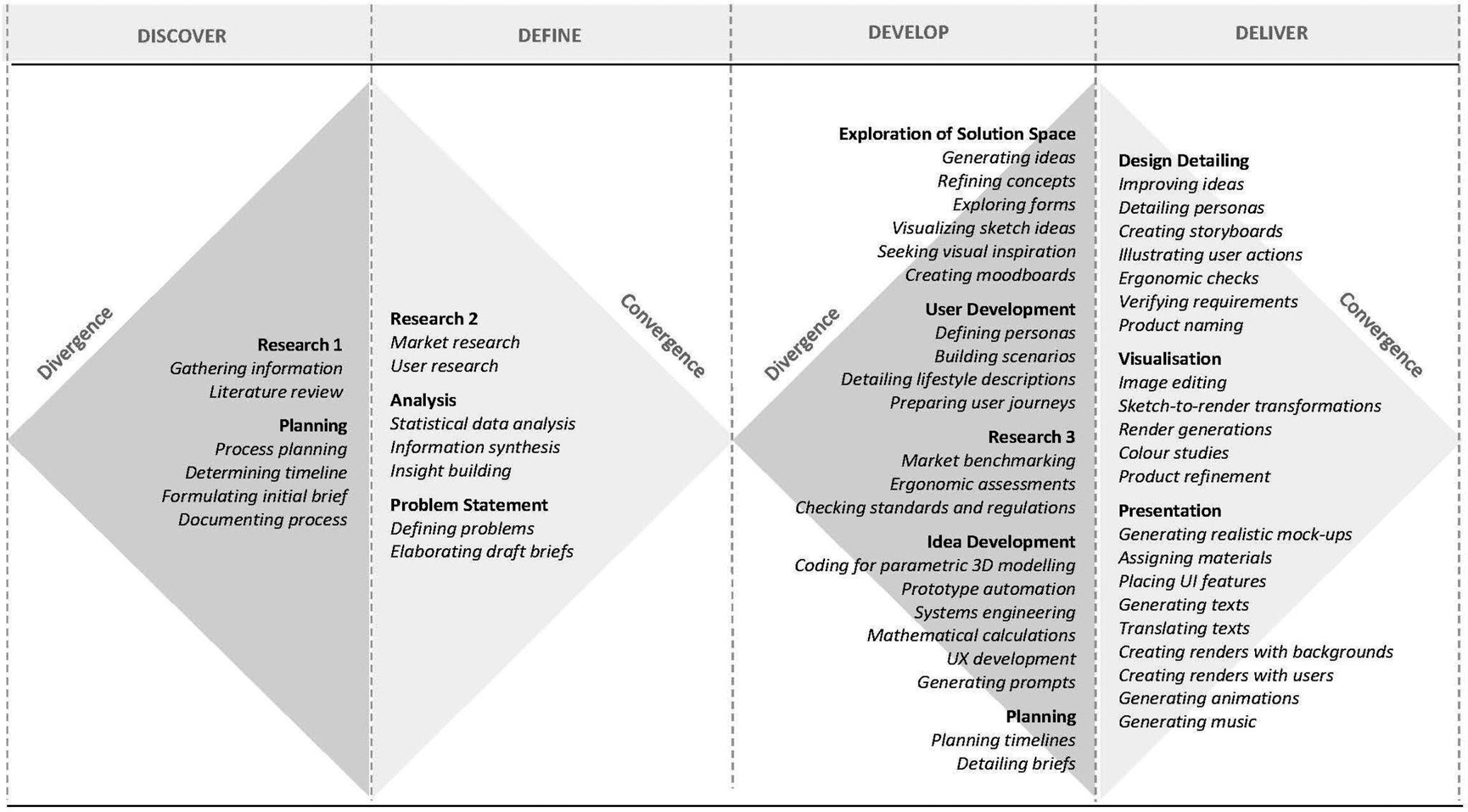
Figure 1. Long description
A horizontal diagram divided into four vertical columns representing the double-diamond model. Two large diamond shapes are formed by the intersection of these columns.
1. Discover (Divergence): The first half of the first diamond. Activities include Research 1 (Gathering information, Literature review) and Planning (Process planning, Determining timeline, Formulating initial brief, Documenting process).
2. Define (Convergence): The second half of the first diamond. Activities include Research 2 (Market research, User research), Analysis (Statistical data analysis, Information synthesis, Insight building), and Problem Statement (Defining problems, Elaborating draft briefs).
3. Develop (Divergence): The first half of the second diamond. This section contains the highest density of tasks, including Exploration of Solution Space (Generating ideas, Refining concepts, Exploring forms, Visualizing sketch ideas, Seeking visual inspiration, Creating moodboards), User Development (Defining personas, Building scenarios, Detailing lifestyle descriptions, Preparing user journeys), Research 3 (Market benchmarking, Ergonomic assessments, Checking standards and regulations), Idea Development (Coding for parametric 3 D modelling, Prototype automation, Systems engineering, Mathematical calculations, U X development, Generating prompts), and Planning (Planning timelines, Detailing briefs).
4. Deliver (Convergence): The second half of the second diamond. Activities include Design Detailing (Improving ideas, Detailing personas, Creating storyboards, Illustrating user actions, Ergonomic checks, Verifying requirements, Product naming), Visualisation (Image editing, Sketch-to-render transformations, Render generations, Colour studies, Product refinement), and Presentation (Generating realistic mock-ups, Assigning materials, Placing U I features, Generating texts, Translating texts, Creating renders with backgrounds, Creating renders with users, Generating animations, Generating music).
Think-aloud interview sessions
Participants for the think-aloud interview sessions were selected from among the 67 survey respondents who had agreed to participate in the following stage of the research. The selection criteria included working in product development, using multiple AI tools in design practices, integrating AI tools in multiple stages of their design processes, and self-assessed proficiency in using these tools. A criterion matrix was prepared, resulting in the identification of 35 suitable candidates who were then contacted via email and invited to participate in the study. The study was carried out with the 10 candidates who responded and agreed to participate. The participants were based in various cities across Türkiye and had time constraints since they were working full-time. Therefore, the sessions were scheduled according to the convenience of the participants and conducted online. No difficulties were expected in the conduct of the online think-aloud interview sessions. Remote conduct and collaboration in design have been widely explored, with studies showing shifts but no decline in cognitive mechanisms involved (Lee and Ostwald, Reference Lee and Ostwald2022; Lee, Reference Lee2024). Various online platforms and software have been developed to ease online collaboration (Ye et al., Reference Ye, Frens and Hu2022). Online meeting platforms for creative tasks have become highly familiar to designers, particularly since the COVID-19 pandemic in 2020 (Ozturk et al., Reference Ozturk, Avci and Kaya2021), when design education and practice had to be transferred into digital media for remote generation, collaboration, learning, and sharing.
Design task and research setup
Think-aloud interviewing, initially developed for studying psychological phenomena, requires participants to think aloud and verbalize their actions while performing a task (Leighton, Reference Leighton2017). As noted in the literature (Sarkar and Chakrabarti, Reference Sarkar and Chakrabarti2013), design activities can be challenging to analyze in terms of the reasoning involved. As a method of investigation, verbal reports obtained through think-aloud applications enable researchers to trace the cognitive steps and design reasoning through the actions undertaken by designers and the resulting outcomes (Cross et al., Reference Cross, Christiaans and Dorst1996). For research purposes, it is recommended for the design task assigned to participants to be relevant to the research objectives, appropriately challenging, realistic, suitable for the participants’ level of expertise, manageable in complexity and scope, feasible within the allocated time, and within the researchers’ sphere of knowledge (Dorst, Reference Dorst, Cross, Christiaans and Dorst1996). For this study, the researchers aimed for a design problem that would be within a familiar problem area for the participants, but not deeply explored by them in the past, allowing freedom in exploration. One hour was estimated to be suitable for the completion of the design task, in order not to cause fatigue, considering the task would also include interaction between the designer and researcher.
After considering several alternatives, the researchers finalized a design brief for a lunchbox concept accommodating various types of food and addressing the needs of a user persona, also to be developed by the participant. The lunchbox was expected to potentially include features such as lids, locks, and inner compartments. The design process was left free to allow participants flexibility in the way they would approach the task, enabling the observation of their interactions with AI tools throughout the process. Miro boards were prepared as the digital workspace for the sessions.
The online think-aloud session procedure was planned to incorporate activities besides designing, such as persona development that would require research, and visual representation that would require prompt generation and digital rendering. These activities could be followed in real-time through the use of screen sharing and access to the same digital interfaces in certain software. In this remote setting, it would not be possible to observe the paper-based or tablet-based sketching activity preceding digital and prompt-based generation, though the outputs would be directly made available in the medium (e.g., through Cam-scan). Miro was to be used as the submission platform, as it allows sketching made directly on its boards as well as access to multiple participants, making it possible for the researcher to be in the same medium during the generation of outputs and filling in the template boards. A pilot study was conducted with a graduate design student to investigate potential issues in the design brief, task procedure, and online session conduct. The pilot study was held via Google Meet and lasted slightly under 1 hour, as anticipated. Adjustments were made to the design brief and the concept submission template on the Miro board. The final version of the design task was written in both Turkish and English and included an introduction to the research, instructions for the session, and the design brief (Table 1). Each Miro board had the design brief and templates ready for the participants to fill during the session (Fig. 2).
Instructions and design brief given to participants (reorganized for this article)

Table 1. Long description
The table is divided into two main sections.
Row 1: Introduction to the Research and Instructions.
- The goal is to observe designers’ individual preferences and habits.
- Participants are encouraged to use A I tools at any stage.
- The task duration is 60 minutes, ending with an advanced product representation.
- Participants must think aloud to provide insight into reasoning.
- Researchers will observe, take notes, and record verbalizations for analysis.
Row 2: Design Brief.
- Task: Design a lunchbox for a chosen user group that holds soup, salad, and rice, is easy to carry, and innovative.
- Requirements: Define user persona and habits. Ensure the product is food-safe, heat-resistant, easy to clean, and spill-free. Specify materials, textures, colors, and mechanical details like locking mechanisms.
- Deliverables: A persona description and a final design concept including drawings, collages, and annotations.
Miro board template (empty) used in the think-aloud interview sessions for the participants to fill in (Left: Description of the design task. Center: Persona board asking name, gender, age, occupation, daily routine, needs/expectations, likes/dislikes. Right: Final board asking name of product, statement of concept, product details.).

Figure 2. Long description
The layout is divided into three vertical panels.
1. Left Panel: Design Task Brief. Titled DESIGN TASK LUNCH BOX. It contains text sections for Requirements, Guidelines, and Deliverables. The text specifies designing a lunchbox for a chosen user group that is easy to carry, heat resistant, and spill-free.
2. Center Panel: Persona Board. At the top left is a square placeholder labeled Photo. To its right are text fields for Isim-Soyisim, Cinsiyet, Yas, and Meslek. Below this header are three sections: Gunluk Rutini with two yellow sticky note icons, Ihtiyaclar / Beklentiler, and Sevdigi / Sevmedigi Seyler.
3. Right Panel: Final Board. At the top is a field for Urun Ismi followed by two large square placeholders labeled Render. Below these is a wide rectangular field for Urun Aciklamasi. The bottom section contains a field for Urun Detaylari flanked by two additional square placeholders labeled Render.
Participants of the study
The participant group consisted of seven male and three female designers (Table 2). All participants were graduates of industrial design departments. The professional backgrounds of the participants varied, as well as their years of work experience. Nine were working as in-house designers, and one was working as a freelance designer. Five were involved in product development, and five were involved in digital product development.
Participants of the think-aloud interview sessions

Table 2. Long description
The table consists of six columns: Participant (gender) and Year of graduation (year of professional experience), Current position/sector or domain, Meeting date, Meeting time, Session duration (min), and A I tools used in the session.
* P 1 (M), graduated 2023 (1 year experience): In-house designer/Chassis-top body equipment. Met 20/05/2024 at 21:00 for 85 minutes. Used Vizcom.
* P 2 (M), graduated 2016 (8 years experience): In-house designer/White goods. Met 31/05/2024 at 11:00 for 75 minutes. Used ChatGPT-4 and Vizcom.
* P 3 (M), graduated 2017 (7 years experience): In-house designer/Defense industry. Met 01/06/2024 at 10:00 for 115 minutes. Used Vizcom.
* P 4 (F), graduated 2015 (7 years experience): U X / U I designer/Software development consultancy. Met 01/06/2024 at 14:00 for 50 minutes. Used ChatGPT (free version) and Figma A I.
* P 5 (F), graduated 2020 (4 years experience): U X designer/Engineering services company. Met 03/06/2024 at 18:30 for 50 minutes. Used ChatGPT-4, Figma A I, and Krea A I.
* P 6 (F), graduated 2022 (2 years experience): Product specialist and game designer/Mobile game development company. Met 08/06/2024 at 10:30 for 65 minutes. Used Adobe Photoshop A I and ChatGPT (free version).
* P 7 (M), graduated 2022 (2 years experience): Industrial and graphic designer/Design consultancy. Met 10/06/2024 at 16:30 for 115 minutes. Used Adobe Firefly, Adobe Photoshop A I, ChatGPT (free version), Lensgo A I, Playground A I, and Vizcom.
* P 8 (M), graduated 2024 (1 year experience): Industrial designer/Engineering services company. Met 11/06/2024 at 12:15 for 80 minutes. Used Adobe Photoshop A I, ChatGPT-4, and Midjourney.
* P 9 (M), graduated 2022 (2 years experience): Experience designer/Engineering services company. Met 24/06/2024 at 18:15 for 70 minutes. Used Adobe Firefly, Adobe Photoshop A I, ChatGPT-4, and Krea A I.
* P 10 (M), graduated 2024 (1 year experience): U X designer and researcher/Engineering services company. Met 25/06/2024 at 20:15 for 65 minutes. Used Vizcom.
Procedure
The sessions were conducted by the first author over Google Meet, within a span of 5 weeks during May and June 2024. The same procedure was followed for each session. After greetings and introductions, the researcher explained the aim of the study, session procedure, and design brief. The session continued following consent for participation and for the session to be recorded. Participants began working on the design task using the AI tools of their choice. Meanwhile, they were expected to articulate their thought processes aloud, explaining their reasoning in the actions they took (including but not limited to designing) and decisions they made. The researcher communicated with the participants over video cameras at both ends and observed their interactions from the shared screen that showed the design-related explorative and generative functions and their outputs in real-time. In its form, the session was not expected to induce cognitive load on the participants; it was anticipated that there would be moments of silence, particularly during reviewing research output or composing prompt-based dialogues with AI tools. The researcher posed clarifying questions when necessary, for instance, when a participant went silent (e.g., during sketching, during prompt generation) or performed an action that required further explanation (e.g., using a search engine for research purposes). The researcher also took notes using pen and paper to record insights that were not documented as task output or verbally expressed. The sessions ended when the participants stated that they had finished, generally with the output of a final design concept. Session durations ranged from 50 to 115 minutes, with an average of 77.2 minutes. The collected data was qualitative in nature and included video recordings of the online sessions (772 minutes in total), detailed notes for each participant kept in a notebook (30 pages in total), and participant-generated outputs documented on Miro board templates (Fig. 3), including persona descriptions, idea generation outcomes, and final design concepts.
Example of a Miro board obtained at the end of a session (pilot participant).

Figure 3. Long description
The digital workspace is divided into four main zones on a grid background.
1. Far Left Zone: A vertical document titled Scenario containing text sections for Requirements, Guidelines, and Deliverables. It outlines a task to design a lunchbox for a specific user group.
2. Center-Top Zone: Seven sticky notes in yellow and green. Yellow notes describe user constraints like Student who also works at an office. Green notes list product features including heat resistant, easy-to-clean, and spillfree. Red handwritten annotations in Turkish point to these notes.
3. Center-Bottom Zone: Three reference photos of lunchboxes showing internal compartments and a packed meal. Below these is a red hand-drawn 3 D sketch of a modular lunchbox system with arrows indicating assembly.
4. Right Zone: A detailed User Persona for Alex Johnson, a 23-year-old non-binary graduate student. The text includes demographics, background, goals, and challenges. Key phrases like To save money by preparing meals at home and Needs for meals that are easy to transport are highlighted in yellow. A small pop-up window in the top right corner shows a stack of three image thumbnails.
Data analysis
The analysis was mainly conducted by the first author, with regular consultations and cross-checking with the second author. The session recordings were initially reviewed four to five times to identify key design-related activities undertaken by the participants. These included the stages of the design processes they followed, outcomes of these activities (as documented on the Miro boards), AI tools used, participants’ interactions with these tools, verbal explanations of actions, reflections on AI tool usage, and evaluations of the outputs. Notes taken during the sessions were also consulted for highlights and insights. Summaries of each session were made, describing the steps followed, actions performed, outcomes generated, and interactions with AI tools, including remarks and explanations made by participants during the process. The workflows of participants were then visualized as process diagrams, mapping their use of generative AI tools and any iterations (backward or forward loops) within the process. The analysis identified five stages in the participants’ design processes: understanding brief and research, benchmarking, persona generation, ideation, and detailing and finalization. These stages were determined based on variations in design-related activities as well as shifts in the usage of AI tools. The durations of each stage were calculated (Table 3).
Session breakdown in minutes for the design process stages

Table 3. Long description
The table consists of 13 columns and 7 rows. The columns represent Participants P 1 through P 10, followed by Stage duration in minutes and Stage duration in percentage. The rows detail the following design stages:
* Understanding brief and research: Durations range from 0 to 11 minutes; total 62 minutes (8.03 percent).
* Benchmarking: Durations range from 0 to 16 minutes; total 79 minutes (10.23 percent).
* Persona generation: Durations range from 0 to 40 minutes; total 152 minutes (19.69 percent).
* Ideation: Durations range from 0 to 50 minutes; total 246 minutes (31.86 percent).
* Detailing and finalization: Durations range from 0 to 45 minutes; total 233 minutes (30.18 percent).
The final row, Total session duration in minutes, shows individual participant totals ranging from 50 to 115 minutes, with a grand total of 772 minutes representing 100 percent of the session time.
a Lewis and Bonollo (Reference Lewis and Bonollo2002) report the percentage distribution of total time dedicated to five major stages of the design process: task clarification 12.2%; concept generation 27.5%; elaboration and refinement 8.8%; detailed design 17.1%; communication of results 34.5%. Goldschmidt and Rodgers (Reference Goldschmidt and Rodgers2013) report the percentage distribution of total time dedicated to nine major stages of the design process: studying the brief 5%; planning the process 4%; collecting information 6%; looking at examples 6%; consulting with others 13.5%; analyzing and comparing 6.5%; thinking about solutions 32%; evaluation 2.5%; and preparing final presentation 24.5%.
Finally, the process diagrams and corresponding AI tool usage from all participants were synthesized into an overall double-diamond design model (Fig. 4), grouping designerly activities and compiling the AI tools employed across the stages.
AI-supported design process of the think-aloud session participants mapped on the double-diamond design model.

Figure 4. Long description
The diagram is divided into four vertical columns representing the design phases.
1. Discover phase. Labeled as Divergence. Activities include Understanding Brief and Research, setting requirements, reflecting on past projects, planning task process, user research, market research, and technical research. Time spent is 62 minutes 8.03 percent. Tools used are ChatGPT and Figma A I.
2. Define phase. Labeled as Convergence. Activities include Benchmarking, Persona Generation, and Articulation of Specifications. Sub-tasks include brand and product search, user journey, and product specifications. Time spent is 79 minutes 10.23 percent. Tool used is ChatGPT.
The first diamond, combining Discover and Define, totals 293 minutes 37.95 percent.
3. Develop phase. Labeled as Divergence. Activities focus on Ideation, including idea generation through sketching and prompting, breaking down design problems, and exploring for diversity. Time spent is 246 minutes 31.86 percent. Tools used include ChatGPT, Krea A I, Adobe Photoshop A I, Adobe Firefly, Recraft A I, Midjourney, LensGo dot A I, and Playground A I.
4. Deliver phase. Labeled as Convergence. Activities include Detailing and Finalisation, decision making, technical and material research, modelling and rendering, and generating visuals and text. Time spent is 233 minutes 30.18 percent. Tools used include ChatGPT, Krea A I, Adobe Photoshop A I, Recraft A I, Midjourney, and Vizcom.
The second diamond, combining Develop and Deliver, totals 479 minutes 62.05 percent.
Designers’ integration of AI tools in the design process
The first diamond in the design model represents exploration of the problem space. Initiated with the design brief, this phase encompassed understanding the brief and research, benchmarking, and persona generation. It concluded with the development of a user persona, alongside product specifications and/or project constraints and objectives. Participants collectively spent 293 out of 772 minutes on this phase, constituting 37.95% of the total duration.
Typically, participants began by reviewing the design brief and identifying requirements to inform the following steps. This stage sometimes included reflecting on past projects and processes they had personally conducted. Following this, participants planned their design processes and tentatively allocated time to specific activities. As the design brief required the development of a persona, the subsequent step involved research to identify and define a target user group. This step was often supported by a search for inspiration and the generation of mood boards. In many cases, the persona was detailed with a scenario or user journey. Defining the attributes of the persona led to the specification of product requirements, which in turn prompted further technical, market, and user research. This stage generally included benchmarking for relevant brands, lunchbox-type products, and analogous solutions from other product categories (e.g., organizer containers). At the end of this research, participants typically articulated product specifications and performance expectations. In some cases, these were accompanied by project constraints (e.g., avoiding food odors that might disturb colleagues) and objectives (e.g., designing lids that can also function as plates) that expanded on those already stated in the brief.
Despite the wide range of designerly activities conducted in this phase during problem exploration, AI tools were less varied, and their usage was relatively limited in duration. The most commonly used tool was a generative AI chatbot, which supported user, technical, and market research, benchmarking, and lifestyle and needs analysis for persona development. A design and prototyping software and a character generator app, both with AI-powered features, were used for the specialized purposes of persona and user journey representation.
The second diamond in the design model represents exploration of the solution space. This phase included ideation, detailing, and finalization, resulting in the delivery of a final design concept. Participants collectively spent 479 out of 772 minutes on this phase, constituting 62.05% of the total duration.
Participants allocated more time to this phase, and AI tools were used more extensively and diversely; however, design-related activities were fewer in variety. The ideation stage was handled in different ways. Some participants began ideation by generating ideas through hand-drawn sketches (paper-based or digital), which they later elaborated and refined using AI tools. In other cases, ideation was directly prompted by AI tools, where participants described a persona and asked “What would this persona use?” or “How should such a product be designed?” This prompted the generation of rough ideas by AI tools in the form of texts or visuals, which were further developed by the participants. Idea generation was carried out following three approaches:
-
1. Divergence by breaking down the design problem into smaller components and resolving them separately (e.g., container, lid, lock, carrying case),
-
2. Divergence through lateral exploration, by searching for alternative and diverse solution ideas, and
-
3. Convergence through vertical exploration, where an immediate idea was explored in depth.
Due to time constraints, participants often made quick decisions during the finalization stage to select a final concept. Some participants dedicated time to develop a digital model of the final concept and produce rendered images. Some participants struggled to select a final concept, and concluded the task by submitting a set of ideation outcomes instead. Generally, technical and material research was included for design detailing of the outstanding ideation outcomes, and their presentation on the Miro board was prepared with a legible rendered sketch and a descriptive text. Exceptions also occurred; in one case, a persona was not generated for the task, and in another, the session was concluded with the generation and submission of the persona only.
In the second diamond, the same generative AI chatbot was used again, particularly in idea generation, additional research, and design detailing. Different versions of the chatbot were used to generate both texts and visuals for the presentation of the final design concept.
Participants additionally made use of drawing and modelling software, AI-powered image and video generating and enhancing tools, as well as image search platforms for sourcing visuals to train the GAI tools. Participants used these tools for iterations in the exploration of design solutions, searching for images, using them as prompts, generating sketches, enhancing them, generating further sketches based on what the AI tools provided, and generating prototypes based on these. A total of nine image content creation and enhancement tools were used by the participants. Five of these were used throughout the second diamond. Proficient participants used multiple AI tools simultaneously for obtaining visuals in different styles, or alternated between AI tools during a specific task for higher performance. They also prepared their AI tools for the delivery of the final design concept by training them with images and preparing image backgrounds and props for enhanced product renders.
Designers’ engagement with AI tools
The integration of AI in the design process required the engagement of designers with AI tools, revealed as the designers’ attitudes, communication styles and interactions. These were identified from the ways in which participants described the tools, explained their capabilities and evaluated the output; the content and style of the generated visual and verbal prompts; and ways of using these tools in terms of strategies and actions, accompanied by specific verbal comments and displayed behaviors.
Attitudes
The various attitudes displayed by participants toward AI tools were divided as negative (n = 3), neutral (n = 4), and positive (n = 3) (Table 4). Participants with a negative attitude tended to reject, ignore, or hesitate to engage with AI tools. They were skeptical about the AI tools’ capabilities and the skills they could acquire through training. They preferred to remain present in the design process, rather than giving control to AI applications. They expressed frustration, anticipated low-quality outputs, and avoided using them. They also mentioned that they had to compromise on aspects of their initial ideas to achieve an end result generated with AI tools. They expressed concerns regarding how these tools could block their creativity due to limited tool capabilities, create ethical issues regarding ownership, and make them feel threatened as designers. Participants with a neutral attitude seemed to blend their own expertise with the capabilities of AI tools, instead of selecting one over the other. They selected, refined, and curated the outputs from their preferred tools, mainly relying on their own judgment and expertise. Participants with a positive attitude demonstrated awareness of the capabilities and skills of AI tools and were willing to leverage them fully. Their expectations were to receive information, get inspiration, visualize ideas, and render drawings. They acknowledged how these tools could aid them rather than being a threat.
Quotes from the think-aloud sessions exemplifying participant attitudes toward AI tool usage (participants not indicated for anonymity)

Table 4. Long description
The table consists of two columns titled Attitudes and Quote (excerpt from interview, translated from Turkish). It contains three rows of data.
* Row 1: Negative attitude. The quote states, I used it in a way that allowed it to take over my profession, and I didn’t get exactly what I wanted.
* Row 2: Neutral attitude. The quote states, It actually gives ideas for the next close steps. I think it speeds up the process by pointing out small details.
* Row 3: Positive attitude. The quote states, I actually filter the information that A I gives me based on my past experiences and knowledge, I eliminate unsuitable ideas and let in ideas that will support me.
Communication styles
In terms of generating images or writing prompts, participants’ communication styles were categorized as brief-explainers (n = 5), balanced communicators (n = 3) and over-explainers (n = 2) (Table 5). Brief-explainers were those expecting results from writing short and straightforward prompts. This was mostly seen when these participants used AI tools to gather information as if they were search engines. In some cases, the participants did not have a clear idea of what they were looking for; therefore, they used such short prompts for inspiration.
Persona descriptions, examples of prompts and design output from the think-aloud sessions illustrating participant communication styles with AI tools (participants not indicated for anonymity)

Table 5. Long description
The table is organized into three columns: Communication Styles, Persona and prompt, and Design output.
* The first row, labeled Brief-explainer, describes a 36-year-old finance worker. The prompt is a list of keywords: Lunchbox, design, minimal, soft color, white and green. The design output shows a photo of a sage green and white cylindrical container with a detached lid and a white inner compartment labeled P 6 a s.
* The second row, labeled Balanced communicator, describes Deniz, an office worker who likes navy blue and balanced meals. The prompt is more conversational, requesting three divisions, foldable silicone material, and a reference image blend. The design output shows a beige rectangular lunchbox with four compartments containing tomatoes, peas, cucumbers, and pasta, with dimensions 25 x 18 x 7 c m noted on the lid.
* The third row, labeled Over-explainer, describes an 8-year-old girl named Ece. The prompt is highly detailed, specifying a blue and silver lunchbox with three compartments, an open lid, and product photography style on a white background. The design output shows three-dimensional renderings and two-dimensional top-down diagrams of a rectangular bento box with rounded corners, featuring one large left compartment and two smaller stacked right compartments.
Balanced communicators were those who engaged in a conversation with AI tools in order to understand a subject and develop ideas based on it. These participants addressed the brief by collaborating with AI, collectively generating refined ideas. Although the participants did not fully control or predict the AI’s contributions, they still edited the outcomes based on their own judgment and expertise. Over-explainers were those expecting AI tools to represent the ideas in their minds as closely as possible; therefore, they wrote detailed prompts to improve the outputs. These prompts could involve long descriptions in complete sentences, in some cases including irrelevant or divergent information. Some participants trained their AI tools by adding images, and even asked from AI tools to generate new prompts for them.
Interaction types
The ways in which participants interacted with AI tools in their design processes divided them as over-reliers (n = 1), collaborators (n = 5), and commanders (n = 4) (Table 6). Over-reliers were those who seemed confident in and dependent on the capabilities of AI tools. These participants asked AI tools what to do (in terms of design action and design idea), and how to do it (planning the next steps). They used AI tools to identify problems for them, as well as generate design directives and visuals for design solutions. Some participants sought for confirmation or approval for their design decisions, as well as for their actions. They tended to directly use the AI output without intervention; this included the submission of final design concepts, directly obtained from generative AI tools. Collaborators were those who were aware of AI’s limitations and capabilities, and made their demands of the AI tools accordingly. They trained AI for the task, with prompts and visuals, as well as by assigning roles to AI in different stages (e.g., asking AI to think like an industrial designer). They believed AI tools were slowing down their design processes and therefore developed strategies to cope with this in their limited session time. Some participants worked in parallel with the AI tools, meaning they carried out design ideation on their own while also prompting AI tools and waiting for their output to compare and negotiate. Commanders were those who used AI tools to enhance their performance as designers. They believed that AI speeds the process, but can make mistakes and hamper creativity. Therefore, they preferred to maintain control of their design processes and were critical of the AI outputs, making the design interventions and final decisions themselves. They assessed alternatives for function and efficiency. They were skilled in AI usage; they used tools in parallel at the same time for the same task, as well as used diverse tools sequentially for specific purposes to complete the task. They also saw the design process as an opportunity to invest in the training of their AI tools for future reference.
Quotes from the think-aloud sessions exemplifying participant interaction types with AI tools (participants not indicated for anonymity)

Table 6. Long description
The table consists of two columns titled Interaction types and Quote.
* The first row identifies the Over-relier interaction type. The quote states that the participant uses A I agents to check for missing elements in their own thinking and feels that not using it is a waste of valuable time.
* The second row identifies the Collaborator interaction type. The quote explains that the participant creates many outputs from prompts and then edits the results to match their ideas before final modeling.
* The third row identifies the Commander interaction type. The quote expresses a concern that using the tool might change what the participant has in mind, leading to a different outcome than intended.
Bearing in mind that the number of participants is low, the distribution of participants according to attitude, communication style, and interaction type categories allowed observing certain patterns (Table 7). All three participants with a negative attitude toward AI interacted with AI tools as commanders, while two of them were also brief explainers in terms of communication style. Two out of four participants with a neutral attitude toward AI interacted with the tools as collaborators and displayed balanced communication. Two out of the three participants with a positive attitude toward AI interacted with the tools as collaborators and were over-explainers, while the third participant was the only over-relier on AI tools in terms of interaction and was a brief-explainer in terms of communication style.
Distribution of participants according to attitudes, communication styles, and interaction types identified in the think-aloud sessions

Table 7. Long description
The table consists of 9 columns grouped under three main headers.
1. Attitudes: Negative, Neutral, Positive.
2. Communication styles: Brief explainer, Balanced, Over-explainer.
3. Interaction types: Over-relier, Collaborator, Commander.
Individual participant data rows:
- Row 1: Negative attitude, Brief explainer, Commander.
- Row 2: Negative attitude, Brief explainer, Commander.
- Row 3: Negative attitude, Balanced communication, Commander.
- Row 4: Neutral attitude, Brief explainer, Collaborator.
- Row 5: Neutral attitude, Brief explainer, Commander.
- Row 6: Neutral attitude, Balanced communication, Collaborator.
- Row 7: Neutral attitude, Balanced communication, Collaborator.
- Row 8: Positive attitude, Brief explainer, Over-relier.
- Row 9: Positive attitude, Over-explainer, Collaborator.
- Row 10: Positive attitude, Over-explainer, Collaborator.
Summary totals (n) at the bottom:
- Attitudes: Negative n equals 3, Neutral n equals 4, Positive n equals 3.
- Communication styles: Brief explainer n equals 5, Balanced n equals 3, Over-explainer n equals 2.
- Interaction types: Over-relier n equals 1, Collaborator n equals 5, Commander n equals 4.
Discussions
The survey findings indicate a rising interest in the adoption of AI technologies and integration of AI tools within professional design processes, with a variety of AI tools available. The younger generation of designers are coordinating multiple AI tools with general or specific purposes for a wide range of functions (i.e., text editing, image generation, sound generation, video editing, planning, research) across the design process. The design process is conducted as a complex series of functions, not only limited to the divergent and convergent act of designing for an output, but also involving the management of the process and communication of the outcomes.
Following the data analysis of the think-aloud interview sessions, the literature was reviewed for studies on design activity timelines for short- and long-duration design tasks. The general agreement is that designers follow a solution-oriented process (Lawson, Reference Lawson2005), meaning they start thinking on solutions early in the process, as a means of understanding the problem, making it difficult to distinguish thresholds between activities, as the process involves iterations (Goldschmidt, Reference Goldschmidt2016). Studies on design tasks indicate them as a session composed of episodes (Teixeira et al., Reference Teixeira, Shafieyoun, de la Rosa, Jun, Li, Xu, Chen, Eckert and Stacey2017), where a session representing a design task expects a design concept output in the form of a sketch or model based on a given brief, and each episode is a design-related activity (e.g., problem formulation, research, ideation, representation) in the pursuit. The timeframe obtained from the think-aloud sessions displays an aligned percentage distribution of time allocation to non-AI-supported designerly activities described in the literature. For example, 31.86% of the total session time was dedicated to ideation; Clayton (Reference Clayton2000) reports time distribution in a design process for idea/concept generation as 38%, Lewis and Bonollo (Reference Lewis and Bonollo2002) report as 36.3% (concept generation+elaboration and refinement), and Goldschmidt and Rodgers (Reference Goldschmidt and Rodgers2013) report as 32%. This may indicate that the designers have conducted the design task as would be expected in a regular design process in terms of procedure and pace; besides, they have developed and submitted a persona for problem framing, alongside the design concept. The AI tools have been used in supporting design-related activities, rather than undertaking activities on behalf of designers, or adding to their workloads with the introduction of extra activities related to AI tool usage (e.g., prompt generation).
It was observed that designers’ AI tool usage incorporated ways of strategic partnership, such as parallel working for different activities (e.g., preparing presentation frame while AI tool renders image, as an example of human–AI cooperation, in reference to Li et al., Reference Li, Huang, Liu and Zheng2022), parallel working for same activity (e.g., hand-generated sketching for an idea while AI is also working on image generation for the same idea based on prompts, followed by iterations between the outputs, as an example of human–AI collaboration, in reference to Cabrera et al., Reference Cabrera, Perer and Hong2023), and work distribution for a goal-specific activity (e.g., giving research directives, synthesizing information compiled by AI, generating a persona and using AI to represent it, as an example of human–AI symbiosis, in reference to Mahmud et al., Reference Mahmud, Hong and Fong2023). These findings bring a new perspective to participation style and task distribution as factors in collaboration style within Rezwana and Maher’s (Reference Rezwana and Maher2023) Co-Creative Framework for Interaction Design. The designer divides the process into a series of activities and distributes the work; the designer assigns some work exclusively to AI, while exclusively undertaking other work, running in parallel and to be compiled later on. Some work is carried out by both parties, through serial turn-taking toward outputs to be combined, or in parallel to create alternatives that compete and to be used for output enhancement.
The think-aloud interview sessions confirmed that the experiences of participants were significant in implementing AI tools in the design process (Gmeiner et al., Reference Gmeiner, Yang, Yao, Holstein and Martelaro2023; Tang et al., Reference Tang, Ciancia, Wang and Gao2024). Experience levels influenced the participants’ design competences (in terms of skill sets and strategic abilities), process conduct (in terms of stage planning and time management), involvement of expertise and domain knowledge, and personal motivation and interests. The more experienced participants were observed to break down the design task into planned and managed stages, giving weight to exploring the problem space as well as the solution space. These participants were more strategic in the way they addressed the design brief toward its finalization, prioritizing particular stages of the process in which they felt more competent and confident, contributing with their knowledge, bringing a different perspective to the brief, or differentiating from available design solutions. They were quicker in decision-making and more open to using AI as an assisting generative tool. Those with personal interest and prior experience in using AI tools were informed of the capabilities of these tools. They were able to use the tools purposefully for various tasks, carrying out interactive generation in coordination with multiple tools, steering them for the realization of their informed design decisions, thus resulting in the production of satisfying outputs.
Participants with less experience could tend to skip or rush through initial stages, jumping to premature idea generation. Strategically, some gave up on the goals they had set for themselves at the onset of the session, due to time constraints. These participants interacted with AI tools at a minimum level, generally conducting the earlier stages on their own and leaving AI tool usage to the later stages of the design process. This could be due to resistance to consulting AI tools, as well as not being fully informed on the usage of AI tools and their capabilities. Difficulties were observed in determining project objectives from the brief, diverging in idea generation, and, as a result, differentiating from already available mainstream products. When these difficulties were coupled with limitations in designerly skills (e.g., sketching, detailing), and the participants did not see their preparations (e.g., research, modelling) as vital in training the AI tools, treating them instead as an agent generating an output by chance (e.g., based on keyword instructions), AI tool usage typically produced unsatisfactory output.
Quality in design output is known to require time (Shah et al., Reference Shah, Vargas-Hernandez and Smith2003), and as the design task was of short duration with the goal of offering a workable design concept, feasibility of the output was not investigated as part of the study. It was observed, though, that participants considered project requirements during problem framing, and the outputs mostly conveyed solutions addressing them. Lunchbox design concepts incorporated solutions such as compartmentation, tiers, locks, handles, and leak-proof lids, as well as additional solutions that participants offered based on how specifically they framed the problem, such as sleeves to carry and keep warm, lids that doubled in function as plates, and collapsible containers for ease of storage when empty. The concept representations were mainly generated based on a series of iterations between participants and AI. In one strand, this involved hand-generated sketches that were then rendered using AI. In another strand, this involved detailed prompting and training with example visuals, which, when reaching a satisfying result after rounds of regeneration, was sketched or modelled by the participant, and then rendered using AI (Table 8). The accuracy of the representations mostly depended on the sketching and modelling skills of the participants; in some cases, the representations obtained using AI lost perspective or proportion (e.g., lid not matching container in dimensions), but still made sense in terms of function and configuration.
Examples from a participant’s iteration of AI-supported solution exploration and image generation for a lunchbox design concept

Table 8. Long description
The table consists of four distinct panels representing different stages of design exploration.
* Panel 1 (Leftmost): A four-panel grid of A I generated lunchbox designs created using Playground A I. Each design features a teal exterior with metallic accents and stainless steel interiors, showing variations in compartment layout and latching mechanisms.
* Panel 2 (Center-Left): A four-panel grid of A I generated lunchbox designs in outdoor settings. These images were generated by LensGo dot a i and edited in Photoshop A I to emulate the aesthetic of the brand Stanley.
* Panel 3 (Center-Right): A photo of a stainless steel Stanley lunchbox resting on a log in a forest setting, used as a reference for the design’s material and environment.
* Panel 4 (Rightmost): A clean digital sketch and final rendering of the lunchbox concept. The design is a rectangular box with rounded corners, a top handle, a central latch, and small feet. This final concept was produced by rendering a hand-generated sketch through Vizcom.
Conclusion
The research described in this article investigated how professional designers integrate AI tools across different stages of the design process and how they engage with these tools in carrying out goal-oriented designerly activities. The research consisted of two consecutive studies, a survey and think-aloud interview sessions that complemented each other in establishing strategies and patterns of AI tool usage throughout the design process. The respondents of the survey provided answers given in reference to their professional design practices for processes conducted over extended periods of time. The respondents reported using a variety of tools for an extensive pool of design functions. In the think-aloud interview sessions, although a limited number of participants used a limited number of AI tools over a tight schedule, the goal-oriented design task allowed observing the interactions of designers with AI tools and the delivery of outputs in real-time. From the survey responses, we identified the design functions for which AI tools are used and placed them on the double-diamond design model framework. We also identified participants for the following study. From the think-aloud interviews, we observed strategies of the designers in interacting with AI tools for divergence and convergence in exploring both the problem space and the solution space, building further on the framework (Fig. 5).
Designers’ AI tool integration reflected within the double-diamond design model.
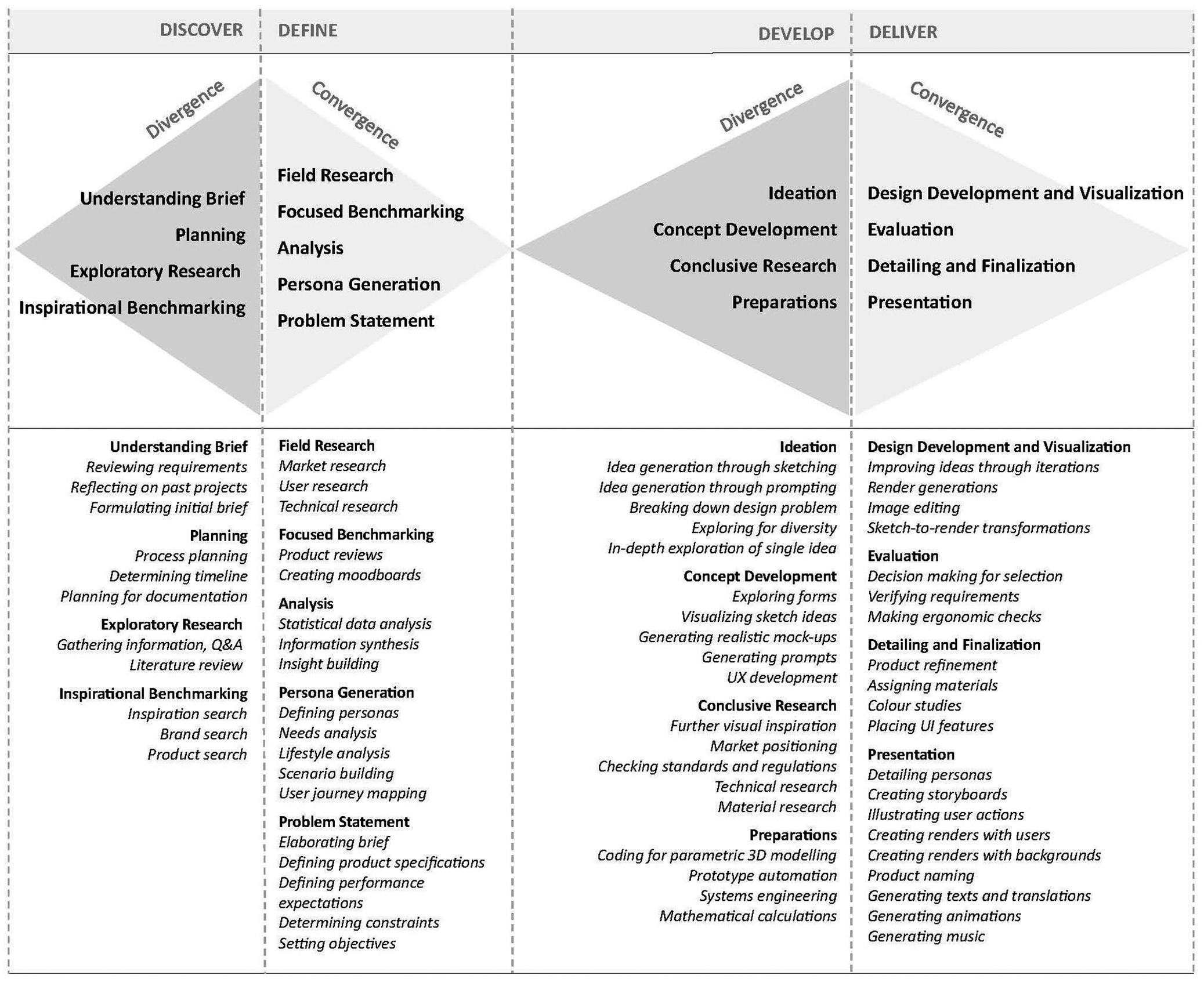
Figure 5. Long description
The flowchart is divided into four vertical columns separated by dashed lines.
1. Discover Phase (Divergence). The upper diamond section lists Understanding Brief, Planning, Exploratory Research, and Inspirational Benchmarking. The lower section details tasks like reviewing requirements, formulating initial briefs, process planning, and literature reviews.
2. Define Phase (Convergence). The upper diamond section lists Field Research, Focused Benchmarking, Analysis, Persona Generation, and Problem Statement. The lower section includes market research, product reviews, statistical data analysis, defining personas, and setting objectives.
3. Develop Phase (Divergence). The upper diamond section lists Ideation, Concept Development, Conclusive Research, and Preparations. The lower section highlights A I tasks such as idea generation through prompting, generating realistic mock-ups, generating prompts, U X development, and coding for parametric 3 D modelling.
4. Deliver Phase (Convergence). The upper diamond section lists Design Development and Visualization, Evaluation, Detailing and Finalization, and Presentation. The lower section includes render generations, image editing, sketch-to-render transformations, making ergonomic checks, placing U I features, and generating texts, translations, animations, and music.
We established from both studies that AI tools are used throughout the design process for the exploration of both problem and solution spaces. The think-aloud sessions confirmed that exploration of the solution space is given more time, and AI tools are primarily perceived as a means for visualizing concepts during idea generation and representation. However, the findings indicate that AI tools are also being used for analytical purposes while exploring the problem space, as well as for synthetic purposes while exploring the solution space, underlining the iterative and reflective nature of the design process. Designers give importance to preparatory activities for problem framing preceding idea generation, supported with AI tools, such as research, benchmarking, and persona generation. Idea generation is carried out through iterations between the designer and AI tools, with further elaboration and refinement as ideas are passed to and fro through conversations, sketching, rendering, image generation, and enhancement. Activities following idea generation are also supported with AI tools for informed synthesis and decision-making through design development, evaluation, and presentation.
Designers’ competences and experiences significantly influenced how they perceived AI tools and implemented them within their processes. Those with greater interest in AI had already explored a variety of tools for distinct purposes and therefore demonstrated the ability to use them in combination across different design stages, alternating or coordinating their use based on specific task requirements, and also training their AI tools for future reference. Notably, a distinctive usage pattern emerged, where some designers worked in parallel with AI tools on the same task, later comparing the generated alternatives to decide which direction to pursue. AI tools with multiple capabilities were preferred, as such a tool could be used in coherence for different functions across the design process. AI tools with specific, task-based capabilities were used when the design decisions were fixed and ready to be represented. Additionally, certain professional sectors in which some participants were employed showed more advanced integration of AI tools. These sectors exhibited a stronger awareness of the range of tools relevant to their domain-specific needs and demonstrated a more sophisticated use of AI in their workflows.
Designers who participated in the research are all from industrial design undergraduate programs. They are working across different sectors such as product design, graphic design, interior design, game design, UX design, and engineering design, and in various roles, such as designer, researcher, systems developer, and software developer. They are working in design consultancies as well as small-, medium- and large-size production companies. Although the core design activities carried out for product design and development are aligned in general, based on our findings, we acknowledge that sectoral context may shape the observed engagement patterns between designers and AI tools, which therefore may not transfer uniformly.
The response rate for the survey was low (103 out of 3004, with 88 valid responses), which poses a limitation to the study. Besides a large percentage who must have missed or ignored the emails, there may have been invitees who do not work as designers, who do not work in product development sectors, or who do not use AI tools in their design practices, therefore choosing not to respond.
Around half of the survey respondents (46/88) were recent graduates of 2020 and later. Likewise, 6 out of 10 of the think-aloud session participants were recent graduates (2022 and forward). These rates indicate more interest in AI tools among the younger professionals. This may be related to the emergence and widening availability of these tools coinciding with the final years of their design education and early years in their careers, when they would be more exposed to or more interested in exploring new technologies and tools for their transitioning professions. The establishment of the AI-integrated careers of the young generation designers is still ongoing, and the transformation of professional practices in design is yet to be observed in the near future.
It should be noted that the coding and categorization of data collected from both the survey and think-aloud interview sessions were conducted primarily by the first author; the second author provided regular feedback and cross-checking, but no formal reliability metrics, such as e.g. Cohen’s kappa or percentage agreement, were calculated.
While numerous AI tools are available in the field, it should be noted that the tools mentioned in this article were predominantly used by participants during the think-aloud sessions conducted in May and June 2024. Therefore, specific features or functionalities of these applications may have changed, although their overarching purposes are likely to remain consistent.
As concluding remarks, the findings imply that integrating AI across both phases of problem definition and solution development within the double-diamond design model supports a holistic design approach, ensuring alignment between the defined design problem and the design solution generated in response. In this context, AI can be positioned as a collaborative agent assisting designers in making informed design decisions and original design interventions. Building on this research, future research directions may include:
-
• A developed version of the design task, conducted over a longer period to better represent real-world design processes;
-
• Specific AI tools purposefully selected for the task, to reveal their roles within the design process and their impact on the outputs;
-
• Application of AI tools in particular stages of the design process for in-depth information on how they can be improved for specific purposes.
This manuscript was edited through personal communication with ChatGPT (GPT-4-turbo model), accessed via OpenAI’s standard plan between April 13–23, 2025. The editing involved no addition or removal of content and was mainly for proofreading. Following this communication, the manuscript has been further developed and finalized by the authors only.
Data availability statement
The data have been collected with the permission of the participants, with the assurance of anonymity, and will be used solely for research purposes. More details on the processed data from both studies and their analysis procedures can be found in the MS thesis available at https://open.metu.edu.tr/handle/11511/111481.
Acknowledgments
This research was conducted at Middle East Technical University, Department of Industrial Design, as part of a Master of Science thesis work. The authors would like to thank the participants of both studies for their contribution to the research.
Funding statement
This research received no specific grant from any funding agency, commercial or not-for-profit sectors.
Competing interests
The authors declare none.
Ethical standard
This research has received approval from the Human Subjects Ethics Committee of Middle East Technical University on May 4, 2024 (Protocol No. 0317-ODTÜİAEK-2024). The collected data, including survey responses and session video recordings, are stored in the first author’s digital archive to which only the first author has access. Participant anonymity in the reported materials has been provided through code assignments when referring to participants, and removing or blurring out any visual identifiers that may be indicative of participant identity.
Tuğçe Sözen, MS received her BID degree in 2021 and MS degree in 2024 from METU Department of Industrial Design, where she is currently pursuing her PhD studies. During her master’s studies, she joined the Erasmus exchange program for one semester at Politecnico di Milano. She has worked as a 3D Artist for the gaming industry as well as in multimedia studios for 3 years. She was also a Student Assistant for the interactive multimedia design courses at METU between the years of 2020 and 2021. Her academic research interests include artificial intelligence, product design, and collaboration between designers and computers.
Naz A.G.Z. Börekçi is currently a professor at METU Department of Industrial Design. She received her BID from METU Department of Industrial Design in 1995, MFA from Bilkent University Interior Architecture and Environmental Design in 1997, and PhD from the University of Kent at Canterbury, KIAD in 2003. She has acted as Associate Dean at METU Faculty of Architecture between March 2020 and May 2023. She teaches manufacturing materials and studio courses at the undergraduate level, and design methodology at the graduate level. She supervises MS and PhD theses. Her academic research interests include design education, design methodology, and university–industry collaboration.


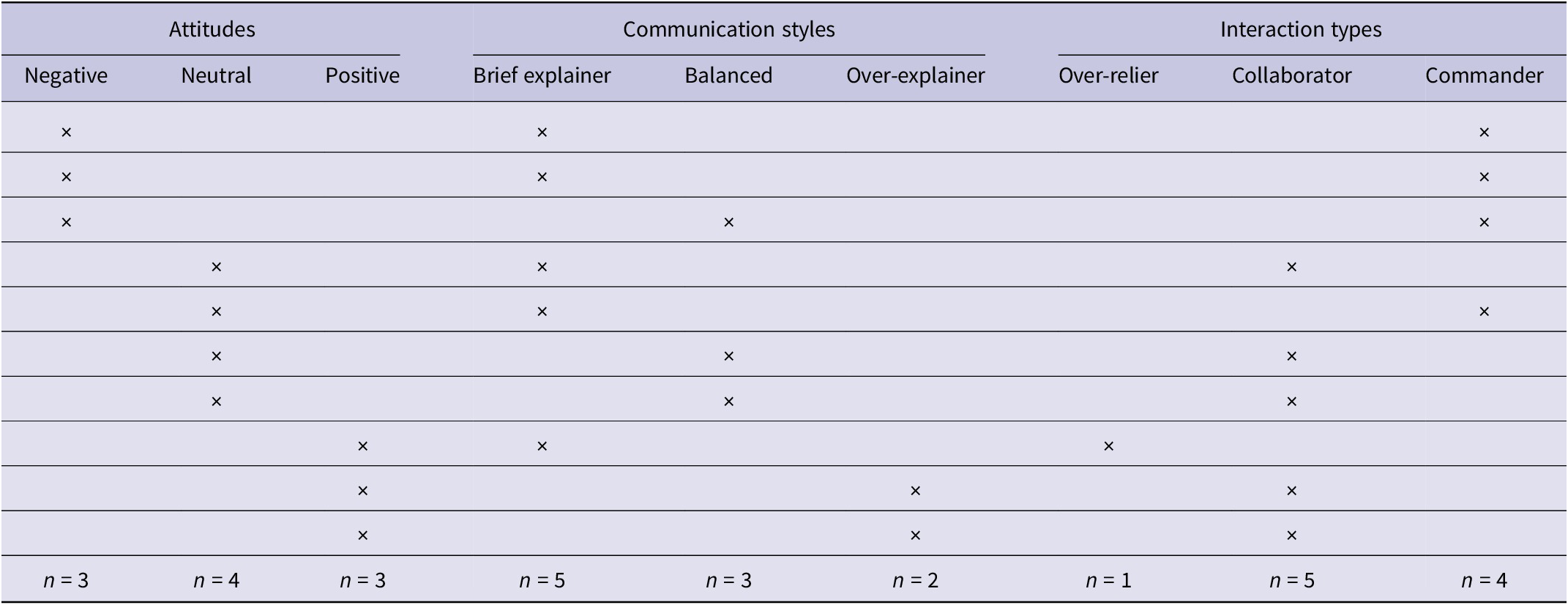


 Open access

