

1. Introduction
This paper presents models, both economic and empirical, of the effects of absent fathers on adolescent criminal activity. The empirical approach uses a dynamic fixed effects specification to control for unobserved heterogeneity, with estimates obtained using Bayesian methods. The main finding is that, although absent fathers correlate with increased adolescent criminal activity, that relationship appears to stem from the fact that families with absent fathers possess other attributes that tend to associate with increased adolescent criminal activity. After controlling for those attributes, the link between absent fathers and adolescent criminal activity vanishes.
Previous research, scattered across a wide range of academic disciplines, has long established a link between parental absence and adolescent criminal activity [Demuth and Brown (Reference Demuth and Brown2004); Harper and McLanahan (Reference Harper and McLanahan2004); Bronte-Tinkew et al. (Reference Bronte-Tinkew, Moore and Carrano2006); Goncy and van Dulmen (Reference Goncy and van Dulmen2010); Wong (Reference Wong2017); Simmons et al. (Reference Simmons, Steinberg, Frick and Cauffman2018)]. A commonly-expressed theory holds that single-parent households have less time and fewer resources to dedicate to parenting, which might lead to less supervision and, consequently, increased delinquency [Rebellon (Reference Rebellon2002); Maume (Reference Maume2011); Reich (Reference Reich2014)].
Despite the well-established link between family structure and adolescent criminal activity, several studies have argued that the relationship between family structure and adolescent delinquency is not purely causal. Rather, that line of research argues that single-parent households tend to exhibit socioeconomic traits, such as lower income or parental education attainment, that also correlate with adolescent criminal activity. And once those socioeconomic traits are controlled for, the argument goes, the observed links between family structures and adolescent criminal activity greatly shrink [Mack et al. (Reference Mack, Leiber, Featherstone and Monserud2007); Porter and King (Reference Porter and King2015)]. The central debate, then, centers on which attributes to control for.
But, rather than entering a debate about appropriate control variables, panel data, such as those employed in this paper, offer researchers the ability to control for many traits, both observed and unobserved. Typically, however, a modeling decision must be made. On the one hand, fixed effects account for many forms of unmeasured heterogeneity, with the added benefit that fixed effects place few statistical restrictions on how that unobserved heterogeneity relates to observed attributes. However, fixed effects only address time-invariant forms of heterogeneity. Fixed effects cannot account for time-varying factors, like job loss or health problems, that might destabilize families and push adolescents toward behavior problems.
Including a lagged-dependent variable in the regression structure provides an alternative to fixed effects. In terms of the current research topic, this means that a regression of criminal activity would include previous-period criminal activity. Lagged-dependent variables are attractive for two reasons. First, to the extent that unmeasured family traits affected criminal activity during the previous period, including the lagged-dependent variable controls for those unmeasured family traits in a similar spirit to fixed effects. But unlike fixed effects, those unmeasured traits are permitted to vary across periods. A second attractive feature of lagged-dependent variables is that an adolescent, after being introduced to some form of criminal activity, might show a propensity to commit that crime again. Such a pattern seems likely, and lagged-dependent variables directly account for such autoregressive forms. Fixed effects specifications do not.
But, fixed effects and lagged-dependent variables do not nest each other, which means that one setup might miss forms of heterogeneity that the other captures [Angrist and Pischke (Reference Angrist and Pischke2009, p. 243)]. In fact, this paper shows that either estimation approach, by itself, produces misleading and conflicting conclusions. In particular, fixed effects suggest that absent fathers reduce criminal activity, while lagged-dependent variables imply the opposite. Ideally, a regression specification would include both fixed effects and a lagged-dependent variable in order to account for a wider variety of unobserved heterogeneity, but dynamic panel models with fixed effects have long been recognized as leading to potentially severe estimation bias [Nickell (Reference Nickell1981)].
This paper eliminates the bias inherent in dynamic fixed effects models using an orthogonal reparameterization approach proposed by Lancaster (Reference Lancaster2002). Model parameters are calculated using a Bayesian approach. The method potentially has wide applicability to economic and demographic studies, especially those that employ micro-level panel data, which are often beset with problems of unobserved heterogeneity. The main finding is that absent fathers do not appear to directly cause adolescent criminal activity. Rather, families with absent fathers possess other traits that appear to correlate with increased adolescent criminal behavior.
2. Economic model
This section presents an economic model of father absence and adolescent criminal behavior. Borrowing from Becker (Reference Becker1968), the model views adolescent crime as having costs and benefits, and thus, the decision to engage in crime is the result of a utility maximization process. The main purpose of the model is to establish that family-specific attributes, especially those difficult to observe in household surveys, likely simultaneously affect both father absence and adolescent criminal proclivity. The presence of those family-specific attributes, in turn, produces ambiguous conclusions as to whether father absence directly affects criminal behaviors.
Suppose that an adolescent receives utility from legally-obtained goods and services, L, as well as illegally-obtained goods and services, I. (The term I could include euphoria from breaking the law or approval from peers.) Assuming Cobb–Douglas utility with constant returns to scale, the adolescent's utility is

where 0 < α < 1 to satisfy diminishing marginal utility.
Borrowing inspiration from Cameron et al. (Reference Cameron, Trivedi, Milne and Piggott1988), who use a similar setup to model the simultaneity between medical insurance and health care usage, the adolescent must “produce” the illegally-obtained goods and services by engaging in criminal activities, denoted c. Let that production function be Cobb–Douglas

where 0 < σ < 1 to satisfy diminishing returns in production. The exponent in the production function depends on father absence, f, and other family-specific attributes, u, according to the function σ = g(f, u). That dependence on f and u can be justified by the argument that the ease with which adolescents translate crimes into tangible benefits likely depends on, among other things, parental supervision, which, in turn, likely depends on socioeconomic traits, including father absence.
The adolescent's budget constraint is

where Y is disposable income. With the price of L normalized to unity, the term p represents the “price” of criminal activities, which incorporates the probability of being caught. The price might be monetary, as with a fine, or it might be translated into monetary terms, as with jail time or parental punishment. Either way, the budget constraint highlights that the adolescent must expend resources to engage in crime. The idea that crime has a “price” borrows from Becker's (1968) seminal work on the economics of crime.
The adolescent seeks to maximize (1), where I is produced according to (2), subject to the constraint in (3). The solution to that problem (shown in Appendix A), yields a demand equation for criminal activities

Note that ∂c/∂σ > 0, implying that larger values of σ lead to more crime. Recalling that σ = g(f, u), let f = 1, 0 denote, respectively, father absence and presence. Then if g(1, u) − g(0, u) > 0, absent fathers lead to increases in adolescent crime.
However, father absence, itself, is the outcome of an optimization process, and one that likely depends on family attributes, u. Borrowing from random utility theory, let f* be a father's propensity to be absent. That propensity can be written as

where h is some function of family attributes, and V denotes other things that affect that propensity. Then, if f* exceeds some threshold, the father becomes absent.
Suppose that certain family attributes included in u, such as financial stress or medical problems, increase the father's propensity to be absent, ∂f*/∂u > 0. Suppose, also, that those same attributes, which appear in σ = g(f, u), alter the adolescent's production of crime, such that ∂σ/∂u > 0. If, as assumed here, u affects both f* and σ, then family traits affect father absence and adolescent criminal behaviors, making it difficult to determine whether father absence causes adolescent criminal activities. Put differently, because f and u are likely jointly distributed across households, it becomes difficult to isolate the pure affect of f. The main aim of this paper is to present empirical methods that seek to isolate the effect of f.
3. Data
Data used in this study come from the National Longitudinal Survey of Youth 1997 (NLSY97). The NLSY97 provides a nationally-representative sample of approximately 9,000 individuals between ages 12 and 16 on December 31, 1996. The first wave of the survey took place in 1997, with subsequent waves occurring annually. This paper considers individuals present in the six annual waves covering the years 1998–2003. The reason for limiting the analysis to those years is that, during those years, all NLSY97 respondents were between ages 14 and 23, prime ages for adolescent criminal behaviors. Furthermore, those 6 years seem to have the most complete information on household structures and criminal activities. (The analyses presented in this paper do not consider the oversample of economically disadvantaged non-black, non-Hispanic respondents, although similar conclusions emerged with that oversample included.) The final estimation sample includes 2,289 unique individuals, each observed for 6 years, for a total of 13,734 persons/year observations.
The main variables involved in this study fall into two categories: adolescent criminal activity and father absence. The criminal behavior measures are binary:
• Has the respondent used any illegal drug since the last interview?
• Has the respondent stolen anything since the last interview?
• Has the respondent attacked anyone since the last interview?
• Has the respondent been arrested since the last interview?
As for the other important category, a father is considered “absent” if the adolescent lives with his or her biological mother, but not with his or her biological father, or if the adolescent lives with non-parental relatives, including grandparents. (The estimation sample does not include the relatively small number of adolescents living with adoptive parents, foster parents, or undetermined parental situations.)
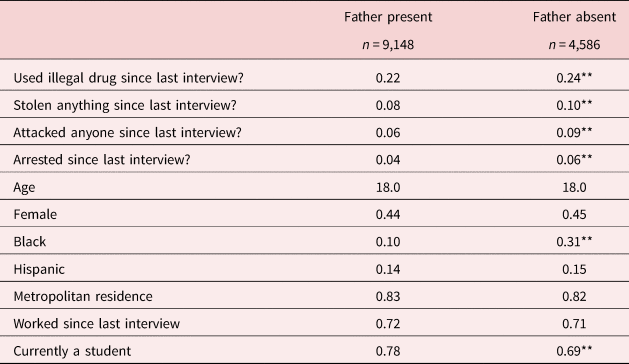
The top portion of Table 1 shows sample means for the criminal activity measures, partitioned according to father absence. The numbers show that, for each of the four measures, father absence correlates with larger, and statistically significant, propensities to engage in criminal activities. However, those differences cannot be interpreted as direct causal consequences of father absence, because adolescents with absent fathers differ from their counterparts along other dimensions that might, themselves, correlate with criminal behaviors. For example, the bottom portion of Table I, which presents a limited number of socioeconomic measures, shows that adolescents with absent fathers are more likely to be black and less likely to be currently enrolled as students. And the fact that the two sample partitions show differences across some observable dimensions raises the possibility of further differences across unmeasurable attributes.
Sample means

**“Father absent” mean differs from “father present” mean at p < 0.05.
*“Father absent” mean differs from “father present” mean at p < 0.10.
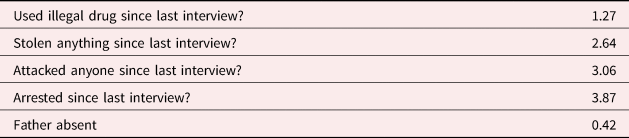
The methods described in the following section, especially those that employ fixed effects, require sufficient intra-person variation across years in the criminal activity and father absence measures. Although few guidelines exist regarding what constitutes sufficient variation, those measures do appear to exhibit non-trivial intra-person movements over time. To that point, Table 2 shows within-person coefficients of variation (within-person standard deviations divided by overall means). The criminal measures show large within-person variation; all four measures have within-person standard deviations that exceed their respective means by 127–387%. The father absent measure, meanwhile, shows less, but still non-trivial, within-person variation, with the within-person standard deviation about 42% the magnitude of the mean.
Within-person coefficients of variation (within-person standard deviation divided by overall mean)

4. Standard panel methods
All empirical models presented in this paper use linear probability setups for which the dependent variable, denoted y it, equals 1 if adolescent i engaged in a criminal activity during sample year t, and 0 otherwise. The main explanatory variable of interest, labeled A it, equals 1 if the adolescent's father was absent during sample year t, and 0 otherwise.
4.1. Simple ordinary least squares
With those variables defined, the main linear probability setup assumes the form

where Xit is a vector of observed socioeconomic controls, some of which vary across time, with estimable coefficient β, and the term ɛ it represents white noise error. The main parameter of interest, γ, captures the extent, if any, to which father absence affects the propensity to engage in criminal behaviors.
Simple ordinary least squares (OLS) estimates of equation (5), reported below, not surprisingly uncover large, and statistically significant, estimates of γ. But those estimates cannot be interpreted as pure causal effects, as many unmeasured attributes likely correlate with both y it and A it. For example, financial stability, and the attendant reduced stress associated with financial stability, might keep fathers around while also reducing adolescent behavior problems. Such unobserved heterogeneity becomes absorbed into the error term and exerts upward bias on γ, leading one to erroneously believe that absent fathers directly cause adolescent criminal problems.
4.2. Fixed effects
To reduce the possibility of such bias, the panel structure of the data is exploiting by the setup

where the individual-specific random intercept c i captures unobserved heterogeneity common to adolescent i. Those unobserved traits likely correlate with other right-hand side variables (i.e., Xit and A it); allowing such correlation often leads to the random intercepts being labeled “fixed effects.”
However, the fixed effects only account for time-invariant unobserved heterogeneity, as indicated by the lack of time subscript attached to c i. That restriction presents a problem for this study, as many forms of heterogeneity that destabilize families and entice adolescent misbehavior, such as job loss or health problems, are inherently time-varying. Such time-varying heterogeneity becomes absorbed into the error term ɛit and imparts bias on the main parameter of interest γ, similar to equation (5).
4.3. Dynamic model
An alternative to the fixed effects setup is a dynamic specification of the form

where the lagged-dependent variable on the right-hand side controls for unobserved heterogeneity, to the extent that unmeasured traits that affected criminal activity last year persist into the current year. But unlike fixed effects, those unmeasured traits are permitted to vary across periods. The lagged-dependent variable setup also make sense if, following a change in a person's propensity to engage in criminal activity, the dependent variable returns partly, but not entirely, to its original state. Such a pattern would be expected if, for example, an introduction to criminal activities tends to beget further illicit behavior.
The dynamic setup seems appropriate in light of the strong correlations in the data between current and past criminal acts. The following table shows sample correlations for y it and y i,t−1, along with p-values for the null hypothesis that the correlation equals zero.

However, neither the dynamic model nor the fixed effect setup nests the other, meaning that each model potentially misses forms of heterogeneity that the other captures. As a formal explanation of the non-nested nature of the two approaches, Angrist and Pischke (Reference Angrist and Pischke2009, pp. 246–247) demonstrate that equations (6) and (7) “bracket” the true effect by showing that, in terms of probability limits, when the dynamic setup in equation (7) represents the true data generating process, but a fixed effects setup like equation (6) is mistakenly used, the estimate of γ tends to be too large. On the other hand, if model (6) is true, estimates of γ based on equation (7) tend to be too small. Indeed, results presented below show that estimates based on models (6) and (7) point to widely conflicting findings. An ideal model would include both dynamics and fixed effects, which the following section attempts to address.
5. Dynamic fixed effects model
Blending the models from the two previous subsections, consider

where the right-hand side includes the lagged-dependent variable and a fixed effect. This setup allows two channels for the aforementioned serial correlation in criminal activity, each with different explanations and policy conclusions. First, as highlighted in the previous subsection, perhaps past criminal behavior begets future criminal behavior, in which case ρ > 0. In that case, policymakers can reduce future criminal acts by preventing current ones. On the other hand, even if ρ = 0, criminal behavior still might exhibit serial correlation if time-invariant traits, captured by the fixed effect c i, exert nontrivial influence on criminal activities. In that case, policymakers can reduce criminal acts by identifying those traits and either reducing them or shrinking their ties to criminal acts.
However, the inclusion of both lagged-dependent variables and fixed effects in the same model introduces (potentially severe) statistical bias [Nickell (Reference Nickell1981)]. Cameron and Trivedi (Reference Cameron and Trivedi2005, p. 764) provide an algebraic explanation of that bias. The standard correction for that bias is the Arellano–Bond estimator, which uses further lags on y it as instruments for y i,t−1 [Anderson and Hsiao (Reference Anderson and Hsiao1981); Holtz-Eakin et al. (Reference Holtz-Eakin, Newey and Rosen1988); Arellano and Bond (Reference Arellano and Bond1991)].
Unfortunately, the Arellano–Bond estimator can produce varied conclusions, both in terms of estimates and efficiency, depending on the number and forms of those instruments. Furthermore, construction of those instruments requires many time periods, which might pose problems for the relatively short panels often available in micro surveys. Lancaster (Reference Lancaster2002) further argues that, whether statistically valid or not, those lagged instruments do not contain suitable information required for model identification. For attempts to improve upon the Arellano–Bond approach, see Ahn and Schmidt (Reference Ahn and Schmidt1995); Blundell and Bond (Reference Blundell and Bond1998), and Arellano and Honore (Reference Arellano, Honore, Heckman and Leamer2001).
To sidestep the bias inherent in dynamic fixed effects models, this paper employs an estimator developed by Lancaster (Reference Lancaster2002). The method is related to the transformed likelihood approach proposed by Hsiao et al. (Reference Hsiao, Pesaran and Tahmiscioglu2002), but in contrast to that model, the Lancaster approach does not require information about criminal activities at time t = 0. Since household surveys almost always being surveying respondents only after some dynamic process has already begun, models that require “initial conditions” also require assumptions about what those initial conditions might have been, with wrong assumptions leading to biased estimates.
In contrast to the models presented in equations (5)–(7), all of which rely on variants of OLS estimation approaches, the Lancaster method relies on a likelihood-based setup, with parameter estimates obtained by Bayesian methods. This section will not repeat Lancaster's entire exposition, but to grasp his method, consider a model for which the log likelihood expression for individual i, denoted L i, can be reparameterized such that the fixed effects are “information orthogonal,”

where ψ represents the model's estimable parameters minus the fixed effects. If such a reparameterization can be found, then the fixed effects can be integrated out of L i by specifying priors on the estimable parameters. [Estimates below use uniform (flat) priors.] This Bayesian approach then yields a marginal posterior for the remaining parameters ψ. Markov chain Monte Carlo (MCMC) methods then are used to draw realizations from the marginal posterior to view distributions of the remaining parameters. (To facilitate comparison with estimates from equations (5)–(7), calculations from this Bayesian method report means and standard deviations of the marginal posterior, which can be interpreted analogously to coefficients and standard errors obtained from estimating equations (5)–(7) by frequentist approaches.)
The main difficulty of this method involves reparameterizing the likelihood according to equation (9), which must be worked out for individual families of models. Lancaster provides the reparameterization for, among others, dynamic linear fixed effects models, which are the main consideration in this paper. The interested reader is referred to Lancaster (Reference Lancaster2002) for the forms of the marginal posterior. (Not surprisingly, for flat priors in a linear setting, the marginal posterior resembles the kernel of a multivariate normal.) The MCMC simulation approach uses the R package OrthoPanels [Pickup et al. (Reference Pickup, Gustafson, Cubranic and Evans2017)].
6. Results
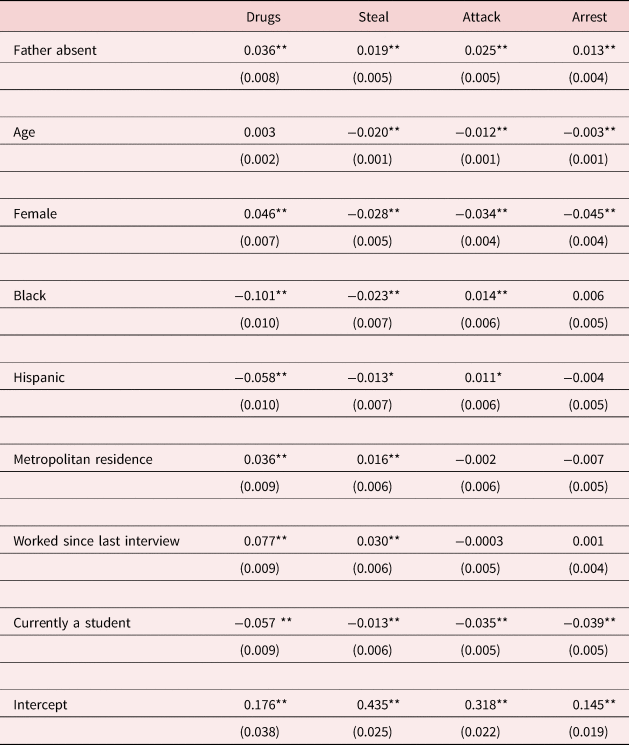
Table 3 presents OLS estimates based on equation (5). Corroborating the simple differences in means reported in Table 1, having an absent father appears to boost an adolescent's propensity to engage in criminal activity by large, and statistically significant, amounts. Specifically, absent fathers correlate with a 3.6 percentage point increase in the likelihood of using illegal drugs, a 1.9 percentage point increase in the likelihood of stealing something, a 2.5 percentage point boost in the probability of attacking someone, and a 1.3 percentage point increase in the likelihood of having been arrested. Those percentage point increases might seem small, but relative to sample means of criminal activity, they are large. That is, absent fathers increase the likelihood of drug use, theft, attacks, and arrests by 16%, 22%, 38%, and 28%, relative to the respective sample means. Those numbers provide the basis for the claim in the abstract that “simple OLS estimates indicate that absent fathers boost probabilities of adolescent criminal behavior by 16–38%.”
OLS estimates

Standard errors in parentheses.
*p < 0.10.
**p < 0.05.
But the specification is equation (5) ignores unobserved heterogeneity, suggesting that those estimates show upward bias. To that end, Table 4 presents fixed effects estimates based on equation (6). The effects of absent fathers on theft and attacks lose magnitude and statistical significance, while the effects of absent fathers on drug use and arrests become negative. Those seemingly implausible negative results likely stem from the fact that fixed effects address one type of heterogeneity (time-invariant) but ignore a potentially more important variety (time-varying).
Fixed effects regression estimates

Standard errors in parentheses.
*p < 0.10.
**p < 0.05.
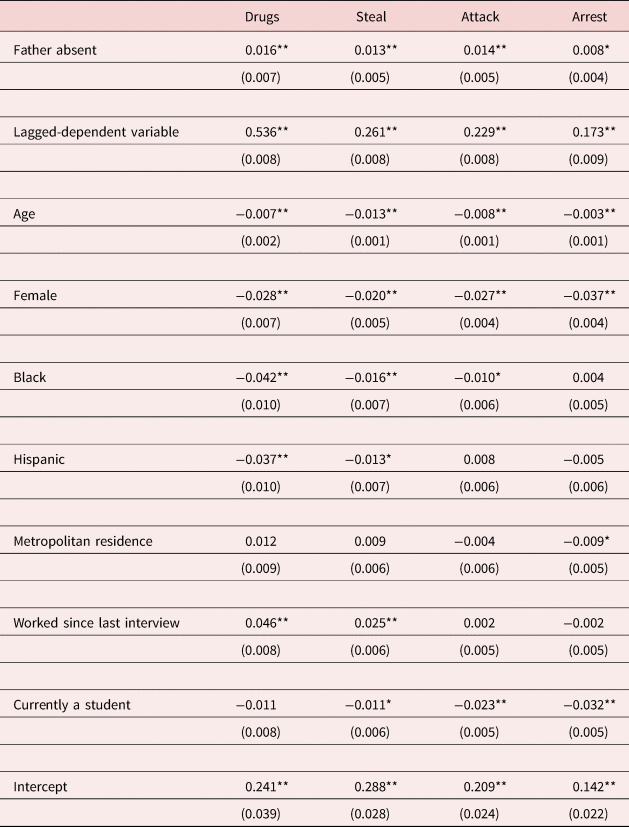
Table 5 attempts to address unobserved heterogeneity—and also serial correlation in criminal behaviors—using a dynamic approach. The effects of absent fathers, while smaller in magnitude than OLS numbers in Table 3, return to more plausible positive, and statistically significant, values. But although the dynamic setup accounts for unobserved heterogeneity, it does not do so in the same manner as fixed effects. The aforementioned “bracketing” argument would suggest that the true causal relationship between father absence and adolescent criminal behavior falls somewhere between the numbers presented in Tables 4 and 5.
Dynamic estimates

Standard errors in parentheses.
*p < 0.10.
**p < 0.05.
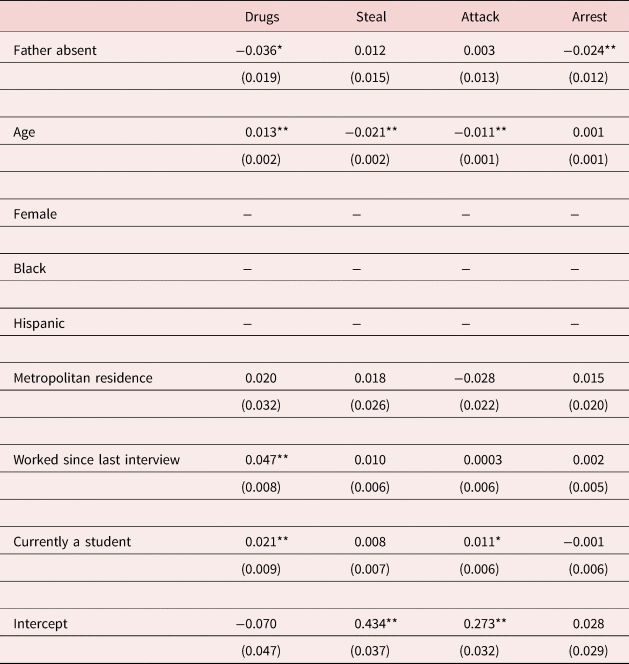
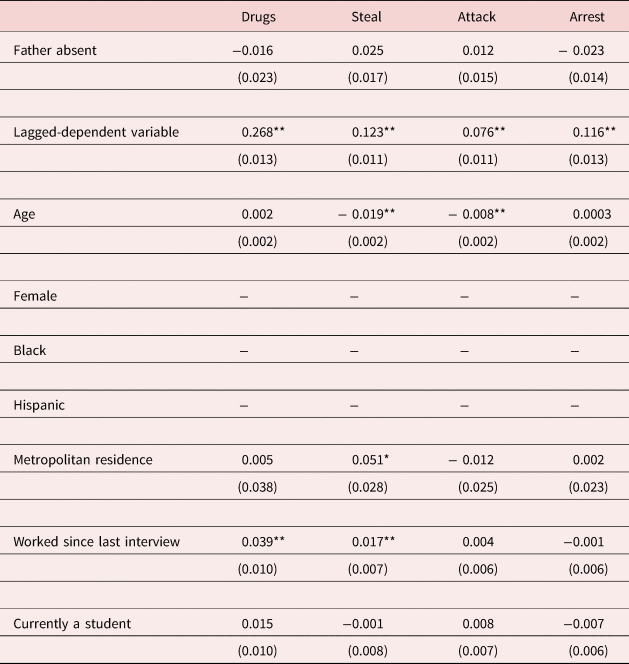
Finally, Table 6 presents estimates from dynamic fixed effects regressions. For the sake of comparison, the table's structure mirrors Tables 3–5, but note that, because the dynamic fixed effects setup uses a Bayesian estimation approach, the numbers in Table 6 are not coefficients and standard errors in the frequentist sense, but rather means and standard deviations of a joint posterior distribution. Nevertheless, the practical interpretation of those numbers mirrors Tables 3–5. The main conclusion from Table 6 is that, after including fixed effect and dynamics, the effects of father absence on adolescent criminal activities are statistically indistinguishable from zero. Evidently, the observed positive correlation between father absence and adolescent crime owes to families with absent fathers possessing traits that correlate with adolescent crime, but not directly due to fathers being absent. (Note: 95% credibility intervals of Father absent, not reported in the table, include the number zero for all four regressions.)
Dynamic fixed effects regression estimates

Means and standard deviations of posterior distributions.
*p < 0.10.
**p < 0.05.
7. Robustness checks
This section considers several robustness checks to the baseline specifications outlined above. First, the baseline specification, by construction, counts households with nonbiological male parents as having absent fathers. The reason for constructing the absent father dummy in that way is that the presence of another male adult in the household points to at least some household disruption occurring since the birth of the child. But perhaps the presence of any male parental figure provides a similar paternal influence, regardless of biological relationship.
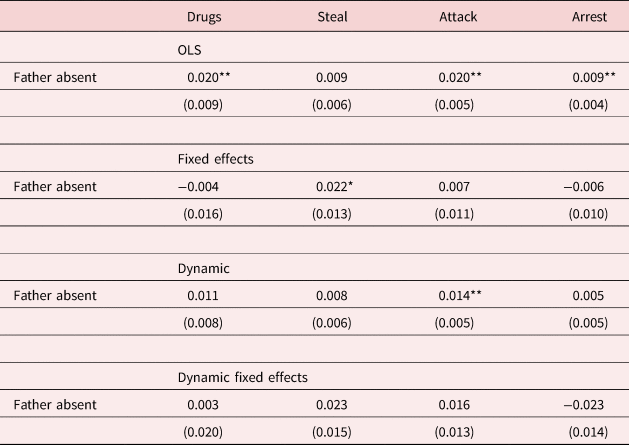
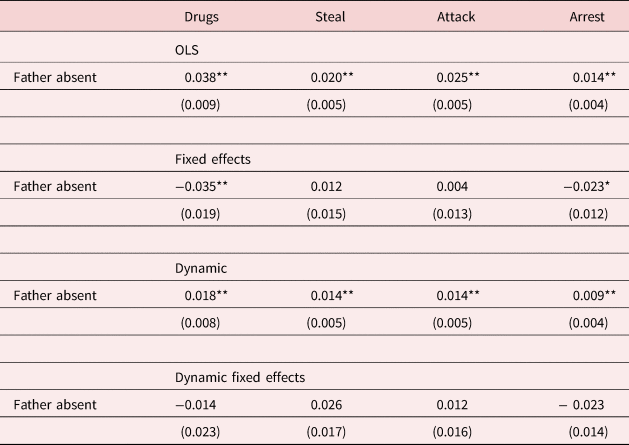
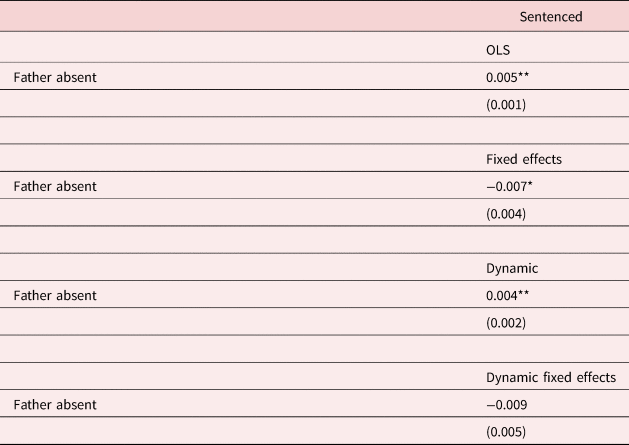
To that end, Table 7 re-estimates all models from Tables 3–6, but redefines the “absent father” dummy such that it equals 0 if a nonbiological male adult resides in the house. (For brevity, Table 7 does not present results for other control variables.) Most of the estimated impacts of absent fathers appear to lose magnitude and statistical significance, but as indicated in the preferred dynamic fixed effects setup, the conclusion is the same: absent fathers do not appear to affect adolescent criminal behavior.

A second robustness check, presented in Table 8, adds a dummy variable for whether family income exceeds 200% of the federal poverty line. The baseline specifications do not include family income for several reasons. First, family income likely strongly correlates with the absent father measure of interest, as having two parents likely boosts household earnings. Another concern is that, in the NLSY97 database, the family income measures contain many missing values. Thus, the measure of exceeding 200% of the poverty line used here is, at best, a blunt and noisy measure of family affluence. Those concerns notwithstanding, estimates in Table 8 are very close to the corresponding numbers presented in Tables 3–6.

A third robustness check considers the possibility that absent fathers, while evidently not affecting the probability of criminal behavior, might influence the severity of criminal behavior. Although the NLSY97 database does not contain direct information on the severity of illicit activities, it does record whether adolescents were sentenced to spend time in correctional institutions during each survey period. (Such institutions are defined to include jails, prisons, juvenile halls, reform schools, or training schools.) Assuming that more severe violations are more likely to result in being sentenced to correctional institutions, Table 9 re-estimates the baseline models where the dependent variable has been changed to a dummy for whether the adolescent has been sentenced to a correctional institution during the survey period. Those results appear to be similar to the main conclusions of this paper.

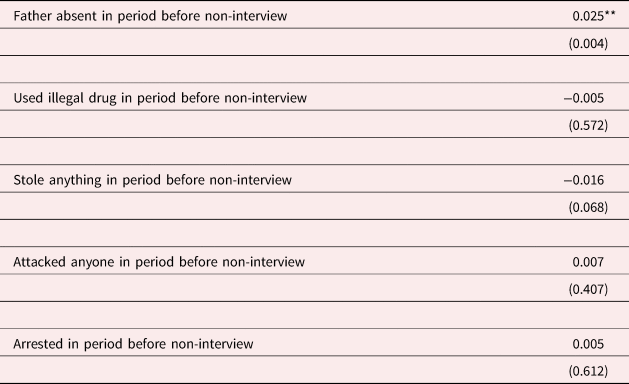
Finally, it is worth noting that the estimation sample in this paper uses a fully-balanced panel. However, if adolescents with missing fathers or criminal records are more likely to attrite from the survey, then such sample attrition could bias the main results. Although difficult to test formally, Table 10 presents sample correlations between (1) whether an adolescent has a “non-interview” period and (2) the paper's main variables—absent father and criminal activity—in the period before the non-interview. Adolescents with absent fathers appear slightly more likely to leave the survey, but the correlation is small in magnitude (0.025). Otherwise, criminal activity does not appear to correlate with subsequently leaving the survey. Thus, although not a formal test for bias, attrition does not appear to contaminate the paper's main findings.
Sample correlations with having a “non-interview ”(p-values for H 0 : ρ = 0 in parentheses)

**p < 0.05.
*p < 0.10.
8. Conclusion
This paper estimates the affects of absent fathers on adolescent criminal activities. Because many forms of unobserved heterogeneity likely influence the link between family structures and adolescent crimes, this paper opts for a dynamic fixed effects specification that accounts for both time-invariant and time-varying unmeasured attributes, as well as the rather sizable serial correlation patterns evident in adolescent crime. To avoid the bias present in standard dynamic fixed effects setups, the paper uses a method proposed by Lancaster (Reference Lancaster2002) that decomposes the likelihood into informational orthogonal pieces, with estimates calculated by a Bayesian approach.
Fixed effects, by themselves, suggest that absent fathers reduce certain types of adolescent crime, while dynamic estimates, by themselves, suggest the opposite. However, combining those together into a dynamic fixed effects setup suggests that absent fathers do not directly affect adolescent crime. Evidently, adolescents with absent fathers possess other traits that happen to correlate with increased crime.
That finding has important policy implications. Had absent fathers been found to directly increase adolescent crime, then policies that aim to reduce adolescent crime would target family structures, and try to encourage two-parent households. But since absent fathers do not appear to directly increase adolescent crime, policies that target family structures will be less effective. Instead, policymakers should seek to identify those unobserved traits that correlate with absent fathers and adolescent crime. (This paper suggests that those unobserved traits, whatever they might be, do not include family income.)
It should be noted that, throughout this study, having an absent father has referred specifically to whether the father lives in the household. But fathers living outside the household might remain actively involved with parenting activities [Hofferth (Reference Hofferth2011)]. And, by converse, fathers living inside the household might not engage actively in parenting responsibilities. In reality, paternal attachment occurs along a continuum, regardless of where fathers actually reside. Although the NLSY97 has some information on “parental processes,” that information is limited and not available in all years. In the end, this paper rests on the assumption that, although paternal attachment is a complicated, and heterogeneous, concept, the presence or absence of a father in the household at least correlates with paternal attachment.
In addition to an investigation of adolescent criminal activity, this paper hopes to serve as an example of how the Lancaster reparameterization approach might be useful in a wide variety of economic and demographic studies. Panel data available in those disciplines often are beset with problems related to unobserved heterogeneity, both time-varying and time-constant. Researchers typically must choose between fixed effects or dynamic models, with limited options for models that allow both. The Lancaster approach, despite being around for more than a decade, remains underused, in part because the reparameterization can be algebraically complicated, and in part because the Bayesian estimation approach can be computationally taxing. But researchers are tackling the algebraic concerns, while statisticians are addressing the computational issues. At the time of this writing, software improvements, including the R package employed in this paper, are greatly simplifying the implementation of these methods.
Appendix A: Solving the model in Section 2
The adolescent seeks to maximize utility L αI 1−α where 0 < α < 1. Illegally-obtained goods and services are produced according to I = c σ where 0 < σ < 1 and where σ = g(f, u). The adolescent's budget constraint is L + pc = Y.
The Lagrangian is

where λ is the Lagrange multiplier. Assuming interior solutions, the first-order conditions for L and c are

Dividing the first by the second and solving for L yields

Plugging that expression for L into the budget constraint and solving for c gives the demand equation for c,

which appears in Section 2 as equation (4). (Plugging the demand expression for c back into the budget constraint and solving for L would produce the demand equation for L.)